

Automotive Semiconductor Market Report 2026
Global Outlook – By Component ( Processor, Analog IC, Discrete Power, Sensor, Memory, Other Components), By Vehicle Type ( Passenger Vehicle, Light Commercial Vehicle, Medium And Heavy Commercial Vehicle), By Propulsion Type ( Internal Combustion Engine, Electric, Hybrid), By Application ( Powertrain, Safety, Body Electronics, Chassis, Telematics And Infotainment) – Market Size, Trends, Strategies, and Forecast to 2030
Automotive Semiconductor Market Overview
• Automotive Semiconductor market size has reached to $66.35 billion in 2025 • Expected to grow to $114.65 billion in 2030 at a compound annual growth rate (CAGR) of 11.6% • Growth Driver: Surge In Electric And Hybrid Vehicles Drives Automotive Semiconductor Market Growth • Market Trend: Advancements In SiC Power Technologies Enhance Efficiency And Performance In Automotive Power Electronics • Asia-Pacific was the largest region and fastest growing region.Market Gains By 2030 – Top Opportunities By Segment
Market Gain identifies the most promising market opportunities by highlighting the segments or products expected to generate the highest incremental revenue growth over the next five years.
What Is Covered Under Automotive Semiconductor Market?
The automotive semiconductor refers to an automotive component that exploits the electronic properties of semiconductor materials, such as silicon, germanium, gallium arsenide, and organic semiconductors. The primary purpose of automotive semiconductors is to be used in producing semiconductor devices, which are required for a wide range of automotive products and these semiconductors can alter their electrical conductivity by applying magnetic or electrical fields, which makes semiconductors useful in various applications and devices. The main components of an automotive semiconductor include a processor, analog IC, discrete power, sensor, memory, and other components. The processors are part of the automotive conductors to conduct the majority of basic arithmetic, logic, and I/O tasks and assign directives to other chips and components in a vehicle. They help control different parts of the vehicle and at the same time act as a coordinator between different actions of the user. Automotive semiconductors are used in various vehicle types such as passenger vehicles, light commercial vehicles, and medium and heavy commercial vehicles having different propulsion types including internal combustion engines, electric, and hybrid. Automotive semiconductors are used in various applications such as powertrain, safety, body electronics, chassis, telematics, and infotainment
What Is The Automotive Semiconductor Market Size 2026 And Growth Rate?
The automotive semiconductor market size has grown rapidly in recent years. It will grow from $66.35 billion in 2025 to $74.04 billion in 2026 at a compound annual growth rate (CAGR) of 11.6%. The growth in the historic period can be attributed to increasing use of silicon-based semiconductor devices, early adoption in powertrain and safety electronics, expansion of analog and discrete components in basic automotive systems, growth in vehicle infotainment semiconductor usage, reliance on traditional sensor and memory architectures.What Is The Automotive Semiconductor Market Growth Forecast?
The automotive semiconductor market size is expected to see rapid growth in the next few years. It will grow to $114.65 billion in 2030 at a compound annual growth rate (CAGR) of 11.6%. The growth in the forecast period can be attributed to rising demand for high-performance automotive processors, increasing deployment of wide-bandgap semiconductors, expansion of semiconductor use in ev battery systems, development of advanced adas-oriented chipsets, increasing integration of telematics and connectivity semiconductor modules. Major trends in the forecast period include development of AI-enhanced automotive semiconductor platforms, expansion of autonomous vehicle chip architectures, growth of ev-oriented power semiconductor solutions, integration of IoT-connected semiconductor systems, advancement of secure cloud-linked automotive processing modules.

Global Automotive Semiconductor Market Segmentation
1) By Component: Processor, Analog IC, Discrete Power, Sensor, Memory, Other Components 2) By Vehicle Type: Passenger Vehicle, Light Commercial Vehicle, Medium And Heavy Commercial Vehicle 3) By Propulsion Type: Internal Combustion Engine, Electric, Hybrid 4) By Application: Powertrain, Safety, Body Electronics, Chassis, Telematics And Infotainment Subsegments: 1) By Processor: Microcontrollers, Microprocessors 2) By Analog IC: Voltage Regulators, Operational Amplifiers 3) By Discrete Power: MOSFETs, IGBTs 4) By Sensor: Temperature Sensors, Pressure Sensors, Proximity Sensors 5) By Memory: RAM (Random Access Memory), Flash Memory 6) By Other Components: Communication ICs, Gate Drivers, Interface ICs The top segments in the automotive semiconductor market will be: • Internal Combustion Engine will reach $55186.75 Million by 2025. • Passenger Vehicle will reach $41331.17 Million by 2025. • Processor will reach $17518 Million by 2025. • Safety will reach $17056.15 Million by 2025. • Body Electronics will reach $15181.13 Million by 2025.What Is The Driver Of The Automotive Semiconductor Market?
The increase in demand for electric and hybrid vehicles is expected to propel the growth of the automotive semiconductor market. Electric and hybrid vehicles are automobiles powered wholly or partly by electric energy, using either a battery-electric drivetrain or a combination of an internal combustion engine and an electric motor. Electric and hybrid vehicles are increasing due to rising consumer demand for cleaner and more energy-efficient transportation options. Automotive semiconductors help electric and hybrid vehicles by enabling efficient power management, advanced control systems and optimized energy usage that enhance overall vehicle performance. For instance, in 2025, according to the International Energy Agency, a France-based intergovernmental organization, global electric car sales surpassed 17 million in 2024, marking a growth of over 25% with an additional 3.5 million units sold compared to 2023. Therefore, the increase in demand for electric and hybrid vehicles is expected to the growth of automotive semiconductor industry.
Infographic Chart Showing Key Market Drivers Analysis And Restraints For Automotive Semiconductor Market
The chart presents an impact analysis of key drivers and restraints, quantifying their relative influence on the market's growth rate and helping assess the balance between growth enablers and limiting factors. This chart offers a high-level perspective; the full report contains more detailed insights.
How Will The Drivers Impact Growth In The Global Automotive Semiconductor Market?
• Rising Number Of Connected Vehicles (High) – The rising number of connected vehicles will become a key driver of growth in the automotive semiconductor market by 2030. Connected vehicles increase demand for advanced automotive semiconductors, as they rely on real-time data processing, communication, and cybersecurity. Features like V2X (Vehicle-to-Everything) communication, infotainment, telematics, and OTA (over-the-air) updates require high-performance chips. As automakers integrate 5G, artificial intelligence, and edge computing to enhance vehicle intelligence and safety, semiconductor usage continues to expand. As a result, the rising number of connected vehicles is anticipated to contributing to a 1.8% annual growth in the market. • Expansion Of Semiconductor Foundries (High) – The expansion of semiconductor foundries will emerge as a major factor driving the expansion of the market by 2030. Increasing semiconductor foundry capacity helps meet the growing demand for automotive chips, reducing supply chain disruptions. As electronic vehicles, advanced driver-assistance system (ADAS), and autonomous vehicles require advanced semiconductors, foundries are investing in new fabrication facilities (fabs) and advanced manufacturing nodes. This expansion enhances chip availability, reduces lead times, and lowers costs, ensuring a stable supply for automakers amid rising semiconductor requirements. Consequently, the expansion of semiconductor foundries is projected to contributing to a 1.5% annual growth in the market. • Rising Consumer Demand For Smart And Digital Cockpit Solutions (Low) – The rising consumer demand for smart and digital cockpit solutions will serve as a key growth catalyst for the market by 2030. Modern vehicles feature high-resolution touchscreens, AI-powered voice assistants, augmented reality (AR) dashboards, and personalized infotainment systems, all requiring powerful processors, memory chips, and GPUs. As automakers integrate 5G connectivity, enhanced user experience, and real-time data processing, semiconductor usage in digital cockpits continues to grow, enhancing safety, convenience, and driver engagement. Therefore, this rising consumer demand for smart and digital cockpit solutions is projected to supporting to a 1.0% annual growth in the market. • Rising Adoption Of Automation In Fleet Management (Low) – The rising adoption of automation in fleet management will become a significant driver contributing to the growth of the market by 2030. Fleets are integrating AI-driven telematics, real-time tracking, predictive maintenance, and autonomous driving features, relying on advanced sensors, processors, and communication chips to optimize fuel efficiency, reduce downtime, and enhance safety. As logistics and transportation companies embrace connected and autonomous fleet solutions, semiconductor usage in fleet management continues to grow. Consequently, the rising adoption of automation in fleet management is projected to contributing to a 0.8% annual growth in the marketHow Will The Restraints Impact Growth In The Global Automotive Semiconductor Market?
• Restrictions On Free Trade (High) – Restrictions On Free Trade will restrict the growth of the Automotive Semiconductor market during the forecast period. Global semiconductor supply chains face increasing trade restrictions, particularly affecting the automotive sector. Export controls and trade restrictions between major economies limit the flow of chips and chipmaking equipment. These restrictions create supply shortages, increase costs, and disrupt production planning for automotive manufacturers, impacting market growth.Key Players In The Global Automotive Semiconductor Market
Major companies operating in the automotive semiconductor market are Infineon Technologies AG, STMicroelectronics N.V., Texas Instruments Incorporated, Renesas Electronics Corporation, NXP Semiconductors N.V., Robert Bosch GmbH, Toshiba Corporation, Micron Technology Inc., Analog Devices Inc., ROHM Co., Ltd., Navitas Semiconductor Corporation, Sanan Optoelectronics Co., Ltd., Enkris Semiconductor Inc., GaN Systems Inc., Exagan SAS, Dialog Semiconductor Plc, Cypress Semiconductor Corporation, GigaDevice Semiconductor Inc., China Resources Microelectronics Limited (CR Micro), Silan Microelectronics Co., Ltd., Continental Device India Limited (CDIL), MosChip Technologies Limited, Unity Semiconductor Corp.
This chart is for illustrative purposes; the full report includes a detailed competitor analysis and comprehensive overview of the top 10 companies in the market.

This chart maps companies by product innovation and brand strength, with bubble size indicating relative revenue, helping identify market leaders, challengers, and niche players. This is an illustrative chart; the full report provides a complete and accurate competitive analysis.
Global Automotive Semiconductor Market Trends and Insights
Major companies operating in the automotive semiconductor market are focusing on developing innovative solutions, such as silicon carbide (SiC) power solutions, to improve energy efficiency, thermal performance, and reliability in electric vehicle power electronics. SiC power devices enable faster switching speeds, lower power losses, and higher voltage tolerance, making them essential for next-generation EV traction inverters, onboard chargers, and DC–DC converters. For instance, in November 2025, SemiQ Inc., a US-based semiconductor company, introduced its high-performance 1200V SiC MOSFET modules designed to deliver superior efficiency and robust thermal management in demanding automotive applications. Engineered to support high-power EV systems, these modules enhance overall drivetrain performance, enabling automakers to achieve improved range, faster charging, and greater power density. These modules offer exceptionally low switching losses and high thermal conductivity, enabling greater system efficiency and improved heat management in high-power automotive applications. They provide robust voltage handling and fast switching speeds, supporting compact inverter and charger designs with higher power density.What Are Latest Mergers And Acquisitions In The Automotive Semiconductor Market?
In November 2025, SK Keyfoundry, a South Korea–based specialty semiconductor foundry, acquired SK Powertech for an undisclosed amount. Through this acquisition, SK Keyfoundry aimed to accelerate its silicon carbide (SiC) power semiconductor development and reinforce its position within the automotive power device supply chain. SK Powertech is a South Korea–based provider of SiC wafer and power device manufacturing solutions that support high-efficiency power conversion in automotive and industrial applications.
Regional Outlook
Asia-Pacific was the largest region in the automotive semiconductor market in 2025, and it is expected to be the fastest-growing region in the forecast period. The regions covered in this market report are Asia-Pacific, South East Asia, Western Europe, Eastern Europe, North America, South America, Middle East, Africa. The countries covered in this market report are Australia, Brazil, China, France, Germany, India, Indonesia, Japan, Taiwan, Russia, South Korea, UK, USA, Canada, Italy, Spain.What Defines the Automotive Semiconductor Market?
The automotive semiconductor market consists of sales of microcontrollers (MCU), input and output devices, circuits, AD (analog and digital) conversion circuits, power supply components, in-vehicle communication circuits, and sensors. Values in this market are ‘factory gate’ values, that is the value of goods sold by the manufacturers or creators of the goods, whether to other entities (including downstream manufacturers, wholesalers, distributors, and retailers) or directly to end customers. The value of goods in this market includes related services sold by the creators of the goods.How is Market Value Defined and Measured?
The market value is defined as the revenues that enterprises gain from the sale of goods and/or services within the specified market and geography through sales, grants, or donations in terms of the currency (in USD unless otherwise specified). The revenues for a specified geography are consumption values that are revenues generated by organizations in the specified geography within the market, irrespective of where they are produced. It does not include revenues from resales along the supply chain, either further along the supply chain or as part of other products.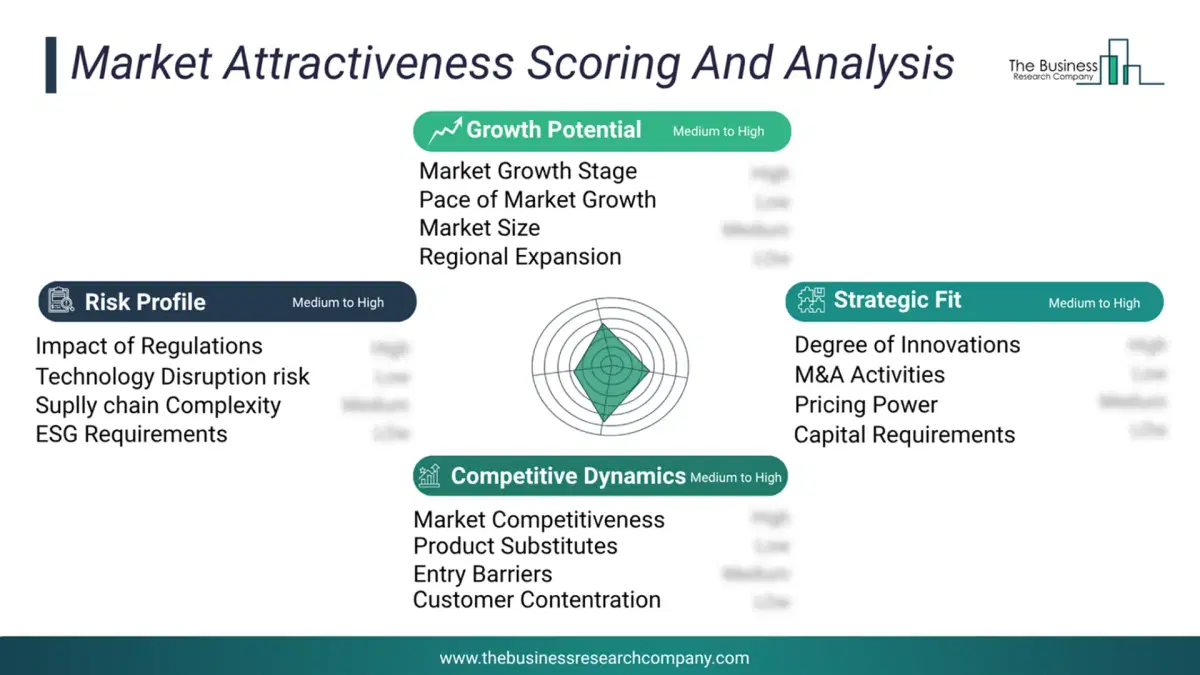
This chart presents market attractiveness based on a quantitative evaluation of growth, competition, strategic alignment, and risk, offering a clear view of opportunity areas for decision-making. This chart is for illustrative purposes; the full report contains the complete analysis.
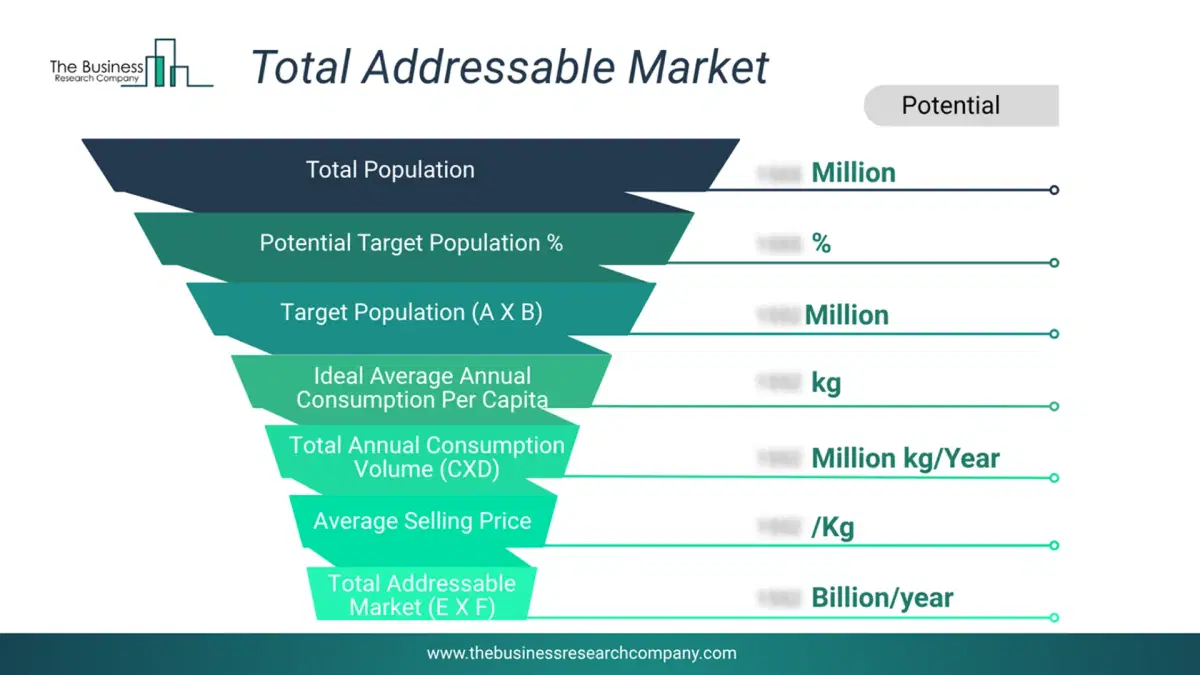
This chart highlights the Total Addressable Market (TAM) by estimating the maximum revenue opportunity using an assumption-driven approach, supporting strategic planning and opportunity sizing across markets. The chart is illustrative; the full report provides a more comprehensive analysis.
What Key Data and Analysis Are Included in the Automotive Semiconductor Market Report 2026?
The automotive semiconductor market research report is one of a series of new reports from The Business Research Company that provides market statistics, including industry global market size, regional shares, competitors with the market share, detailed market segments, market trends and opportunities, and any further data you may need to thrive in the automotive semiconductor industry. The market research report delivers a complete perspective of everything you need, with an in-depth analysis of the current and future state of the industry.Automotive Semiconductor Market Report 2026 Market Report Forecast Analysis
| Report Attribute | Details |
|---|---|
| Market Size Value In 2026 | $74.04 billion |
| Revenue Forecast In 2030 | $114.65 billion |
| Growth Rate | CAGR of 11.6% from 2026 to 2030 |
| Base Year For Estimation | 2025 |
| Actual Estimates/Historical Data | 2020-2025 |
| Forecast Period | 2026 - 2030 |
| Market Representation | Revenue in USD Billion and CAGR from 2026 to 2030 |
| Segments Covered | Component, Vehicle Type, Propulsion Type, Application |
| Regional Scope | Asia-Pacific, Western Europe, Eastern Europe, North America, South America, Middle East, Africa |
| Country Scope | The countries covered in the report are Australia, Brazil, China, France, Germany, India, Indonesia, Japan, Taiwan, Russia, South Korea, UK, USA, Canada, Italy, Spain. |
| Key Companies Profiled | Infineon Technologies AG, STMicroelectronics N.V., Texas Instruments Incorporated, Renesas Electronics Corporation, NXP Semiconductors N.V., Robert Bosch GmbH, Toshiba Corporation, Micron Technology Inc., Analog Devices Inc., ROHM Co., Ltd., Navitas Semiconductor Corporation, Sanan Optoelectronics Co., Ltd., Enkris Semiconductor Inc., GaN Systems Inc., Exagan SAS, Dialog Semiconductor Plc, Cypress Semiconductor Corporation, GigaDevice Semiconductor Inc., China Resources Microelectronics Limited (CR Micro), Silan Microelectronics Co., Ltd., Continental Device India Limited (CDIL), MosChip Technologies Limited, Unity Semiconductor Corp. |
| Customization Scope | Request for Customization |
| Pricing And Purchase Options | Explore Purchase Options |