

Kinase Inhibitors Market Report 2026
Global Outlook – By Type (Tyrosine Kinase Inhibitors, Multikinase Inhibitors, mTOR Kinase Inhibitors, Other Types), By Route of Administration (Oral, Parenteral, Other Routes), By Application (Oncology, Inflammatory Diseases), By Distribution Channel (Hospital Pharmacy, Online Pharmacy, Retail Pharmacy), By End User (Hospitals, Homecare, Specialty Clinics, Other End-Users) – Market Size, Trends, Strategies, and Forecast to 2035
Kinase Inhibitors Market Overview
• Kinase Inhibitors market size has reached to $67.21 billion in 2025 • Expected to grow to $94.01 billion in 2030 at a compound annual growth rate (CAGR) of 6.8% • Growth Driver: Increasing Incidence of Cancer Fueling Growth of the Kinase Inhibitors Market • Market Trend: Innovative Tablet Formulation Enhances Bioavailability And Patient Convenience In Leukemia Treatment • Asia-Pacific was the largest region and fastest growing region.What Is Covered Under Kinase Inhibitors Market?
Kinase inhibitors are medications that block the activity of kinases, enzymes essential for various cellular processes like growth and signaling. They are primarily used to treat cancers by interfering with the pathways that drive cancer cell growth and spread. Kinase inhibitors are also used to manage inflammatory diseases and other conditions characterized by abnormal kinase activity. The main types of kinase inhibitors are tyrosine kinase inhibitors, multikinase inhibitors, mTOR kinase inhibitors, and others. Tyrosine kinase inhibitors refers to a class of drugs that block the action of enzymes called tyrosine kinases, which are involved in the growth of cancer cells. They can be administered through oral, parenteral, and other routes for the treatment applications of oncology and inflammatory diseases and are distributed through various channels including hospital pharmacy, online pharmacy, and retail pharmacy for hospitals, homecare, specialty clinics, and others.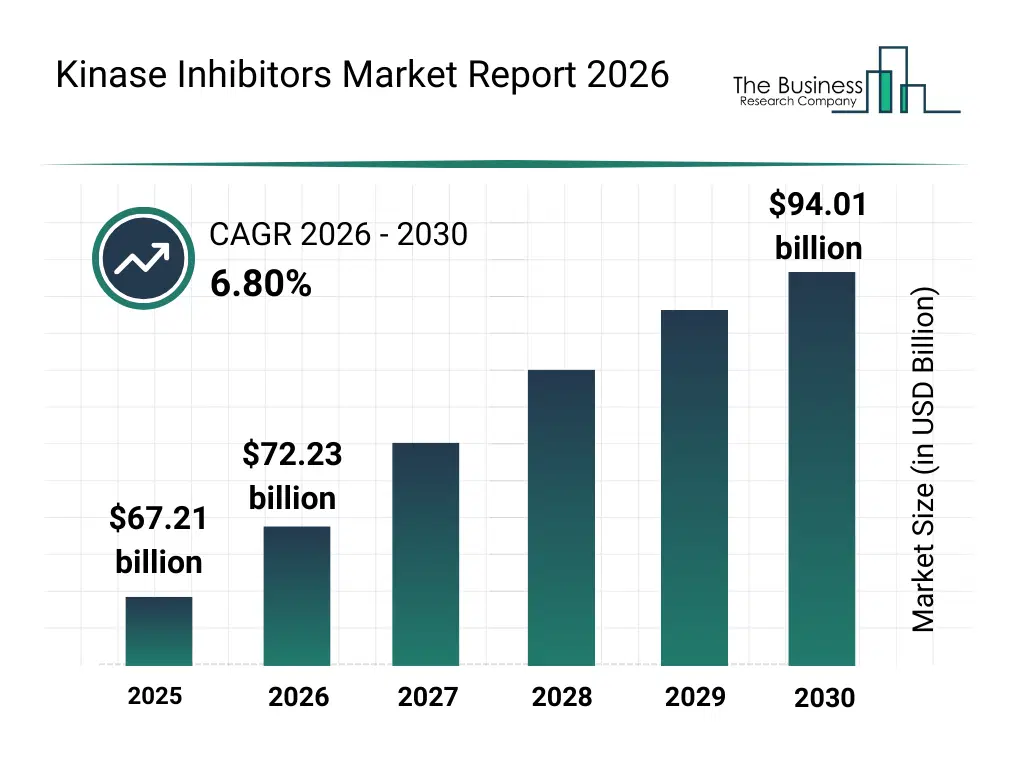
What Is The Kinase Inhibitors Market Size and Share 2026?
The kinase inhibitors market size has grown strongly in recent years. It will grow from $67.21 billion in 2025 to $72.23 billion in 2026 at a compound annual growth rate (CAGR) of 7.5%. The growth in the historic period can be attributed to breakthrough clinical success of early tyrosine kinase inhibitors, increasing understanding of kinase-driven disease pathways, rising cancer incidence globally, availability of validated molecular targets, expansion of oncology specialty care infrastructure.What Is The Kinase Inhibitors Market Growth Forecast?
The kinase inhibitors market size is expected to see strong growth in the next few years. It will grow to $94.01 billion in 2030 at a compound annual growth rate (CAGR) of 6.8%. The growth in the forecast period can be attributed to continued growth of precision oncology approaches, expanding pipeline of kinase-targeted drugs, increasing use of kinase inhibitors in inflammatory diseases, rising demand for personalized treatment regimens, ongoing innovation in selective kinase inhibition. Major trends in the forecast period include growing adoption of targeted kinase inhibitors in oncology treatment, increasing use of combination regimens involving kinase inhibitors, rising preference for oral kinase inhibitor therapies, expansion of kinase inhibitor applications beyond oncology, steady shift toward next-generation and more selective kinase inhibitors.
Global Kinase Inhibitors Market Segmentation
1) By Type: Tyrosine Kinase Inhibitors, Multikinase Inhibitors, mTOR Kinase Inhibitors, Other Types 2) By Route of Administration: Oral, Parenteral, Other Routes 3) By Application: Oncology, Inflammatory Diseases 4) By Distribution Channel: Hospital Pharmacy, Online Pharmacy, Retail Pharmacy 5) By End User: Hospitals, Homecare, Specialty Clinics, Other End-Users Subsegments: 1) By Tyrosine Kinase Inhibitors: EGFR Inhibitors, HER2 Inhibitors, BCR-ABL Inhibitors, Other Tyrosine Kinase Inhibitors 2) By Multikinase Inhibitors: VEGFR Inhibitors, PDGFR Inhibitors, FGFR Inhibitors, Other Multikinase Inhibitors 3) By MTOR Kinase Inhibitors: Everolimus, Temsirolimus, Other MTOR Kinase Inhibitors 4) By Other Types: JAK Inhibitors, ROCK Inhibitors, CDK Inhibitors, Other Kinase InhibitorsWhat Is The Driver Of The Kinase Inhibitors Market?
The increasing incidence of cancer is expected to propel the growth of the kinase inhibitors market going forward. Cancer refers to the group of diseases characterized by uncontrolled growth and spread of abnormal cells in the body. The rising incidence of cancer is driven by ageing populations, lifestyle-related risk factors such as tobacco use and diet, and improved diagnostic techniques enabling more frequent detection. The kinase inhibitors supports cancer treatment by offering drugs that block key signalling enzymes (kinases), disrupting tumour cell growth, survival and proliferation. For instance, in October 2025, according to National Health Service (NHS), a UK-based government health agency, there were 354,820 new cancer diagnoses in 2023, an average of 972 per day, which is 8,605 more than in 2022. Therefore, the increasing prevalence of cancer is driving the growth of the kinase inhibitors industry.Key Players In The Global Kinase Inhibitors Market
Major companies operating in the kinase inhibitors market are Pfizer Inc., Johnson & Johnson, F. Hoffmann-La Roche Ltd, Merck & Co. Inc., Bristol-Myers Squibb Company, AstraZeneca Plc, Novartis AG, GlaxoSmithKline PLC, Takeda Pharmaceutical Company Limited, Eli Lilly and Company, Teva Pharmaceutical Industries Ltd, Astellas Pharma Inc, Cipla Inc, Dr. Reddy's Laboratories Ltd, Amneal Pharmaceuticals LLC, Lupin Limited, Exelixis Inc, Glenmark Pharmaceuticals Ltd, Torrent Pharmaceuticals Ltd, Hutchison China MediTech Limited, Sierra Oncology Inc.Global Kinase Inhibitors Market Trends and Insights
Major companies operating in the kinase inhibitors market are increasingly focusing on developing innovative formulations, such as novel dasatinib tablet formulations, to improve drug bioavailability and patient adherence. Novel dasatinib tablet formulations are new versions of the cancer drug dasatinib designed to improve absorption, reduce side effects, or allow more convenient dosing compared to standard tablets. For instance, in October 2025, Cycle Pharmaceuticals Ltd., a UK-based biopharmaceutical company, partnered with Handa Therapeutics, LLC, a US-based pharmaceutical company, to launch its first oncology product in the US, PHYRAGO™ (dasatinib) tablets. It is an FDA-approved tyrosine kinase inhibitor used for treating Philadelphia chromosome-positive chronic myeloid leukemia (Ph+ CML) and Philadelphia chromosome-positive acute lymphoblastic leukemia (Ph+ ALL) in adults, including newly diagnosed patients and those with resistance or intolerance to prior therapies like imatinib. The product is distinguished by its ability to be taken with proton pump inhibitors (PPIs) and H2 receptor antagonists, which helps manage gastric acid-related disorders often encountered by patients.What Are Latest Mergers And Acquisitions In The Kinase Inhibitors Market?
In April 2024, ONO Pharmaceutical Co. Ltd., a Japan-based pharmaceutical company, acquired Deciphera Pharmaceuticals, Inc. for an $2.4 billion. With this acquisition ONO Pharmaceutical Co. Ltd aims to strengthen its oncology pipeline, expand its global presence particularly in the U.S. and Europe and accelerate the development and commercialization of innovative cancer therapies. Deciphera Pharmaceuticals Inc. is a US-based biopharmaceutical company known for its kinase drug discovery efforts in cancer.Regional Insights
Asia-Pacific was the largest region in the kinase inhibitors market in 2025. Asia-Pacific is expected to be the fastest-growing region in the forecast period. The regions covered in this market report are Asia-Pacific, South East Asia, Western Europe, Eastern Europe, North America, South America, Middle East, Africa. The countries covered in this market report are Australia, Brazil, China, France, Germany, India, Indonesia, Japan, Taiwan, Russia, South Korea, UK, USA, Canada, Italy, Spain.What Defines the Kinase Inhibitors Market?
The kinase inhibitors market consists of sales of BCR-ABL Inhibitors, ALK Inhibitors, lapatinib, cabozantinib, and sunitinib. Values in this market are ‘factory gate’ values, that is the value of goods sold by the manufacturers or creators of the goods, whether to other entities (including downstream manufacturers, wholesalers, distributors and retailers) or directly to end customers. The value of goods in this market includes related services sold by the creators of the goods.How is Market Value Defined and Measured?
The market value is defined as the revenues that enterprises gain from the sale of goods and/or services within the specified market and geography through sales, grants, or donations in terms of the currency (in USD unless otherwise specified). The revenues for a specified geography are consumption values that are revenues generated by organizations in the specified geography within the market, irrespective of where they are produced. It does not include revenues from resales along the supply chain, either further along the supply chain or as part of other products.What Key Data and Analysis Are Included in the Kinase Inhibitors Market Report 2026?
The kinase inhibitors market research report is one of a series of new reports from The Business Research Company that provides market statistics, including industry global market size, regional shares, competitors with the market share, detailed market segments, market trends and opportunities, and any further data you may need to thrive in the kinase inhibitors industry. The market research report delivers a complete perspective of everything you need, with an in-depth analysis of the current and future state of the industry.Kinase Inhibitors Market Report Forecast Analysis
| Report Attribute | Details |
|---|---|
| Market Size Value In 2026 | $72.23 billion |
| Revenue Forecast In 2035 | $94.01 billion |
| Growth Rate | CAGR of 7.5% from 2026 to 2035 |
| Base Year For Estimation | 2025 |
| Actual Estimates/Historical Data | 2020-2025 |
| Forecast Period | 2026 - 2030 - 2035 |
| Market Representation | Revenue in USD Billion and CAGR from 2026 to 2035 |
| Segments Covered | Type, Route of Administration, Application, Distribution Channel, End User |
| Regional Scope | Asia-Pacific, Western Europe, Eastern Europe, North America, South America, Middle East, Africa |
| Country Scope | The countries covered in the report are Australia, Brazil, China, France, Germany, India, ... |
| Key Companies Profiled | Pfizer Inc., Johnson & Johnson, F. Hoffmann-La Roche Ltd, Merck & Co. Inc., Bristol-Myers Squibb Company, AstraZeneca Plc, Novartis AG, GlaxoSmithKline PLC, Takeda Pharmaceutical Company Limited, Eli Lilly and Company, Teva Pharmaceutical Industries Ltd, Astellas Pharma Inc, Cipla Inc, Dr. Reddy's Laboratories Ltd, Amneal Pharmaceuticals LLC, Lupin Limited, Exelixis Inc, Glenmark Pharmaceuticals Ltd, Torrent Pharmaceuticals Ltd, Hutchison China MediTech Limited, Sierra Oncology Inc. |
| Customization Scope | Request for Customization |
| Pricing And Purchase Options | Explore Purchase Options |