

Semiconductor Fabrication Material Market Report 2026
Global Outlook – By Semiconductor Type ( N-Type, P-Type), By Fabrication Material ( Silicon wafers, Photomasks, Photoresists, Other Fabrication Materials), By End User ( Telecommunication, Energy, Electrical and Electronics, Medical and Healthcare, Automotive, Defense and Aerospace, Other End Users) – Market Size, Trends, Strategies, and Forecast to 2030
Semiconductor Fabrication Material Market Overview
• Semiconductor Fabrication Material market size has reached to $65.14 billion in 2025 • Expected to grow to $87.06 billion in 2030 at a compound annual growth rate (CAGR) of 5.8% • Growth Driver: Semiconductor Fabrication Materials Market To Benefit From Booming Electric Vehicle Demand • Market Trend: Innovation In The Semiconductor Fabrication Material Market • Asia-Pacific was the largest region and fastest growing region.Market Gains By 2030 – Top Opportunities By Segment
Market Gain identifies the most promising market opportunities by highlighting the segments or products expected to generate the highest incremental revenue growth over the next five years.
What Is Covered Under Semiconductor Fabrication Material Market?
The semiconductor fabrication material is a special material that are used in the manufacturing of semiconductors through advanced wafer-level packaging processes, as well as other related technologies used in solar cells, field-effect transistors, IoT sensors, and self-driving car circuits. Semiconductor fabrication is an intricate process that involves circuits that are created on top of a wafer made from a semiconducting material. The main types of semiconductor fabrication material are n-type and p-type. The n-type semiconductor is an intrinsic semiconductor doped with phosphorus (P), arsenic (As), or antimony (Sb) as an impurity. The various fabrication materials include silicon wafers, photomasks, photoresists, and others, which are used across various end users such as telecommunication, energy, electrical and electronics, medical and healthcare, automotive, defence and aerospace, and others.
What Is The Semiconductor Fabrication Material Market Size 2026 And Growth Rate?
The semiconductor fabrication material market size has grown strongly in recent years. It will grow from $65.14 billion in 2025 to $69.51 billion in 2026 at a compound annual growth rate (CAGR) of 6.7%. The growth in the historic period can be attributed to increasing use of silicon wafers in electronics, early development of photomasks and photoresists, expansion of semiconductor demand across telecom devices, growing utilization of fabrication materials in automotive chips, rising adoption of wafer-level packaging technologies.What Is The Semiconductor Fabrication Material Market Growth Forecast?
The semiconductor fabrication material market size is expected to see strong growth in the next few years. It will grow to $87.06 billion in 2030 at a compound annual growth rate (CAGR) of 5.8%. The growth in the forecast period can be attributed to rising demand for advanced lithography materials, development of specialty photoresists, growth of semiconductor content in evs and iot devices, expansion of fab capacity worldwide, increasing shift toward high-purity fabrication materials. Major trends in the forecast period include adoption of AI-enhanced semiconductor fabrication, expansion of intelligent manufacturing in wafer processing, deployment of IoT-integrated cleanroom monitoring, advancement of cloud-based fab data analytics, integration of robotics in wafer-level material handling.

Global Semiconductor Fabrication Material Market Segmentation
1) By Semiconductor Type: N-Type, P-Type 2) By Fabrication Material: Silicon wafers, Photomasks, Photoresists, Other Fabrication Materials 3) By End User: Telecommunication, Energy, Electrical and Electronics, Medical and Healthcare, Automotive, Defense and Aerospace, Other End Users Subsegments: 1) By Silicon Wafers: Monocrystalline Silicon Wafers, Polycrystalline Silicon Wafers, SOI (Silicon-On-Insulator) Wafers 2) By Photomasks: Binary Photomasks, Phase Shift Photomasks, Attenuated Phase Shift Masks 3) By Photoresists: Positive Photoresists, Negative Photoresists, Specialty Photoresists 4) By Other Fabrication Materials: Dielectrics, Metals, Etchants and Strippers, CMP (Chemical Mechanical Polishing) Slurries The top segments in the semiconductor fabrication material market will be: • Silicon Wafers will reach $48.01 billion by 2030. • Photoresists will reach $16.82 billion by 2030. • Other Fabrication Materials will reach $12.59 billion by 2030. • Photomasks will reach $9.65 billion by 2030.What Is The Driver Of The Semiconductor Fabrication Material Market?
Rising demand for electric vehicles is expected to propel the growth of the semiconductor fabrication material market going forward. An electric vehicle is a type of automobile that is powered by electricity, typically through one or more electric motors, rather than an internal combustion engine that relies on gasoline or diesel fuel. The rising demand for electric vehicles is increasing due to environmental concerns, government incentives, technological improvements, and lower operating costs. Semiconductor fabrication materials play an important role in electric vehicles by facilitating effective power management and control, leading to improved energy conversion, better battery performance, and the overall optimization of the vehicle's electric systems. For instance, in October 2024, according to the European Environment Agency, a Denmark-based government agency, registrations of new battery electric cars grew by 37%, while the number of newly registered plug-in hybrid cars fell by almost 4%. In the same year, a total of 91,000 new electric vans were registered, most of which were battery electric. Therefore, rising demand for electric vehicles is driving the growth of the semiconductor fabrication material industry.
Infographic Chart Showing Key Market Drivers Analysis And Restraints For Semiconductor Fabrication Material Market
The chart presents an impact analysis of key drivers and restraints, quantifying their relative influence on the market's growth rate and helping assess the balance between growth enablers and limiting factors. This chart offers a high-level perspective; the full report contains more detailed insights.
How Will The Drivers Impact Growth In The Global Semiconductor Fabrication Material Market?
• Advancement Of Leading -Edge And Sub -5nm Semiconductor Nodes (High) – During the forecast period, the advancement of leading -edge and sub -5nm semiconductor nodes is expected to become a key growth driver for the semiconductor fabrication material market by 2030. The rapid expansion of advanced semiconductor manufacturing nodes (5nm, 3nm, and below) is a primary growth driver for the semiconductor fabrication material market. As chipmakers push toward smaller geometries, demand for high -purity silicon wafers, advanced photoresists, specialty gases, cmp slurries, and deposition materials increases significantly. Euv lithography and 3d architectures such as finfet and gaafet require more sophisticated and higher -performance materials. Continuous innovation in materials science is therefore critical to enabling next -generation chip production, driving steady market expansion. • Rising Semiconductor Demand Across AI, 5G, Automotive, And IoT Applications (High) – During the forecast period, the rising semiconductor demand across ai, 5g, automotive, and iot applications is expected to emerge as a major factor driving the expansion of the semiconductor fabrication material market by 2030. The increasing demand for semiconductors across ai, 5g, automotive electronics, iot, and high-performance computing strongly fuels material consumption. Growth in electric vehicles, autonomous systems, data centers, and consumer electronics is expanding wafer starts globally. Each fabrication cycle consumes substantial volumes of specialty chemicals, photomasks, and process materials. As global digitalization accelerates, sustained semiconductor demand directly translates into higher material usage. • Government Support And Global Fab Expansion Initiatives (Low) – During the forecast period, the government support and global fab expansion initiatives is expected to act as a key growth catalyst for the semiconductor fabrication material market by 2030. Government incentives and localization strategies for semiconductor manufacturing further accelerate market growth. Countries including the u.s., china, south korea, japan, and members of the eu are investing heavily in domestic fabrication facilities to strengthen supply chain resilience. New fab construction increases demand for silicon wafers, gases, chemicals, and advanced process materials. Long-term policy support and capital expenditure in new fabs are expected to provide sustained growth momentum for material suppliers.How Will The Restraints Impact Growth In The Global Semiconductor Fabrication Material Market?
• Cyclical Semiconductor Demand And Capital Intensity (Medium) – During the forecast period, the high capital intensity and cyclical nature of the semiconductor industry act as major restraints for the semiconductor fabrication material market. Semiconductor manufacturing investments are highly sensitive to demand cycles, leading to periods of oversupply and reduced wafer starts. During downturns, material consumption declines sharply as chipmakers scale back production. This cyclical volatility can impact revenue stability for material suppliers. • Geopolitical Risks And Supply Chain Disruptions (High) – During the forecast period, the supply chain vulnerabilities and geopolitical tensions also restrain market expansion. The semiconductor ecosystem depends on a highly globalized supply chain for rare gases, specialty chemicals, and high-purity materials. Trade restrictions, export controls, and regional conflicts can disrupt material availability and increase costs. Such uncertainties may delay production expansion plans and create operational risks for manufacturers. • Stringent Quality Standards And Contamination Control Requirements (High) – During the forecast period, the stringent quality standards and contamination control requirements act as a restraint for the semiconductor fabrication material market by increasing production complexity and compliance costs. Semiconductor manufacturing demands ultra-high purity levels, where even minute impurities can impact wafer yield and device performance. This necessitates advanced purification processes, cleanroom environments, and continuous quality monitoring. These requirements raise operational expenses for material suppliers and limit the entry of smaller players lacking advanced capabilities. As a result, overall production flexibility is reduced and scaling becomes more challenging.Key Players In The Global Semiconductor Fabrication Material Market
Major companies operating in the semiconductor fabrication material market are Air Liquide SA, Avantor Inc., BASF SE, Dow Inc., Hitachi Chemical Company Limited, JSR Corporation, Kanto Chemical Co. Inc., KMG Chemicals Inc., Linde AG, Indium Corporation, Kyocera Corporation, Showa Denko Materials Co. Ltd., Applied Materials Inc., DuPont de Nemours Inc., Cabot Microelectronics Corporation, Merck KGaA, Mitsubishi Chemical Corporation, Mitsui Chemicals Inc., Nippon Steel Chemical & Material Co. Ltd., Praxair Inc., Shin-Etsu Chemical Co. Ltd., Sumitomo Chemical Co. Ltd., Tokyo Ohka Kogyo Co. Ltd., Tosoh Corporation, Ube Industries Ltd., Versum Materials Inc., Wacker Chemie AG, Wafer World Inc., Air Products and Chemicals Inc., Entegris Inc., Heraeus Holding GmbH, Honeywell International Inc., Lam Research Corporation, Tokyo Electron Limited
This chart is for illustrative purposes; the full report includes a detailed competitor analysis and comprehensive overview of the top 10 companies in the market.

This chart maps companies by product innovation and brand strength, with bubble size indicating relative revenue, helping identify market leaders, challengers, and niche players. This is an illustrative chart; the full report provides a complete and accurate competitive analysis.
Global Semiconductor Fabrication Material Market Trends and Insights
Major companies operating in the semiconductor fabrication material market are increasing their focus on introducing new products, such as Coronus DX, to gain a competitive edge in the market. Coronus DX is a bevel deposition solution that is optimized for next-generation logic, 3D NAND, and advanced packaging applications. For instance, in June 2023, Lam Research Corporation, a US-based semiconductor company, launched Coronus DX, an innovative tool designed to enhance advanced wafer semiconductor production. This tool simplifies the process by applying a proprietary protective film to both edges of the wafer in a single step, effectively reducing defects and damage that can occur during advanced semiconductor manufacturing. It has been adopted for high-volume manufacturing at prominent customer fabs globally.What Are Latest Mergers And Acquisitions In The Semiconductor Fabrication Material Market?
In May 2023, FUJIFILM Corporation, a Japan-based provider of semiconductor fabrication materials, photoresists, electronic process chemicals, imaging products, and advanced materials, acquired the Electronic Chemicals business of Entegris, Inc. for approximately USD 700 million. With this acquisition, FUJIFILM aimed to expand its semiconductor materials portfolio and strengthen its global supply capability for high-purity process chemicals used in chip manufacturing. Entegris, Inc. is a US-based manufacturing company provider of advanced materials and process solutions, including specialty chemicals, filtration and purification systems, and critical materials for semiconductor and electronics manufacturing.
Regional Outlook
Asia-Pacific was the largest region in the semiconductor fabrication material market in 2025. Asia-Pacific is expected to be the fastest-growing region in the forecast period. The regions covered in this market report are Asia-Pacific, South East Asia, Western Europe, Eastern Europe, North America, South America, Middle East, Africa. The countries covered in this market report are Australia, Brazil, China, France, Germany, India, Indonesia, Japan, Taiwan, Russia, South Korea, UK, USA, Canada, Italy, Spain.What Defines the Semiconductor Fabrication Material Market?
The semiconductor fabrication materials market consists of sales of silicon, selenium, boron, tellurium, and germanium. Values in this market are ‘factory gate’ values, that is the value of goods sold by the manufacturers or creators of the goods, whether to other entities (including downstream manufacturers, wholesalers, distributors, and retailers) or directly to end customers. The value of goods in this market includes related services sold by the creators of the goods.How is Market Value Defined and Measured?
The market value is defined as the revenues that enterprises gain from the sale of goods and/or services within the specified market and geography through sales, grants, or donations in terms of the currency (in USD unless otherwise specified). The revenues for a specified geography are consumption values that are revenues generated by organizations in the specified geography within the market, irrespective of where they are produced. It does not include revenues from resales along the supply chain, either further along the supply chain or as part of other products.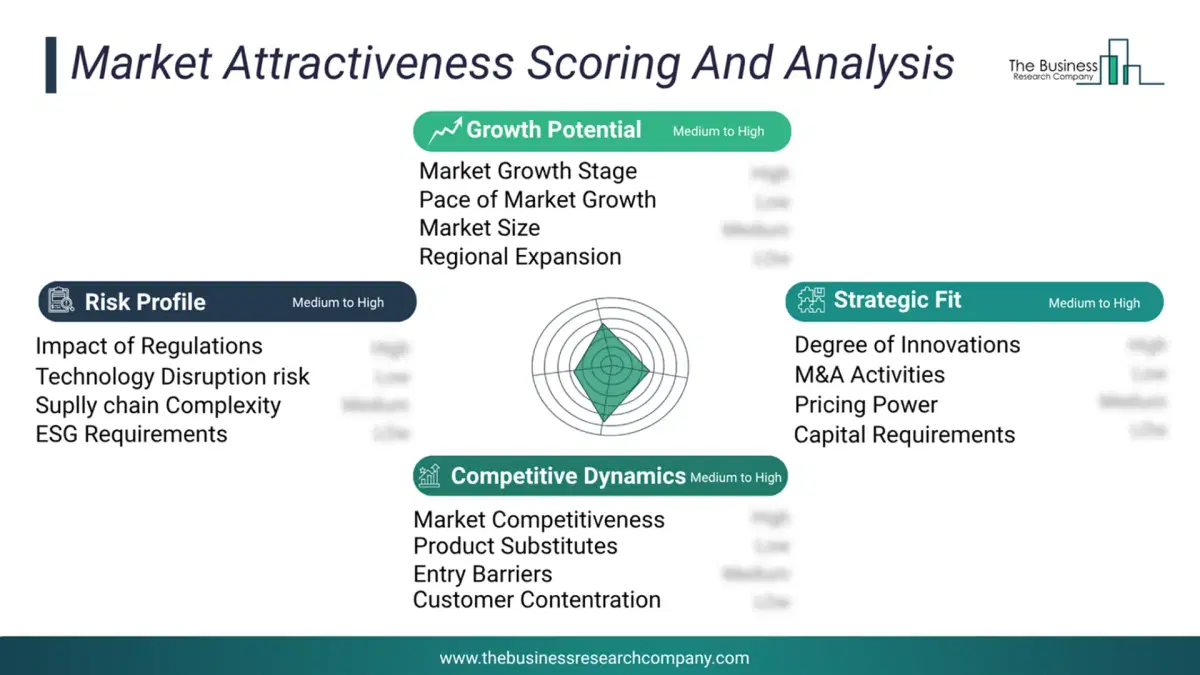
This chart presents market attractiveness based on a quantitative evaluation of growth, competition, strategic alignment, and risk, offering a clear view of opportunity areas for decision-making. This chart is for illustrative purposes; the full report contains the complete analysis.
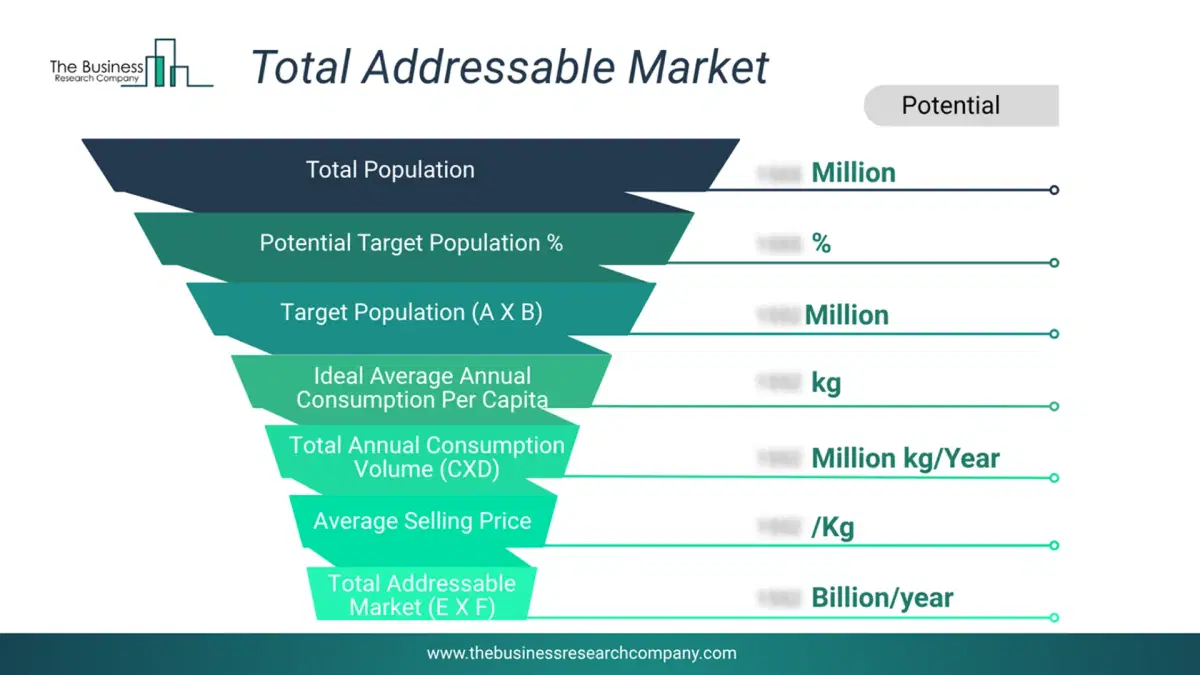
This chart highlights the Total Addressable Market (TAM) by estimating the maximum revenue opportunity using an assumption-driven approach, supporting strategic planning and opportunity sizing across markets. The chart is illustrative; the full report provides a more comprehensive analysis.
What Key Data and Analysis Are Included in the Semiconductor Fabrication Material Market Report 2026?
The semiconductor fabrication material market research report is one of a series of new reports from The Business Research Company that provides market statistics, including industry global market size, regional shares, competitors with the market share, detailed market segments, market trends and opportunities, and any further data you may need to thrive in the semiconductor fabrication material industry. The market research report delivers a complete perspective of everything you need, with an in-depth analysis of the current and future state of the industry.Semiconductor Fabrication Material Market Report 2026 Market Report Forecast Analysis
| Report Attribute | Details |
|---|---|
| Market Size Value In 2026 | $69.51 billion |
| Revenue Forecast In 2030 | $87.06 billion |
| Growth Rate | CAGR of 6.7% from 2026 to 2030 |
| Base Year For Estimation | 2025 |
| Actual Estimates/Historical Data | 2020-2025 |
| Forecast Period | 2026 - 2030 |
| Market Representation | Revenue in USD Billion and CAGR from 2026 to 2030 |
| Segments Covered | Semiconductor Type, Fabrication Material, End User |
| Regional Scope | Asia-Pacific, Western Europe, Eastern Europe, North America, South America, Middle East, Africa |
| Country Scope | The countries covered in the report are Australia, Brazil, China, France, Germany, India, Indonesia, Japan, Taiwan, Russia, South Korea, UK, USA, Canada, Italy, Spain. |
| Key Companies Profiled | Air Liquide SA, Avantor Inc., BASF SE, Dow Inc., Hitachi Chemical Company Limited, JSR Corporation, Kanto Chemical Co. Inc., KMG Chemicals Inc., Linde AG, Indium Corporation, Kyocera Corporation, Showa Denko Materials Co. Ltd., Applied Materials Inc., DuPont de Nemours Inc., Cabot Microelectronics Corporation, Merck KGaA, Mitsubishi Chemical Corporation, Mitsui Chemicals Inc., Nippon Steel Chemical & Material Co. Ltd., Praxair Inc., Shin-Etsu Chemical Co. Ltd., Sumitomo Chemical Co. Ltd., Tokyo Ohka Kogyo Co. Ltd., Tosoh Corporation, Ube Industries Ltd., Versum Materials Inc., Wacker Chemie AG, Wafer World Inc., Air Products and Chemicals Inc., Entegris Inc., Heraeus Holding GmbH, Honeywell International Inc., Lam Research Corporation, Tokyo Electron Limited |
| Customization Scope | Request for Customization |
| Pricing And Purchase Options | Explore Purchase Options |