
AI In Energy Market Report 2026
Global Outlook – By Offering (Support Services, Hardware, Artificial Intelligence (AI)-As-A-Service, Software), By Deployment (On-Premise, Cloud), By Application (Demand Response Management, Fleet And Asset Management, Renewable Energy Management, Precision Drilling, Demand Forecasting, Infrastructure Management, Other Applications), By End User (Energy Transmission, Energy Generation, Energy Distribution, Utilities, Other End Users) – Market Size, Trends, Strategies, and Forecast to 2030
AI In Energy Market Overview
• AI In Energy market size has reached to $22.82 billion in 2025 • Expected to grow to $60.6 billion in 2030 at a compound annual growth rate (CAGR) of 21.4% • Growth Driver: Surge In Microgrid Adoption Drives Growth Of AI in The Energy Market • Market Trend: Advance Model Revolutionizing AI in The Energy Sector • North America was the largest region in 2025 and Asia-pacific is the fastest growing region.Market Gains By 2030 – Top Opportunities By Segment
Market Gain identifies the most promising market opportunities by highlighting the segments or products expected to generate the highest incremental revenue growth over the next five years.
What Is Covered Under AI In Energy Market?
AI in energy refers to the application of artificial intelligence (AI) technologies and techniques in the energy sector to improve efficiency, optimize operations, and enhance decision-making. AI in energy includes data analysis, grid management and security, and demand response. AI in energy is used to maximize the recycling of materials used in renewable energy systems, such as solar panels, wind turbines, and hydroelectric dams. The main offerings of AI in energy are support services, hardware, AI-as-a-service, and software. Support services refer to a range of activities and resources provided to individuals, organizations, or customers to assist them with their needs, address issues, and ensure their satisfaction. The technology is deployed through on-premises and cloud deployment modes. It is used in a variety of applications, including demand response management, fleet and asset management, renewable energy management, precision drilling, demand forecasting, infrastructure management, and others, by end users such as energy transmission, energy generation, energy distribution, utilities, and others.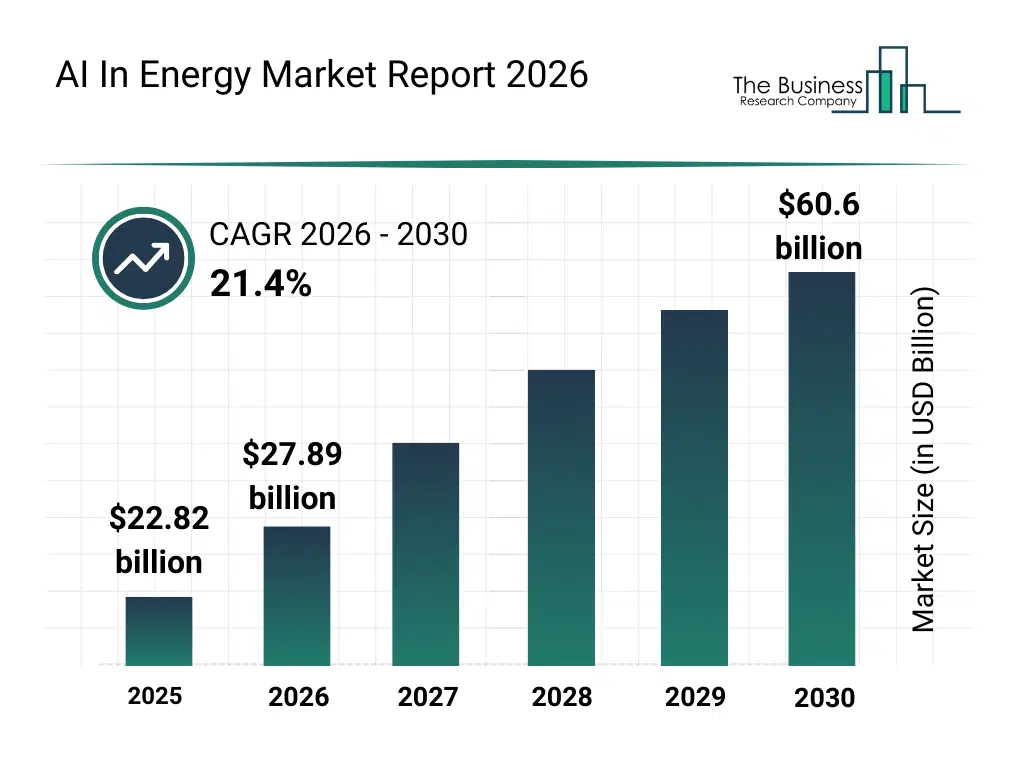
What Is The AI In Energy Market Size and Share 2026?
The AI in energy market size has grown exponentially in recent years. It will grow from $22.82 billion in 2025 to $27.89 billion in 2026 at a compound annual growth rate (CAGR) of 22.2%. The growth in the historic period can be attributed to rising energy consumption, early grid automation initiatives, expansion of renewable energy capacity, demand for operational efficiency, growth of smart metering infrastructure.What Is The AI In Energy Market Growth Forecast?
The AI in energy market size is expected to see exponential growth in the next few years. It will grow to $60.6 billion in 2030 at a compound annual growth rate (CAGR) of 21.4%. The growth in the forecast period can be attributed to decarbonization targets, AI driven grid intelligence adoption, growth of distributed energy resources, real time energy analytics demand, resilience focused energy management. Major trends in the forecast period include adoption of AI based demand forecasting, growth of smart grid optimization, integration of predictive maintenance solutions, expansion of renewable energy management, use of AI for energy efficiency optimization.
Global AI In Energy Market Segmentation
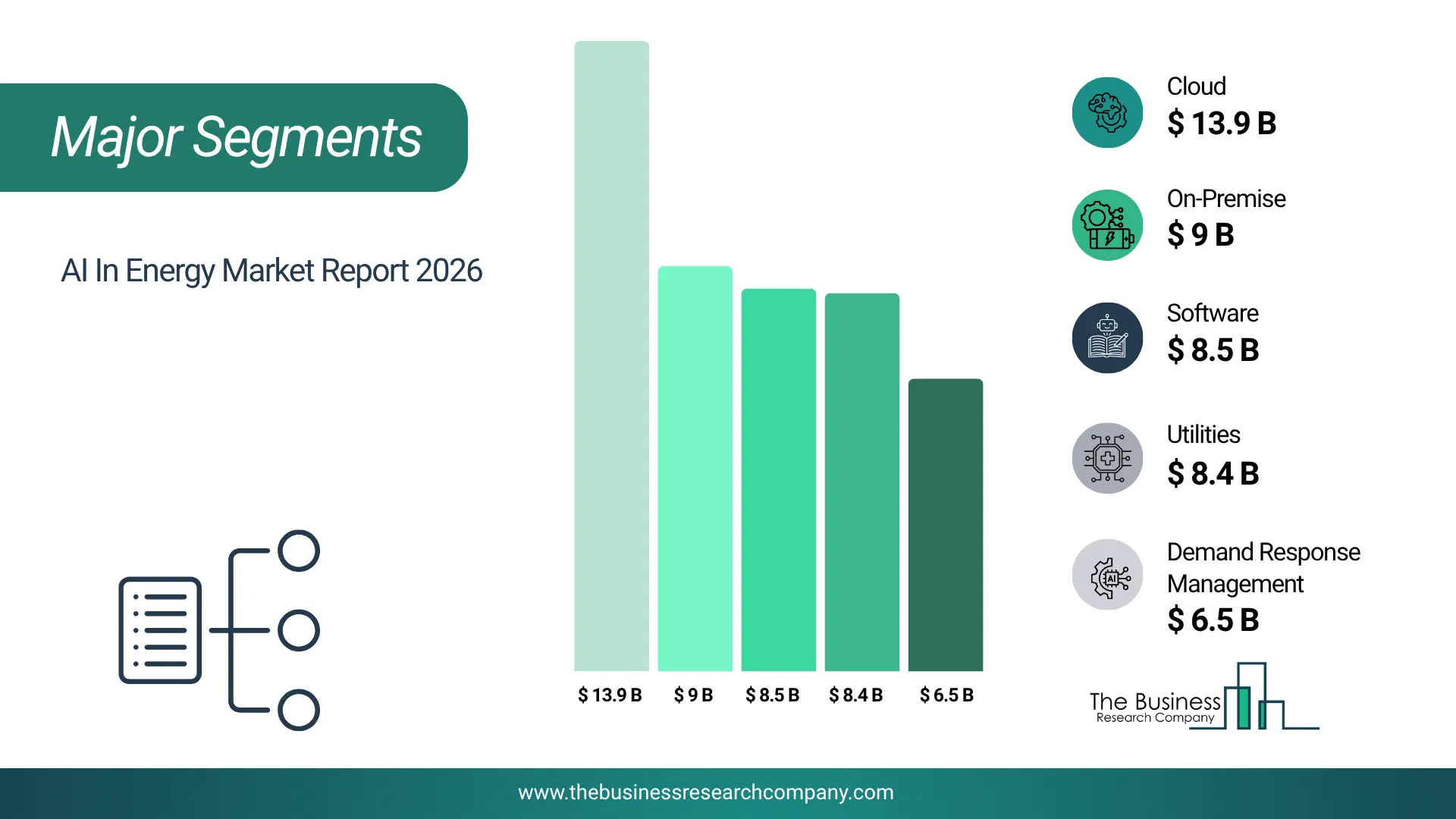
1) By Offering: Support Services, Hardware, Artificial Intelligence (AI)-As-A-Service, Software 2) By Deployment: On-Premise, Cloud 3) By Application: Demand Response Management, Fleet And Asset Management, Renewable Energy Management, Precision Drilling, Demand Forecasting, Infrastructure Management, Other Applications 4) By End User: Energy Transmission, Energy Generation, Energy Distribution, Utilities, Other End Users Subsegments: 1) By Support Services: Consulting Services, Implementation Services, Maintenance And Support Services 2) By Hardware: Artificial Intelligence (AI)-Powered Sensors, Smart Meters, Edge Computing Devices 3) By Artificial Intelligence (AI)-As-A-Service: Machine Learning Platforms, Data Analytics Services, Model Training And Development Services 4) By Software: Energy Management Software, Predictive Maintenance Software, Demand Response Software, Grid Management Software The top segments in the ai in energy market will be: • Cloud will reach $13903.52 Million by 2025. • On-Premise will reach $9040.52 Million by 2025. • Software will reach $8590.69 Million by 2025. • Utilities will reach $8466.5 Million by 2025. • Demand Response Management will reach $6587.67 Million by 2025.What Is The Driver Of The AI In Energy Market?
The increasing use of microgrids is expected to propel the growth of AI in the energy market going forward. A microgrid is a localized energy system operating independently or in conjunction with the primary power grid. Microgrids play a significant role in integrating and optimizing AI technology within the energy sector, enabling intelligent energy management, grid optimization, and the integration of renewable energy sources. These help in AI energy applications like demand response, load balancing, and the integration of renewable energy. AI in the energy market is seeing significant growth as there is an increase in the use of microgrids. For instance, in September 2024, according to the Energy Trends published by the Department for Energy Security and Net Zero, a UK-based ministerial department, the installed capacity rose by 3.9 percent (2.1 GW) in the second quarter of 2024 compared to the same quarter in 2023, resulting in a total of 57.5 GW. Therefore, the increasing use of microgrids is expected to drive the growth of AI in the energy market.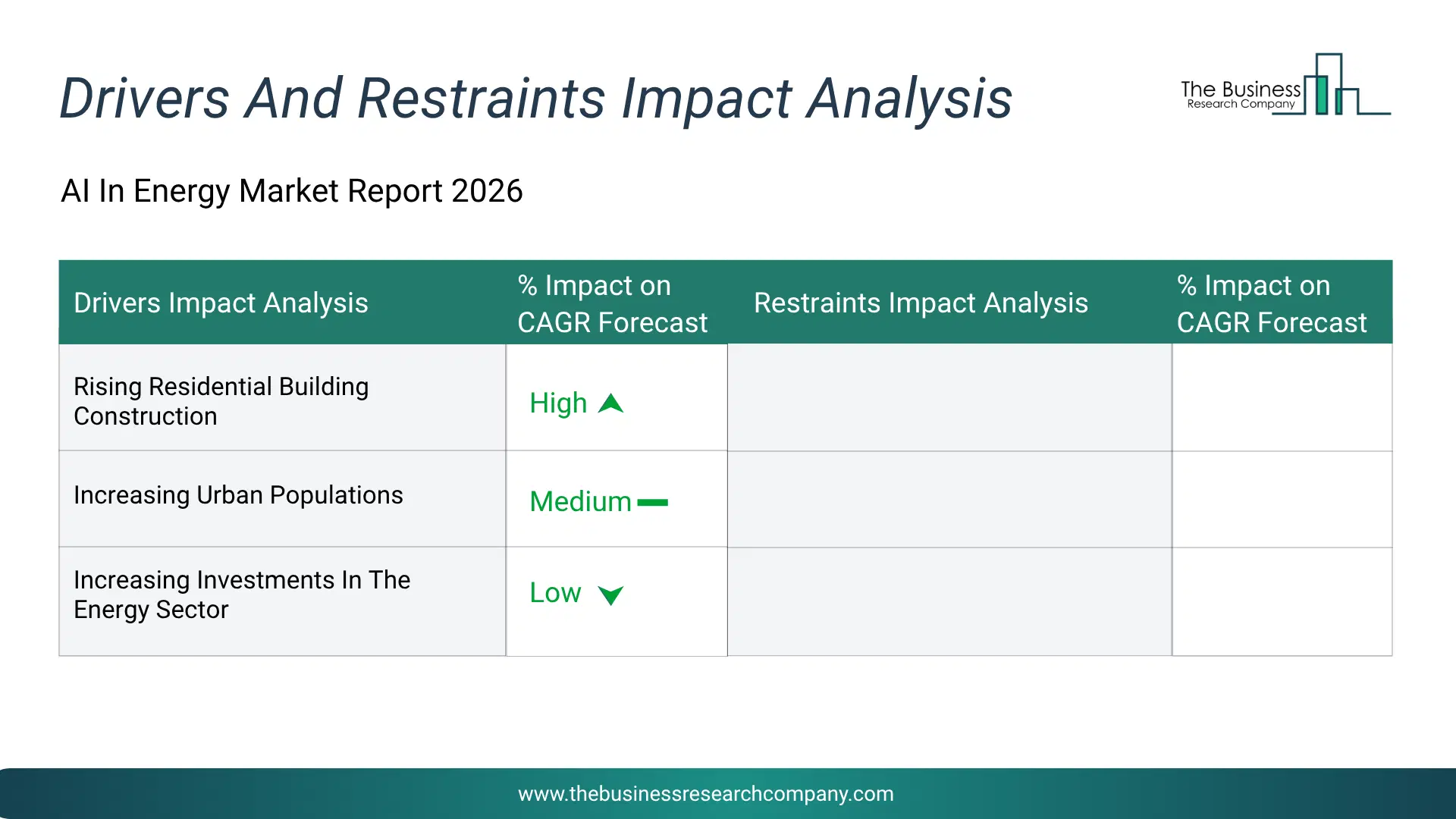
Infographic Chart Showing Key Market Drivers Analysis And Restraints For Ai In Energy Market
The chart presents an impact analysis of key drivers and restraints, quantifying their relative influence on the market's growth rate and helping assess the balance between growth enablers and limiting factors. This chart offers a high-level perspective; the full report contains more detailed insights.
How Will The Drivers Impact Growth In The Global AI In Energy Market?
• Rising Residential Building Construction (High) – The rising residential building construction will become a key driver of growth in the AI in energy market by 2030. Residential buildings refer to structures specifically designed and constructed for people. With a focus on sustainability, modern residential constructions often incorporate energy-efficient features, such as solar panels, smart appliances and advanced insulation. AI technologies are integrated into these systems to monitor energy usage, adjust settings for optimal efficiency and provide insights for further improvements. As a result, the rising residential building construction is anticipated to contributing to annual growth in the market. • Increasing Urban Populations (Medium) – The increasing urban populations will emerge as a major factor driving the expansion of the AI in energy market by 2030. Increasing urban populations drive higher energy demand, straining existing energy infrastructure and necessitating efficient solutions. AI can optimize energy distribution, reduce waste and manage grid stability in densely populated areas. It enables smart energy systems, such as predictive maintenance, demand forecasting and real-time monitoring, ensuring reliable energy supply. Urban growth also encourages the adoption of AI-driven renewable energy integration and energy-efficient technologies, supporting sustainable urbanization and driving the AI in the energy market's growth. Consequently, the increasing urban populations is projected to contributing to annual growth in the market. • Increasing Investments In The Energy Sector (Low) – The increasing investments in the energy sector will serve as a key growth catalyst for the AI in energy market by 2030. Increasing investments in the energy sector create opportunities for leveraging AI technologies to drive innovation, improve operational efficiency and address sustainability challenges. By integrating AI into energy systems, stakeholders can optimize energy production, distribution and consumption, leading to a more resilient, reliable and sustainable energy future. Therefore, this increasing investments in the energy sector is projected to supporting to annual growth in the market. • Increasing Cloud-Based Services (Low) – The increasing cloud-based services will become a significant driver contributing to the growth of the AI in energy market by 2030. Cloud-based services providing scalable, cost-effective infrastructure for data storage, processing and real-time analytics. Cloud platforms enable seamless integration of AI tools for energy management, predictive maintenance and demand forecasting. They facilitate collaboration across distributed energy systems and ensure efficient deployment of AI-driven solutions for renewable energy optimization and grid management. Consequently, the increasing cloud-based services is projected to contributing to annual growth in the market.How Will The Restraints Impact Growth In The Global AI In Energy Market?
• Loss Of Jobs Due To Automation (High) – Loss Of Jobs Due To Automation will restrict the growth of the AI In Energy market during the forecast period. The adoption of AI in energy operations raises concerns about job displacement among energy sector workers. Fears of automation replacing human roles in utilities and energy companies can lead to resistance from employees and labor unions. Organizational reluctance to implement AI technologies that may affect employment can limit market growth.Key Players In The Global AI In Energy Market
Major companies operating in the AI in energy market are Google; Microsoft Corporation; Engie SA; Huawei Technologies Co Ltd.; Siemens AG; General Electric Company; Intel Corporation; International Business Machines Corporation; Iberdrola; Cisco Systems Inc.; Schneider Electric SE; Honeywell International Inc.; ABB Ltd; Duke Energy Corporation; Nvidia Corporation; Alpiq Holding AG; ATOS SE; Enel Green Power S.p.A.; Databricks Inc.; C3 AI; Uptake Technologies; Sentient Energy Inc.; AutoGrid Systems Inc.; Arundo Analytics Inc.; Bidgely Inc.; Verdigris Technologies; Greenbird Integration Technology AS; AppOrchid Inc.; Ecube Labs Co. Ltd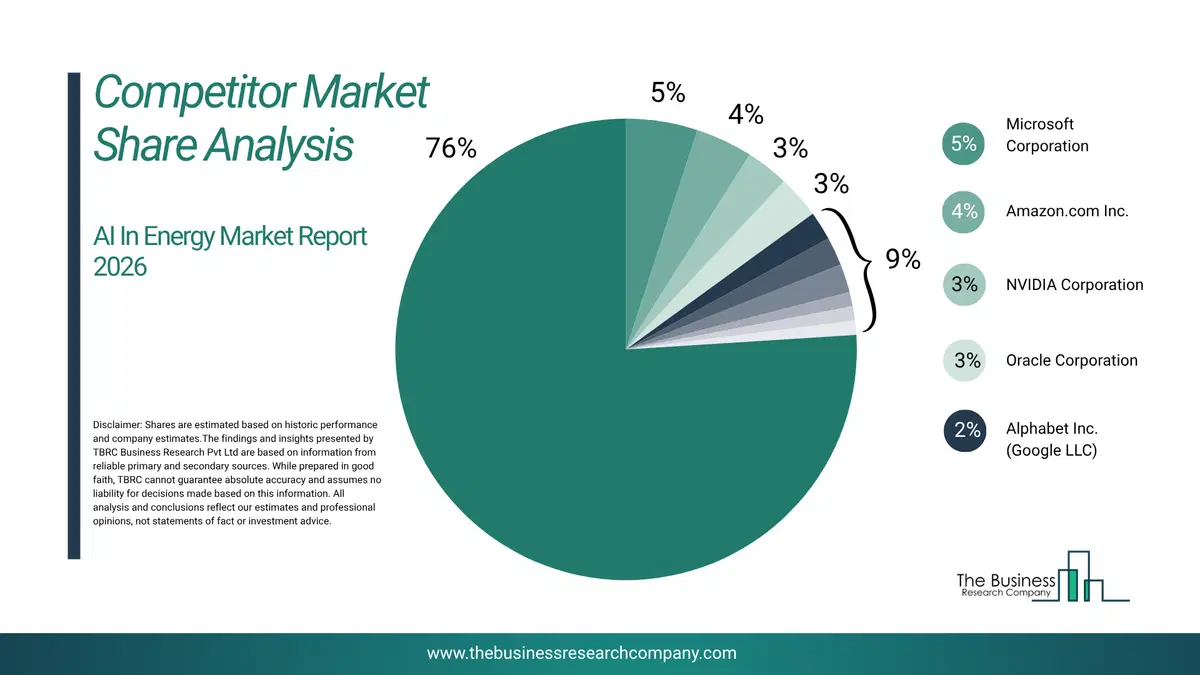
This chart is for illustrative purposes; the full report includes a detailed competitor analysis and comprehensive overview of the top 10 companies in the market.
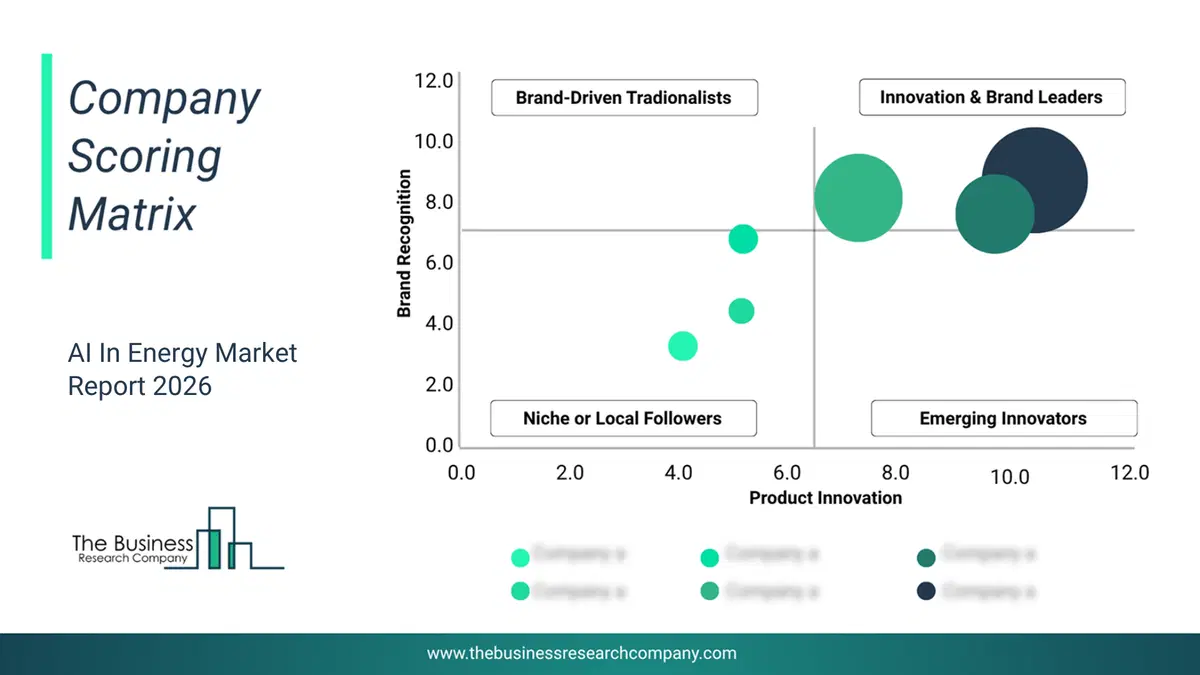
This chart maps companies by product innovation and brand strength, with bubble size indicating relative revenue, helping identify market leaders, challengers, and niche players. This is an illustrative chart; the full report provides a complete and accurate competitive analysis.
Global AI In Energy Market Trends and Insights
Major companies operating in AI in the energy market are innovating new technologies, such as the Pangu Mine Model, which is the world's first commercially available large AI model for the energy sector. The Pangu Mine Model is designed to address challenges in the mining industry and the broader energy sector by deploying large AI models in industrial production. For instance, in July 2023, Shandong Energy Group Co. Ltd., a China-based coal mining company, YunDing Tech Co. Ltd., a China-based network technology company, and Huawei Technologies Co. Ltd., a China-based manufacturing company, jointly launched the Pangu Mine Model. The Pangu Model features decoupled operation management, intelligent production, in-campus data processing, large-scale replicability, and learning and analysis from small samples. It is designed to improve the intelligence level of energy in the mining industry by expanding the depth and breadth of AI applications in different scenarios and continually using AI to deliver more automation, achieve greater efficiency, reduce labor intensity, and improve safety in energy utilization for mining purposes.What Are Latest Mergers And Acquisitions In The AI In Energy Market?
In March 2025, Bidgely, a US-based provider of AI-powered SaaS energy analytics and consumer engagement solutions, acquired Grid4C for an undisclosed amount. With this acquisition, Bidgely aims to enhance its AI-driven energy intelligence platform and expand its offerings in grid-side management and consumer engagement. Grid4C is a US-based provider of AI-powered predictive analytics solutions for the energy industry.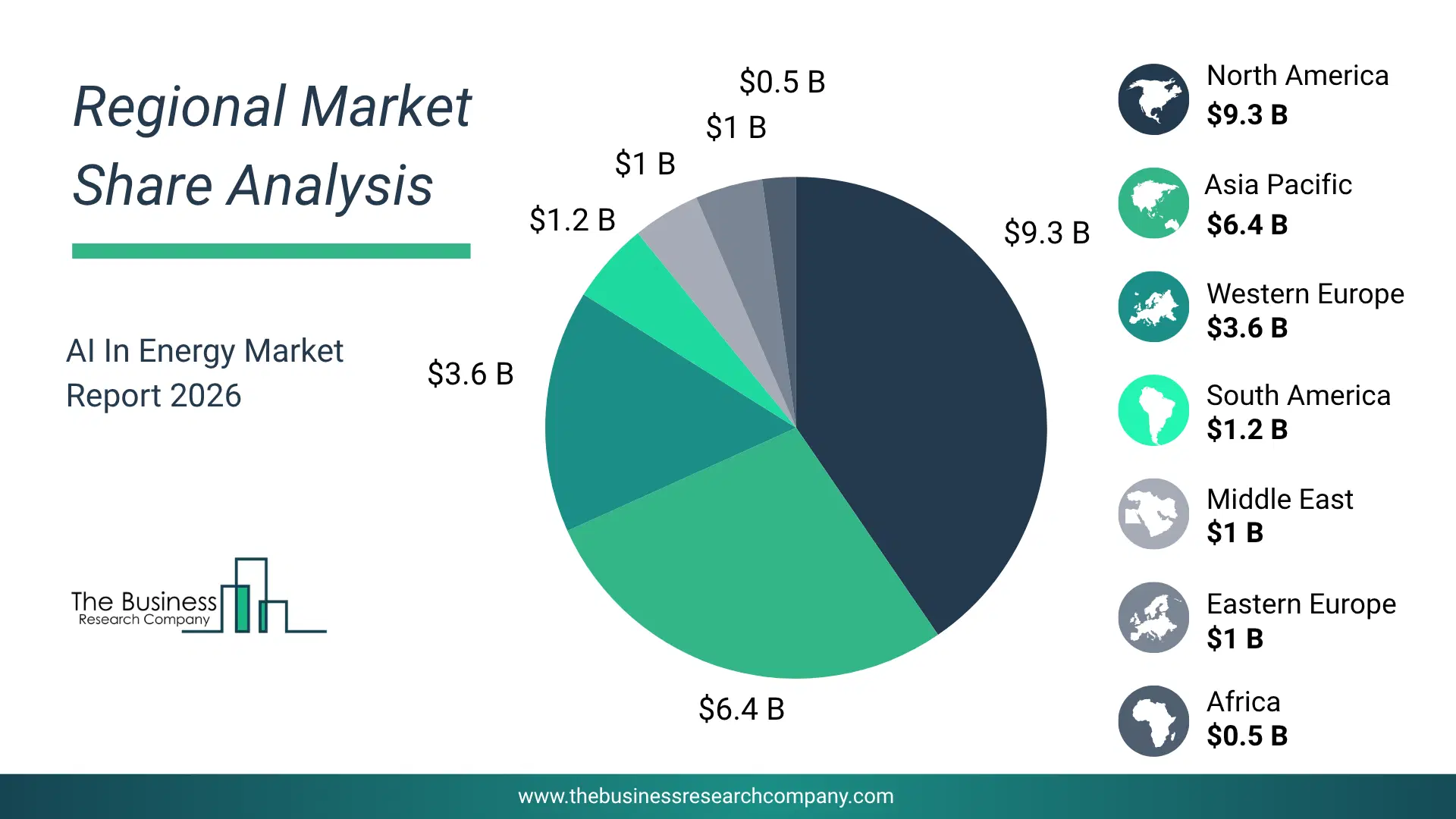
Regional Insights
North America was the largest region in AI in the energy market in 2025. Asia-pacific is expected to be the fastest-growing region in the forecast period. The regions covered in this market report are Asia-Pacific, South East Asia, Western Europe, Eastern Europe, North America, South America, Middle East, Africa. The countries covered in this market report are Australia, Brazil, China, France, Germany, India, Indonesia, Japan, Taiwan, Russia, South Korea, UK, USA, Canada, Italy, SpainWhat Defines the AI In Energy Market?
The AI in the energy market consists of revenues earned by entities by providing services such as smart grid operations and robotics. The market value includes the value of related goods sold by the service provider or included within the service offering. The AI in the energy market also includes sales of PyTorch integration and analog device simulators. Values in this market are ‘factory gate’ values, that is, the value of goods sold by the manufacturers or creators of the goods, whether to other entities (including downstream manufacturers, wholesalers, distributors, and retailers) or directly to end customers. The value of goods in this market includes related services sold by the creators of the goods.How is Market Value Defined and Measured?
The market value is defined as the revenues that enterprises gain from the sale of goods and/or services within the specified market and geography through sales, grants, or donations in terms of the currency (in USD unless otherwise specified). The revenues for a specified geography are consumption values that are revenues generated by organizations in the specified geography within the market, irrespective of where they are produced. It does not include revenues from resales along the supply chain, either further along the supply chain or as part of other products.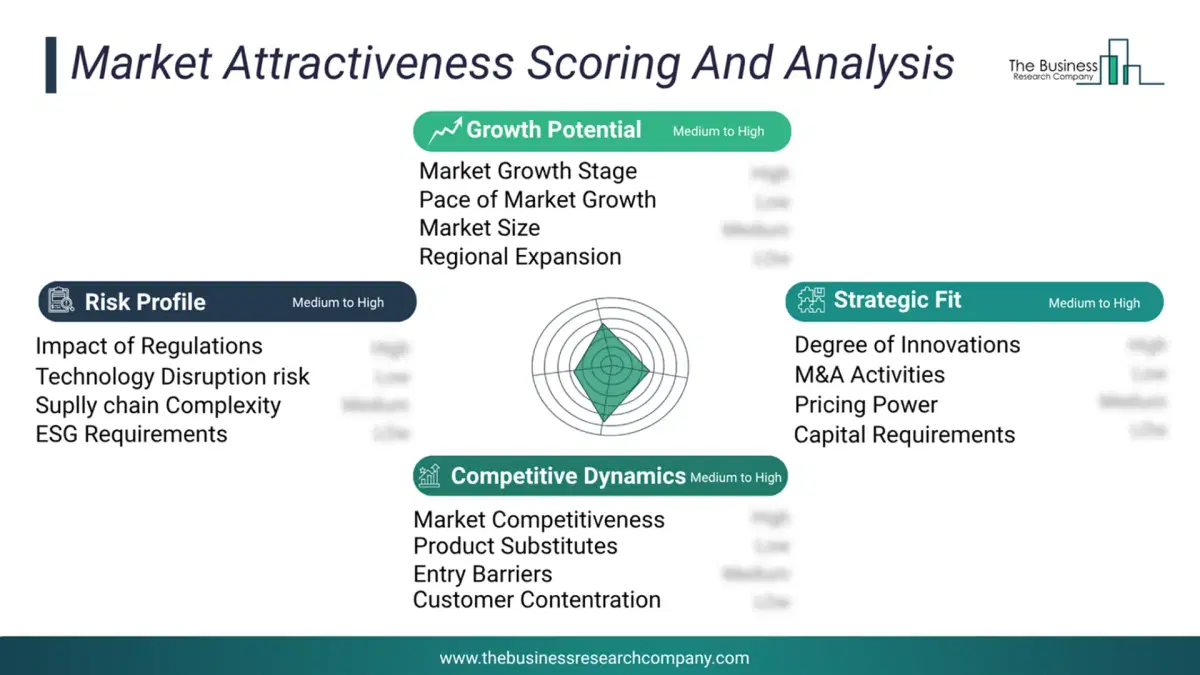
This chart presents market attractiveness based on a quantitative evaluation of growth, competition, strategic alignment, and risk, offering a clear view of opportunity areas for decision-making. This chart is for illustrative purposes; the full report contains the complete analysis.
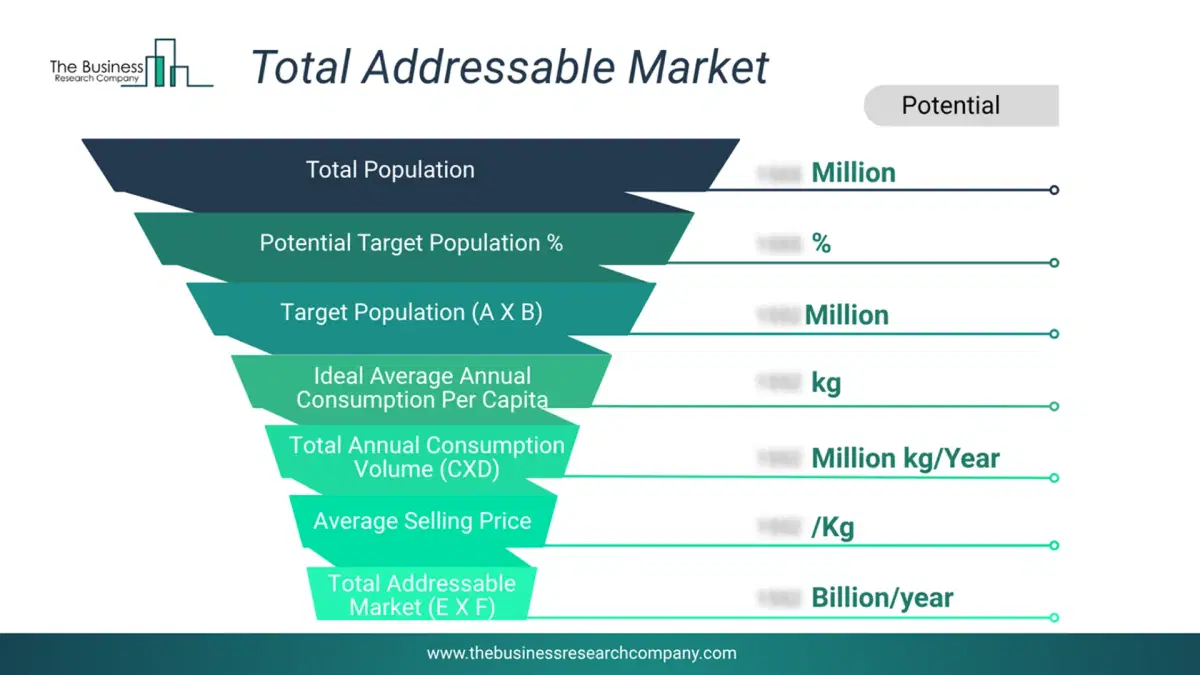
This chart highlights the Total Addressable Market (TAM) by estimating the maximum revenue opportunity using an assumption-driven approach, supporting strategic planning and opportunity sizing across markets. The chart is illustrative; the full report provides a more comprehensive analysis.
What Key Data and Analysis Are Included in the AI In Energy Market Report 2026?
The ai in energy market research report is one of a series of new reports from The Business Research Company that provides market statistics, including industry global market size, regional shares, competitors with the market share, detailed market segments, market trends and opportunities, and any further data you may need to thrive in the ai in energy industry. The market research report delivers a complete perspective of everything you need, with an in-depth analysis of the current and future state of the industry.AI In Energy Market Report Forecast Analysis
| Report Attribute | Details |
|---|---|
| Market Size Value In 2026 | $27.89 billion |
| Revenue Forecast In 2030 | $60.6 billion |
| Growth Rate | CAGR of 22.2% from 2026 to 2030 |
| Base Year For Estimation | 2025 |
| Actual Estimates/Historical Data | 2020-2025 |
| Forecast Period | 2026 - 2030 |
| Market Representation | Revenue in USD Billion and CAGR from 2026 to 2030 |
| Segments Covered | Offering, Deployment, Application, End User |
| Regional Scope | Asia-Pacific, Western Europe, Eastern Europe, North America, South America, Middle East, Africa |
| Country Scope | The countries covered in the report are Australia, Brazil, China, France, Germany, India, Indonesia, Japan, Taiwan, Russia, South Korea, UK, USA, Canada, Italy, Spain. |
| Key Companies Profiled | Google; Microsoft Corporation; Engie SA; Huawei Technologies Co Ltd.; Siemens AG; General Electric Company; Intel Corporation; International Business Machines Corporation; Iberdrola; Cisco Systems Inc.; Schneider Electric SE; Honeywell International Inc.; ABB Ltd; Duke Energy Corporation; Nvidia Corporation; Alpiq Holding AG; ATOS SE; Enel Green Power S.p.A.; Databricks Inc.; C3 AI; Uptake Technologies; Sentient Energy Inc.; AutoGrid Systems Inc.; Arundo Analytics Inc.; Bidgely Inc.; Verdigris Technologies; Greenbird Integration Technology AS; AppOrchid Inc.; Ecube Labs Co. Ltd |
| Customization Scope | Request for Customization |
| Pricing And Purchase Options | Explore Purchase Options |