
AI in Inventory Management Market Report 2026
Global Outlook – By Offering (Solutions, Services), By Deployment (Cloud, On-premise), By Technology (Machine Learning, Natural Language Processing, Context Awareness, Computer Vision, Other Technologies), By Application (Intelligent Robotic Sorting Or Visual Inspection, Warehouse Management, Supply Chain Planning, Predictive Demand And Capacity Planning, Other Applications), By End-User Industries (Retail, Healthcare, Automotive, Aerospace And Defense, Other End-Use Industries) – Market Size, Trends, Strategies, and Forecast to 2030
AI in Inventory Management Market Overview
• AI in Inventory Management market size has reached to $9.54 billion in 2025 • Expected to grow to $30.01 billion in 2030 at a compound annual growth rate (CAGR) of 24.8% • Growth Driver: Rising Number Of Retail Stores Drives Growth In The AI Inventory Management Market • Market Trend: Cloud-Native AI-Powered Inventory Management Platforms Revolutionize Inventory Management • North America was the largest region in 2025 and Asia-Pacific is the fastest growing region.What Is Covered Under AI in Inventory Management Market?
Artificial intelligence (AI) in inventory management refers to using AI methods and tools to streamline supply chain processes related to inventory handling, tracking, and organization. It is used in various ways to optimize inventory management, including demand forecasting, real-time monitoring, smart replenishment, and inventory optimization. The main offerings of AI in inventory management are solutions and services. Solutions refer to homogeneous mixes made up of two or more substances uniformly distributed at the molecular or ionic level. It can be deployed in the cloud and on-premise. The different types of technologies include machine learning, natural language processing, context awareness, computer vision, and others, which are used for several applications such as intelligent robotic sorting or visual inspection, warehouse management, supply chain planning, risk management or network management, freight brokerage, fleet management, intelligent route optimization, predictive demand and capacity planning, and others. It is used by various end-use industries including retail, healthcare, automotive, oil and gas, aerospace and defense and others.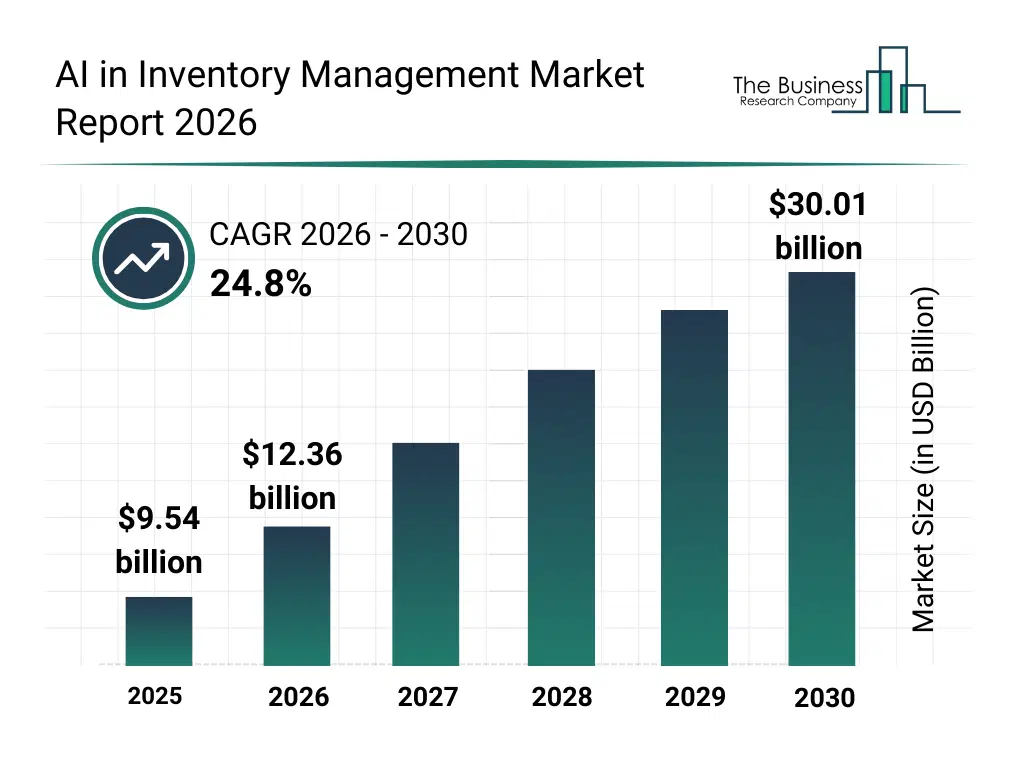
What Is The AI in Inventory Management Market Size and Share 2026?
The AI in inventory management market size has grown exponentially in recent years. It will grow from $9.54 billion in 2025 to $12.36 billion in 2026 at a compound annual growth rate (CAGR) of 29.6%. The growth in the historic period can be attributed to manual inventory tracking, inefficiencies in supply chain operations, growth of e-commerce and retail, increasing demand for warehouse automation, rising adoption of enterprise resource planning (ERP) systems.What Is The AI in Inventory Management Market Growth Forecast?
The AI in inventory management market size is expected to see exponential growth in the next few years. It will grow to $30.01 billion in 2030 at a compound annual growth rate (CAGR) of 24.8%. The growth in the forecast period can be attributed to advancements in machine learning and computer vision, integration of AI with supply chain management platforms, growing investment in predictive analytics tools, expansion of cloud-based inventory management solutions, increased focus on operational efficiency and cost reduction. Major trends in the forecast period include ai-based inventory forecasting, predictive demand and capacity planning, smart warehouse management, automated stock replenishment, intelligent route and fleet optimization.
Global AI in Inventory Management Market Segmentation
1) By Offering: Solutions, Services 2) By Deployment: Cloud, On-premise 3) By Technology: Machine Learning, Natural Language Processing, Context Awareness, Computer Vision, Other Technologies 4) By Application: Intelligent Robotic Sorting Or Visual Inspection, Warehouse Management, Supply Chain Planning, Predictive Demand And Capacity Planning, Other Applications 5) By End-User Industries: Retail, Healthcare, Automotive, Aerospace And Defense, Other End-Use Industries Subsegments: 1) By Solutions: AI-Based Inventory Forecasting, AI-Based Demand Planning, AI-Based Stock Replenishment, AI-Based Warehouse Management 2) By Services: Consulting Services, Integration Services, Support And Maintenance ServicesWhat Is The Driver Of The AI in Inventory Management Market?
The rising number of retail stores is expected to propel the growth of the AI in inventory management market going forward. Retail stores refer to establishments where goods are sold to consumers directly in relatively small quantities for their consumption or use. The rising number of retail stores is due to online and offline shopping, economic conditions, consumer preferences, and strategic business decisions. AI in inventory management can significantly improve operational efficiency, reduce costs, and enhance the overall customer shopping experience with retail stores. For instance, in January 2024, according to the National Association of Convenience Stores, a US-based trade association, the number of convenience stores operating in the United States until 2024 had risen to 152,396, reflecting a 1.5% growth compared to the previous year's count. Therefore, the rising number of retail stores is driving the growth of the AI in inventory management industry.Key Players In The Global AI in Inventory Management Market
Major companies operating in the AI in inventory management market are Walmart Inc.; Amazon.com Inc.; Microsoft Corporation; United Parcel Service Inc.; FedEx Corporation; A.P. Moller-Maersk Group; Siemens AG; Hitachi Ltd.; Intel Corporation; Accenture Plc; International Business Machines Corporation; Cisco Systems Inc.; Deloitte Touche Tohmatsu Limited; Oracle Corporation; PricewaterhouseCoopers International Limited; Schneider Electric SE; Honeywell International Inc.; KPMG International Cooperative; SAP SE; Tata Consultancy Services Limited; NVIDIA Corporation; Capgemini SE; Cognizant Technology Solutions Corporation; Infosys Limited; Wipro Limited
This chart is for illustrative purposes; the full report includes a detailed competitor analysis and comprehensive overview of the top 10 companies in the market.
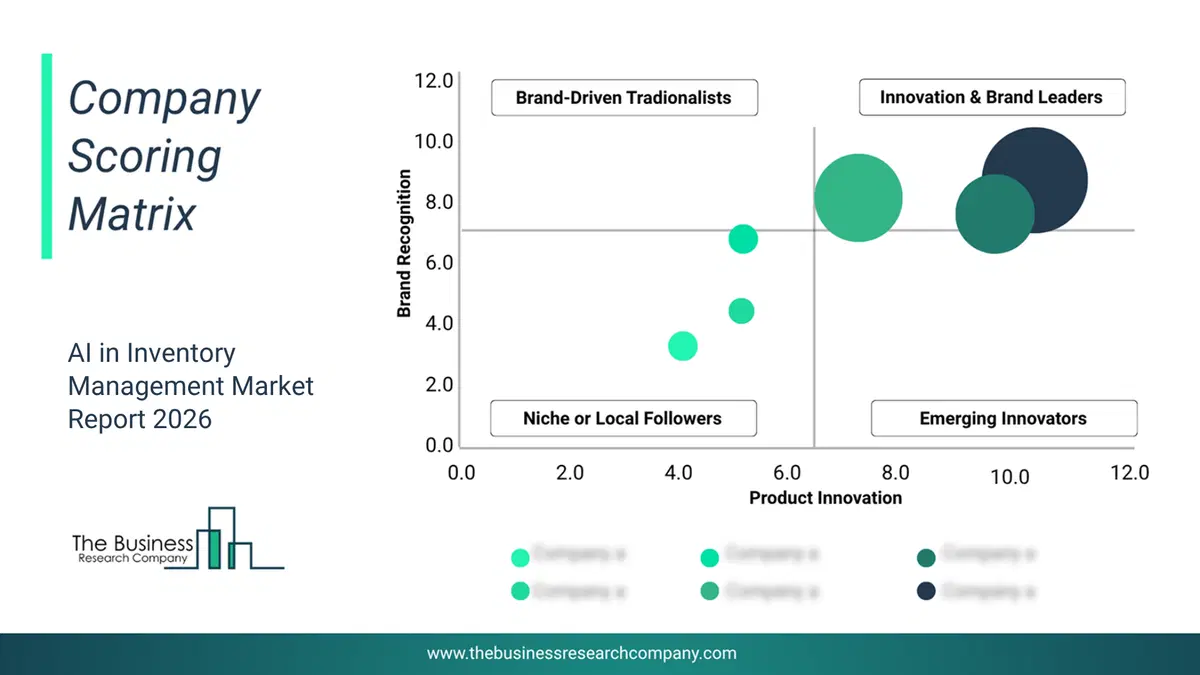
This chart maps companies by product innovation and brand strength, with bubble size indicating relative revenue, helping identify market leaders, challengers, and niche players. This is an illustrative chart; the full report provides a complete and accurate competitive analysis.
Global AI in Inventory Management Market Trends and Insights
Major companies operating in the AI inventory management market are developing advanced systems such as cloud-native AI-powered inventory management systems, to gain a competitive edge in the market. Cloud-native artificial intelligence-powered inventory management solutions are software solutions designed to operate in a cloud environment, leveraging cloud serverless computing technology to provide real-time access to inventory information. For instance, in January 2024, Predian, a US-based provider of AI-powered inventory management solutions, launched a cloud-native artificial intelligence-powered inventory management solution. This solution is designed to streamline stock control and optimize operational efficiency, making it a significant development in the field of AI-powered inventory management. These solutions can process vast amounts of data quickly, accurately, and without fatigue, making them invaluable tools for businesses looking to improve their inventory management processes.What Are Latest Mergers And Acquisitions In The AI in Inventory Management Market?
In March 2023, Gather AI, a US-based software company, acquired Ware Inc. for an undisclosed amount. This acquisition allows Gather AI to offer its proven solution to more warehouses, enabling customers to leverage data insights from across its growing network to provide real-time inventory visibility through AI software. Ware Inc. is a US-based provider of AI-powered autonomous inventory management solutions.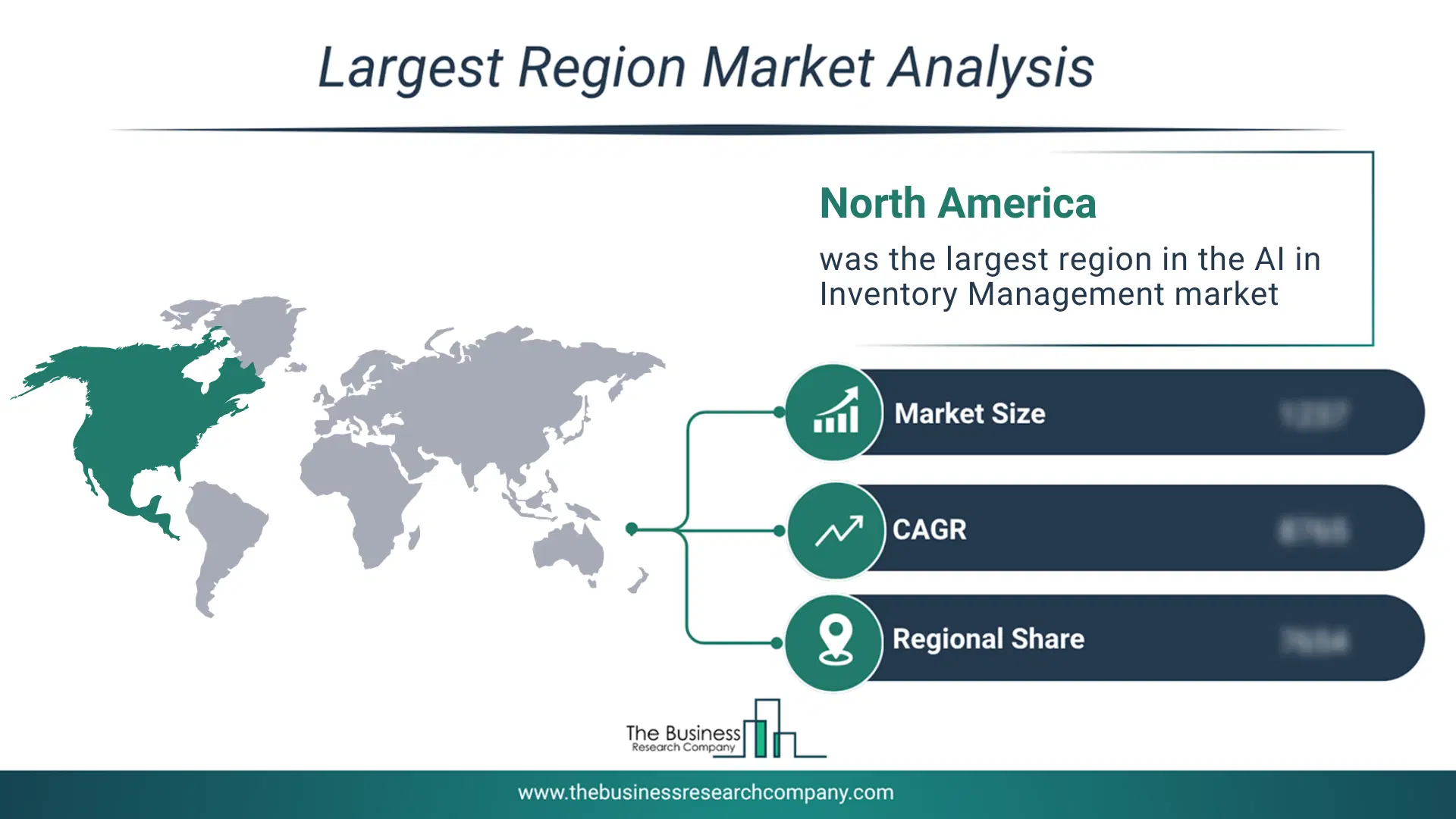
Regional Insights
North America was the largest region in the AI in inventory management market in 2025. Asia-Pacific is expected to be the fastest-growing region in the forecast period. The regions covered in this market report are Asia-Pacific, South East Asia, Western Europe, Eastern Europe, North America, South America, Middle East, Africa. The countries covered in this market report are Australia, Brazil, China, France, Germany, India, Indonesia, Japan, Taiwan, Russia, South Korea, UK, USA, Canada, Italy, SpainWhat Defines the AI in Inventory Management Market?
The AI in inventory management includes revenues earned by entities by providing services such as warehouse management, order fulfillment automation, real-time inventory tracking, and predictive maintenance. The market value includes the value of related goods sold by the service provider or included within the service offering. Only goods and services traded between entities or sold to end consumers are included.How is Market Value Defined and Measured?
The market value is defined as the revenues that enterprises gain from the sale of goods and/or services within the specified market and geography through sales, grants, or donations in terms of the currency (in USD unless otherwise specified). The revenues for a specified geography are consumption values that are revenues generated by organizations in the specified geography within the market, irrespective of where they are produced. It does not include revenues from resales along the supply chain, either further along the supply chain or as part of other products.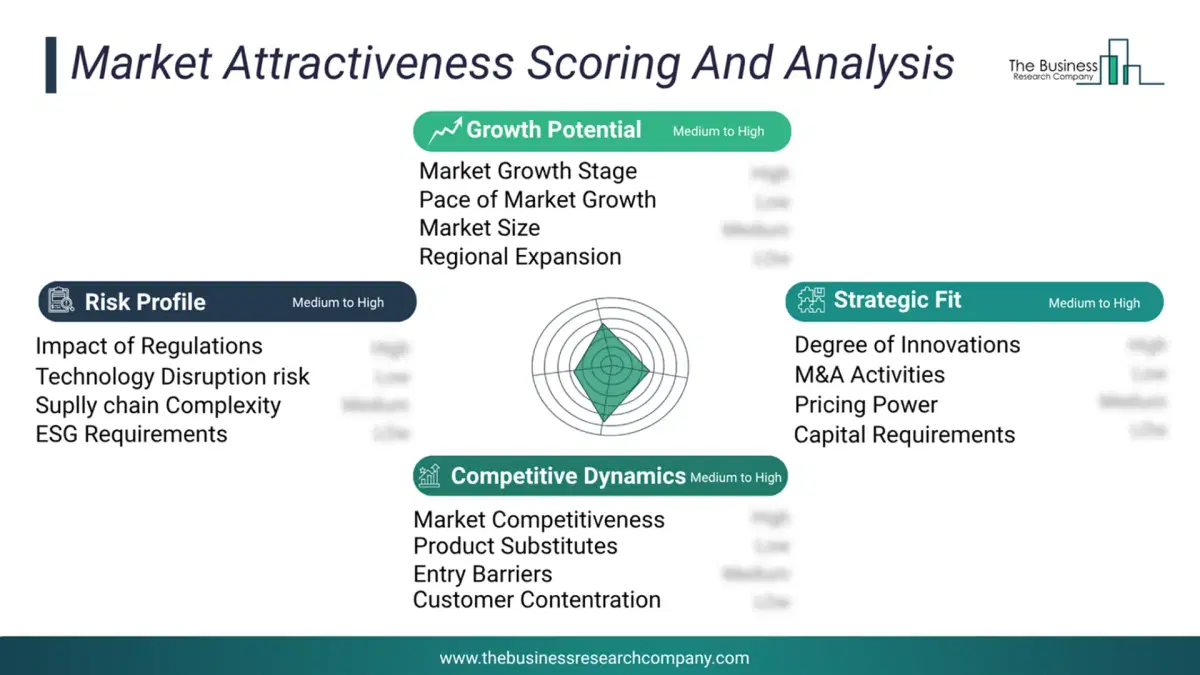
This chart presents market attractiveness based on a quantitative evaluation of growth, competition, strategic alignment, and risk, offering a clear view of opportunity areas for decision-making. This chart is for illustrative purposes; the full report contains the complete analysis.
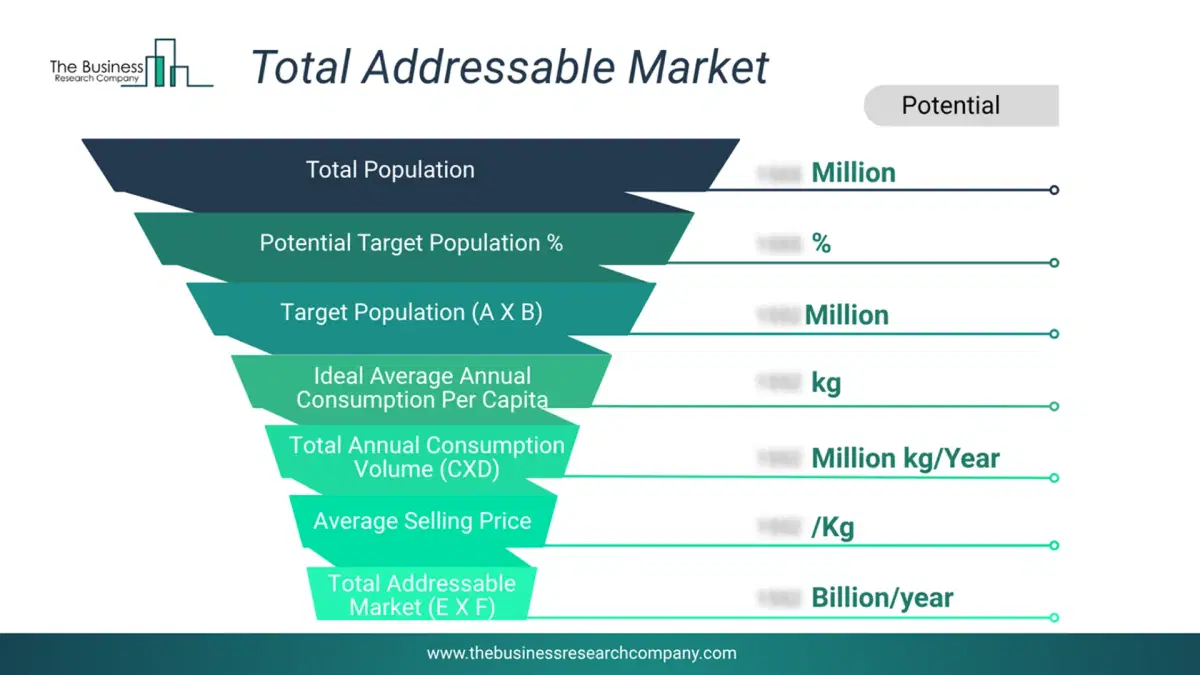
This chart highlights the Total Addressable Market (TAM) by estimating the maximum revenue opportunity using an assumption-driven approach, supporting strategic planning and opportunity sizing across markets. The chart is illustrative; the full report provides a more comprehensive analysis.
What Key Data and Analysis Are Included in the AI in Inventory Management Market Report 2026?
The ai in inventory management market research report is one of a series of new reports from The Business Research Company that provides market statistics, including industry global market size, regional shares, competitors with the market share, detailed market segments, market trends and opportunities, and any further data you may need to thrive in the ai in inventory management industry. The market research report delivers a complete perspective of everything you need, with an in-depth analysis of the current and future state of the industry.AI in Inventory Management Market Report Forecast Analysis
| Report Attribute | Details |
|---|---|
| Market Size Value In 2026 | $12.36 billion |
| Revenue Forecast In 2030 | $30.01 billion |
| Growth Rate | CAGR of 24.8% from 2026 to 2030 |
| Base Year For Estimation | 2025 |
| Actual Estimates/Historical Data | 2020-2025 |
| Forecast Period | 2026 - 2030 |
| Market Representation | Revenue in USD Billion and CAGR from 2026 to 2030 |
| Segments Covered | Offering, Deployment, Technology, Application, End-User Industries |
| Regional Scope | Asia-Pacific, Western Europe, Eastern Europe, North America, South America, Middle East, Africa |
| Country Scope | The Countries Covered In This Market Report Are Australia, Brazil, China, France, Germany, India, Indonesia, Japan, Taiwan, Russia, South Korea, Uk, Usa, Canada, Italy, Spain. |
| Key Companies Profiled | Walmart Inc., Amazon.com Inc., Microsoft Corporation, United Parcel Service Inc., FedEx Corporation, A.P. Moller-Maersk Group, Siemens AG, Hitachi Ltd., Intel Corporation, Accenture Plc, International Business Machines Corporation, Cisco Systems Inc., Deloitte Touche Tohmatsu Limited, Oracle Corporation, PricewaterhouseCoopers International Limited, Schneider Electric SE, Honeywell International Inc., KPMG International Cooperative, SAP SE, Tata Consultancy Services Limited, NVIDIA Corporation, Capgemini SE, Cognizant Technology Solutions Corporation, Infosys Limited, Wipro Limited |
| Customization Scope | Request for Customization |
| Pricing And Purchase Options | Explore Purchase Options |