
Airport Construction Market Report 2026
Global Outlook – By Technology (Security Systems, Communication Systems, Passenger, Cargo and Baggage Ground Handling Control, Air or Ground Traffic Control ), By Location (Landside, Airside, Terminal Side), By Applications (Defense and Military, Commercial And Civil) – Market Size, Trends, Strategies, and Forecast to 2030
Airport Construction Market Overview
• Airport Construction market size has reached to $1216.8 billion in 2025 • Expected to grow to $1430.52 billion in 2030 at a compound annual growth rate (CAGR) of 3.3% • Growth Driver: Growing Air Traffic Propels Expansion In The Airport Construction Market • Market Trend: Airport Construction Embrace Smart Solutions For Enhanced Efficiency And Passenger Experience • Asia-Pacific was the largest region in 2025 and North America is the fastest growing region.Market Gains By 2030 – Top Opportunities By Segment
Market Gain identifies the most promising market opportunities by highlighting the segments or products expected to generate the highest incremental revenue growth over the next five years.
What Is Covered Under Airport Construction Market?
The airport construction is a methodical process used to create standards for an airport's efficient development that is in line with municipal, state, and federal objectives. Assuring the efficient use of airport resources to meet aviation demand in a financially viable manner is a primary goal of airport planning. The main types of technologies in airport construction are security systems, communication systems, passenger, cargo, and baggage ground handling control, and air or ground traffic control. Security systems refer to a collection of policies, procedures, tools, and resources designed to protect airport infrastructure, staff, and passengers against unauthorized conduct. The various locations involved are landside, airside, and terminal side that are used in defense and military, commercial and civil applications.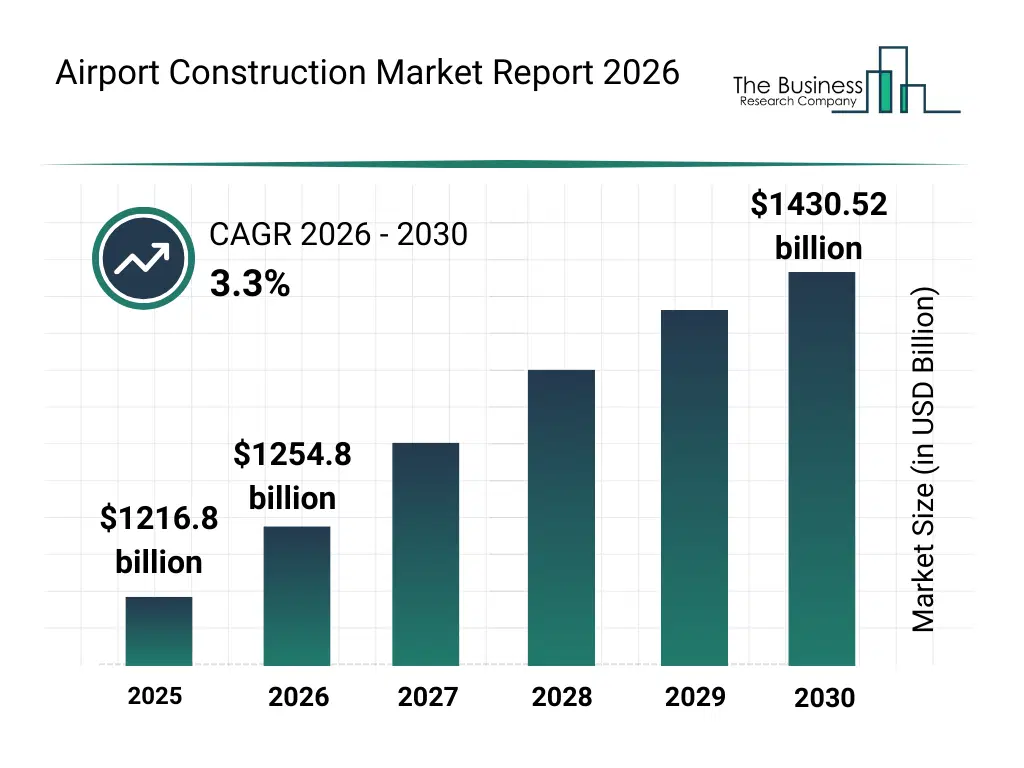
What Is The Airport Construction Market Size and Share 2026?
The airport construction market size has grown steadily in recent years. It will grow from $1216.8 billion in 2025 to $1254.8 billion in 2026 at a compound annual growth rate (CAGR) of 3.1%. The growth in the historic period can be attributed to growth in international air travel, government airport development initiatives, increase in public-private partnerships, modernization of aging airport infrastructure, rise in airport expansion projects.What Is The Airport Construction Market Growth Forecast?
The airport construction market size is expected to see steady growth in the next few years. It will grow to $1430.52 billion in 2030 at a compound annual growth rate (CAGR) of 3.3%. The growth in the forecast period can be attributed to adoption of green and sustainable construction technologies, growth of smart airport projects, increase in mega airport construction, investment in runway and terminal upgrades, incorporation of modular and rapid construction methods. Major trends in the forecast period include modular airport construction techniques, prefabricated terminal structures, smart runway and taxiway systems, advanced baggage handling automation, green building materials for airport infrastructure.
Global Airport Construction Market Segmentation
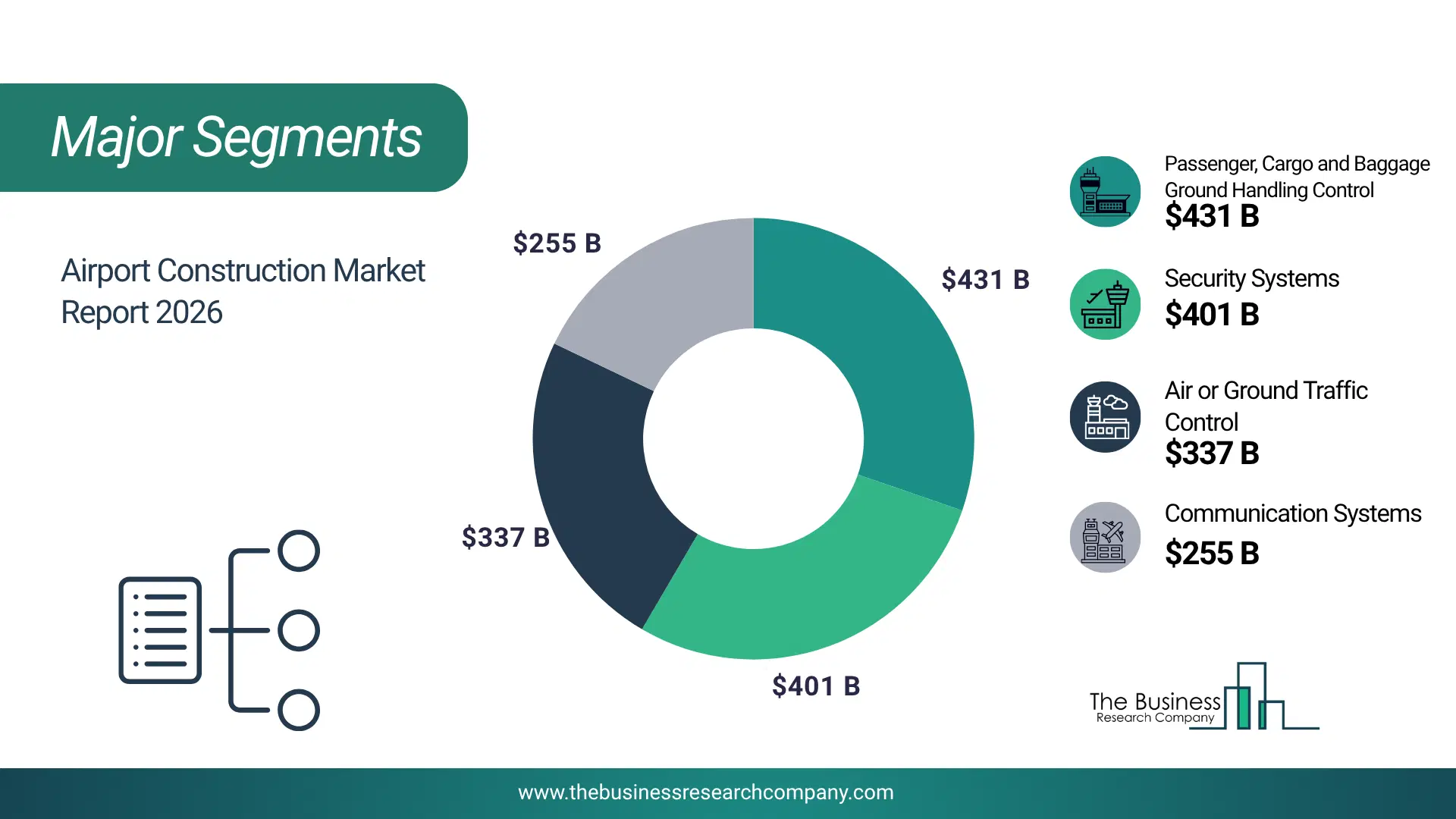
1) By Technology: Security Systems, Communication Systems, Passenger, Cargo and Baggage Ground Handling Control, Air or Ground Traffic Control 2) By Location: Landside, Airside, Terminal Side 3) By Applications: Defense and Military, Commercial And Civil Subsegments: 1) By Security Systems: Access Control Systems, Surveillance Systems, Screening Systems 2) By Communication Systems: Public Address Systems, Intercom Systems, Data Communication Systems 3) By Passenger, Cargo, And Baggage Ground Handling Control: Baggage Handling Systems, Cargo Management Systems, Passenger Boarding Bridges 4) By Air Or Ground Traffic Control: Air Traffic Control Systems, Ground Traffic Management Systems, Navigation Systems The top segments in the airport construction market will be: • Passenger, Cargo and Baggage Ground Handling Control will reach $431 Billion by 2030. • Security Systems will reach $401 Billion by 2030. • Air or Ground Traffic Control will reach $337 Billion by 2030. • Communication Systems will reach $255 Billion by 2030.What Is Driver Of The Airport Construction Market?
The growing air traffic is expected to drive the growth of the airport construction market going forward. Air traffic refers to the procedure or technique by which ground personnel coordinates radio communications with pilots to monitor and control aircraft movements. Air traffic is increasing as global economic growth and a rising middle class drive higher demand for air travel, resulting in more passengers and frequent flights worldwide. Airport construction boosts air traffic by increasing runway and terminal capacity to handle more flights and passengers efficiently while minimizing congestion and improving overall connectivity and operations. For instance, in September 2024, according to Airports Council International, a Canada-based trade association, global passenger traffic climbed to 8.7 billion in 2023, marking a 30.6% increase compared to 2022. Therefore, the surge in air traffic will benefit the airport construction industry in the forecasting period.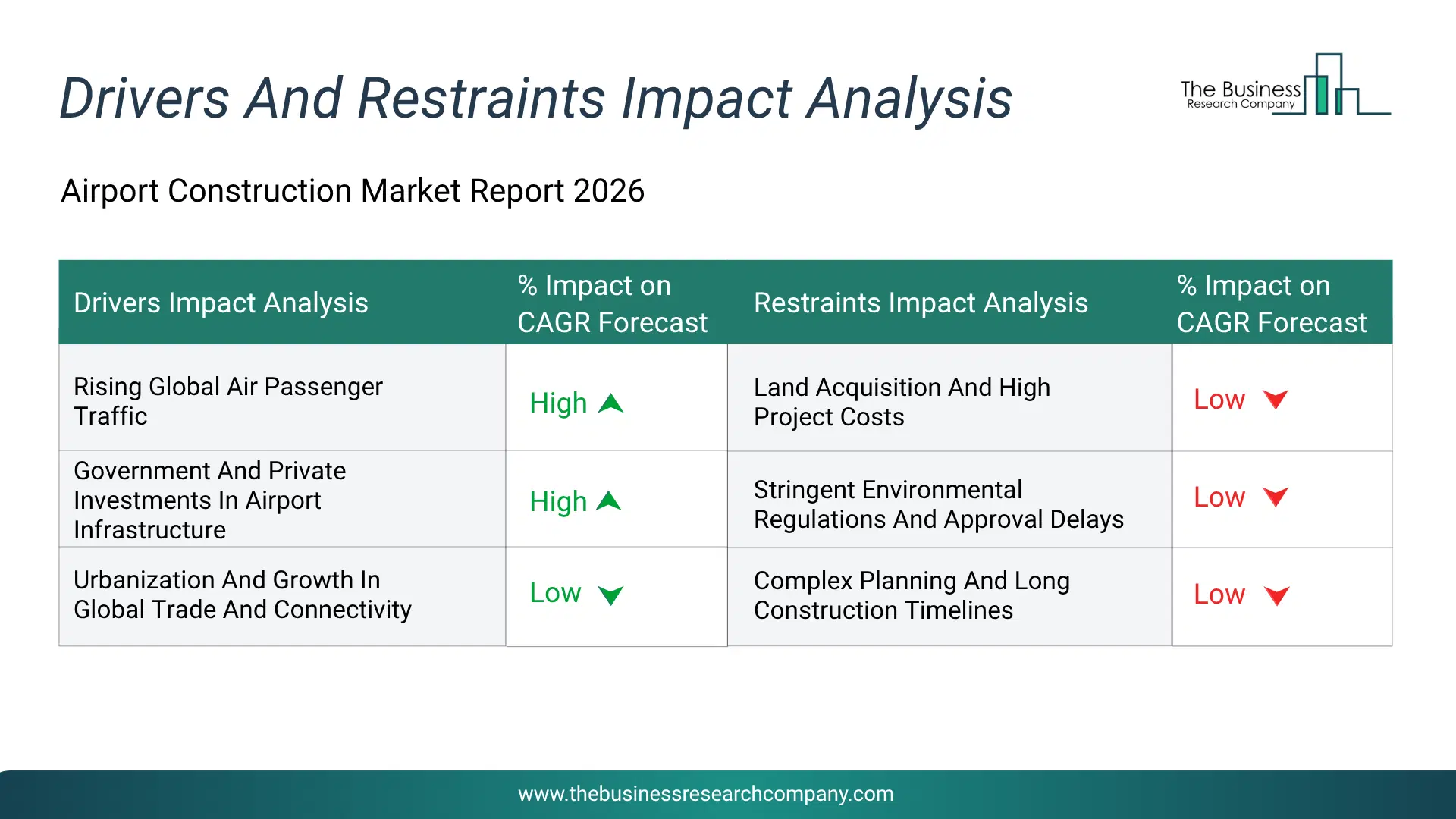
Infographic Chart Showing Key Market Drivers Analysis And Restraints For Airport Construction Market
The chart presents an impact analysis of key drivers and restraints, quantifying their relative influence on the market's growth rate and helping assess the balance between growth enablers and limiting factors. This chart offers a high-level perspective; the full report contains more detailed insights.
How Will The Drivers Impact Growth In The Global Airport Construction Market?
• Rising Global Air Passenger Traffic (High) – During the forecast period, the rising global air passenger traffic is expected to become a key growth driver for the airport construction market by 2030. Rising global air passenger traffic acts as a major driver for the airport construction market, as increasing travel demand puts pressure on existing airport infrastructure. Airports must expand terminals, runways, and support facilities to accommodate higher passenger volumes and avoid congestion. Governments and airport authorities invest in new construction and modernization projects to enhance capacity and improve passenger experience. Growing tourism, business travel, and low-cost carrier penetration further accelerate this demand. As a result, the continuous increase in air passenger traffic significantly drives airport construction activities. • Government And Private Investments In Airport Infrastructure (High) – During the forecast period, the government and private investments in airport infrastructure is expected to emerge as a major factor driving the expansion of the airport construction market by 2030. Government and private investments in airport infrastructure act as a major driver for the airport construction market, as increasing funding enables the development of new airports and expansion of existing facilities. Public-private partnerships and large-scale capital investments support modernization of terminals, runways, and air traffic systems. These investments are aimed at improving capacity, operational efficiency, and passenger experience. Additionally, growing economic development and connectivity goals encourage continuous infrastructure spending. As a result, rising investments from both public and private sectors significantly drive airport construction activities. • Urbanization And Growth In Global Trade And Connectivity (Low) – During the forecast period, the urbanization and growth in global trade and connectivity is expected to act as a key growth catalyst for the airport construction market by 2030. The urbanization and growth in global trade and connectivity act as a major driver for the airport construction market, as expanding urban populations increase demand for efficient air transport infrastructure. Rapid urban development leads to higher passenger movement and cargo traffic, requiring new airports and expansion of existing facilities. Growing international trade and business activities further strengthen the need for enhanced air connectivity between regions. Airports play a crucial role in supporting economic growth by enabling faster movement of goods and people. As a result, increasing urbanization and global connectivity significantly drive airport construction activities.How Will The Restraints Impact Growth In The Global Airport Construction Market?
• Land Acquisition And High Project Costs (High) – During the forecast period, the land acquisition and high project costs act as a major restraint on the airport construction market, as developing new airports or expanding existing ones requires large parcels of land, often in densely populated or high-value areas. Securing such land involves complex legal processes, compensation issues, and potential delays due to public opposition. Additionally, airport construction projects demand significant capital investment in infrastructure, materials, and advanced systems. These high costs can strain government budgets and deter private investors. As a result, land and cost-related challenges limit the pace and scale of airport construction projects. • Stringent Environmental Regulations And Approval Delays (High) – During the forecast period, the stringent environmental regulations and approval delays act as a significant restraint on the airport construction market, as projects must comply with strict environmental impact assessments and sustainability standards. Obtaining approvals from multiple regulatory bodies can be time-consuming and complex. These processes often involve detailed studies on noise pollution, emissions, and ecological impact, which can delay project initiation. Additionally, non-compliance risks legal penalties and project cancellations. As a result, regulatory hurdles and approval delays slow down the execution of airport construction projects. • Complex Planning And Long Construction Timelines (Low) – During the forecast period, the complex planning and long construction timelines act as a significant restraint on the airport construction market, as these projects require extensive design, feasibility studies, and coordination among multiple stakeholders. The involvement of regulatory bodies, contractors, and government agencies increases project complexity and decision-making time. Large-scale infrastructure development also involves phased execution, which can extend project duration over several years. Delays due to funding issues, approvals, or technical challenges further prolong completion timelines. As a result, lengthy planning and construction cycles can slow down market growth and delay returns on investment.Key Players In The Global Airport Construction Market
Major companies operating in the airport construction market are China State Construction Engineering Corporation, Actividades de Construcción y Servicios S.A, Vinci Construction, Hochtief AG, TAV Construction, Larsen & Toubro Limited, Bechtel Corporation, Turner Construction Company, Jacobs Engineering Group, Fluor Corporation, AECOM Technology Corporation, Balfour Beatty, Ferrovial SA, Skanska USA Inc., Gilbane Building Company, Hensel Phelps Construction Company, Amadeus It Group, PCL Constructors Inc., Parsons Corporation, McCarthy Holdings Inc., Granite Construction Inc., Mace Group, Austin Industries Inc., Shikun & Binui Ltd., Mott MacDonald, Walsh Group, Crossland Construction, GMR Group, Hill International Inc., GVK Industries Limited d/b/a., Bouygues Construction, SNC-Lavalin Group Inc., OHL Group, Kier Group plc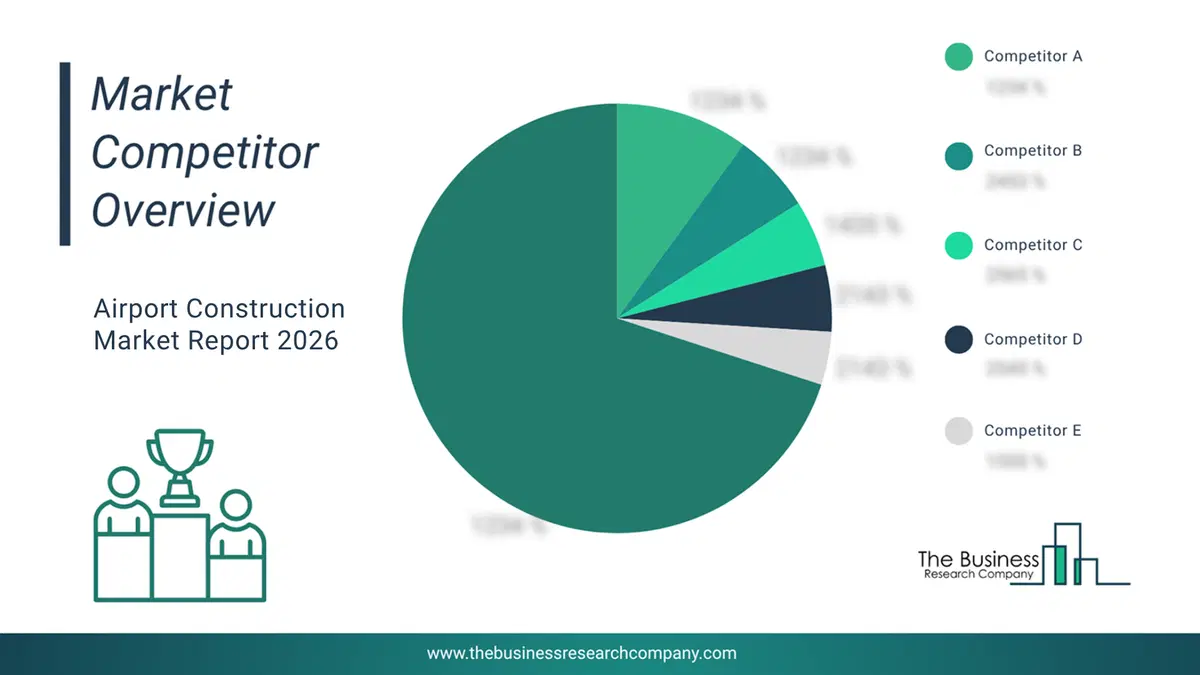
This chart is for illustrative purposes; the full report includes a detailed competitor analysis and comprehensive overview of the top 10 companies in the market.
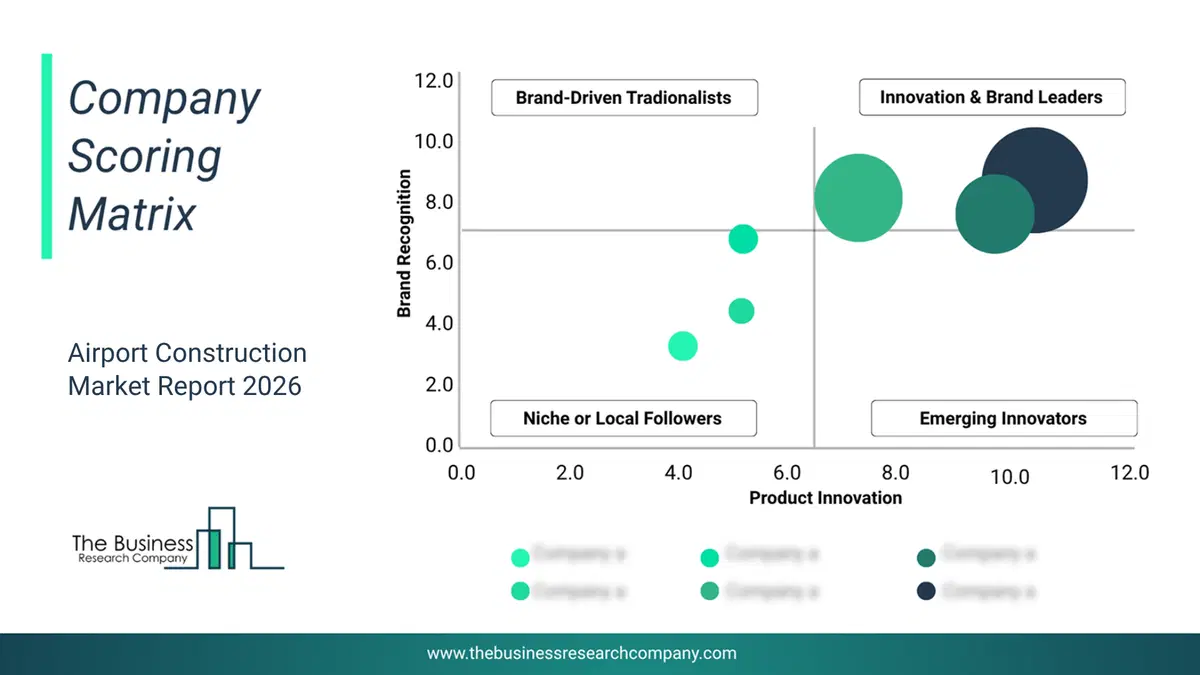
This chart maps companies by product innovation and brand strength, with bubble size indicating relative revenue, helping identify market leaders, challengers, and niche players. This is an illustrative chart; the full report provides a complete and accurate competitive analysis.
Global Airport Construction Market Trends and Insights
Major companies operating in the airport construction market are increasing their focus on introducing smart airport solutions to gain a competitive edge in the market. Smart airport solutions refer to advanced technologies and integrated systems that enhance efficiency, security, and the passenger experience in airports. For instance, in November 2023, Huawei Technologies Co. Ltd., a China-based technology company, launched a series of innovative smart airport solutions for international markets at the Airports Innovate Exhibition in Muscat, Oman. These solutions include the Fully Connected Fiber Network Solution, Smart Airport Perimeter Security with Fiber, Airport Cloud, and panoramic smart airport solutions. The solutions are designed to serve customers worldwide and improve their airport experience.What Are Latest Mergers And Acquisitions In The Airport Construction Market? Avialliance Acquired AGS Airports To Expand Its Global Airport Portfolio And Strengthen Regional Connectivity In The UK
In January 2025, AviAlliance, a Germany-based provider of airport investment and operations services, acquired AGS Airports for an enterprise value of £1.53 billion ($1.78 billion). With this acquisition, AviAlliance aimed to expand its global airport portfolio and enhance regional connectivity, passenger experience, and route development in the UK. AGS Airports is a UK-based provider of managed overall airport operations and infrastructure solutions.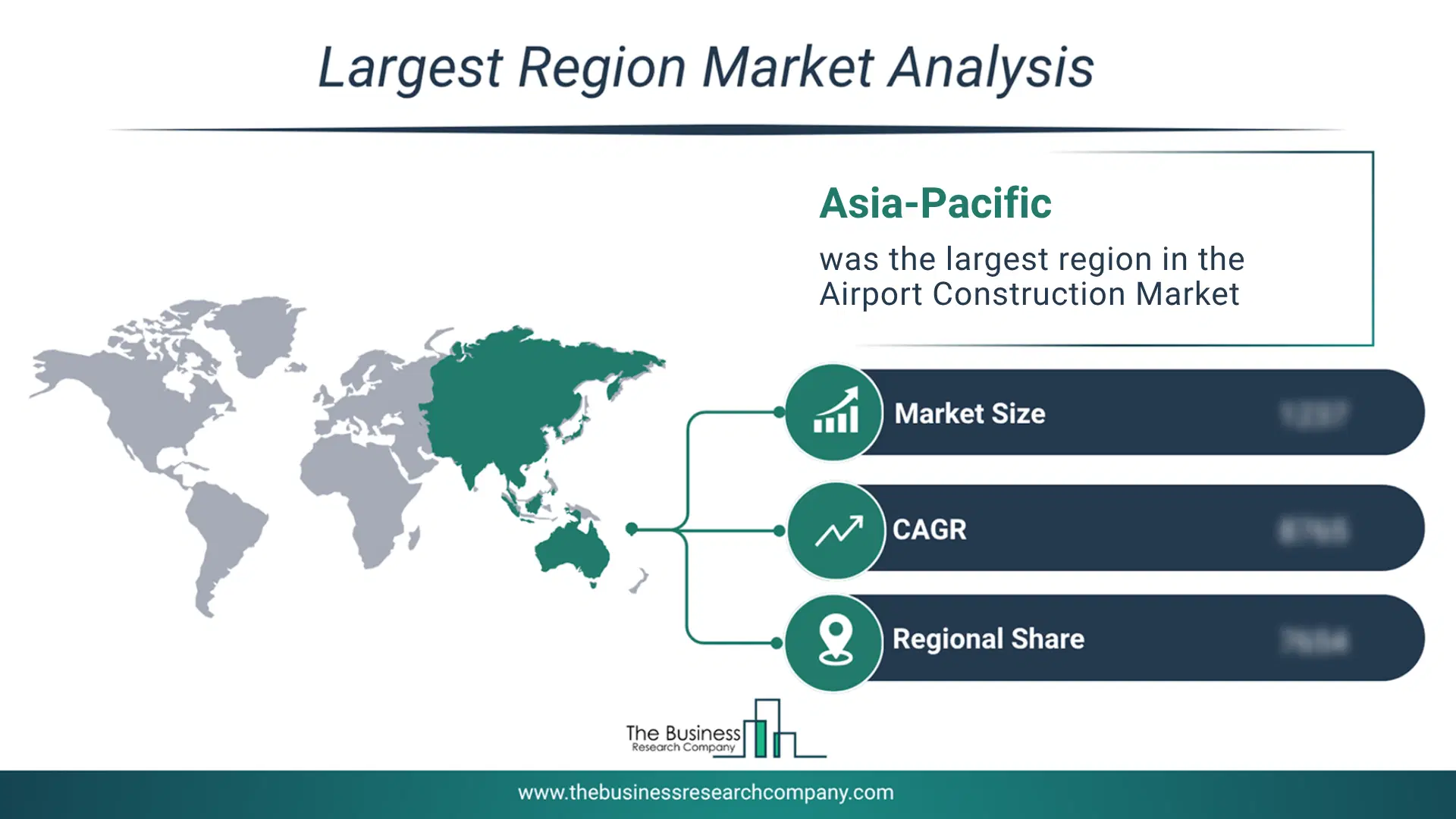
Regional Insights
Asia-Pacific was the largest region in the airport construction market in 2025. North America is expected to be the fastest growing region in the forecast period. The regions covered in the airport construction market report are Asia-Pacific, South East Asia, Western Europe, Eastern Europe, North America, South America, Middle East, Africa. The countries covered in the airport construction market report are Australia, Brazil, China, France, Germany, India, Indonesia, Japan, Taiwan, Russia, South Korea, UK, USA, Canada, Italy, SpainWhat Defines the Airport Construction Market?
The airport construction market includes revenues earned by entities through initiatives for the different structures, infrastructure, and facilities at the airport to be built, rebuilt, expanded, relocated, maintained, and repaired. The market value includes the value of related goods sold by the service provider or included within the service offering. Only goods and services traded between entities or sold to end consumers are included.How is Market Value Defined and Measured?
The market value is defined as the revenues that enterprises gain from the sale of goods and/or services within the specified market and geography through sales, grants, or donations in terms of the currency (in USD unless otherwise specified). The revenues for a specified geography are consumption values that are revenues generated by organizations in the specified geography within the market, irrespective of where they are produced. It does not include revenues from resales along the supply chain, either further along the supply chain or as part of other products.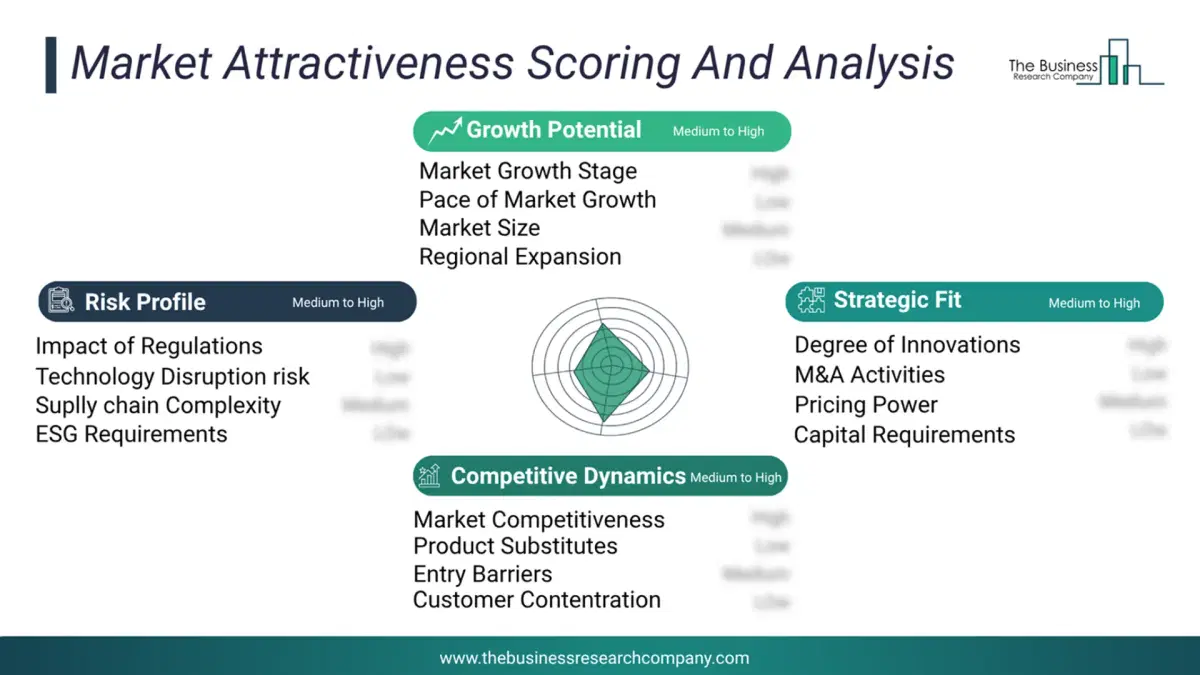
This chart presents market attractiveness based on a quantitative evaluation of growth, competition, strategic alignment, and risk, offering a clear view of opportunity areas for decision-making. This chart is for illustrative purposes; the full report contains the complete analysis.
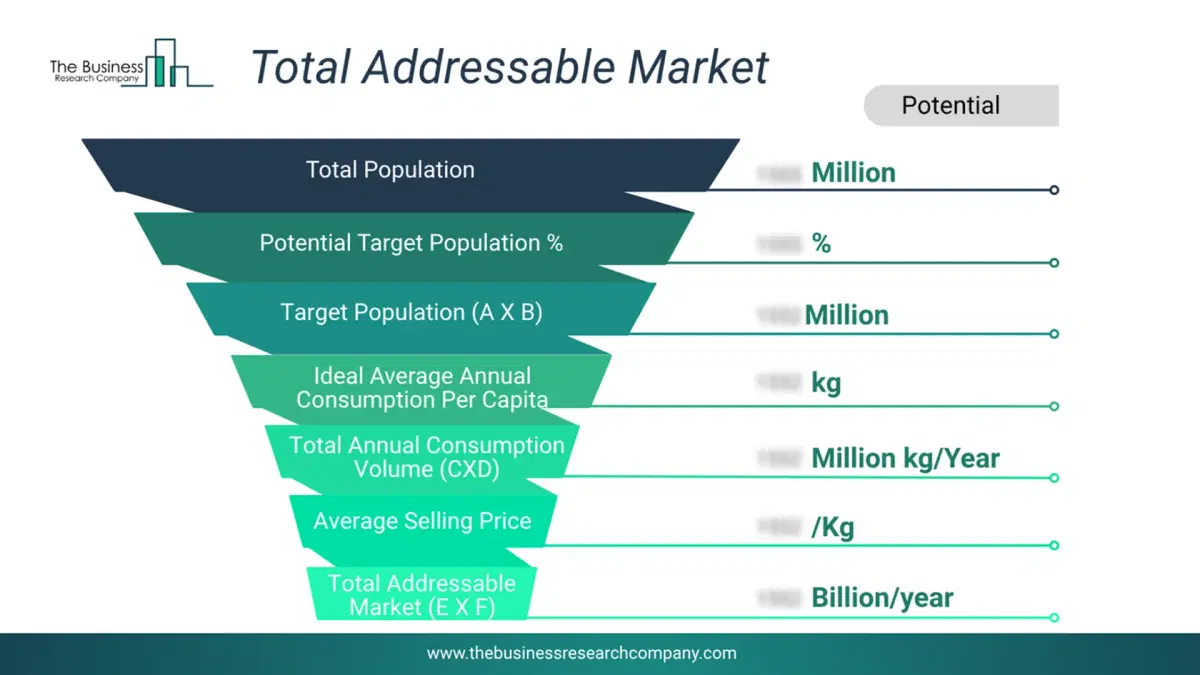
This chart highlights the Total Addressable Market (TAM) by estimating the maximum revenue opportunity using an assumption-driven approach, supporting strategic planning and opportunity sizing across markets. The chart is illustrative; the full report provides a more comprehensive analysis.
What Key Data and Analysis Are Included in the Airport Construction Market Report 2026?
The airport construction market research report is one of a series of new reports from The Business Research Company that provides market statistics, including industry global market size, regional shares, competitors with the market share, detailed market segments, market trends and opportunities, and any further data you may need to thrive in the airport construction industry. The market research report delivers a complete perspective of everything you need, with an in-depth analysis of the current and future state of the industry.Airport Construction Market Report Forecast Analysis
| Report Attribute | Details |
|---|---|
| Market Size Value In 2026 | $1254.8 billion |
| Revenue Forecast In 2030 | $1430.52 billion |
| Growth Rate | CAGR of 3.3% from 2026 to 2030 |
| Base Year For Estimation | 2025 |
| Actual Estimates/Historical Data | 2020-2025 |
| Forecast Period | 2026 - 2030 |
| Market Representation | Revenue in USD Billion and CAGR from 2026 to 2030 |
| Segments Covered | Technology, Location, Applications |
| Regional Scope | Asia-Pacific, Western Europe, Eastern Europe, North America, South America, Middle East, Africa |
| Country Scope | The countries covered in the report are Australia, Brazil, China, France, Germany, India, Indonesia, Japan, Taiwan, Russia, South Korea, UK, USA, Canada, Italy, Spain. |
| Key Companies Profiled | China State Construction Engineering Corporation, Actividades de Construcción y Servicios S.A, Vinci Construction, Hochtief AG, TAV Construction, Larsen & Toubro Limited, Bechtel Corporation, Turner Construction Company, Jacobs Engineering Group, Fluor Corporation, AECOM Technology Corporation, Balfour Beatty, Ferrovial SA, Skanska USA Inc., Gilbane Building Company, Hensel Phelps Construction Company, Amadeus It Group, PCL Constructors Inc., Parsons Corporation, McCarthy Holdings Inc., Granite Construction Inc., Mace Group, Austin Industries Inc., Shikun & Binui Ltd., Mott MacDonald, Walsh Group, Crossland Construction, GMR Group, Hill International Inc., GVK Industries Limited d/b/a., Bouygues Construction, SNC-Lavalin Group Inc., OHL Group, Kier Group plc |
| Customization Scope | Request for Customization |
| Pricing And Purchase Options | Explore Purchase Options |