
Application Modernization Services Market Report 2026
Global Outlook – By Type (Cobol, ADA, PL Or 1, RPG, Assembler, PowerBuilder, Others Types), By Cloud Deployment Mode (Private Cloud, Public Cloud, Hybrid Cloud), By Application (Post Modernization, Application Portfolio Assignment, UI Modernization, Cloud Application Mitigation, Application Integration, Application Re Platforming), By Vertical (BFSI, Healthcare And Life Sciences, Telecommunications, IT And ITeS, Retail And Consumer Goods, Government And Public Sector, Energy And Utilities, Manufacturing, Others Vertical) – Market Size, Trends, Strategies, and Forecast to 2030
Application Modernization Services Market Overview
• Application Modernization Services market size has reached to $24.39 billion in 2025 • Expected to grow to $60.95 billion in 2030 at a compound annual growth rate (CAGR) of 20.1% • Growth Driver: Cloud Computing's Surge Is Fueling Growth In The Application Modernization Services Market • Market Trend: IBM Revolutionizes Coding With Watsonx Code Assistant • North America was the largest region in 2025.Market Gains By 2030 – Top Opportunities By Segment
Market Gain identifies the most promising market opportunities by highlighting the segments or products expected to generate the highest incremental revenue growth over the next five years.
What Is Covered Under Application Modernization Services Market?
Application modernization refers to the technique of modernizing older software for newer computing methodologies. It helps in increasing agility and innovation, lowering costs and risks to streamline business and facilitate growth. The application modernization services are used to update older software that helps in developing new computing approaches, that includes newer languages, frameworks, and infrastructure platforms. The main types of application modernization services are COBOL, ADA, PL/1, RPG, assembler, power builder, and other types. COBOL is used to migrate COBOL applications in mass or stages to the target programming language and platform of preference. COBOL stands for Common Business-Oriented Language, a high-level programming language that uses the English language and is designed for business computer programs in industries such as finance and human resources The various cloud development modes are private cloud, public cloud, and hybrid cloud. The various applications are post-modernization, application portfolio assignment, UI modernization, cloud application mitigation, application integration, and application re-platforming. The various verticals are BFSI, healthcare, and life sciences, telecommunications, IT and ITeS, retail and consumer goods, government and public sector, energy and utilities, manufacturing, and other verticals.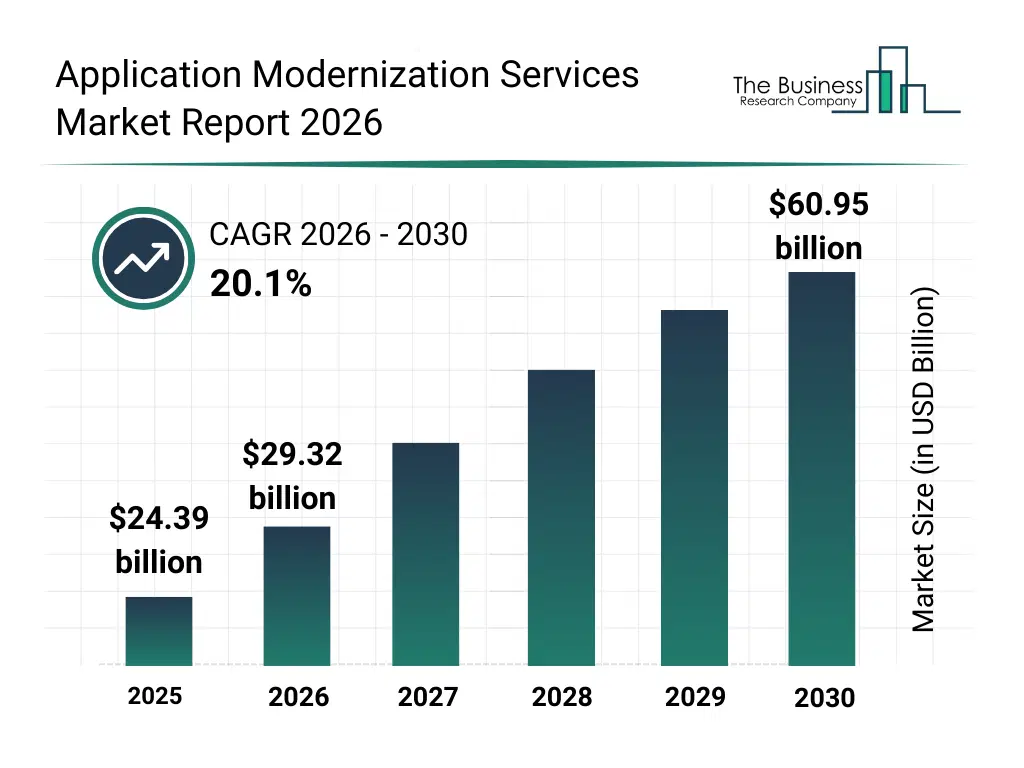
What Is The Application Modernization Services Market Size and Share 2026?
The application modernization services market size has grown exponentially in recent years. It will grow from $24.39 billion in 2025 to $29.32 billion in 2026 at a compound annual growth rate (CAGR) of 20.2%. The growth in the historic period can be attributed to increasing legacy system complexity, rising enterprise it modernization initiatives, expansion of enterprise software ecosystems, growing demand for operational agility, increasing reliance on mission-critical applications.What Is The Application Modernization Services Market Growth Forecast?
The application modernization services market size is expected to see exponential growth in the next few years. It will grow to $60.95 billion in 2030 at a compound annual growth rate (CAGR) of 20.1%. The growth in the forecast period can be attributed to increasing cloud migration investments, rising adoption of containerization technologies, expansion of hybrid cloud strategies, growing emphasis on application security modernization, increasing demand for continuous application innovation. Major trends in the forecast period include increasing adoption of cloud-native application architectures, rising demand for legacy application reengineering, growing use of microservices-based modernization, expansion of devops-driven modernization programs, enhanced focus on application scalability and resilience.
Global Application Modernization Services Market Segmentation
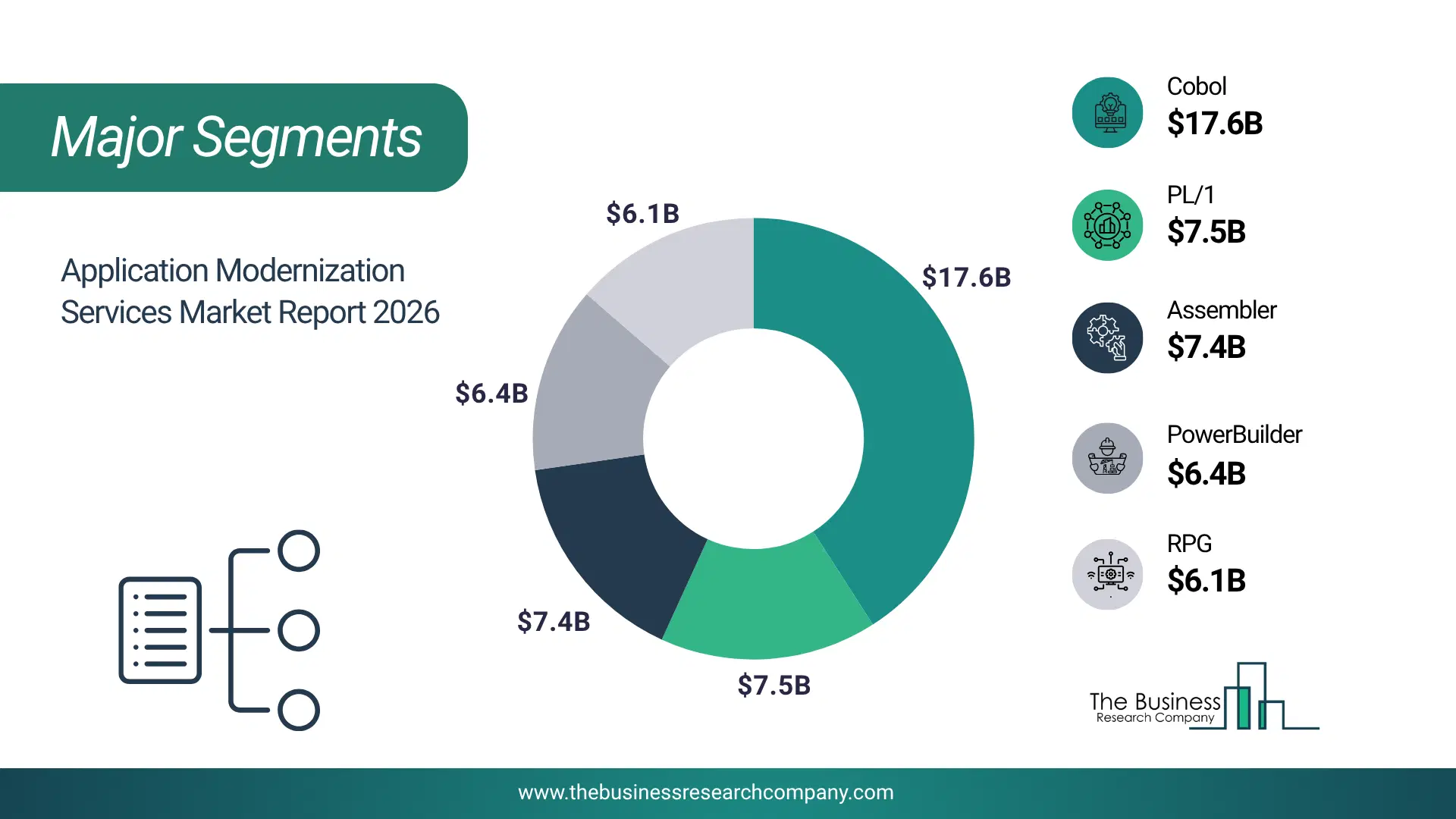
1) By Type: Cobol, ADA, PL Or 1, RPG, Assembler, PowerBuilder, Others Types 2) By Cloud Deployment Mode: Private Cloud, Public Cloud, Hybrid Cloud 3) By Application: Post Modernization, Application Portfolio Assignment, UI Modernization, Cloud Application Mitigation, Application Integration, Application Re Platforming 4) By Vertical: BFSI, Healthcare And Life Sciences, Telecommunications, IT And ITeS, Retail And Consumer Goods, Government And Public Sector, Energy And Utilities, Manufacturing, Others Vertical Subsegments: 1) By Cobol: Cobol To Java Migration, Cobol To.NET Migration 2) By ADA: ADA Code Conversion, ADA Integration Services 3) By PL Or 1: PL Or 1 Modernization, PLOr 1 To Java Migration 4) By RPG: RPG To Java Migration, RPG Web Enabling 5) By Assembler: Assembler Code Conversion, Assembler Modernization Solutions 6) By PowerBuilder: PowerBuilder Migration To Web, PowerBuilder Application Reengineering 7) By Other Types: Legacy Application Modernization, Database Modernization, Custom Application Development The top segments in the application modernization services market will be: • Cobol will reach $17.6 billion by 2030. • PL/1 will reach $7.5 billion by 2030. • Assembler will reach $7.32 billion by 2030. • PowerBuilder will reach $6.37 billion by 2030. • RPG will reach $6.02 billion by 2030.What Is The Driver Of The Application Modernization Services Market?
Increasing utilization of cloud computing is expected to drive the growth of the application modernization services market going forward. Cloud computing refers to the delivery of various computing services, including servers, storage, databases, networking, software, analytics, and more, over the internet. Cloud computing provides a scalable and flexible infrastructure, allowing businesses to easily scale their applications up or down based on demand. Application modernization services enable organizations to adapt their existing applications to leverage the scalability and flexibility offered by cloud platforms. For instance, in July 2024, according to CloudZero, a US-based cloud cost intelligence platform, more than 90% of organizations are utilizing cloud services, with approximately 67% operating in a public cloud environment and 45% using private clouds. Additionally, 48% of organizations plan to migrate at least half of their applications to the cloud within the next year, indicating a strong trend toward cloud adoption. Therefore, the increasing utilization of cloud computing is driving the growth of the application modernization services industry.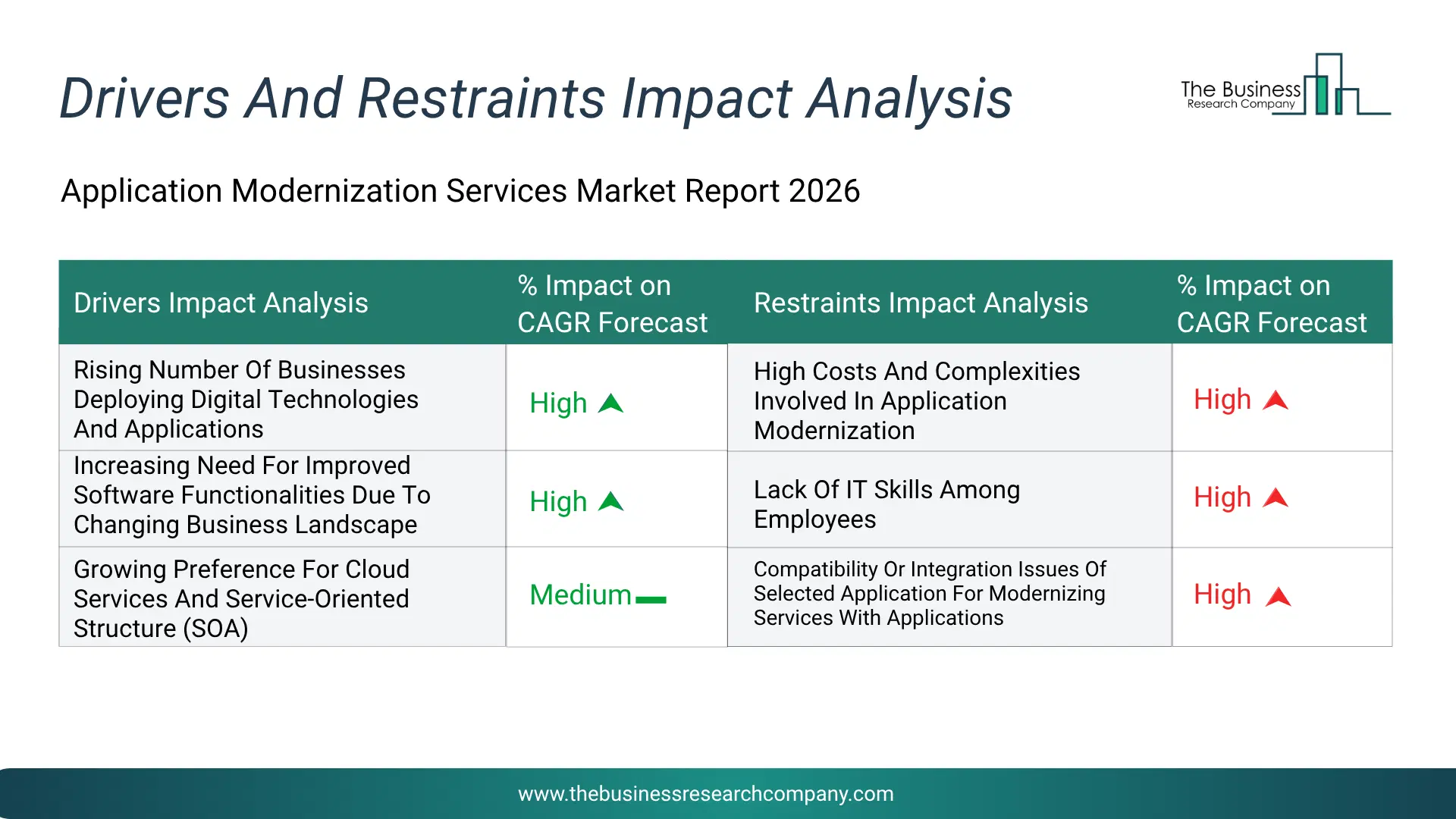
Infographic Chart Showing Key Market Drivers Analysis And Restraints For Application Modernization Services Market
The chart presents an impact analysis of key drivers and restraints, quantifying their relative influence on the market's growth rate and helping assess the balance between growth enablers and limiting factors. This chart offers a high-level perspective; the full report contains more detailed insights.
How Will The Drivers Impact Growth In The Global Application Modernization Services Market?
• Rising Number Of Businesses Deploying Digital Technologies And Applications (High) – During the forecast period, the rising adoption of digital technologies and applications is expected to be a key driver of the application modernization services market by 2030. As organizations increasingly implement cloud platforms, enterprise software, and data analytics solutions, the limitations of legacy systems become more pronounced, particularly in terms of integration, scalability, and real -time processing. Application modernization enables businesses to upgrade existing systems through rehosting, rearchitecting, or recoding, allowing them to align with modern digital environments without complete system replacement. This ensures business continuity while enhancing operational efficiency and performance. With enterprises accelerating digital transformation initiatives to remain competitive, demand for modernization services continues to grow. • Increasing Need For Improved Software Functionalities Due To Changing Business Landscape (High) – During the forecast period, the growing need for enhanced software functionalities driven by an evolving business landscape is anticipated to significantly support the application modernization services market by 2030. Rapid innovation, shifting customer expectations, and competitive pressures require agile and high-performing applications, which many legacy systems fail to deliver. Modernization services help organizations upgrade application capabilities by redesigning architectures, adopting modern programming languages, and integrating advanced frameworks. This results in improved performance, better user experience, and increased adaptability to changing business requirements. Additionally, modern systems support faster deployment cycles and more efficient updates. As businesses continue to evolve and demand more flexible software solutions, the need for modernization services rises steadily. • Growing Preference For Cloud Services And Service-Oriented Structure (SOA) (Medium) – During the forecast period, the increasing preference for cloud services and service-oriented architecture (soa) is set to be a major growth catalyst for the application modernization services market by 2030. Organizations are rapidly shifting from traditional on-premise infrastructure to cloud-based environments to achieve greater scalability, flexibility, and cost optimization. However, legacy applications often lack compatibility with cloud platforms and distributed architectures. Application modernization facilitates the transformation of these systems through approaches such as rehosting and rearchitecting, enabling seamless cloud migration and adoption of soa or microservices. This enhances system interoperability, simplifies integration, and improves overall operational efficiency. As enterprises continue to prioritize cloud adoption as part of their digital strategies, the demand for modernization services expands accordingly.How Will The Restraints Impact Growth In The Global Application Modernization Services Market?
• High Costs And Complexities Involved In Application Modernization (High) – During the forecast period, the high costs and technical complexities associated with application modernization act as a significant restraint for the application modernization services market. Modernizing legacy systems often requires substantial investment in new infrastructure, cloud platforms, development tools, and specialized consulting services. Organizations must allocate financial resources for planning, testing, migration, and deployment processes, which can increase the overall cost of modernization initiatives. Additionally, legacy systems are frequently built using outdated programming languages and architectures, making them difficult to modify or migrate to modern environments. The complexity of rehosting, rearchitecting, or recoding applications can require extensive analysis and redesign to ensure functionality and performance are maintained. These modernization processes may also involve long project timelines and potential operational disruptions. As a result, small and medium-sized enterprises with limited budgets may delay or avoid modernization projects. Even large enterprises may approach modernization gradually due to cost concerns and implementation risks. The uncertainty regarding return on investment can further discourage organizations from initiating modernization initiatives. Consequently, high implementation costs and technical complexities slow the adoption of application modernization services across various industries. • Lack Of IT Skills Among Employees (High) – During the forecast period, the the shortage of skilled it professionals capable of managing modernization projects limits the growth of the application modernization services market. Application modernization requires expertise in modern programming languages, cloud computing, containerization, microservices architecture, and devops practices. However, many organizations still rely on employees who are primarily experienced in maintaining legacy systems rather than transforming them into modern architectures. The transition from traditional systems to cloud-native platforms requires specialized knowledge that is not always readily available within existing it teams. Training employees to acquire these skills can be time-consuming and expensive, further delaying modernization initiatives. In some cases, organizations must rely heavily on external service providers to handle modernization projects, which increases dependency and project costs. Additionally, the global shortage of cloud architects, devops engineers, and modernization specialists creates talent gaps in the market. Without adequate technical expertise, organizations may struggle to plan, execute, and maintain modernization projects effectively. This skills shortage slows down adoption rates and reduces the pace at which enterprises modernize their legacy applications. • Compatibility Or Integration Issues Of Selected Application For Modernizing Services With Applications (High) – During the forecast period, the compatibility and integration challenges between modernized applications and existing systems also restrain the growth of the application modernization services market. Many organizations operate complex it environments where legacy applications interact with multiple databases, middleware systems, and third-party platforms. When modernizing an application through rehosting, rearchitecting, or recoding, maintaining seamless communication with these existing systems becomes technically challenging. Differences in programming languages, data formats, and system architectures can create integration difficulties. Organizations must ensure that modernized applications remain compatible with current business processes and enterprise systems to avoid operational disruptions. Testing and validating these integrations often require additional time and resources. In some cases, modernization efforts may expose hidden dependencies or outdated components that must also be upgraded, increasing project complexity. If integration issues are not resolved effectively, system performance and data flow may be affected. These risks make some organizations hesitant to initiate modernization projects. As a result, compatibility and integration concerns can slow decision-making and limit the adoption of application modernization services.Key Players In The Global Application Modernization Services Market
Major companies operating in the application modernization services market are Accenture PLC; Aspire Systems Inc.; Asysco Inc.; Bell Integrator Inc.; Blu Age Corp.; Capgemini SE; Cognizant Technology Solutions Corporation; DXC Technology Company; EPAM Systems Inc.; HCL Technologies Limited; Hexaware Technologies Limited; IBM Corporation; Infosys Limited; Micro Focus International PLC; Modern Systems Inc.; Tata Consultancy Services Limited; Tech Mahindra Limited; The Software Revolution Inc.; Wipro Limited; Atos Information Technology Incorporated; Deloitte Touche Tohmatsu LLC; Cuelogic Technologies Pvt. Ltd.; Mindtree Consulting Private Limited; Larsen & Toubro Infotech Ltd.; Virtusa Consulting Services Private Limited; Trianz Holdings Private Limited; Persistent Systems and Solutions Limited; Sonata Software Ltd.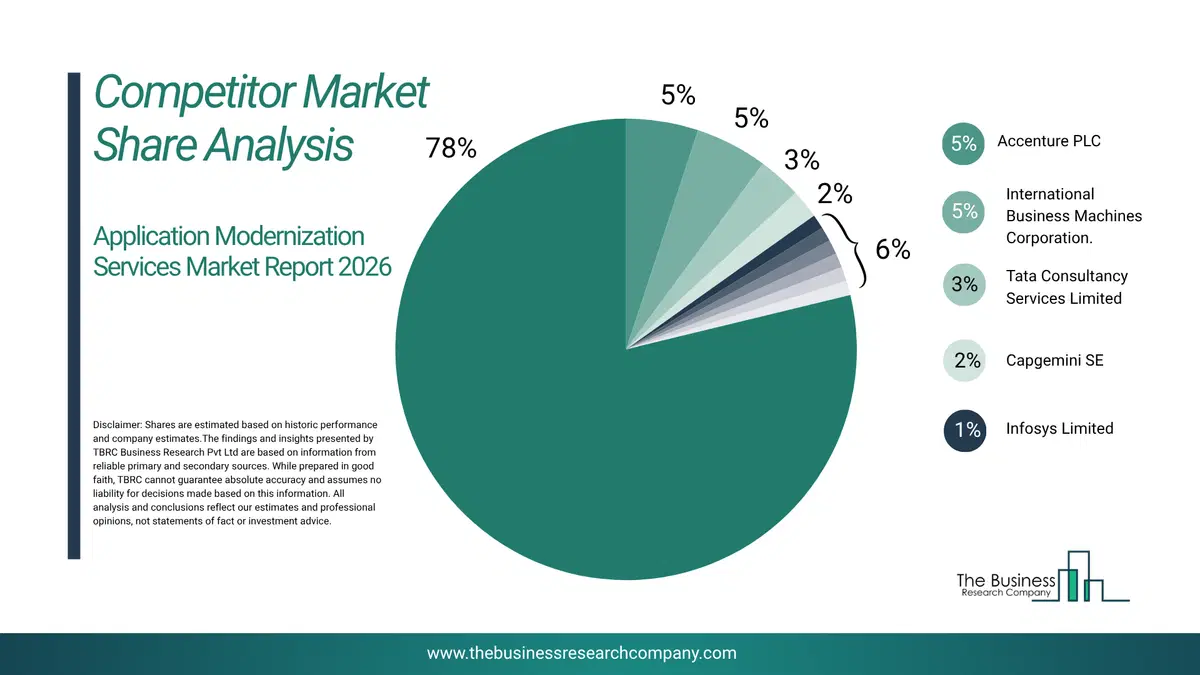
This chart is for illustrative purposes; the full report includes a detailed competitor analysis and comprehensive overview of the top 10 companies in the market.
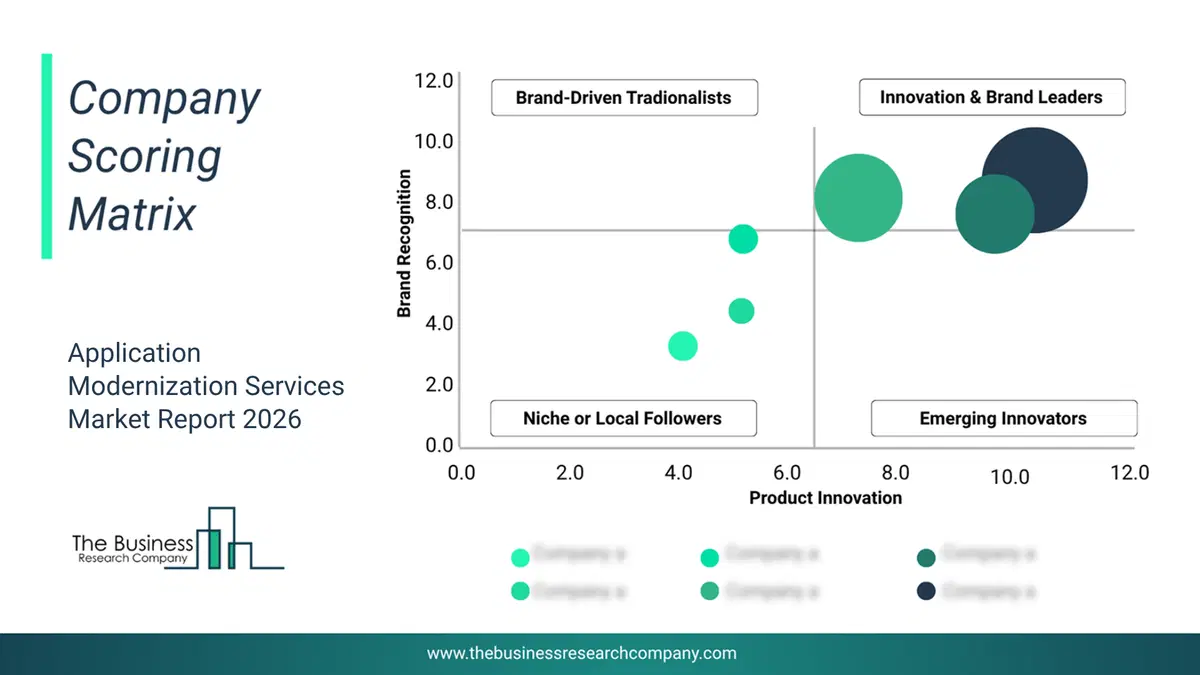
This chart maps companies by product innovation and brand strength, with bubble size indicating relative revenue, helping identify market leaders, challengers, and niche players. This is an illustrative chart; the full report provides a complete and accurate competitive analysis.
Global Application Modernization Services Market Trends and Insights
Major companies operating in the application modernization services market are focusing on product developments, such as AI-powered assistants, to sustain their position in the market. AI-powered assistants enterprise coding assistant refers to software tools that use artificial intelligence to help developers write code faster and more accurately. For instance, in October 2023, International Business Machines Corporation, a US-based multinational technology and consulting company, introduced Watsonx Code Assistant, a cutting-edge generative AI-powered assistant designed to assist enterprise developers and information technology (IT) operators in coding more efficiently and accurately. This innovative tool utilizes natural language prompts to streamline coding processes. Currently catering to two key enterprise use cases, it offers IT automation through Watsonx Code Assistant for Red Hat Ansible Lightspeed, facilitating tasks like network configuration and code deployment. Additionally, it addresses mainframe application modernization with Watsonx Code Assistant for Z, enabling the translation of COBOL to Java. In essence, IBM's Watsonx Code Assistant aims to enhance coding productivity by leveraging the power of artificial intelligence to understand and respond to natural language queries, thereby simplifying complex coding tasks for enterprise users.What Are Latest Mergers And Acquisitions In The Application Modernization Services Market?
In May 2024, Rocket Software, a US-based software company, acquired OpenText's application modernization and connectivity (AMC) business for $2.275 billion. The acquisition enhances Rocket Software's capabilities in mainframe modernization, providing industry-leading tools for legacy system updates and positioning the company as a key player in facilitating transitions to hybrid cloud environments. OpenText, a US-based software company, offers a variety of strategies for application modernization, including platform upgrades, user experience enhancements, and operational optimizations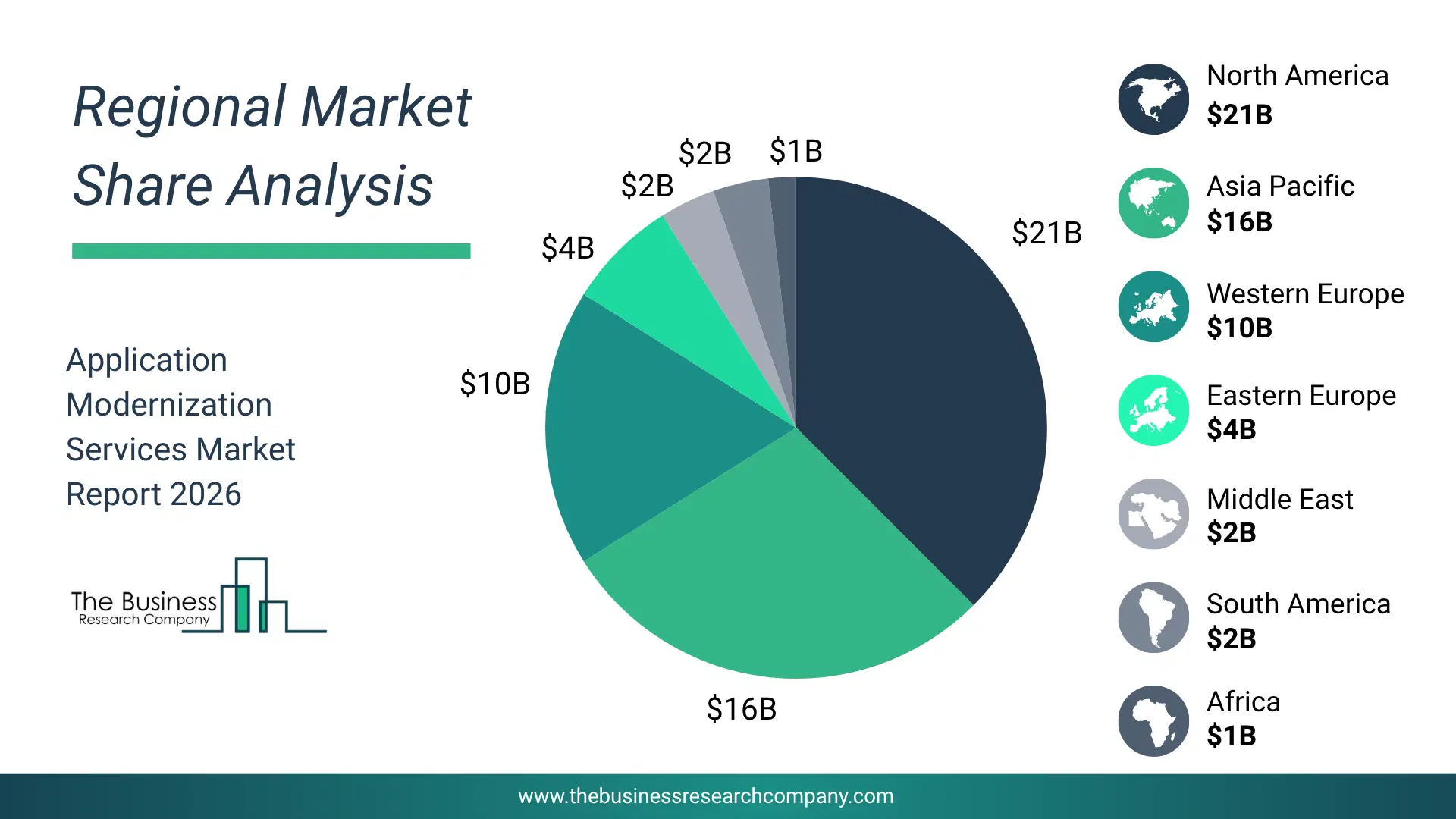
Regional Insights
North America was the largest region in the application modernization services market in 2025. The regions covered in this market report are Asia-Pacific, South East Asia, Western Europe, Eastern Europe, North America, South America, Middle East, Africa. The countries covered in this market report are Australia, Brazil, China, France, Germany, India, Indonesia, Japan, Taiwan, Russia, South Korea, UK, USA, Canada, Italy, SpainWhat Defines the Application Modernization Services Market?
The application modernization services market includes revenues earned by entities by providing rehosting, rearchitecting and recoding application modernization services. The market value includes the value of related goods sold by the service provider or included within the service offering. Only goods and services traded between entities or sold to end consumers are included.How is Market Value Defined and Measured?
The market value is defined as the revenues that enterprises gain from the sale of goods and/or services within the specified market and geography through sales, grants, or donations in terms of the currency (in USD unless otherwise specified). The revenues for a specified geography are consumption values that are revenues generated by organizations in the specified geography within the market, irrespective of where they are produced. It does not include revenues from resales along the supply chain, either further along the supply chain or as part of other products.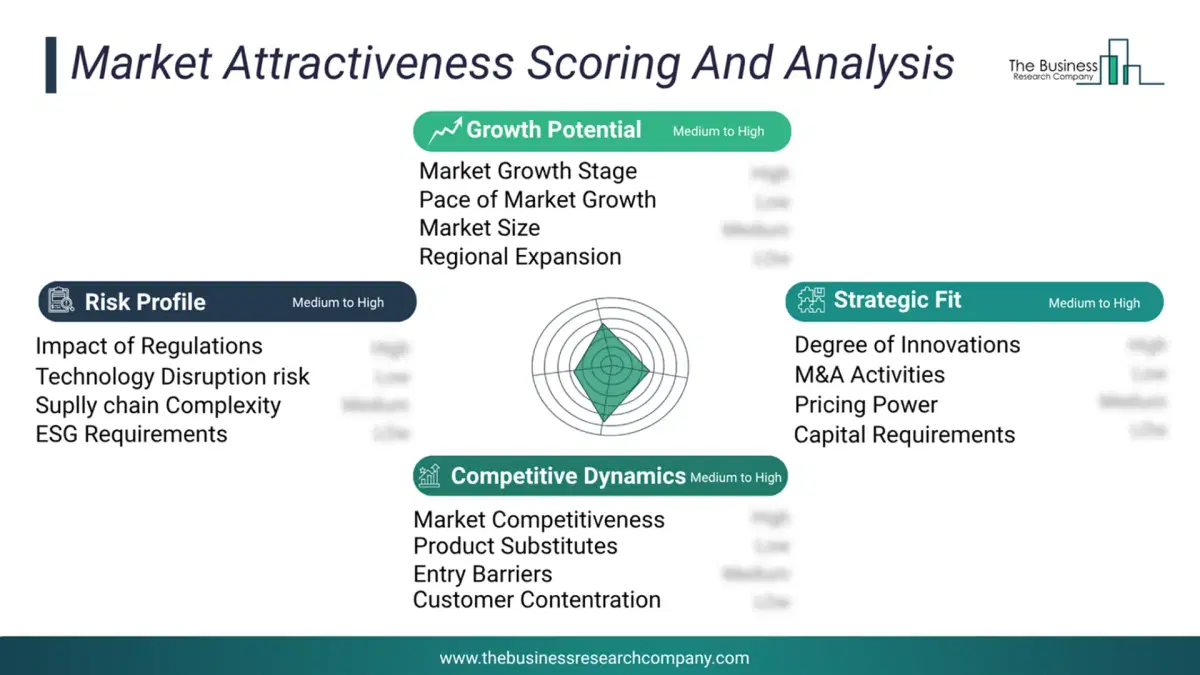
This chart presents market attractiveness based on a quantitative evaluation of growth, competition, strategic alignment, and risk, offering a clear view of opportunity areas for decision-making. This chart is for illustrative purposes; the full report contains the complete analysis.
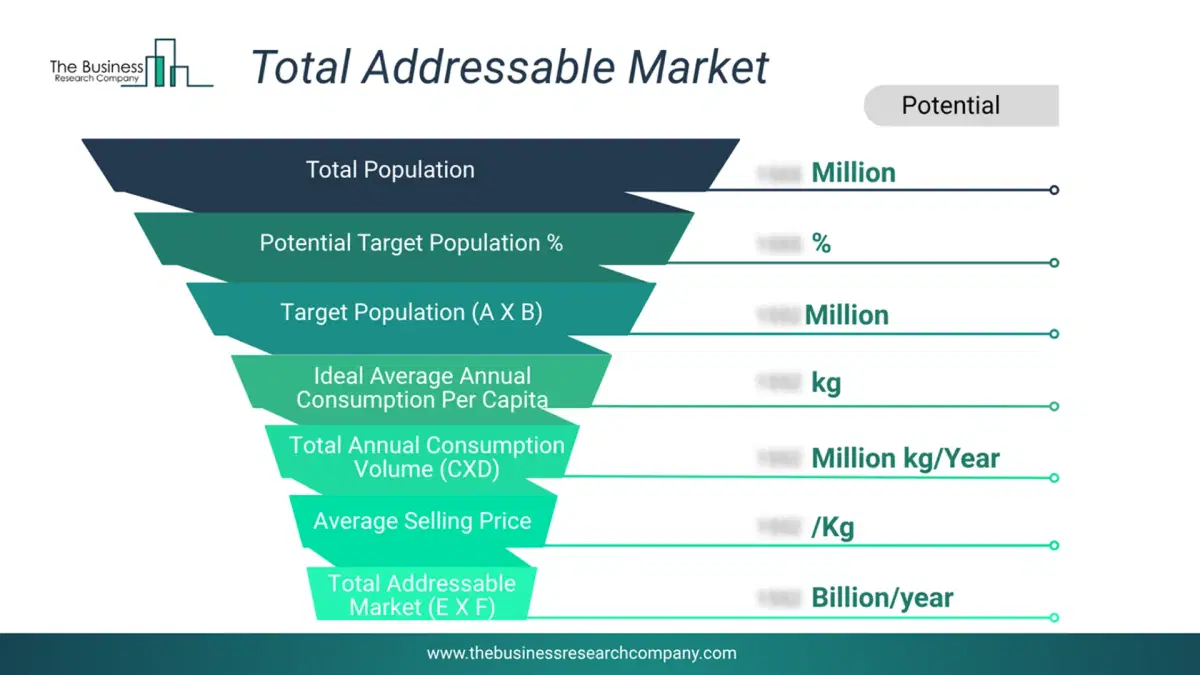
This chart highlights the Total Addressable Market (TAM) by estimating the maximum revenue opportunity using an assumption-driven approach, supporting strategic planning and opportunity sizing across markets. The chart is illustrative; the full report provides a more comprehensive analysis.
What Key Data and Analysis Are Included in the Application Modernization Services Market Report 2026?
The application modernization services market research report is one of a series of new reports from The Business Research Company that provides market statistics, including industry global market size, regional shares, competitors with the market share, detailed market segments, market trends and opportunities, and any further data you may need to thrive in the application modernization services industry. The market research report delivers a complete perspective of everything you need, with an in-depth analysis of the current and future state of the industry.Application Modernization Services Market Report Forecast Analysis
| Report Attribute | Details |
|---|---|
| Market Size Value In 2026 | $29.32 billion |
| Revenue Forecast In 2030 | $60.95 billion |
| Growth Rate | CAGR of 20.1% from 2026 to 2030 |
| Base Year For Estimation | 2025 |
| Actual Estimates/Historical Data | 2020-2025 |
| Forecast Period | 2026 - 2030 |
| Market Representation | Revenue in USD Billion and CAGR from 2026 to 2030 |
| Segments Covered | Type, Cloud Deployment Mode, Application, Vertical |
| Regional Scope | Asia-Pacific, Western Europe, Eastern Europe, North America, South America, Middle East, Africa |
| Country Scope | The countries covered in the report are Australia, Brazil, China, France, Germany, India, ... |
| Key Companies Profiled | Accenture PLC; Aspire Systems Inc.; Asysco Inc.; Bell Integrator Inc.; Blu Age Corp.; Capgemini SE; Cognizant Technology Solutions Corporation; DXC Technology Company; EPAM Systems Inc.; HCL Technologies Limited; Hexaware Technologies Limited; IBM Corporation; Infosys Limited; Micro Focus International PLC; Modern Systems Inc.; Tata Consultancy Services Limited; Tech Mahindra Limited; The Software Revolution Inc.; Wipro Limited; Atos Information Technology Incorporated; Deloitte Touche Tohmatsu LLC; Cuelogic Technologies Pvt. Ltd.; Mindtree Consulting Private Limited; Larsen & Toubro Infotech Ltd.; Virtusa Consulting Services Private Limited; Trianz Holdings Private Limited; Persistent Systems and Solutions Limited; Sonata Software Ltd. |
| Customization Scope | Request for Customization |
| Pricing And Purchase Options | Explore Purchase Options |