
Artificial Intelligence (AI) In Games Market Report 2026
Global Outlook – By Component (Software, Hardware), By Technology (Machine Learning, Natural Language Processing, Computer Vision, Gesture Control, Other Technologies), By Genre (Action, Adventure, Puzzle, Simulation, Role-Playing, Other Genres), By Application (PC Gaming, TV Gaming, Smartphone And Tablet Gaming) – Market Size, Trends, Strategies, and Forecast to 2030
Artificial Intelligence (AI) In Games Market Overview
• Artificial Intelligence (AI) In Games market size has reached to $2.87 billion in 2025 • Expected to grow to $6.73 billion in 2030 at a compound annual growth rate (CAGR) of 18.6% • Growth Driver: Mobile And Online Gaming Driving Growth Of Artificial Intelligence (AI) In Games Market • Market Trend: Leading Companies Innovate AI-Powered NPCs For Enhanced Gaming Experiences • North America was the largest region in 2025 and Europe is the fastest growing region.Market Gains By 2030 – Top Opportunities By Segment
Market Gain identifies the most promising market opportunities by highlighting the segments or products expected to generate the highest incremental revenue growth over the next five years.
What Is Covered Under Artificial Intelligence (AI) In Games Market?
Artificial intelligence (AI) in games refers to the integration of intelligent algorithms and computing systems that simulate human-like behaviors, decision-making, and learning processes to enhance the gaming experience, adapt to player actions, and create dynamic and challenging gameplay scenarios. The main components of artificial intelligence (AI) in games are software and hardware. Software components in artificial intelligence for games act as building blocks or tools that utilize artificial intelligence to improve different aspects of video game development. The technology category includes machine learning, natural language processing, computer vision, gesture control, and others for genre types such as action, adventure, puzzles, simulation, role-playing, and others used in several applications categorized into PC gaming, TV gaming, smartphone gaming, and tablet gaming.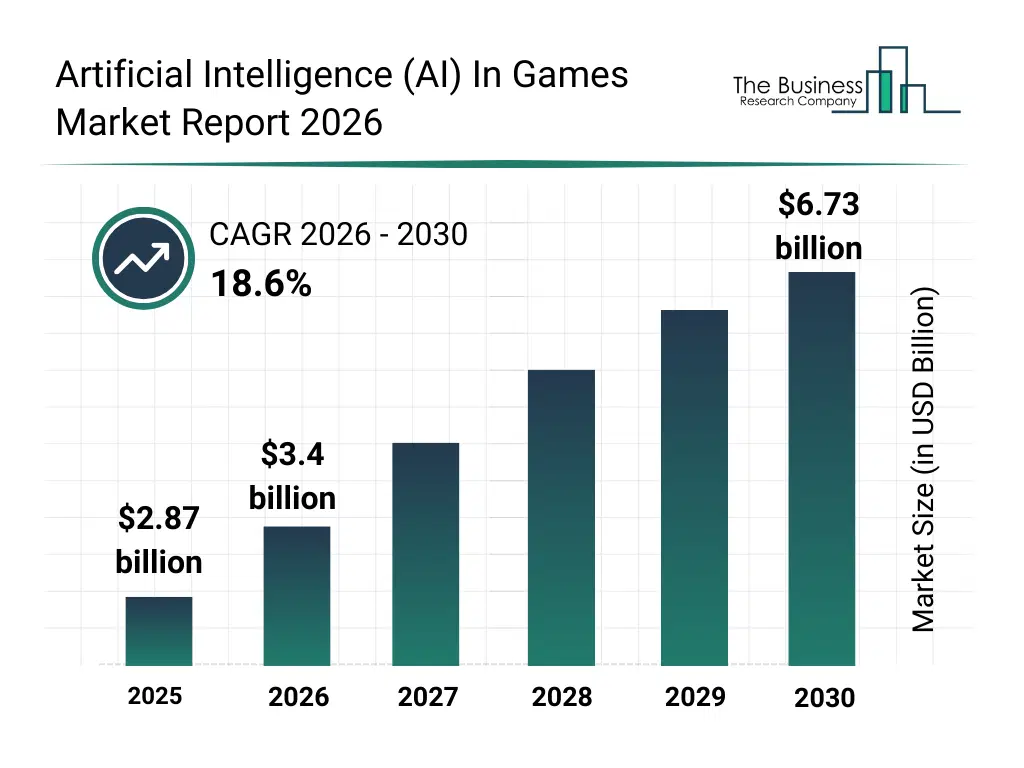
What Is The Artificial Intelligence (AI) In Games Market Size and Share 2026?
The artificial intelligence (AI) in games market size has grown rapidly in recent years. It will grow from $2.87 billion in 2025 to $3.4 billion in 2026 at a compound annual growth rate (CAGR) of 18.5%. The growth in the historic period can be attributed to growth of pc and console gaming, increasing adoption of AI in gaming, demand for immersive player experiences, advancements in machine learning algorithms, rise of online multiplayer games.What Is The Artificial Intelligence (AI) In Games Market Growth Forecast?
The artificial intelligence (AI) in games market size is expected to see rapid growth in the next few years. It will grow to $6.73 billion in 2030 at a compound annual growth rate (CAGR) of 18.6%. The growth in the forecast period can be attributed to integration of AI with ar/xr technologies, expansion of cloud gaming platforms, demand for personalized gaming experiences, adoption of procedural content generation techniques, use of AI for player retention and engagement. Major trends in the forecast period include ai-powered non-player character (npc) behavior, procedural content generation, dynamic difficulty adjustment, real-time player analytics, adaptive game storylines.
Global Artificial Intelligence (AI) In Games Market Segmentation
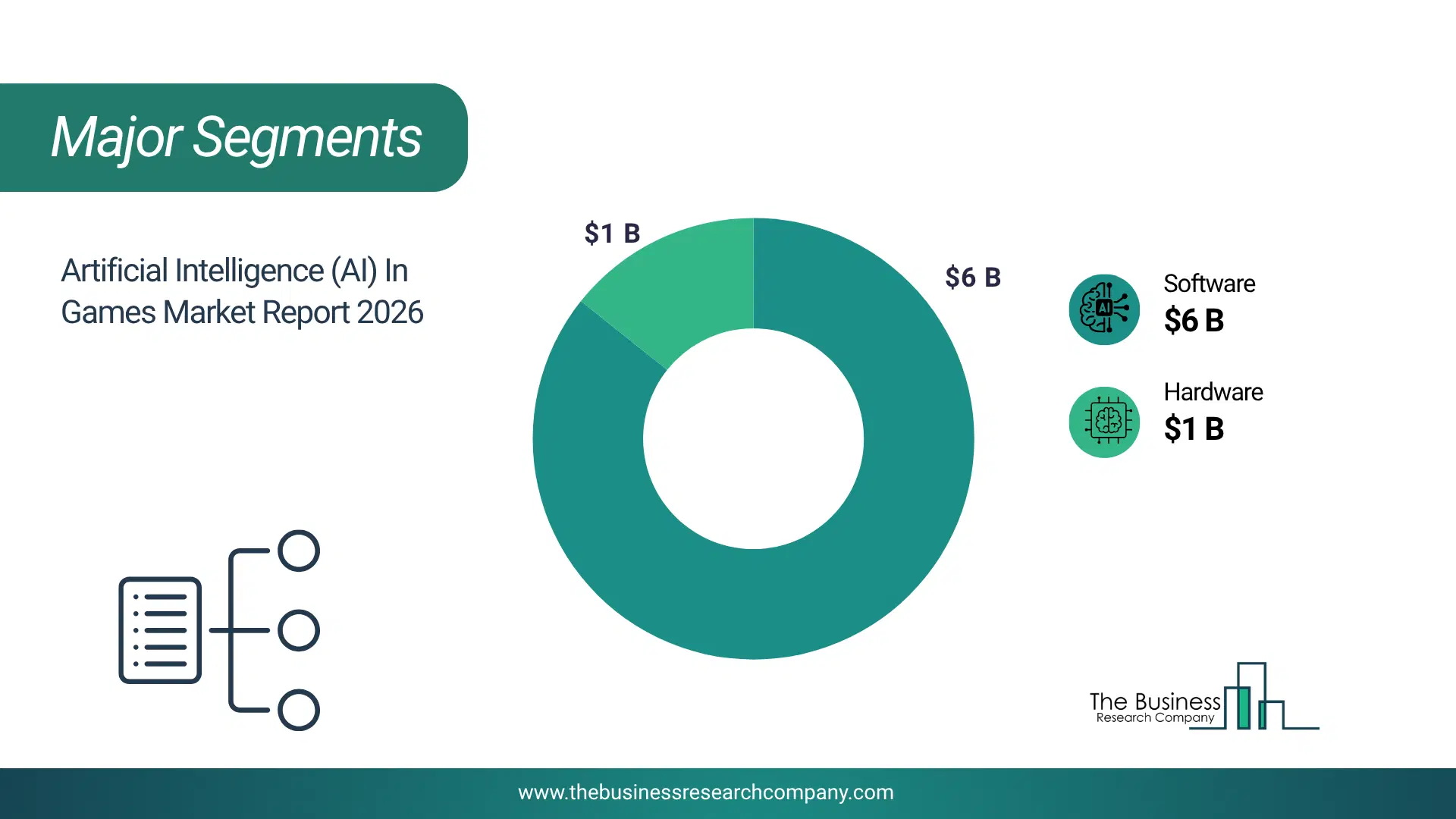
1) By Component: Software, Hardware 2) By Technology: Machine Learning, Natural Language Processing, Computer Vision, Gesture Control, Other Technologies 3) By Genre: Action, Adventure, Puzzle, Simulation, Role-Playing, Other Genres 4) By Application: PC Gaming, TV Gaming, Smartphone And Tablet Gaming Subsegments: 1) By Software: Game AI Engines, Machine Learning Algorithms, Natural Language Processing (NLP) Tools, Physics Simulation Software 2) By Hardware: Graphics Processing Units (GPUs), Central Processing Units (CPUs), Game Consoles, Cloud Computing Infrastructure The top segments in the artificial intelligence (ai) in games market will be: • Software will reach $5.95 Billion by 2030. • Hardware will reach $1.3 Billion by 2030.What Is The Driver Of The Artificial Intelligence (AI) In Games Market?
The growing popularity of mobile and online gaming is expected to propel the growth of artificial intelligence (AI) in the games market going forward. Mobile and online gaming refers to the playing of video games on mobile devices such as smartphones and tablets, as well as through online platforms. Developers constantly push boundaries with innovative game designs, storytelling, and immersive graphics, capturing the interest of players and making them more accessible to a broader audience. AI development in games provides vast datasets for training algorithms, enabling AI systems to learn and improve through interactions with diverse player behaviors and preferences. For instance, in July 2023, according to the London Economic, a UK-based non-governmental organization, the number of active online gamblers in the UK rose to 24.7 million, a 6.2% increase from the previous year. In 2023, the online gambling sector achieved record revenues of $6.75 billion (£5.4 billion). Therefore, the growing popularity of mobile and online gaming experiences is driving the growth of artificial intelligence (AI) in the games market.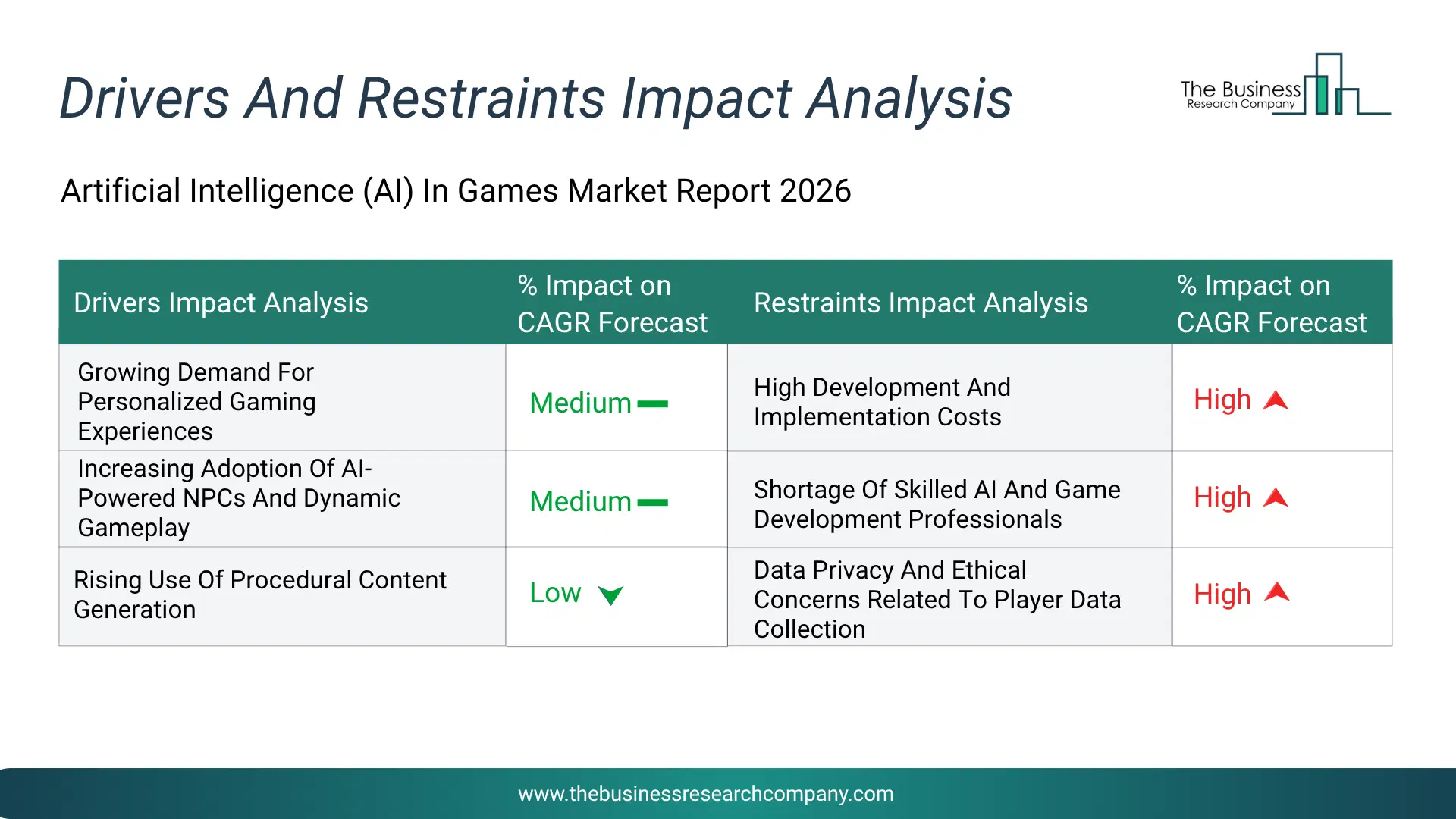
Infographic Chart Showing Key Market Drivers Analysis And Restraints For Artificial Intelligence (Ai) In Games Market
The chart presents an impact analysis of key drivers and restraints, quantifying their relative influence on the market's growth rate and helping assess the balance between growth enablers and limiting factors. This chart offers a high-level perspective; the full report contains more detailed insights.
How Will The Drivers Impact Growth In The Global Artificial Intelligence (AI) In Games Market?
• Growing Demand For Personalized Gaming Experiences (Medium) – During the forecast period, the growing demand for personalized gaming experiences is expected to become a key growth driver for the artificial intelligence (AI) in games market by 2030. Game developers are increasingly leveraging AI to analyze player preferences, behavior, and skill levels to deliver customized gameplay experiences. Personalized recommendations, adaptive difficulty settings, and tailored story progression enhance player engagement and long-term retention. As gaming platforms compete to improve user satisfaction and maximize player lifetime value, investments in AI-powered personalization technologies continue to expand. • Increasing Adoption Of AI-Powered NPCs And Dynamic Gameplay (Medium) – During the forecast period, the increasing adoption of AI-powered NPCs and dynamic gameplay is expected to emerge as a major factor driving the expansion of the artificial intelligence (AI) in games market by 2030. Intelligent NPCs capable of responding to player actions and adapting their behavior create more immersive and realistic gaming environments. AI also enables dynamic game mechanics that modify scenarios, challenges, and interactions in real time based on player decisions. Growing demand for highly interactive and engaging gameplay experiences is encouraging developers to integrate advanced AI capabilities into modern game titles. • Rising Use Of Procedural Content Generation (Low) – During the forecast period, the rising use of procedural content generation is expected to act as a key growth catalyst for the artificial intelligence (AI) in games market by 2030. AI-driven content generation technologies enable developers to automatically create game environments, characters, missions, and story elements with greater speed and efficiency. These capabilities reduce development time while supporting continuous content updates and virtually unlimited gameplay possibilities. As studios seek to improve production efficiency and deliver fresh gaming experiences, the adoption of AI-powered procedural generation tools is expected to accelerate.How Will The Restraints Impact Growth In The Global Artificial Intelligence (AI) In Games Market?
• High Development And Implementation Costs (Medium) – During the forecast period, the adoption of AI in games requires substantial investment in software development, computing infrastructure, data processing capabilities, and ongoing system maintenance. Game developers must spend heavily on creating intelligent NPCs, procedural content generation systems, player behavior analytics tools, and advanced anti-cheat solutions. Training and testing AI models also require significant computational resources, increasing operational expenses. Small and mid-sized game studios often face budget limitations that make it difficult to implement advanced AI features at scale. In addition, integrating AI into existing game engines and ensuring smooth performance across different platforms can further raise development costs. As a result, many developers delay or limit AI adoption, which slows the overall growth of the artificial intelligence in games market. • Shortage Of Skilled AI And Game Development Professionals (Medium) – During the forecast period, the successful implementation of AI in games depends on professionals who possess expertise in both artificial intelligence technologies and game development processes. However, there is a limited supply of skilled talent capable of designing machine learning models, developing intelligent game mechanics, and optimizing AI-driven player experiences. The increasing demand for AI specialists across industries such as healthcare, finance, and technology has intensified competition for qualified professionals. This talent shortage raises hiring costs and extends development timelines for gaming companies. Smaller studios are particularly affected because they often lack the resources to attract highly skilled AI engineers. As a result, many game developers face challenges in deploying advanced AI capabilities, restricting innovation and slowing the expansion of the artificial intelligence in games market. • Data Privacy And Ethical Concerns Related To Player Data Collection (Low) – During the forecast period, the data privacy and ethical concerns related to player data collection are expected to restrain the growth of the artificial intelligence in games market. Artificial intelligence-driven gaming systems rely heavily on collecting and analyzing player behavior, gameplay patterns, preferences, and in-game interactions to deliver personalized experiences, adaptive gameplay, and targeted recommendations. However, the extensive use of player data raises concerns regarding privacy, consent, data ownership, and compliance with evolving data protection regulations such as GDPR and other regional privacy laws. Players are increasingly cautious about how their personal information is collected, stored, and utilized by gaming platforms. In addition, ethical concerns surrounding AI-driven profiling, behavioral manipulation, and algorithmic bias may affect player trust and acceptance. Game developers must invest in robust data governance frameworks, cybersecurity measures, and regulatory compliance processes to safeguard player information and maintain transparency. These additional requirements increase implementation complexity and operational costs while potentially slowing the adoption of advanced AI technologies in gaming. Consequently, data privacy and ethical concerns related to player data collection remain a significant restraint on the growth of the artificial intelligence in games market.Key Players In The Global Artificial Intelligence (AI) In Games Market
Major companies operating in the artificial intelligence (AI) in games market are Google LLC; Microsoft Corp.; Tencent Holdings Ltd.; Sony Group Corp.; NVIDIA Corp.; Nintendo Co. Ltd.; NetEase Inc.; Vivendi; Activision Blizzard; Electronic Arts Inc.; Take Two Interactive Software Inc.; Playtika; Square Enix; Konami Group Corp.; NCSoft; Unity Software Inc.; Capcom Co. Ltd.; Behaviour Interactive Inc.; Side Effects Software Inc.; Quantic Dream; Charisma Entertainment Ltd.; Ubisoft Entertainment SA; Insomniac Games; Crytek GmbH; PrometheanAI Inc.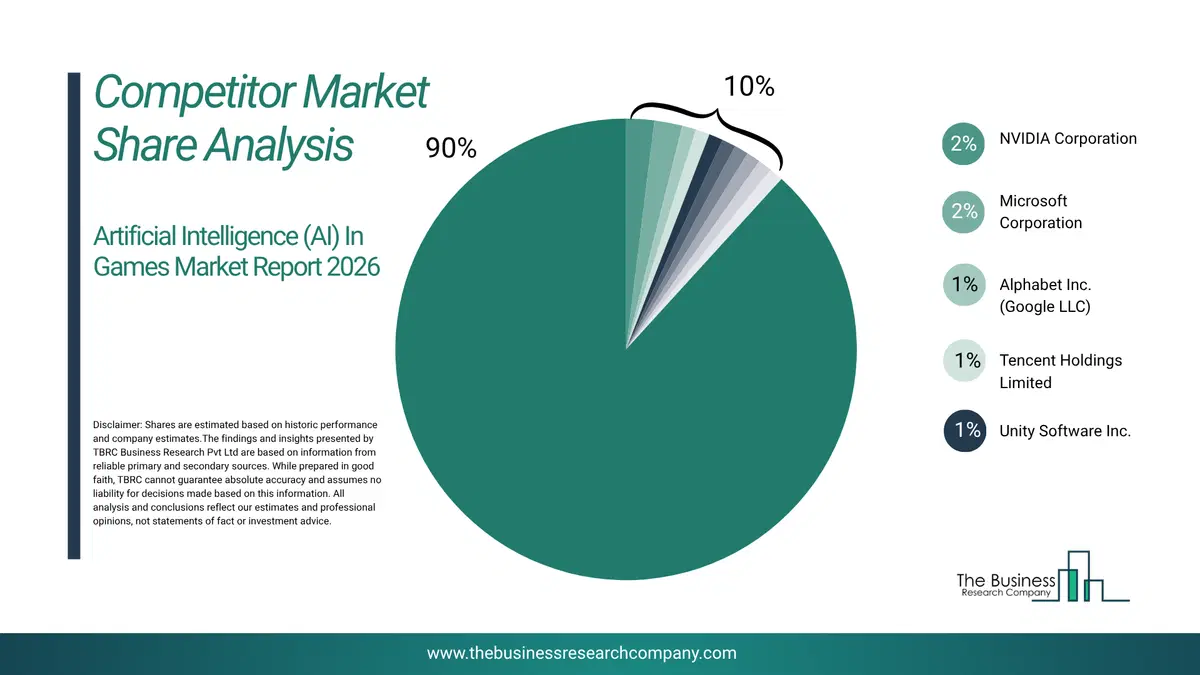
This chart is for illustrative purposes; the full report includes a detailed competitor analysis and comprehensive overview of the top 10 companies in the market.
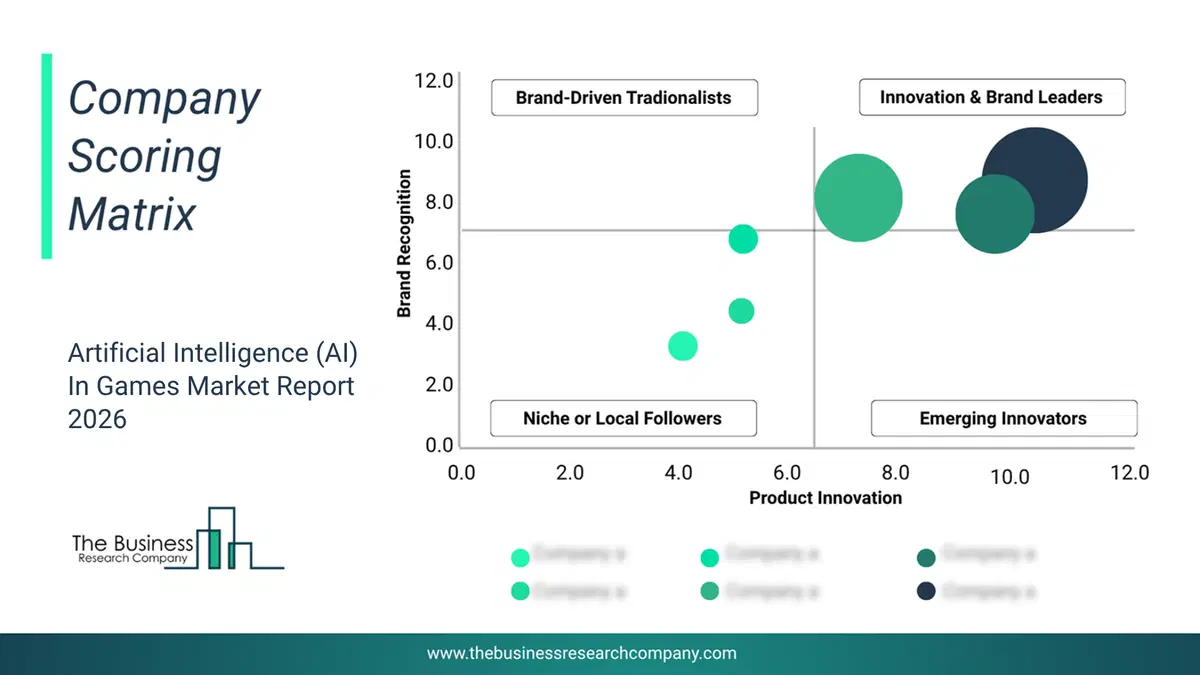
This chart maps companies by product innovation and brand strength, with bubble size indicating relative revenue, helping identify market leaders, challengers, and niche players. This is an illustrative chart; the full report provides a complete and accurate competitive analysis.
Global Artificial Intelligence (AI) In Games Market Trends and Insights
Major companies operating in artificial intelligence (AI) in the games market are developing advanced technologies, such as AI-powered NPCs, to serve customers better with advanced features. These are virtual entities in video games or simulations driven by artificial intelligence algorithms, enabling dynamic and responsive behavior. For instance, in May 2023, Replica Studios, an Australia-based AI software company, launched AI-driven intelligent non-player characters (NPCs) for unreal engines equipped with either OpenAI or users' custom AI language models. The technology leverages Replica's extensive library of 120+ ethically licensed AI voices, empowering game developers to scale up game development and craft innovative, dynamic gaming interactions.What Are Latest Mergers And Acquisitions In The Artificial Intelligence (AI) In Games Market?
In October 2023, Microsoft Corporation, a US-based developer of computer software, operating systems, cloud computing, and artificial intelligence applications, acquired Activision Blizzard, Inc., for $69 billion. The acquisition provides Microsoft with a strong foothold in the gaming industry, as Activision Blizzard owns popular gaming franchises such as Call of Duty, Warcraft, and Candy Crush. Activision Blizzard Inc. is a US-based developer and manufacturer of video games that offers AI-based technologies and features in video games.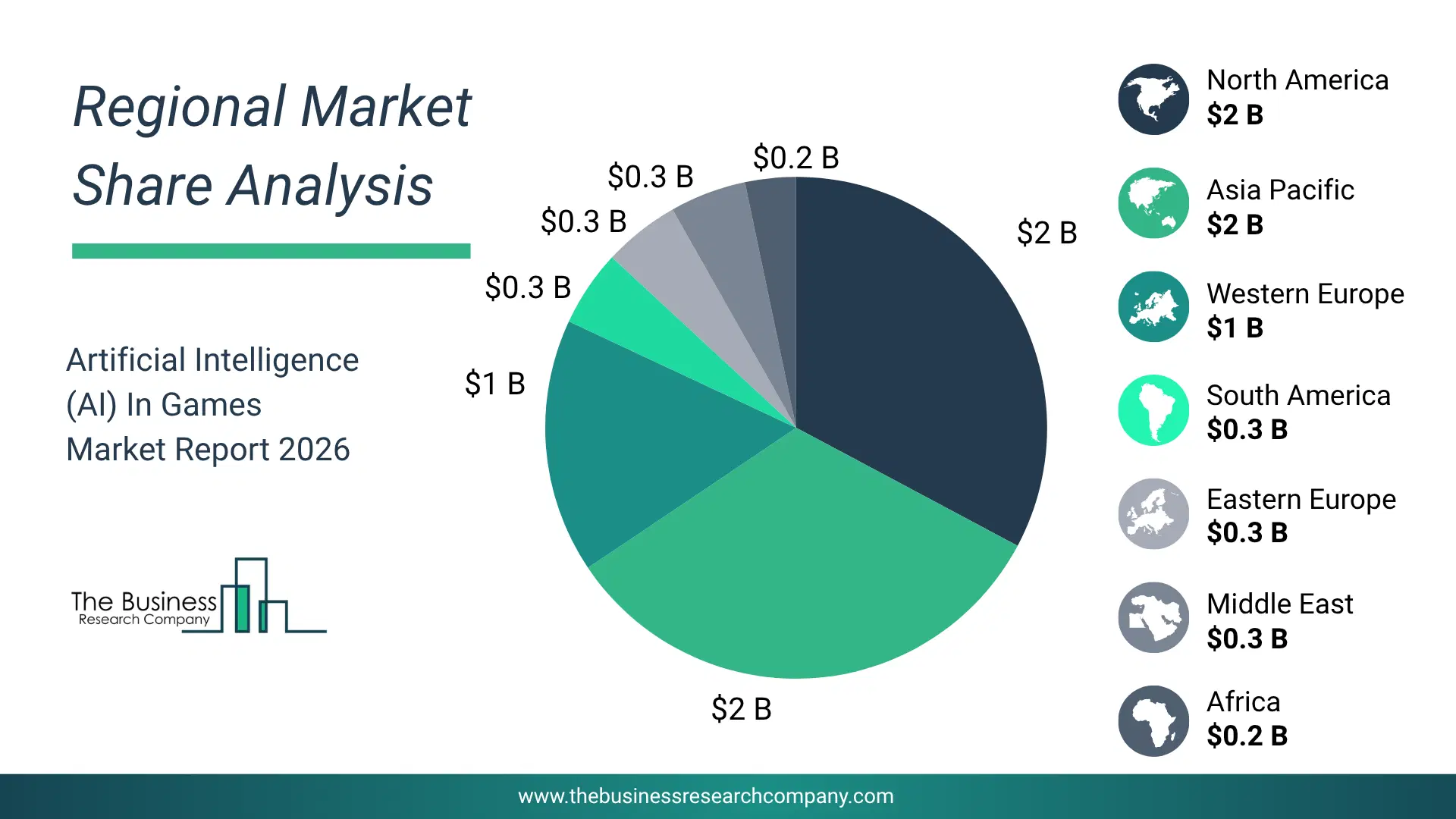
Regional Insights
North America was the largest region in the artificial intelligence (AI) in games market in 2025. Europe is expected to be the fastest-growing region in the forecast period. The regions covered in this market report are Asia-Pacific, South East Asia, Western Europe, Eastern Europe, North America, South America, Middle East, Africa. The countries covered in this market report are Australia, Brazil, China, France, Germany, India, Indonesia, Japan, Taiwan, Russia, South Korea, UK, USA, Canada, Italy, SpainWhat Defines the Artificial Intelligence (AI) In Games Market?
The artificial intelligence (AI) in games market consists of revenues earned by entities by providing services such as NPC behavior modeling, procedural content generation, player behavior analysis, and virtual assistants. The market value includes the value of related goods sold by the service provider or included within the service offering. The artificial intelligence (AI) in games market also includes sales of dynamic difficulty adjustment, AI-powered NPCs, anti-cheat systems, and emotion recognition. Values in this market are ‘factory gate’ values, that is the value of goods sold by the manufacturers or creators of the goods, whether to other entities (including downstream manufacturers, wholesalers, distributors and retailers) or directly to end customers. The value of goods in this market includes related services sold by the creators of the goods.How is Market Value Defined and Measured?
The market value is defined as the revenues that enterprises gain from the sale of goods and/or services within the specified market and geography through sales, grants, or donations in terms of the currency (in USD unless otherwise specified). The revenues for a specified geography are consumption values that are revenues generated by organizations in the specified geography within the market, irrespective of where they are produced. It does not include revenues from resales along the supply chain, either further along the supply chain or as part of other products.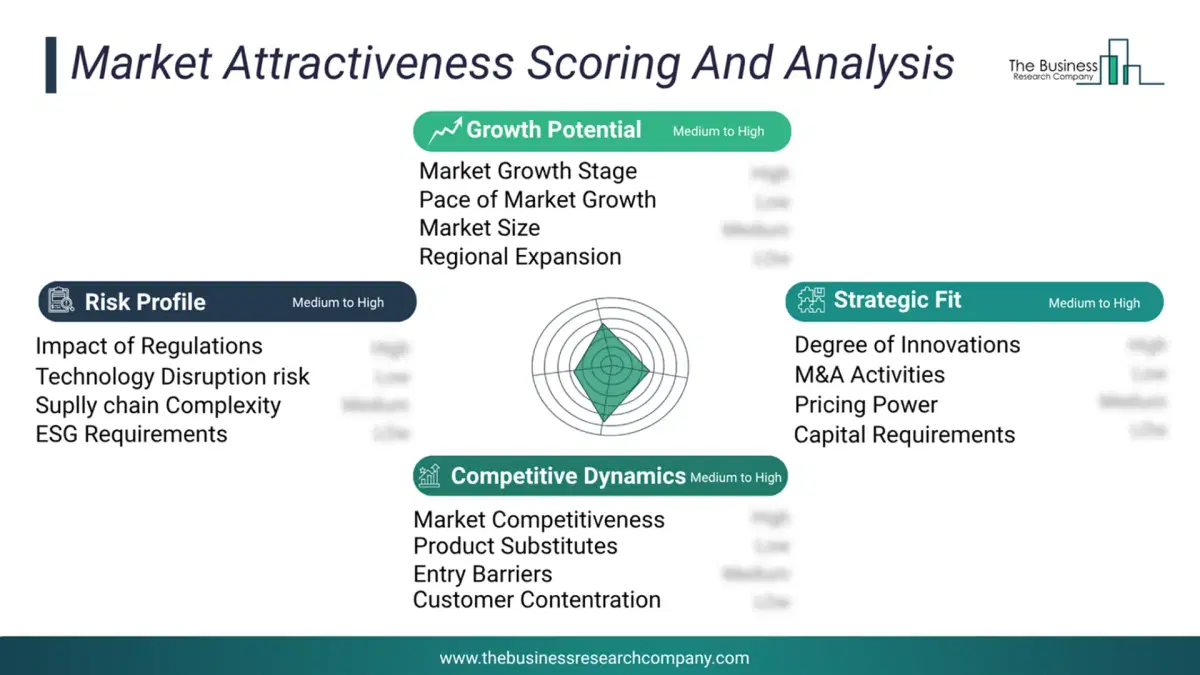
This chart presents market attractiveness based on a quantitative evaluation of growth, competition, strategic alignment, and risk, offering a clear view of opportunity areas for decision-making. This chart is for illustrative purposes; the full report contains the complete analysis.
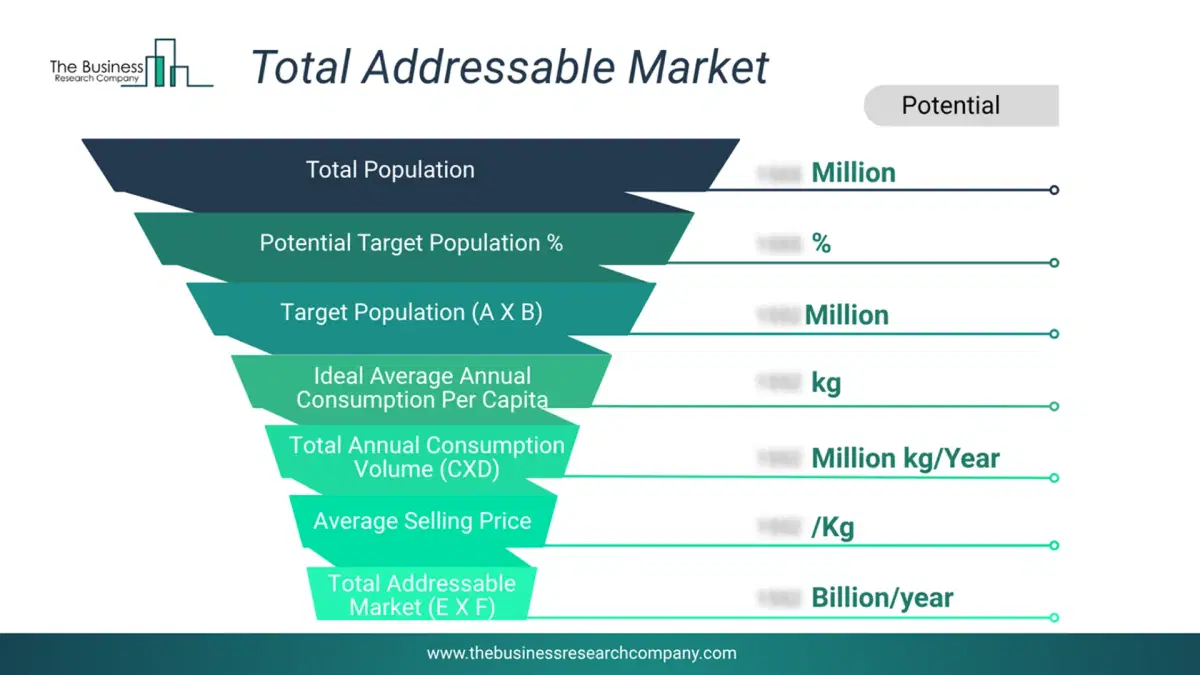
This chart highlights the Total Addressable Market (TAM) by estimating the maximum revenue opportunity using an assumption-driven approach, supporting strategic planning and opportunity sizing across markets. The chart is illustrative; the full report provides a more comprehensive analysis.
What Key Data and Analysis Are Included in the Artificial Intelligence (AI) In Games Market Report 2026?
The artificial intelligence (ai) in games market research report is one of a series of new reports from The Business Research Company that provides market statistics, including industry global market size, regional shares, competitors with the market share, detailed market segments, market trends and opportunities, and any further data you may need to thrive in the artificial intelligence (ai) in games industry. The market research report delivers a complete perspective of everything you need, with an in-depth analysis of the current and future state of the industry.Artificial Intelligence (AI) In Games Market Report Forecast Analysis
| Report Attribute | Details |
|---|---|
| Market Size Value In 2026 | $3.4 billion |
| Revenue Forecast In 2030 | $6.73 billion |
| Growth Rate | CAGR of 18.5% from 2026 to 2030 |
| Base Year For Estimation | 2025 |
| Actual Estimates/Historical Data | 2020-2025 |
| Forecast Period | 2026 - 2030 |
| Market Representation | Revenue in USD Billion and CAGR from 2026 to 2030 |
| Segments Covered | Component, Technology, Genre, Application |
| Regional Scope | Asia-Pacific, Western Europe, Eastern Europe, North America, South America, Middle East, Africa |
| Country Scope | The countries covered in the report are Australia, Brazil, China, France, Germany, India, Indonesia, Japan, Taiwan, Russia, South Korea, UK, USA, Canada, Italy, Spain. |
| Key Companies Profiled | Google LLC; Microsoft Corp.; Tencent Holdings Ltd.; Sony Group Corp.; NVIDIA Corp.; Nintendo Co. Ltd.; NetEase Inc.; Vivendi; Activision Blizzard; Electronic Arts Inc.; Take Two Interactive Software Inc.; Playtika; Square Enix; Konami Group Corp.; NCSoft; Unity Software Inc.; Capcom Co. Ltd.; Behaviour Interactive Inc.; Side Effects Software Inc.; Quantic Dream; Charisma Entertainment Ltd.; Ubisoft Entertainment SA; Insomniac Games; Crytek GmbH; PrometheanAI Inc. |
| Customization Scope | Request for Customization |
| Pricing And Purchase Options | Explore Purchase Options |