
Artificial Intelligence (AI) in Operating Room Market Report 2026
Global Outlook – By Offerings (Hardware, Software-As-A-Service (SaaS)), By Indication (Cardiology, Orthopedics, Urology, Gastroenterology, Neurology, Other Indications), By Technology (Machine Learning (ML), Deep Learning (DL), Natural Language Processing (NLP), Computer Vision), By Application (Training And Supporting, Diagnosis And Monitoring, Outcome And Risk Analysis, Surgical Planning And Rehabilitation, Integration And Connectivity, Other Applications), By End User (Hospitals, Ambulatory Surgical Centers (ASCs), Standalone Or Specialized Facilities, Other End Users) – Market Size, Trends, Strategies, and Forecast to 2030
Artificial Intelligence (AI) in Operating Room Market Overview
• Artificial Intelligence (AI) in Operating Room market size has reached to $0.9 billion in 2025 • Expected to grow to $3.29 billion in 2030 at a compound annual growth rate (CAGR) of 29.6% • Growth Driver: Surge In Robotics Is Anticipated To Boost The Growth Of The Artificial Intelligence (AI) In Operating Room Market • Market Trend: Exploring The Latest AI Solutions From Industry Giants In The Operating Room • North America was the largest region in 2025 and Asia-Pacific is the fastest growing region.What Is Covered Under Artificial Intelligence (AI) in Operating Room Market?
Artificial intelligence (AI) in the operating room refers to the deployment of machine learning and artificial intelligence and the application of algorithms and technologies to optimize the efficiency and usage of resources in the operating room, pre-operative region, and post-anesthesia treatment unit. It is used to help operating room systems perceive complicated in-vivo settings, make decisions, and complete tasks with greater precision, safety, and efficiency. The main offerings in artificial intelligence (AI) in the operating room are hardware and software-as-a-service (SaaS). Hardware is the device that has been incorporated with AI into their next-generation equipment to assist healthcare practitioners and researchers in operating rooms. The various indications include cardiology, orthopedics, urology, gastroenterology, neurology, and others. The various technologies include machine learning (ML), deep learning (DL), natural language processing (NLP), and computer vision, which are used for several applications, such as training and supporting, diagnosis and monitoring, outcome and risk analysis, surgical planning and rehabilitation, integration and connectivity, and others. It is used by various end users, including hospitals, ambulatory surgical centers (ASCs), standalone or specialized facilities, and others.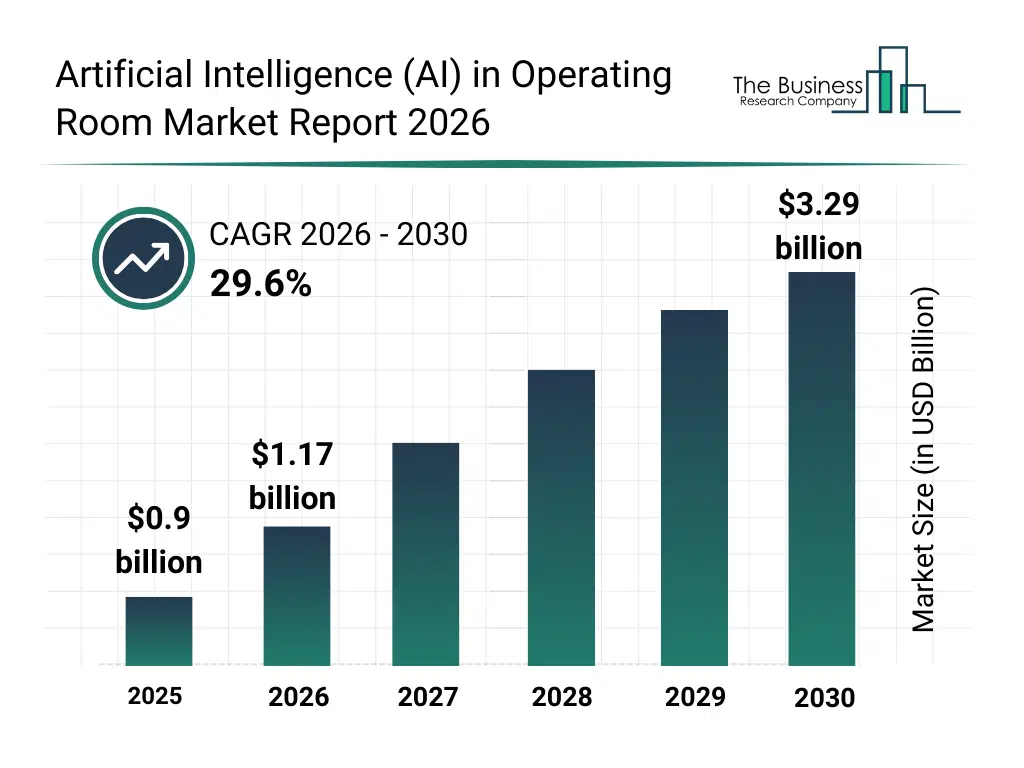
What Is The Artificial Intelligence (AI) in Operating Room Market Size and Share 2026?
The artificial intelligence (AI) in operating room market size has grown exponentially in recent years. It will grow from $0.9 billion in 2025 to $1.17 billion in 2026 at a compound annual growth rate (CAGR) of 30.0%. The growth in the historic period can be attributed to growth in surgical procedure volumes, advancements in medical imaging, adoption of robotic surgery systems, demand for improved surgical outcomes, need for operating room efficiency.What Is The Artificial Intelligence (AI) in Operating Room Market Growth Forecast?
The artificial intelligence (AI) in operating room market size is expected to see exponential growth in the next few years. It will grow to $3.29 billion in 2030 at a compound annual growth rate (CAGR) of 29.6%. The growth in the forecast period can be attributed to increasing minimally invasive surgeries, expansion of AI powered surgical robotics, rising healthcare digitization, demand for precision based interventions, integration of real time analytics in surgery. Major trends in the forecast period include AI assisted surgical planning, real time intraoperative decision support, robotic surgery integration, predictive operating room scheduling, post operative outcome analytics.
Global Artificial Intelligence (AI) in Operating Room Market Segmentation
1) By Offerings: Hardware, Software-As-A-Service (SaaS) 2) By Indication: Cardiology, Orthopedics, Urology, Gastroenterology, Neurology, Other Indications 3) By Technology: Machine Learning (ML), Deep Learning (DL), Natural Language Processing (NLP), Computer Vision 4) By Application: Training And Supporting, Diagnosis And Monitoring, Outcome And Risk Analysis, Surgical Planning And Rehabilitation, Integration And Connectivity, Other Applications 5) By End User: Hospitals, Ambulatory Surgical Centers (ASCs), Standalone Or Specialized Facilities, Other End Users Subsegments: 1) By Hardware: Surgical Robots, Imaging Systems, Monitoring Devices 2) By Software-As-A-Service (SaaS): Surgical Planning Software, AI-Powered Analytics Tools, Remote Monitoring And Support SoftwareWhat Is The Driver Of The Artificial Intelligence (AI) in Operating Room Market?
The rising adoption of robotics is expected to propel the growth of artificial intelligence (AI) in the operating room market going forward. Robotics refers to the interdisciplinary field of study and development that involves the design, construction, operation, and use of robots. The integration of AI with robotic surgical systems enhances the capabilities of robotic-assisted surgeries. Surgeons can benefit from features such as precise movements, 3D visualisation, and the ability to perform complex tasks with greater control. For instance, in September 2023, according to the International Federation of Robotics, a Germany-based professional non-profit organization to promote, strengthen, and protect the robotics industry worldwide, there was a significant rise in robot installations worldwide, with a total of 553,052 units deployed in 2022, marking 5% year-on-year growth, and projections indicate a further 7% increase in 2023, reaching over 590,000 units. Therefore, the rising adoption of robotics is driving the growth of artificial intelligence (AI) in the operating room market.Key Players In The Global Artificial Intelligence (AI) in Operating Room Market
Major companies operating in the artificial intelligence (AI) in operating room market are Medtronic; Siemens Healthineers; Stryker; Zimmer Biomet; Olympus; Intuitive Surgical; Vicarious Surgical; Augmedics; NovaSignal; Caresyntax; Quibim; Corindus Vascular Robotics; Lunit; Nano-X Imaging; Viz.ai; Subtle Medical; Caption Health; Inovus Medical; Asensus Surgical; Activ Surgical; Orpheus Medical; MaxQ AI; Perimeter Medical Imaging AI; RadLogics; Therapixel; Proximie; Gauss Surgical
This chart is for illustrative purposes; the full report includes a detailed competitor analysis and comprehensive overview of the top 10 companies in the market.
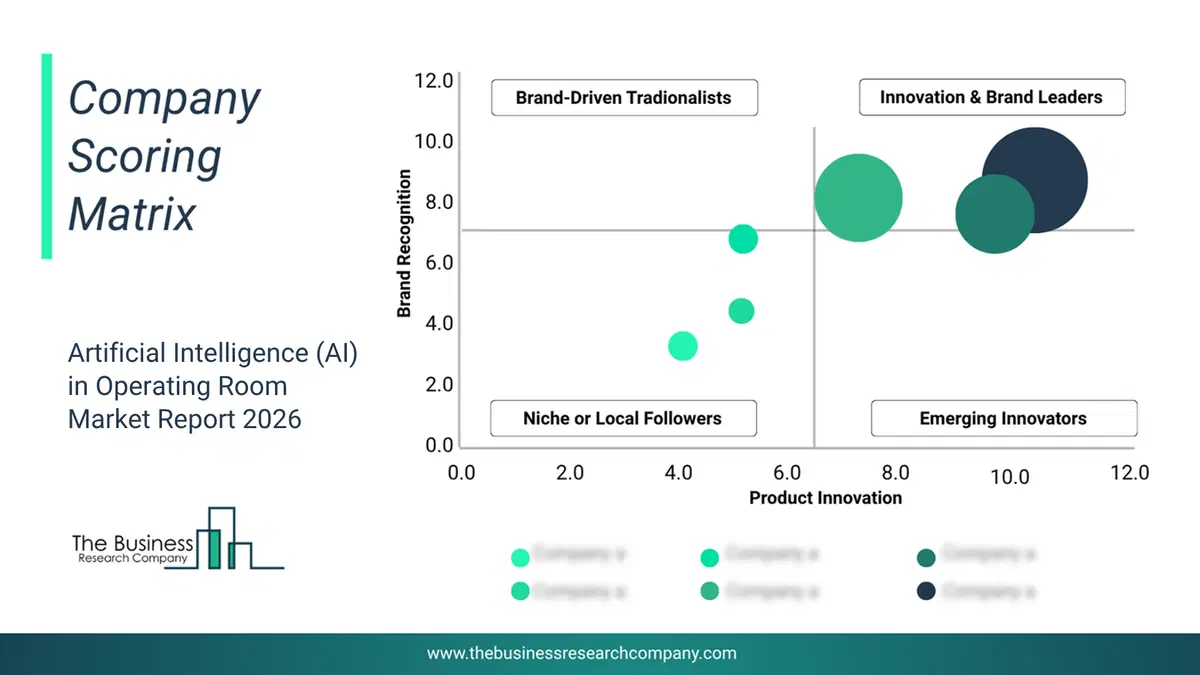
This chart maps companies by product innovation and brand strength, with bubble size indicating relative revenue, helping identify market leaders, challengers, and niche players. This is an illustrative chart; the full report provides a complete and accurate competitive analysis.
Global Artificial Intelligence (AI) in Operating Room Market Trends and Insights
Major companies operating in the artificial intelligence (AI) in the operating room market are focused on developing innovative technologies, such as revolutionary AI solutions. Revolutionary AI solutions refer to groundbreaking and transformative artificial intelligence applications that significantly alter or improve existing paradigms, processes, or industries. For instance, in September 2023, Copient Health, a US-based healthcare technology company, launched the ‘ARDEN’ AI solution. It facilitates the expansion of operating room (OR) access, improves operational efficiency, and increases margins by offering unparalleled control over information and activities within the operating room. ARDEN allows for the ongoing enhancement of both real-time and long-term operating room (OR) utilisation, optimisation of block templates, and improvement of financial outcomes.What Are Latest Mergers And Acquisitions In The Artificial Intelligence (AI) in Operating Room Market?
In September 2024, Stryker Corporation, a US-based medical technology corporation, acquired care.AI for an undisclosed amount. The acquisition of care.AI is intended to bolster Stryker's digital capabilities by integrating AI-assisted technologies that enhance real-time decision-making for healthcare providers. Care.AI is a US-based virtual care and ambient intelligence solutions platform.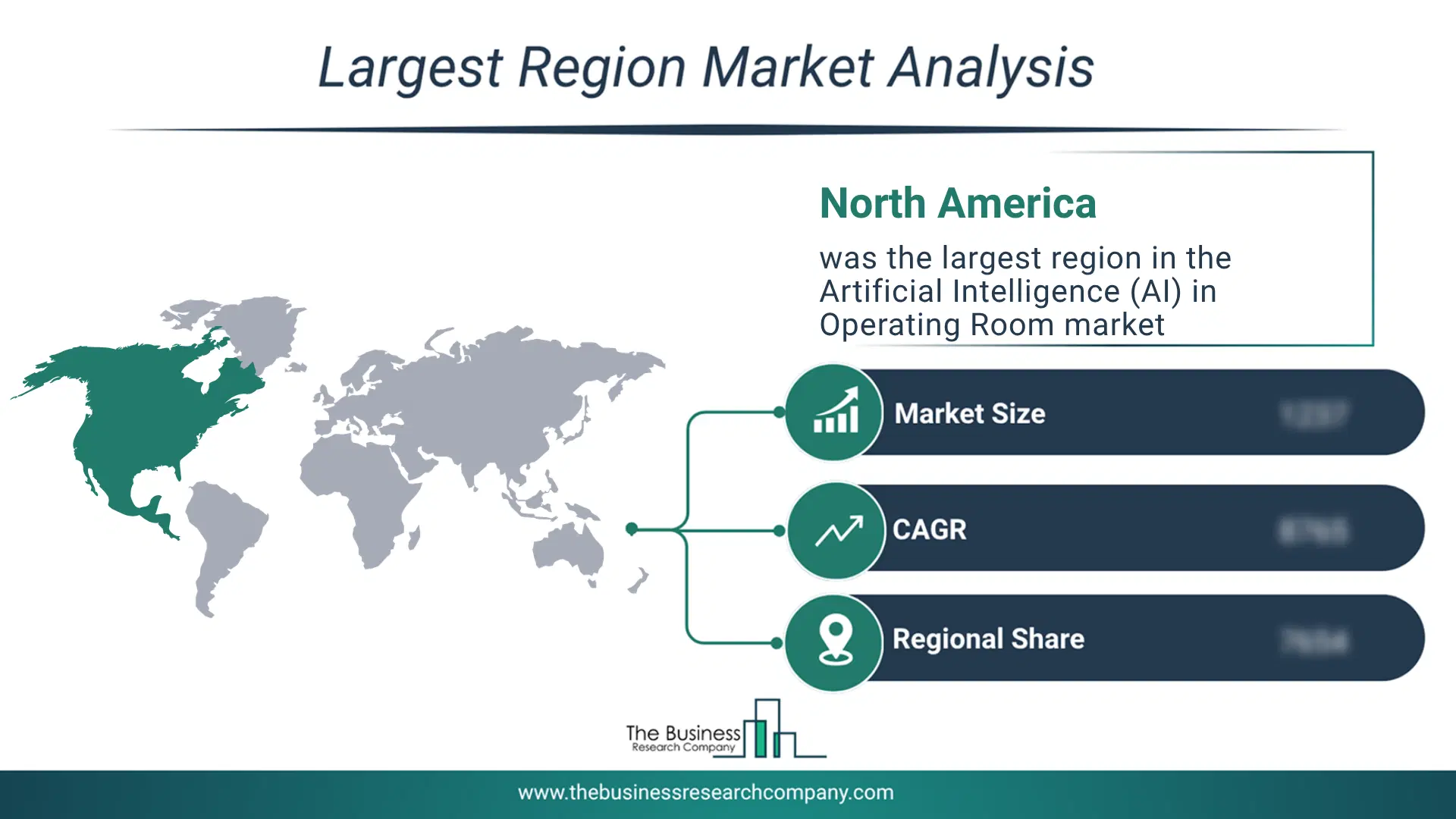
Regional Insights
North America was the largest region in the artificial intelligence (AI) in operating room market in 2025. Asia-Pacific is expected to be the fastest-growing region in the forecast period. The regions covered in this market report are Asia-Pacific, South East Asia, Western Europe, Eastern Europe, North America, South America, Middle East, Africa. The countries covered in this market report are Australia, Brazil, China, France, Germany, India, Indonesia, Japan, Taiwan, Russia, South Korea, UK, USA, Canada, Italy, SpainWhat Defines the Artificial Intelligence (AI) in Operating Room Market?
The artificial intelligence (AI) in the operating room market consists of revenue earned by entities by provide real-time guidance, autonomous actions, and assistance during surgery. The market value includes the value of related goods sold by the service provider or included within the service offering. The artificial intelligence (AI) in the operating room market also includes sales of AI-driven surgical robots, real-time AI systems, image-guided systems, surgical planning systems, and smart surgical instruments. Values in this market are ‘factory gate’ values, that is, the value of goods sold by the manufacturers or creators of the goods, whether to other entities (including downstream manufacturers, wholesalers, distributors, and retailers) or directly to end customers. The value of goods in this market includes related services sold by the creators of the goods.How is Market Value Defined and Measured?
The market value is defined as the revenues that enterprises gain from the sale of goods and/or services within the specified market and geography through sales, grants, or donations in terms of the currency (in USD unless otherwise specified). The revenues for a specified geography are consumption values that are revenues generated by organizations in the specified geography within the market, irrespective of where they are produced. It does not include revenues from resales along the supply chain, either further along the supply chain or as part of other products.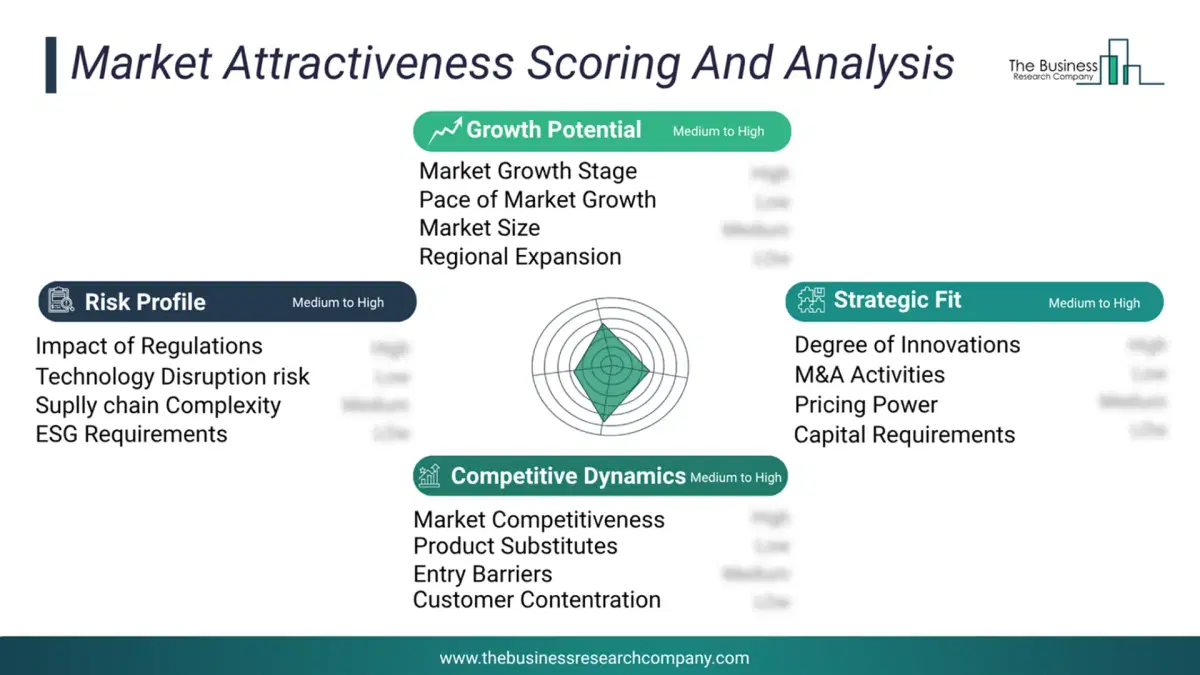
This chart presents market attractiveness based on a quantitative evaluation of growth, competition, strategic alignment, and risk, offering a clear view of opportunity areas for decision-making. This chart is for illustrative purposes; the full report contains the complete analysis.
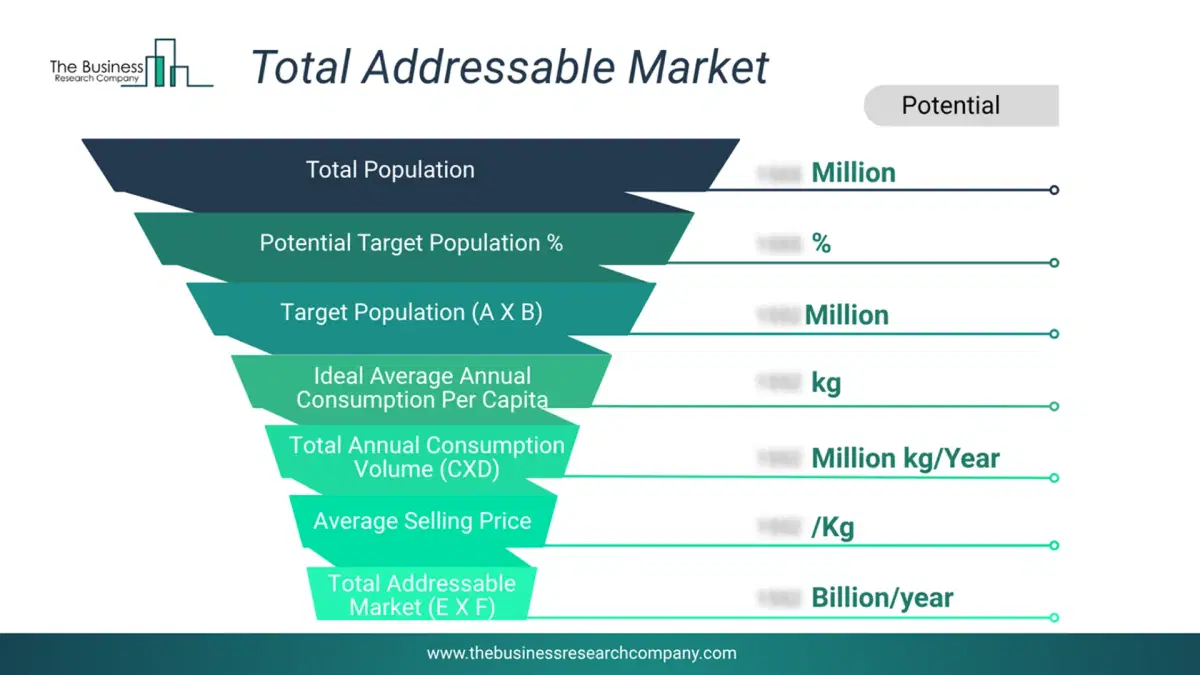
This chart highlights the Total Addressable Market (TAM) by estimating the maximum revenue opportunity using an assumption-driven approach, supporting strategic planning and opportunity sizing across markets. The chart is illustrative; the full report provides a more comprehensive analysis.
What Key Data and Analysis Are Included in the Artificial Intelligence (AI) in Operating Room Market Report 2026?
The artificial intelligence (ai) in operating room market research report is one of a series of new reports from The Business Research Company that provides market statistics, including industry global market size, regional shares, competitors with the market share, detailed market segments, market trends and opportunities, and any further data you may need to thrive in the artificial intelligence (ai) in operating room industry. The market research report delivers a complete perspective of everything you need, with an in-depth analysis of the current and future state of the industry.Artificial Intelligence (AI) in Operating Room Market Report Forecast Analysis
| Report Attribute | Details |
|---|---|
| Market Size Value In 2026 | $1.17 billion |
| Revenue Forecast In 2030 | $3.29 billion |
| Growth Rate | CAGR of 29.6% from 2026 to 2030 |
| Base Year For Estimation | 2025 |
| Actual Estimates/Historical Data | 2020-2025 |
| Forecast Period | 2026 - 2030 |
| Market Representation | Revenue in USD Billion and CAGR from 2026 to 2030 |
| Segments Covered | Offerings, Indication, Technology, Application, End User |
| Regional Scope | Asia-Pacific, Western Europe, Eastern Europe, North America, South America, Middle East, Africa |
| Country Scope | The Countries Covered In This Market Report Are Australia, Brazil, China, France, Germany, India, Indonesia, Japan, Taiwan, Russia, South Korea, Uk, Usa, Canada, Italy, Spain. |
| Key Companies Profiled | Medtronic, Siemens Healthineers, Stryker, Zimmer Biomet, Olympus, Intuitive Surgical, Vicarious Surgical, Augmedics, NovaSignal, Caresyntax, Quibim, Corindus Vascular Robotics, Lunit, Nano-X Imaging, Viz.ai, Subtle Medical, Caption Health, Inovus Medical, Asensus Surgical, Activ Surgical, Orpheus Medical, MaxQ AI, Perimeter Medical Imaging AI, RadLogics, Therapixel, Proximie, Gauss Surgical |
| Customization Scope | Request for Customization |
| Pricing And Purchase Options | Explore Purchase Options |