

Artificial Intelligence in Military Market Report 2026
Global Outlook – By Offering (Hardware, Software, Service), By Technology (Machine Learning, Natural Language Processing, Context-Aware Computing, Computer Vision, Intelligent Virtual Agent (IVA) or Virtual Agents, Other Technologies), By Platform (Land, Naval, Airborne), By Installation (New Procurement, Upgradation), By Application (Information Processing, Simulation and Training, Warfare Platform, Threat Monitoring and Situational Awareness, Cyber Security, Other Applications) – Market Size, Trends, Strategies, and Forecast to 2030
Artificial Intelligence in Military Market Overview
• Artificial Intelligence in Military market size has reached to $11.53 billion in 2025 • Expected to grow to $28.67 billion in 2030 at a compound annual growth rate (CAGR) of 20.1% • Growth Driver: Rising Global Conflicts Fueling The Growth Of The Market Due To Increasing Demand For Advanced Decision-Making And Defense Capabilities • Market Trend: Focus On Technological Advancements For Developing New Products • North America was the largest region in 2025 and Asia-Pacific is the fastest growing region.Market Gains By 2030 – Top Opportunities By Segment
Market Gain identifies the most promising market opportunities by highlighting the segments or products expected to generate the highest incremental revenue growth over the next five years.
What Is Covered Under Artificial Intelligence in Military Market?
Artificial intelligence in the military facilitates quick decision-making, both in dynamic, information-dense environments and in information-scarce ones. Artificial intelligence is employed in military intelligence to analyze the enemy's intelligence and as an application in autonomous vehicles and weapon systems. Artificial intelligence in the military is used in supporting and planning military operations. The main offerings of artificial intelligence in military are hardware, software, and services. Hardware refers to the computer's tangible components that store and run the written instructions provided by the software. The different technologies include machine learning, natural language processing, context-aware computing, computer vision, intelligent virtual agent (IVA) or virtual agents, and others that involve several platforms such as land, naval, and airborne. The different installations include new procurement and upgradation that are used in information processing, simulation and training, warfare platform, threat monitoring, situational awareness, cyber security, and other applications.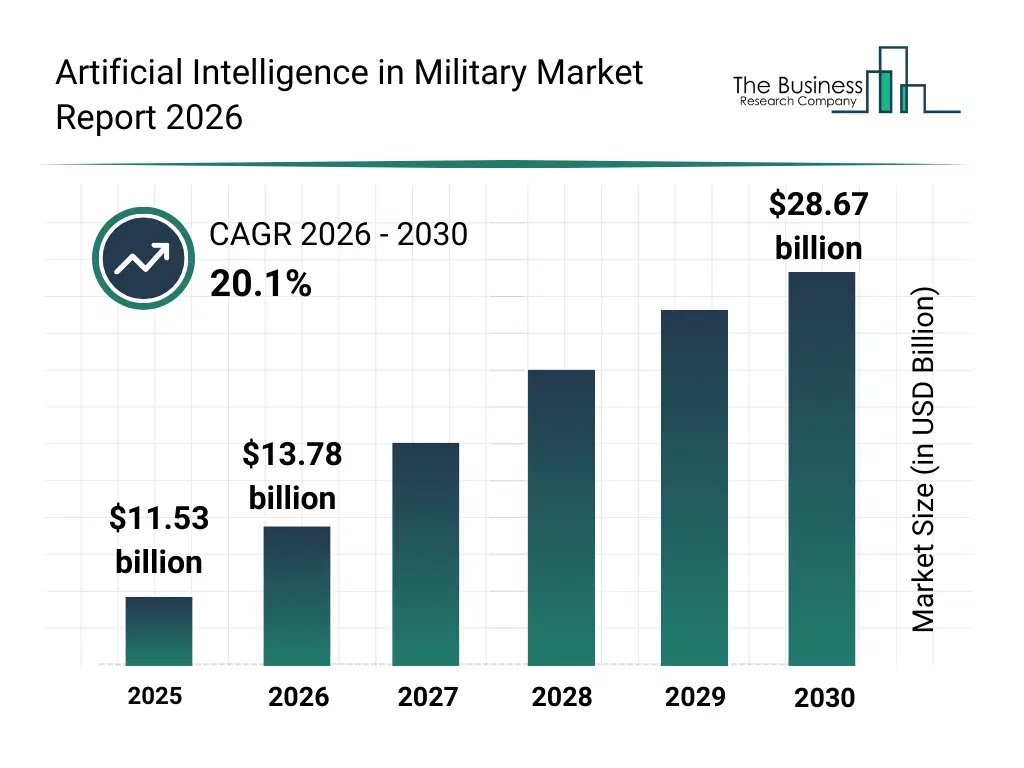
What Is The Artificial Intelligence in Military Market Size and Share 2026?
The artificial intelligence in military market size has grown rapidly in recent years. It will grow from $11.53 billion in 2025 to $13.78 billion in 2026 at a compound annual growth rate (CAGR) of 19.5%. The growth in the historic period can be attributed to early adoption of autonomous surveillance drones for battlefield intelligence, increasing deployment of facial recognition and language translation tools for tactical operations, modernization programs integrating AI-enabled command and control systems, rising use of robotic mine detectors and unmanned ground systems for troop protection, growth in military data generation requiring advanced AI analytics capabilities.What Is The Artificial Intelligence in Military Market Growth Forecast?
The artificial intelligence in military market size is expected to see exponential growth in the next few years. It will grow to $28.67 billion in 2030 at a compound annual growth rate (CAGR) of 20.1%. The growth in the forecast period can be attributed to expanding investment in autonomous weapon systems with enhanced decision-support capabilities, increasing integration of edge AI in battlefield sensors and communication networks, rising demand for ai-driven intrusion detection and cybersecurity tools within defense infrastructure, continued modernization of military platforms requiring advanced AI hardware and software, growing use of ai-enabled simulation and training systems to enhance operational readiness. Major trends in the forecast period include growing deployment of ai-based battlefield decision-support systems, rising adoption of autonomous surveillance and reconnaissance platforms, increasing integration of ai-enabled threat detection and analysis tools, expansion of ai-driven simulation and training environments, growing use of predictive analytics for mission planning and logistics.
Global Artificial Intelligence in Military Market Segmentation
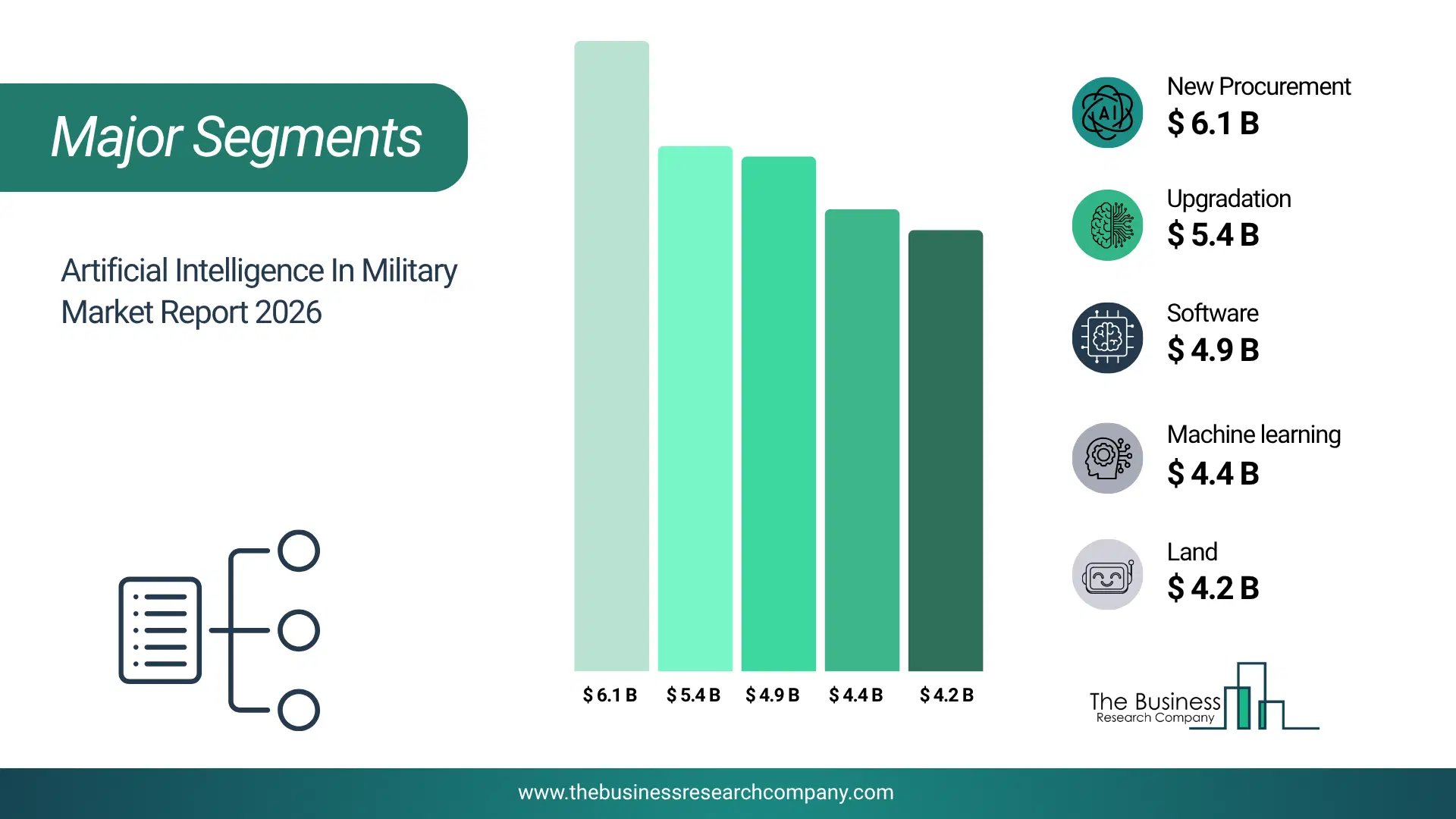
1) By Offering: Hardware, Software, Service 2) By Technology: Machine Learning, Natural Language Processing, Context-Aware Computing, Computer Vision, Intelligent Virtual Agent (IVA) or Virtual Agents, Other Technologies 3) By Platform: Land, Naval, Airborne 4) By Installation: New Procurement, Upgradation 5) By Application: Information Processing, Simulation and Training, Warfare Platform, Threat Monitoring and Situational Awareness, Cyber Security, Other Applications Subsegments: 1) By Hardware: AI-Powered Sensors, Robotics and Drones, Computing Hardware (GPUs, TPUs), Network Infrastructure 2) By Software: AI Algorithms and Models, Machine Learning Software, Data Analytics Software, Cybersecurity Software 3) By Service: AI Integration Services, Consulting Services, Maintenance and Support Services, Training and Development Services The top segments in the artificial intelligence in military market will be: • New Procurement will reach $6120.39 Million by 2025. • Upgradation will reach $5467.43 Million by 2025. • Software will reach $4918.87 Million by 2025. • Machine learning will reach $4442.28 Million by 2025. • Land will reach $4219.42 Million by 2025.What Is Driver Of The Artificial Intelligence in Military Market?
The rising global conflicts are expected to propel the growth of artificial intelligence in military market going forward. Global conflicts refer to the increasing number and intensity of armed confrontations and violent disputes between nations or groups worldwide. The rise in global conflicts is due to escalating geopolitical tensions, territorial disputes, and civil unrest in various regions, leading nations to enhance their military capabilities. Artificial intelligence in military enhances the management of global conflicts by enabling faster decision-making, predictive threat analysis, and autonomous systems for surveillance, defense, and strategic operations. For instance, in December 2024, according to Armed Conflict Location and Event Data (ACLED), a US-based non-profit organization, global conflicts have doubled over the past five years, with the number of people killed in conflicts rising 30% from 179,099 deaths in 2023 to 233,597 in 2024. Therefore, the rising global conflicts are driving the growth of artificial intelligence in military industry.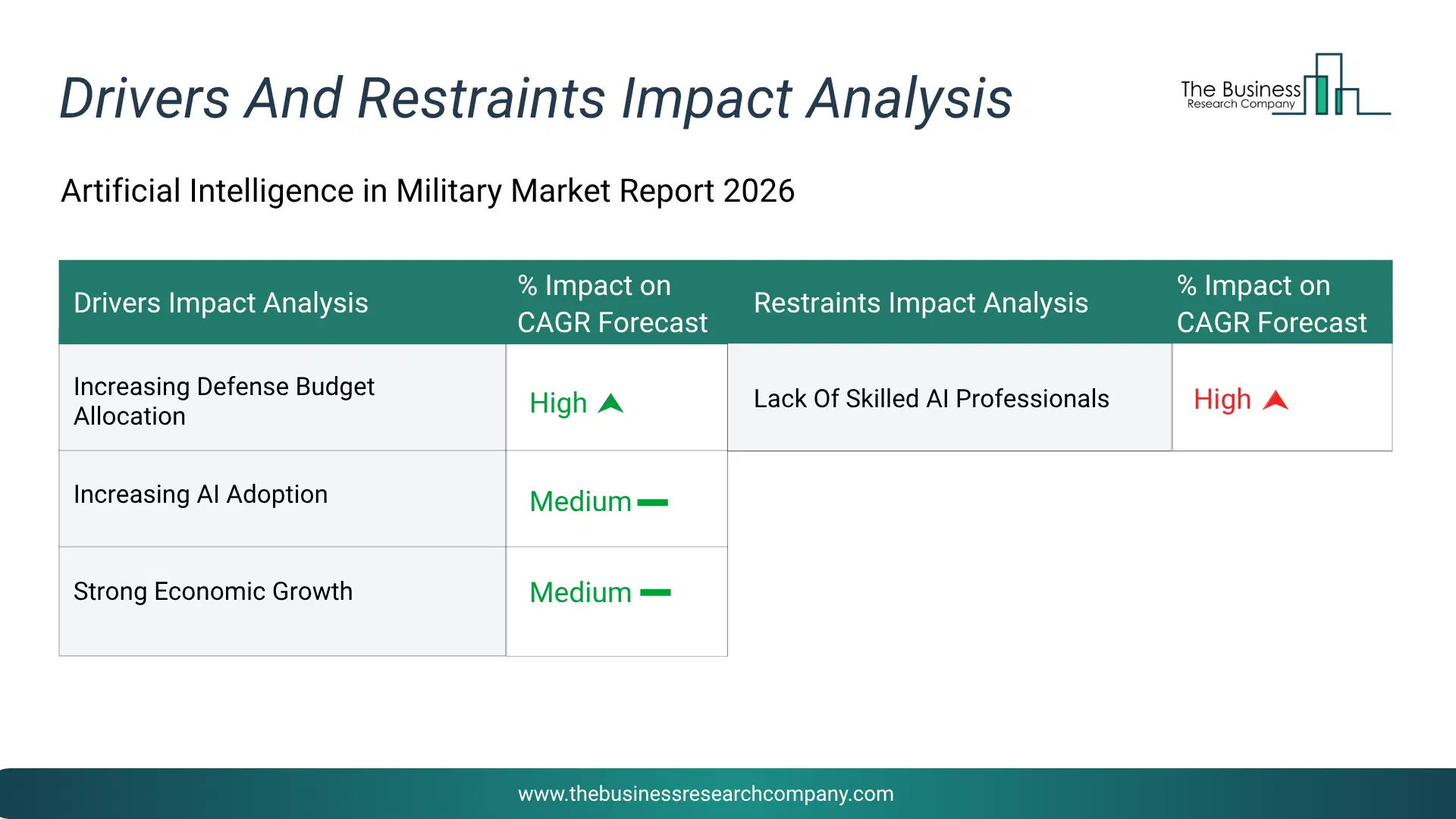
Infographic Chart Showing Key Market Drivers Analysis And Restraints For Artificial Intelligence In Military Market
The chart presents an impact analysis of key drivers and restraints, quantifying their relative influence on the market's growth rate and helping assess the balance between growth enablers and limiting factors. This chart offers a high-level perspective; the full report contains more detailed insights.
How Will The Drivers Impact Growth In The Global Artificial Intelligence in Military Market?
• Increasing Defense Budget Allocation (High) – The increasing emphasis on defense budget allocation will become a key driver of growth in the artificial intelligence in military market by 2030. A larger defense budget facilitates increased investment in AI research and development, driving advancements in surveillance, reconnaissance, automation and decision-making. AI technologies, including drones, autonomous systems and predictive analytics, benefit from these resources. AI enhances situational awareness, streamlines repetitive tasks such as logistics and boosts operational efficiency by optimizing threat prediction, resource allocation and readiness. As a result, the increasing defense budget allocation is anticipated to contributing annual growth in the market. • Increasing AI Adoption (Medium) – The growing focus on AI adoption will emerge as a major factor driving the expansion of the artificial intelligence in military market by 2030. AI-powered autonomous systems like UAVs and ground vehicles are transforming military operations by enhancing efficiency and reducing costs. These systems excel in surveillance, reconnaissance and combat, offering real-time data analysis and insights. AI technologies such as machine learning and data analytics enable rapid information processing, leading to better decision-making, improved situational awareness and more effective resource allocation. Consequently, the accelerating AI adoption is projected to contributing to annual growth in the market. • Strong Economic Growth (Medium) – The expanding integration of economic growth processes will serve as a key growth catalyst for the artificial intelligence in military market by 2030. Strong economic growth boosts the defense budgets, funding research and development (R&D) and fostering operational efficiency. Economic prosperity ensures more resources are allocated to AI-driven technologies such as drones, cybersecurity and advanced surveillance. It also enhances global competitiveness, encouraging collaboration between governments and private sectors to develop cutting-edge AI solutions. This financial capacity fuels innovation and ensures nations maintain military superiority through AI advancements. Therefore, the economic growth is projected to supporting to annual growth in the market. • Favorable Government Initiatives (Medium) – The increasing emphasis on government initiatives will become a significant driver contributing to the growth of the artificial intelligence in military market by 2030. Governments allocate significant budgets to defense to bolster national security. The integration of AI systems, such as surveillance, reconnaissance and autonomous weaponry, is becoming crucial in military operations. Investments in AI-driven technologies are expected to enhance efficiency, precision and operational effectiveness. Consequently, the favorable government initiatives is projected to contributing to annual growth in the market.How Will The Restraints Impact Growth In The Global Artificial Intelligence in Military Market?
• Lack Of Skilled AI Professionals (High) – Lack Of Skilled AI Professionals will restrict the growth of the Artificial Intelligence In Military market during the forecast period. The development and deployment of military AI systems require specialized expertise in artificial intelligence, cybersecurity, and defense systems. The shortage of qualified professionals with security clearances and military domain knowledge limits innovation and implementation. This skill gap can affect the development of advanced military AI capabilities and slow the adoption of AI in defense applications.Key Players In The Global Artificial Intelligence in Military Market
Major companies operating in the artificial intelligence in military market are Charles River Analytics Inc., BAE Systems PLC., Northrop Grumman Corporation, RTX Corporation, Lockheed Martin Corporation, Thales Group, Harris Corporation, International Business Machines Corporation, Rafael Advanced Defense Systems, Microsoft Corporation, Oracle Corporation, Amazon Web Services Inc., SAS Institute, Meta Platforms Inc., SAP SE, Salesforce Inc., Baidu Inc., SoarTech, Google LLC, NVIDIA Corporation, Intel Corporation, General Dynamics Corporation, Rolls-Royce Holdings plc, General Electric Aviation, Safran S.A., Israel Aerospace Industries, Triumph Group Inc., Boeing Co., Airbus SE, Leonardo S.p.A., L3Harris Technologies Inc., Elbit Systems Ltd., Rheinmetall AG, Collins Aerospace, Kongsberg Gruppen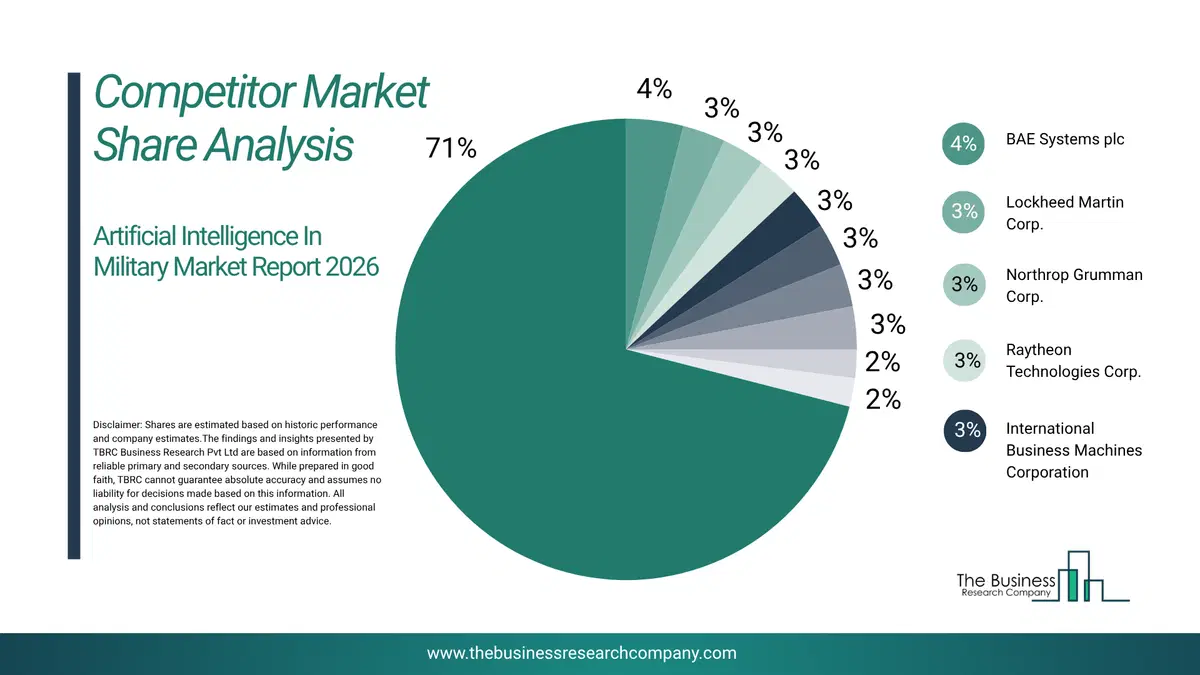
This chart is for illustrative purposes; the full report includes a detailed competitor analysis and comprehensive overview of the top 10 companies in the market.
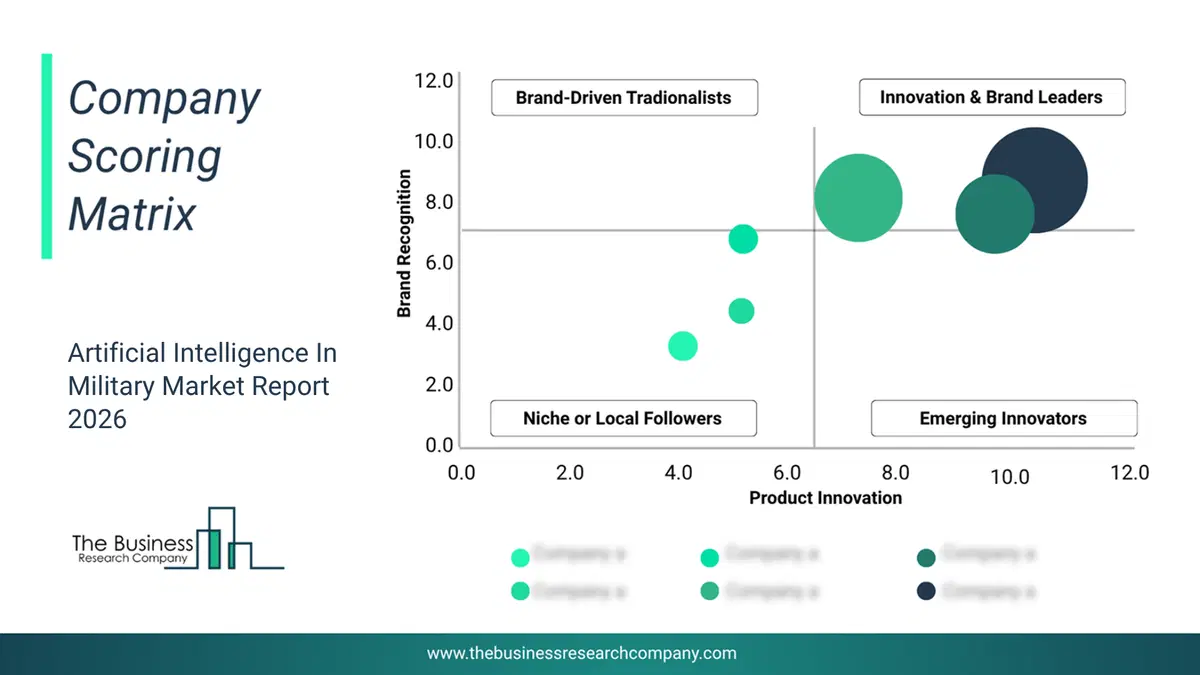
This chart maps companies by product innovation and brand strength, with bubble size indicating relative revenue, helping identify market leaders, challengers, and niche players. This is an illustrative chart; the full report provides a complete and accurate competitive analysis.
Global Artificial Intelligence in Military Market Trends and Insights
Major companies operating in the artificial intelligence in the military market are focusing on integrating innovative technologies such as sensor fusion technologies to enhance situational awareness and improve decision-making in real time. Sensor fusion technology, which combines data from multiple sensors to produce more accurate and comprehensive information, helps enhance situational awareness, improve decision-making, and enable faster, more precise responses in complex environments. For instance, in March 2025, Leonardo DRS, a US-based defense technology company, launched its next-generation Artificial Intelligence Processor (AIP), designed to enhance situational awareness, enable real-time threat detection, and support advanced mission processing for military vehicles. The ruggedized AIP system is engineered to operate in extreme environments and process vast amounts of battlefield data, from advanced image sensors to sensor fusion systems, delivering actionable intelligence directly to soldiers at the tactical edge. It integrates seamlessly with current and future U.S. Army combat applications, providing a platform-agnostic, compact, and high-speed computing solution. Leveraging cutting-edge AI algorithms and commercial technology, the AIP helps reduce the cognitive burden on commanders and crews, enabling faster and more informed decisions during multi-domain operations.What Are Latest Mergers And Acquisitions In The Artificial Intelligence in Military Market? Sightline Applications LLC Acquires Athena Artificial Intelligence Pty Ltd To Strengthen AI-Enabled Military Situational Awareness
In March 2025, SightLine Applications LLC, a US-based technology company, acquired Athena Artificial Intelligence Pty Ltd for an undisclosed amount. With this acquisition, SightLine aims to enhance its real-time situational awareness and decision-making capabilities by integrating Athena AI's advanced, AI-enabled computer vision and decision support systems into its core image processing platform. Athena Artificial Intelligence Pty Ltd is an Australia-based software company that offers artificial intelligence in the military.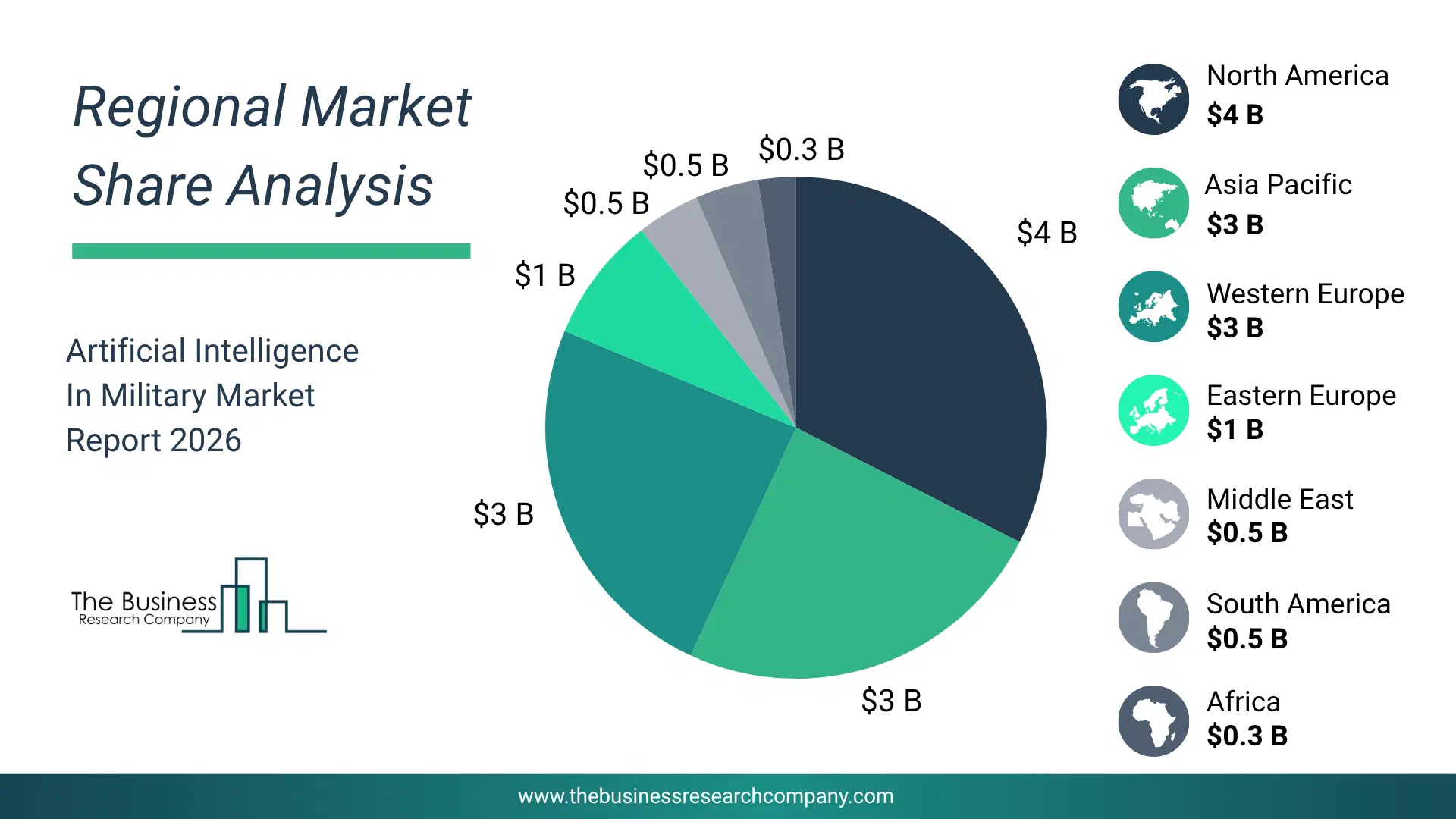
Regional Insights
North America was the largest region in the artificial intelligence in military market in 2025. Asia-Pacific is expected to be the fastest-growing region in the forecast period. The regions covered in this market report are Asia-Pacific, South East Asia, Western Europe, Eastern Europe, North America, South America, Middle East, Africa. The countries covered in this market report are Australia, Brazil, China, France, Germany, India, Indonesia, Japan, Taiwan, Russia, South Korea, UK, USA, Canada, Italy, SpainWhat Defines the Artificial Intelligence in Military Market?
The artificial intelligence in military market consists of sales of artificial intelligence in military services such as facial recognition, language translation, remotely operated weapon stations, robotic mine detectors, and intrusion detection services. The market value includes the value of related goods sold by the service provider or included within the service offering. The artificial intelligence in military market also includes sales of sensor, drone, detector, computers equipment’s which are used in providing artificial intelligence in military. Values in this market are ‘factory gate’ values, that is the value of goods sold by the manufacturers or creators of the goods, whether to other entities (including downstream manufacturers, wholesalers, distributors and retailers) or directly to end customers. The value of goods in this market includes related services sold by the creators of the goods.How is Market Value Defined and Measured?
The market value is defined as the revenues that enterprises gain from the sale of goods and/or services within the specified market and geography through sales, grants, or donations in terms of the currency (in USD unless otherwise specified). The revenues for a specified geography are consumption values that are revenues generated by organizations in the specified geography within the market, irrespective of where they are produced. It does not include revenues from resales along the supply chain, either further along the supply chain or as part of other products.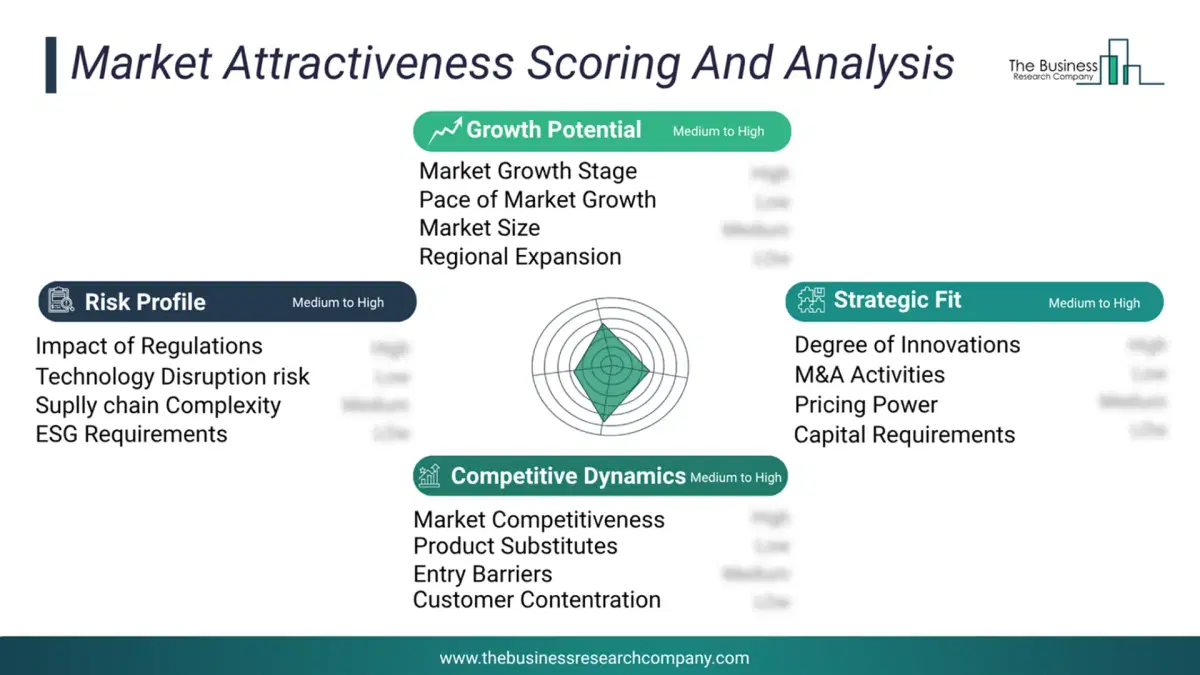
This chart presents market attractiveness based on a quantitative evaluation of growth, competition, strategic alignment, and risk, offering a clear view of opportunity areas for decision-making. This chart is for illustrative purposes; the full report contains the complete analysis.
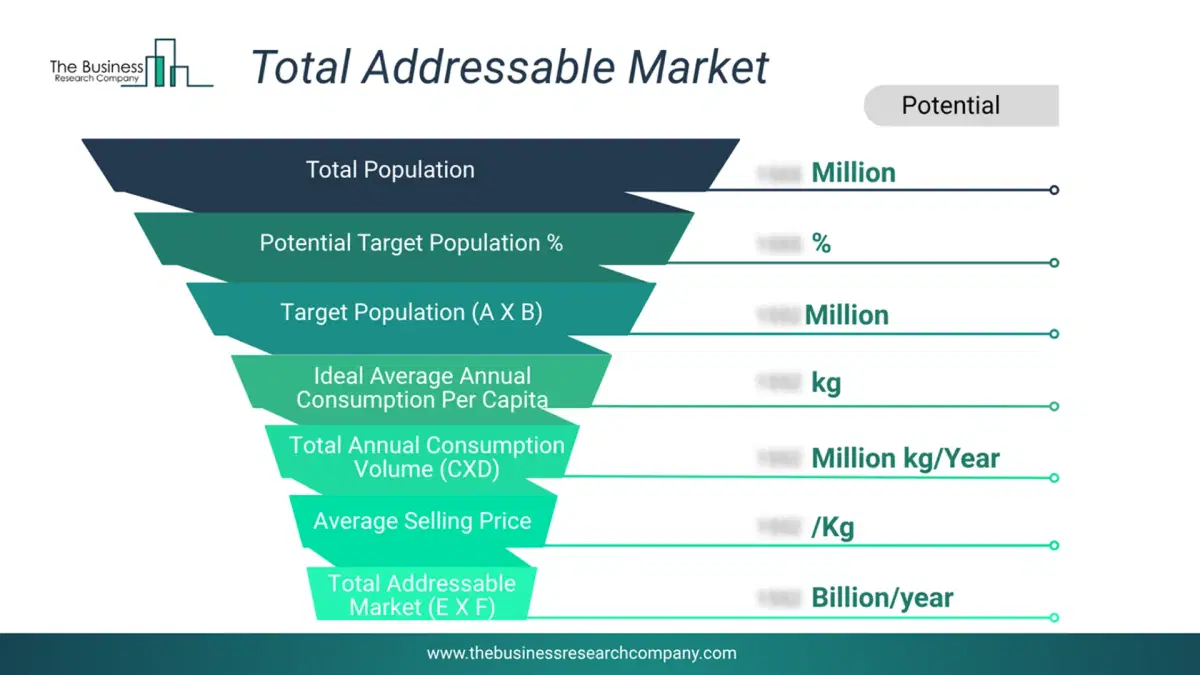
This chart highlights the Total Addressable Market (TAM) by estimating the maximum revenue opportunity using an assumption-driven approach, supporting strategic planning and opportunity sizing across markets. The chart is illustrative; the full report provides a more comprehensive analysis.
What Key Data and Analysis Are Included in the Artificial Intelligence in Military Market Report 2026?
The artificial intelligence in military market research report is one of a series of new reports from The Business Research Company that provides market statistics, including industry global market size, regional shares, competitors with the market share, detailed market segments, market trends and opportunities, and any further data you may need to thrive in the artificial intelligence in military industry. The market research report delivers a complete perspective of everything you need, with an in-depth analysis of the current and future state of the industry.Artificial Intelligence in Military Market Report Forecast Analysis
| Report Attribute | Details |
|---|---|
| Market Size Value In 2026 | $13.78 billion |
| Revenue Forecast In 2030 | $28.67 billion |
| Growth Rate | CAGR of 19.5% from 2026 to 2030 |
| Base Year For Estimation | 2025 |
| Actual Estimates/Historical Data | 2020-2025 |
| Forecast Period | 2026 - 2030 |
| Market Representation | Revenue in USD Billion and CAGR from 2026 to 2030 |
| Segments Covered | Offering, Technology, Platform, Installation, Application |
| Regional Scope | Asia-Pacific, Western Europe, Eastern Europe, North America, South America, Middle East, Africa |
| Country Scope | The countries covered in the report are Australia, Brazil, China, France, Germany, India, Indonesia, Japan, Taiwan, Russia, South Korea, UK, USA, Canada, Italy, Spain. |
| Key Companies Profiled | Charles River Analytics Inc., BAE Systems PLC., Northrop Grumman Corporation, RTX Corporation, Lockheed Martin Corporation, Thales Group, Harris Corporation, International Business Machines Corporation, Rafael Advanced Defense Systems, Microsoft Corporation, Oracle Corporation, Amazon Web Services Inc., SAS Institute, Meta Platforms Inc., SAP SE, Salesforce Inc., Baidu Inc., SoarTech, Google LLC, NVIDIA Corporation, Intel Corporation, General Dynamics Corporation, Rolls-Royce Holdings plc, General Electric Aviation, Safran S.A., Israel Aerospace Industries, Triumph Group Inc., Boeing Co., Airbus SE, Leonardo S.p.A., L3Harris Technologies Inc., Elbit Systems Ltd., Rheinmetall AG, Collins Aerospace, Kongsberg Gruppen |
| Customization Scope | Request for Customization |
| Pricing And Purchase Options | Explore Purchase Options |