
Automotive Infotainment Market Report 2026
Global Outlook – By Operating System (QNX, Microsoft, Linux), By Form (Embedded, Tethered, Integrated), By Vehicle Type (Passenger Car, Light Commercial Vehicle, Heavy Commercial Vehicle) – Market Size, Trends, Strategies, and Forecast to 2030
Automotive Infotainment Market Overview
• Automotive Infotainment market size has reached to $21.93 billion in 2025 • Expected to grow to $31.97 billion in 2030 at a compound annual growth rate (CAGR) of 7.7% • Growth Driver: Surge In Electric Vehicle Fuels Automotive Infotainment Market Growth • Market Trend: Innovative Solutions Enhance Connectivity And Reduce System Redundancy • Asia-Pacific was the largest region in 2025.Market Gains By 2030 – Top Opportunities By Segment
Market Gain identifies the most promising market opportunities by highlighting the segments or products expected to generate the highest incremental revenue growth over the next five years.
What Is Covered Under Automotive Infotainment Market?
The automotive infotainment is a hardware and software platform that helps deliver audio and video entertainment in vehicles. Some of the known entertainment provided by automotive infotainment include car radio broadcasting, video streaming, navigation, and streaming services that are combined into one system. Automotive infotainment is used in the automotive instrument cluster, automotive display, telematics, digital cockpit controller, and smart device integration. The main operating systems for automotive infotainment include QNX, Microsoft, and Linux. QNX is a software stack used to manage multi-media, speech integration, web apps, voice recognition, and navigation. The different forms of automotive infotainment include embedded, tethered, and integrated. Different automotive infotainment systems are used in different vehicle types, such as passenger cars, light commercial vehicles, and heavy commercial vehicles.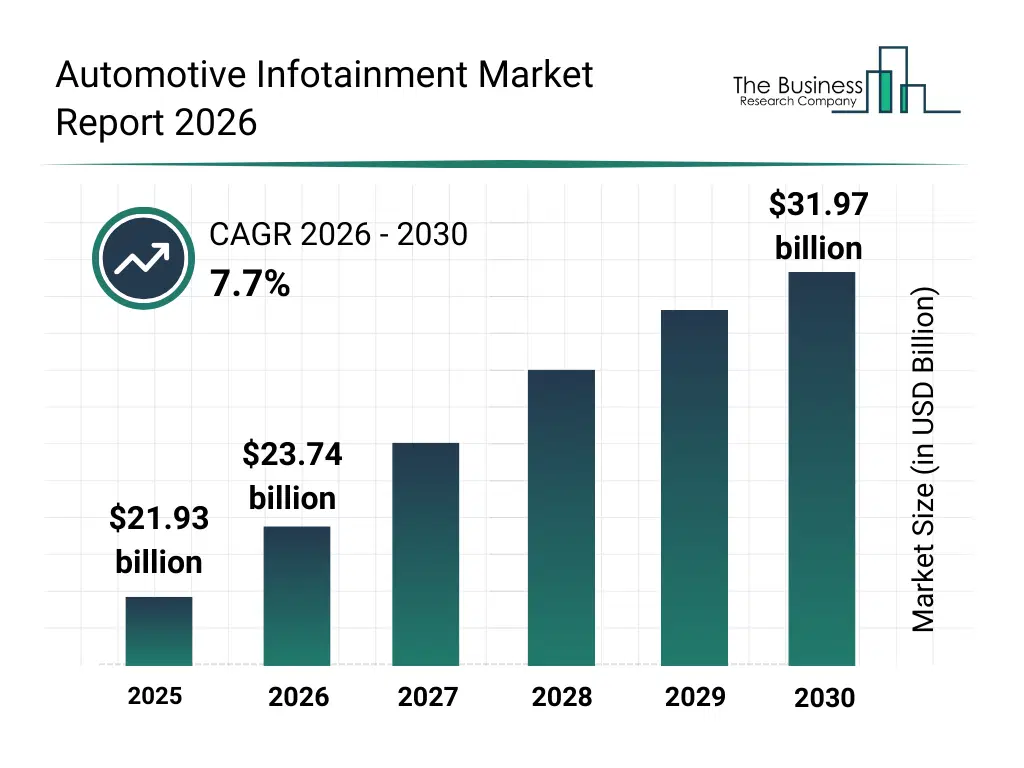
What Is The Automotive Infotainment Market Size and Share 2026?
The automotive infotainment market size has grown strongly in recent years. It will grow from $21.93 billion in 2025 to $23.74 billion in 2026 at a compound annual growth rate (CAGR) of 8.2%. The growth in the historic period can be attributed to increasing consumer demand for in-car entertainment, expansion of connected vehicle technologies, rising installation of infotainment systems in passenger cars, improvements in automotive display technologies, growing software-defined vehicle architectures.What Is The Automotive Infotainment Market Growth Forecast?
The automotive infotainment market size is expected to see strong growth in the next few years. It will grow to $31.97 billion in 2030 at a compound annual growth rate (CAGR) of 7.7%. The growth in the forecast period can be attributed to increasing adoption of immersive in-car experiences, rising integration of cloud-based infotainment platforms, expansion of infotainment in commercial vehicles, growing focus on personalized user interfaces, advancements in automotive HMI technologies. Major trends in the forecast period include expansion of digital cockpit platforms, growing adoption of touch-based and voice-controlled interfaces, increasing integration of smartphone connectivity systems, rising demand for high-resolution automotive displays, enhanced focus on in-vehicle user experience.

Global Automotive Infotainment Market Segmentation
1) By Operating System: QNX, Microsoft, Linux 2) By Form: Embedded, Tethered, Integrated 3) By Vehicle Type: Passenger Car, Light Commercial Vehicle, Heavy Commercial Vehicle Subsegments: 1) By QNX: QNX Neutrino RTOS, QNX Car Platform 2) By Microsoft: Windows Embedded Automotive, Windows Automotive Platform 3) By Linux: Android Automotive OS, Automotive Grade Linux (AGL) The top segments in the automotive infotainment market will be: • QNX will reach $21.36 billion by 2030. • Linux will reach $11.23 billion by 2030. • Microsoft will reach $5.72 billion by 2030.What Is The Driver Of The Automotive Infotainment Market?
The rising adoption of electric vehicles is expected to propel the growth of the automotive infotainment market going forward. Electric vehicles (EVs) are automobiles powered by electricity rather than traditional internal combustion engines that rely on gasoline or diesel. Automotive infotainment systems in electric vehicles provide information, entertainment, and connectivity while also optimizing energy efficiency and range management. For instance, in July 2023, according to the International Energy Agency, a France-based intergovernmental organization, over 2.3 million electric cars were sold globally, marking a 25% year-on-year increase, with total sales projected to reach 14 million by year-end, up 35% from 2022. Therefore, the rising adoption of electric vehicles is driving the growth of the automotive infotainment industry.
Infographic Chart Showing Key Market Drivers Analysis And Restraints For Automotive Infotainment Market
The chart presents an impact analysis of key drivers and restraints, quantifying their relative influence on the market's growth rate and helping assess the balance between growth enablers and limiting factors. This chart offers a high-level perspective; the full report contains more detailed insights.
How Will The Drivers Impact Growth In The Global Automotive Infotainment Market?
• Rising Demand For Connected And Smart In -Vehicle Experiences (High) – During the forecast period, the rising demand for connected and smart in -vehicle experiences is expected to become a key growth driver for the automotive infotainment market by 2030. The increasing consumer demand for connected vehicles and enhanced in -car digital experiences is a primary driver for the automotive infotainment market. Modern buyers expect seamless smartphone integration, real -time navigation, voice assistants, and multimedia streaming within vehicles. Integration of technologies such as apple carplay, android auto, and cloud -based services enhances user convenience and personalization. As vehicles evolve into connected digital ecosystems, infotainment systems are becoming a critical differentiating feature for oems. • Technological Advancements In HMI, Displays, And AI Integration (High) – During the forecast period, the technological advancements in hmi, displays, and ai integration is expected to emerge as a major factor driving the expansion of the automotive infotainment market by 2030. Rapid advancements in display technologies, user interfaces, and ai-enabled voice recognition significantly accelerate market growth. Automakers are adopting larger touchscreens, curved oled displays, augmented reality (ar) head-up displays, and advanced human-machine interface (hmi) systems. Ai-powered voice assistants and over-the-air (ota) updates improve functionality and user engagement. These innovations enhance safety, personalization, and overall driving experience, driving higher adoption rates across vehicle segments. • Increasing EV Adoption And Vehicle Digitalization (Low) – During the forecast period, the increasing ev adoption and vehicle digitalization is expected to act as a key growth catalyst for the automotive infotainment market by 2030. The growing penetration of electric vehicles (evs) and premium vehicle segments further supports market expansion. Evs typically feature advanced digital dashboards and centralized infotainment systems as core components of their value proposition. Premium and mid-segment vehicles increasingly offer multi-screen layouts, connected services, and subscription-based digital features. As electrification and vehicle digitalization progress globally, infotainment system demand rises proportionally.How Will The Restraints Impact Growth In The Global Automotive Infotainment Market?
• High Development Costs And Integration Challenges (High) – During the forecast period, the high system development costs and integration complexity act as significant restraints in the automotive infotainment market. Designing advanced infotainment platforms requires substantial investment in software development, cybersecurity, hardware components, and compliance with automotive safety standards. Integration with multiple vehicle systems such as adas, telematics, and connectivity modules increases engineering complexity. These factors can limit adoption in entry-level vehicle segments and price-sensitive markets. • Cybersecurity And Data Privacy Concerns (Medium) – During the forecast period, the cybersecurity risks and data privacy concerns also restrain market growth. Connected infotainment systems are vulnerable to hacking, malware, and unauthorized data access, posing safety and reputational risks. Increasing regulatory scrutiny on vehicle data protection requires robust cybersecurity frameworks and regular system updates. Addressing these risks increases operational costs and technical complexity for oems and suppliers. • Dependence On Semiconductor Supply Chain And Hardware Shortages (High) – During the forecast period, the dependence on the semiconductor supply chain and hardware shortages act as a restraint for the automotive infotainment market by creating production delays and limiting system availability. Infotainment systems rely heavily on advanced chips, processors, and display components, which are often subject to global supply fluctuations. Any disruption in semiconductor manufacturing or logistics directly impacts vehicle production schedules. This leads to delayed deliveries, increased costs, and reduced output for automakers. As a result, supply chain vulnerabilities restrict the smooth scaling of infotainment system deployment across the automotive industry.Key Players In The Global Automotive Infotainment Market
Major companies operating in the automotive infotainment market are Robert Bosch GmbH; HARMAN International; Mitsubishi Electric Corporation; DENSO CORPORATION; Visteon Corporation; Kenwood Corporation; Continental AG; Pioneer Corporation; Panasonic Corporation; Alpine Electronics; Delphi Automotive PLC; ALLGo Embedded Systems Pvt. Ltd.; Aptiv PLC; Clarion Co. Ltd.; Aisin Seiki Co. Ltd.; Garmin Ltd.; Pacific Industrial Co. Ltd.; Fujitsu Ten Limited; Magnetic Marelli SpA; General Motors Company; Tesla Inc.; HyundAI Mobis Co. Ltd.; TomTom International BV; Sony Corporation; LG Electronics Inc.; Blaupunkt GmbH; Qualcomm Incorporated; NXP Semiconductors N. V.; Infineon Technologies AG; JVC Kenwood Corporation; Bose Corporation
This chart is for illustrative purposes; the full report includes a detailed competitor analysis and comprehensive overview of the top 10 companies in the market.
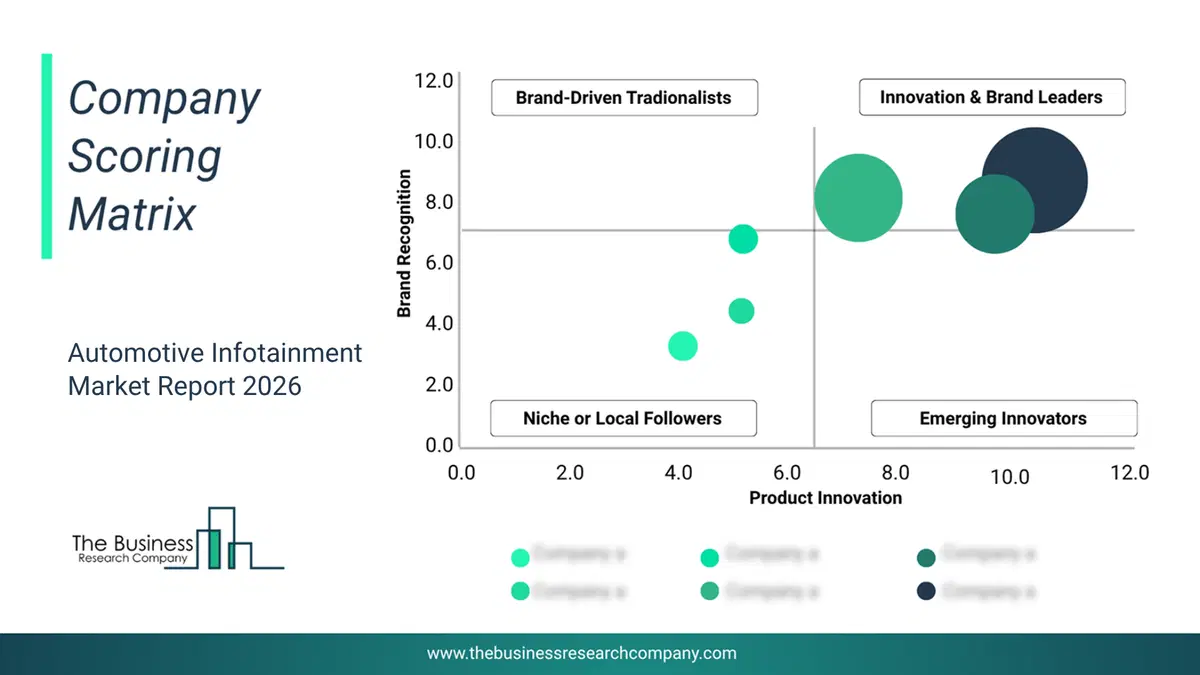
This chart maps companies by product innovation and brand strength, with bubble size indicating relative revenue, helping identify market leaders, challengers, and niche players. This is an illustrative chart; the full report provides a complete and accurate competitive analysis.
Global Automotive Infotainment Market Trends and Insights
Major companies operating in the automotive infotainment segment are focusing on developing advanced integrated cockpit and telematics platforms to enhance connectivity, streamline architecture, and reduce system redundancy. These platforms consolidate multiple vehicle functions such as infotainment, instrument cluster, and telematics control into unified systems to bolster user experience and reduce cost. For instance, in April 2024, Marelli, an Italy‑based mobility‑technology supplier, launched its ProConnect integrated cockpit and 5G telematics platform aimed at the Chinese market. Powered by MediaTek’s MT8675 system‑on‑chip, the platform manages instrument cluster and infotainment systems simultaneously, supports up to six displays and twelve cameras, and delivers 5G Release 15 telematics performance, while eliminating redundant components and potentially saving OEMs up to 40% compared to traditional architectures.What Are Latest Mergers And Acquisitions In The Automotive Infotainment Market?
In March 2024, Apollo Global Management, a US-based investment firm, acquired a majority stake in Panasonic Automotive Systems Co., Ltd. (PAS) for approximately $2.05 billion (¥311 billion). Through this acquisition, Apollo aims to expand PAS’s capabilities in advanced cockpit, infotainment, and ADAS enabled systems while Panasonic retains a 20% stake and continues servicing automakers globally. Panasonic Automotive Systems Co., Ltd. is a Japan-based company specializing in automotive infotainment and ADAS technologies.
Regional Insights
Asia-Pacific was the largest region in the automotive infotainment market in 2025. The regions covered in this market report are Asia-Pacific, South East Asia, Western Europe, Eastern Europe, North America, South America, Middle East, Africa. The countries covered in this market report are Australia, Brazil, China, France, Germany, India, Indonesia, Japan, Taiwan, Russia, South Korea, UK, USA, Canada, Italy, SpainWhat Defines the Automotive Infotainment Market?
The automotive infotainment market includes revenues earned by entities by providing hardware and software that can be used to display technologies to display multimedia and information content in automobiles for an enhanced in-vehicle experience. It provides navigation, audio/visual entertainment content management, rear-seat entertainment, connectivity with smartphones, and voice commands in vehicles. The market value includes the value of related goods sold by the service provider or included within the service offering. Only goods and services traded between entities or sold to end consumers are included.How is Market Value Defined and Measured?
The market value is defined as the revenues that enterprises gain from the sale of goods and/or services within the specified market and geography through sales, grants, or donations in terms of the currency (in USD unless otherwise specified). The revenues for a specified geography are consumption values that are revenues generated by organizations in the specified geography within the market, irrespective of where they are produced. It does not include revenues from resales along the supply chain, either further along the supply chain or as part of other products.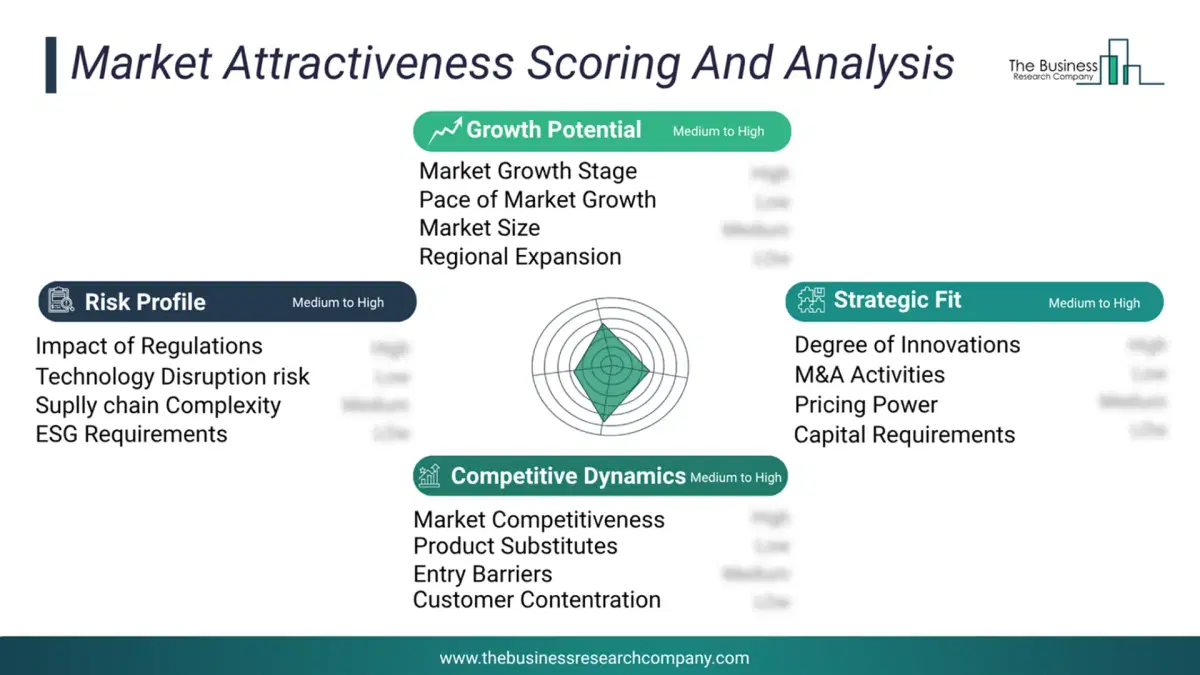
This chart presents market attractiveness based on a quantitative evaluation of growth, competition, strategic alignment, and risk, offering a clear view of opportunity areas for decision-making. This chart is for illustrative purposes; the full report contains the complete analysis.
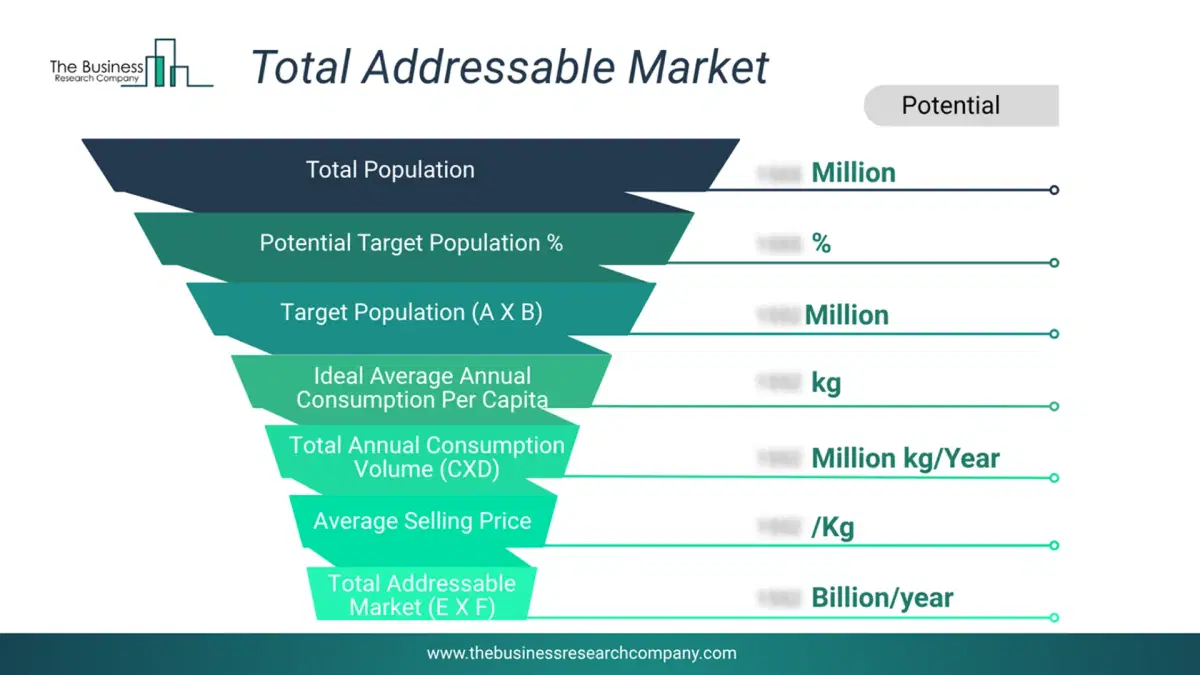
This chart highlights the Total Addressable Market (TAM) by estimating the maximum revenue opportunity using an assumption-driven approach, supporting strategic planning and opportunity sizing across markets. The chart is illustrative; the full report provides a more comprehensive analysis.
What Key Data and Analysis Are Included in the Automotive Infotainment Market Report 2026?
The automotive infotainment market research report is one of a series of new reports from The Business Research Company that provides market statistics, including industry global market size, regional shares, competitors with the market share, detailed market segments, market trends and opportunities, and any further data you may need to thrive in the automotive infotainment industry. The market research report delivers a complete perspective of everything you need, with an in-depth analysis of the current and future state of the industry.Automotive Infotainment Market Report Forecast Analysis
| Report Attribute | Details |
|---|---|
| Market Size Value In 2026 | $23.74 billion |
| Revenue Forecast In 2030 | $31.97 billion |
| Growth Rate | CAGR of 7.7% from 2026 to 2030 |
| Base Year For Estimation | 2025 |
| Actual Estimates/Historical Data | 2020-2025 |
| Forecast Period | 2026 - 2030 |
| Market Representation | Revenue in USD Billion and CAGR from 2026 to 2030 |
| Segments Covered | Operating System, Form, Vehicle Type |
| Regional Scope | Asia-Pacific, Western Europe, Eastern Europe, North America, South America, Middle East, Africa |
| Country Scope | The countries covered in the report are Australia, Brazil, China, France, Germany, India, ... |
| Key Companies Profiled | Robert Bosch GmbH; HARMAN International; Mitsubishi Electric Corporation; DENSO CORPORATION; Visteon Corporation; Kenwood Corporation; Continental AG; Pioneer Corporation; Panasonic Corporation; Alpine Electronics; Delphi Automotive PLC; ALLGo Embedded Systems Pvt. Ltd.; Aptiv PLC; Clarion Co. Ltd.; Aisin Seiki Co. Ltd.; Garmin Ltd.; Pacific Industrial Co. Ltd.; Fujitsu Ten Limited; Magnetic Marelli SpA; General Motors Company; Tesla Inc.; HyundAI Mobis Co. Ltd.; TomTom International BV; Sony Corporation; LG Electronics Inc.; Blaupunkt GmbH; Qualcomm Incorporated; NXP Semiconductors N. V.; Infineon Technologies AG; JVC Kenwood Corporation; Bose Corporation |
| Customization Scope | Request for Customization |
| Pricing And Purchase Options | Explore Purchase Options |