

Black Lung Disease Market Report 2026
Global Outlook – By Type (Simple Coal Worker’s Pneumoconiosis, Complicated Coal Worker’s Pneumoconiosis), By Treatment (Oxygen Therapy, Bronchodilators, Lung Transplant, Stem Cell Therapy, Other Treatment), By Diagnosis (Biopsy, Imaging, Full Blood Count, Pulmonary Or Lung Function Tests, Physical Examination, Other Diagnosis), By End Users (Hospitals And Clinics, Research Organizations And Academic Institutes, Diagnostic Centers And Labs, Other End Users) - Market Size, Trends, And Global Forecast 2026-2035
Black Lung Disease Market Overview
• Black Lung Disease market size has reached to $10.92 billion in 2025 • Expected to grow to $22.5 billion in 2030 at a compound annual growth rate (CAGR) of 15.8% • Growth Driver: Mining Industry Expansion Fuels The Prevalence Of Black Lung Disease • North America was the largest region in 2025 and Asia-Pacific is the fastest growing region.
What Is Covered Under Black Lung Disease Market?
Black lung disease is a chronic and potentially fatal lung disease that affects coal miners and other individuals who work in coal mines or are exposed to coal dust. The disease is characterized by the accumulation of coal dust particles in the lungs, which can lead to inflammation, scarring and damage to lung tissues. The main types of black lung disease are simple coal workers’ pneumoconiosis, complicated coal workers’ pneumoconiosis and others. Simple coal worker's pneumoconiosis (CWP), also known as simple black lung disease, is a lung condition caused by the inhalation of coal dust over an extended period. The various treatment includes oxygen therapy, bronchodilators, lung transplant, stem cell therapy and others and involves various diagnoses such as biopsy, imaging, full blood count, pulmonary or lung function tests, physical examination and others. These are used by various end-users such as hospitals and clinics, research organizations and academic institutes, diagnostic centers and labs and others.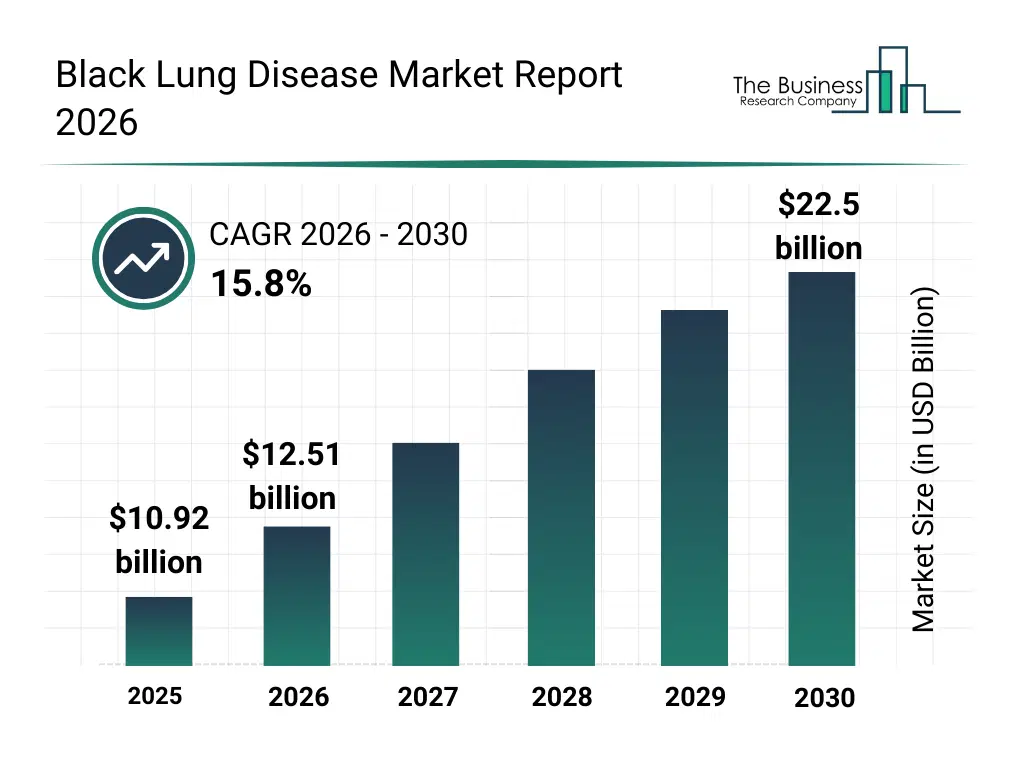
What Is The Black Lung Disease Market Size and Share 2026?
The black lung disease market size has grown rapidly in recent years. It will grow from $10.92 billion in 2025 to $12.51 billion in 2026 at a compound annual growth rate (CAGR) of 14.6%. The growth in the historic period can be attributed to increasing coal mining activities, prolonged exposure to coal dust among miners, limited early diagnostic access in mining regions, rising incidence of respiratory occupational diseases, dependence on traditional diagnostic methods.What Is The Black Lung Disease Market Growth Forecast?
The black lung disease market size is expected to see rapid growth in the next few years. It will grow to $22.5 billion in 2030 at a compound annual growth rate (CAGR) of 15.8%. The growth in the forecast period can be attributed to increasing adoption of advanced diagnostic technologies, rising investments in occupational health programs, growing research in stem cell and regenerative therapies, expansion of healthcare access in mining regions, increasing regulatory enforcement on worker health safety. Major trends in the forecast period include improved diagnostic imaging for early detection, growing focus on preventive occupational health screening, rising adoption of advanced pulmonary function testing, expansion of research into regenerative therapies, enhanced monitoring of coal dust exposure.Global Black Lung Disease Market Segmentation
1) By Type: Simple Coal Worker’s Pneumoconiosis, Complicated Coal Worker’s Pneumoconiosis 2) By Treatment: Oxygen Therapy, Bronchodilators, Lung Transplant, Stem Cell Therapy, Other Treatment 3) By Diagnosis: Biopsy, Imaging, Full Blood Count, Pulmonary Or Lung Function Tests, Physical Examination, Other Diagnosis 4) By End Users: Hospitals And Clinics, Research Organizations And Academic Institutes, Diagnostic Centers And Labs, Other End Users Subsegments: 1) By Simple Coal Worker’s Pneumoconiosis: Asymptomatic Simple Pneumoconiosis, Symptomatic Simple Pneumoconiosis 2) By Complicated Coal Worker’s Pneumoconiosis: Progressive Massive Fibrosis (PMF), Complicated Pneumoconiosis With Respiratory SymptomsWhat Are The Drivers Of The Black Lung Disease Market?
The increasing mining activities are expected to propel the growth of the black lung disease market going forward. Mining activities involve extracting valuable minerals, ores, and other geological materials from the earth's crust. Black lung disease is caused by mining activities and inhaling coal mine dust, which contains dangerous carbon-containing particles and affects coal miners. For instance, in July 2024, according to the International Energy Agency (IEA), a France-based intergovernmental organization, reported that global coal production in 2023 grew by 3.1% to 8,970 Mt, an all-time high, driven by a push from the top three coal producers such as China, India, and Indonesia. Therefore, increasing mining activities are driving the growth of the black lung disease industry. The increasing prevalence of tuberculosis is expected to propel the growth of the black lung disease market going forward. Tuberculosis refers to a bacterial infection primarily caused by Mycobacterium tuberculosis. It spreads through the air when an infected person coughs or sneezes, and it can lead to symptoms such as coughing, fever, weight loss, and fatigue. The increasing prevalence of tuberculosis (TB) is a factor in black lung disease because people with tuberculosis (TB) are at increased risk of developing black lung disease, and they are more likely to be exposed to coal dust. For instance, in November 2024, according to the Centers for Disease Control and Prevention, a US-based national public health organization, reported that in 2023, reported TB disease cases and incidence rate (number of TB cases per 100,000 persons) in the United States increased for the third year in a row. Therefore, the increasing prevalence of tuberculosis is driving the growth of the black lung disease industry. Government funding initiatives are expected to propel the growth of the black lung disease market. Government funding refers to financial resources a government provides, typically at the federal, state, or local level, to support various activities, programs, projects, initiatives, or organizations serving public interests or fulfilling government objectives. Government authorities are implementing specific regulations and initiatives to protect coal miners from black lung disease. For instance, in June 2024, according to United States Congress, a US-based Legislative branch of the United States federal government, reported that the FY2025 budget request proposes an NIH and ARPA-H program level of $50.174 billion, an increase of $1.363 billion (+2.8%) over the FY2024-enacted level. Therefore, government funding initiatives are driving the black lung disease industry.Key Players In The Global Black Lung Disease Market
Major companies operating in the black lung disease market are Pfizer Inc., Johnson and Johnson, Siemens AG, General Electric, F. Hoffmann-La Roche AG, Merck and Co. Inc., Bayer AG, Novartis AG, Sanofi S.A., AstraZeneca plc, GlaxoSmithKline plc, Medtronic plc, Eli Lilly and Company, Boehringer Ingelheim International GmbH, Toshiba Corporation, Koninklijke Philips N.V., Mayo Clinic, Baxter International Inc., Teva Pharmaceutical Industries Ltd., Sun Pharmaceutical Industries Ltd., Aurobindo Pharma Limited, Hikma Pharmaceuticals plc, Lupin LimitedRegional Outlook
North America was the largest region in the black lung disease market in 2025. Asia-Pacific is expected to be the fastest-growing region in the forecast period. The regions covered in this market report are Asia-Pacific, South East Asia, Western Europe, Eastern Europe, North America, South America, Middle East, Africa. The countries covered in this market report are Australia, Brazil, China, France, Germany, India, Indonesia, Japan, Taiwan, Russia, South Korea, UK, USA, Canada, Italy, Spain.What Defines the Black Lung Disease Market?
The black lung disease market includes revenues earned by entities by providing pulmonary rehabilitation (PR), medical services and palliative care. The market value includes the value of related goods sold by the service provider or included within the service offering. The market value includes the value of related goods sold by the service provider or included within the service offering. Only goods and services traded between entities or sold to end consumers are included.How is Market Value Defined and Measured?
The market value is defined as the revenues that enterprises gain from the sale of goods and/or services within the specified market and geography through sales, grants, or donations in terms of the currency (in USD unless otherwise specified). The revenues for a specified geography are consumption values that are revenues generated by organizations in the specified geography within the market, irrespective of where they are produced. It does not include revenues from resales along the supply chain, either further along the supply chain or as part of other products.What Key Data and Analysis Are Included in the Black Lung Disease Market Report 2026?
The black lung disease market research report is one of a series of new reports from The Business Research Company that provides market statistics, including industry global market size, regional shares, competitors with the market share, detailed market segments, market trends and opportunities, and any further data you may need to thrive in the black lung disease industry. The market research report delivers a complete perspective of everything you need, with an in-depth analysis of the current and future state of the industry.Black Lung Disease Market Report Forecast Analysis
| Report Attribute | Details |
|---|---|
| Market Size Value In 2026 | $12.51 billion |
| Revenue Forecast In 2035 | $22.5 billion |
| Growth Rate | CAGR of 14.6% from 2026 to 2035 |
| Base Year For Estimation | 2025 |
| Actual Estimates/Historical Data | 2020-2025 |
| Forecast Period | 2026 - 2030 - 2035 |
| Market Representation | Revenue in USD Billion and CAGR from 2026 to 2035 |
| Segments Covered | Type, Treatment, Diagnosis, End Users |
| Regional Scope | Asia-Pacific, Western Europe, Eastern Europe, North America, South America, Middle East, Africa |
| Country Scope | The countries covered in the report are Australia, Brazil, China, France, Germany, India, ... |
| Key Companies Profiled | Pfizer Inc., Johnson and Johnson, Siemens AG, General Electric, F. Hoffmann-La Roche AG, Merck and Co. Inc., Bayer AG, Novartis AG, Sanofi S.A., AstraZeneca plc, GlaxoSmithKline plc, Medtronic plc, Eli Lilly and Company, Boehringer Ingelheim International GmbH, Toshiba Corporation, Koninklijke Philips N.V., Mayo Clinic, Baxter International Inc., Teva Pharmaceutical Industries Ltd., Sun Pharmaceutical Industries Ltd., Aurobindo Pharma Limited, Hikma Pharmaceuticals plc, Lupin Limited |
| Customization Scope | Request for Customization |
| Pricing And Purchase Options | Explore Purchase Options |