
Broadcast And Media Technology Market Report 2026
Global Outlook – By Solution Type (Web Content Management, Content Storage Solutions, Editorial And Print Workflow, Media OR Digital Asset Management, Revenue Management, Ad And Data Management, User management), By Hosting Model Type (Integrated, Standalone), By End User Type (Broadcasters, Distributors, OTT, IPTV) – Market Size, Trends, Strategies, and Forecast to 2030
Broadcast And Media Technology Market Overview
• Broadcast And Media Technology market size has reached to $60.1 billion in 2025 • Expected to grow to $109.23 billion in 2030 at a compound annual growth rate (CAGR) of 12.7% • Growth Driver: Increasing Ott Services Usage Drives Growth Of Broadcast And Media Technology Market • Market Trend: Innovative Ip-driven Systems Enhance Live Production And Remote Collaboration • North America was the largest region in 2025 and Asia-Pacific is the fastest growing region.Market Gains By 2030 – Top Opportunities By Segment
Market Gain identifies the most promising market opportunities by highlighting the segments or products expected to generate the highest incremental revenue growth over the next five years.
What Is Covered Under Broadcast And Media Technology Market?
The broadcast and media technology refer to a variety of communication systems that entail transferring data across long distances utilizing electronic and electromagnetic approaches. Radio and television broadcasting technology, satellite broadcasting technology, digital cable and satellite television technology, digital terrestrial television, and satellite television technologies are examples of broadcast and media technology. The various solutions in broadcast and media technology include web content management, content storage solutions, editorial, and print workflows, media/digital asset management, revenue management, ad and data management, and user management. Web content management is a software used to manage content, allowing multiple contributors to create, edit, and publish. The hosting models in the broadcast and media technology include integrated and standalone. The end users of broadcast and media technology include broadcasters, distributors, OTT, and IPTV.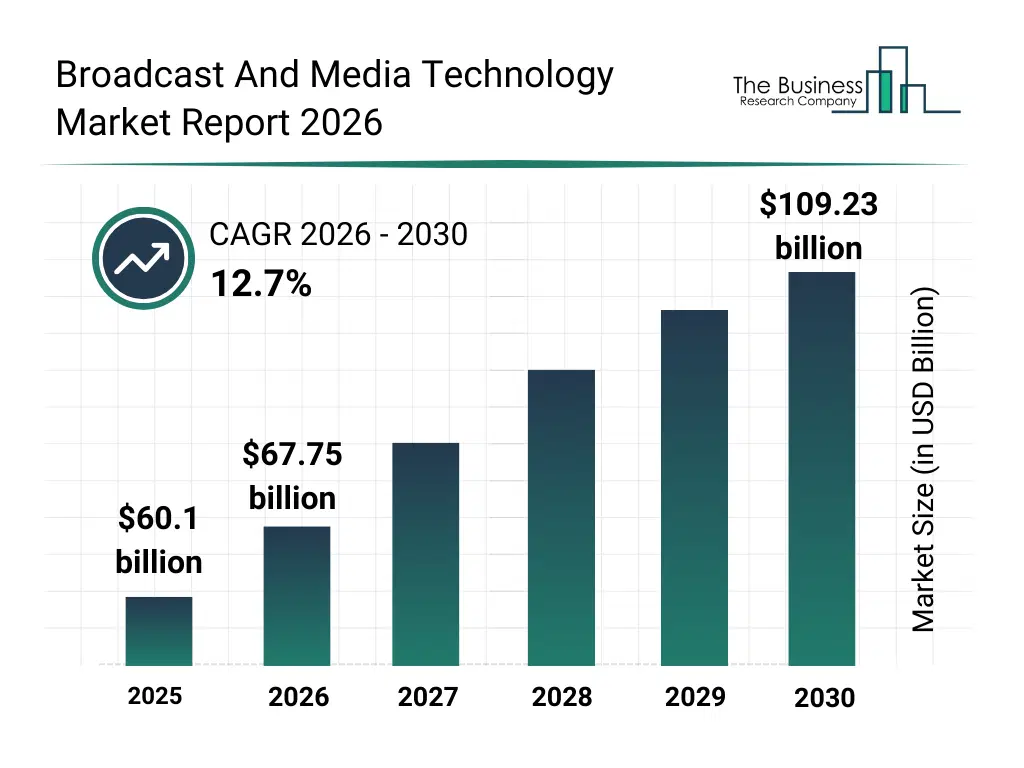
What Is The Broadcast And Media Technology Market Size and Share 2026?
The broadcast and media technology market size has grown rapidly in recent years. It will grow from $60.1 billion in 2025 to $67.75 billion in 2026 at a compound annual growth rate (CAGR) of 12.7%. The growth in the historic period can be attributed to transition from analog to digital broadcasting, growth of satellite and cable television, expansion of global media networks, early adoption of content management platforms, increasing demand for multi-channel distribution.What Is The Broadcast And Media Technology Market Growth Forecast?
The broadcast and media technology market size is expected to see rapid growth in the next few years. It will grow to $109.23 billion in 2030 at a compound annual growth rate (CAGR) of 12.7%. The growth in the forecast period can be attributed to expansion of immersive media experiences, rising demand for personalized content delivery, increasing investments in cloud-native broadcasting, growth of data-driven monetization models, wider adoption of ai-powered media workflows. Major trends in the forecast period include increasing shift toward cloud-based broadcasting platforms, rising adoption of digital asset management systems, growing integration of data-driven advertising technologies, expansion of ott and streaming infrastructure, enhanced focus on audience analytics.
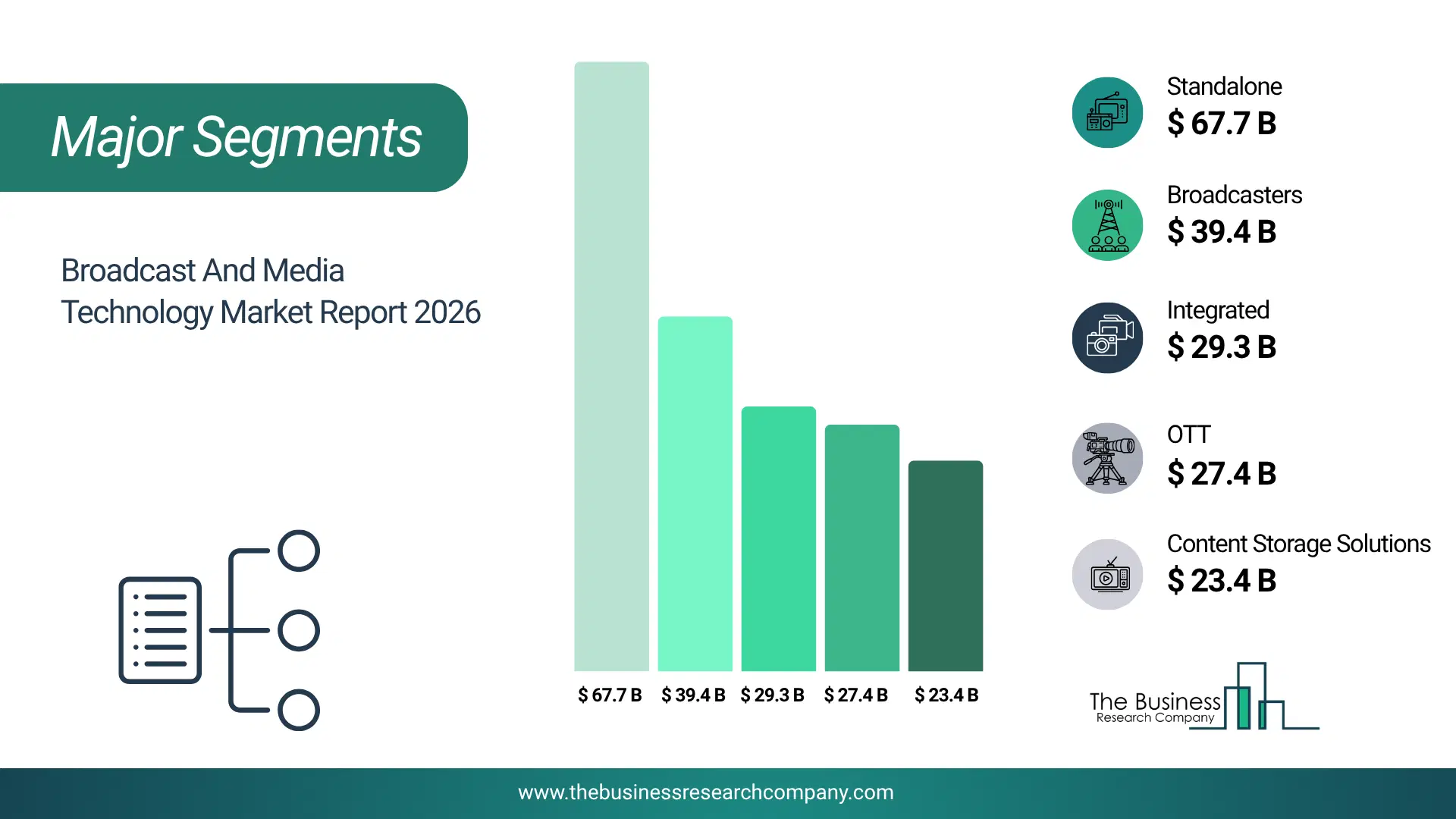
Global Broadcast And Media Technology Market Segmentation
1) By Solution Type: Web Content Management, Content Storage Solutions, Editorial And Print Workflow, Media OR Digital Asset Management, Revenue Management, Ad And Data Management, User management 2) By Hosting Model Type: Integrated, Standalone 3) By End User Type: Broadcasters, Distributors, OTT, IPTV Subsegments: 1) By Web Content Management: Content Creation And Editing Tools, Content Delivery And Distribution, Analytics And Reporting Tools 2) By Content Storage Solutions: Cloud Storage, On-Premises Storage, Archiving Solutions 3) By Editorial And Print Workflow: Workflow Management Systems, Collaboration Tools, Proofing And Approval Solutions 4) By Media Or Digital Asset Management: Asset Organization And Cataloging, Metadata Management, Rights And Usage Management 5) By Revenue Management: Pricing And Billing Solutions, Subscription Management, Revenue Analytics 6) By Ad And Data Management: Ad Serving Solutions, Audience Analytics And Insights, Programmatic Advertising Platforms 7) By User Management: User Access And Permissions Management, Authentication And Security Solutions, User Engagement Tools The top segments in the broadcast and media technology market will be: • Standalone will reach $67764.48 Million by 2030. • Broadcasters will reach $39397.23 Million by 2030. • Integrated will reach $29324.19 Million by 2030. • OTT will reach $27479.72 Million by 2030. • Content Storage Solutions will reach $23412.7 Million by 2030.What Is The Driver Of The Broadcast And Media Technology Market?
The increasing use of over-the-top (OTT) services is expected to propel the growth of the broadcast and media technology market going forward. OTT refers to a kind of content delivery paradigm that displaces traditional cable or satellite television providers by allowing consumers to stream and access audio, video, and another media material directly via the Internet. OTT services use broadcast and media technology to stream video content to users, enabling users to watch high-quality video content on a variety of devices, including smartphones, tablets, and smart TVs. For instance, in April 2023, according to Netflix, Inc., a U.S.-based streaming media company, reported that having 231 million paying subscribers in Q1 2023. Therefore, the increasing use of OTT services is driving the growth of the broadcast and media technology industry.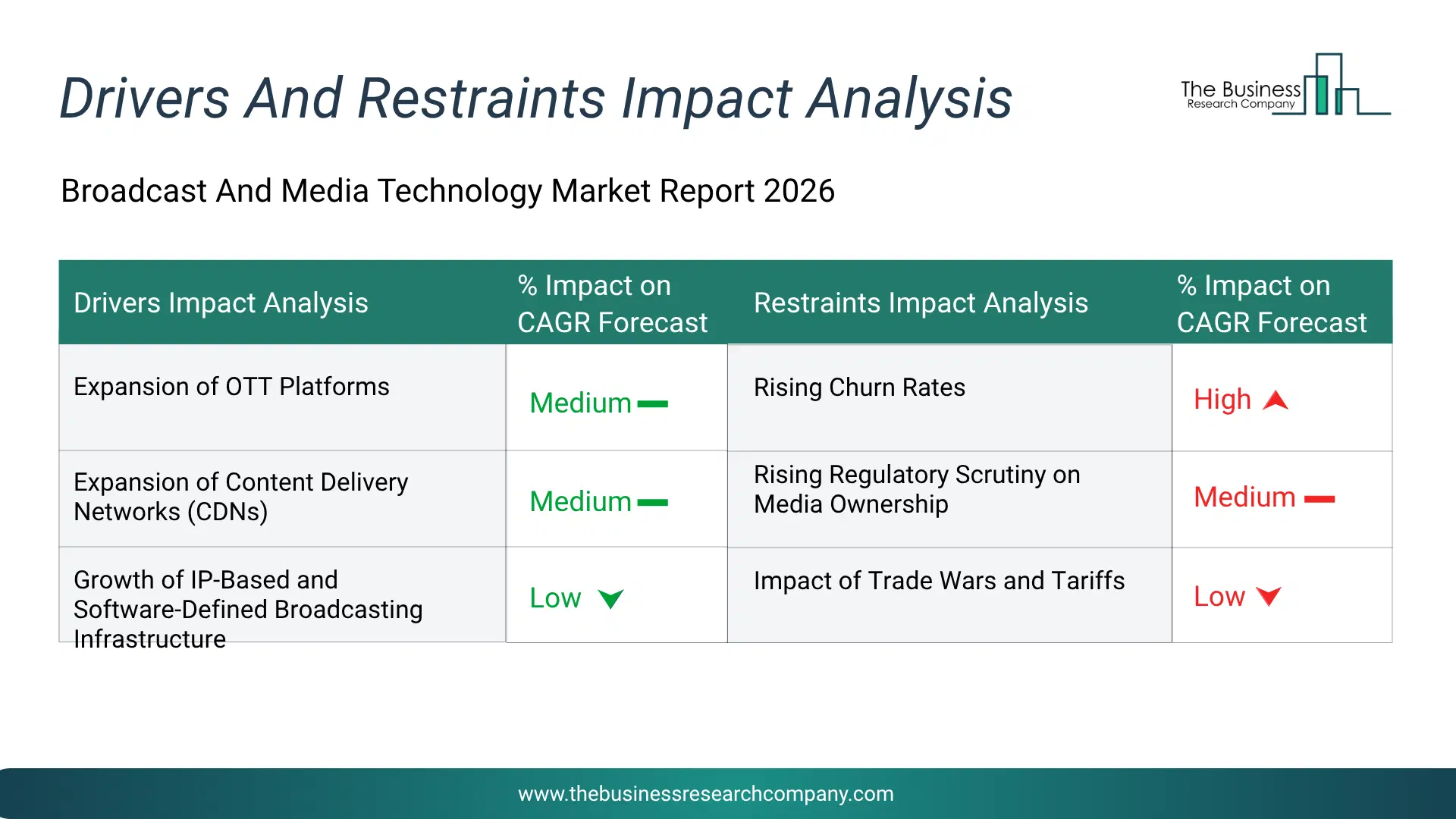
Infographic Chart Showing Key Market Drivers Analysis And Restraints For Broadcast And Media Technology Market
The chart presents an impact analysis of key drivers and restraints, quantifying their relative influence on the market's growth rate and helping assess the balance between growth enablers and limiting factors. This chart offers a high-level perspective; the full report contains more detailed insights.
How Will The Drivers Impact Growth In The Global Broadcast And Media Technology Market?
• Expansion of OTT Platforms (Medium) – During the forecast period, the expansion of ott platforms will become a key driver of growth in the broadcast and media technology market by 2030. as audiences increasingly prefer on-demand, subscription-based, and ad-supported streaming services, media companies are expanding their ott portfolios to reach broader audiences across multiple devices and regions. this shift is fueling demand for advanced broadcast and media technologies that enable efficient content creation, encoding, streaming, digital rights management, analytics, and personalized viewing experiences. with global ott adoption accelerating and new platforms continually entering the market to capture rising digital viewership, the need for scalable, flexible, and technology-enabled broadcast solutions is growing substantially, thereby supporting overall market growth. as a result, the expansion of ott platforms is anticipated to contributing to a 1.5% annual growth in the market. • Expansion of Content Delivery Networks (CDNs) (Medium) – During the forecast period, the expansion of content delivery networks (cdns) will emerge as a major factor driving the expansion of the broadcast and media technology market by 2030. as global audiences increasingly access live and on-demand video across multiple devices and regions, media companies require robust delivery infrastructures that ensure low latency, high reliability, and consistent streaming quality at scale. large cdns meet these needs by delivering content closer to end users, easing network congestion, reducing buffering, and enhancing overall viewing experiences, especially for high-traffic live events such as sports, news, and entertainment. as broadcasters, streaming platforms, and content owners continue to expand their digital distribution strategies to address growing global demand, dependence on large, resilient cdns rises significantly, thereby supporting market growth. consequently, the expansion of content delivery networks (cdns) is projected to contributing to a 1.0% annual growth in the market. • Growth of IP-Based and Software-Defined Broadcasting Infrastructure (Low) – During the forecast period, the growth of ip-based and software-defined broadcasting infrastructure will serve as a key growth catalyst for the broadcast and media technology market by 2030. as broadcasters transition away from traditional sdi-based systems toward ip-enabled and software-defined networks, they gain greater flexibility, scalability, and cost efficiency in managing complex media workflows. ip-based infrastructures enable media organizations to route, process, and distribute content more dynamically across on-premise, remote, and cloud environments, supporting modern production requirements such as remote production, virtualization, and multi-platform delivery. as the industry increasingly prioritizes agility, interoperability, and future-ready network architectures to support high-bandwidth video and distributed production models, investment in ip-based and software-defined broadcasting solutions continues to rise, thereby driving the growth of the broadcast and media technology market. therefore, this growth of ip-based and software-defined broadcasting infrastructure is projected to supporting to a 0.8% annual growth in the market. • Growth of Digital Advertising (Low) – During the forecast period, the growth of digital advertising will propel the growth of the broadcast and media technology market. As advertisers continue to shift budgets toward digital and addressable channels, broadcasters and media companies are increasingly investing in advanced technologies to support targeted advertising, audience measurement, and cross-platform ad delivery. Digital advertising relies heavily on broadcast and media technologies such as ad insertion systems, data analytics platforms, content management tools, and programmatic advertising infrastructure to enable precise targeting and real-time performance tracking. As global digital advertising revenues continue to rise and brands prioritize data-driven marketing strategies, demand for advanced broadcast and media technology solutions increases significantly, thereby driving the growth of the broadcast and media technology market. The growth of digital advertising growth contribution during the forecast period in 2025 is 0.5%.How Will The Restraints Impact Growth In The Global Broadcast And Media Technology Market?
• Rising Churn Rates (Medium) – During the forecast period, rising churn rates are restricting the growth of the broadcast and media technology market during the forecast period. as streaming platforms and digital broadcasters face increasing subscriber cancellations, media companies are shifting their focus from aggressive expansion to customer retention and cost control. high churn rates reduce revenue stability and create uncertainty around long-term subscriber growth, limiting the ability of broadcasters and streaming services to commit to large-scale investments in advanced broadcast infrastructure and emerging media technologies. as competition intensifies and audiences become more price-sensitive and selective in their content choices, sustained churn pressures are expected to constrain spending on new broadcast and media technology deployments. this growing emphasis on retention over expansion is gradually restraining the growth of the broadcast and media technology market. growth affected by rising churn rates during the forecast period in 2025 is -2.5%. • Rising Regulatory Scrutiny on Media Ownership (Medium) – During the forecast period, rising regulatory scrutiny on media ownership is restricting the growth of the broadcast and media technology market during the forecast period. increasing examination of ownership concentration, cross-media consolidation, and market dominance by regulators is creating uncertainty for broadcasters, media groups, and technology providers. stricter ownership rules and prolonged approval processes can delay mergers, acquisitions, and network expansions, limiting the pace at which companies invest in new broadcast infrastructure and advanced media technologies. as regulatory bodies intensify oversight of media ownership structures amid rapid industry transformation, broadcasters may adopt a more cautious approach toward capital expenditure and long-term technology investments. this environment of heightened regulatory scrutiny is gradually restraining the adoption and expansion of broadcast and media technology solutions, particularly in markets where ownership regulations play a critical role in shaping industry structure. growth affected by rising regulatory scrutiny on media ownership during the forecast period in 2025 is -1.5% • Impact of Trade Wars and Tariffs (Low) – During the forecast period, the impact of trade wars and tariffs is restricting the growth of the broadcast and media technology market during the forecast period. ongoing trade tensions and the imposition of tariffs on electronics and technology components are increasing production and procurement costs for broadcast equipment, media hardware, and related infrastructure. many broadcast and media technology solutions rely on globally sourced components such as semiconductors, displays, networking hardware, and electronic assemblies, making them particularly vulnerable to tariff-driven cost increases and supply chain disruptions. higher import duties and uncertain trade policies can also delay manufacturing timelines and discourage cross-border investments in new technology deployments. as a result, broadcasters and media organizations may postpone or scale back infrastructure upgrades and technology adoption to manage rising costs and operational risk. this prolonged trade uncertainty is gradually constraining capital expenditure and slowing the adoption of advanced broadcast and media technology solutions, thereby restraining the growth of the broadcast and media technology market during the forecast period. growth affected by trade war and tariffs across regions during the forecast period in 2025 is -0.3%.Key Players In The Global Broadcast And Media Technology Market
Major companies operating in the broadcast and media technology market are Evertz Microsystems Limited; International Business Machines Corporation; Quantum Corporation; Rohde & Schwarz GmbH & Co. KG; Dell Technologies Inc.; Amagi Media Labs Private Limited; Zoomph Inc.; PHYTunes Inc.; Focal Point VR Ltd; Arqiva Limited; Vislink Technologies Inc.; C360 Technologies Inc.; Brompton Technology Limited; Grass Valley USA LLC; AVI Systems Inc.; Video Stream Networks S. L.; WideOrbit Inc.; Harmonic Inc.; Eletec Broadcast Telecom S. A. R. L.; Clyde Broadcast Technology Limited; Sencore Inc.; EVS Broadcast Equipment SA; ACORDE Technologies S. A.; Cisco Systems Inc.; Telefonaktiebolaget LM Ericsson; CommScope Holding Company Inc.; Avid Technology Inc.; Blackmagic Design Pty. Ltd.; Chyron Corporation; Dalet Digital Media Systems S. A.; Dolby Laboratories Inc.; Imagine Communications Corp.; Ross Video Limited; Snell Advanced Media Limited; Sony Corporation; Vizrt Group AS; Xilinx Inc.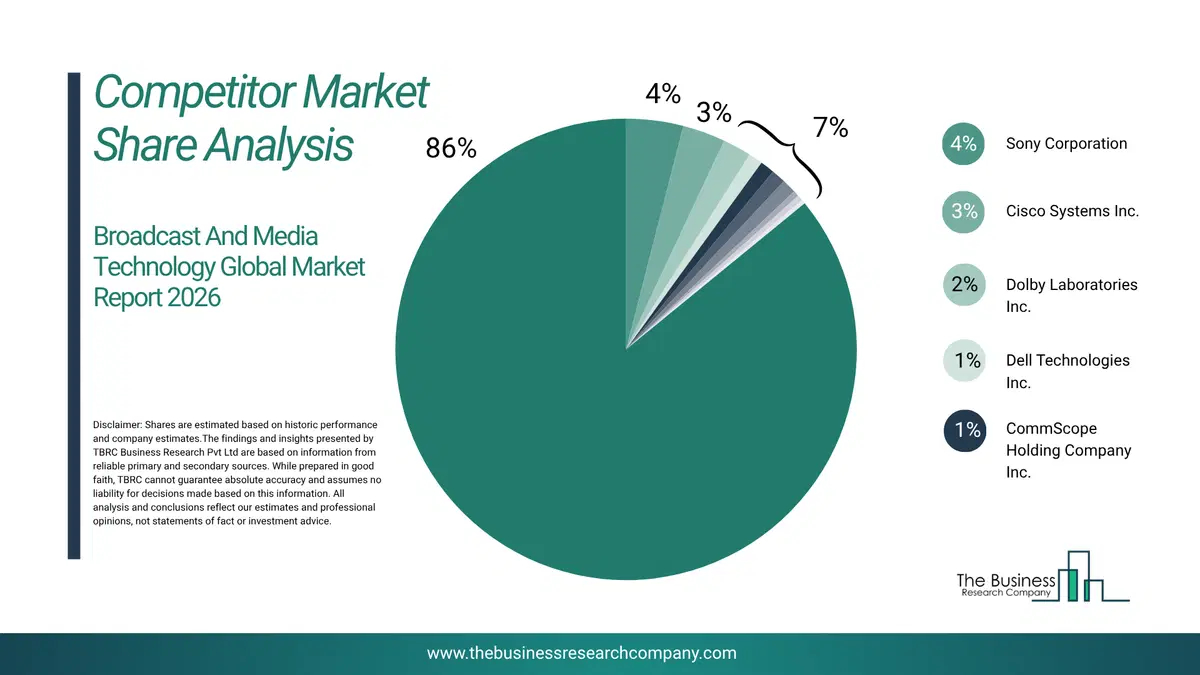
This chart is for illustrative purposes; the full report includes a detailed competitor analysis and comprehensive overview of the top 10 companies in the market.
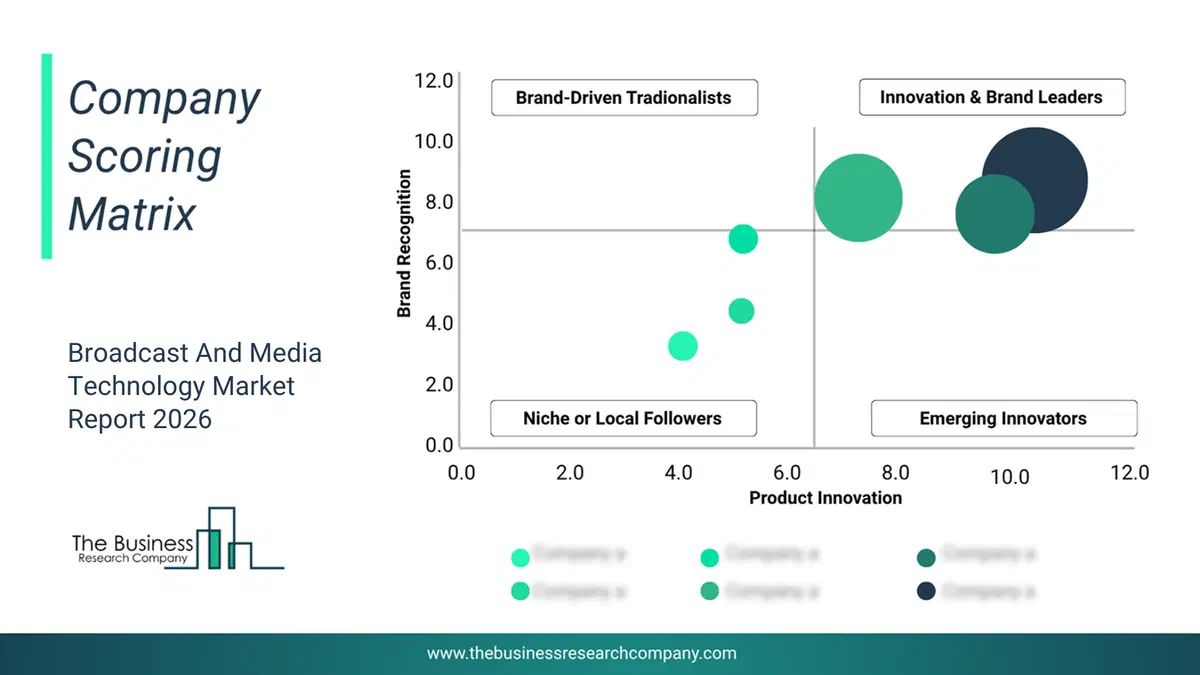
This chart maps companies by product innovation and brand strength, with bubble size indicating relative revenue, helping identify market leaders, challengers, and niche players. This is an illustrative chart; the full report provides a complete and accurate competitive analysis.
Global Broadcast And Media Technology Market Trends and Insights
Major companies operating in the broadcast and media technology sector are focusing on advanced solutions, such as fully IP-based broadcast systems, to enhance operational efficiency, content flexibility, and production scalability. Fully IP-based broadcast systems refer to infrastructures that leverage Internet Protocol (IP) networks for the capture, transport, processing, and distribution of audio and video signals, replacing traditional hardware-dependent broadcast workflows with scalable, software-driven solutions. For instance, in June 2025, Radio 47, an Africa-based radio station, introduced the continent’s first fully IP-based broadcast facility powered by Lawo, a Germany-based media technology company. The facility integrates IP-native mixing consoles, multiviewers, and routing systems to streamline live content production, enable remote collaboration, and support high-quality broadcasting. By adopting fully IP-based architectures, this initiative improves workflow agility, reduces operational complexity, and sets a new benchmark for modern, networked broadcasting operations.What Are Latest Mergers And Acquisitions In The Broadcast And Media Technology Market?
In August 2024, EVS Broadcast Equipment SA, a Belgium-based company that is a is a leading provider of live video technology for broadcast and new media productions, acquired MOG Technologies. for an undisclosed amount. With this acquisition, EVS Broadcast Equipment SA aims to enhance its product portfolio, strengthen cloud services, drive innovation, expand market reach, and improve customer support in the media and broadcast industry. MOG Technologies S.A.is a Portugal-based technology company that specializes in media and broadcast solutions.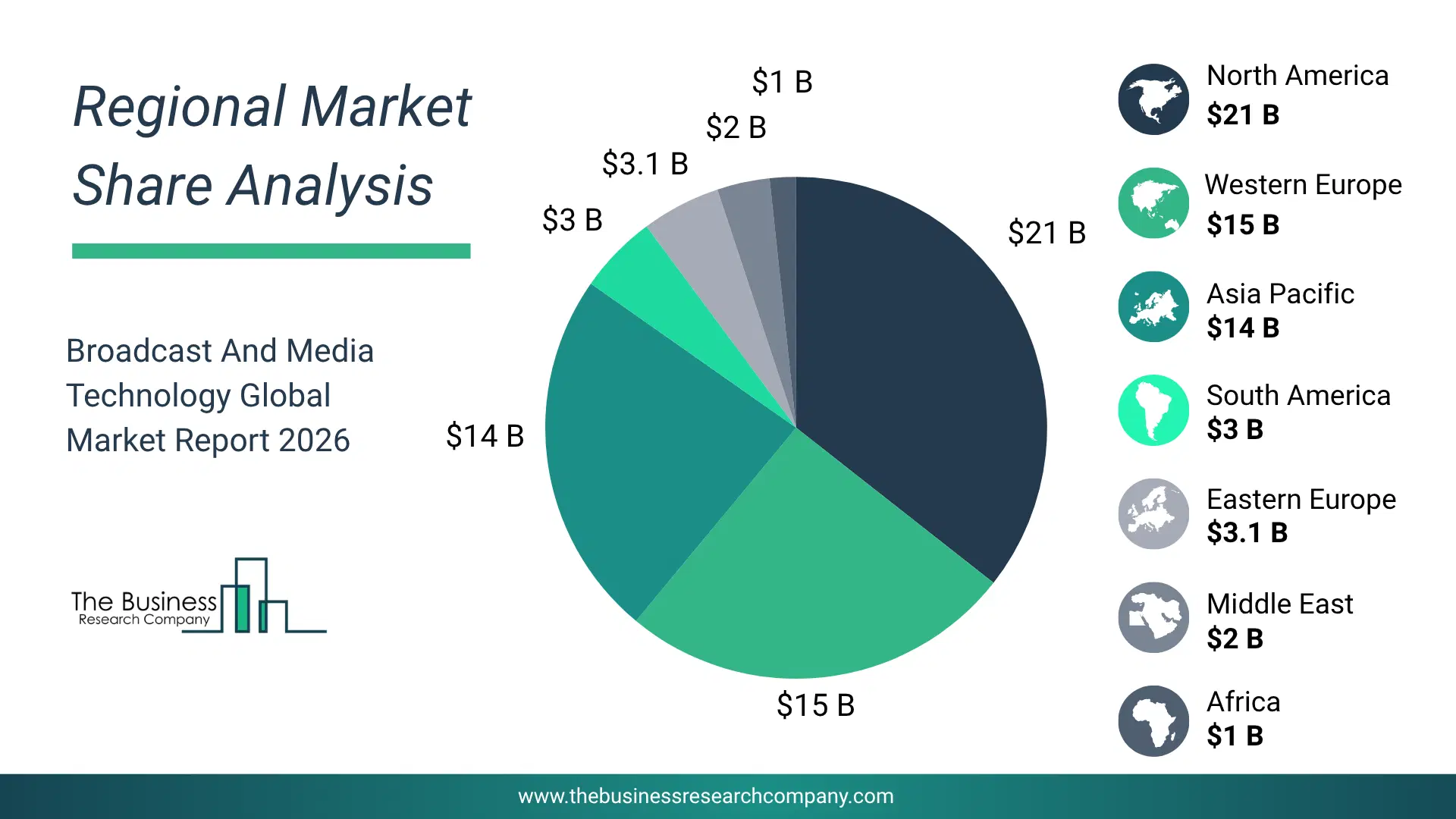
Regional Insights
North America was the largest region in the broadcast and media technology market in 2025. Asia-Pacific is expected to be the fastest-growing region in the forecast period. The regions covered in this market report are Asia-Pacific, South East Asia, Western Europe, Eastern Europe, North America, South America, Middle East, Africa. The countries covered in this market report are Australia, Brazil, China, France, Germany, India, Indonesia, Japan, Taiwan, Russia, South Korea, UK, USA, Canada, Italy, SpainWhat Defines the Broadcast And Media Technology Market?
The broadcast and media technology market consists of revenues earned by entities by providing broadcast and media technology components such as on-premise, consulting and support and maintenance. Values in this market are ‘factory gate’ values, that is, the value of goods sold by the manufacturers or creators of the goods, whether to other entities (including downstream manufacturers, wholesalers, distributors, and retailers) or directly to end customers. The value of goods in this market includes related services sold by the creators of the goods.How is Market Value Defined and Measured?
The market value is defined as the revenues that enterprises gain from the sale of goods and/or services within the specified market and geography through sales, grants, or donations in terms of the currency (in USD unless otherwise specified). The revenues for a specified geography are consumption values that are revenues generated by organizations in the specified geography within the market, irrespective of where they are produced. It does not include revenues from resales along the supply chain, either further along the supply chain or as part of other products.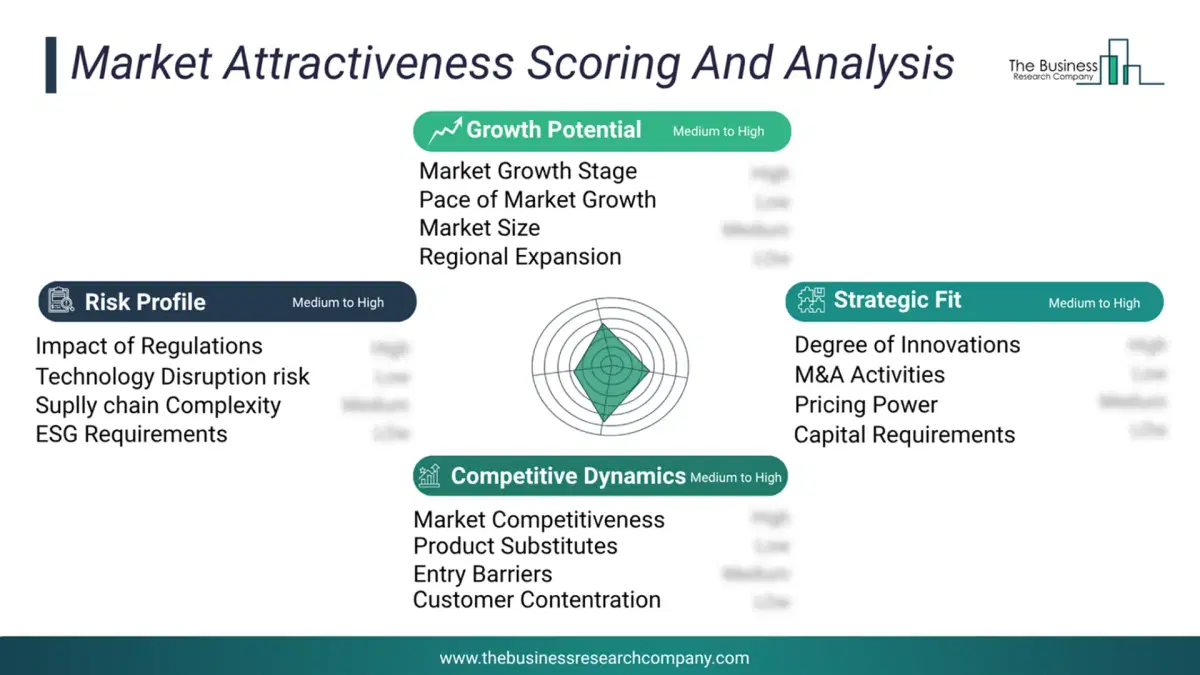
This chart presents market attractiveness based on a quantitative evaluation of growth, competition, strategic alignment, and risk, offering a clear view of opportunity areas for decision-making. This chart is for illustrative purposes; the full report contains the complete analysis.
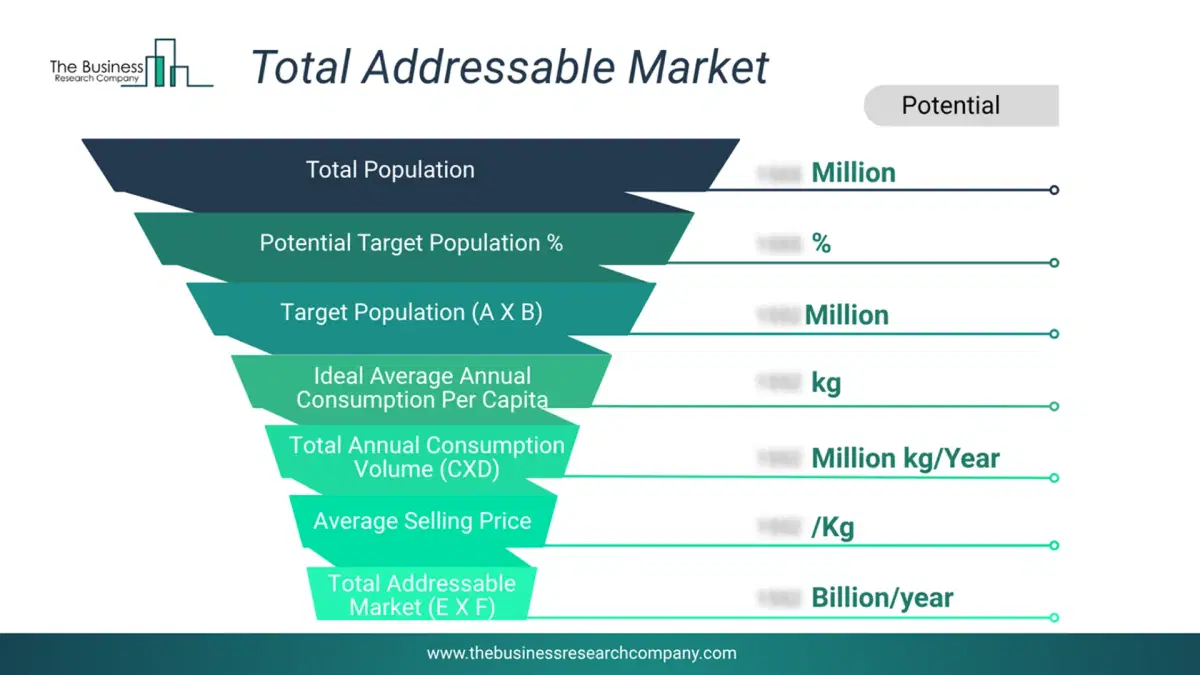
This chart highlights the Total Addressable Market (TAM) by estimating the maximum revenue opportunity using an assumption-driven approach, supporting strategic planning and opportunity sizing across markets. The chart is illustrative; the full report provides a more comprehensive analysis.
What Key Data and Analysis Are Included in the Broadcast And Media Technology Market Report 2026?
The broadcast and media technology market research report is one of a series of new reports from The Business Research Company that provides market statistics, including industry global market size, regional shares, competitors with the market share, detailed market segments, market trends and opportunities, and any further data you may need to thrive in the broadcast and media technology industry. The market research report delivers a complete perspective of everything you need, with an in-depth analysis of the current and future state of the industry.Broadcast And Media Technology Market Report Forecast Analysis
| Report Attribute | Details |
|---|---|
| Market Size Value In 2026 | $67.75 billion |
| Revenue Forecast In 2030 | $109.23 billion |
| Growth Rate | CAGR of 12.7% from 2026 to 2030 |
| Base Year For Estimation | 2025 |
| Actual Estimates/Historical Data | 2020-2025 |
| Forecast Period | 2026 - 2030 - 2035 |
| Market Representation | Revenue in USD Billion and CAGR from 2026 to 2030 |
| Segments Covered | Solution Type, Hosting Model Type, End User Type |
| Regional Scope | Asia-Pacific, Western Europe, Eastern Europe, North America, South America, Middle East, Africa |
| Country Scope | The countries covered in the report are Australia, Brazil, China, France, Germany, India, Indonesia, Japan, Taiwan, Russia, South Korea, UK, USA, Canada, Italy, Spain. |
| Key Companies Profiled | Evertz Microsystems Limited; International Business Machines Corporation; Quantum Corporation; Rohde & Schwarz GmbH & Co. KG; Dell Technologies Inc.; Amagi Media Labs Private Limited; Zoomph Inc.; PHYTunes Inc.; Focal Point VR Ltd; Arqiva Limited; Vislink Technologies Inc.; C360 Technologies Inc.; Brompton Technology Limited; Grass Valley USA LLC; AVI Systems Inc.; Video Stream Networks S. L.; WideOrbit Inc.; Harmonic Inc.; Eletec Broadcast Telecom S. A. R. L.; Clyde Broadcast Technology Limited; Sencore Inc.; EVS Broadcast Equipment SA; ACORDE Technologies S. A.; Cisco Systems Inc.; Telefonaktiebolaget LM Ericsson; CommScope Holding Company Inc.; Avid Technology Inc.; Blackmagic Design Pty. Ltd.; Chyron Corporation; Dalet Digital Media Systems S. A.; Dolby Laboratories Inc.; Imagine Communications Corp.; Ross Video Limited; Snell Advanced Media Limited; Sony Corporation; Vizrt Group AS; Xilinx Inc. |
| Customization Scope | Request for Customization |
| Pricing And Purchase Options | Explore Purchase Options |