
Building Equipment Contractors Market Report 2026
Global Outlook – By Type (Electrical Contractors And Other Wiring Installation Contractors, Plumbing, Heating And Air-Conditioning Contractors, Other Building Equipment Contractors ), By Service Provider (Large Chain Companies, Independent Contractors), By Mode (Online, Offline ), By Application (Residential Building Construction, Nonresidential Building Construction, Utility System Construction, Other Applications ) – Market Size, Trends, Strategies, and Forecast to 2030
Building Equipment Contractors Market Overview
• Building Equipment Contractors market size has reached to $3292.02 billion in 2025 • Expected to grow to $4465.69 billion in 2030 at a compound annual growth rate (CAGR) of 6.4% • Growth Driver: Rising Construction Industry Fueling Growth In The Building Equipment Contractors Market • Market Trend: Smart Wearables Revolutionizing The Building Equipment Contractors Market For Enhanced Operations And Safety Management • Asia-Pacific was the largest region in 2025 and North America is the fastest growing region.Market Gains By 2030 – Top Opportunities By Segment
Market Gain identifies the most promising market opportunities by highlighting the segments or products expected to generate the highest incremental revenue growth over the next five years.
What Is Covered Under Building Equipment Contractors Market?
Building equipment means all machinery, systems, appliances, equipment, and other equipment in a building or the infrastructure required to operate it. The main types of building equipment contractors are electrical contractors and other wiring installation contractors, plumbing, heating, and air-conditioning contractors, and other building equipment contractors. Plumbing refers to any system that transports fluids for a variety of purposes. To transport fluids, plumbers employ pipes, valves, plumbing fittings, tanks, and other devices. The different service providers include large chain companies and independent contractors and are available in various modes, such as online and offline. The building equipment contractors are involved in residential construction, non-residential building construction, utility system construction, and others.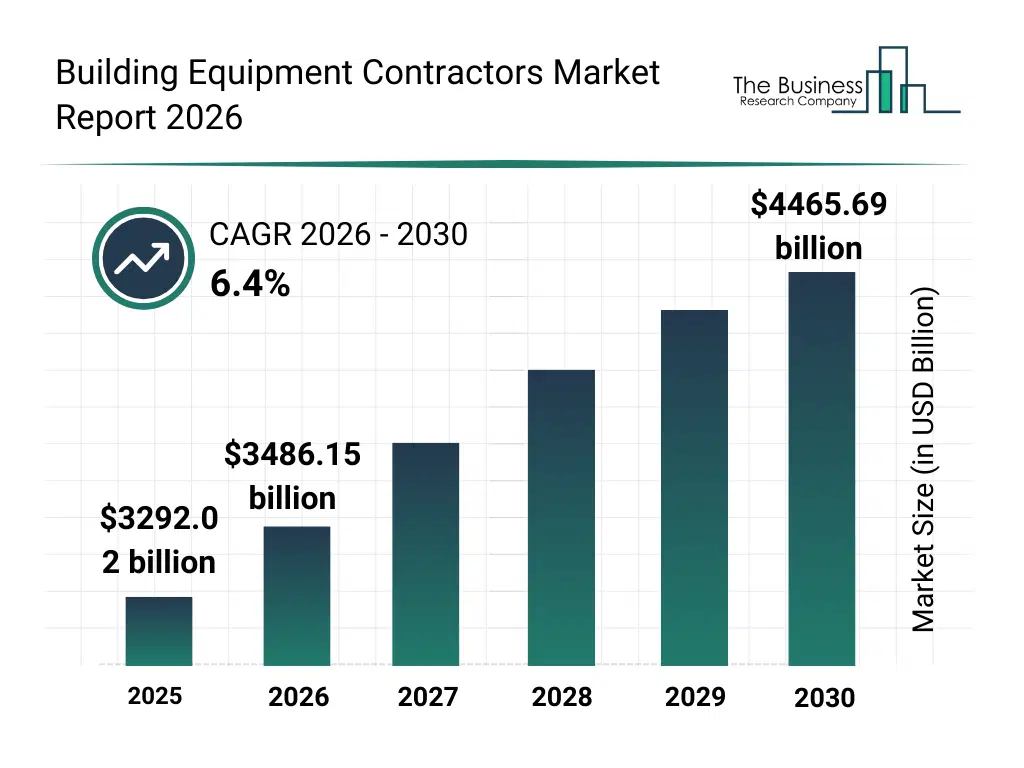
What Is The Building Equipment Contractors Market Size and Share 2026?
The building equipment contractors market size has grown strongly in recent years. It will grow from $3292.02 billion in 2025 to $3486.15 billion in 2026 at a compound annual growth rate (CAGR) of 5.9%. The growth in the historic period can be attributed to increasing building construction activity, early adoption of modern building equipment, rising integration of HVAC and electrical systems, expansion of commercial facilities, growing need for reliable utility systems.What Is The Building Equipment Contractors Market Growth Forecast?
The building equipment contractors market size is expected to see strong growth in the next few years. It will grow to $4465.69 billion in 2030 at a compound annual growth rate (CAGR) of 6.4%. The growth in the forecast period can be attributed to increased adoption of smart building equipment, expansion of automated contracting services, rising investment in efficient HVAC systems, growth in domestic manufacturing of building components, increased use of predictive maintenance technologies. Major trends in the forecast period include increased adoption of automated installation systems, rise in energy-efficient building equipment, expansion of smart wiring and hvac integration, growth in digitally managed contracting workflows, increased use of AI-based maintenance planning.
Global Building Equipment Contractors Market Segmentation
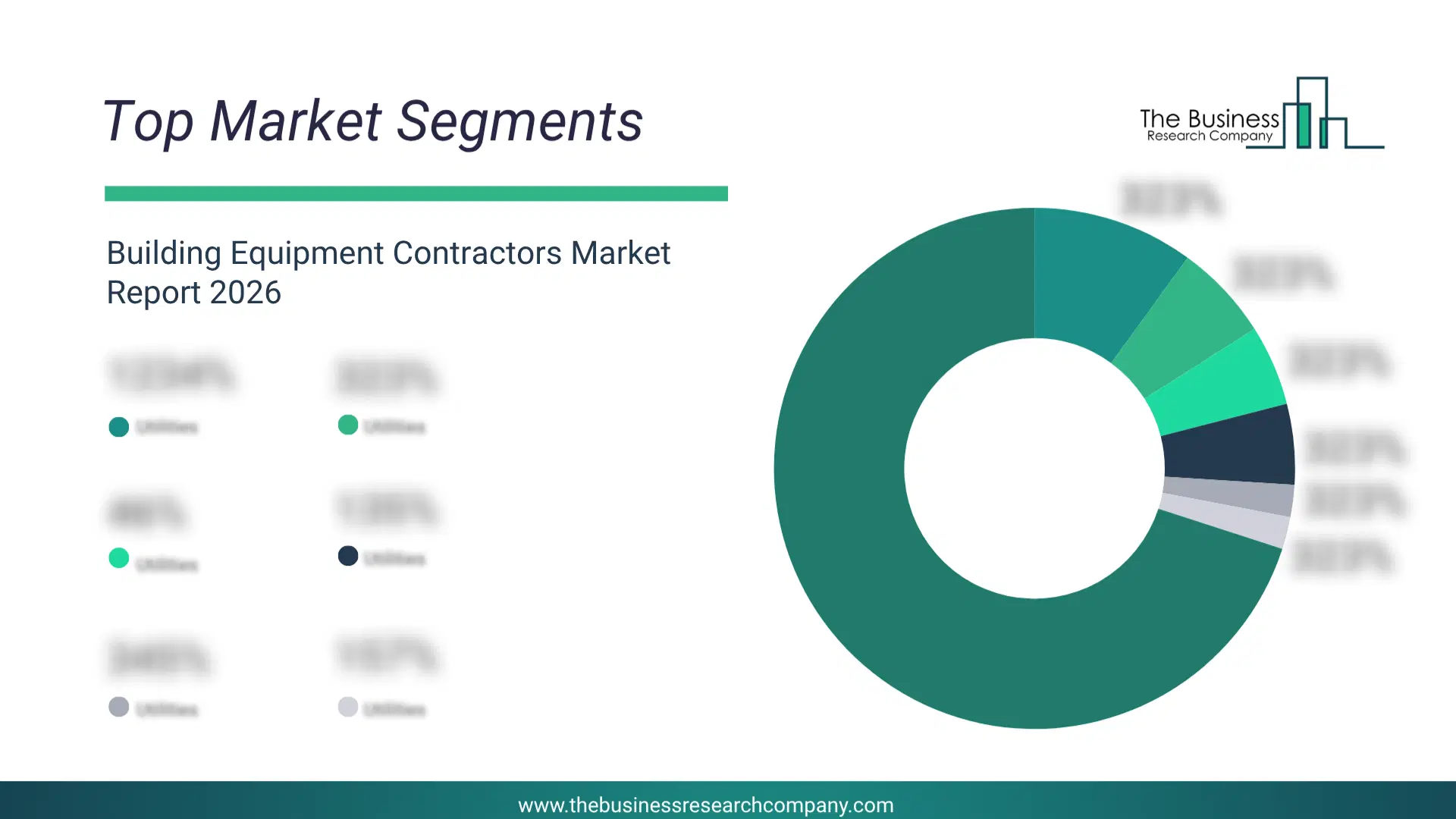
1) By Type: Electrical Contractors And Other Wiring Installation Contractors, Plumbing, Heating And Air-Conditioning Contractors, Other Building Equipment Contractors 2) By Service Provider: Large Chain Companies, Independent Contractors 3) By Mode: Online, Offline 4) By Application: Residential Building Construction, Nonresidential Building Construction, Utility System Construction, Other Applications Subsegments: 1) By Electrical Contractors and Other Wiring Installation Contractors: Power and Lighting Contractors, Telecommunications Wiring Contractors, Fire Alarm and Security System Contractors, Low-Voltage and Specialty Wiring Contractors, Renewable and Energy Infrastructure Contractors 2) By Plumbing, Heating, and Air-Conditioning Contractors: Plumbing Contractors, Heating Contractors, Ventilation Contractors, Air-Conditioning and Refrigeration Contractors, HVAC Controls and Energy-Efficient Systems 3) Other Building Equipment Contractors: Elevator and Escalator Installation Contractors, Fire Protection System Contractors, Industrial and Commercial Equipment Contractors, Building Automation and Control Contractors, Specialty Equipment ContractorsThe top segments in the building equipment contractors market will be: • Plumbing, Heating And Air-Conditioning Contractors will reach $2315 Billion by 2030. • Electrical Contractors And Other Wiring Installation Contractors will reach $1887 Billion by 2030. • Other Building Equipment Contractors will reach $368 Billion by 2030.What Is The Driver Of The Building Equipment Contractors Market?
The growth in the construction industry is expected to propel the growth of the building equipment contractor market. The construction industry involves the planning, design, and physical construction of buildings, infrastructure, and other structures to meet various societal and commercial needs. Building equipment contractors provide specialized expertise and services in the installation, maintenance, and repair of essential building systems and equipment, contributing to the efficient and functional operation of the construction industry. For instance, in February 2025, according to the Office for National Statistics, a UK-based statistics authority, annual construction output increased by 0.4% in 2024 compared with 2023, driven entirely by an 8.5% rise in repair and maintenance work. Therefore, the growth in the construction industry is driving the building equipment contractor industry.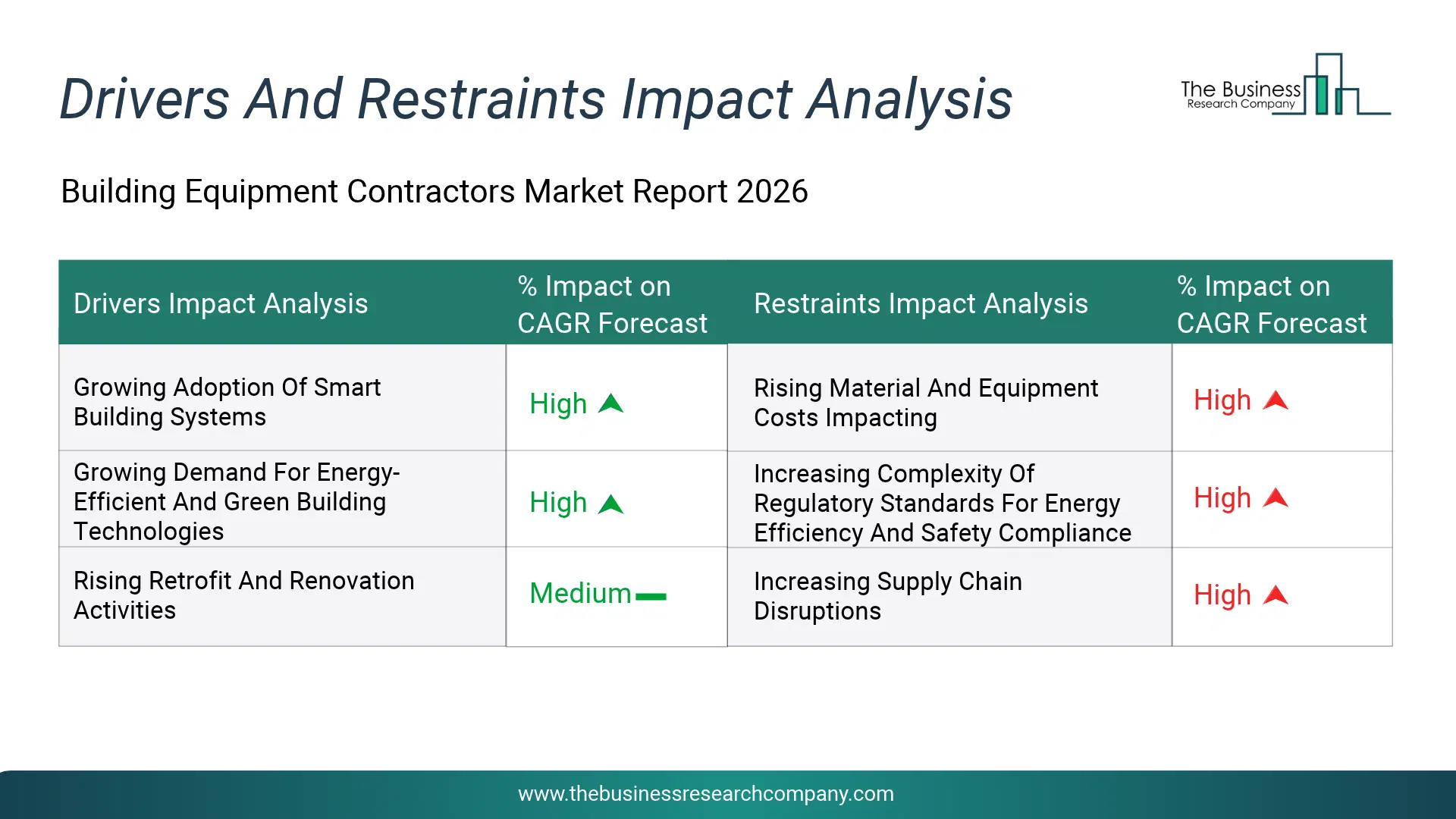
Infographic Chart Showing Key Market Drivers Analysis And Restraints For Building Equipment Contractors Market
The chart presents an impact analysis of key drivers and restraints, quantifying their relative influence on the market's growth rate and helping assess the balance between growth enablers and limiting factors. This chart offers a high-level perspective; the full report contains more detailed insights.
How Will The Drivers Impact Growth In The Global Building Equipment Contractors Market?
• Growing Adoption Of Smart Building Systems (High) – During the forecast period, the growing adoption of smart building systems is expected to become a key growth driver for the building equipment contractors market by 2030. Growing adoption of smart building systems is driving the growth of the building equipment contractors market by increasing project activity and the use of planning, construction, engineering, property, and building-support solutions. This trend encourages property developers, governments, businesses, and households to increase spending and capacity related to housing, commercial facilities, public infrastructure, and urban development. As this trend continues, suppliers are expected to expand capacity, improve their offerings, and strengthen distribution to support housing, commercial facilities, public infrastructure, and urban development. • Growing Demand For Energy-Efficient And Green Building Technologies (High) – During the forecast period, the growing demand for energy-efficient and green building technologies is expected to emerge as a major factor driving the expansion of the building equipment contractors market by 2030. Growing demand for energy-efficient and green building technologies is driving the growth of the building equipment contractors market by accelerating lower-carbon and resource-efficient applications that use planning, construction, engineering, property, and building-support solutions. This trend encourages property developers, governments, businesses, and households to increase spending and capacity related to housing, commercial facilities, public infrastructure, and urban development. As this trend continues, suppliers are expected to expand capacity, improve their offerings, and strengthen distribution to support housing, commercial facilities, public infrastructure, and urban development. • Rising Retrofit And Renovation Activities (Medium) – During the forecast period, the rising retrofit and renovation activities are expected to act as a key growth catalyst for the building equipment contractors market by 2030. Rising retrofit and renovation activities are driving the growth of the building equipment contractors market by increasing project activity and the use of planning, construction, engineering, property, and building-support solutions. This trend encourages property developers, governments, businesses, and households to increase spending and capacity related to housing, commercial facilities, public infrastructure, and urban development. As this trend continues, suppliers are expected to expand capacity, improve their offerings, and strengthen distribution to support housing, commercial facilities, public infrastructure, and urban development.How Will The Restraints Impact Growth In The Global Building Equipment Contractors Market?
• Rising Material And Equipment Costs Impacting (High) – During the forecast period, the rising material and equipment costs are restraining the growth of the building equipment contractors market by weakening affordability, margins, and investment capacity for planning, construction, engineering, property, and building-support solutions. Because project financing, permitting, design, material procurement, and construction execution is cost-sensitive, these increases can be difficult to absorb or pass on to customers. As a result, market participants may delay expansion, limit new investment, or increase prices, slowing the adoption and availability of planning, construction, engineering, property, and building-support solutions. • Increasing Complexity Of Regulatory Standards For Energy Efficiency And Safety Compliance (High) – During the forecast period, the increasing complexity of regulatory standards for energy efficiency and safety compliance is restraining the growth of the building equipment contractors market by lengthening approval cycles and increasing compliance expenses for planning, construction, engineering, property, and building-support solutions. Providers must allocate more time and capital to meet evolving rules while maintaining project financing, permitting, design, material procurement, and construction execution. As a result, market participants may delay expansion, limit new investment, or increase prices, slowing the adoption and availability of planning, construction, engineering, property, and building-support solutions. • Increasing Supply Chain Disruptions (Medium) – During the forecast period, the increasing supply chain disruptions are restraining the growth of the building equipment contractors market by reducing input availability, extending lead times, and increasing costs for planning, construction, engineering, property, and building-support solutions. Market participants depend on timely access to inputs and equipment to sustain project financing, permitting, design, material procurement, and construction execution. As a result, market participants may delay expansion, limit new investment, or increase prices, slowing the adoption and availability of planning, construction, engineering, property, and building-support solutions.Key Players In The Global Building Equipment Contractors Market
Major companies operating in the building equipment contractors market are KONE Corporation, Comfort Systems USA Inc., Mitsubishi Electric Corp, Integrated Electrical Services Inc., Johnson Controls International plc, Honeywell International Inc., Siemens AG, Schneider Electric SE, United Technologies Corporation, Ingersoll-Rand plc, Carrier Global Corporation, Daikin Industries Ltd., LG Electronics Inc., Trane Technologies plc, Lennox International Inc., Rheem Manufacturing Company, Goodman Manufacturing Company L.P., York International Corporation, American Standard Companies Inc., A.O. Smith Corporation, Bradford White Corporation, Navien Inc., Rinnai Corporation, Noritz Corporation, Bosch Thermotechnology Corp., Viessmann Manufacturing Company Inc., Weil-McLain, Burnham Holdings Inc., Taco Comfort Solutions, Grundfos Pumps Corporation, Armstrong Fluid Technology, Bell & Gossett, Wilo USA LLC.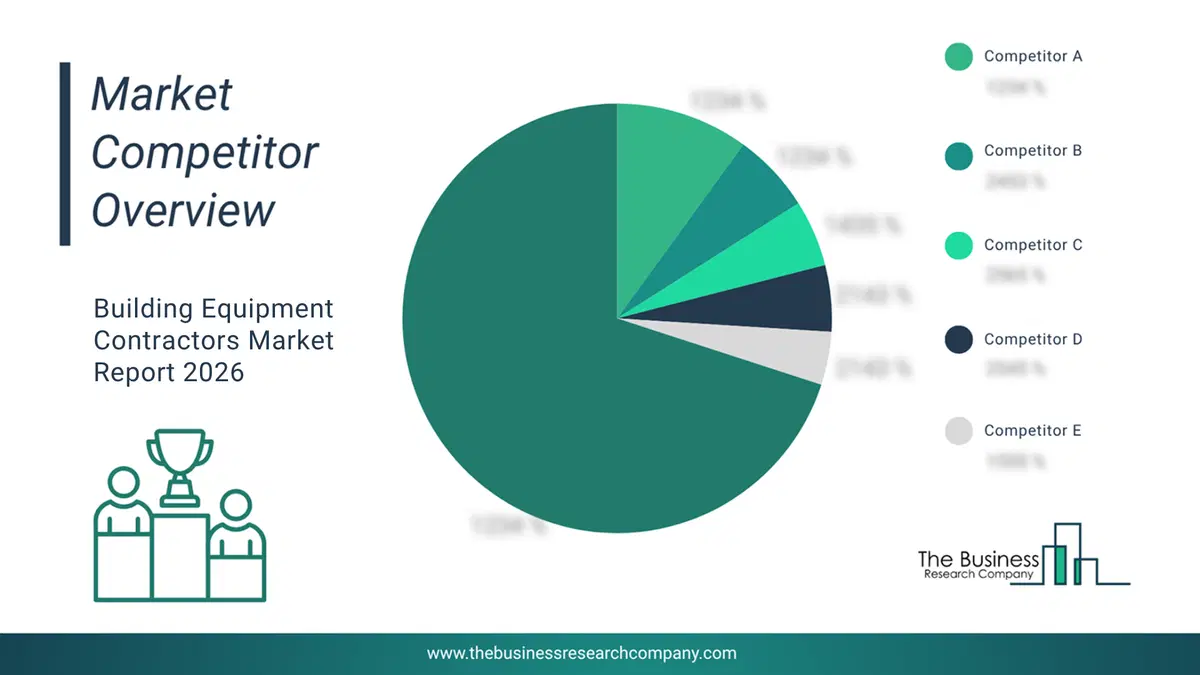
This chart is for illustrative purposes; the full report includes a detailed competitor analysis and comprehensive overview of the top 10 companies in the market.
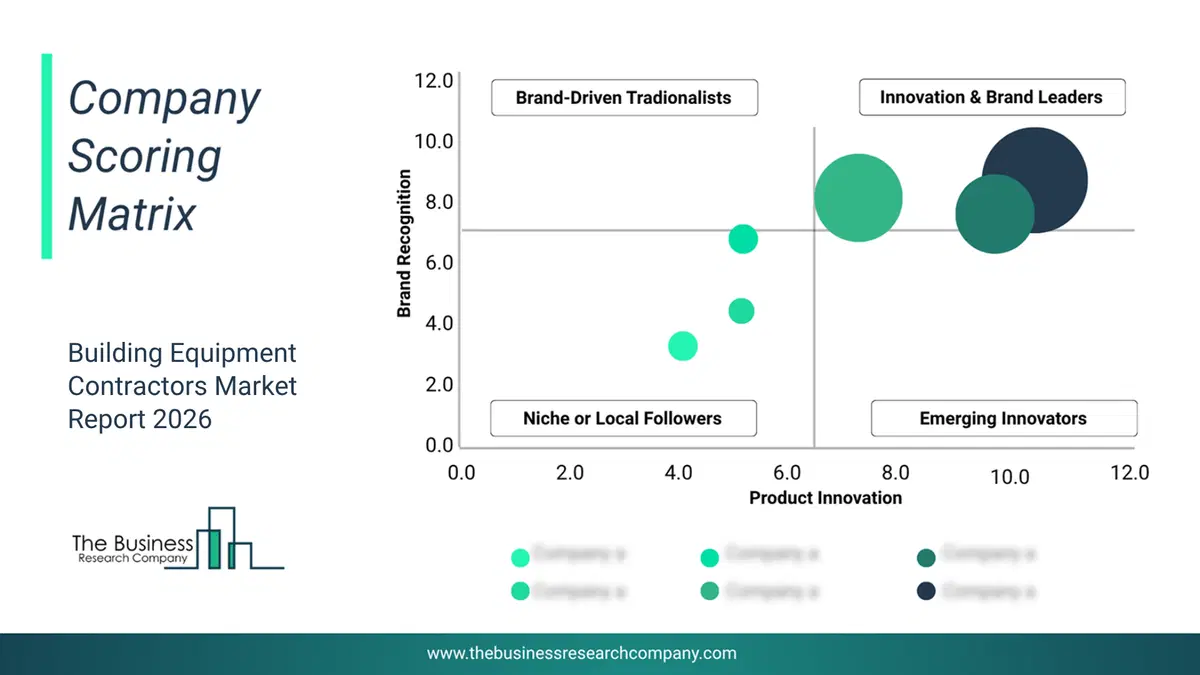
This chart maps companies by product innovation and brand strength, with bubble size indicating relative revenue, helping identify market leaders, challengers, and niche players. This is an illustrative chart; the full report provides a complete and accurate competitive analysis.
Global Building Equipment Contractors Market Trends and Insights
Major companies operating in the building equipment contractor industry are increasingly focusing on developing smart wearables and technologies to improve efficiency, safety, and productivity on construction sites. Smart wearables are paving their way into the building equipment contractor market and are being used by supervisors for monitoring operations. Wearable devices generally include a computer or electronic device worn on the body, personal protective equipment, or clothing. Wearables like the smart cap, badges, and biosensors evaluate real-time data like location, impact, motion, temperature, and vital signs. For instance, in 2023, Masimo, a US-based medical technology company, launched the Masimo Freedom smartwatch. It was created to revolutionize the wearable technology sector and give the freedom to control your personal health and privacy through accurate and ongoing health tracking. It also includes a cutting-edge hardware feature intended to lessen radiation and free you from privacy invasion.What Are Latest Mergers And Acquisitions In The Building Equipment Contractors Market?
In February 2024, Comfort Systems USA, a US-based provider of mechanical construction and MEP (mechanical, electrical, and plumbing) services, acquired J & S Mechanical Contractors, Inc. for approximately $120.6 million. Through this acquisition, Comfort Systems aims to expand its mechanical and plumbing installation capabilities across commercial, industrial, and healthcare sectors and strengthen its presence in the building equipment contracting market. J & S Mechanical Contractors, a US-based provider of HVAC, plumbing, and medical gas system installation services, complements Comfort Systems’ existing portfolio and enhances its expertise in large-scale mechanical contracting and MEP solutions.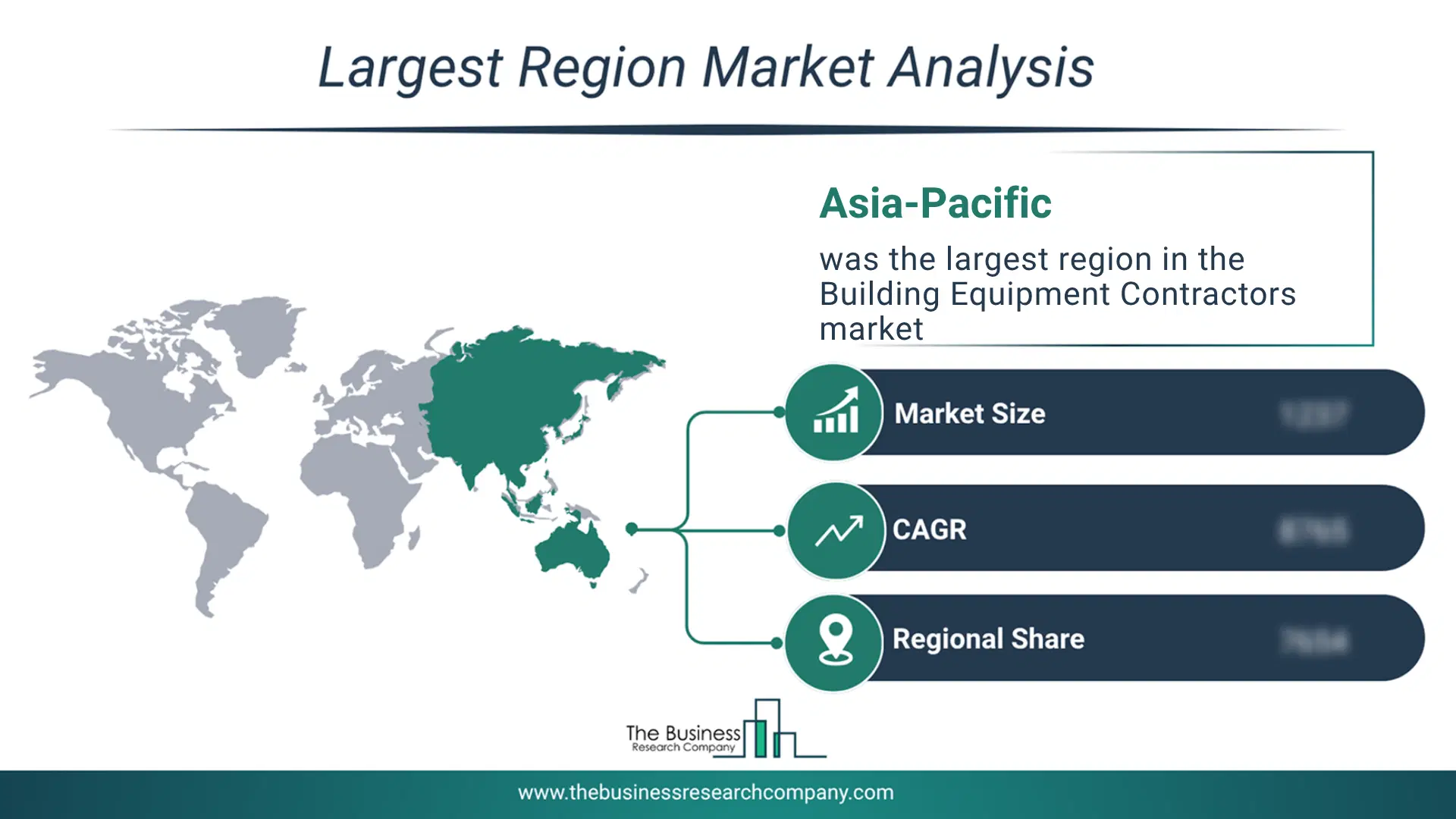
Regional Insights
Asia-Pacific was the largest region in the building equipment contractors market in 2025. North America was the second-largest region in the building equipment contractors market. The regions covered in this market report are Asia-Pacific, South East Asia, Western Europe, Eastern Europe, North America, South America, Middle East, Africa. The countries covered in this market report are China, India, Japan, Australia, Indonesia, South Korea, Bangladesh, Thailand, Vietnam, Malaysia, Singapore, Philippines, Hong Kong, Taiwan, New Zealand, UK, Germany, France, Italy, Spain, Austria, Belgium, Denmark, Finland, Ireland, Netherlands, Norway, Portugal, Sweden, Switzerland, Russia, Czech Republic, Poland, Romania, Ukraine, USA, Canada, Mexico, Brazil, Chile, Argentina, Colombia, Peru, Saudi Arabia, Israel, Iran, Turkey, UAE, Egypt, Nigeria, South AfricaWhat Defines the Building Equipment Contractors Market?
The building equipment contractors market includes revenues earned by entities by elevators, escalators, service station equipment, and central vacuum cleaning systems. The market value includes the value of related goods sold by the service provider or included within the service offering. Only goods and services traded between entities or sold to end consumers are included.How is Market Value Defined and Measured?
The market value is defined as the revenues that enterprises gain from the sale of goods and/or services within the specified market and geography through sales, grants, or donations in terms of the currency (in USD unless otherwise specified). The revenues for a specified geography are consumption values that are revenues generated by organizations in the specified geography within the market, irrespective of where they are produced. It does not include revenues from resales along the supply chain, either further along the supply chain or as part of other products.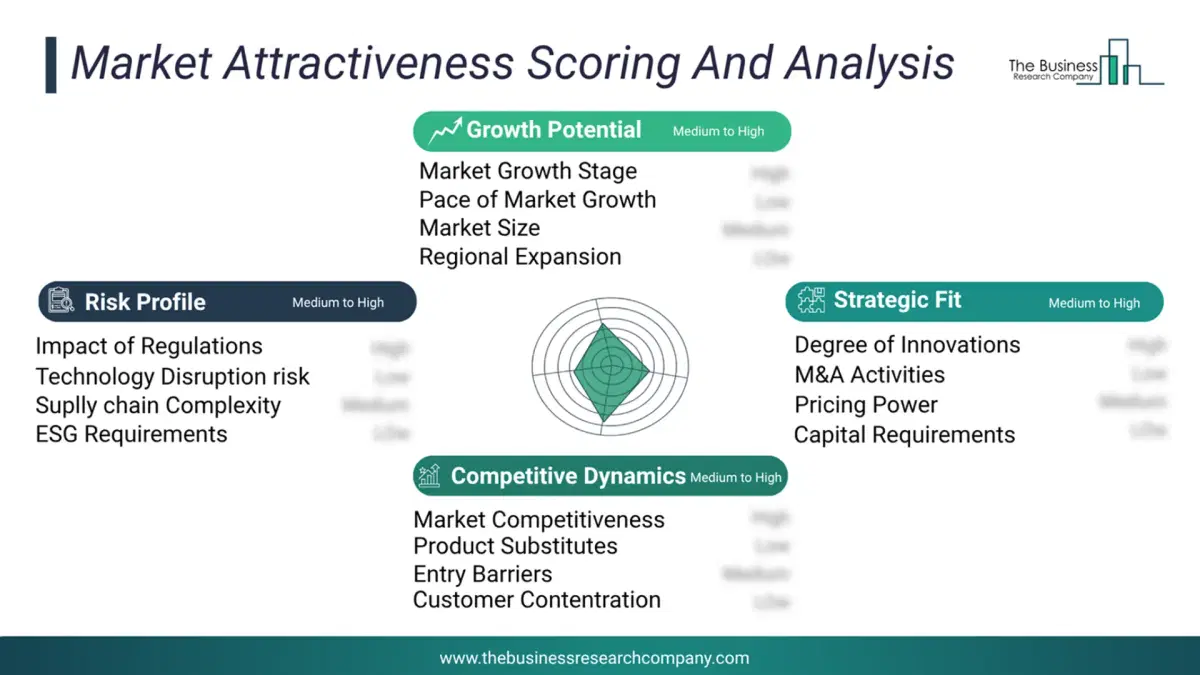
This chart presents market attractiveness based on a quantitative evaluation of growth, competition, strategic alignment, and risk, offering a clear view of opportunity areas for decision-making. This chart is for illustrative purposes; the full report contains the complete analysis.
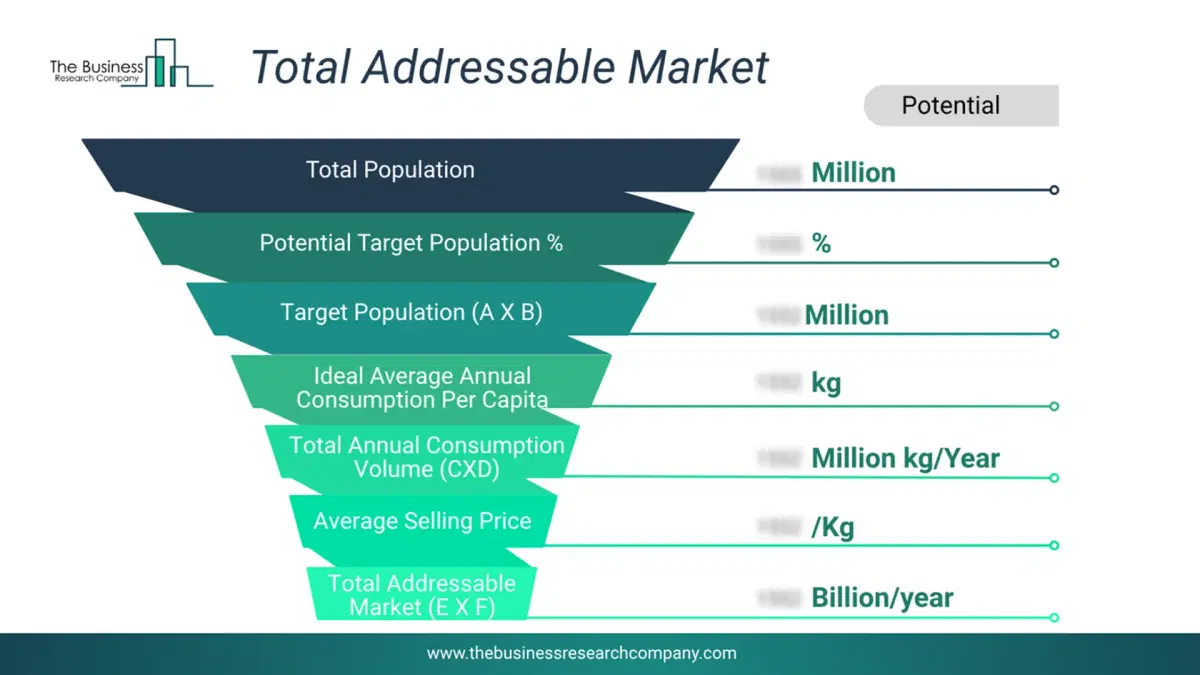
This chart highlights the Total Addressable Market (TAM) by estimating the maximum revenue opportunity using an assumption-driven approach, supporting strategic planning and opportunity sizing across markets. The chart is illustrative; the full report provides a more comprehensive analysis.
What Key Data and Analysis Are Included in theBuilding Equipment Contractors Market Report 2026?
The building equipment contractors market research report is one of a series of new reports from The Business Research Company that provides market statistics, including industry global market size, regional shares, competitors with the market share, detailed market segments, market trends and opportunities, and any further data you may need to thrive in the building equipment contractors industry. The market research report delivers a complete perspective of everything you need, with an in-depth analysis of the current and future state of the industry.Building Equipment Contractors Market Report Forecast Analysis
| Report Attribute | Details |
|---|---|
| Market Size Value In 2026 | $3486.15 billion |
| Revenue Forecast In 2035 | $4465.69 billion |
| Growth Rate | CAGR of 5.9% from 2026 to 2035 |
| Base Year For Estimation | 2025 |
| Actual Estimates/Historical Data | 2020-2025 |
| Forecast Period | 2026 - 2030 - 2035 |
| Market Representation | Revenue in USD Billion and CAGR from 2026 to 2035 |
| Segments Covered | Type, Service Provider, Mode, Application |
| Regional Scope | Asia-Pacific, Western Europe, Eastern Europe, North America, South America, Middle East, Africa |
| Country Scope | The countries covered in the report are Australia, Brazil, China, France, Germany, India, ... |
| Key Companies Profiled | KONE Corporation, Comfort Systems USA Inc., Mitsubishi Electric Corp, Integrated Electrical Services Inc., Johnson Controls International plc, Honeywell International Inc., Siemens AG, Schneider Electric SE, United Technologies Corporation, Ingersoll-Rand plc, Carrier Global Corporation, Daikin Industries Ltd., LG Electronics Inc., Trane Technologies plc, Lennox International Inc., Rheem Manufacturing Company, Goodman Manufacturing Company L.P., York International Corporation, American Standard Companies Inc., A.O. Smith Corporation, Bradford White Corporation, Navien Inc., Rinnai Corporation, Noritz Corporation, Bosch Thermotechnology Corp., Viessmann Manufacturing Company Inc., Weil-McLain, Burnham Holdings Inc., Taco Comfort Solutions, Grundfos Pumps Corporation, Armstrong Fluid Technology, Bell & Gossett, Wilo USA LLC. |
| Customization Scope | Request for Customization |
| Pricing And Purchase Options | Explore Purchase Options |