
Cancer Monoclonal Antibodies Market Report 2026
Global Outlook – By Monoclonal Antibody Therapies (Avastin, Herceptin,Keytruda, Opdivo, Darzalex, Perjeta, Others), By Application (Breast Cancer, Blood Cancer, Lung Cancer, Brain Tumor,Colorectal Cancer, Cervical Cancer, Gastric Cancer, Others), By End-User (Hospitals, Research Laboratories, Others) – Market Size, Trends, Strategies, and Forecast to 2035
Cancer Monoclonal Antibodies Market Overview
• Cancer Monoclonal Antibodies market size has reached to $86.23 billion in 2025 • Expected to grow to $166.92 billion in 2030 at a compound annual growth rate (CAGR) of 14.2% • Growth Driver: Cancer Monoclonal Antibody Market Driven By Rising Cancer Incidence Rates • Market Trend: Advancements In Bispecific Monoclonal Antibodies For Targeted Cancer Immunotherapy • North America was the largest region in 2025.
What Is Covered Under Cancer Monoclonal Antibodies Market?
Cancer monoclonal antibodies refer to a particular class of protein created in a lab that has the ability to bind to certain bodily targets, such as antigens on the surface of cancer cells. Each monoclonal antibody is designed to bind to a single antigen, and there are many different types of monoclonal antibodies. The main types of monoclonal antibody therapies in cancer are bevacizumab (Avastin), rituximab (Rituxan), trastuzumab (Herceptin), cetuximab (Erbitux), and panitumumab (Vectibix). Avastin is a medication that helps people with wet age-related macular degeneration (AMD). It can also be employed to treat diabetic eye problems and other retinal issues. It's administered into the eye to help delay the loss of eyesight caused by certain disorders. The different applications include breast cancer, blood cancer, liver cancer, brain cancer, colorectal cancer, and others, and involve various sectors such as hospitals and clinics, research laboratories, pharmacies, and others.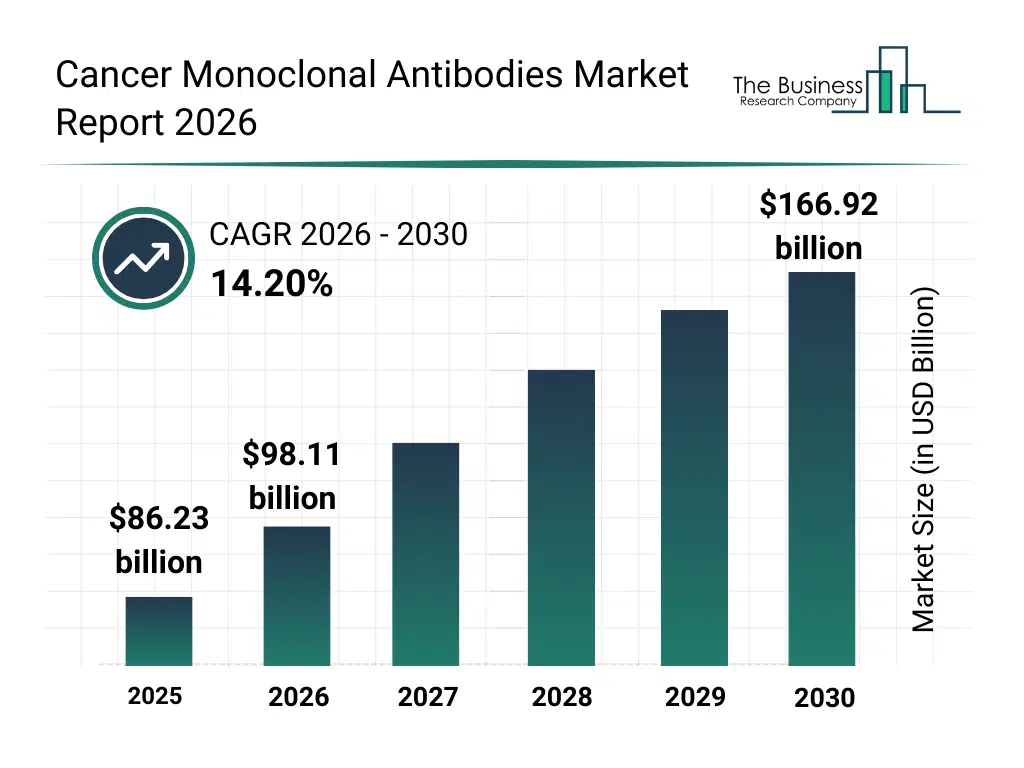
What Is The Cancer Monoclonal Antibodies Market Size and Share 2026?
The cancer monoclonal antibodies market size has grown rapidly in recent years. It will grow from $86.23 billion in 2025 to $98.11 billion in 2026 at a compound annual growth rate (CAGR) of 13.8%. The growth in the historic period can be attributed to limited availability of monoclonal antibody therapies, reliance on traditional chemotherapy, growing incidence of breast and blood cancers, increasing physician awareness of targeted therapies, expansion of hospital oncology departments.What Is The Cancer Monoclonal Antibodies Market Growth Forecast?
The cancer monoclonal antibodies market size is expected to see rapid growth in the next few years. It will grow to $166.92 billion in 2030 at a compound annual growth rate (CAGR) of 14.2%. The growth in the forecast period can be attributed to launch of novel immuno-oncology monoclonal antibodies, development of combination therapies, increasing adoption of personalized cancer treatment approaches, growth in research laboratory capabilities, rising investment in clinical trials and biologics manufacturing. Major trends in the forecast period include rising adoption of targeted monoclonal antibody therapies for various cancers, increasing investment in immuno-oncology research and development, expansion of personalized and precision cancer treatment programs, growth in hospital and research laboratory infrastructure for cancer therapy, integration of combination therapies and novel biologics in cancer treatment.Global Cancer Monoclonal Antibodies Market Segmentation
1) By Monoclonal Antibody Therapies: Avastin, Herceptin,Keytruda, Opdivo, Darzalex, Perjeta, Others 2) By Application: Breast Cancer, Blood Cancer, Lung Cancer, Brain Tumor,Colorectal Cancer, Cervical Cancer, Gastric Cancer, Others 3) By End-User: Hospitals, Research Laboratories, Others Subsegments: 1) By Avastin: Colorectal Cancer Treatment, Lung Cancer Treatment, Renal Cell Carcinoma Treatment 2) By Herceptin: Breast Cancer Treatment, Gastric Cancer Treatment 3) By Keytruda: Melanoma Treatment, Non-Small Cell Lung Cancer (NSCLC) Treatment, Head And Neck Cancer Treatment 4) By Opdivo: Melanoma Treatment, Renal Cell Carcinoma Treatment, Hodgkin Lymphoma Treatment 5) By Darzalex: Multiple Myeloma Treatment, AL Amyloidosis Treatment 6) By Perjeta: Breast Cancer Treatment, Neoadjuvant Therapy For HER2-Positive Breast Cancer 7) By Others: Cetuximab (Erbitux) For Colorectal And Head And Neck Cancers, Rituximab (Rituxan) For Non-Hodgkin Lymphoma And Chronic Lymphocytic Leukemia, Atezolizumab (Tecentriq) For Various CancersWhat Is The Driver Of The Cancer Monoclonal Antibodies Market?
The rise in the number of cancer cases across the globe is likely to contribute to the growth of the cancer monoclonal antibody market. Cancer is a group of diseases where abnormal cells grow uncontrollably, invade tissues, and can spread to other parts of the body. The increasing cancer prevalence is due to aging population, as advanced age is the most significant risk factor for developing most types of cancer, with the majority of cases occurring in individuals over 65 years old. Cancer monoclonal antibody therapies support cancer treatment by specifically recognizing and binding to tumor-associated antigens, thereby directly inhibiting cancer cell growth, flagging malignant cells for immune-mediated destruction, delivering cytotoxic agents precisely to tumors, and modulating the tumor microenvironment to enhance the body’s anti-cancer immune response. For instance, in July 2024, according to the Australian Institute of Health and Welfare, an Australia-based government agency, in Australia the number of cancer cases diagnosed increased from 160,570 in 2022 to 164,694 in 2023, reflecting a notable rise over the year. This upward trend highlights the growing prevalence of cancer within the country. The four most common types of cancer worldwide are lung, prostate, bowel, and female breast cancer, accounting for 43 percent of all new cancer cases. Therefore, the rise in the cancer incidence rate globally is anticipated to boost the demand for growth of the cancer monoclonal antibody market.Key Players In The Global Cancer Monoclonal Antibodies Market
Major companies operating in the cancer monoclonal antibodies market are F. Hoffmann-La Roche Ltd, Merck & Co. Inc, Bristol Myers Squibb Company, Johnson & Johnson, Amgen Inc, AstraZeneca plc, Eli Lilly and Company, Pfizer Inc, Regeneron Pharmaceuticals Inc, Sanofi S.A, Innovent Biologics, Sino biological, Shanghai Henlius Biotech, Intas bio, Zydus Cadila, Ranbaxy, Takeda pharmaceuticals, AbbVie Inc, Biogen Idec, Bayer AG, Novartis AG, BiosanaPharma, WuXi, GlaxoSmithKline, Teva UK Limited, Abbott Laboratories, Fujifilm, Procos SpA, BSP Pharmaceuticals, Genmab, Insysbio, Gilead Sciences, Eurofarma, BIONOVIS BRASIL, Ache, Libbs Farmaceutica, Julphar, Spimaco Addwaeih, Hikma Pharmaceuticals, Tabuk, GenzymeGlobal Cancer Monoclonal Antibodies Market Trends and Insights
Major companies operating in the cancer monoclonal antibodies market are focusing on technological advancement in oncology, such as bispecific antibody technology to engage T-cells in targeting malignant B-cells. Bispecific antibody technology refers to engineered antibodies that simultaneously bind two antigens, enabling precise immune activation against cancer cells. For instance, in May 2023, AbbVie Inc., a U.S.-based biopharmaceutical company, received FDA accelerated approval for and launched EPKINLY (epcoritamab-bysp). This therapy treats adult patients with relapsed or refractory diffuse large B-cell lymphoma and high-grade B-cell lymphoma after two or more prior systemic therapies, leveraging bispecific antibody technology to recruit T-cells for a targeted and innovative approach to lymphoma treatment.What Are Latest Mergers And Acquisitions In The Cancer Monoclonal Antibodies Market?
In March 2024, Johnson & Johnson, a US-based multinational corporation that develops and manufactures medical devices and pharmaceuticals, acquired Ambrx for a $2 billion amount. With this acquisition, Johnson & Johnson aims to enhance its oncology pipeline by advancing next-generation antibody-drug conjugates, particularly for treating metastatic castration-resistant prostate cancer. Ambrx is a US-based biotechnology company that specializes in antibody drug conjugates.Regional Insights
North America was the largest region in the cancer monoclonal antibodies market in 2025. The regions covered in this market report are Asia-Pacific, South East Asia, Western Europe, Eastern Europe, North America, South America, Middle East, Africa. The countries covered in this market report are Australia, Brazil, China, France, Germany, India, Indonesia, Japan, Taiwan, Russia, South Korea, UK, USA, Canada, Italy, Spain.What Defines the Cancer Monoclonal Antibodies Market?
The cancer monoclonal antibody market consists of sales of pembrolizumab, blinatumomab, casirivimab, and imdevimab. Values in this market are """"""""factory gate values,"""""""" that is, the value of goods sold by the manufacturers or creators of the goods, whether to other entities (including downstream manufacturers, wholesalers, distributors, and retailers) or directly to end customers. The value of goods in this market includes related services sold by the creators of the goods.How is Market Value Defined and Measured?
The market value is defined as the revenues that enterprises gain from the sale of goods and/or services within the specified market and geography through sales, grants, or donations in terms of the currency (in USD unless otherwise specified). The revenues for a specified geography are consumption values that are revenues generated by organizations in the specified geography within the market, irrespective of where they are produced. It does not include revenues from resales along the supply chain, either further along the supply chain or as part of other products.What Key Data and Analysis Are Included in the Cancer Monoclonal Antibodies Market Report 2026?
The cancer monoclonal antibodies market research report is one of a series of new reports from The Business Research Company that provides market statistics, including industry global market size, regional shares, competitors with the market share, detailed market segments, market trends and opportunities, and any further data you may need to thrive in the cancer monoclonal antibodies industry. The market research report delivers a complete perspective of everything you need, with an in-depth analysis of the current and future state of the industry.Cancer Monoclonal Antibodies Market Report Forecast Analysis
| Report Attribute | Details |
|---|---|
| Market Size Value In 2026 | $98.11 billion |
| Revenue Forecast In 2035 | $166.92 billion |
| Growth Rate | CAGR of 13.8% from 2026 to 2035 |
| Base Year For Estimation | 2025 |
| Actual Estimates/Historical Data | 2020-2025 |
| Forecast Period | 2026 - 2030 - 2035 |
| Market Representation | Revenue in USD Billion and CAGR from 2026 to 2035 |
| Segments Covered | Monoclonal Antibody Therapies, Application, End-User |
| Regional Scope | Asia-Pacific, Western Europe, Eastern Europe, North America, South America, Middle East, Africa |
| Country Scope | The countries covered in the report are Australia, Brazil, China, France, Germany, India, ... |
| Key Companies Profiled | F. Hoffmann-La Roche Ltd, Merck & Co. Inc, Bristol Myers Squibb Company, Johnson & Johnson, Amgen Inc, AstraZeneca plc, Eli Lilly and Company, Pfizer Inc, Regeneron Pharmaceuticals Inc, Sanofi S.A, Innovent Biologics, Sino biological, Shanghai Henlius Biotech, Intas bio, Zydus Cadila, Ranbaxy, Takeda pharmaceuticals, AbbVie Inc, Biogen Idec, Bayer AG, Novartis AG, BiosanaPharma, WuXi, GlaxoSmithKline, Teva UK Limited, Abbott Laboratories, Fujifilm, Procos SpA, BSP Pharmaceuticals, Genmab, Insysbio, Gilead Sciences, Eurofarma, BIONOVIS BRASIL, Ache, Libbs Farmaceutica, Julphar, Spimaco Addwaeih, Hikma Pharmaceuticals, Tabuk, Genzyme |
| Customization Scope | Request for Customization |
| Pricing And Purchase Options | Explore Purchase Options |