

Colocation Edge Data Center Market Report 2026
Global Outlook – By Type (Retail Colocation, Wholesale Colocation), By Application (Banking, Financial Services And Insurance (BFSI), Energy, Government And Defense, Healthcare, Information Technology And Telecom, Manufacturing, Retail, Other Applications), By End-Use (Small And Midsize Enterprise (SMEs), Large Enterprises) – Market Size, Trends, Strategies, and Forecast to 2030
Colocation Edge Data Center Market Overview
• Colocation Edge Data Center market size has reached to $10.52 billion in 2025 • Expected to grow to $26.89 billion in 2030 at a compound annual growth rate (CAGR) of 20.7% • Growth Driver: 5G Adoption Fuels Growth In The Colocation Edge Data Center Market • Market Trend: Metaedge Expands India’s Digital Infrastructure With Nationwide Edge Platform Launch • North America was the largest region in 2025 and Asia-Pacific is the fastest growing region.Market Gains By 2030 – Top Opportunities By Segment
Market Gain identifies the most promising market opportunities by highlighting the segments or products expected to generate the highest incremental revenue growth over the next five years.
What Is Covered Under Colocation Edge Data Center Market?
A colocation edge data center typically refers to a facility that provides space, power, cooling, and physical security for businesses to deploy their server, storage, and networking equipment. These are strategically positioned at the periphery of a network, closer to where data is generated and consumed, such as in urban areas or near industrial sites. They are primarily used to provide organizations with a cost-effective and scalable solution for housing their IT infrastructure. The main types of colocation edge data centers include retail colocation and wholesale colocation. Retail colocation refers to renting space, power, and cooling within a data center facility operated by a third-party provider. The several application areas include banking, financial services, and insurance (BFSI), energy, government and defense, healthcare, information technology and telecom, manufacturing, retail, and others, which are used by various end users, such as small and medium enterprises (SMEs) and large enterprises.
What Is The Colocation Edge Data Center Market Size and Share 2026?
The colocation edge data center market size has grown exponentially in recent years. It will grow from $10.52 billion in 2025 to $12.67 billion in 2026 at a compound annual growth rate (CAGR) of 20.4%. The growth in the historic period can be attributed to growth of urban data centers, rising demand for cloud services, increasing adoption of hybrid it infrastructures, expansion of smes requiring retail colocation, need for secure and reliable data center facilities.What Is The Colocation Edge Data Center Market Growth Forecast?
The colocation edge data center market size is expected to see exponential growth in the next few years. It will grow to $26.89 billion in 2030 at a compound annual growth rate (CAGR) of 20.7%. The growth in the forecast period can be attributed to increasing adoption of high-density wholesale colocation, growth of iot and edge computing applications, expansion of managed and cloud connectivity services, rising demand from large enterprises, focus on energy-efficient and sustainable data center operations. Major trends in the forecast period include scalable rack space and cabinet leasing, customized space solutions for smes, managed services with colocation, direct connectivity to cloud providers, high-density and flexible power cooling configurations.
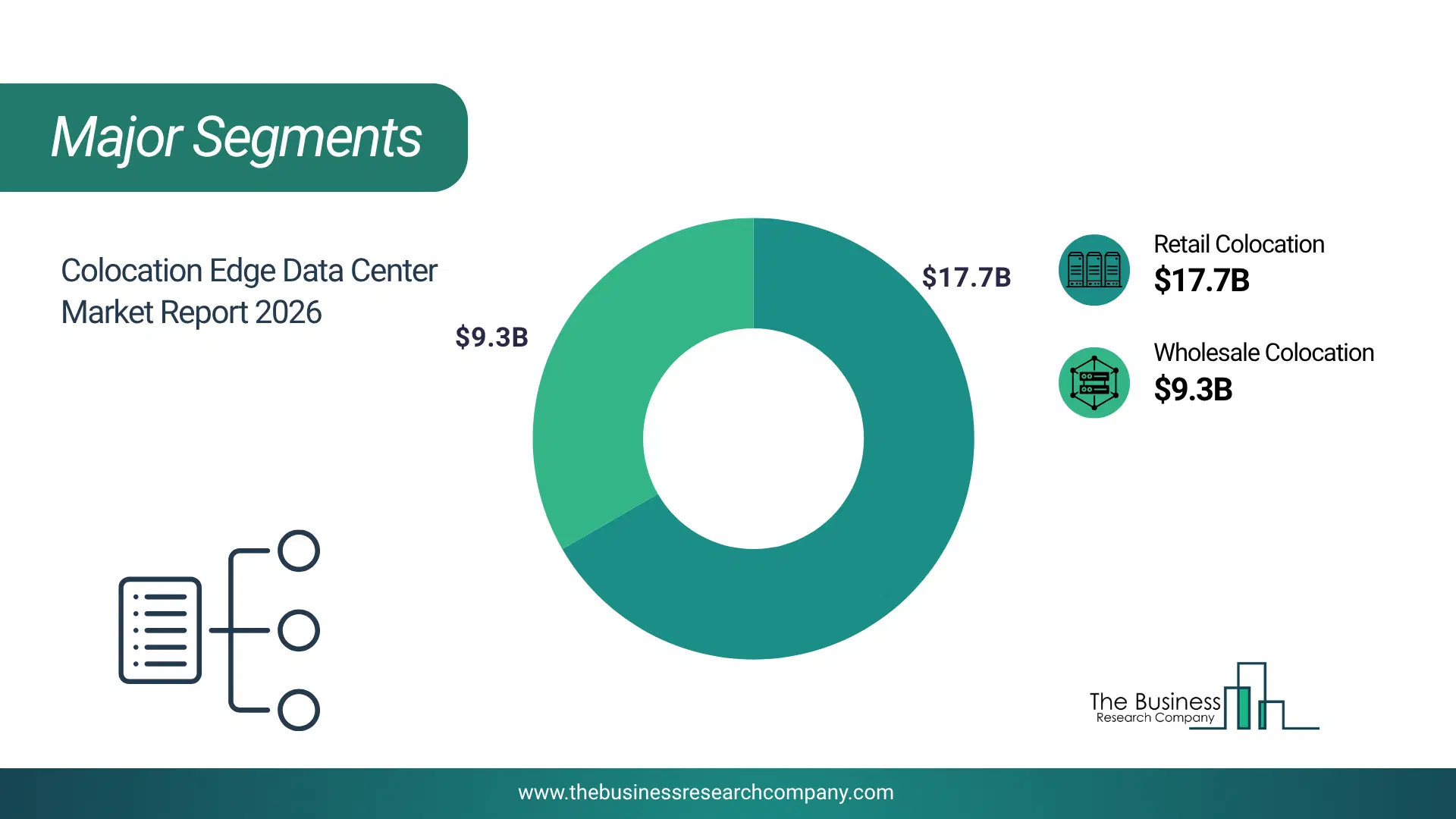
Global Colocation Edge Data Center Market Segmentation
1) By Type: Retail Colocation, Wholesale Colocation 2) By Application: Banking, Financial Services And Insurance (BFSI), Energy, Government And Defense, Healthcare, Information Technology And Telecom, Manufacturing, Retail, Other Applications 3) By End-Use: Small And Midsize Enterprise (SMEs), Large Enterprises Subsegments: 1) By Retail Colocation: Single Rack Or Cabinet Leasing, Customized Space Solutions For Small To Medium Businesses, Managed Services With Colocation, Cloud Connectivity Solutions For Retail Colocation, Colocated Infrastructure For Enterprises And SMBs, Scalable And Flexible Rack Space Options 2) By Wholesale Colocation: Large-Scale Data Center Leasing, Dedicated Space For Large Enterprises And Service Providers, High-Density Colocation Solutions, Direct Connectivity To Cloud Providers, Customized Power, Cooling, And Rack Configurations, Cross-Connects And Interconnection Services For Wholesale Clients The top segments in the colocation edge data center market will be: • Retail Colocation will reach $17.68 billion by 2030. • Wholesale Colocation will reach $9.21 billion by 2030.What Is The Driver Of The Colocation Edge Data Center Market?
The increasing adoption of 5G networks is expected to propel the growth of the colocation edge data center market going forward. 5G network technology refers to the fifth generation of mobile network technology, which represents a significant advancement over its predecessors (2G, 3G, and 4G/LTE, or Long-Term Evolution). The adoption of 5G is driven by the need for faster data speeds, lower latency, and increased network capacity to support the growing demands of IoT, streaming services, and emerging technologies such as autonomous vehicles and smart cities. Colocation edge data centers enable the widespread adoption of 5G technology by delivering low-latency, high-performance computing resources at the network edge. These facilities enable edge computing, scalability, dependability, and IoT deployments, which provide the infrastructure needed to fully utilize 5G networks. For instance, in December 2023, according to the Office of Communications (Ofcom), a UK-based regulator and competition authority, the level of outdoor 5G coverage provided by at least one mobile network operator rose to 85-93% in 2023, an increase from 67-78% in 2022. Therefore, the increasing adoption of 5G networks is driving the growth of the colocation edge data center industry.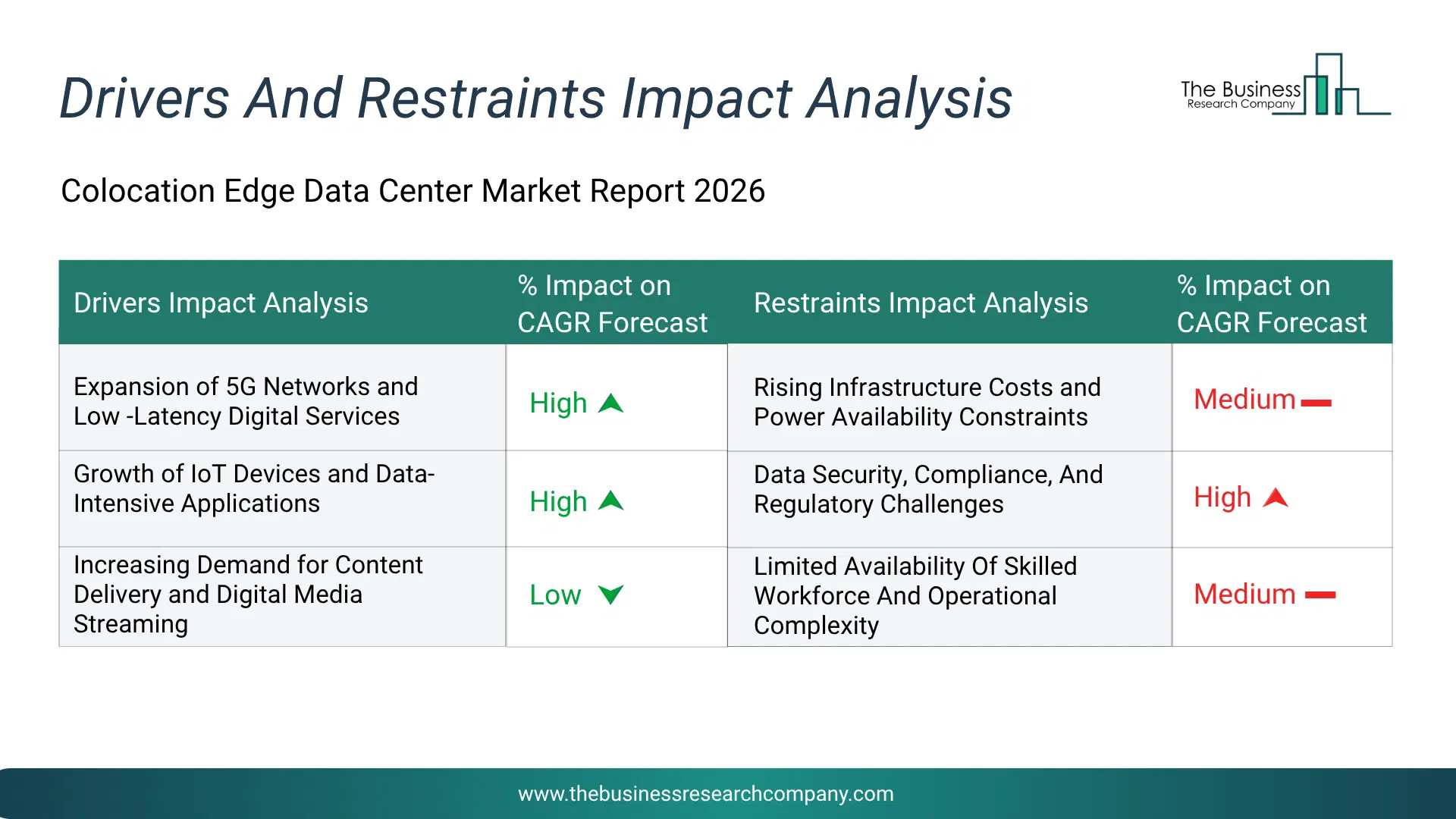
Infographic Chart Showing Key Market Drivers Analysis And Restraints For Colocation Edge Data Center Market
The chart presents an impact analysis of key drivers and restraints, quantifying their relative influence on the market's growth rate and helping assess the balance between growth enablers and limiting factors. This chart offers a high-level perspective; the full report contains more detailed insights.
How Will The Drivers Impact Growth In The Global Colocation Edge Data Center Market?
• Expansion of 5G Networks and Low -Latency Digital Services (High) – During the forecast period, the expansion of 5g networks and low -latency digital services is expected to become a key growth driver for the colocation edge data center market by 2030. The rapid deployment of 5g infrastructure is significantly increasing the demand for colocation edge data centers. Telecommunications providers and enterprises require localized computing capabilities to process data closer to end users, minimizing latency for applications such as autonomous vehicles, augmented and virtual reality, and real -time analytics. Edge colocation facilities support distributed computing architectures that enable high -speed connectivity and enhanced application performance. As 5g adoption continues to expand worldwide, edge data centers are emerging as essential infrastructure for delivering advanced digital services. • Growth of IoT Devices and Data-Intensive Applications (High) – During the forecast period, the growth of iot devices and data-intensive applications is expected to emerge as a major factor driving the expansion of the colocation edge data center market by 2030. The increasing deployment of internet of things (iot) devices across various industries is generating enormous volumes of real-time data that require localized processing capabilities. Edge colocation facilities enable organizations to process data near its source instead of transmitting it to centralized cloud data centers. This approach improves processing speed, lowers bandwidth consumption, and enhances operational efficiency for applications such as smart cities, industrial automation, and connected healthcare systems. The rapid expansion of iot ecosystems is therefore becoming a major driver of the edge colocation market. • Increasing Demand for Content Delivery and Digital Media Streaming (Low) – During the forecast period, the increasing demand for content delivery and digital media streaming is expected to act as a key growth catalyst for the colocation edge data center market by 2030. The global surge in video streaming, online gaming, and digital media services is driving the need for localized computing infrastructure and content delivery networks. Edge colocation data centers allow content providers to deploy servers closer to end users, improving streaming performance and minimizing latency. As consumer demand for high-definition content and cloud-based gaming platforms continues to grow, content providers are increasingly investing in edge infrastructure. This trend significantly strengthens the demand for colocation edge data center services.How Will The Restraints Impact Growth In The Global Colocation Edge Data Center Market?
• Rising Infrastructure Costs and Power Availability Constraints (Medium) – During the forecast period, the despite strong demand growth, the expansion of edge colocation facilities is constrained by rising infrastructure costs and energy availability challenges. Building distributed data centers requires substantial investment in land, power infrastructure, cooling systems, and network connectivity. Additionally, power supply limitations in certain urban locations can restrict new facility deployments. These factors may slow down market expansion in regions where energy infrastructure and real estate costs are high. • Data Security, Compliance, And Regulatory Challenges (High) – During the forecast period, the expansion of colocation edge data centers is also constrained by increasing concerns related to data security, privacy regulations, and compliance requirements. Edge environments process sensitive data closer to end users, which increases exposure to cybersecurity risks and requires strict governance frameworks. Organizations must comply with regional data protection regulations such as gdpr and other data sovereignty laws, which can complicate infrastructure deployment across multiple locations. These regulatory complexities may slow the adoption of distributed edge data center architectures. • Limited Availability Of Skilled Workforce And Operational Complexity (Medium) – During the forecast period, the limited availability of skilled workforce and operational complexity act as a restraint for the colocation edge data center market by making it difficult for operators to efficiently manage and maintain distributed infrastructure. Edge data centers require expertise in networking, power systems, cooling technologies, and cybersecurity, which is not always readily available in all regions. This shortage of qualified professionals increases operational risks and dependence on external vendors. Additionally, managing multiple small-scale facilities across different locations adds complexity in monitoring, maintenance, and coordination. As a result, operational inefficiencies and talent gaps can slow down market expansion.Key Players In The Global Colocation Edge Data Center Market
Major companies operating in the colocation edge data center market are Verizon Communications Inc; Dell Inc; Huawei Technologies Co. Ltd; NTT Communications Corporation; Hitachi Ltd; China Telecom Global Limited; International Business Machines Corporation; Cisco Systems Inc; KDDI Corporation; Schneider Electric SE; Fujitsu Limited; Hewlett Packard Enterprise Company; NVIDIA Corporation; NEC Corporation; Eaton Corporation PLC; Inventec Corporation; ASUSTeK Computer Inc; Singapore Telecommunications Limited; Equinix Inc; Vertiv Group Corporation; Super Micro Computer Inc; Digital Realty Trust Inc; Rackspace Inc; Arm Ltd; Inspur Co. Ltd; Arrcus Inc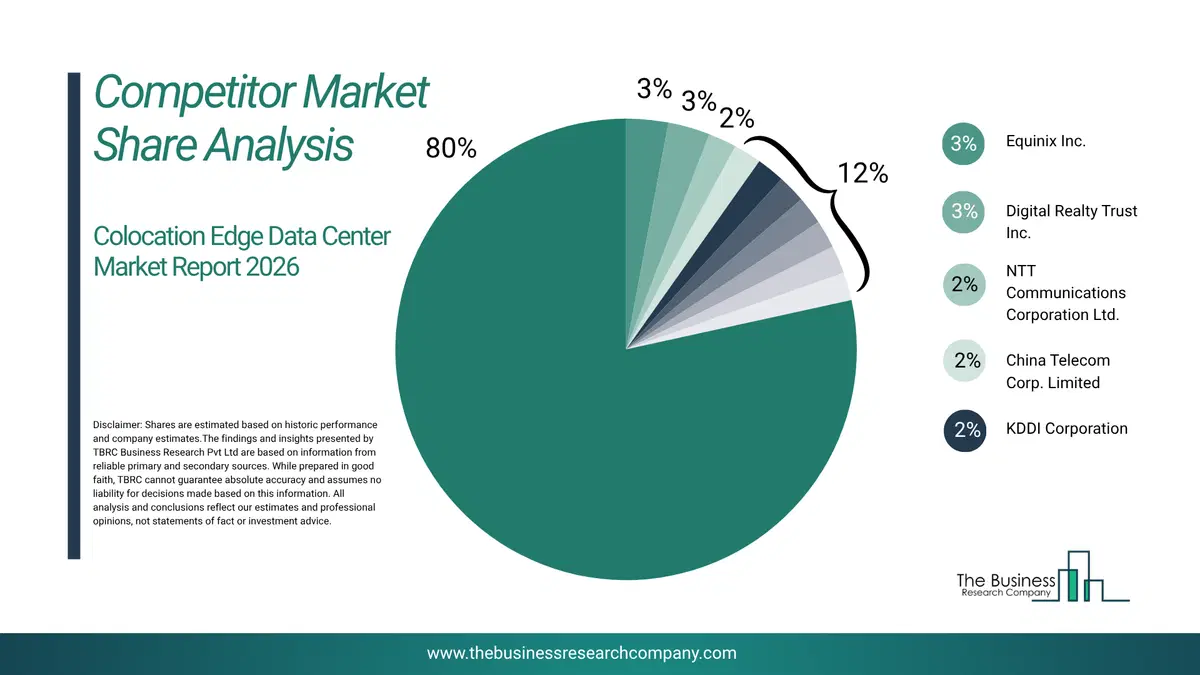
This chart is for illustrative purposes; the full report includes a detailed competitor analysis and comprehensive overview of the top 10 companies in the market.
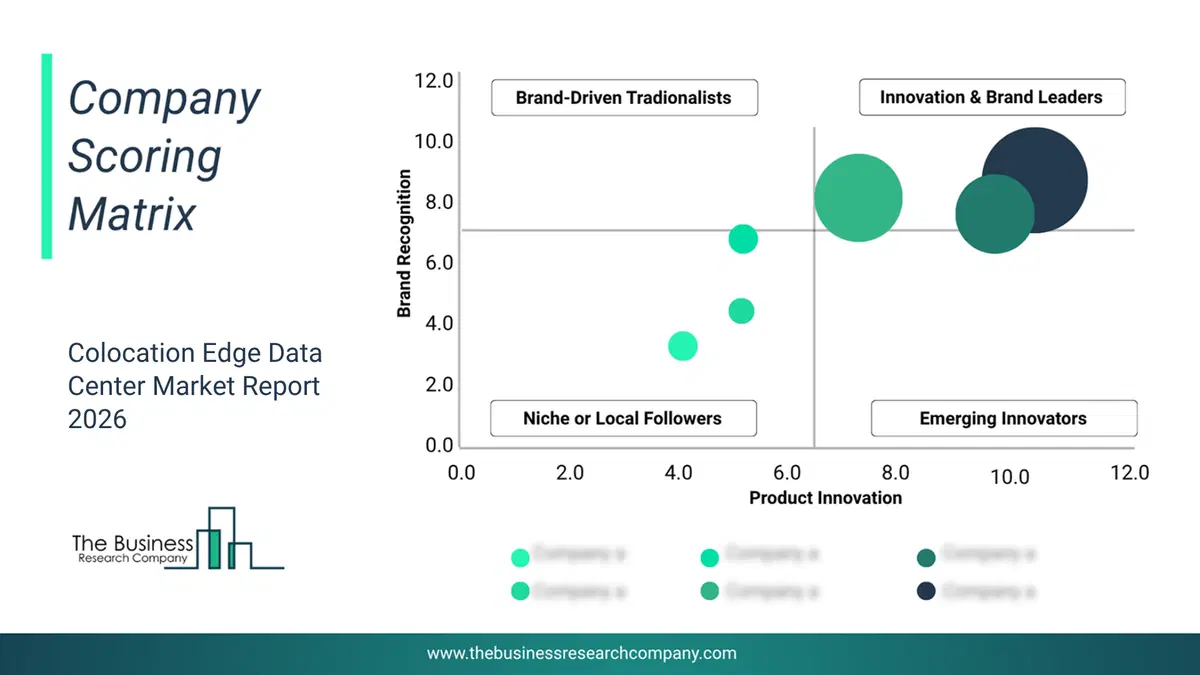
This chart maps companies by product innovation and brand strength, with bubble size indicating relative revenue, helping identify market leaders, challengers, and niche players. This is an illustrative chart; the full report provides a complete and accurate competitive analysis.
Global Colocation Edge Data Center Market Trends and Insights
Major companies operating in the colocation edge data center market are focusing on developing advanced platforms, such as centralized management consoles, to simplify operations and improve efficiency. Centralized management consoles refer to unified software platforms that allow administrators to monitor, control, and manage multiple data center or edge site resources from a single interface. For instance, in March 2023, MetaEdge, an India-based edge data center platform provider, launched its edge data center platform featuring colocation, bare-metal and cloud services from facilities in Indore, MumbAI and Delhi. This platform is a hyper-converged system that integrates computing, storage, networking, and security into a single, managed solution. It includes a centralized management console and automation functionality, enabling seamless deployment and orchestration of applications across distributed edge locations without constant manual intervention.What Are Latest Mergers And Acquisitions In The Colocation Edge Data Center Market?
In September 2023, nLighten, a Germany-based information technology services company, acquired Proximity Data Centers for an undisclosed amount. This acquisition aims to advance nLighten's goal of establishing the pan-European edge data center platform. The acquisition allows nLighten to leverage Proximity's reputation, agility, and track record in entering local markets to capture the increasing shift towards edge computing and the colocation of edge data centers in the UK. Proximity Data Centers is a UK-based data center services company that provides services such as colocation edge data centers, cloud connectivity, and security.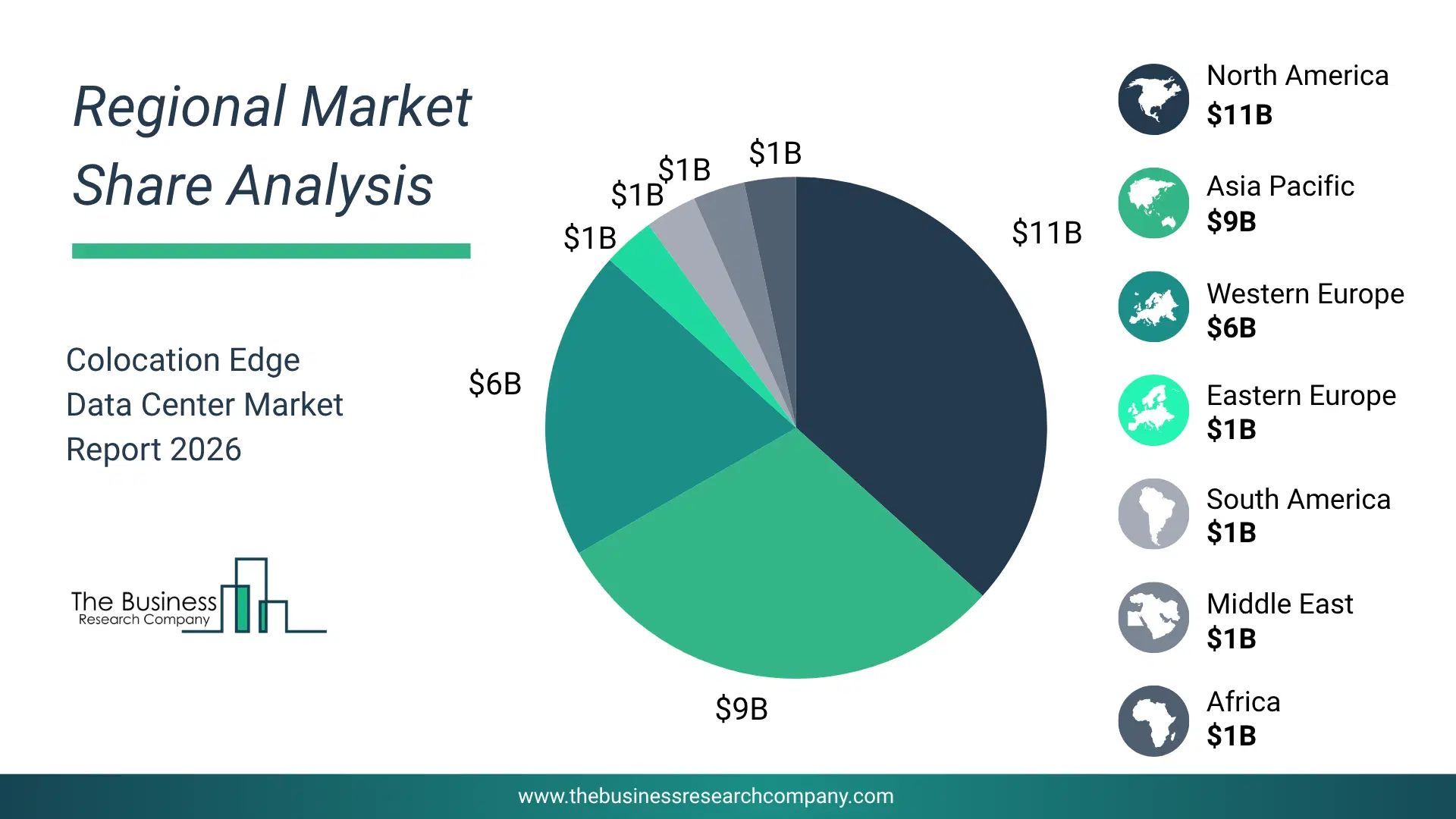
Regional Insights
North America was the largest region in the colocation edge data center market in 2025. Asia-Pacific is expected to be the fastest-growing region in the forecast period. The regions covered in this market report are Asia-Pacific, South East Asia, Western Europe, Eastern Europe, North America, South America, Middle East, Africa. The countries covered in this market report are Australia, Brazil, China, France, Germany, India, Indonesia, Japan, Taiwan, Russia, South Korea, UK, USA, Canada, Italy, SpainWhat Defines the Colocation Edge Data Center Market?
The colocation edge data center market includes revenues earned by entities by providing network connectivity services, remote hands support, hardware installation, maintenance, and monitoring services. The market value includes the value of related goods sold by the service provider or included within the service offering. Only goods and services traded between entities or sold to end consumers are included.How is Market Value Defined and Measured?
The market value is defined as the revenues that enterprises gain from the sale of goods and/or services within the specified market and geography through sales, grants, or donations in terms of the currency (in USD unless otherwise specified). The revenues for a specified geography are consumption values that are revenues generated by organizations in the specified geography within the market, irrespective of where they are produced. It does not include revenues from resales along the supply chain, either further along the supply chain or as part of other products.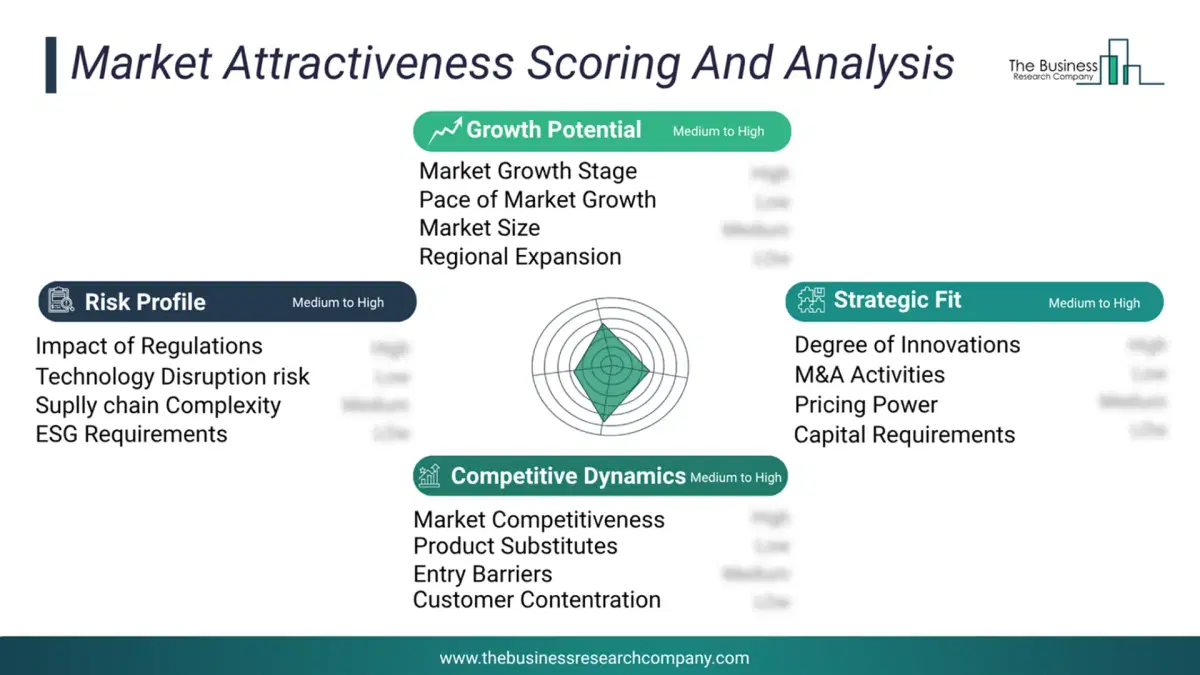
This chart presents market attractiveness based on a quantitative evaluation of growth, competition, strategic alignment, and risk, offering a clear view of opportunity areas for decision-making. This chart is for illustrative purposes; the full report contains the complete analysis.
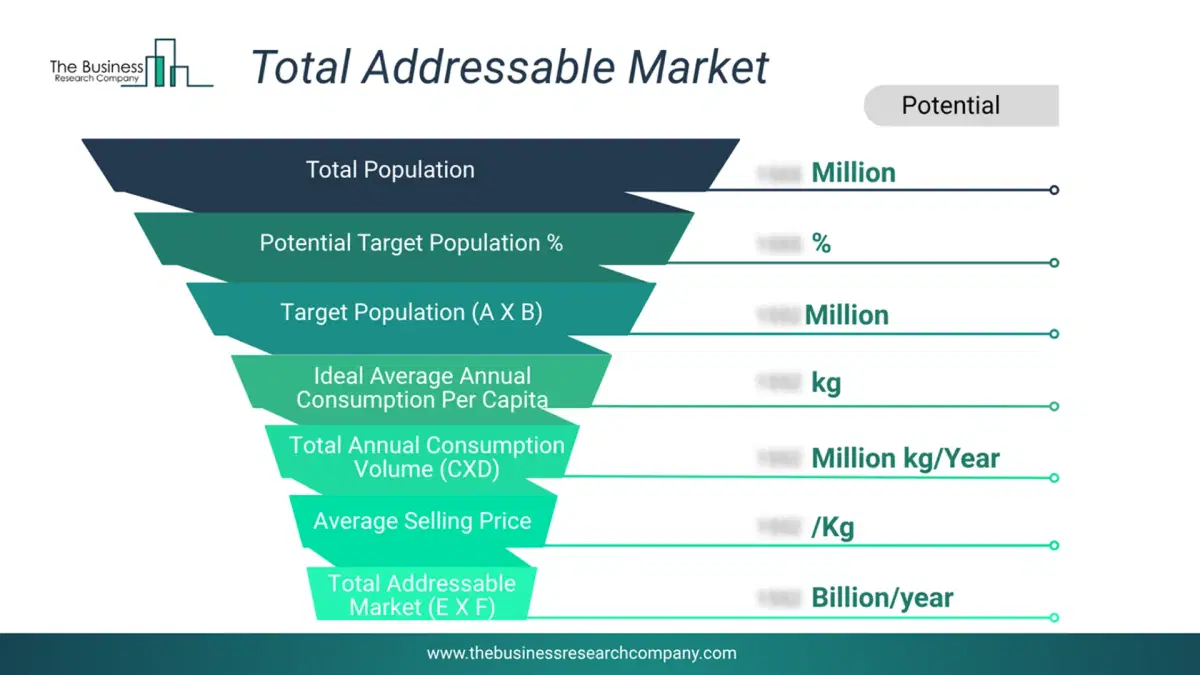
This chart highlights the Total Addressable Market (TAM) by estimating the maximum revenue opportunity using an assumption-driven approach, supporting strategic planning and opportunity sizing across markets. The chart is illustrative; the full report provides a more comprehensive analysis.
What Key Data and Analysis Are Included in the Colocation Edge Data Center Market Report 2026?
The colocation edge data center market research report is one of a series of new reports from The Business Research Company that provides market statistics, including industry global market size, regional shares, competitors with the market share, detailed market segments, market trends and opportunities, and any further data you may need to thrive in the colocation edge data center industry. The market research report delivers a complete perspective of everything you need, with an in-depth analysis of the current and future state of the industry.Colocation Edge Data Center Market Report Forecast Analysis
| Report Attribute | Details |
|---|---|
| Market Size Value In 2026 | $12.67 billion |
| Revenue Forecast In 2030 | $26.89 billion |
| Growth Rate | CAGR of 20.7% from 2026 to 2030 |
| Base Year For Estimation | 2025 |
| Actual Estimates/Historical Data | 2020-2025 |
| Forecast Period | 2026 - 2030 |
| Market Representation | Revenue in USD Billion and CAGR from 2026 to 2030 |
| Segments Covered | Type, Application, End-Use |
| Regional Scope | Asia-Pacific, Western Europe, Eastern Europe, North America, South America, Middle East, Africa |
| Country Scope | The countries covered in the report are Australia, Brazil, China, France, Germany, India, ... |
| Key Companies Profiled | Verizon Communications Inc; Dell Inc; Huawei Technologies Co. Ltd; NTT Communications Corporation; Hitachi Ltd; China Telecom Global Limited; International Business Machines Corporation; Cisco Systems Inc; KDDI Corporation; Schneider Electric SE; Fujitsu Limited; Hewlett Packard Enterprise Company; NVIDIA Corporation; NEC Corporation; Eaton Corporation PLC; Inventec Corporation; ASUSTeK Computer Inc; Singapore Telecommunications Limited; Equinix Inc; Vertiv Group Corporation; Super Micro Computer Inc; Digital Realty Trust Inc; Rackspace Inc; Arm Ltd; Inspur Co. Ltd; Arrcus Inc |
| Customization Scope | Request for Customization |
| Pricing And Purchase Options | Explore Purchase Options |