

Commercial Aircraft Market Report 2026
Global Outlook – By Type (Passenger Aircrafts, Commercial Helicopters, Commercial Gliders And Drones, Aircraft Turbines, Aircraft Engines), By Engine Type (Turbofan, Turboprop, Turboshaft ), By Size (Wide-Body, Narrow-Body, Regional, Others ), By End-User (Government, Private Sector ), By Operation (Autonomous Aircraft, Manual ) – Market Size, Trends, Strategies, and Forecast to 2030
Commercial Aircraft Market Overview
• Commercial Aircraft market size has reached to $216.97 billion in 2025 • Expected to grow to $274.06 billion in 2030 at a compound annual growth rate (CAGR) of 4.9% • Growth Driver: Increasing Demand For Air Travel Boosts The Commercial Aircraft Market • Market Trend: Increasing Focus On Developing Home-Built Aircraft To Reduce Foreign Dependence In The Commercial Aircraft Market • North America was the largest region and fastest growing region.Market Gains By 2030 – Top Opportunities By Segment
Market Gain identifies the most promising market opportunities by highlighting the segments or products expected to generate the highest incremental revenue growth over the next five years.
What Is Covered Under Commercial Aircraft Market?
The commercial aircraft refers to civilian and commercial aircraft used for commercial purposes such as passenger and cargo transportation. The main components of commercial aircraft include fuselage, wings, cockpit, engine, propeller, tail assembly, and landing gear. The main types of the commercial aircraft include passenger aircrafts, commercial helicopters, commercial gliders and drones, aircraft turbines, and aircraft engines. Passenger aircrafts refer to fixed-wing airplanes designed primarily to transport passengers and cargo over varying distances with efficiency, safety, and comfort. The engine types include turbofan, turboprop, and turboshaft. The sizes include wide-body, narrow-body, regional, and others. The various end-users include government and private sector entities, and they are used by several operations such as autonomous aircraft and manual.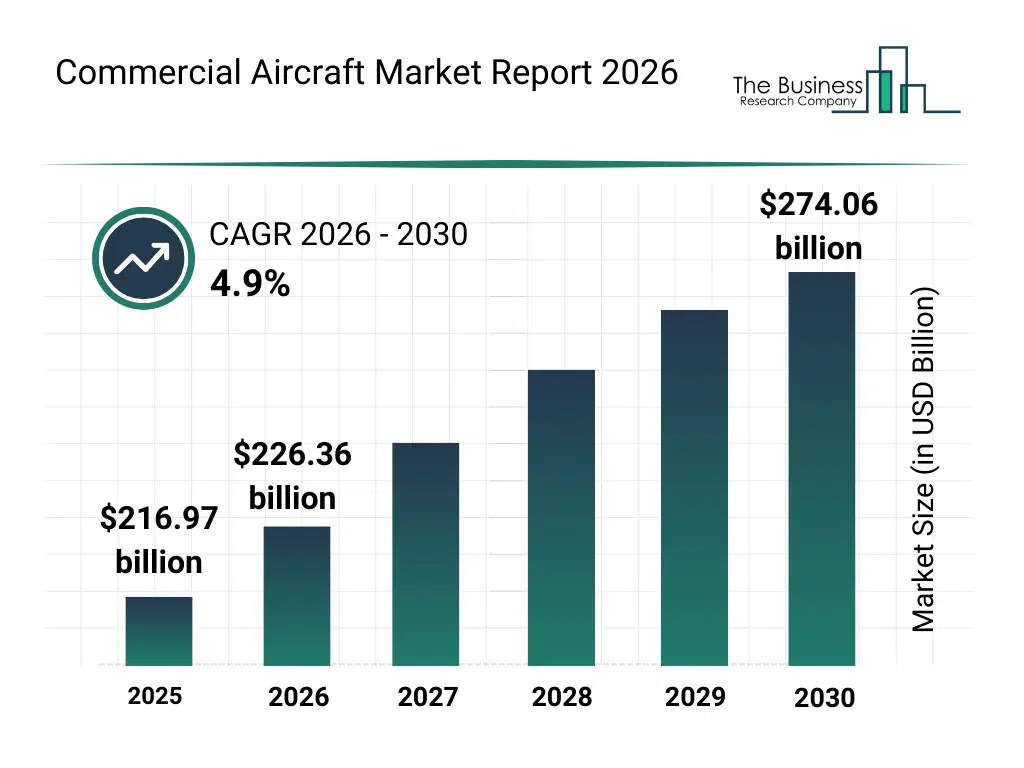
What Is The Commercial Aircraft Market Size and Share 2026?
The commercial aircraft market size has grown steadily in recent years. It will grow from $216.97 billion in 2025 to $226.36 billion in 2026 at a compound annual growth rate (CAGR) of 4.3%. The growth in the historic period can be attributed to growth in global passenger air travel increasing demand for new commercial aircraft, expansion of cargo transportation driving procurement of freight-capable aircraft, advancements in engine efficiency and aerostructure design, rising fleet modernization programs replacing aging aircraft, increased reliance on mro services provided by manufacturers during warranty periods.What Is The Commercial Aircraft Market Growth Forecast?
The commercial aircraft market size is expected to see steady growth in the next few years. It will grow to $274.06 billion in 2030 at a compound annual growth rate (CAGR) of 4.9%. The growth in the forecast period can be attributed to rising production of next-generation fuel-efficient aircraft, growing demand for regional and narrow-body jets driven by route optimization, increasing investment in sustainable aviation technologies including hybrid and electric concepts, expansion of low-cost carriers driving higher aircraft order volumes, advancements in digital maintenance solutions enhancing manufacturer-provided mro services. Major trends in the forecast period include advanced mro technologies and predictive maintenance, growth in regional air travel demand, integration of lightweight composite materials, expansion of cargo aircraft services, increasing adoption of fuel-efficient aircraft.
Global Commercial Aircraft Market Segmentation
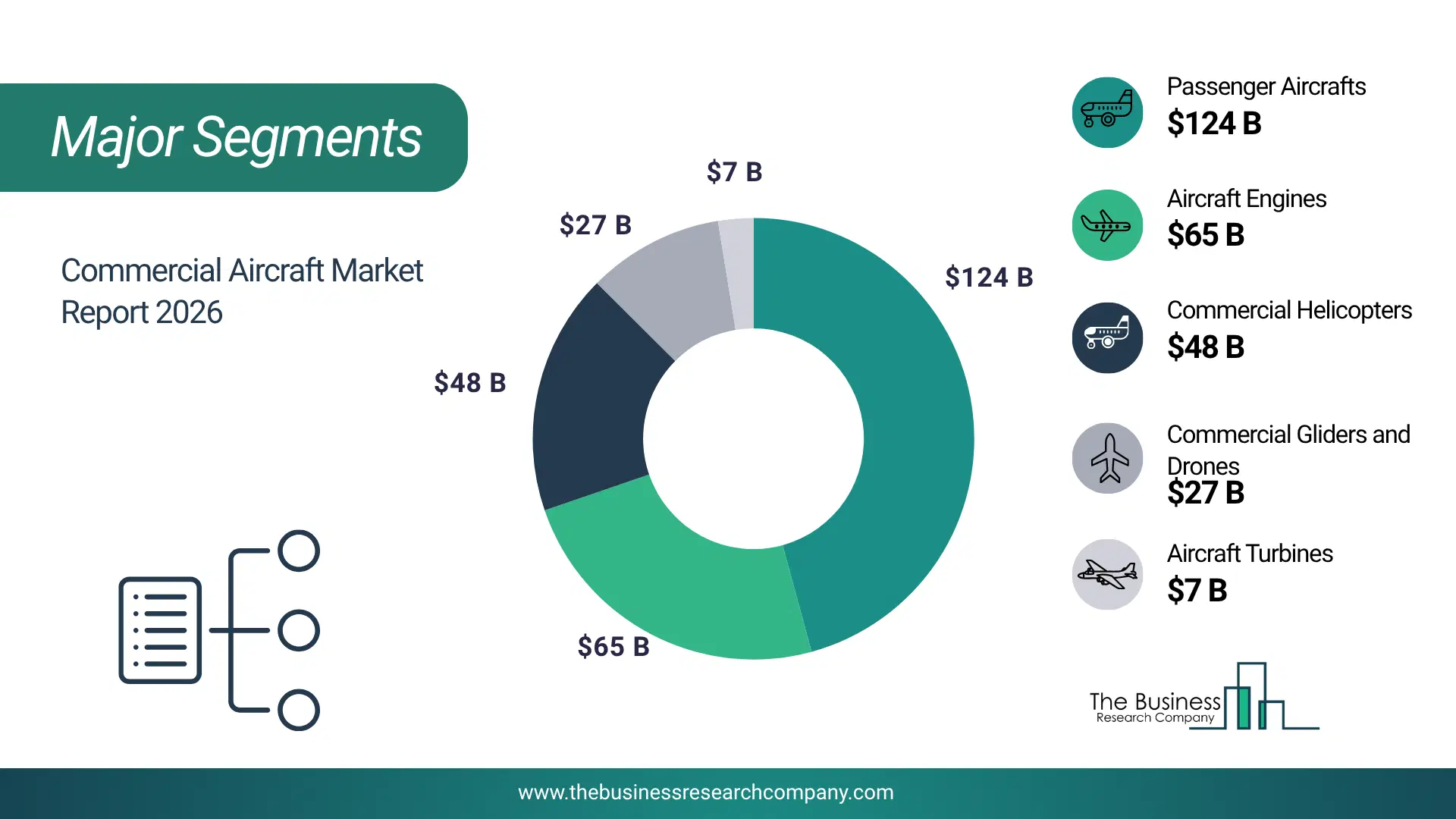
1) By Type: Passenger Aircrafts, Commercial Helicopters, Commercial Gliders And Drones, Aircraft Turbines, Aircraft Engines 2) By Engine Type: Turbofan, Turboprop, Turboshaft 3) By Size: Wide-Body, Narrow-Body, Regional, Others 4) By End-User: Government, Private Sector 5) By Operation: Autonomous Aircraft, Manual Subsegments: 1) By Passenger Aircraft: Narrow-Body Aircraft, Wide-Body Aircraft, Regional Aircraft 2) By Commercial Helicopters: Single-Engine Helicopters, Multi-Engine Helicopters, Utility Helicopters 3) By Commercial Gliders And Drones: Unmanned Aerial Vehicles (UAVs), Commercial Gliders 4) By Aircraft Turbines: Turbojet Engines, Turbofan Engines, Turboprop Engines 5) By Aircraft Engines: Jet Engines, Reciprocating Engines, Electric Aircraft EnginesThe top segments in the commercial aircraft market will be: • Passenger Aircrafts will reach $124 Billion by 2030. • Aircraft Engines will reach $65 Billion by 2030. • Commercial Helicopters will reach $48 Billion by 2030. • Commercial Gliders and Drones will reach $27 Billion by 2030. • Aircraft Turbines will reach $7 Billion by 2030.What Is Driver Of The Commercial Aircraft Market?
The increasing demand for air travel is expected to propel the growth of the commercial aircraft market going forward. Air travel involves the transportation of passengers or cargo by aircraft through the atmosphere. Commercial aircraft are designed to transport passengers from one point to another. They provide a fast and efficient means of transportation, allowing passengers to travel long distances in a short amount of time. For instance, In December 2024, according to Eurostat, a Luxembourg-based Directorate-General of the European Commission, in 2023, there were 976 million air passengers carried in the EU, a 19 % increase compared to 2022. Therefore, the increasing demand for air travel is driving the growth of the commercial aircraft industry.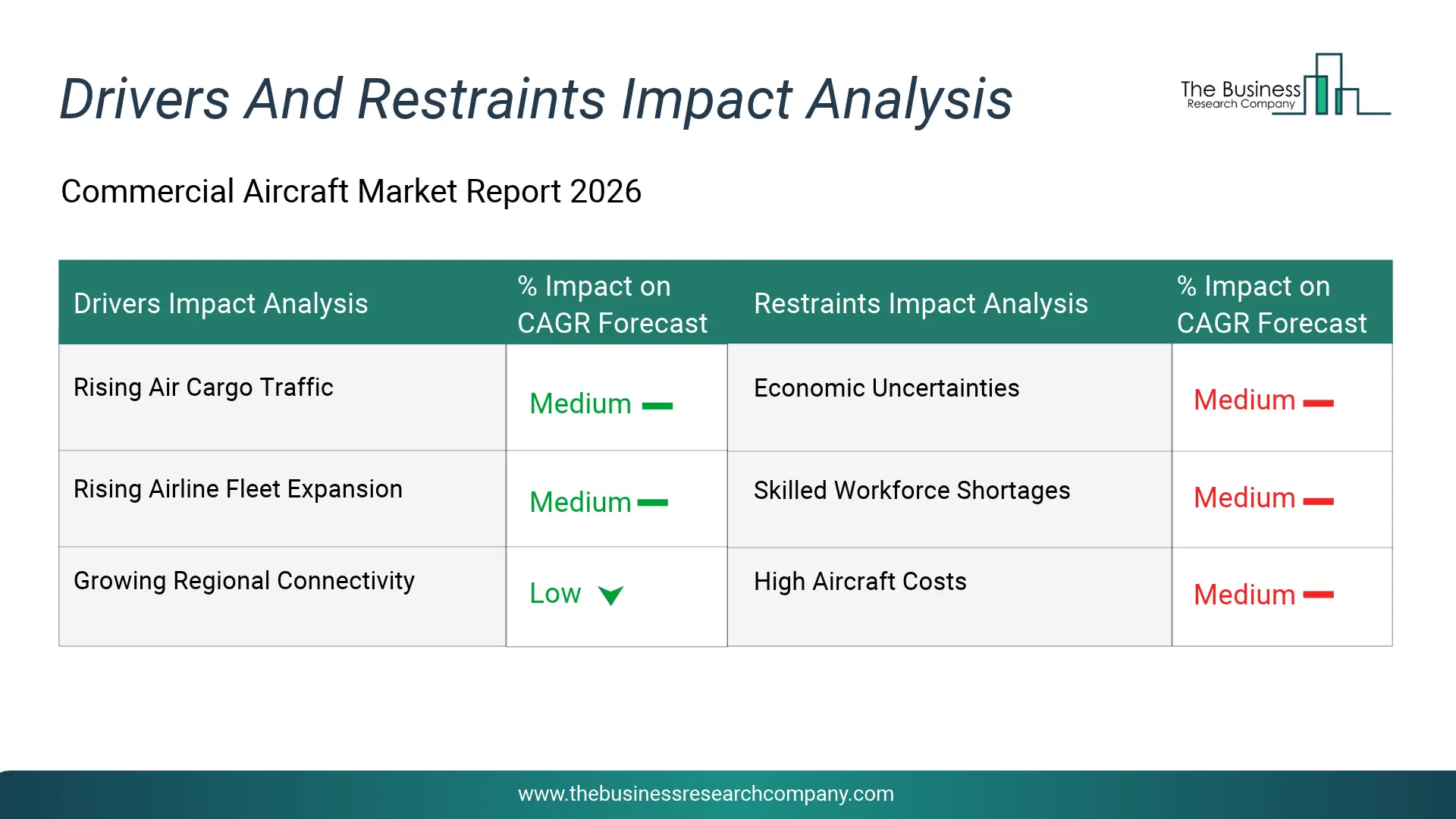
Infographic Chart Showing Key Market Drivers Analysis And Restraints For Commercial Aircraft Market
The chart presents an impact analysis of key drivers and restraints, quantifying their relative influence on the market's growth rate and helping assess the balance between growth enablers and limiting factors. This chart offers a high-level perspective; the full report contains more detailed insights.
How Will The Drivers Impact Growth In The Global Commercial Aircraft Market?
• Rising Air Cargo Traffic (Medium) – During the forecast period, the rising air cargo traffic is expected to become a key growth driver for the commercial aircraft market by 2030. Rising air cargo traffic is driving the growth of the commercial aircraft market by expanding the customer base and purchases of commercial aircraft, aerospace systems, precision components, and maintenance solutions. This trend encourages airlines, aircraft manufacturers, lessors, and aerospace suppliers to increase spending and capacity related to passenger and cargo aviation, fleet modernization, safety, and operational efficiency. As this trend continues, suppliers are expected to expand capacity, improve their offerings, and strengthen distribution to support passenger and cargo aviation, fleet modernization, safety, and operational efficiency. • Rising Airline Fleet Expansion (Medium) – During the forecast period, the rising airline fleet expansion is expected to emerge as a major factor driving the expansion of the commercial aircraft market by 2030. Rising airline fleet expansion is driving the growth of the commercial aircraft market by raising production volumes and requirements for reliable commercial aircraft, aerospace systems, precision components, and maintenance solutions. This trend encourages airlines, aircraft manufacturers, lessors, and aerospace suppliers to increase spending and capacity related to passenger and cargo aviation, fleet modernization, safety, and operational efficiency. As this trend continues, suppliers are expected to expand capacity, improve their offerings, and strengthen distribution to support passenger and cargo aviation, fleet modernization, safety, and operational efficiency. • Growing Regional Connectivity (Low) – During the forecast period, the growing regional connectivity is expected to act as a key growth catalyst for the commercial aircraft market by 2030. Growing regional connectivity is driving the growth of the commercial aircraft market by expanding the customer base and purchases of commercial aircraft, aerospace systems, precision components, and maintenance solutions. This trend encourages airlines, aircraft manufacturers, lessors, and aerospace suppliers to increase spending and capacity related to passenger and cargo aviation, fleet modernization, safety, and operational efficiency. As this trend continues, suppliers are expected to expand capacity, improve their offerings, and strengthen distribution to support passenger and cargo aviation, fleet modernization, safety, and operational efficiency.How Will The Restraints Impact Growth In The Global Commercial Aircraft Market?
• Economic Uncertainties (Medium) – During the forecast period, the economic uncertainties is restraining the growth of the commercial aircraft market by reducing confidence, financing availability, and expenditure on commercial aircraft, aerospace systems, precision components, and maintenance solutions. Customers commonly postpone discretionary purchases and projects when financial visibility weakens. As a result, market participants may delay expansion, limit new investment, or increase prices, slowing the adoption and availability of commercial aircraft, aerospace systems, precision components, and maintenance solutions. • Skilled Workforce Shortages (Medium) – During the forecast period, the skilled workforce shortages are restraining the growth of the commercial aircraft market by reducing input availability, extending lead times, and increasing costs for commercial aircraft, aerospace systems, precision components, and maintenance solutions. Market participants depend on timely access to inputs and equipment to sustain aircraft design, certification, production, component sourcing, delivery, and maintenance. As a result, market participants may delay expansion, limit new investment, or increase prices, slowing the adoption and availability of commercial aircraft, aerospace systems, precision components, and maintenance solutions. • High Aircraft Costs (Low) – During the forecast period, the high aircraft costs are restraining the growth of the commercial aircraft market by reducing production utilization, capital expenditure, and orders for commercial aircraft, aerospace systems, precision components, and maintenance solutions. Because aircraft design, certification, production, component sourcing, delivery, and maintenance is cost-sensitive, these increases can be difficult to absorb or pass on to customers. As a result, market participants may delay expansion, limit new investment, or increase prices, slowing the adoption and availability of commercial aircraft, aerospace systems, precision components, and maintenance solutions.Key Players In The Global Commercial Aircraft Market
Major companies operating in the commercial aircraft market are Boeing, Airbus, Embraer, Bombardier, Textron Aviation, United Aircraft Corporation, Dassault Aviation, Leonardo S.p.A., Mitsubishi Heavy Industries, COMAC (Commercial Aircraft Corporation of China), Gulfstream Aerospace, Pilatus Aircraft, Cessna Aircraft Company, Sukhoi Civil Aircraft, ATR (Aerei da Trasporto Regionale), Antonov Company, AVIC (Aviation Industry Corporation of China), Kawasaki Heavy Industries, Hindustan Aeronautics Limited (HAL), Saab AB, De Havilland Aircraft of Canada, Viking Air, Embraer Commercial Aviation, Irkut Corporation, Boeing Defense Space & Security, Fokker Technologies, Israel Aerospace Industries, Korea Aerospace Industries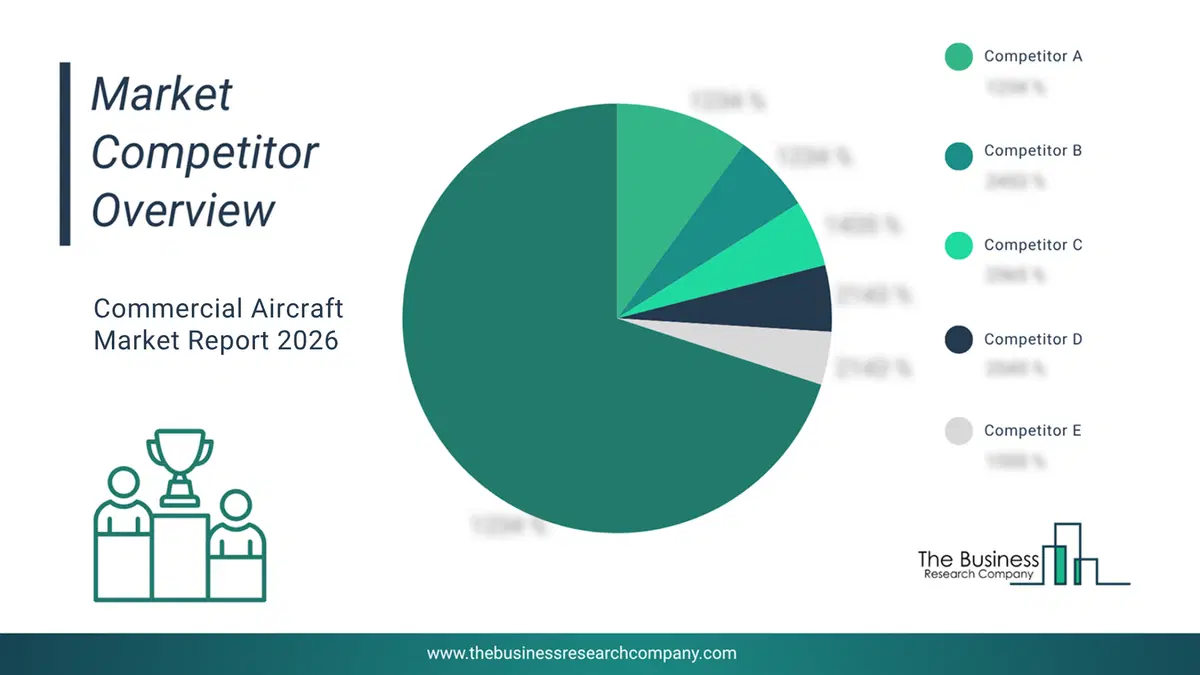
This chart is for illustrative purposes; the full report includes a detailed competitor analysis and comprehensive overview of the top 10 companies in the market.
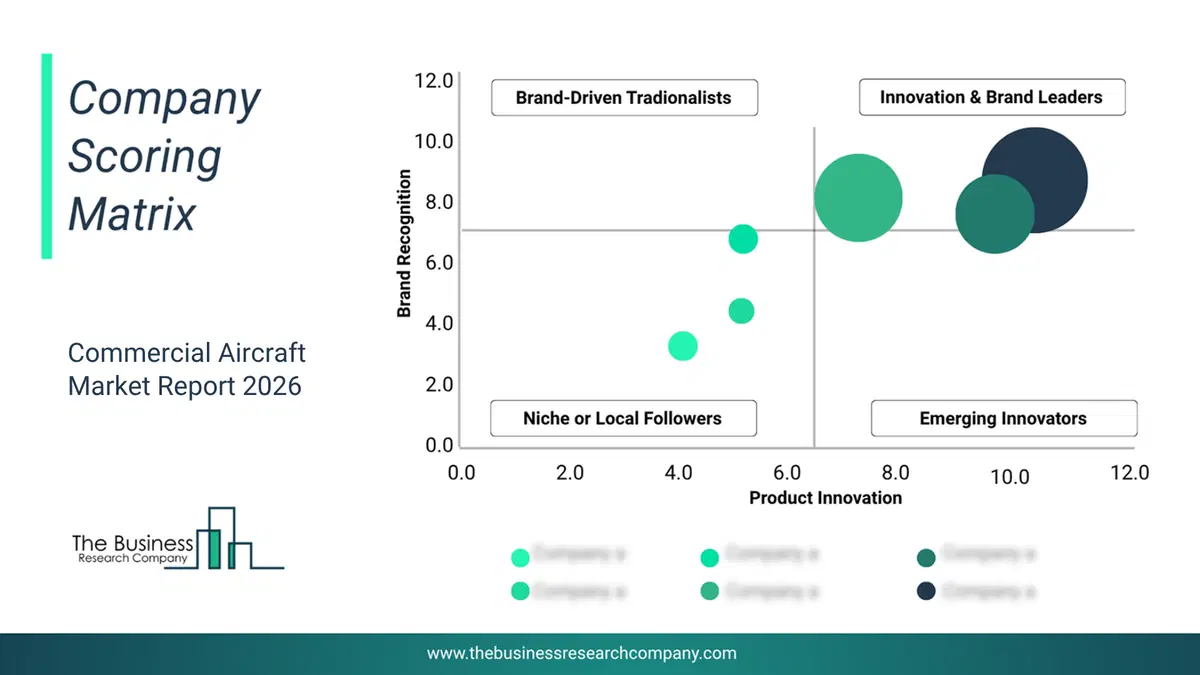
This chart maps companies by product innovation and brand strength, with bubble size indicating relative revenue, helping identify market leaders, challengers, and niche players. This is an illustrative chart; the full report provides a complete and accurate competitive analysis.
Global Commercial Aircraft Market Trends and Insights
Major companies operating in the commercial aircraft market are increasing their focus on developing innovative aircraft such as home-built aircraft to remove foreign dependence and gain a competitive edge in the market. Home-built aircraft refer to aircraft that are built domestically to achieve greater self-sufficiency and may be constructed from scratch, from plans, or from assembly kits. For instance, in May 2023, Commercial Aviation Corp. of China (COMAC), a China-based aerospace manufacturer, launched the COMAC C919, a narrow-body airliner. Although the Comac C919 and the Airbus A320 and Boeing 737 have similar sizes and flight ranges, the Comac C919 has received slightly over 1,000 aircraft orders from various operators and businesses. The C919 is the largest commercial airplane ever produced in China, and it marks a huge accomplishment for Comac as it seeks to compete with the duopoly of Airbus and Boeing.What Are Latest Mergers And Acquisitions In The Commercial Aircraft Market? De Havilland Canada Acquires Field Aviation to Enhance Manufacturing and Engineering Capabilities
In February 2024, De Havilland Canada,a Canada-based aerospace company, acquired Field Aviation Company Inc. for an undisclosed amount. The acquisition aims to strengthen De Havilland Canada's manufacturing footprint and enhance its engineering and avionics design capabilities. This strategic move is focused on improving the in-house supply chain and ensuring timely delivery of parts to meet growing global customer demand. Field Aviation Company Inc. is a US-based company that specializes in the modification and missionization of commercial aircraft.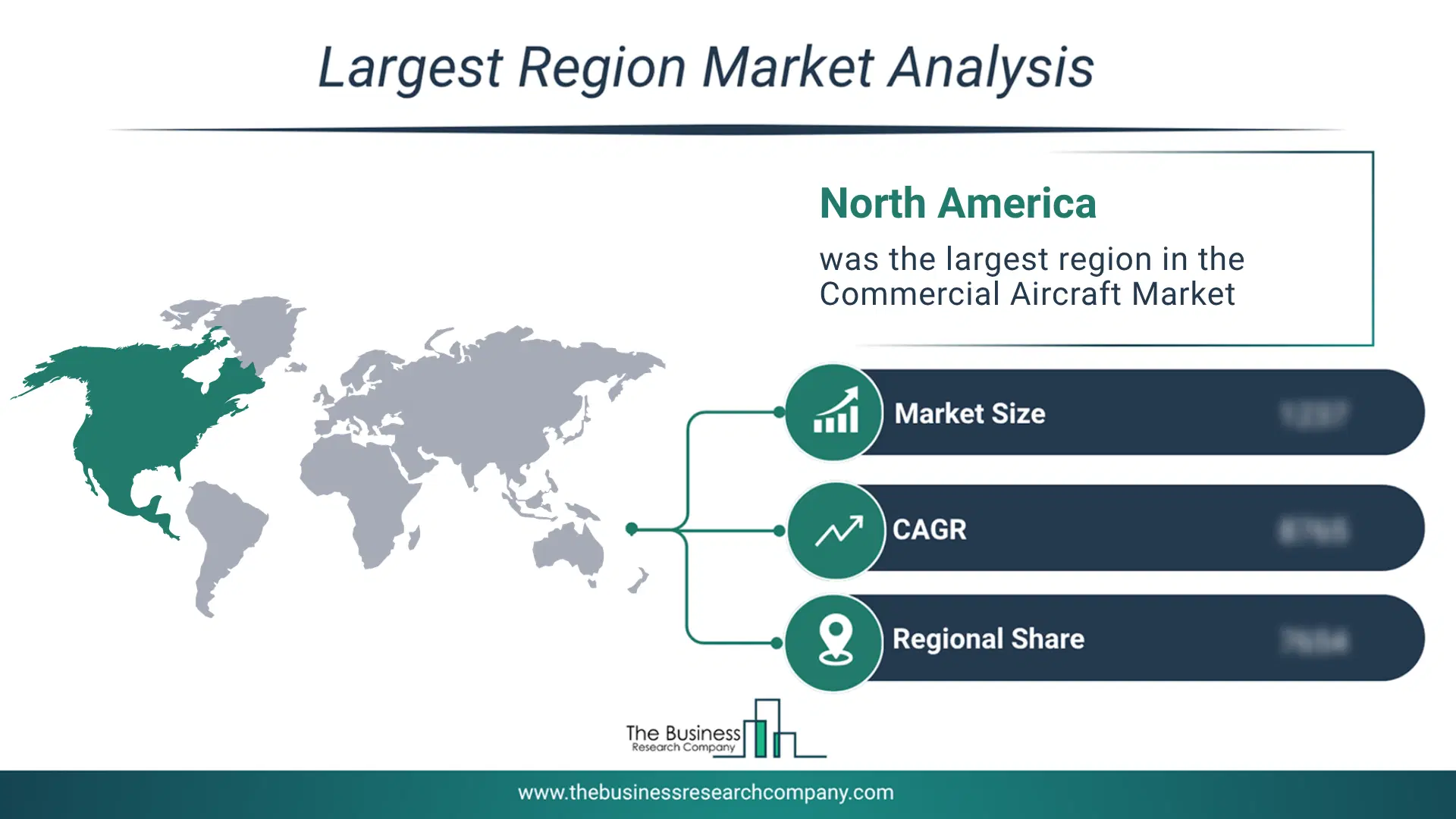
Regional Insights
North America was the largest region in the commercial aircraft market in 2025. North America is expected to be the fastest growing region in the forecast period. The regions covered in the commercial aircraft market report are Asia-Pacific, South East Asia, Western Europe, Eastern Europe, North America, South America, Middle East, Africa. The countries covered in the commercial aircraft market report are China, India, Japan, Australia, Indonesia, South Korea, Bangladesh, Thailand, Vietnam, Malaysia, Singapore, Philippines, Hong Kong, Taiwan, New Zealand, UK, Germany, France, Italy, Spain, Austria, Belgium, Denmark, Finland, Ireland, Netherlands, Norway, Portugal, Sweden, Switzerland, Russia, Czech Republic, Poland, Romania, Ukraine, USA, Canada, Mexico, Brazil, Chile, Argentina, Colombia, Peru, Saudi Arabia, Israel, Iran, Turkey, UAE, Egypt, Nigeria, South Africa.What Defines the Commercial Aircraft Market?
The commercial aircraft market consists of sales of commercial aircraft of various types such as piston aircraft, light jets, and heavy jets. The market includes MRO (maintenance, repair, and overhaul) services provided by manufacturers during the aircraft’s warranty period. Values in this market are ‘factory gate’ values, that is the value of goods sold by the manufacturers or creators of the goods, whether to other entities (including downstream manufacturers, wholesalers, distributors, and retailers) or directly to end customers. The value of goods in this market includes related services sold by the creators of the goods.How is Market Value Defined and Measured?
The market value is defined as the revenues that enterprises gain from the sale of goods and/or services within the specified market and geography through sales, grants, or donations in terms of the currency (in USD unless otherwise specified). The revenues for a specified geography are consumption values that are revenues generated by organizations in the specified geography within the market, irrespective of where they are produced. It does not include revenues from resales along the supply chain, either further along the supply chain or as part of other products.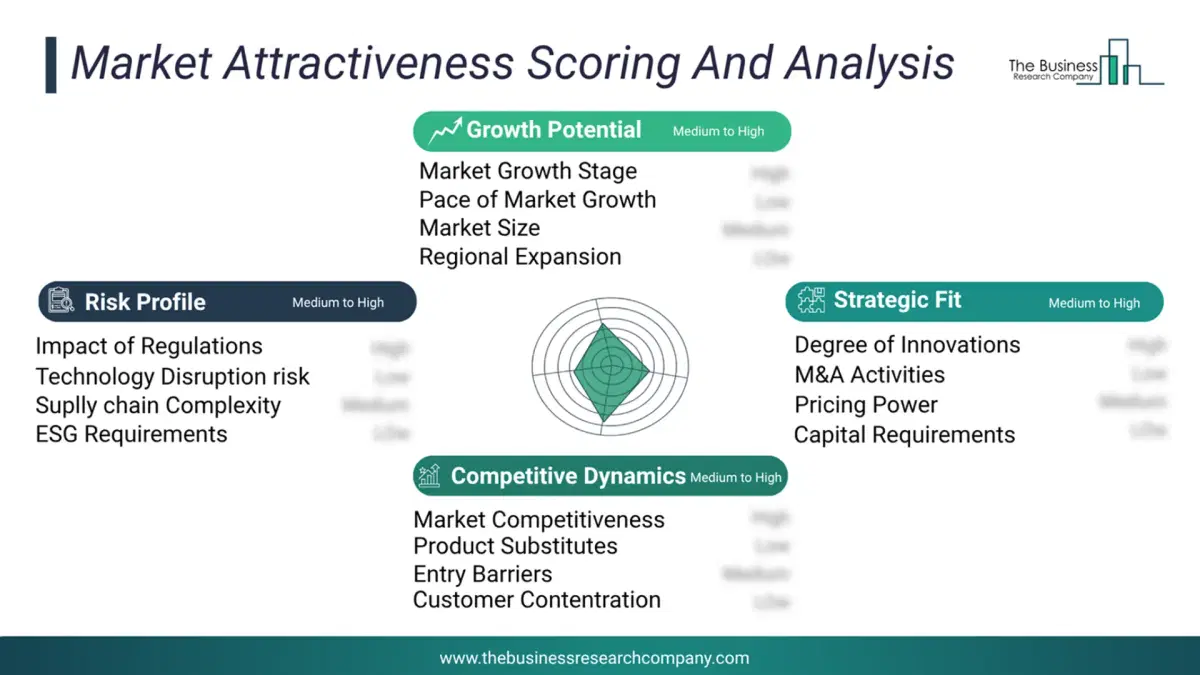
This chart presents market attractiveness based on a quantitative evaluation of growth, competition, strategic alignment, and risk, offering a clear view of opportunity areas for decision-making. This chart is for illustrative purposes; the full report contains the complete analysis.
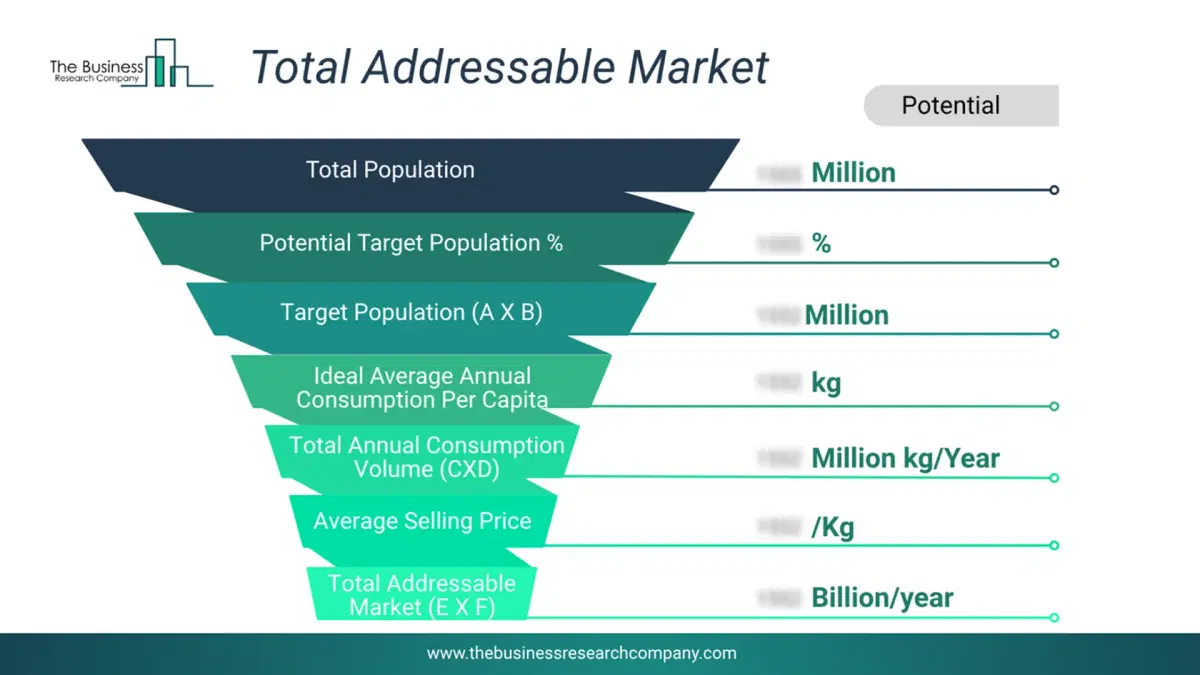
This chart highlights the Total Addressable Market (TAM) by estimating the maximum revenue opportunity using an assumption-driven approach, supporting strategic planning and opportunity sizing across markets. The chart is illustrative; the full report provides a more comprehensive analysis.
What Key Data and Analysis Are Included in the Commercial Aircraft Market Report 2026?
The commercial aircraft market research report is one of a series of new reports from The Business Research Company that provides market statistics, including industry global market size, regional shares, competitors with the market share, detailed market segments, market trends and opportunities, and any further data you may need to thrive in the commercial aircraft industry. The market research report delivers a complete perspective of everything you need, with an in-depth analysis of the current and future state of the industry.Commercial Aircraft Market Report Forecast Analysis
| Report Attribute | Details |
|---|---|
| Market Size Value In 2026 | $226.36 billion |
| Revenue Forecast In 2035 | $274.06 billion |
| Growth Rate | CAGR of 4.3% from 2026 to 2035 |
| Base Year For Estimation | 2025 |
| Actual Estimates/Historical Data | 2020-2025 |
| Forecast Period | 2026 - 2030 - 2035 |
| Market Representation | Revenue in USD Billion and CAGR from 2026 to 2035 |
| Segments Covered | Type, Engine Type, Size, End-User, Operation |
| Regional Scope | Asia-Pacific, Western Europe, Eastern Europe, North America, South America, Middle East, Africa |
| Country Scope | The countries covered in the report are Australia, Brazil, China, France, Germany, India, ... |
| Key Companies Profiled | Boeing, Airbus, Embraer, Bombardier, Textron Aviation, United Aircraft Corporation, Dassault Aviation, Leonardo S.p.A., Mitsubishi Heavy Industries, COMAC (Commercial Aircraft Corporation of China), Gulfstream Aerospace, Pilatus Aircraft, Cessna Aircraft Company, Sukhoi Civil Aircraft, ATR (Aerei da Trasporto Regionale), Antonov Company, AVIC (Aviation Industry Corporation of China), Kawasaki Heavy Industries, Hindustan Aeronautics Limited (HAL), Saab AB, De Havilland Aircraft of Canada, Viking Air, Embraer Commercial Aviation, Irkut Corporation, Boeing Defense Space & Security, Fokker Technologies, Israel Aerospace Industries, Korea Aerospace Industries |
| Customization Scope | Request for Customization |
| Pricing And Purchase Options | Explore Purchase Options |