
Dry Construction Market Report 2026
Dry Construction Market Report 2026
Global Outlook – By Type (Supporting Framework, Boarding), By Material (Plasterboard, Wood, Metal, Plastic), By System (Ceiling System, Wall System, Flooring System), By Application (Residential, Non Residential) – Market Size, Trends, Strategies, and Forecast to 2035
Dry Construction Market Overview
• Dry Construction market size has reached to $75.8 billion in 2025 • Expected to grow to $88.99 billion in 2030 at a compound annual growth rate (CAGR) of 3.2% • Growth Driver: Increase In Demand For Green Buildings Driving The Market Growth Due To Rising Government Regulations And Climate Commitments • Market Trend: Sustainable Building Design Transformed By 3D Printing In Construction • Asia-Pacific was the largest region in 2025 and North America is the fastest growing region.
What Is Covered Under Dry Construction Market?
Dry construction refers to the use of lightweight materials, structures, and systems created on the principle of lightweight construction. Dry construction aims at reducing the use of water, reducing construction time, improving moisture resistance, enhancing fire safety, and reducing the impact of real estate on the environment. The main dry construction types include supporting framework and boarding. Supporting frameworks are used in dry construction as a framework of beams (rafters, posts, struts) forming a right-angle structure that supports a roof, bridge, or other structure. The different dry construction materials include plasterboard, wood, metal, and Plastic. They also consist of various systems, such as ceiling systems, wall systems, and flooring systems, used in different applications, which include residential and non-residential.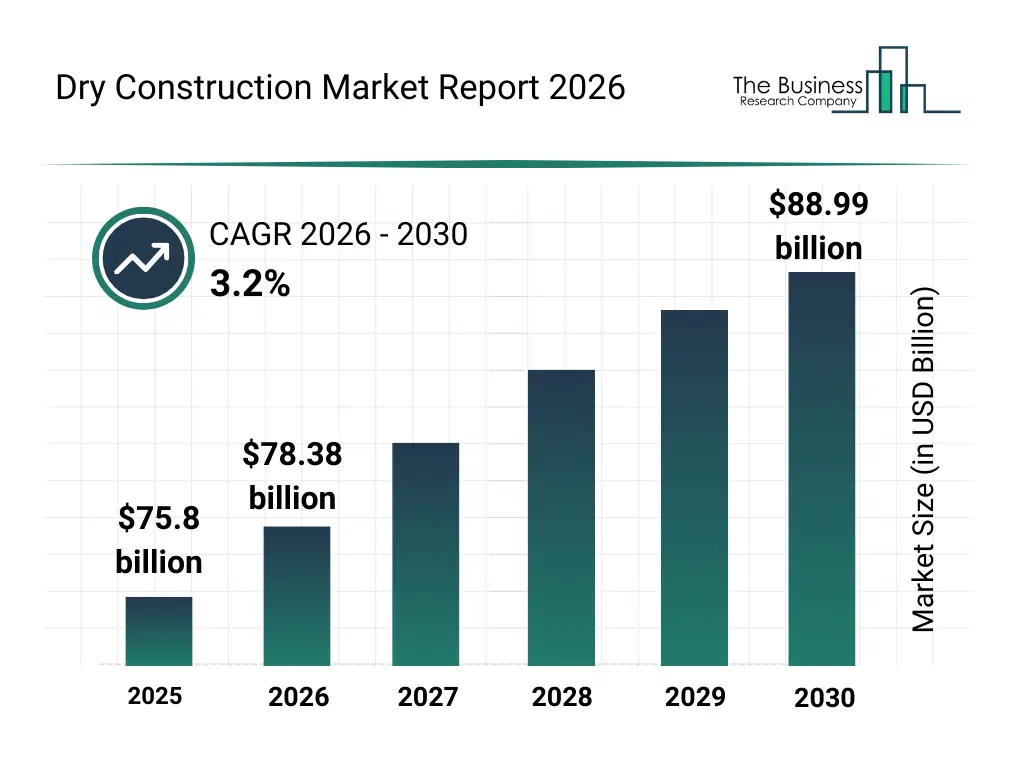
What Is The Dry Construction Market Size and Share 2026?
The dry construction market size has grown steadily in recent years. It will grow from $75.8 billion in 2025 to $78.38 billion in 2026 at a compound annual growth rate (CAGR) of 3.4%. The growth in the historic period can be attributed to increasing adoption of lightweight materials, rising demand for faster construction methods, expansion of commercial building projects, greater awareness of moisture-resistant construction solutions, growing preference for modular interior systems.What Is The Dry Construction Market Growth Forecast?
The dry construction market size is expected to see steady growth in the next few years. It will grow to $88.99 billion in 2030 at a compound annual growth rate (CAGR) of 3.2%. The growth in the forecast period can be attributed to growth in sustainable building practices, rising integration of prefabricated dry construction systems, increasing adoption of insulated and acoustic panels, expansion of residential renovation activities, advancements in engineered dry construction materials. Major trends in the forecast period include growing adoption of lightweight construction materials, increased use of pre-engineered and modular systems, rising demand for moisture-resistant and fire-safe boards, expansion of drywall applications across residential and commercial spaces, advancements in acoustic and insulated board technologies.Global Dry Construction Market Segmentation
1) By Type: Supporting Framework, Boarding 2) By Material: Plasterboard, Wood, Metal, Plastic 3) By System: Ceiling System, Wall System, Flooring System 4) By Application: Residential, Non Residential Subsegments: 1) By Supporting Framework: Metal Studs and Tracks, Wooden Studs, Steel Frames, Pre-engineered Frames 2) By Boarding: Gypsum Boards (Drywall), Cement Boards, Plywood and Particle Boards, Insulated Boards, Acoustic BoardsWhat Is The Driver Of The Dry Construction Market?
The increase in demand for green buildings is expected to propel the growth of the dry construction market going forward. Green buildings are structures designed, constructed, and operated to minimize environmental impact through energy efficiency, resource conservation, and sustainable practices. The growing demand for green buildings is primarily driven by increasing government regulations and climate commitments, as cities and states implement stricter building codes and mandate energy-efficient construction to meet emission reduction targets. Buildings designed with energy-efficient features and sustainable materials require advanced dry construction methods that provide better insulation, faster installation, and reduced material waste. For instance, in May 2024, according to the U.S. Environmental Protection Agency, a US-based federal government agency responsible for environmental protection, the number of commercial buildings that earned ENERGY STAR certification rose from more than 7,000 in 2022 to more than 8,800 in 2023, reflecting an increase of approximately 1,800 buildings. Therefore, the increase in demand for green buildings is driving the growth of the dry construction industry.Key Players In The Global Dry Construction Market
Major companies operating in the dry construction market are Saint Gobain SA, Etex Group Ltd., Fletcher Building Limited, USG Boral Pvt. Ltd., Knauf AG, Panel Rey SA, PABCO Building Products LLC, Armstrong World Industries Inc., Georgia pacisific LLC, Beijing New Building Materials Public Limited, 3G Drywall LLC, Cano Estructuras, Knauf Gips KG, USG Corporation, Boral Limited, National Gypsum Company, Compagnie de Saint-Gobain S.A., James Hardie Industries plc, Continental Building Products Inc., CertainTeed Corporation, LafargeHolcim Ltd., Paneltech Systems Ltd., Pennar Industries Limited, Rondo Building Services Pty Ltd., Siniat Ltd., VANS Gypsum Pvt. Ltd., Winstone Wallboards Limited, Zhejiang Yulong Building Materials Co. Ltd., China National Building Material Company Limited, Etex Building Performance NVGlobal Dry Construction Market Trends and Insights
Major companies operating in the construction market are focusing on developing advanced solutions, such as 3D printing technology, to enhance construction efficiency, sustainability, and design flexibility. 3D printing technology is an additive manufacturing process that builds walls, floors, and roofs layer by layer using advanced materials, minimizing waste, speeding up construction, and enabling complex, customized architectural designs. For example, in August 2023, MENSE KORTE, a Germany-based construction company, used a 3D printer to construct Europe's largest 3D-printed building in the city of Heidelberg. The building is a tiny house for bikers, using cement-free concrete to reduce CO2 emissions. This innovative project highlights the potential of 3D printing technology in the construction industry, particularly in terms of sustainability and design flexibility. The tiny house is located in the area of a biker railway in Beckum and features an elliptical facade that curves outwards, a design made possible by 3D printing. The cement-free 3D dry mortar used in the project, MC-PowerPrint GeCO₂, enables a significant reduction in CO2 emissions compared to traditional cementitious mortar products.What Are Latest Mergers And Acquisitions In The Dry Construction Market?
In September 2023, Summit Materials, a US-based integrated materials company that supplies aggregates, cement, and ready-mix concrete to construction companies and projects, acquired Argos USA for approximately $3.2 billion. The acquisition aimed to create a leading building materials platform with a national scale in the United States. Moreover, the deal is expected to help Summit diversify its footprint and meet the rising demand for dry construction materials from home builders and infrastructure companies. Argos USA is a US-based producer and distributor of cement, ready-mix concrete, aggregates, and related building materials.Regional Insights
Asia-Pacific was the largest region in the dry construction market in 2025. North America is expected to be the fastest-growing region in the dry construction market during the forecast period. The regions covered in this market report are Asia-Pacific, South East Asia, Western Europe, Eastern Europe, North America, South America, Middle East, Africa. The countries covered in this market report are Australia, Brazil, China, France, Germany, India, Indonesia, Japan, Taiwan, Russia, South Korea, UK, USA, Canada, Italy, Spain.What Defines the Dry Construction Market?
The dry construction market includes revenues earned by entities by dry construction using materials including timber, metal (steel), and precast reinforced concrete. The market value includes the value of related goods sold by the service provider or included within the service offering. Only goods and services traded between entities or sold to end consumers are included.How is Market Value Defined and Measured?
The market value is defined as the revenues that enterprises gain from the sale of goods and/or services within the specified market and geography through sales, grants, or donations in terms of the currency (in USD unless otherwise specified). The revenues for a specified geography are consumption values that are revenues generated by organizations in the specified geography within the market, irrespective of where they are produced. It does not include revenues from resales along the supply chain, either further along the supply chain or as part of other products.What Key Data and Analysis Are Included in theDry Construction Market Report 2026?
The dry construction market research report is one of a series of new reports from The Business Research Company that provides market statistics, including industry global market size, regional shares, competitors with the market share, detailed market segments, market trends and opportunities, and any further data you may need to thrive in the dry construction industry. The market research report delivers a complete perspective of everything you need, with an in-depth analysis of the current and future state of the industry.Dry Construction Market Report Forecast Analysis
| Report Attribute | Details |
|---|---|
| Market Size Value In 2026 | $78.38 billion |
| Revenue Forecast In 2035 | $88.99 billion |
| Growth Rate | CAGR of 3.4% from 2026 to 2035 |
| Base Year For Estimation | 2025 |
| Actual Estimates/Historical Data | 2020-2025 |
| Forecast Period | 2026 - 2030 - 2035 |
| Market Representation | Revenue in USD Billion and CAGR from 2026 to 2035 |
| Segments Covered | Type, Material, System, Application |
| Regional Scope | Asia-Pacific, Western Europe, Eastern Europe, North America, South America, Middle East, Africa |
| Country Scope | The countries covered in the report are Australia, Brazil, China, France, Germany, India, ... |
| Key Companies Profiled | Saint Gobain SA, Etex Group Ltd., Fletcher Building Limited, USG Boral Pvt. Ltd., Knauf AG, Panel Rey SA, PABCO Building Products LLC, Armstrong World Industries Inc., Georgia pacisific LLC, Beijing New Building Materials Public Limited, 3G Drywall LLC, Cano Estructuras, Knauf Gips KG, USG Corporation, Boral Limited, National Gypsum Company, Compagnie de Saint-Gobain S.A., James Hardie Industries plc, Continental Building Products Inc., CertainTeed Corporation, LafargeHolcim Ltd., Paneltech Systems Ltd., Pennar Industries Limited, Rondo Building Services Pty Ltd., Siniat Ltd., VANS Gypsum Pvt. Ltd., Winstone Wallboards Limited, Zhejiang Yulong Building Materials Co. Ltd., China National Building Material Company Limited, Etex Building Performance NV |
| Customization Scope | Request for Customization |
| Pricing And Purchase Options | Explore Purchase Options |
Frequently Asked Questions
The Dry Construction market was valued at $75.8 billion in 2025, increased to $75.8 billion in 2026, and is projected to reach $88.99 billion by 2030.
request a sample hereThe expected CAGR for the Dry Construction market during the forecast period 2025–2030 is 3.2%.
request a sample hereMajor growth driver of the market includes: Increase In Demand For Green Buildings Driving The Market Growth Due To Rising Government Regulations And Climate Commitments in the Dry Construction market. For further insights on this market,
request a sample hereThe dry construction market covered in this report is segmented –
1) By Type: Supporting Framework, Boarding
2) By Material: Plasterboard, Wood, Metal, Plastic
3) By System: Ceiling System, Wall System, Flooring System
4) By Application: Residential, Non Residential Subsegments:
1) By Supporting Framework: Metal Studs and Tracks, Wooden Studs, Steel Frames, Pre-engineered Frames
2) By Boarding: Gypsum Boards (Drywall), Cement Boards, Plywood and Particle Boards, Insulated Boards, Acoustic Boards
request a sample here1) By Type: Supporting Framework, Boarding
2) By Material: Plasterboard, Wood, Metal, Plastic
3) By System: Ceiling System, Wall System, Flooring System
4) By Application: Residential, Non Residential Subsegments:
1) By Supporting Framework: Metal Studs and Tracks, Wooden Studs, Steel Frames, Pre-engineered Frames
2) By Boarding: Gypsum Boards (Drywall), Cement Boards, Plywood and Particle Boards, Insulated Boards, Acoustic Boards
Major trend in this market includes: Sustainable Building Design Transformed By 3D Printing In Construction For further insights on this market,
request a sample hereMajor companies operating in the Dry Construction market are Major companies operating in the dry construction market are Saint Gobain SA, Etex Group Ltd., Fletcher Building Limited, USG Boral Pvt. Ltd., Knauf AG, Panel Rey SA, PABCO Building Products LLC, Armstrong World Industries Inc., Georgia pacisific LLC, Beijing New Building Materials Public Limited, 3G Drywall LLC, Cano Estructuras, Knauf Gips KG, USG Corporation, Boral Limited, National Gypsum Company, Compagnie de Saint-Gobain S.A., James Hardie Industries plc, Continental Building Products Inc., CertainTeed Corporation, LafargeHolcim Ltd., Paneltech Systems Ltd., Pennar Industries Limited, Rondo Building Services Pty Ltd., Siniat Ltd., VANS Gypsum Pvt. Ltd., Winstone Wallboards Limited, Zhejiang Yulong Building Materials Co. Ltd., China National Building Material Company Limited, Etex Building Performance NV
request a sample hereAsia-Pacific was the largest region in the dry construction market in 2025. North America is expected to be the fastest-growing region in the dry construction market during the forecast period. The regions covered in the dry construction market report are Asia-Pacific, South East Asia, Western Europe, Eastern Europe, North America, South America, Middle East, Africa.
request a sample here