

Edge AI Hardware Market Report 2026
Global Outlook – By Component (Processor, Memory, Sensor, Other Components), By Device Type (Smartphones, Cameras, Robots, Wearables, Smart Speakers, Other Device Types), By End User (Consumer Electronics, Smart Home, Automotive, Government, Aerospace And Defense, Healthcare, Industrial, Construction, Other End Users) – Market Size, Trends, Strategies, and Forecast to 2030
Edge AI Hardware Market Overview
• Edge AI Hardware market size has reached to $9.12 billion in 2025 • Expected to grow to $24.81 billion in 2030 at a compound annual growth rate (CAGR) of 22.1% • Growth Driver: Adoption Of 5G Connectivity Is Anticipated To Fuel The Edge AI Hardware Market • Market Trend: Advancements In Ultra?Low?Power Edge AI SoCs For IoT And Smart Devices • North America was the largest region in 2025 and Asia-Pacific is the fastest growing region.Market Gains By 2030 – Top Opportunities By Segment
Market Gain identifies the most promising market opportunities by highlighting the segments or products expected to generate the highest incremental revenue growth over the next five years.
What Is Covered Under Edge AI Hardware Market?
Edge AI hardware, often referred to as AI accelerators are used to accelerate deep learning inference on edge devices, making them a viable solution for many computation-intensive applications. The edge AI platform can run on a wide range of hardware platforms, from normal MCUs (microcontroller units) to advanced neural processors. The main devices of edge AI hardware are smartphones, cameras, robots, wearables, smart speakers, and others. A smartphone refers to a handheld electronic device that is connected to a cellular network. Its components include processor, memory, sensor, and others, which are employed by various end users including consumer electronics, smart home, automotive, government, aerospace and defense, healthcare, industrial, construction, and others.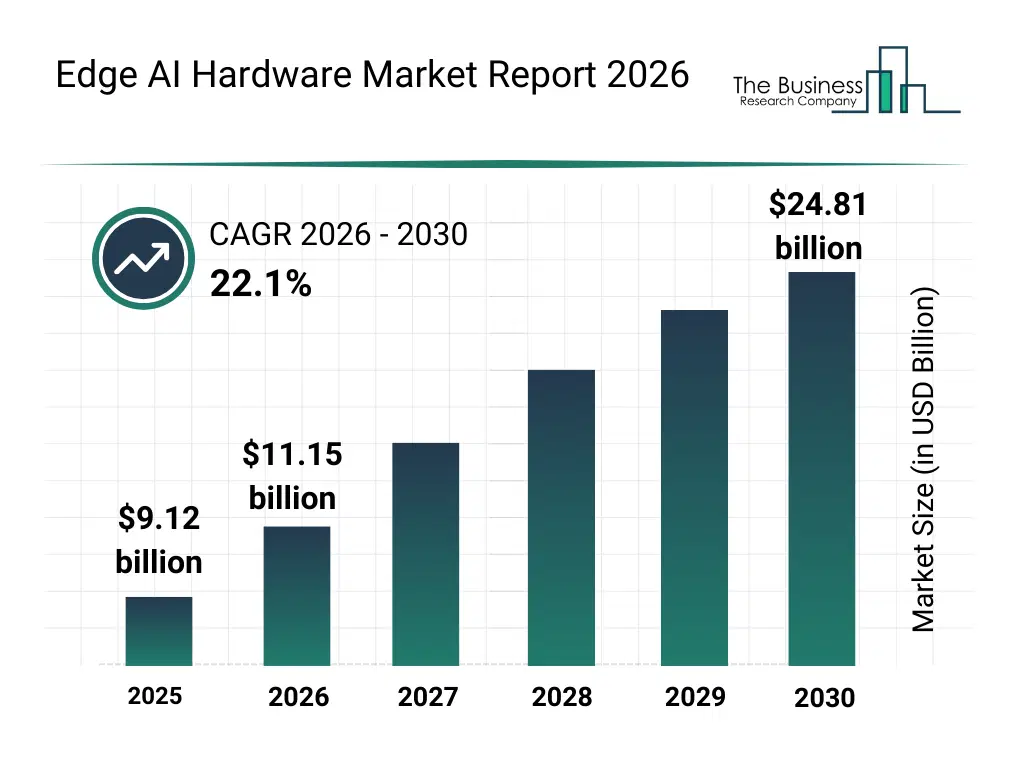
What Is The Edge AI Hardware Market Size and Share 2026?
The edge AI hardware market size has grown exponentially in recent years. It will grow from $9.12 billion in 2025 to $11.15 billion in 2026 at a compound annual growth rate (CAGR) of 22.3%. The growth in the historic period can be attributed to growth in connected device adoption, rising demand for real-time analytics, expansion of embedded systems usage, improvements in semiconductor fabrication processes, increasing deployment of iot-enabled hardware.What Is The Edge AI Hardware Market Growth Forecast?
The edge AI hardware market size is expected to see exponential growth in the next few years. It will grow to $24.81 billion in 2030 at a compound annual growth rate (CAGR) of 22.1%. The growth in the forecast period can be attributed to increasing adoption of edge intelligence across industries, rising investments in specialized AI silicon, expansion of autonomous system deployments, growing demand for privacy-preserving AI processing, increasing integration of edge AI in industrial automation. Major trends in the forecast period include increasing deployment of dedicated AI accelerators at the edge, rising adoption of heterogeneous computing architectures, growing demand for low-power high-performance inference chips, expansion of edge AI integration across smart devices, enhanced focus on on-device data processing.
Global Edge AI Hardware Market Segmentation
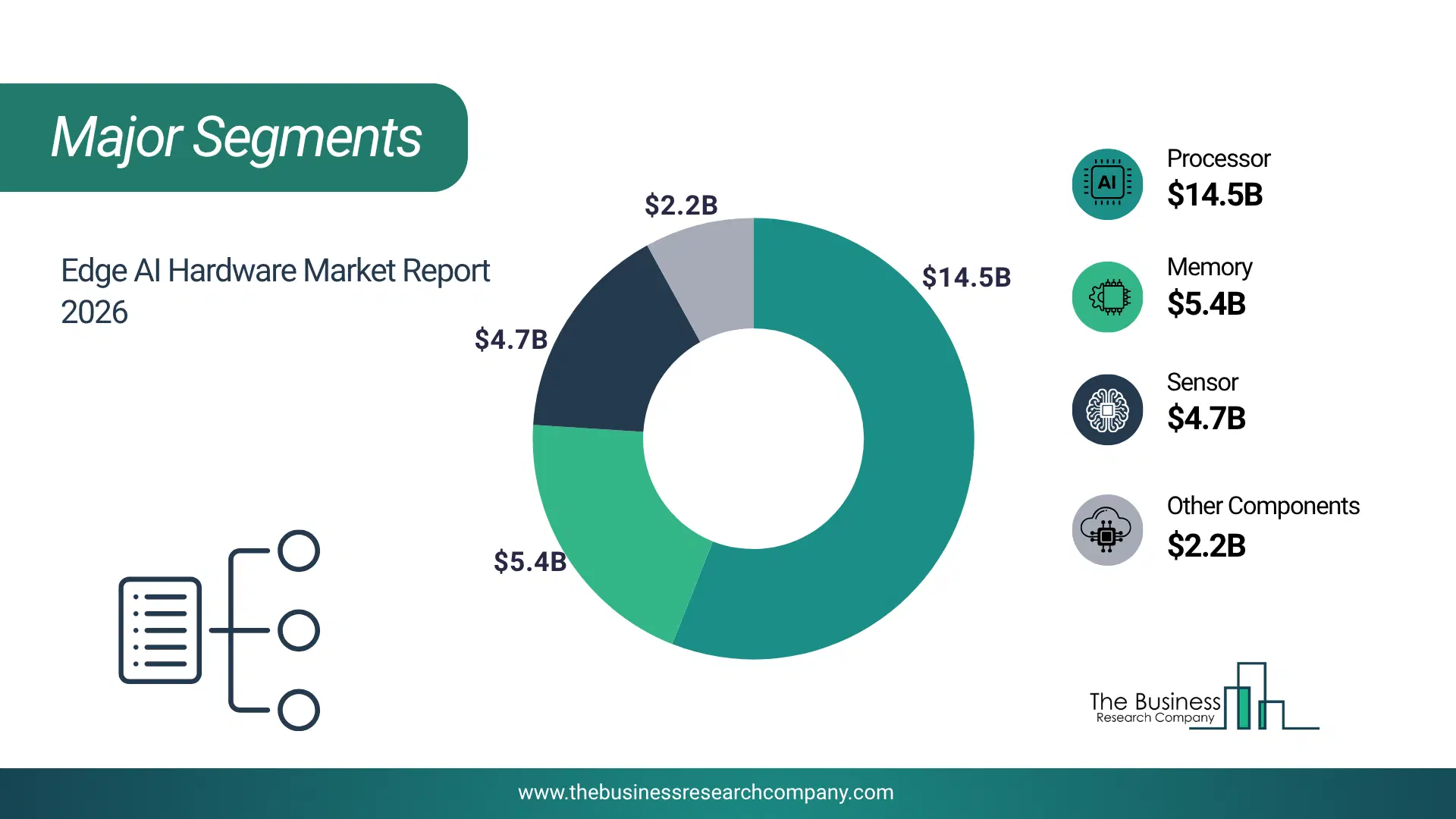
1) By Component: Processor, Memory, Sensor, Other Components 2) By Device Type: Smartphones, Cameras, Robots, Wearables, Smart Speakers, Other Device Types 3) By End User: Consumer Electronics, Smart Home, Automotive, Government, Aerospace And Defense, Healthcare, Industrial, Construction, Other End Users Subsegments: 1) By Processor: CPU (Central Processing Unit), GPU (Graphics Processing Unit), FPGA (Field-Programmable Gate Array), ASIC (Application-Specific Integrated Circuit), DSP (Digital Signal Processor) 2) By Memory: RAM (Random Access Memory), Flash Memory, Solid State Drive (SSD), EEPROM (Electrically Erasable Programmable Read-Only Memory) 3) By Sensor: Camera, LiDAR (Light Detection And Ranging), Microphones, Temperature Sensors, Pressure Sensors, Proximity Sensors 4) By Other Components: Power Management ICs, Connectivity Modules, Circuit Boards, Cooling Systems The top segments in the edge ai hardware market will be: • Processor will reach $14.4 billion by 2030. • Memory will reach $5.37 billion by 2030. • Sensor will reach $4.64 billion by 2030. • Other Components will reach $2.18 billion by 2030.What Is The Driver Of The Edge AI Hardware Market?
The adoption of 5G connectivity is expected to propel the growth of the edge AI hardware market going forward. 5G connectivity refers to the fifth generation of mobile networks, providing faster data speeds, lower latency, and increased capacity for wireless communication. Edge AI hardware enhances 5G connectivity by enabling real-time processing at the network edge, reducing latency, and optimizing data traffic for efficient and responsive applications. For instance, in June 2023, according to 5G Americas, a US-based trade organization, global 5G connections have reached 1.2 billion and are projected to grow to 1.9 billion by the end of 2023, with an expected surge to 6.8 billion by the end of 2027. Therefore, the adoption of 5G connectivity is driving the edge AI hardware industry.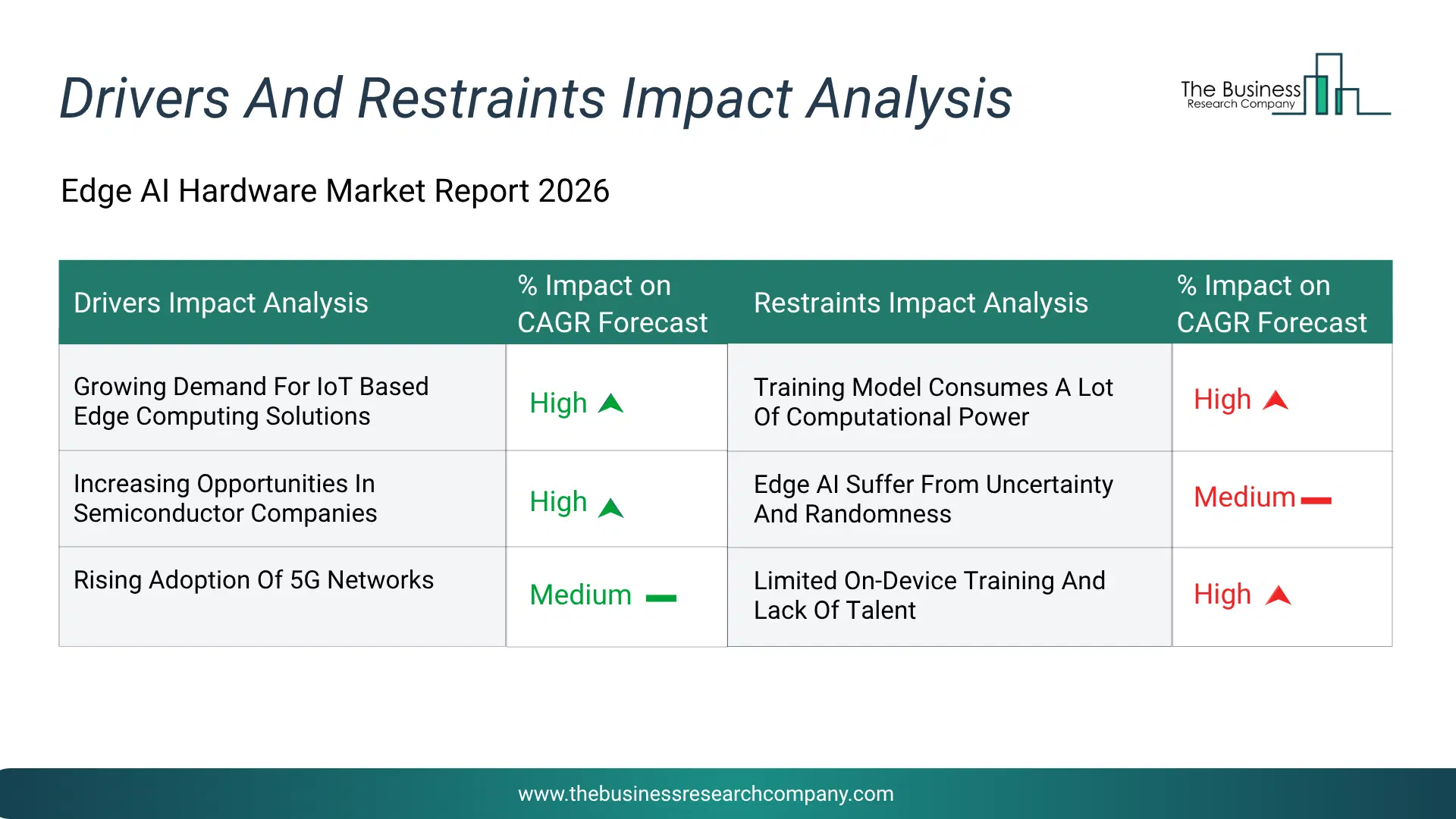
Infographic Chart Showing Key Market Drivers Analysis And Restraints For Edge Ai Hardware Market
The chart presents an impact analysis of key drivers and restraints, quantifying their relative influence on the market's growth rate and helping assess the balance between growth enablers and limiting factors. This chart offers a high-level perspective; the full report contains more detailed insights.
How Will The Drivers Impact Growth In The Global Edge AI Hardware Market?
• Growing Demand For IoT Based Edge Computing Solutions (High) – During the forecast period, the growing demand for iot -based edge computing solutions is expected to become a key growth driver for the edge ai hardware market by 2030. Enterprises and industries are increasingly deploying connected devices that require real -time data processing, low latency, and enhanced data privacy, which cannot be efficiently achieved through centralized cloud systems alone. Edge ai hardware enables on -device intelligence in iot ecosystems such as smart homes, industrial automation, healthcare monitoring, and smart cities. This shift is driving demand for energy -efficient processors, sensors, and ai -enabled modules capable of handling localized computation. Manufacturers are therefore investing in scalable and high -performance edge ai chipsets tailored for iot applications. • Increasing Opportunities In Semiconductor Companies (High) – During the forecast period, the increasing opportunities in semiconductor companies are expected to emerge as a major factor driving the expansion of the edge ai hardware market by 2030. The rapid evolution of ai workloads, coupled with the need for specialized hardware such as gpus, npus, and ai accelerators, is encouraging semiconductor firms to develop advanced chip architectures optimized for edge deployment. Companies are investing heavily in r&d, advanced node manufacturing, and heterogeneous integration technologies to deliver high-performance, low-power ai solutions. Additionally, the expansion of fabless semiconductor models and strategic collaborations across the value chain are accelerating innovation and commercialization. • Rising Adoption Of 5G Networks (Medium) – During the forecast period, the rising adoption of 5g networks is expected to act as a key growth catalyst for the edge ai hardware market by 2030. The deployment of 5g infrastructure enables ultra-low latency, high bandwidth, and reliable connectivity, which are essential for real-time ai applications at the edge such as autonomous vehicles, smart surveillance, and industrial automation. The combination of 5g and edge ai allows faster data processing closer to the source, reducing dependence on centralized cloud systems. This is increasing demand for advanced edge hardware capable of handling high-speed data streams and ai inference workloads. As 5g adoption expands globally, the integration of edge ai hardware into connected ecosystems is expected to accelerate significantly.How Will The Restraints Impact Growth In The Global Edge AI Hardware Market?
• Training Model Consumes A Lot Of Computational Power (High) – During the forecast period, the training ai models requires substantial computational resources, including high-performance processors and large memory capacity. Edge devices are generally designed to operate with limited processing capabilities compared to centralized data centers. As a result, performing complex ai training directly on edge hardware becomes difficult and inefficient. Organizations often need to rely on cloud infrastructure for training tasks, which reduces the independence of edge systems. This high computational requirement acts as a limitation for the widespread adoption of edge ai hardware. • Edge AI Suffer From Uncertainty And Randomness (Medium) – During the forecast period, the edge ai systems operate in dynamic real-world environments where input data can vary significantly. Such unpredictable conditions may affect the accuracy and reliability of ai models deployed on edge devices. Random variations in data, environmental factors, or sensor noise can introduce inconsistencies in results. Ensuring stable and reliable ai performance in these situations remains a technological challenge. This uncertainty can slow the adoption of edge ai hardware in critical applications. • Limited On-Device Training And Lack Of Talent (High) – During the forecast period, the many edge ai systems mainly support inference rather than full ai model training due to hardware limitations. Developing and optimizing ai models for edge environments requires specialized technical expertise. However, there is a shortage of professionals with strong knowledge of ai algorithms, embedded systems, and edge computing. This skill gap slows down the development and deployment of advanced edge ai solutions. Consequently, limited on-device training capabilities and lack of skilled talent restrict market growth.Key Players In The Global Edge AI Hardware Market
Major companies operating in the edge AI hardware market are Apple Inc.; MediaTek Inc.; Qualcomm Technologies Inc.; Huawei Technologies Co. Ltd.; Samsung Electronics Co. Ltd.; Intel Corporation; NVIDIA Corporation; Google LLC; Advanced Micro Devices Inc.; Imagination Technologies Limited; Adapteva Inc.; Arm Limited; ADLINK Technology Inc.; Alphabet Inc.; Continental AG; Denso Corporation; Renesas Electronics Corporation; Infineon Technologies AG; KALRAY Corporation; Robert Bosch GmbH; Rockchip Electronics Co. Ltd.; NXP Semiconductors N.V.; ON Semiconductor Corporation; STMicroelectronics N.V.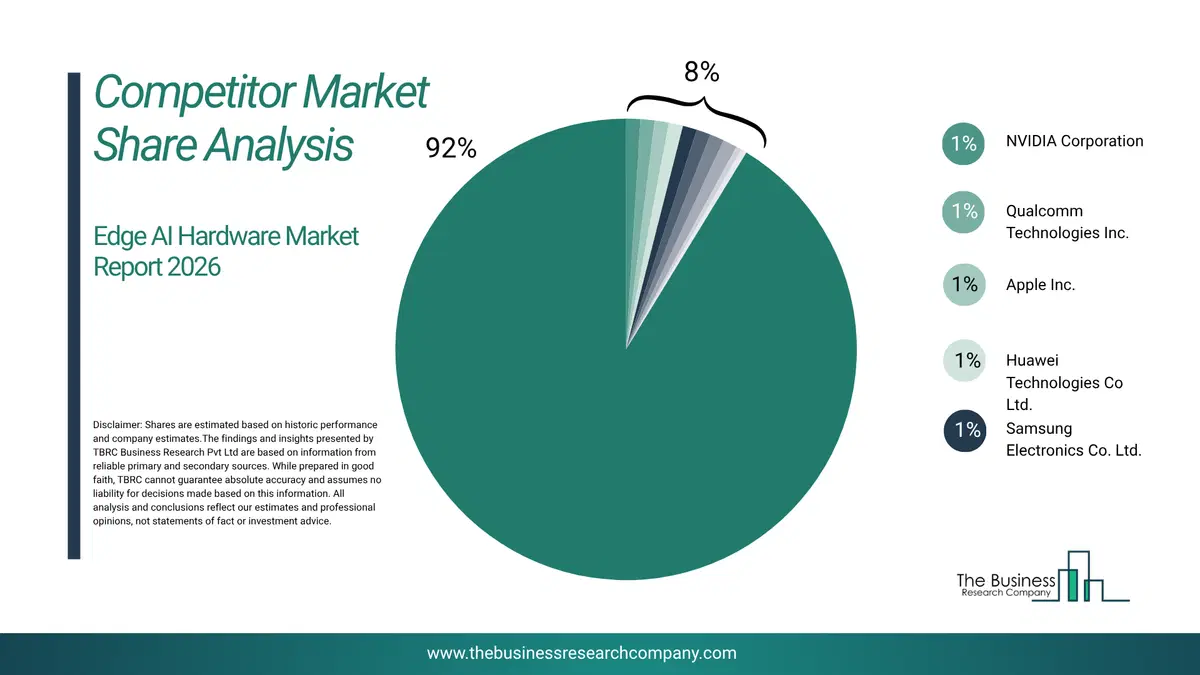
This chart is for illustrative purposes; the full report includes a detailed competitor analysis and comprehensive overview of the top 10 companies in the market.
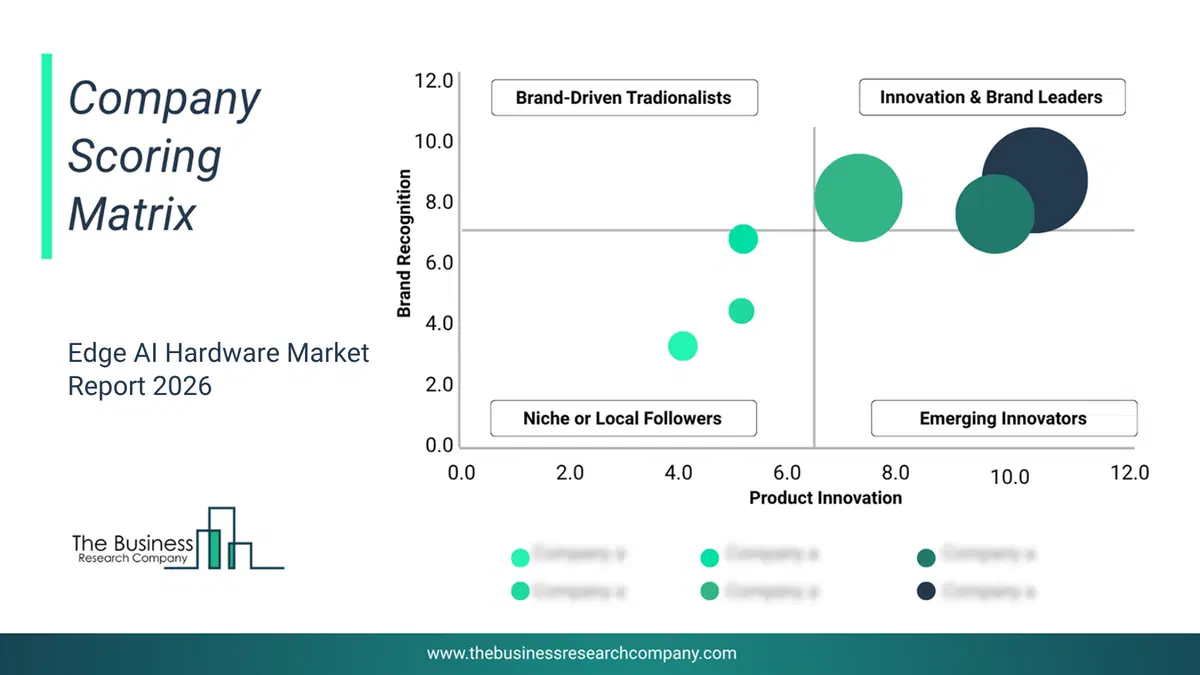
This chart maps companies by product innovation and brand strength, with bubble size indicating relative revenue, helping identify market leaders, challengers, and niche players. This is an illustrative chart; the full report provides a complete and accurate competitive analysis.
Global Edge AI Hardware Market Trends and Insights
Major companies operating in the edge AI hardware market are focusing on developing innovative solutions, such as ultra‑low‑power integrated edge AI SoCs to enhance real-time data processing at the device level, reduce latency, optimize energy efficiency, and support the growing demand for AI-driven applications in IoT, autonomous systems, and smart devices. Ultra-low-power integrated edge AI SoCs are energy-efficient chips that enable artificial intelligence processing directly on edge devices without relying on cloud computing. For instance, in February 2025, Telink Semiconductor Co. Ltd., a China‑based semiconductor company, launched its TL‑EdgeAI platform, including the new‑generation highly integrated chips TL721X and TL751X. The TL721X and TL751X series support mainstream local AI models (such as Google’s LiteRT and TVM) and feature ultra‑low power consumption (operating current as low as 1 mA for TL721X), multi‑protocol wireless connectivity and high integration across connectivity and AI compute. The TL751X adds a multi‑core design with HiFi‑5 DSP, enabling intelligent voice interaction in smart audio devices, while TL721X targets smart home and edge sensor hubs with Matter protocol support and ultra‑low latency/low power operation.What Are Latest Mergers And Acquisitions In The Edge AI Hardware Market?
In October 2025, NXP Semiconductors N.V., a Netherlands‑based provider of semiconductor solutions, acquired Kinara Inc. for $307 million. With this acquisition, NXP aims to enhance its edge AI processing capabilities by integrating Kinara’s high‑performance, energy‑efficient discrete neural processing units (NPUs) and AI software into its broader portfolio of connectivity, security and advanced analog solutions. Kinara Inc. is a US-based provider of edge AI hardware.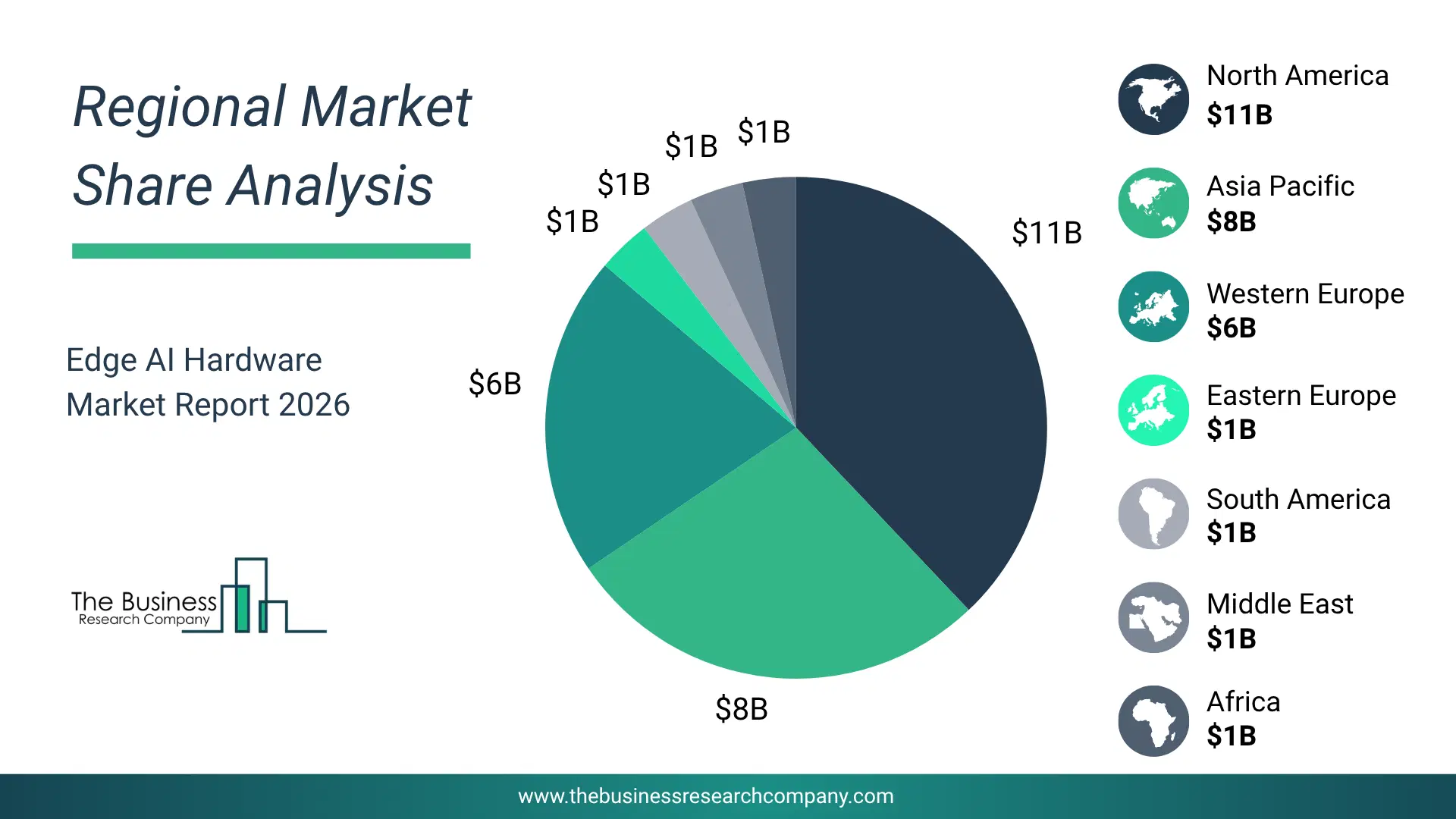
Regional Insights
North America was the largest region in the edge AI hardware market in 2025. Asia-Pacific is expected to be the fastest-growing region in the edge AI hardware market during the forecast period. The regions covered in this market report are Asia-Pacific, South East Asia, Western Europe, Eastern Europe, North America, South America, Middle East, Africa. The countries covered in this market report are Australia, Brazil, China, France, Germany, India, Indonesia, Japan, Taiwan, Russia, South Korea, UK, USA, Canada, Italy, SpainWhat Defines the Edge AI Hardware Market?
The edge AI hardware market consists of sales of IoT devices, and laptops used in the edge AI platform. Values in this market are ‘factory gate’ values, that is the value of goods sold by the manufacturers or creators of the goods, whether to other entities (including downstream manufacturers, wholesalers, distributors, and retailers) or directly to end customers. The value of goods in this market includes related services sold by the creators of the goods.How is Market Value Defined and Measured?
The market value is defined as the revenues that enterprises gain from the sale of goods and/or services within the specified market and geography through sales, grants, or donations in terms of the currency (in USD unless otherwise specified). The revenues for a specified geography are consumption values that are revenues generated by organizations in the specified geography within the market, irrespective of where they are produced. It does not include revenues from resales along the supply chain, either further along the supply chain or as part of other products.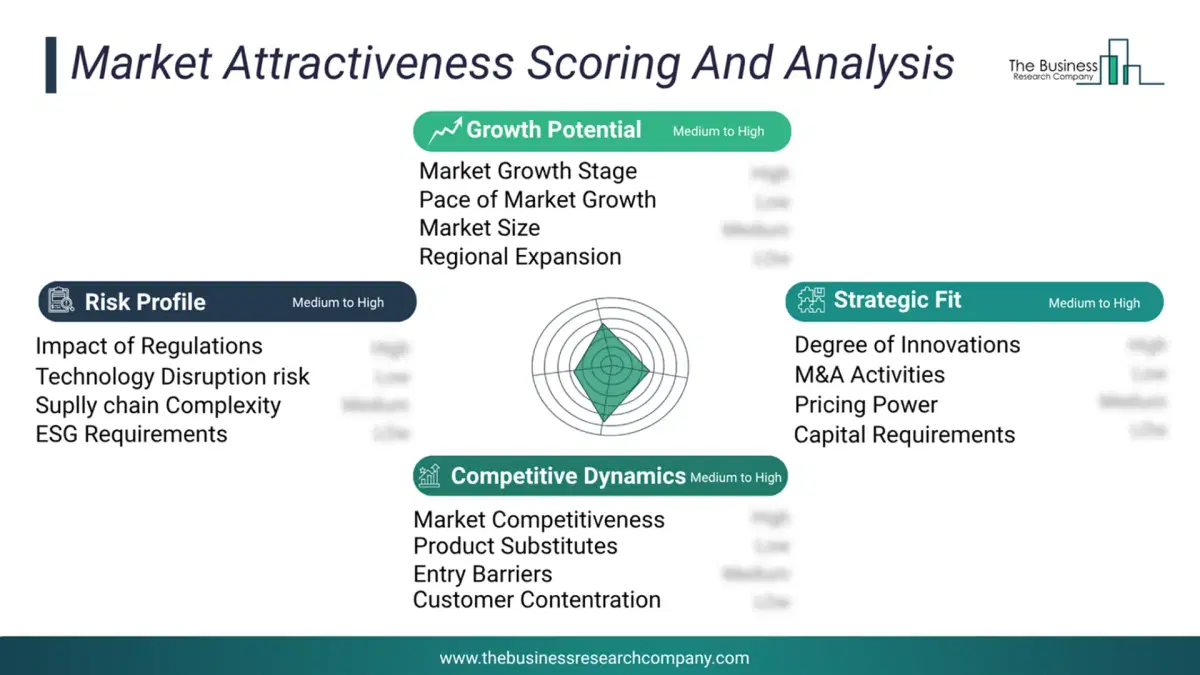
This chart presents market attractiveness based on a quantitative evaluation of growth, competition, strategic alignment, and risk, offering a clear view of opportunity areas for decision-making. This chart is for illustrative purposes; the full report contains the complete analysis.
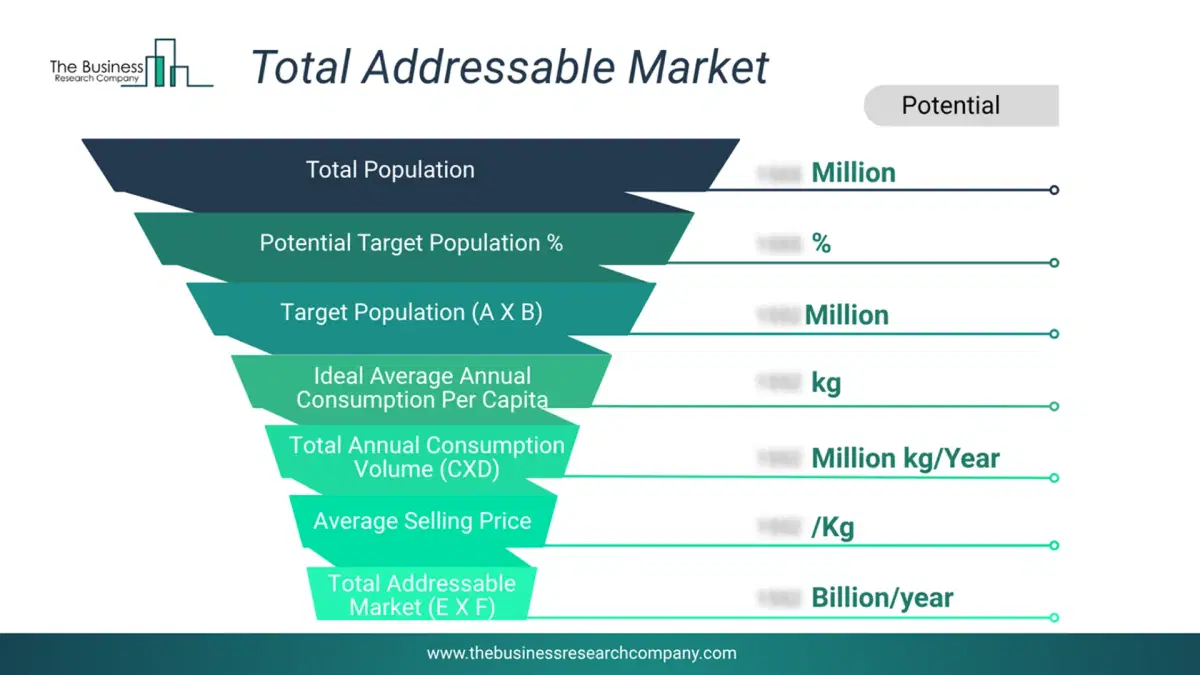
This chart highlights the Total Addressable Market (TAM) by estimating the maximum revenue opportunity using an assumption-driven approach, supporting strategic planning and opportunity sizing across markets. The chart is illustrative; the full report provides a more comprehensive analysis.
What Key Data and Analysis Are Included in the Edge AI Hardware Market Report 2026?
The edge ai hardware market research report is one of a series of new reports from The Business Research Company that provides market statistics, including industry global market size, regional shares, competitors with the market share, detailed market segments, market trends and opportunities, and any further data you may need to thrive in the edge ai hardware industry. The market research report delivers a complete perspective of everything you need, with an in-depth analysis of the current and future state of the industry.Edge AI Hardware Market Report Forecast Analysis
| Report Attribute | Details |
|---|---|
| Market Size Value In 2026 | $11.15 billion |
| Revenue Forecast In 2030 | $24.81 billion |
| Growth Rate | CAGR of 22.1% from 2026 to 2030 |
| Base Year For Estimation | 2025 |
| Actual Estimates/Historical Data | 2020-2025 |
| Forecast Period | 2026 - 2030 |
| Market Representation | Revenue in USD Billion and CAGR from 2026 to 2030 |
| Segments Covered | Component, Device Type, End User |
| Regional Scope | Asia-Pacific, Western Europe, Eastern Europe, North America, South America, Middle East, Africa |
| Country Scope | The countries covered in the report are Australia, Brazil, China, France, Germany, India, ... |
| Key Companies Profiled | Apple Inc.; MediaTek Inc.; Qualcomm Technologies Inc.; Huawei Technologies Co. Ltd.; Samsung Electronics Co. Ltd.; Intel Corporation; NVIDIA Corporation; Google LLC; Advanced Micro Devices Inc.; Imagination Technologies Limited; Adapteva Inc.; Arm Limited; ADLINK Technology Inc.; Alphabet Inc.; Continental AG; Denso Corporation; Renesas Electronics Corporation; Infineon Technologies AG; KALRAY Corporation; Robert Bosch GmbH; Rockchip Electronics Co. Ltd.; NXP Semiconductors N.V.; ON Semiconductor Corporation; STMicroelectronics N.V. |
| Customization Scope | Request for Customization |
| Pricing And Purchase Options | Explore Purchase Options |