
Electronic Data Interchange (EDI) Software Market Report 2026
Global Outlook – By Component (Software, Services), By Deployment (On-Premise, Cloud Based), By Organization Size (Small And Medium-Sized Enterprises, Large Enterprises), By Industry (Automotive, Banking, Financial Services And Insurance, Telecommunication And Information Technology, Retail And Consumer Goods, Manufacturing, Healthcare, Logistics, Other Industries) – Market Size, Trends, Strategies, and Forecast to 2030
Electronic Data Interchange (EDI) Software Market Overview
• Electronic Data Interchange (EDI) Software market size has reached to $2.46 billion in 2025 • Expected to grow to $4.41 billion in 2030 at a compound annual growth rate (CAGR) of 12.3% • Growth Driver: Rising Adoption Of Automation Solutions Fuels Growth In Electronic Data Interchange (EDI) Software Market • Market Trend: New Programs To Strengthen Collaboration With ERP Resellers • North America was the largest region in 2025 and Europe is the fastest growing region.Market Gains By 2030 – Top Opportunities By Segment
Market Gain identifies the most promising market opportunities by highlighting the segments or products expected to generate the highest incremental revenue growth over the next five years.
What Is Covered Under Electronic Data Interchange (EDI) Software Market?
Electronic data interchange (EDI) software refers to software that is created for data exchange. It helps to transfer business information using a standardized format. The business documents can be exchanged using EDI. The two most common exchanges are purchase orders and invoices. The main types of electronic data interchange (EDI) software are on-premise and cloud-based. On-premise refers to IT infrastructure, which are hardware and software applications that are hosted on-site. An on-premises solution is accessible from one server or location but tends to offer more security and control. The components are software and services. It is applied in small, medium, and large-scale enterprises and used by automotive, banking, financial services and insurance, telecommunication and information technology, retail and consumer goods, manufacturing, healthcare, logistics, and others.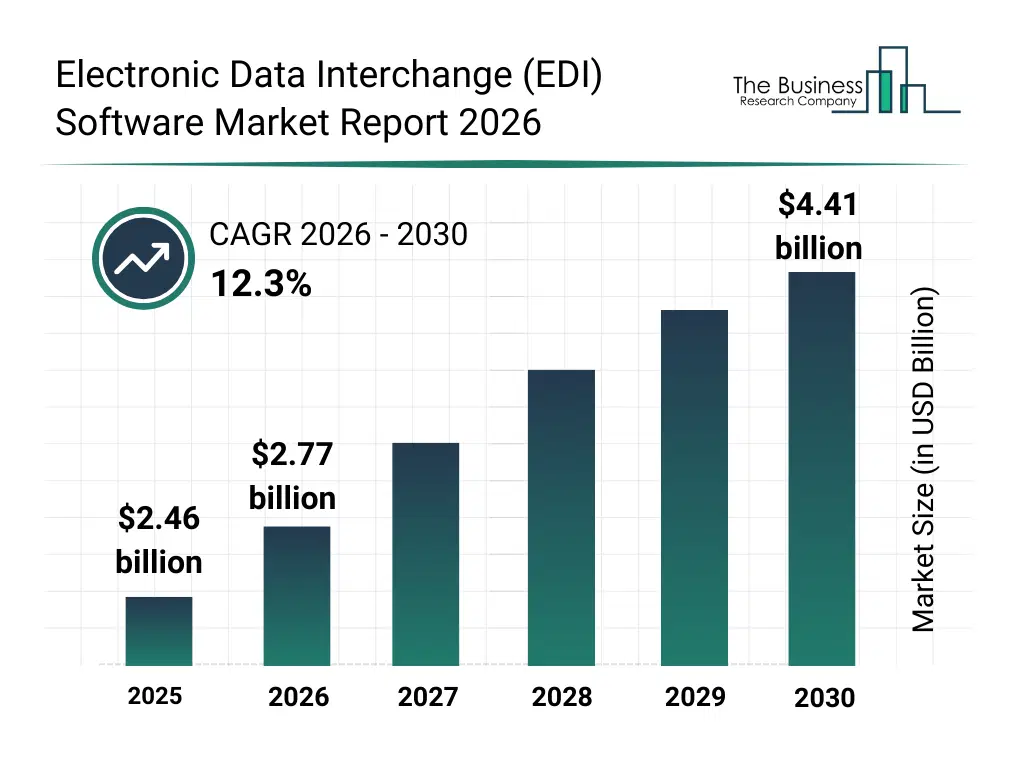
What Is The Electronic Data Interchange (EDI) Software Market Size and Share 2026?
The electronic data interchange (edi) software market size has grown rapidly in recent years. It will grow from $2.46 billion in 2025 to $2.77 billion in 2026 at a compound annual growth rate (CAGR) of 12.8%. The growth in the historic period can be attributed to expansion of global trade activities, rising digitization of supply chains, increasing adoption of electronic invoicing, growth in enterprise automation initiatives, availability of standardized data exchange protocols.What Is The Electronic Data Interchange (EDI) Software Market Growth Forecast?
The electronic data interchange (edi) software market size is expected to see rapid growth in the next few years. It will grow to $4.41 billion in 2030 at a compound annual growth rate (CAGR) of 12.3%. The growth in the forecast period can be attributed to increasing demand for interoperable digital ecosystems, rising adoption among smes, expansion of cross-border digital trade, growing focus on data security automation, increasing integration with enterprise resource planning systems. Major trends in the forecast period include increasing adoption of cloud-based edi solutions, rising integration of apis and middleware platforms, growing demand for real-time data exchange, expansion of automated transaction processing, enhanced focus on compliance and data standardization.
Global Electronic Data Interchange (EDI) Software Market Segmentation
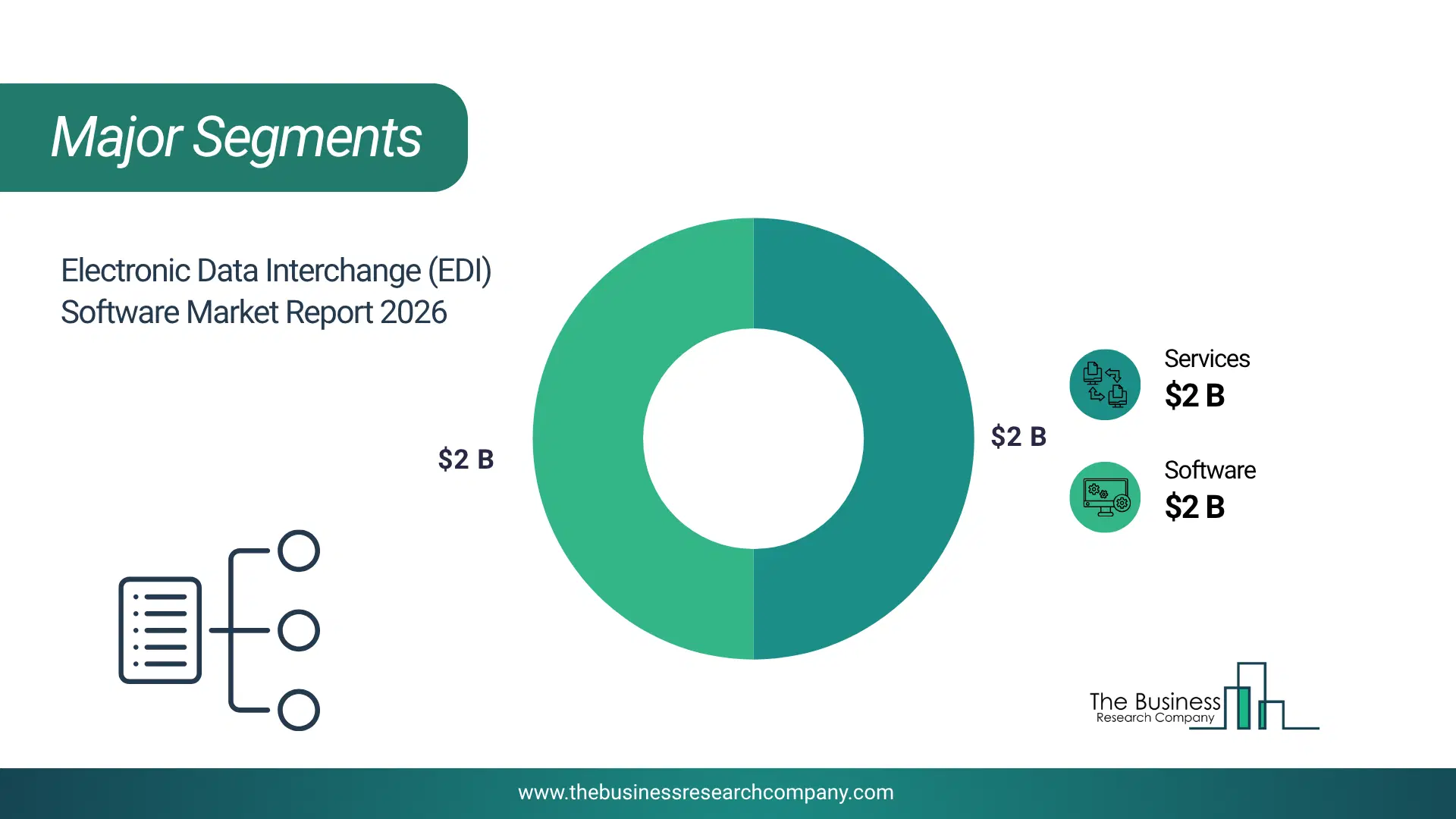
1) By Component: Software, Services 2) By Deployment: On-Premise, Cloud Based 3) By Organization Size: Small And Medium-Sized Enterprises, Large Enterprises 4) By Industry: Automotive, Banking, Financial Services And Insurance, Telecommunication And Information Technology, Retail And Consumer Goods, Manufacturing, Healthcare, Logistics, Other Industries Subsegments: 1) By Software: On-Premises EDI Software, Cloud-Based EDI Software, Integration Software (APIs, Middleware) 2) By Services: EDI Implementation Services, EDI Consulting Services, EDI Managed Services, EDI Support And Maintenance Services The top segments in the electronic data interchange (edi) software market will be: • Services will reach $2.39 Billion by 2030. • Software will reach $2 Billion by 2030.What Is The Driver Of The Electronic Data Interchange (EDI) Software Market?
The increasing adoption of automation solutions in business processes is driving the electronic data interchange (EDI) software market. Automation solutions in business processes comprise using software applications to automate repeatable business activities and services. Electronic data interchange (EDI) software is an automated solution used for B2B to transfer business documents between business partners, such as suppliers or customers. EDI technology automates a process that was previously manually handled with paper documents, saving time and money for businesses. For instance, in April 2024, according to the International Federation of Robotics, a Germany-based non-profit organization, the total number of industrial robot installations increased by 12%, reaching 44,303 units in 2023. Thus, the increasing adoption of automation solutions in business processes is driving the electronic data interchange (EDI) software industry.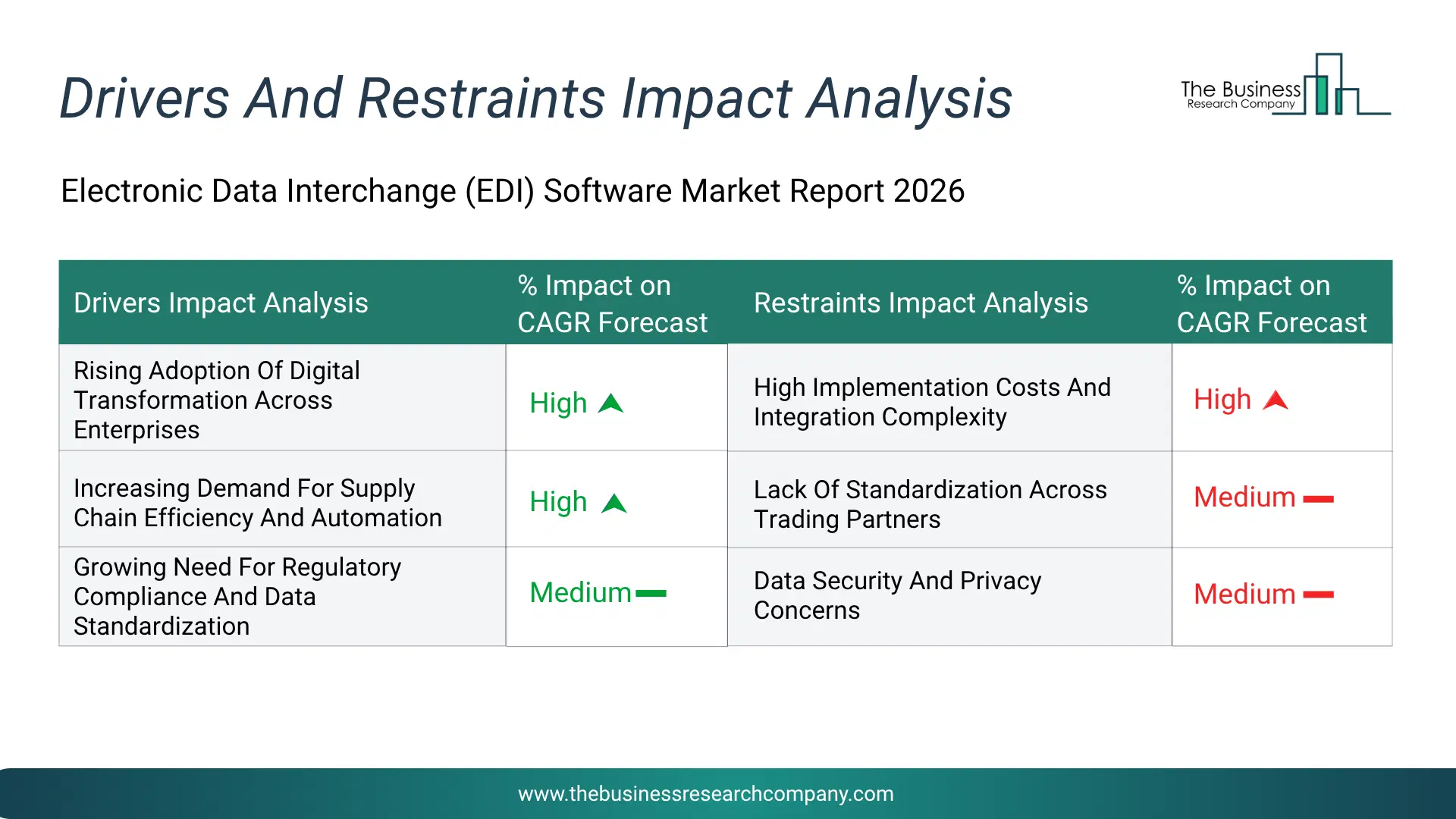
Infographic Chart Showing Key Market Drivers Analysis And Restraints For Electronic Data Interchange (Edi) Software Market
The chart presents an impact analysis of key drivers and restraints, quantifying their relative influence on the market's growth rate and helping assess the balance between growth enablers and limiting factors. This chart offers a high-level perspective; the full report contains more detailed insights.
How Will The Drivers Impact Growth In The Global Electronic Data Interchange (EDI) Software Market?
• Rising Adoption Of Digital Transformation Across Enterprises (High) – During the forecast period,the rising adoption of digital transformation across enterprises is expected to become a key growth driver for the electronic data interchange (EDI) software market by 2030. Rising adoption of digital transformation across enterprises acts as a major driver for the electronic data interchange (EDI) software market because organizations are shifting from manual, paper-based processes to automated and integrated digital systems. Businesses aim to improve operational efficiency, reduce human errors, and accelerate transaction processing across supply chains. EDI solutions enable seamless data exchange between partners, supporting real-time decision-making and improved collaboration. As industries increasingly embrace cloud computing and enterprise resource planning systems, the demand for standardized data exchange grows significantly. This continuous transition toward digital ecosystems strengthens the adoption of EDI software and drives overall market expansion. • Increasing Demand For Supply Chain Efficiency And Automation (High) – During the forecast period,the increasing demand for supply chain efficiency and automation is expected to emerge as a major factor driving the expansion of the electronic data interchange (EDI) software market by 2030. Increasing demand for supply chain efficiency and automation acts as a major driver for the electronic data interchange (EDI) software market because companies seek faster, more accurate, and cost-effective ways to manage transactions such as orders, invoices, and shipments. EDI minimizes manual intervention, reduces processing time, and enhances data accuracy across the supply chain network. This leads to improved inventory management, better vendor coordination, and reduced operational costs. Industries such as retail, manufacturing, and logistics increasingly rely on automated data exchange to maintain competitiveness. As global trade expands, the need for efficient and synchronized supply chain operations further accelerates EDI adoption. • Growing Need For Regulatory Compliance And Data Standardization (Medium) – During the forecast period,the growing need for regulatory compliance and data standardization is expected to act as a key growth catalyst for the electronic data interchange (EDI) software market by 2030. Growing need for regulatory compliance and data standardization acts as a major driver for the electronic data interchange (EDI) software market because businesses must adhere to industry-specific regulations and standardized communication protocols. EDI ensures secure, accurate, and compliant exchange of business documents, reducing the risk of errors and penalties. Sectors such as healthcare, finance, and retail require strict data handling and reporting standards, which EDI systems help fulfill efficiently. Standardization also enables interoperability between diverse systems and trading partners across regions. As regulatory requirements become more stringent, organizations increasingly adopt EDI solutions to maintain compliance and streamline operations.How Will The Restraints Impact Growth In The Global Electronic Data Interchange (EDI) Software Market?
• High Implementation Costs And Integration Complexity (High) – During the forecast period,the high implementation costs and integration complexity act as a major restraint in the electronic data interchange (EDI) software market by creating barriers for small and medium-sized enterprises. Deploying EDI systems often requires significant upfront investment in infrastructure, software customization, and skilled personnel. Integrating EDI with existing legacy systems can be technically challenging and time-consuming, leading to operational disruptions during transition phases. Businesses may also incur ongoing maintenance and upgrade expenses, increasing the total cost of ownership. As a result, many organizations delay or avoid adopting EDI solutions, limiting overall market growth. • Lack Of Standardization Across Trading Partners (High) – During the forecast period,the lack of standardization across trading partners restrains the EDI software market by complicating seamless data exchange between different systems. Although EDI relies on standardized formats, variations in implementation and regional requirements create inconsistencies in data interpretation. Businesses often need to customize EDI solutions for each partner, increasing complexity and reducing efficiency. This lack of uniformity leads to higher operational costs and longer onboarding times for new partners. Consequently, companies may face delays in communication and reduced effectiveness of automated workflows, slowing adoption rates. • Data Security And Privacy Concerns (Medium) – During the forecast period,the data security and privacy concerns act as a significant restraint by raising risks associated with the exchange of sensitive business information through EDI platforms. Organizations handle critical data such as financial transactions, invoices, and supply chain details, making them targets for cyberattacks and data breaches. Ensuring secure transmission requires robust encryption, compliance with data protection regulations, and continuous monitoring, which can increase operational costs. Any security lapse may lead to financial losses, legal penalties, and reputational damage. These concerns make businesses cautious about adopting EDI solutions, thereby limiting market expansion.Key Players In The Global Electronic Data Interchange (EDI) Software Market
Major companies operating in the electronic data interchange (edi) software market are Boomi Inc.; SPS Commerce Inc.; MuleSoft LLC; TrueCommerce Inc.; Rocket Software Inc.; Open Text Corporation; Babelway SA; Comarch SA; Cleo Communications; 1 EDI Source Inc.; DiCentral Corporation; Intertrade Systems; Epicor Software Corporation; Business Systems Integrators; Software AG; Crossinx GmbH; Data Masons Software LLC; IBM Corporation; The Descartes Systems Group Inc.; Liaison International Inc.; Oracle Corporation; Edifecs Inc.; Symbology Inc.; Optum360 LLC; HighJump Software Inc.; Jitterbit Inc.; Actian Corporation; Talend Inc.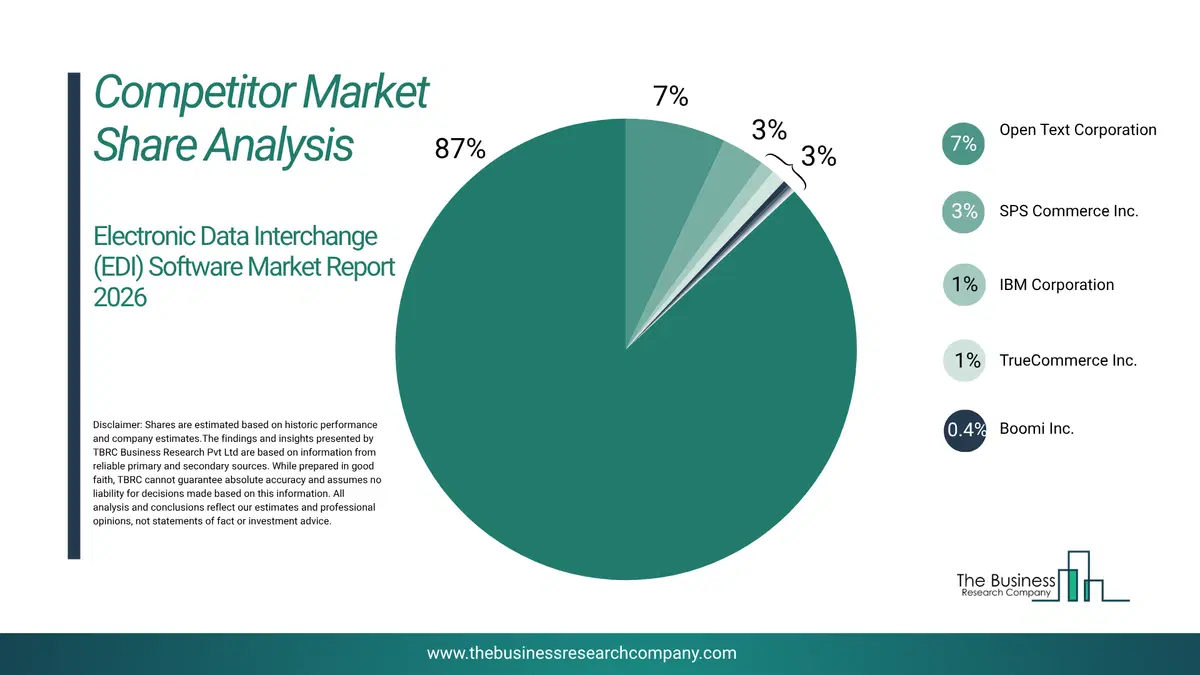
This chart is for illustrative purposes; the full report includes a detailed competitor analysis and comprehensive overview of the top 10 companies in the market.
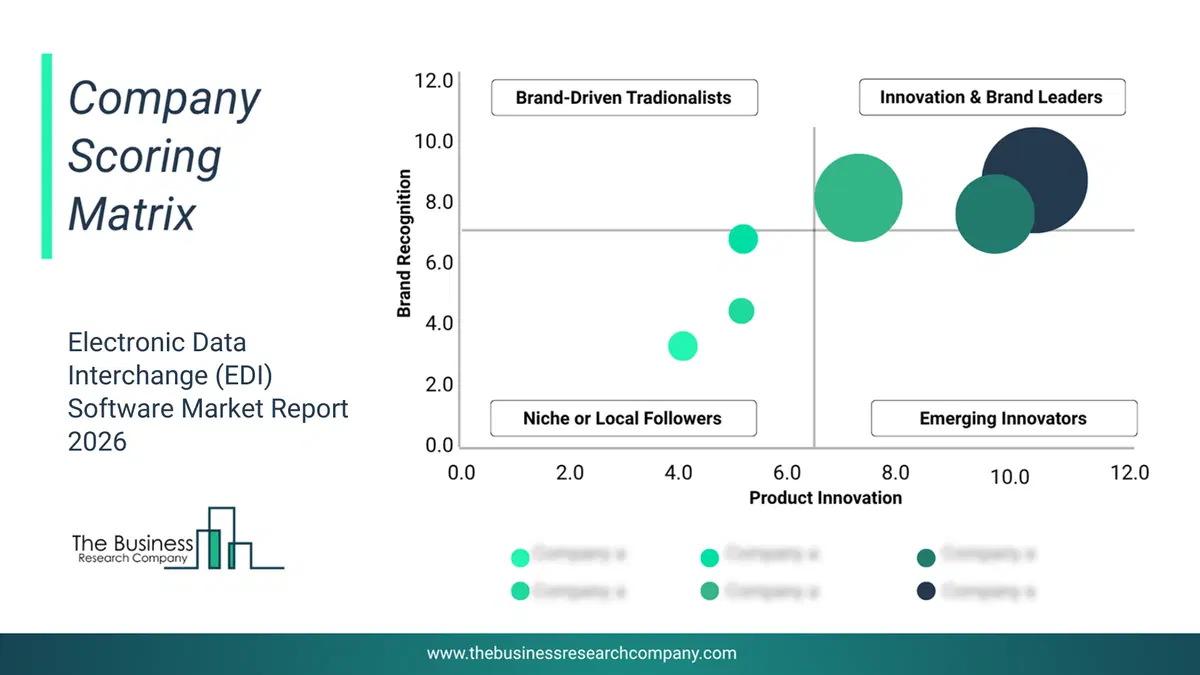
This chart maps companies by product innovation and brand strength, with bubble size indicating relative revenue, helping identify market leaders, challengers, and niche players. This is an illustrative chart; the full report provides a complete and accurate competitive analysis.
Global Electronic Data Interchange (EDI) Software Market Trends and Insights
Major companies operating in the electronic data interchange (EDI) software market are launching new programs such as the TrueCommerce xChange to strengthen collaboration with ERP resellers. TrueCommerce xChange is a partner program of electronic data interchange (EDI) solutions to facilitate seamless integration with top ERP systems. For instance, in April 2023, TrueCommerce, a US-based provider of supply chain and trading partner connectivity, integration, and omnichannel solutions, launched TrueCommerce xChange, a Partner Program Enhancing ERP Resellers' Affiliation for Seamless Electronic Data Interchange (EDI) Solutions Integration. TrueCommerce xChange empowers ERP resellers with opportunities for business growth, offering advantages in EDI-ERP integration. The program provides partners with dedicated sales resources, solution training, and co-marketing opportunities, enhancing support for their companies and clientele. By simplifying EDI implementation, TrueCommerce xChange helps ERP partners deliver accelerated returns on their customers' ERP investments.What Are Latest Mergers And Acquisitions In The Electronic Data Interchange (EDI) Software Market?
In September 2023, SPS Commerce, Inc., a US-based provider of cloud-based supply chain management solutions, acquired Tie Kinetix B.V. for an undisclosed amount. With this acquisition, SPS Commerce, Inc. aims to enhance its digital commerce network capabilities and expand its European market presence, strengthening its end-to-end supply chain solutions portfolio. Tie Kinetix B.V. is a Netherlands-based provider of electronic data interchange (EDI) software.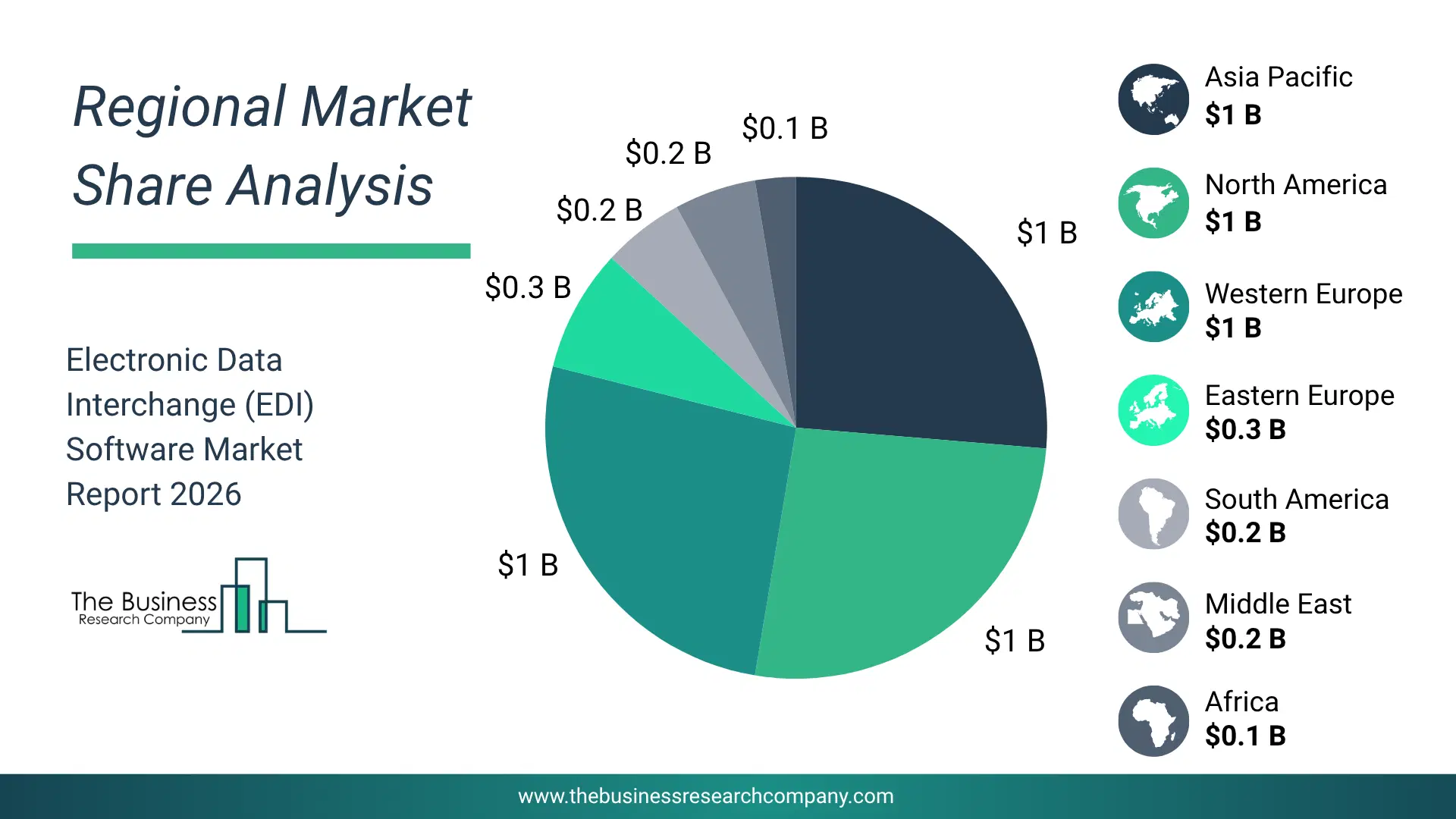
Regional Insights
North America was the largest region in the electronic data interchange (EDI) Software market in 2025. Europe is expected to be the fastest-growing region in the forecast period. The regions covered in this market report are Asia-Pacific, South East Asia, Western Europe, Eastern Europe, North America, South America, Middle East, Africa. The countries covered in this market report are Australia, Brazil, China, France, Germany, India, Indonesia, Japan, Taiwan, Russia, South Korea, UK, USA, Canada, Italy, SpainWhat Defines the Electronic Data Interchange (EDI) Software Market?
The electronic data interchange (EDI) software market consists of revenues earned by providing the transfer of purchase orders, invoices, and shipment transactions. The market value includes the value of related goods sold by the service provider or included within the service offering. Only goods and services traded between entities or sold to end consumers are included.How is Market Value Defined and Measured?
The market value is defined as the revenues that enterprises gain from the sale of goods and/or services within the specified market and geography through sales, grants, or donations in terms of the currency (in USD unless otherwise specified). The revenues for a specified geography are consumption values that are revenues generated by organizations in the specified geography within the market, irrespective of where they are produced. It does not include revenues from resales along the supply chain, either further along the supply chain or as part of other products.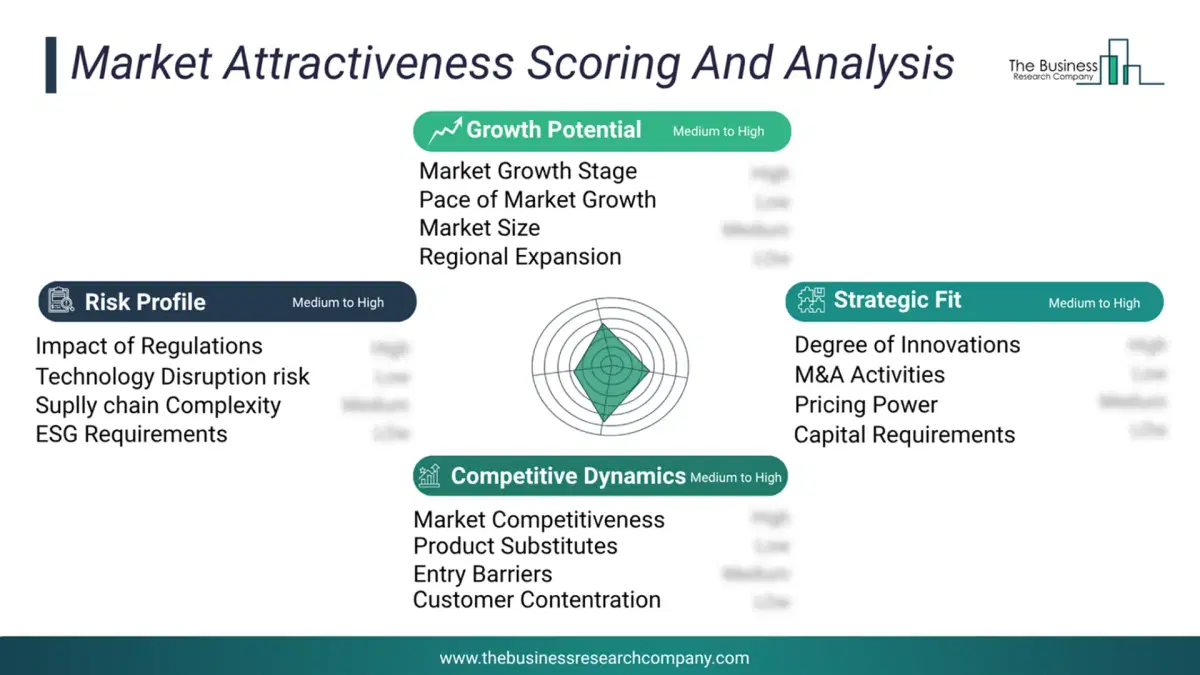
This chart presents market attractiveness based on a quantitative evaluation of growth, competition, strategic alignment, and risk, offering a clear view of opportunity areas for decision-making. This chart is for illustrative purposes; the full report contains the complete analysis.
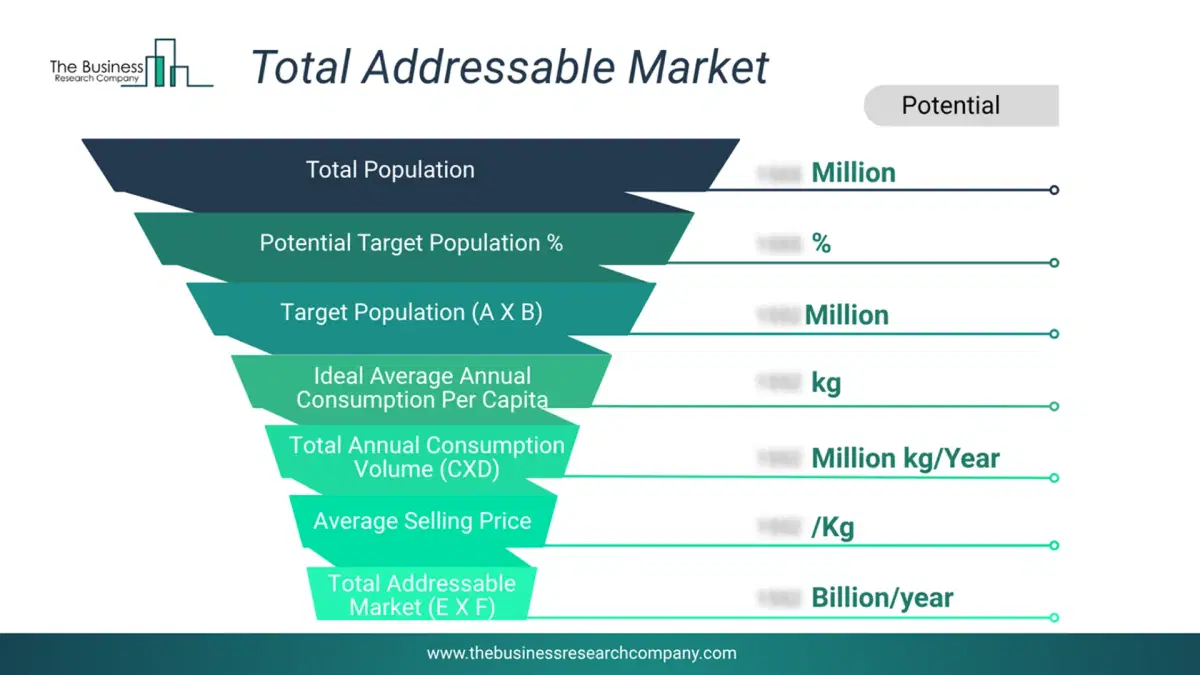
This chart highlights the Total Addressable Market (TAM) by estimating the maximum revenue opportunity using an assumption-driven approach, supporting strategic planning and opportunity sizing across markets. The chart is illustrative; the full report provides a more comprehensive analysis.
What Key Data and Analysis Are Included in the Electronic Data Interchange (EDI) Software Market Report 2026?
The electronic data interchange (edi) software market research report is one of a series of new reports from The Business Research Company that provides market statistics, including industry global market size, regional shares, competitors with the market share, detailed market segments, market trends and opportunities, and any further data you may need to thrive in the electronic data interchange (edi) software industry. The market research report delivers a complete perspective of everything you need, with an in-depth analysis of the current and future state of the industry.Electronic Data Interchange (EDI) Software Market Report Forecast Analysis
| Report Attribute | Details |
|---|---|
| Market Size Value In 2026 | $2.77 billion |
| Revenue Forecast In 2030 | $4.41 billion |
| Growth Rate | CAGR of 12.8% from 2026 to 2030 |
| Base Year For Estimation | 2025 |
| Actual Estimates/Historical Data | 2020-2025 |
| Forecast Period | 2026 - 2030 |
| Market Representation | Revenue in USD Billion and CAGR from 2026 to 2030 |
| Segments Covered | Component, Deployment, Organization Size, Industry |
| Regional Scope | Asia-Pacific, Western Europe, Eastern Europe, North America, South America, Middle East, Africa |
| Country Scope | The countries covered in the report are Australia, Brazil, China, France, Germany, India, Indonesia, Japan, Taiwan, Russia, South Korea, UK, USA, Canada, Italy, Spain. |
| Key Companies Profiled | Boomi Inc.; SPS Commerce Inc.; MuleSoft LLC; TrueCommerce Inc.; Rocket Software Inc.; Open Text Corporation; Babelway SA; Comarch SA; Cleo Communications; 1 EDI Source Inc.; DiCentral Corporation; Intertrade Systems; Epicor Software Corporation; Business Systems Integrators; Software AG; Crossinx GmbH; Data Masons Software LLC; IBM Corporation; The Descartes Systems Group Inc.; Liaison International Inc.; Oracle Corporation; Edifecs Inc.; Symbology Inc.; Optum360 LLC; HighJump Software Inc.; Jitterbit Inc.; Actian Corporation; Talend Inc. |
| Customization Scope | Request for Customization |
| Pricing And Purchase Options | Explore Purchase Options |