

Enterprise Performance Management Market Report 2026
Global Outlook – By Component (Solutions Or Software, Services), By Deployment (On-Premise, Cloud), By Application (Enterprise Planning And Budgeting, Financial Consolidation, Reporting And Compliance, Integrated Performance Management System, Other Applications), By Industry Vertical (BFSI, IT And Telecom, Retail, Manufacturing, Healthcare, Energy And Utilities, Other Verticals) – Market Size, Trends, Strategies, and Forecast to 2030
Enterprise Performance Management Market Overview
• Enterprise Performance Management market size has reached to $7.54 billion in 2025 • Expected to grow to $11.6 billion in 2030 at a compound annual growth rate (CAGR) of 8.9% • Growth Driver: The Surge Of Enterprise Performance Management Market Fueled By Widespread Adoption Of Cloud-Based Solutions • Market Trend: Advancements in Cloud-Based Solutions for Enterprise Management • North America was the largest region in 2025.Market Gains By 2030 – Top Opportunities By Segment
Market Gain identifies the most promising market opportunities by highlighting the segments or products expected to generate the highest incremental revenue growth over the next five years.
What Is Covered Under Enterprise Performance Management Market?
Enterprise Performance Management (EPM) is a process supported through planning, reporting, and business intelligence software that enables an organization to connect its strategy with planning and execution. These are used as an integrated technical and functional performance monitoring process in an organization. The main components of enterprise performance management are solutions, software, and services. The EPM software refers to software that aids in the analysis, comprehension, and reporting of the company's operations. Enterprise performance management software includes project management software, statistical tools, financial and accounting solutions, customer support websites, and others. The deployment includes on-premise and cloud applications that are used for enterprise planning and budgeting, financial consolidation, reporting and compliance, an integrated performance management system, and other applications. The end-users of enterprise performance management include BFSI, IT and telecom, retail, manufacturing, healthcare, energy and utilities, and other verticals.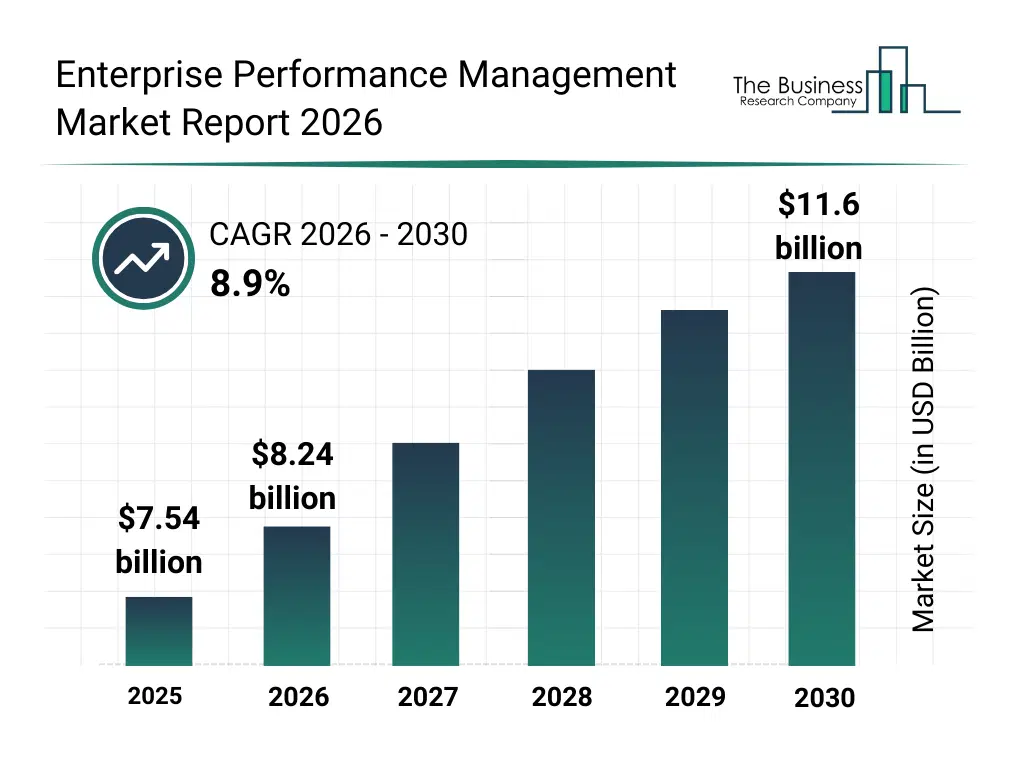
What Is The Enterprise Performance Management Market Size and Share 2026?
The enterprise performance management market size has grown strongly in recent years. It will grow from $7.54 billion in 2025 to $8.24 billion in 2026 at a compound annual growth rate (CAGR) of 9.3%. The growth in the historic period can be attributed to increasing complexity of enterprise financial operations, rising demand for consolidated reporting, adoption of business intelligence tools, expansion of multinational enterprise structures, availability of enterprise performance software.What Is The Enterprise Performance Management Market Growth Forecast?
The enterprise performance management market size is expected to see strong growth in the next few years. It will grow to $11.6 billion in 2030 at a compound annual growth rate (CAGR) of 8.9%. The growth in the forecast period can be attributed to increasing focus on agile financial planning, rising integration of AI-driven forecasting, expansion of cloud-based enterprise platforms, growing regulatory reporting requirements, increasing demand for real-time business insights. Major trends in the forecast period include increasing adoption of integrated financial planning platforms, rising demand for real-time performance reporting tools, growing use of predictive forecasting capabilities, expansion of cloud-based epm solutions, enhanced focus on enterprise-wide performance visibility.
Global Enterprise Performance Management Market Segmentation
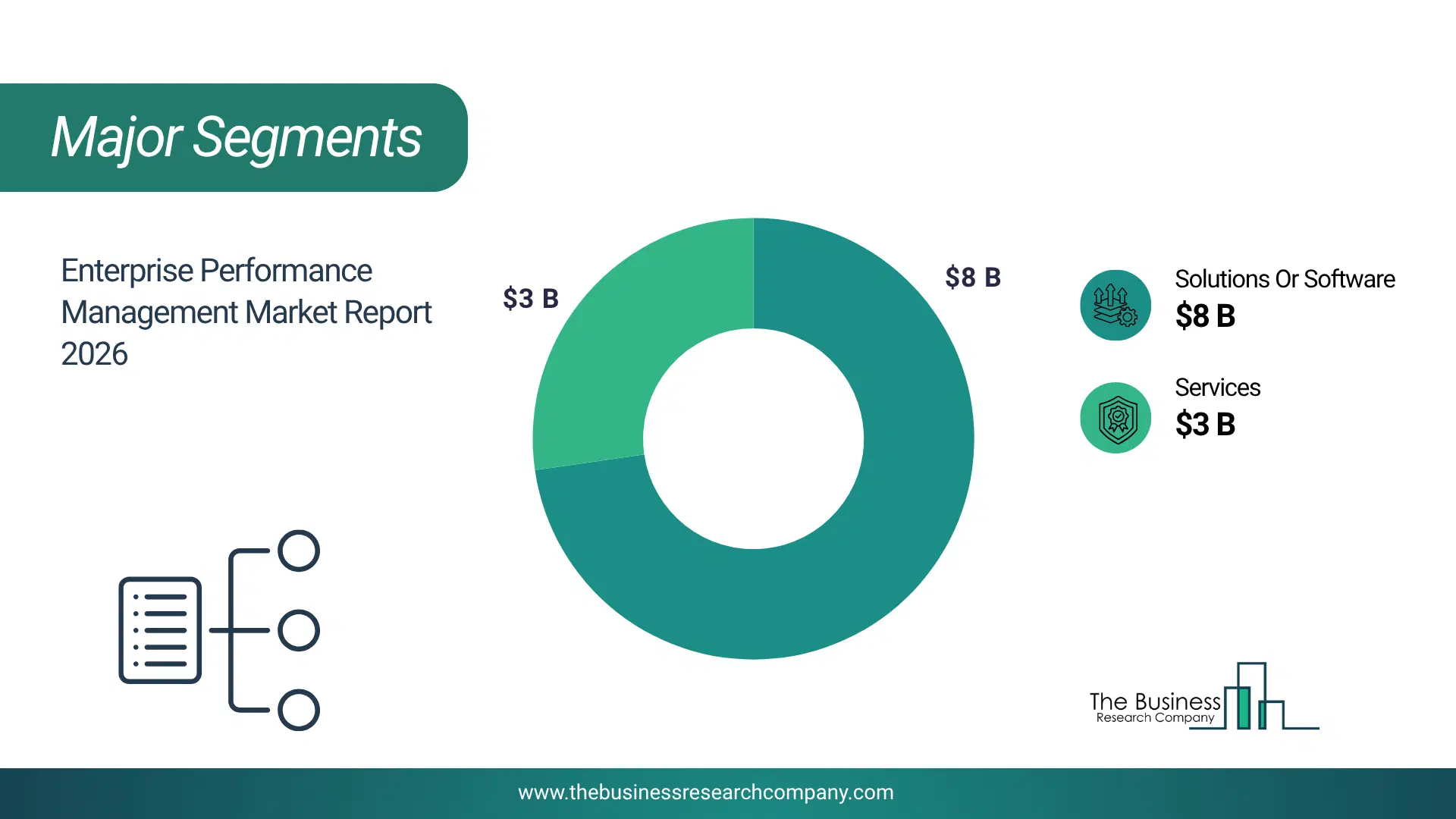
1) By Component: Solutions Or Software, Services 2) By Deployment: On-Premise, Cloud 3) By Application: Enterprise Planning And Budgeting, Financial Consolidation, Reporting And Compliance, Integrated Performance Management System, Other Applications 4) By Industry Vertical: BFSI, IT And Telecom, Retail, Manufacturing, Healthcare, Energy And Utilities, Other Verticals Subsegments: 1) By Solutions Or Software: Financial Planning And Analysis Software, Budgeting And Forecasting Software, Consolidation And Reporting Software, Performance Measurement Software, Business Intelligence Tools 2) By Services: Consulting Services, Implementation Services, Support And Maintenance Services, Training And Education Services The top segments in the enterprise performance management market will be: • Solutions Or Software will reach $8757.95 Million by 2030. • Cloud will reach $8583.06 Million by 2030. • On-Premise will reach $3540.93 Million by 2030. • Enterprise Planning And Budgeting will reach $4039.86 Million by 2030. • Financial Consolidation will reach $3448.56 Million by 2030.What Is The Driver Of The Enterprise Performance Management Market?
The growing adoption of cloud-based EPM solutions are driving the enterprise performance management market. Cloud-based solutions refer to services, applications, or resources that are delivered over the internet, hosted on remote servers, and accessed through web browsers or dedicated software. Cloud-based EPM solutions offer faster time to value, reduced total cost of ownership, and increased autonomy. They eliminate the effort and costs of setting up infrastructure, provide a lower overall cost compared to on-premises software, and empower Finance to drive and control the implementation and maintenance of the EPM solution. For instance, in 2023, according to European Commission, a Belgium-based executive branch of the European Union, in 2023, 75.3% of enterprises that acquired cloud computing services were considered ‘highly dependent’ on the cloud, reflecting their use of advanced cloud solutions. Compared to the previous year, cloud computing adoption rose by 4.2%. Therefore, increasing adoption of cloud-based EPM solutions will propel the growth of the enterprise performance management industry.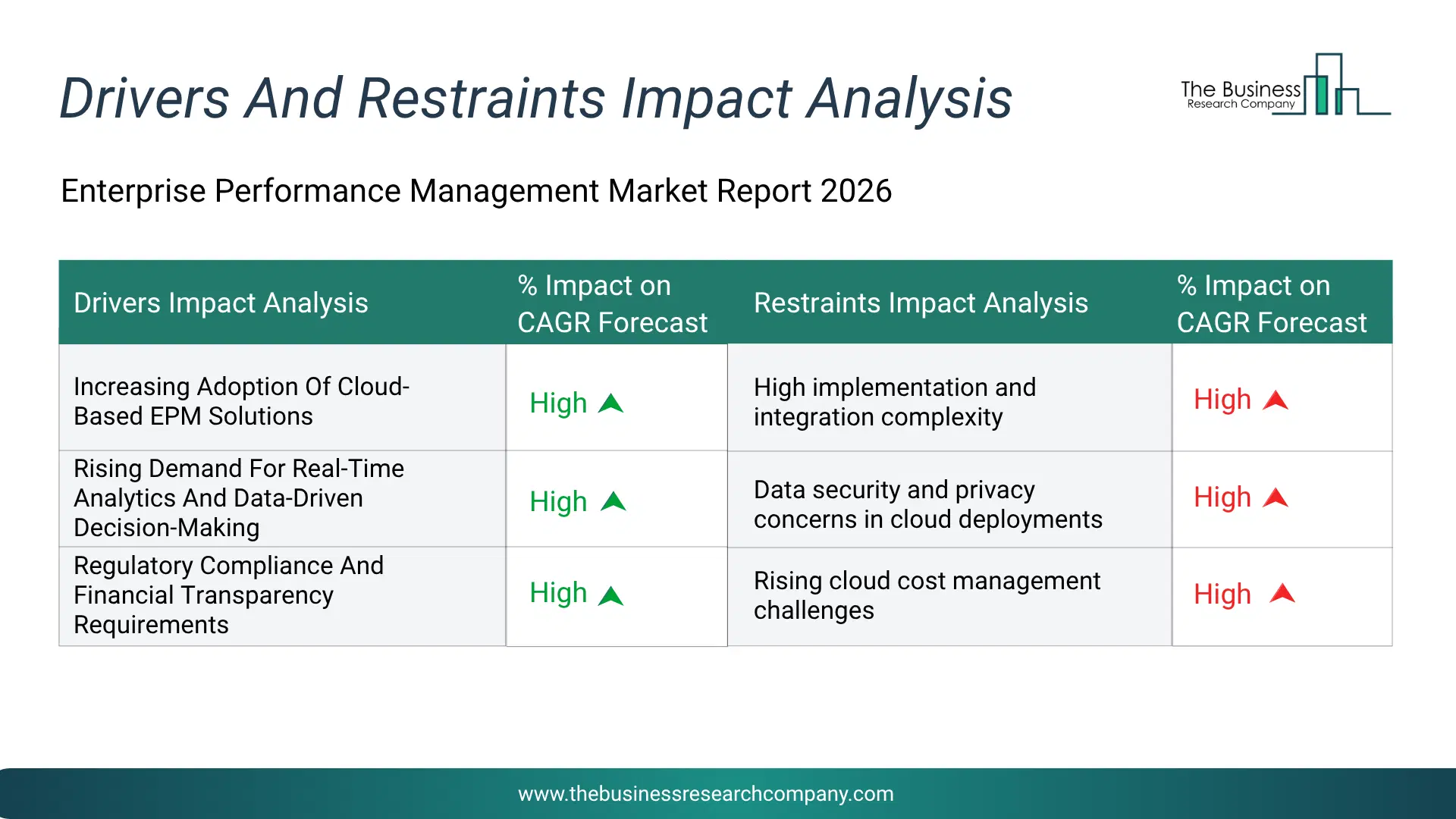
Infographic Chart Showing Key Market Drivers Analysis And Restraints For Enterprise Performance Management Market
The chart presents an impact analysis of key drivers and restraints, quantifying their relative influence on the market's growth rate and helping assess the balance between growth enablers and limiting factors. This chart offers a high-level perspective; the full report contains more detailed insights.
How Will The Drivers Impact Growth In The Global Enterprise Performance Management Market?
• Increasing Demand For Real-Time Strategic Decision-Making (High) – During the forecast period, increasing demand for real-time strategic decision-making are accelerating the adoption of enterprise performance management. as organizations operate in increasingly dynamic, competitive, and data-intensive environments, the need for instant access to accurate financial, operational, and strategic performance data continues to rise across industries. a growing emphasis on agility, transparency, and performance accountability is increasing the frequency of enterprise performance management system deployments, upgrades, and integrations across large enterprises and small and medium-sized businesses. organizations are seeking solutions that support scenario modeling, rolling forecasts, variance analysis, and cross-functional performance tracking, thereby strengthening alignment between strategic objectives and measurable outcomes. as a result, enterprise performance management solution providers are increasingly expanding cloud-based offerings, enhancing artificial intelligence and predictive analytics capabilities, and strengthening integration with enterprise resource planning and business intelligence platforms to support real-time strategic decision-making and sustain long-term growth in the global market enterprise performance management market. the increasing demand for real-time strategic decision-making growth contribution during the forecast period in 2025 is 2.0%. • Increasing Demand For Real-Time Strategic Decision-Making (Medium) – During the forecast period, the growing emphasis on predictive and scenario planning is driving demand for enterprise performance management. as business environments become increasingly volatile due to economic uncertainty, regulatory changes, geopolitical tensions, and rapid technological advancements, organizations across industries are projected to adopt more forward-looking planning approaches to enhance strategic agility and financial stability. a growing focus on predictive and scenario planning increases the frequency of enterprise performance management solution deployments, upgrades, and integrations across finance, operations, and executive management functions, driving sustained demand for cloud-based planning platforms, advanced analytics tools, financial consolidation systems, and integrated performance dashboards. as a result, enterprise performance management software providers, cloud vendors, and consulting firms are increasingly expanding product capabilities, strengthening analytics and ai integration, and enhancing implementation and advisory services to support rising demand for predictive and scenario-driven planning, thereby sustaining long-term growth in the global enterprise performance management market. the growing emphasis on predictive and scenario planning growth contribution during the forecast period in 2025 is 1.5%. • Increasing Complexity Of Business Operations (Medium) – During the forecast period, the increasing complexity of business operations is driving increased demand for enterprise performance management. as organizations expand into new geographic regions, diversify revenue streams, adopt hybrid operating models, and manage multi-entity corporate structures, operational processes are becoming more interconnected and data-intensive, leading to greater demand for centralized planning, consolidation, reporting, and performance monitoring solutions. the growing scale and structural complexity of enterprises across industries are projected to increase the need for integrated enterprise performance management platforms across financial planning, budgeting, forecasting, risk management, and strategic performance tracking applications. as a result, enterprise performance management solution providers are increasingly expanding cloud deployment capabilities, strengthening system integration frameworks, enhancing advanced analytics functionalities, and building strategic consulting and implementation partnerships to support rising operational complexity and sustain long-term growth in the global enterprise performance management market. the increasing complexity of business operations growth contribution during the forecast period in 2025 is 1.0%. • Increasing Pressure For Cost Optimization And Profitability Improvement (Low) – During the forecast period, the increasing pressure for cost optimization and profitability improvement accelerating the adoption of enterprise performance management. as organizations across industries face heightened competition, margin compression, economic uncertainty, and rising operational costs, there is a growing emphasis on improving financial visibility, streamlining operations, and enhancing data-driven decision-making to sustain profitability and shareholder value. growing demand for enhanced financial visibility and real-time performance insights is accelerating the adoption of enterprise performance management solutions across large enterprises and mid-sized organizations. companies are increasingly seeking tools that enable scenario analysis, predictive forecasting, profitability modeling, and cost allocation optimization to improve decision-making accuracy and resource utilization. as a result, solution providers are enhancing product innovation, expanding ai-enabled forecasting features, and strengthening consulting and implementation services to support evolving business requirements. this sustained emphasis on cost efficiency and profitability improvement is expected to contribute significantly to the long-term growth of the global enterprise performance management market. the increasing pressure for cost optimization and profitability improvement growth contribution during the forecast period in 2025 is 0.8%.How Will The Restraints Impact Growth In The Global Enterprise Performance Management Market?
• Increasing Integration Complexity With Multi-Cloud And Hybrid IT Environments (High) – During the forecast period, the increasing integration complexity with multi-cloud and hybrid it environments remains a significant barrier to market expansion. persistent challenges associated with integrating enterprise performance management platforms across multiple cloud providers, on-premises infrastructure, legacy enterprise resource planning systems, and third-party applications are placing operational and financial pressure on enterprises, which in turn discourages rapid deployment and full-scale adoption of advanced performance management solutions. from a commercial and operational perspective, the need to consolidate data from disparate environments, maintain real-time synchronization, ensure data consistency, and enforce unified governance frameworks across hybrid it architectures significantly increases implementation timelines and total cost of ownership. these complexities often compel organizations to adopt phased implementation strategies, rely heavily on external consultants, or delay upgrades to advanced analytics and ai-driven performance management capabilities. as a result, enterprise performance management solution providers may face extended sales cycles, cautious enterprise spending, and moderated adoption rates, particularly among organizations navigating complex multi-cloud and hybrid it transformation initiatives. growth affected by increasing integration complexity with multi-cloud and hybrid it environments during the forecast period in 2025 is -2.0%. • Organizational Resistance To Process Standardization (Medium) – During the forecast period, the organizational resistance to process standardization limits a significant barrier to market expansion. persistent reluctance among departments and business units to align financial planning, budgeting, forecasting, and reporting workflows under unified frameworks is creating structural barriers to enterprise-wide epm adoption. from an operational and managerial perspective, resistance to standardized financial and performance processes increases the complexity of epm deployment, as organizations must navigate fragmented data structures, inconsistent reporting methodologies, and incompatible legacy systems. these process-related barriers, combined with competing strategic priorities and limited cross-functional alignment, encourage enterprises to adopt phased or partial deployments rather than comprehensive standardization initiatives. as a result, organizational resistance to process standardization constrains enterprise-wide rollout strategies, prolongs procurement and implementation cycles, and moderates long-term digital finance modernization efforts, thereby restraining the growth of the enterprise performance management market during the forecast period. growth affected by organizational resistance to process standardization limits during the forecast period in 2025 is -1.0%. • Trade War And Tariffs (Medium) – During the forecast period, the trade war and tariffs remains a significant barrier to market expansion. escalating tariff barriers, retaliatory trade measures, and shifting trade policies on imported it hardware, cloud infrastructure components, and software-related services are increasing operational and deployment costs for enterprise performance management vendors and end-user organizations. from a commercial and operational perspective, the imposition of tariffs on servers, data storage systems, networking equipment, and semiconductor components critical for on-premises and hybrid epm deployments places additional financial pressure on solution providers and enterprises. these rising costs limit budget allocations for advanced analytics, financial planning, and performance optimization platforms, thereby moderating overall market expansion. as a result, enterprise performance management vendors, system integrators, and enterprise customers may experience constrained profitability, elongated sales cycles, and delayed investments in product innovation, artificial intelligence–enabled forecasting tools, and global market expansion strategies. growth affected by trade war and tariffs during the forecast period in 2025 is -0.3%Key Players In The Global Enterprise Performance Management Market
Major companies operating in the enterprise performance management market are Oracle Corporation; IBM Corporation; Infor Inc.; SAP AG; Anaplan Inc.; Workday Inc.; Planful; Workiva Inc.; Unit4; BOARD International SA; Adaptive Insights Inc.; Host Analytics Inc.; SAS Institute Inc.; OneStream Software LLC; BearingPoint; Vena; Prophix; Jedox; Longview Solutions; MicroStrategy; QlikView; Tableau; TIBCO Spotfire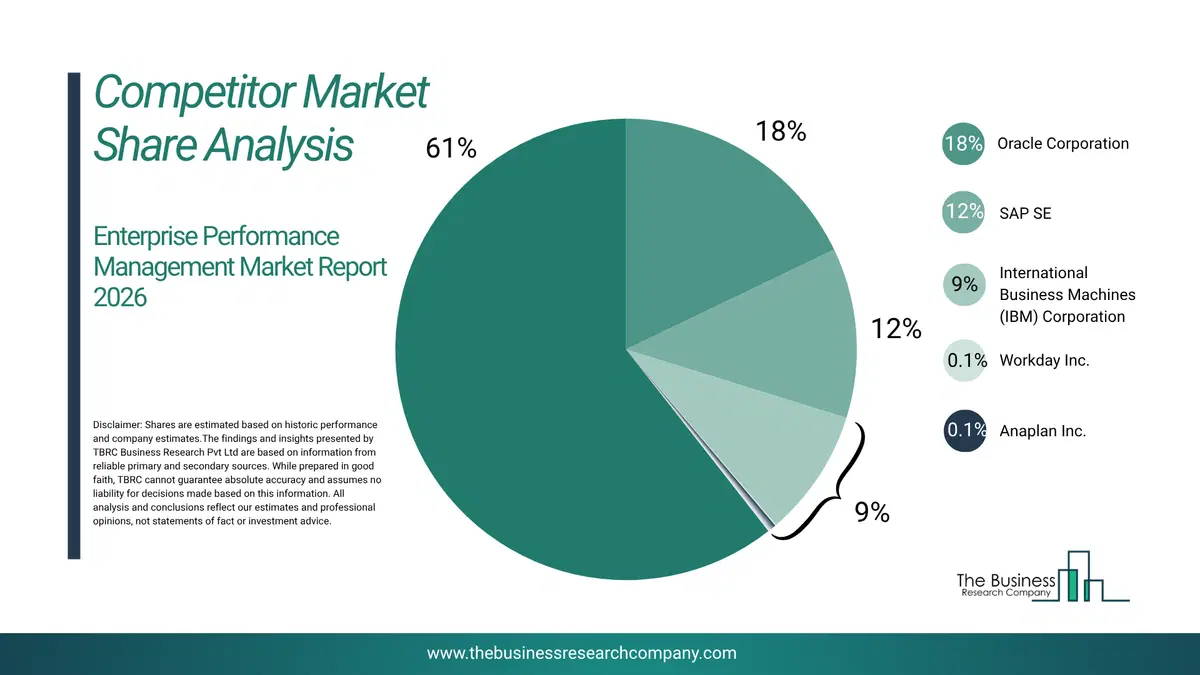
This chart is for illustrative purposes; the full report includes a detailed competitor analysis and comprehensive overview of the top 10 companies in the market.
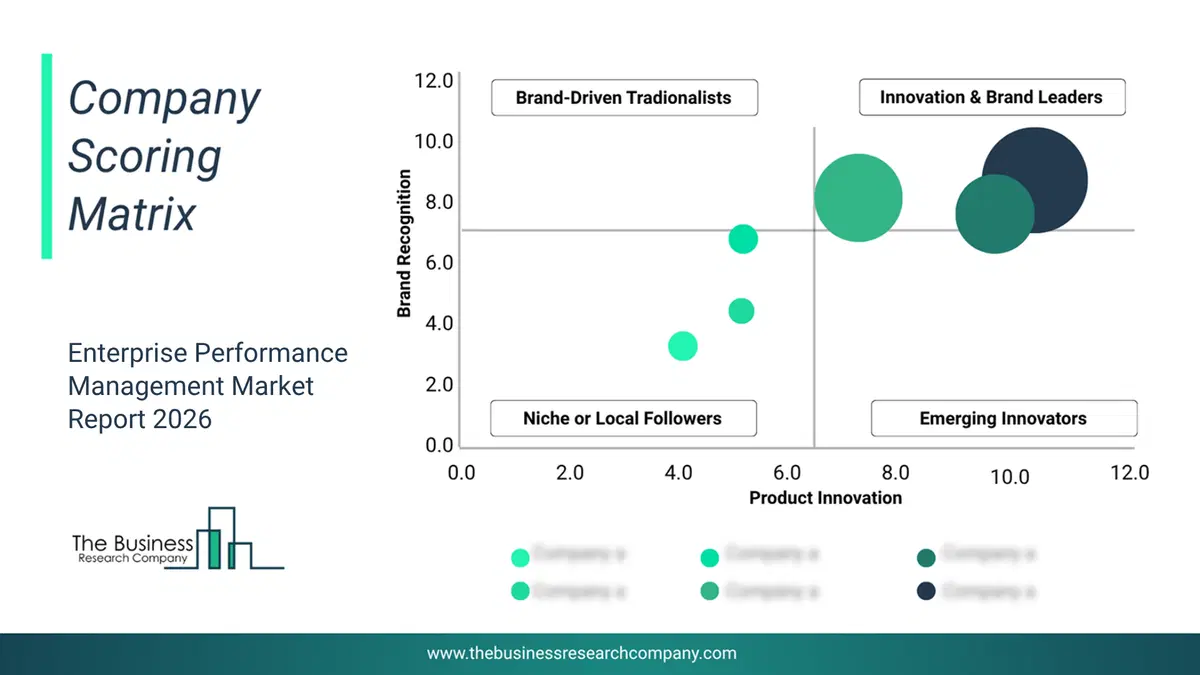
This chart maps companies by product innovation and brand strength, with bubble size indicating relative revenue, helping identify market leaders, challengers, and niche players. This is an illustrative chart; the full report provides a complete and accurate competitive analysis.
Global Enterprise Performance Management Market Trends and Insights
Major companies operating in the enterprise performance management (EPM) market are increasingly focusing on technological advancements particularly cloud-based innovations to enhance performance visibility, streamline operations, and strengthen their competitive position. Organizations are shifting toward cloud-driven EPM solutions to improve scalability, optimize resource allocation, and simplify the management of complex enterprise environments. For instance, in May 2023, IBM, a US-based multinational technology company, introduced IBM Hybrid Cloud Mesh, a new SaaS solution designed to help enterprises efficiently manage their hybrid multicloud infrastructures. Centered on Application-Centric Connectivity, the platform automates the management and observability of application interactions across both public and private cloud environments. It delivers secure, scalable, and seamless connections for applications, addressing the rising complexities of modern enterprise networking. Leveraging DNS traffic steering from NS1, IBM Hybrid Cloud Mesh enhances application performance, cost efficiency, and availability by ensuring optimal routing between clouds and end users.What Are Latest Mergers And Acquisitions In The Enterprise Performance Management Market?
In December 2023, OneStream Software, a US-based provider of corporate performance management (CPM) solutions Partnered with KPMG Spain.a strategic partnership aimed at helping organizations manage complexity and drive finance transformation in the region. This collaboration will leverage KPMG's consulting expertise alongside OneStream's cloud-based corporate performance management (CPM) software. KPMG is a UK-based multinational professional services network and one of the ""Big Four"" accounting organizations.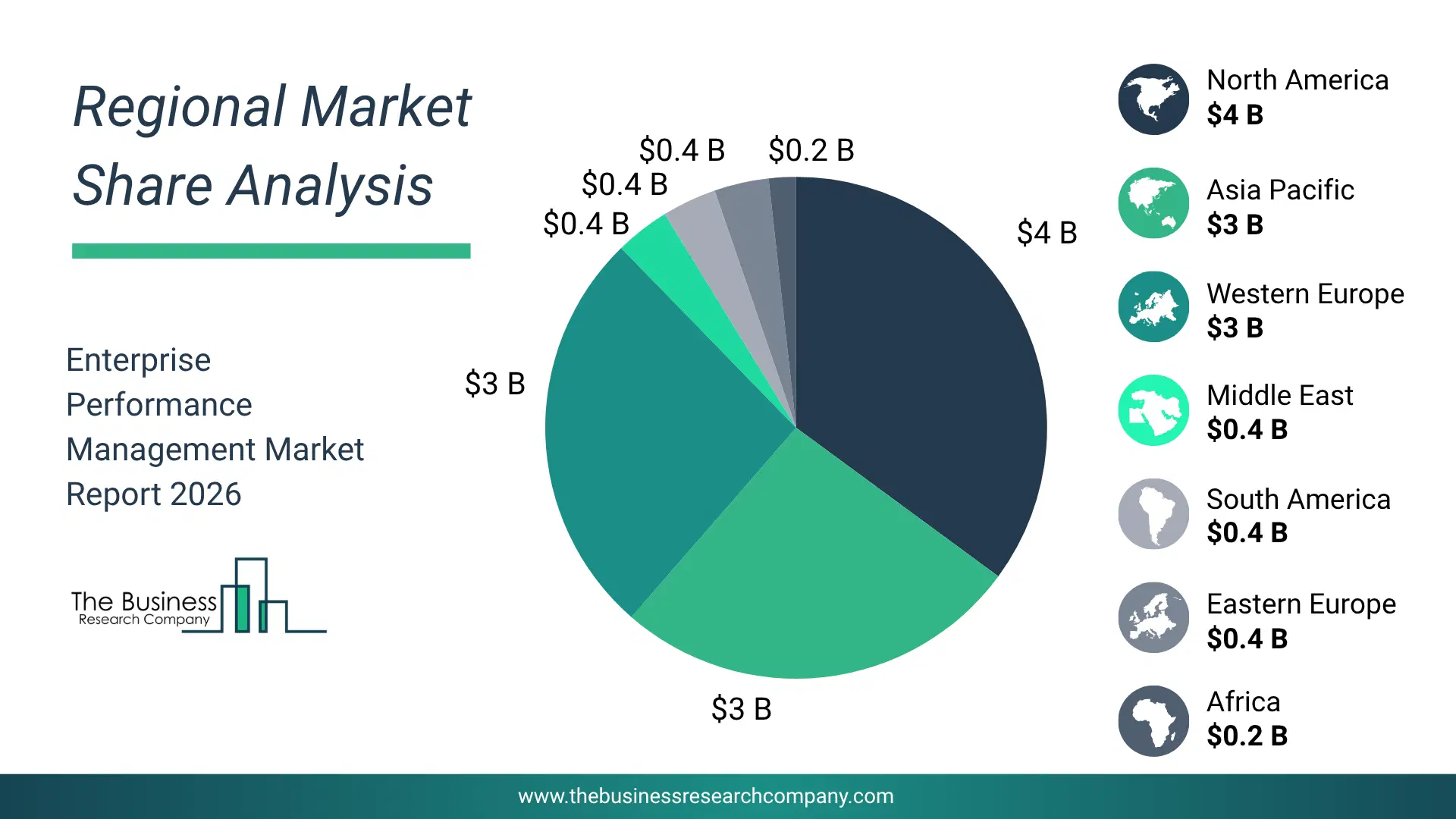
Regional Insights
North America was the largest region in the enterprise performance management market share in 2025. The regions covered in this market report are Asia-Pacific, South East Asia, Western Europe, Eastern Europe, North America, South America, Middle East, Africa. The countries covered in this market report are Australia, Brazil, China, France, Germany, India, Indonesia, Japan, Taiwan, Russia, South Korea, UK, USA, Canada, Italy, SpainWhat Defines the Enterprise Performance Management Market?
The enterprise performance management (EPM) market consists of revenues earned by entities by providing services such as tax reporting and narrative reporting. The market value includes the value of related goods sold by the service provider or included within the service offering. The enterprise performance management (EPM) market also includes sales of software such as profitability and cost management software. Values in this market are ‘factory gate’ values, that is, the value of goods sold by the manufacturers or creators of the goods, whether to other entities (including downstream manufacturers, wholesalers, distributors, and retailers) or directly to end customers. The value of goods in this market includes related services sold by the creators of the goods.How is Market Value Defined and Measured?
The market value is defined as the revenues that enterprises gain from the sale of goods and/or services within the specified market and geography through sales, grants, or donations in terms of the currency (in USD unless otherwise specified). The revenues for a specified geography are consumption values that are revenues generated by organizations in the specified geography within the market, irrespective of where they are produced. It does not include revenues from resales along the supply chain, either further along the supply chain or as part of other products.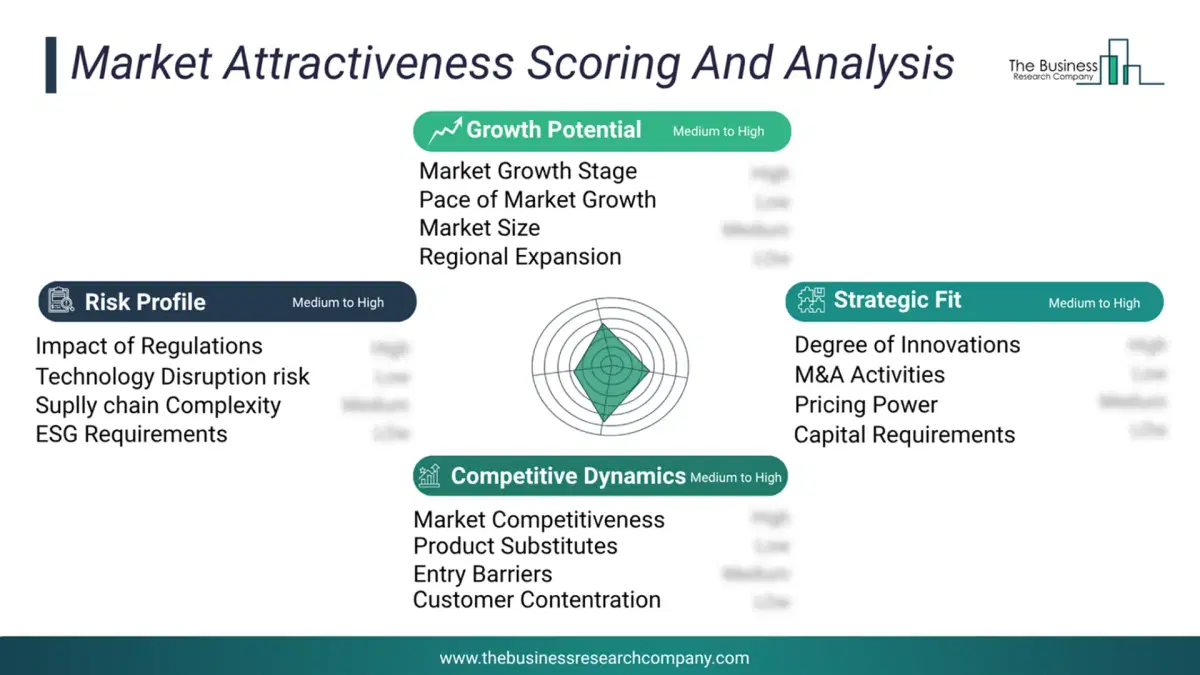
This chart presents market attractiveness based on a quantitative evaluation of growth, competition, strategic alignment, and risk, offering a clear view of opportunity areas for decision-making. This chart is for illustrative purposes; the full report contains the complete analysis.
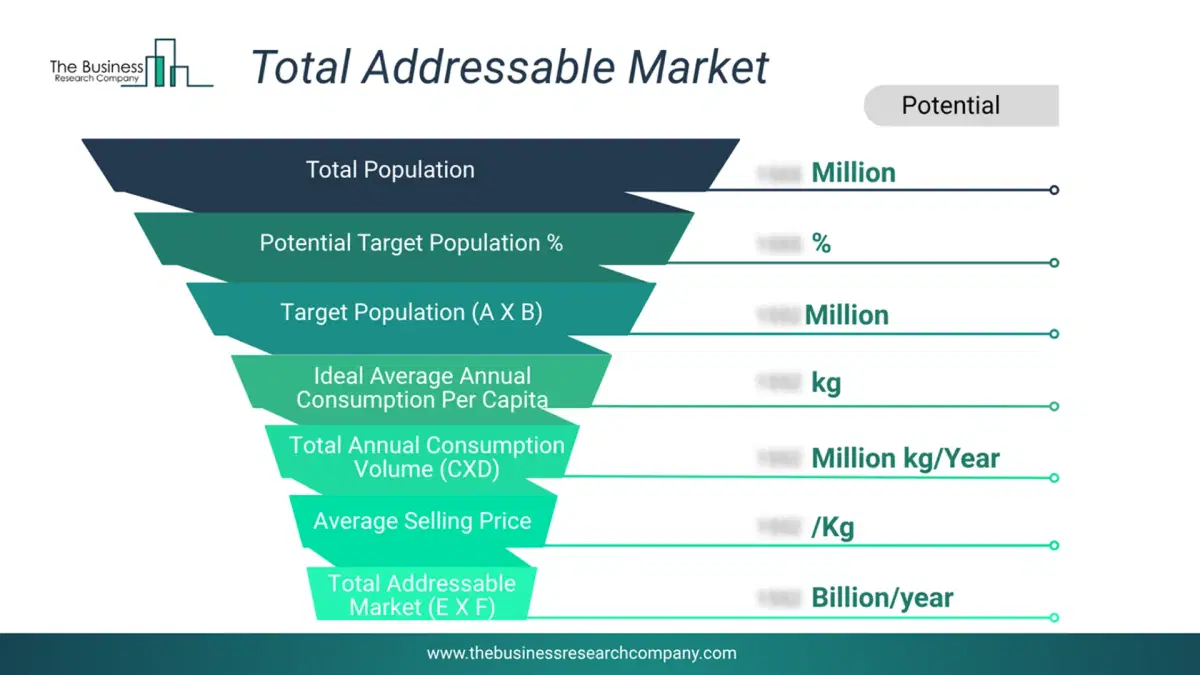
This chart highlights the Total Addressable Market (TAM) by estimating the maximum revenue opportunity using an assumption-driven approach, supporting strategic planning and opportunity sizing across markets. The chart is illustrative; the full report provides a more comprehensive analysis.
What Key Data and Analysis Are Included in the Enterprise Performance Management Market Report 2026?
The enterprise performance management market research report is one of a series of new reports from The Business Research Company that provides market statistics, including industry global market size, regional shares, competitors with the market share, detailed market segments, market trends and opportunities, and any further data you may need to thrive in the enterprise performance management industry. The market research report delivers a complete perspective of everything you need, with an in-depth analysis of the current and future state of the industry.Enterprise Performance Management Market Report Forecast Analysis
| Report Attribute | Details |
|---|---|
| Market Size Value In 2026 | $8.24 billion |
| Revenue Forecast In 2030 | $11.6 billion |
| Growth Rate | CAGR of 9.3% from 2026 to 2030 |
| Base Year For Estimation | 2025 |
| Actual Estimates/Historical Data | 2020-2025 |
| Forecast Period | 2026 - 2030 - 2035 |
| Market Representation | Revenue in USD Billion and CAGR from 2026 to 2030 |
| Segments Covered | Component, Deployment, Application, Industry Vertical |
| Regional Scope | Asia-Pacific, Western Europe, Eastern Europe, North America, South America, Middle East, Africa |
| Country Scope | The countries covered in the report are Australia, Brazil, China, France, Germany, India, Indonesia, Japan, Taiwan, Russia, South Korea, UK, USA, Canada, Italy, Spain. |
| Key Companies Profiled | Oracle Corporation; IBM Corporation; Infor Inc.; SAP AG; Anaplan Inc.; Workday Inc.; Planful; Workiva Inc.; Unit4; BOARD International SA; Adaptive Insights Inc.; Host Analytics Inc.; SAS Institute Inc.; OneStream Software LLC; BearingPoint; Vena; Prophix; Jedox; Longview Solutions; MicroStrategy; QlikView; Tableau; TIBCO Spotfire |
| Customization Scope | Request for Customization |
| Pricing And Purchase Options | Explore Purchase Options |