

Fiber Optic Connectors Market Report 2026
Global Outlook – By Product (SC (Standard Connectors), LC (Lucent Connectors), FC (Ferrule Connector), ST (Straight Tip), MXC Connector, Other Products), By Cable (Simplex, Duplex, Multi-Fiber), By Application (Telecommunication, Inter Or Intra Building, Community Antenna Television, Datacenter, High Density Interconnection, Security Systems, Other Applications) – Market Size, Trends, Strategies, and Forecast to 2030
Fiber Optic Connectors Market Overview
• Fiber Optic Connectors market size has reached to $5.61 billion in 2025 • Expected to grow to $7.57 billion in 2030 at a compound annual growth rate (CAGR) of 6.1% • Growth Driver: Rapid Expansion Of Smart Devices And 4G/5G Networks Driving Growth In The Global Fiber Optic Connectors Market • Market Trend: Field-Terminable Fiber Optic Connectors To Enhance Efficiency • Asia-Pacific was the largest region in 2025.Market Gains By 2030 – Top Opportunities By Segment
Market Gain identifies the most promising market opportunities by highlighting the segments or products expected to generate the highest incremental revenue growth over the next five years.
What Is Covered Under Fiber Optic Connectors Market?
Fiber optic connectors refer to high-speed connectors that are used for public telecommunication networks and wiring installations. A fiber optic connector is a flexible device that can connect and disconnect fiber optic cables quickly. Optical fibers combine two fiber connections without splicing or terminate fiber-optic connections to fiber equipment. The fiber optic connectors market covered in this report is segmented by product into SC (standard connectors), LC (lucent connectors), FC (ferrule connector), ST (straight tip), MTP/MPO (multiple-fiber push-on/pull-off), MXC connector, others. It is also segmented by cable into simplex, duplex, multi-fiber and by application into telecommunication, inter/intra building, community antenna television, data center, high-density interconnection, security systems, and others.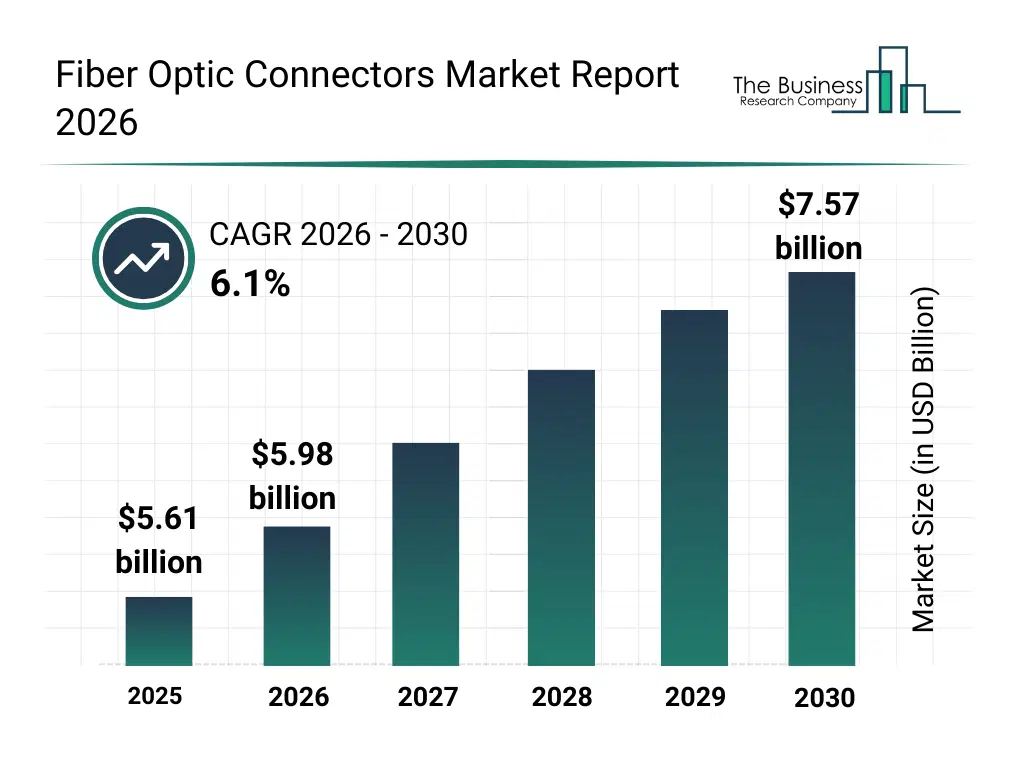
What Is The Fiber Optic Connectors Market Size and Share 2026?
The fiber optic connectors market size has grown strongly in recent years. It will grow from $5.61 billion in 2025 to $5.98 billion in 2026 at a compound annual growth rate (CAGR) of 6.5%. The growth in the historic period can be attributed to expansion of broadband communication networks, growth of telecom infrastructure projects, rising deployment of fiber-to-the-home connections, increasing data center construction, adoption of optical networking technologies.What Is The Fiber Optic Connectors Market Growth Forecast?
The fiber optic connectors market size is expected to see strong growth in the next few years. It will grow to $7.57 billion in 2030 at a compound annual growth rate (CAGR) of 6.1%. The growth in the forecast period can be attributed to increasing investments in 5G and hyperscale data centers, rising demand for high-speed data transmission, expansion of cloud computing infrastructure, growing adoption of fiber in industrial automation, increasing focus on high-density interconnection solutions. Major trends in the forecast period include increasing demand for high-density fiber connectivity, rising adoption of data center interconnect solutions, growing use of mpo and mtp connectors, expansion of fiber deployment in smart infrastructure, enhanced focus on low-loss optical performance.
Global Fiber Optic Connectors Market Segmentation
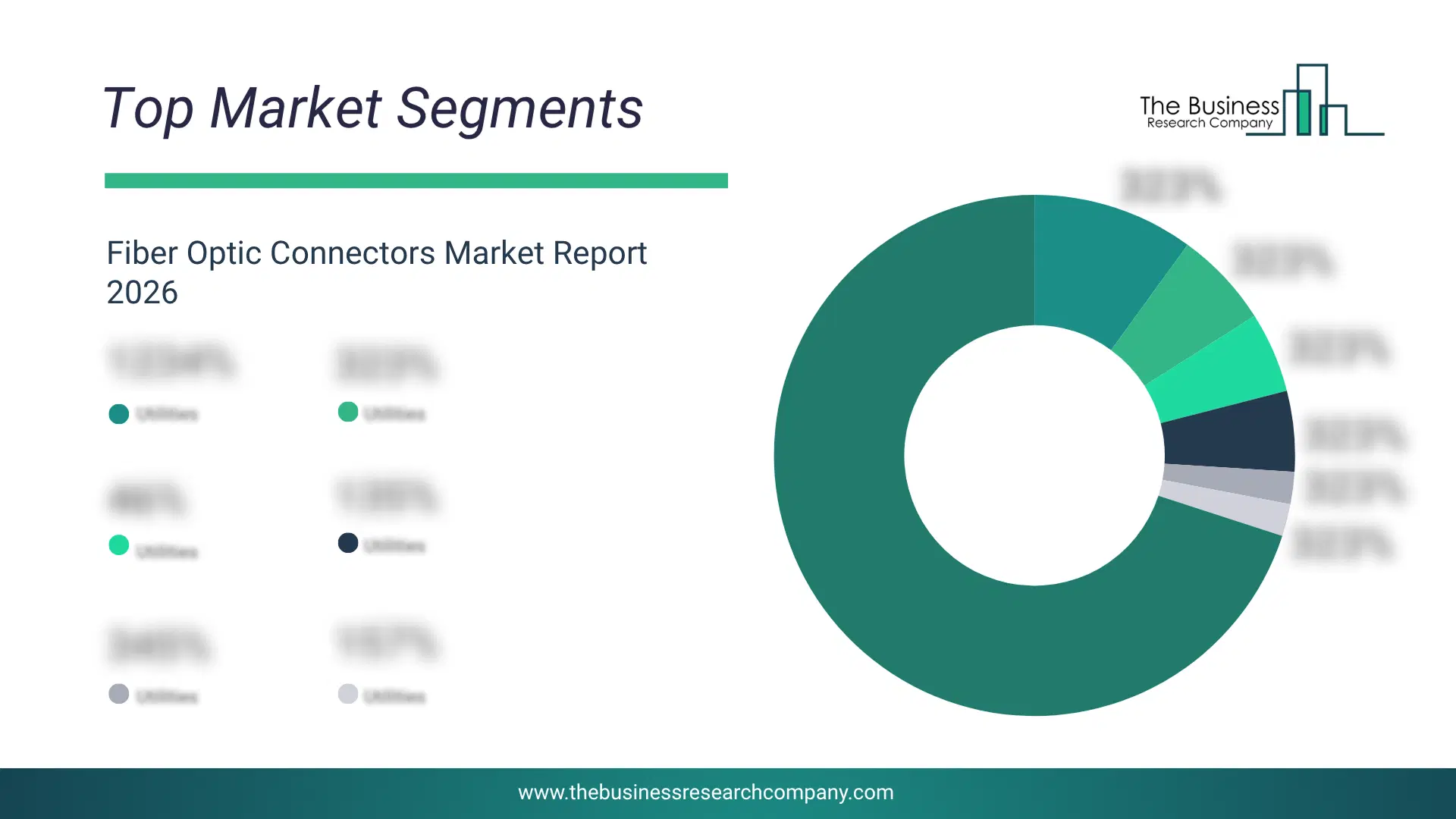
1) By Product: SC (Standard Connectors), LC (Lucent Connectors), FC (Ferrule Connector), ST (Straight Tip), MXC Connector, Other Products 2) By Cable: Simplex, Duplex, Multi-Fiber 3) By Application: Telecommunication, Inter Or Intra Building, Community Antenna Television, Datacenter, High Density Interconnection, Security Systems, Other Applications Subsegments: 1) By SC (Standard Connectors): Single-Mode SC Connectors, Multi-Mode SC Connectors 2) By LC (Lucent Connectors): Single-Mode LC Connectors, Multi-Mode LC Connectors 3) By FC (Ferrule Connector): Single-Mode FC Connectors, Multi-Mode FC Connectors 4) By ST (Straight Tip): Single-Mode ST Connectors, Multi-Mode ST Connectors 5) By MXC Connector: MXC For High-Density Applications, MXC For Data Centers 6) By Other Products: E2000 Connectors, LC Or APC And SC Or APC Connectors The top segments in the fiber optic connectors market will be: • LC (Lucent Connectors) will reach $3 Billion by 2030. • SC (Standard Connectors) will reach $2 Billion by 2030. • FC (Ferrule Connector) will reach $0.85 Billion by 2030. • ST (Straight Tip) will reach $0.68 Billion by 2030. • Other Products will reach $0.68 Billion by 2030.What Is The Driver Of The Fiber Optic Connectors Market?
The number of people using smart devices and smartphones and the commercialization of 4G LTE and 5G network platforms are rapidly increasing, which will drive the growth of the global fiber optic connectors market. Smartphones and the commercialization of 4G LTE and 5G network platforms refer to the widespread adoption of advanced mobile technologies that enable high-speed connectivity, real-time data access, and enhanced IoT and digital communication capabilities. For instance, in August 2023, according to RubyHome, a US-based real estate company, in the US, 63.43 million homes use smart home devices, and around 7 in 10 homebuyers are willing to buy a smart home. Therefore, the rapid expansion of smart devices and 4G/5G networks is driving growth in the fiber optic connectors industry.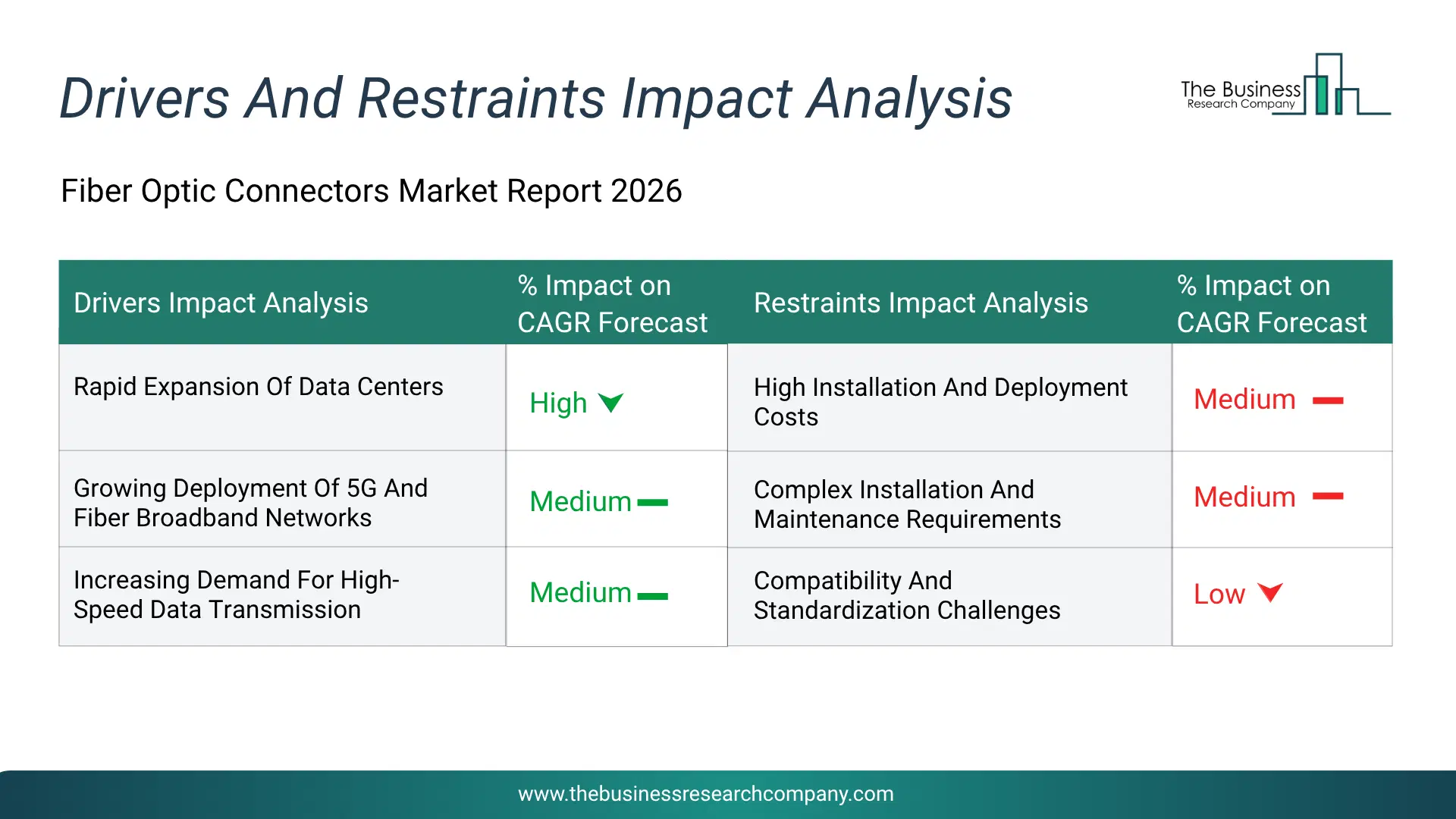
Infographic Chart Showing Key Market Drivers Analysis And Restraints For Fiber Optic Connectors Market
The chart presents an impact analysis of key drivers and restraints, quantifying their relative influence on the market's growth rate and helping assess the balance between growth enablers and limiting factors. This chart offers a high-level perspective; the full report contains more detailed insights.
How Will The Drivers Impact Growth In The Global Fiber Optic Connectors Market?
• Rapid Expansion Of Data Centers (High) – During the forecast period, the rapid expansion of data centers is expected to emerge as a major factor driving the expansion of the fiber optic connectors market by 2030. As cloud computing, artificial intelligence, and digital services continue to expand, operators are investing heavily in advanced fiber infrastructure. Fiber optic connectors enable low-loss, high-speed, and reliable interconnections between servers, storage systems, and networking equipment. Their compact designs and superior transmission performance make them essential for modern data center architectures, resulting in sustained demand across global markets. • Growing Deployment Of 5G And Fiber Broadband Networks (Medium) – During the forecast period, the growing deployment of 5G and fiber broadband networks is expected to emerge as a major factor driving the expansion of the fiber optic connectors market by 2030. The rollout of 5G requires extensive fiber backhaul and fronthaul networks that depend on reliable optical connectors for efficient signal transmission. In addition, fiber-to-the-home (FTTH) projects are expanding broadband access in both developed and emerging economies. These infrastructure investments significantly increase the installation of fiber optic connectors across telecom networks and communication systems. • Increasing Demand For High-Speed Data Transmission (Medium) – During the forecast period, the increasing demand for high-speed data transmission is expected to act as a key growth catalyst for the fiber optic connectors market by 2030. Fiber optic connectors support higher bandwidth with minimal signal loss compared to conventional copper-based systems. Industries including healthcare, banking, manufacturing, transportation, and defense are also modernizing their communication infrastructure, further increasing demand for high-performance optical connectivity solutions.How Will The Restraints Impact Growth In The Global Fiber Optic Connectors Market?
• High Installation And Deployment Costs (High) – During the forecast period, the high installation and deployment costs remain a significant restraint because fiber optic networks require substantial investments in cables, connectors, installation equipment, and skilled labor. Organizations must also invest in testing, maintenance, and network upgrades to ensure optimal performance. These high upfront costs can discourage adoption among small and medium-sized enterprises and delay large-scale deployments in cost-sensitive regions, limiting overall market expansion. • Complex Installation And Maintenance Requirements (Medium) – During the forecast period, the complex installation and maintenance requirements hinder market growth because fiber optic connectors require precise alignment, specialized tools, and trained technicians to ensure minimal insertion loss and reliable performance. Improper installation or contamination can significantly affect network efficiency. The need for regular inspection, cleaning, and technical expertise increases operational complexity, making deployment more challenging compared to conventional networking solutions. • Compatibility And Standardization Challenges (Medium) – During the forecast period, the compatibility and standardization challenges restrain the market as multiple connector types, interface standards, and network architectures coexist across industries. Organizations often face integration issues when upgrading legacy infrastructure or connecting equipment from different manufacturers. Ensuring interoperability while maintaining network performance can increase deployment time and implementation costs, slowing adoption in certain applications and industries.Key Players In The Global Fiber Optic Connectors Market
Major companies operating in the fiber optic connectors market are Corning Incorporated; Amphenol Corporation; TE Connectivity Ltd.; Molex LLC; Hirose Electric Co. Ltd.; Furukawa Electric Co. Ltd.; Sumitomo Electric Industries; Diamond SA; Huber+Suhner; Panduit Corporation; Siemon; Rosenberger Group; Radiall; OFS Fitel LLC; AFL; L-com; Senko Advanced Components; US Conec; Samtec; Phoenix Contact
This chart is for illustrative purposes; the full report includes a detailed competitor analysis and comprehensive overview of the top 10 companies in the market.
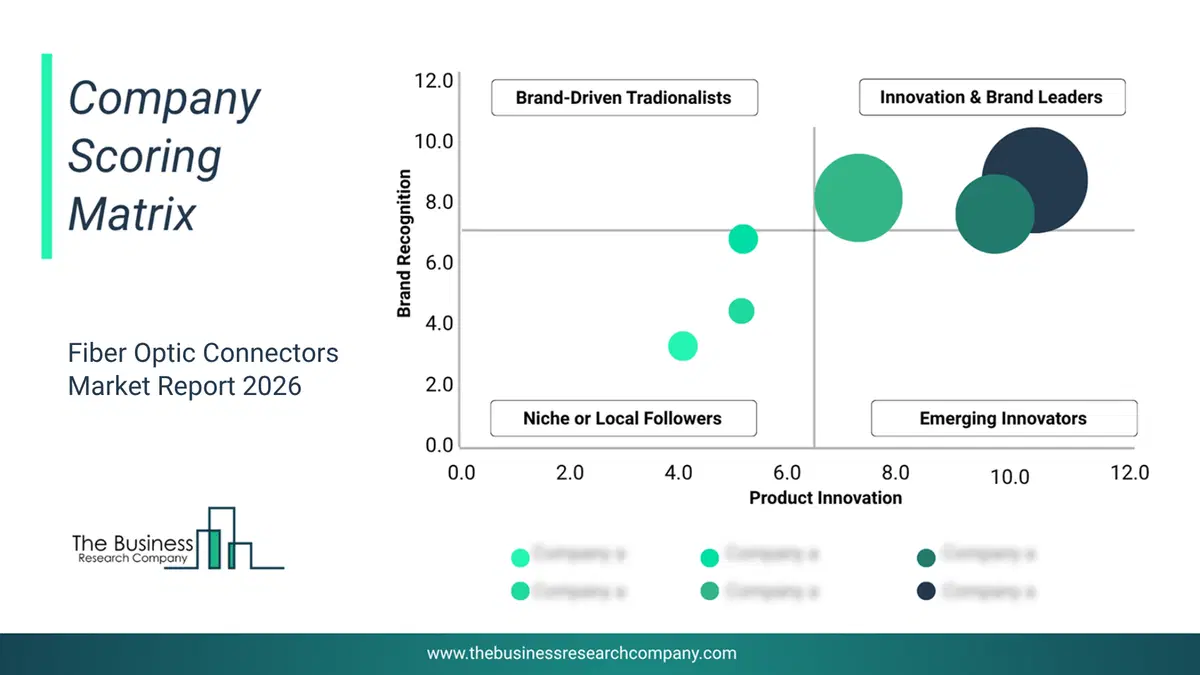
This chart maps companies by product innovation and brand strength, with bubble size indicating relative revenue, helping identify market leaders, challengers, and niche players. This is an illustrative chart; the full report provides a complete and accurate competitive analysis.
Global Fiber Optic Connectors Market Trends and Insights
Major companies operating in the fiber optic connectors market are focusing on innovative products such as field-terminable fiber optic connectors to enhance efficiency in their market. Field-terminable fiber optic connectors are specialized connectors designed to allow users to terminate, or assemble, optical fibers in the field, typically at the installation site, rather than in a controlled manufacturing environment. For instance, in May 2025, Corning Incorporated, a US-based company providing optical communications, fiber, cable, and connectivity solutions, introduced its Evolv Field Installable Pushlok connector system. With this launch, the company aimed to dramatically reduce installation time for field terminations by enabling installers to strip, clean, cleave, and connect without fusion splicing, improving deployment efficiency and lowering tool requirements. The new connector is designed for rapid field installation (under 5 minutes), is compatible with hardened subscriber drop cables, and is targeted at accelerating broadband rollout, especially in rural and challenging access environments.What Are Latest Mergers And Acquisitions In The Fiber Optic Connectors Market?
In May 2024, Amphenol Corporation, a US-based company that manufactures electronic and fiber optic connectors, cables, and interconnect systems, acquired Carlisle Interconnect Technologies (CIT) business from Carlisle Companies Incorporated for an undisclosed amount. With this acquisition, Amphenol Corporation aims to enhance its product portfolio and market presence in the aerospace, defense, and industrial sectors by integrating Carlisle Interconnect Technologies' advanced interconnect solutions and expertise, thereby strengthening its competitive edge in the global market. Carlisle Companies Incorporated is a US-based company that manufactures fiber optic connectors.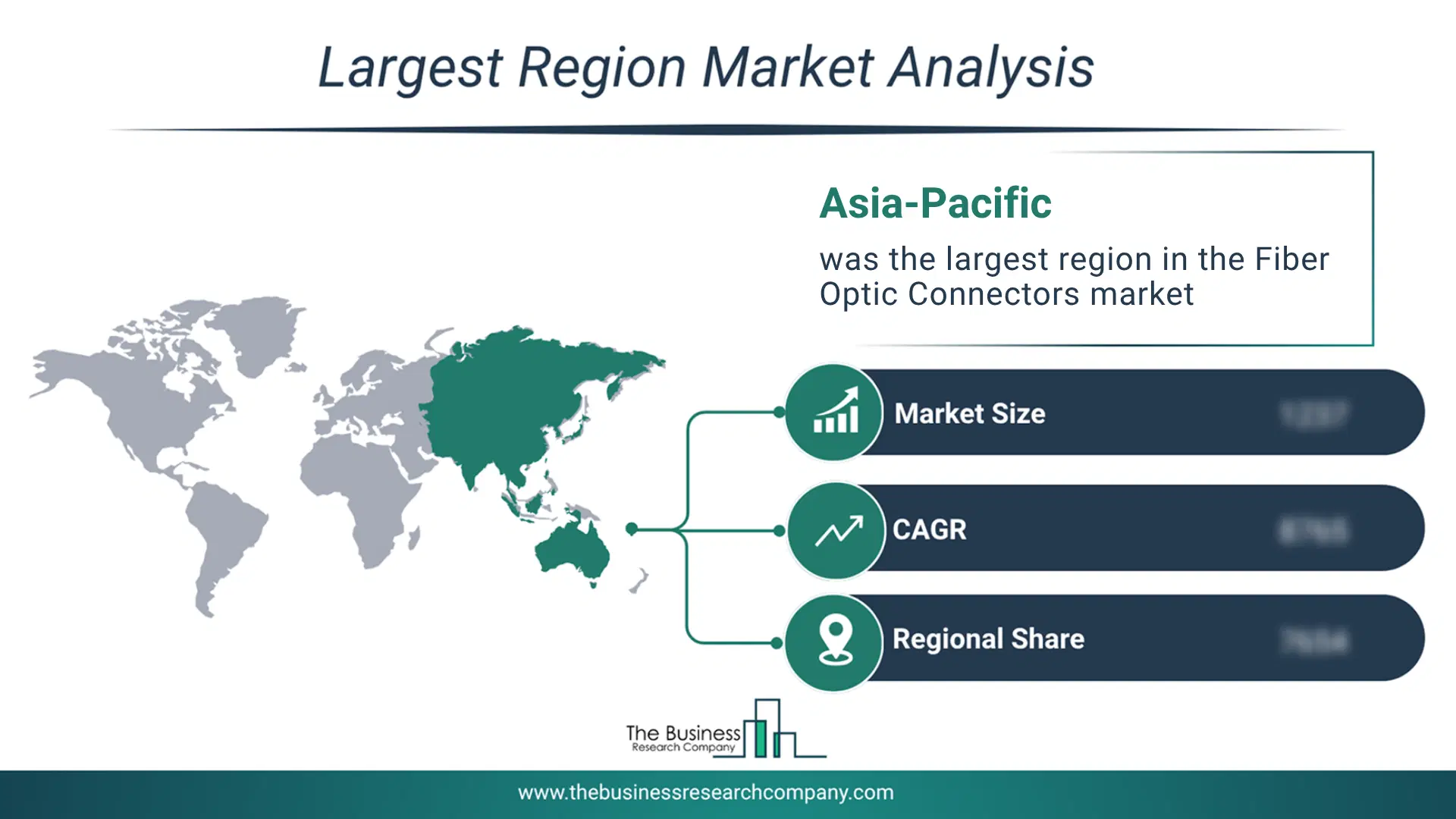
Regional Insights
Asia-Pacific was the largest region in the fiber optic connectors market in 2025. The regions covered in this market report are Asia-Pacific, South East Asia, Western Europe, Eastern Europe, North America, South America, Middle East, Africa. The countries covered in this market report are Australia, Brazil, China, France, Germany, India, Indonesia, Japan, Taiwan, Russia, South Korea, UK, USA, Canada, Italy, SpainWhat Defines the Fiber Optic Connectors Market?
The fiber optics market consists of sales of step index-single mode fiber, graded index-single mode fiber, step index-multimode fiber, and graded index-multimode fiber. Values in this market are ‘factory gate’ values, that is the value of goods sold by the manufacturers or creators of the goods, whether to other entities (including downstream manufacturers, wholesalers, distributors and retailers) or directly to end customers. The value of goods in this market includes related services sold by the creators of the goods.How is Market Value Defined and Measured?
The market value is defined as the revenues that enterprises gain from the sale of goods and/or services within the specified market and geography through sales, grants, or donations in terms of the currency (in USD unless otherwise specified). The revenues for a specified geography are consumption values that are revenues generated by organizations in the specified geography within the market, irrespective of where they are produced. It does not include revenues from resales along the supply chain, either further along the supply chain or as part of other products.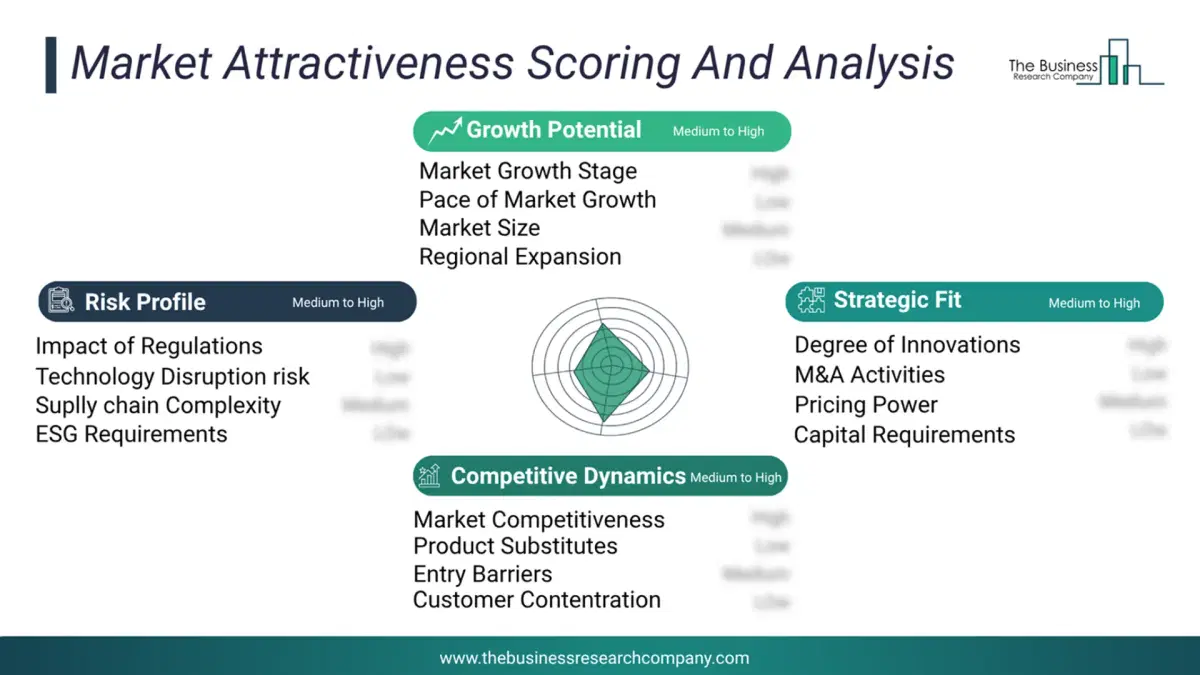
This chart presents market attractiveness based on a quantitative evaluation of growth, competition, strategic alignment, and risk, offering a clear view of opportunity areas for decision-making. This chart is for illustrative purposes; the full report contains the complete analysis.
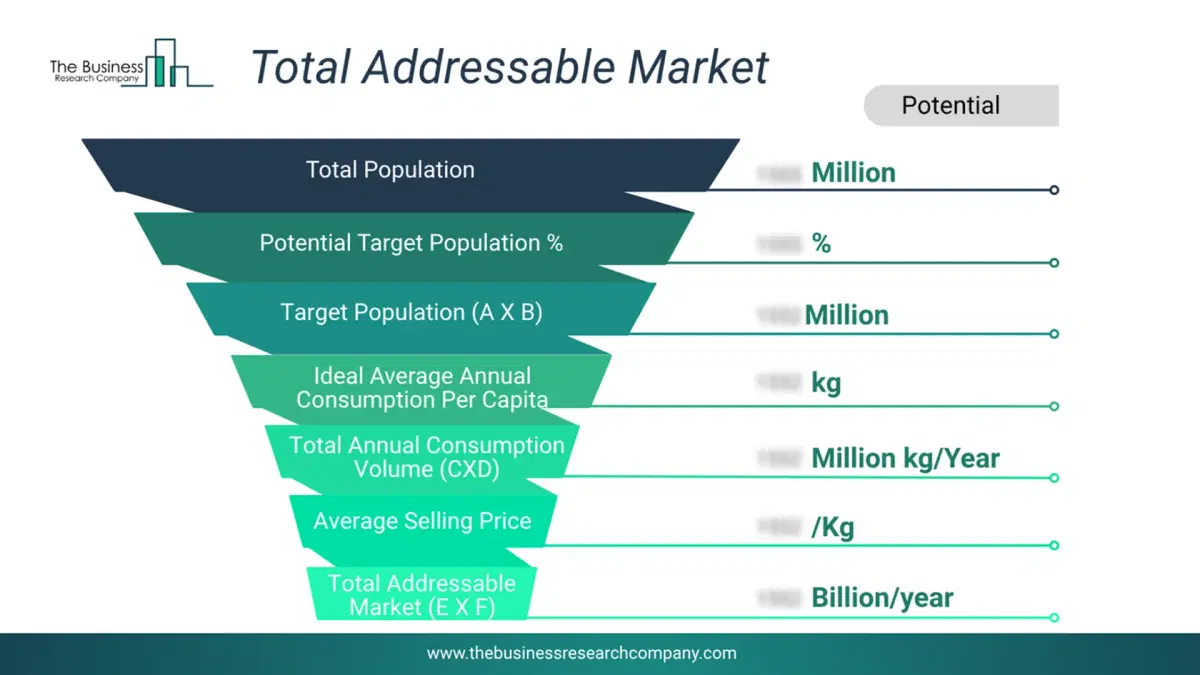
This chart highlights the Total Addressable Market (TAM) by estimating the maximum revenue opportunity using an assumption-driven approach, supporting strategic planning and opportunity sizing across markets. The chart is illustrative; the full report provides a more comprehensive analysis.
What Key Data and Analysis Are Included in the Fiber Optic Connectors Market Report 2026?
The fiber optic connectors market research report is one of a series of new reports from The Business Research Company that provides market statistics, including industry global market size, regional shares, competitors with the market share, detailed market segments, market trends and opportunities, and any further data you may need to thrive in the fiber optic connectors industry. The market research report delivers a complete perspective of everything you need, with an in-depth analysis of the current and future state of the industry.Fiber Optic Connectors Market Report Forecast Analysis
| Report Attribute | Details |
|---|---|
| Market Size Value In 2026 | $5.98 billion |
| Revenue Forecast In 2030 | $7.57 billion |
| Growth Rate | CAGR of 6.1% from 2026 to 2030 |
| Base Year For Estimation | 2025 |
| Actual Estimates/Historical Data | 2020-2025 |
| Forecast Period | 2026 - 2030 |
| Market Representation | Revenue in USD Billion and CAGR from 2026 to 2030 |
| Segments Covered | Product, Cable, Application |
| Regional Scope | Asia-Pacific, Western Europe, Eastern Europe, North America, South America, Middle East, Africa |
| Country Scope | The countries covered in the report are Australia, Brazil, China, France, Germany, India, Indonesia, Japan, Taiwan, Russia, South Korea, UK, USA, Canada, Italy, Spain. |
| Key Companies Profiled | Corning Incorporated; Amphenol Corporation; TE Connectivity Ltd.; Molex LLC; Hirose Electric Co. Ltd.; Furukawa Electric Co. Ltd.; Sumitomo Electric Industries; Diamond SA; Huber+Suhner; Panduit Corporation; Siemon; Rosenberger Group; Radiall; OFS Fitel LLC; AFL; L-com; Senko Advanced Components; US Conec; Samtec; Phoenix Contact |
| Customization Scope | Request for Customization |
| Pricing And Purchase Options | Explore Purchase Options |