

Field Service Management Market Report 2026
Global Outlook – By Component (Solution, Services), By Deployment Type (On-Premise, Cloud), By Application (Energy And Utilities, Telecom, Manufacturing, Healthcare, BFSI, Construction And Real Estate, Transportation And Logistics, Other Applications) – Market Size, Trends, Strategies, and Forecast to 2030
Field Service Management Market Overview
• Field Service Management market size has reached to $5.12 billion in 2025 • Expected to grow to $10.09 billion in 2030 at a compound annual growth rate (CAGR) of 14.4% • Growth Driver: Rising Demand For Automation And Digitalization Catalysts Field Service Management Market Growth • Market Trend: Rising Trend Enhanced Field Service Management Through Innovations • North America was the largest region in 2025 and Asia-Pacific is the fastest growing region.Market Gains By 2030 – Top Opportunities By Segment
Market Gain identifies the most promising market opportunities by highlighting the segments or products expected to generate the highest incremental revenue growth over the next five years.
What Is Covered Under Field Service Management Market?
Field service management (FSM) is a system for managing remote workers and the resources a company needs to work efficiently. Field service management helps businesses manage all the resources involved in field service management activities. It can help technicians process job orders, keep track of service and repair tasks, automate scheduling and dispatch, manage customer service contracts, collect payment and more. The main types of components in field service management are solutions and services. The various services include consulting, training and support, and integration and implementation with third-party systems to boost the performance of the field service. The different deployment modes include on-premise, and cloud and are used in various applications such as energy and utilities, telecom, manufacturing, healthcare, BFSI, construction and real estate, transportation, and logistics, among others.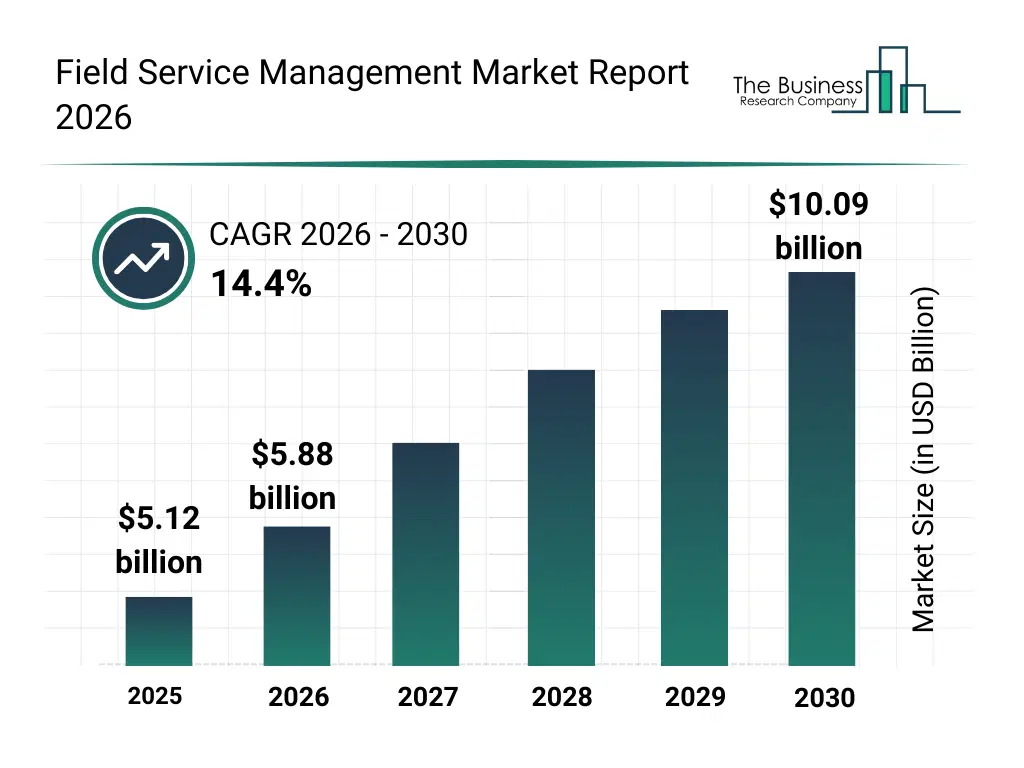
What Is The Field Service Management Market Size and Share 2026?
The field service management market size has grown rapidly in recent years. It will grow from $5.12 billion in 2025 to $5.88 billion in 2026 at a compound annual growth rate (CAGR) of 15.0%. The growth in the historic period can be attributed to expansion of service-based business models, increasing complexity of field operations, growth of mobile workforce deployment, rising customer service expectations, adoption of enterprise software solutions.What Is The Field Service Management Market Growth Forecast?
The field service management market size is expected to see rapid growth in the next few years. It will grow to $10.09 billion in 2030 at a compound annual growth rate (CAGR) of 14.4%. The growth in the forecast period can be attributed to increasing demand for remote service optimization, rising integration of iot-enabled assets, expansion of data-driven field operations, growing adoption of subscription-based FSM solutions, increasing focus on workforce productivity analytics. Major trends in the forecast period include increasing adoption of cloud-based fsm platforms, growing use of ai-driven scheduling tools, rising integration of mobile workforce applications, expansion of predictive maintenance capabilities, enhanced focus on real-time service visibility.
Global Field Service Management Market Segmentation
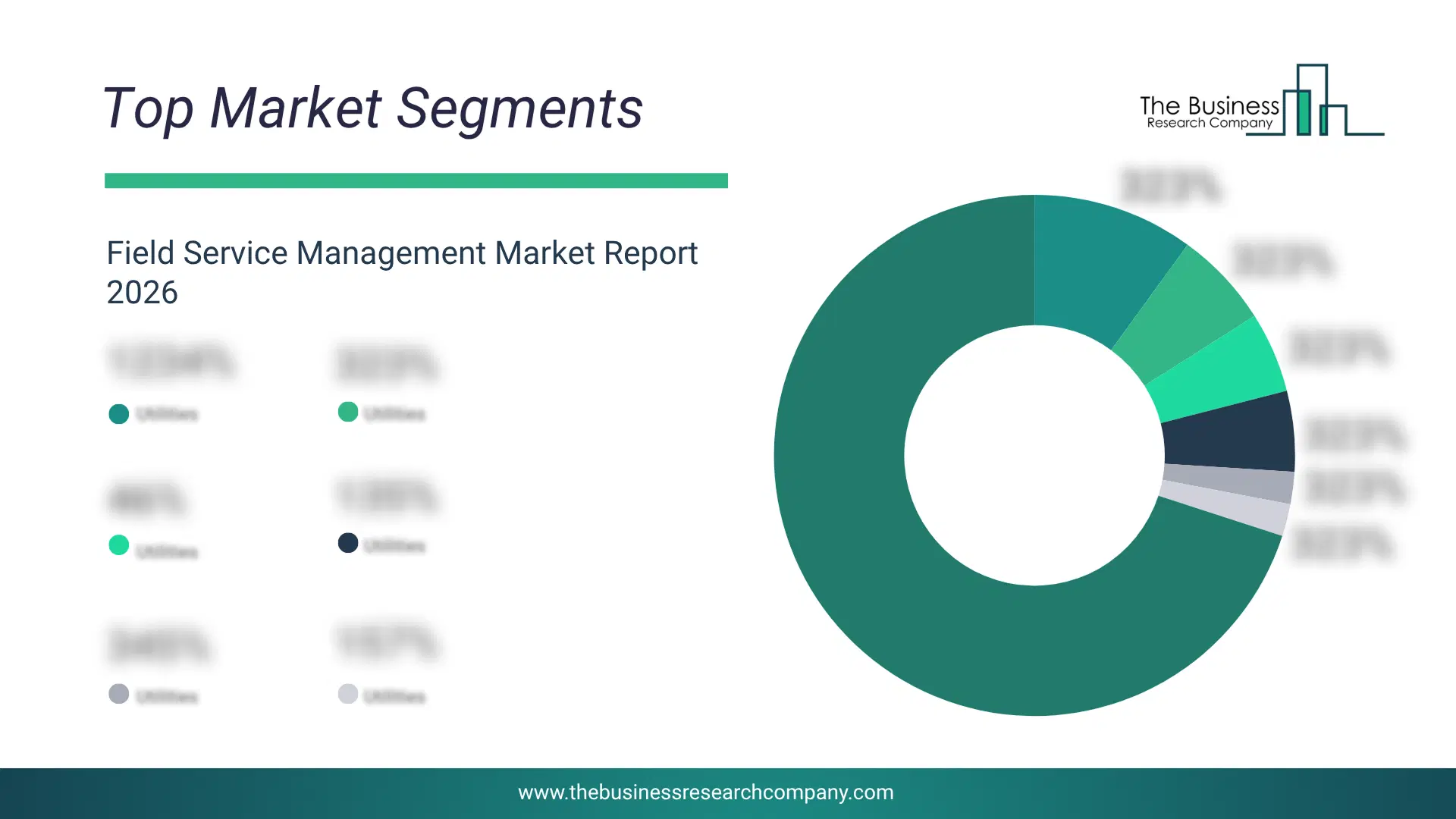
1) By Component: Solution, Services 2) By Deployment Type: On-Premise, Cloud 3) By Application: Energy And Utilities, Telecom, Manufacturing, Healthcare, BFSI, Construction And Real Estate, Transportation And Logistics, Other Applications Subsegments: 1) By Solution: Field Service Management Software, Scheduling And Dispatching Solutions, Mobile Field Service Applications, Inventory Management Solutions, Customer Relationship Management (CRM) Integration, Analytics And Reporting Tools 2) By Services: Consulting Services, Implementation Services, Support And Maintenance Services, Training And Education Services The top segments in the field service management market will be: • Solution will reach $7 Billion by 2030. • Services will reach $3 Billion by 2030.What Is The Driver Of The Field Service Management Market?
The increasing adoption of automation and digitalization is expected to propel the growth of the field service management market in the forecast period. Automation and digitalization are used for the automatic execution of tasks at a particular interval with the use of digital technology. The advantages of adopting automation and digitalization in field service management are optimal utilization of resources, effective tracking and monitoring of resources, and lower operational costs. For instance, in September 2023, according to Cavintek Inc., a US-based company that provides workflow automation as well as productivity applications, more than 80% of corporate executives reported hastening work process automation and increasing the usage of remote work. 43% of organizations intend to minimize their staff by implementing automation technology. Therefore, the increasing demand for automation and digitalization drives the growth of the field service management industry.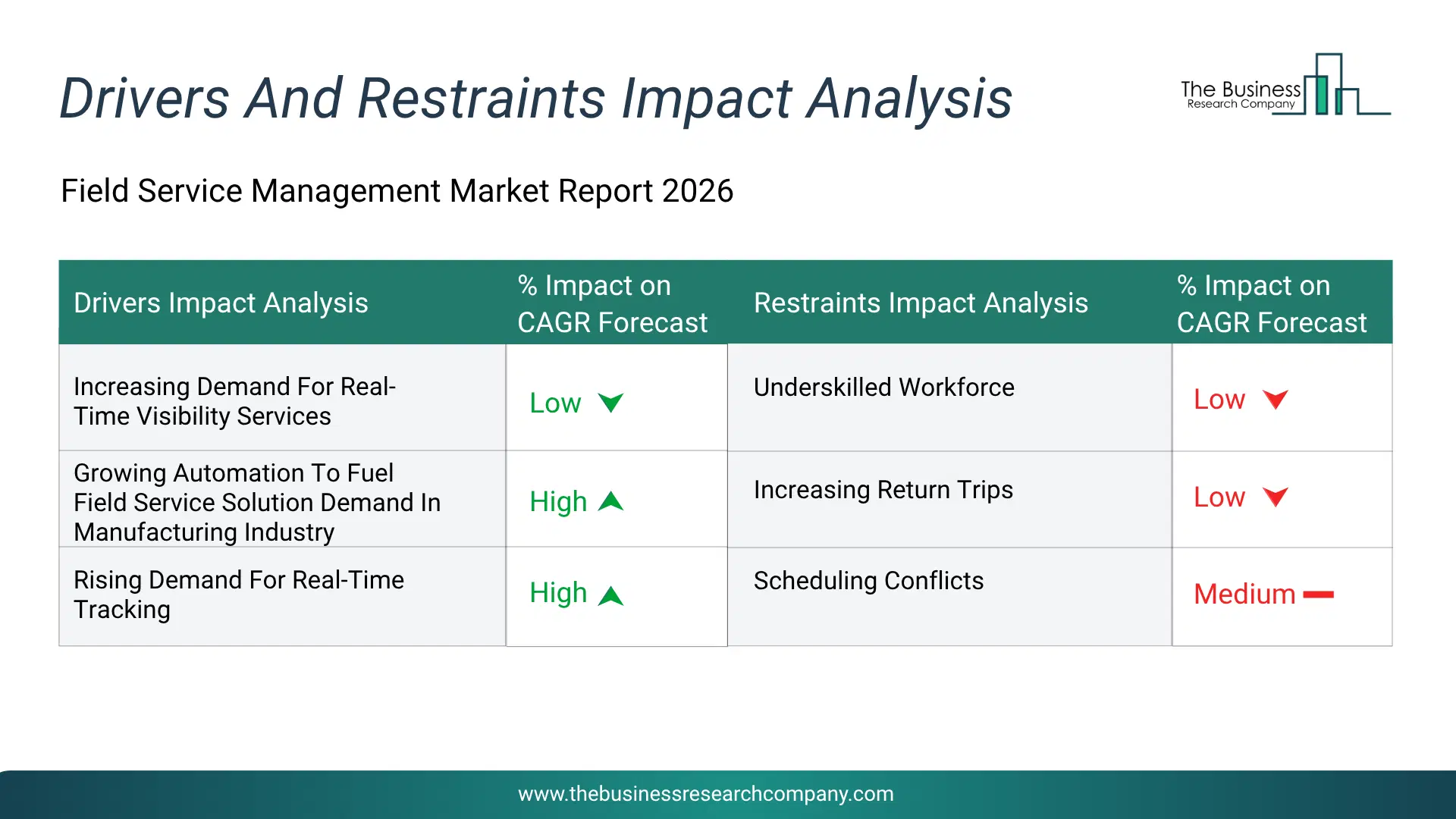
Infographic Chart Showing Key Market Drivers Analysis And Restraints For Field Service Management Market
The chart presents an impact analysis of key drivers and restraints, quantifying their relative influence on the market's growth rate and helping assess the balance between growth enablers and limiting factors. This chart offers a high-level perspective; the full report contains more detailed insights.
How Will The Drivers Impact Growth In The Global Field Service Management Market?
• Increasing Demand For Real-Time Visibility Services (Low) – During the forecast period, the increasing demand for real-time visibility services is expected to emerge as a major factor driving the expansion of the field service management market by 2030. Real-time monitoring enables managers to track technician locations, job progress, and equipment status without delays. This improves workforce productivity by allowing quick adjustments to schedules and resource allocation. It also enhances customer satisfaction through accurate service updates and faster response times. Businesses benefit from reduced operational costs by minimizing travel time and eliminating unnecessary dispatches. Furthermore, real-time insights help identify service bottlenecks and improve overall operational efficiency. As enterprises continue their digital transformation initiatives, investments in real-time visibility solutions continue to accelerate market growth. • Growing Automation To Fuel Field Service Solution Demand In Manufacturing Industry (High) – During the forecast period, the growing automation to fuel field service solution demand in the manufacturing industry is expected to emerge as a major factor driving the expansion of the field service management market by 2030. Modern manufacturing facilities rely on automated equipment that requires regular monitoring, predictive maintenance, and rapid servicing to avoid production downtime. Field service management solutions automate work order creation, technician dispatching, and maintenance scheduling, ensuring timely service delivery. Integration with Industrial IoT devices enables early fault detection and proactive maintenance planning. Automation also improves workforce efficiency by reducing manual administrative tasks and optimizing technician utilization. Manufacturers gain higher equipment reliability, improved productivity, and lower maintenance costs through digital field service platforms. • Rising Demand For Real-Time Tracking (High) – During the forecast period, the rising demand for real-time tracking is expected to act as a key growth catalyst for the field service management market by 2030. Businesses increasingly require GPS-enabled tracking to monitor technician movements, vehicle locations, and service completion in real time. This capability improves dispatch accuracy and reduces response times for urgent service requests. Real-time tracking also enhances route optimization, lowering fuel expenses and increasing daily service capacity. Customers benefit from accurate arrival estimates and timely service notifications, improving overall service experiences. Managers can analyze live operational data to optimize workforce performance and resource utilization. As organizations prioritize operational efficiency and customer-centric services, the adoption of real-time tracking solutions continues to expand across the field service management market.How Will The Restraints Impact Growth In The Global Field Service Management Market?
• Underskilled Workforce (Low) – During the forecast period, the an underskilled workforce is a significant restraint on the field service management market because technicians without adequate training often struggle to resolve service issues during the first visit. This reduces operational efficiency and increases the likelihood of service errors. Organizations must invest additional time and resources in training, certifications, and continuous skill development, increasing operational costs. A shortage of qualified professionals also limits the adoption of advanced technologies such as AI, IoT, and predictive maintenance solutions. Poor service quality can negatively affect customer satisfaction and brand reputation. Furthermore, workforce skill gaps slow digital transformation initiatives and reduce productivity. As a result, the lack of skilled field technicians continues to hinder market growth. • Increasing Return Trips (High) – During the forecast period, the increasing return trips act as a restraint on the field service management market by reducing operational efficiency and increasing service delivery costs. When technicians are unable to complete repairs during the first visit due to missing parts, insufficient expertise, or inaccurate diagnostics, additional visits become necessary. These repeat visits consume valuable technician time and limit the number of service calls completed each day. They also increase transportation, fuel, and labor expenses for service providers. Frequent return trips delay issue resolution, leading to customer dissatisfaction and lower service quality. Businesses may experience reduced profitability because of higher operational overheads. Consequently, minimizing repeat visits remains a major challenge for organizations implementing field service management solutions. • Scheduling Conflicts (High) – During the forecast period, the scheduling conflicts are a key restraint in the field service management market because overlapping appointments and inefficient resource allocation reduce service efficiency. Poor scheduling can result in delayed technician arrivals, missed appointments, and extended customer waiting times. It also creates unnecessary workload imbalances among field personnel, reducing workforce productivity. Organizations may incur higher operational costs due to overtime, rescheduling, and inefficient dispatching. Frequent scheduling issues can negatively impact customer satisfaction and weaken long-term client relationships. In addition, conflicts make it difficult to optimize technician utilization and meet service-level agreements (SLAs). Therefore, scheduling challenges continue to limit operational performance and restrain the growth of the field service management market.Key Players In The Global Field Service Management Market
Major companies operating in the field service management market include Accruent LLC, Acumatica Inc., Comarch SA, FieldAware Group Ltd., Geoconcept SAS, Kirona Solutions Ltd., IFS AB, International Business Machines Corporation, Microsoft Corporation, Mize Inc., OverIT S. p. A, Praxedo SAS, Salesforce. com Inc., SAP SE, ServiceMax Inc., Trimble Inc., Zinier Inc., ServicePower Inc., Oracle Corporation, Accenture plc., Cisco Systems Inc., FieldEZ Technologies Pvt LTD, ABB Ltd., Advanced Distribution Solutions Inc., AgileField LLC, ServiceTitan Inc., ServiceNow Inc.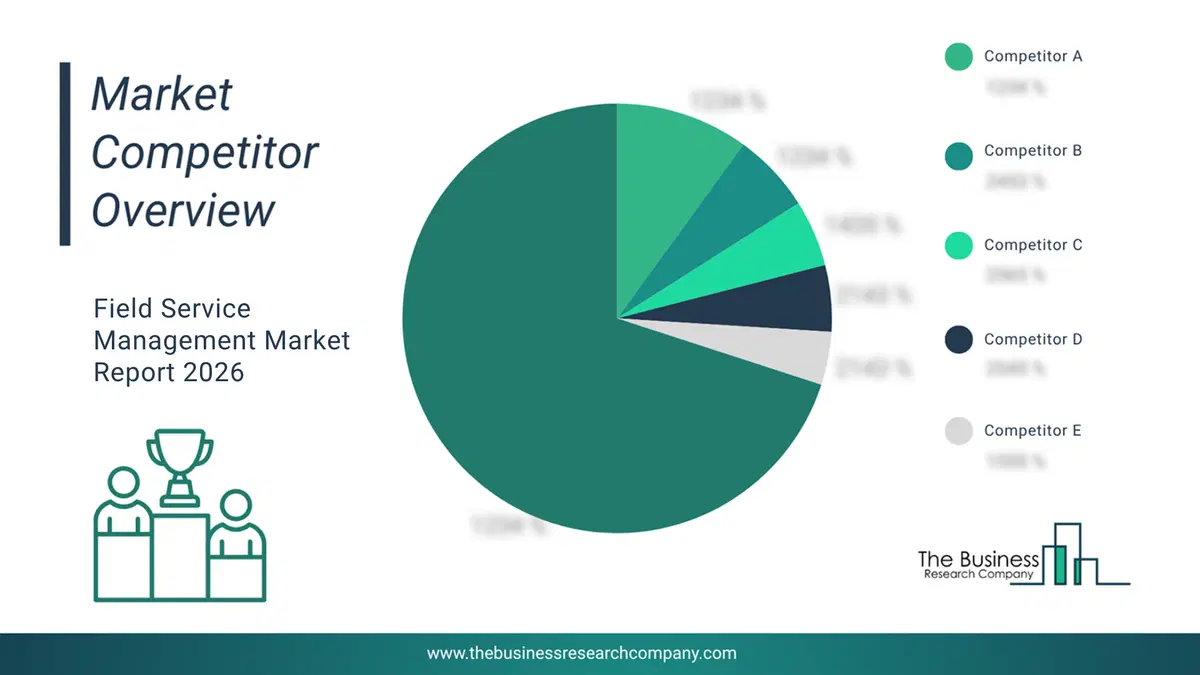
This chart is for illustrative purposes; the full report includes a detailed competitor analysis and comprehensive overview of the top 10 companies in the market.
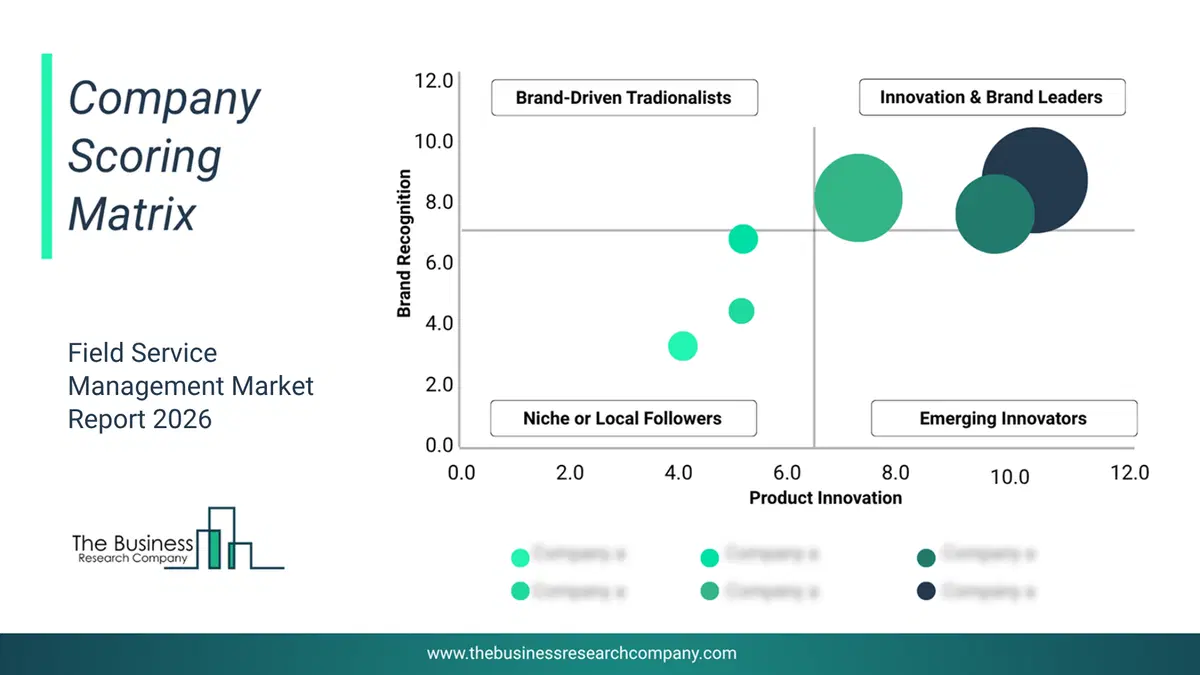
This chart maps companies by product innovation and brand strength, with bubble size indicating relative revenue, helping identify market leaders, challengers, and niche players. This is an illustrative chart; the full report provides a complete and accurate competitive analysis.
Global Field Service Management Market Trends and Insights
Major companies operating in the field service management market are focusing on developing advanced technological solutions such as artificial intelligence (AI)-driven toolkits to enhance operational efficiency and improve service delivery for field teams across various industries. AI-driven toolkits are intelligent software systems that leverage machine learning models to analyze workflows, automate routine tasks, and support decision-making, enabling capabilities such as predictive scheduling, real-time insights, and workflow optimization. For Instance, in March 2024, Workiz, a US-based Software company, launched 'Genius,' an easy-to-use AI-powered tool kit redefining the field service industry by seamlessly integrating cutting-edge technology with solutions that empower field service management professionals with a new way to communicate with their clients and run their business with AI. This adapts and learns, becoming a personalized intelligent assistant for users, providing valuable suggestions and insights and allowing service professionals to focus on what they do best.What Are Latest Mergers And Acquisitions In The Field Service Management Market?
In January 2023, PTC Inc., a US-based computer software company, acquired ServiceMax for an undisclosed amount. With this acquisition, PTC aims to enhance its closed-loop product lifecycle management (PLM) strategy by integrating field service management capabilities and extending the digital thread of product information into enterprise asset management. ServiceMax is a US-based company that provides field service management solutions.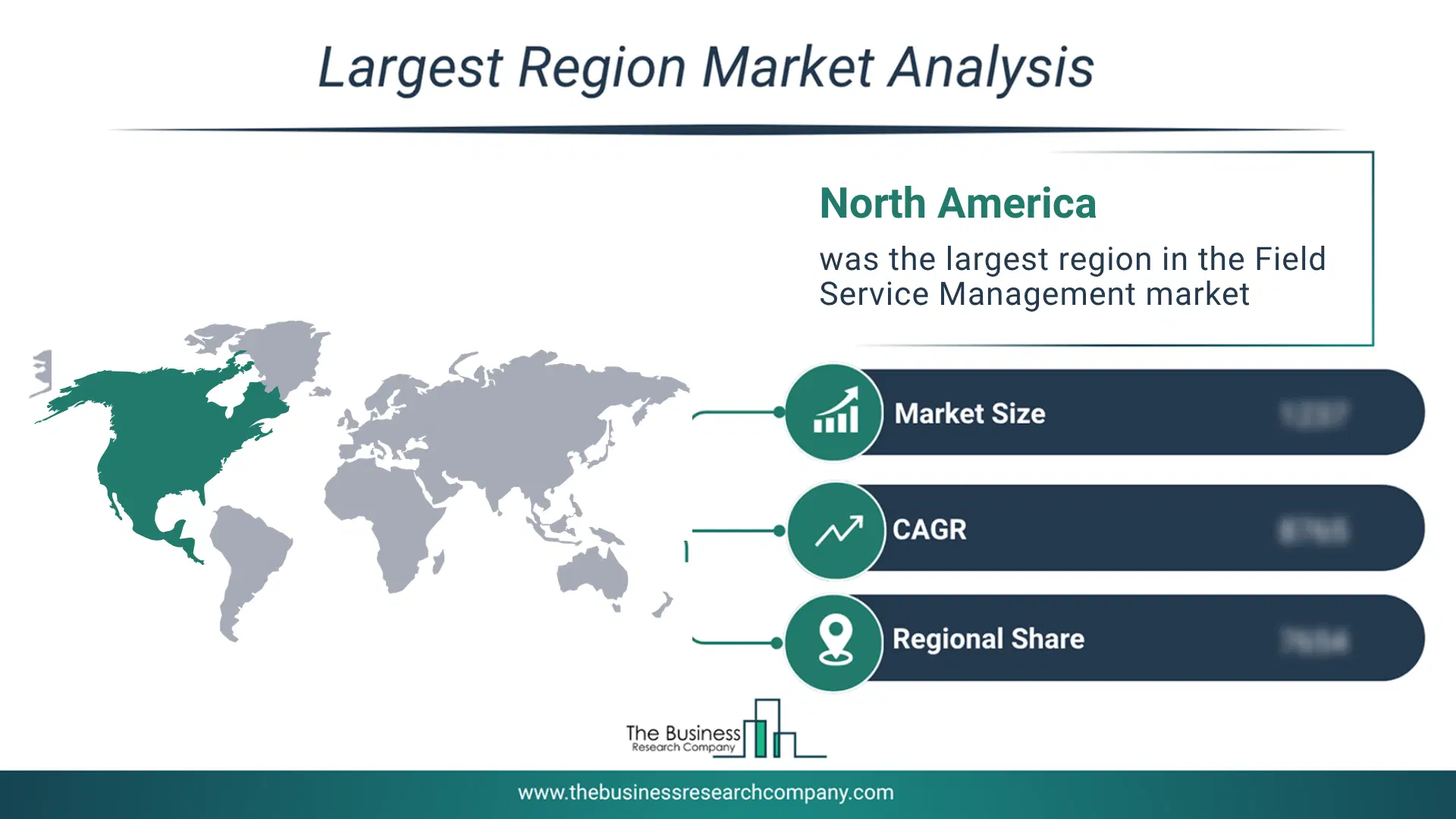
Regional Insights
North America was the largest region in the field service management market in 2025. Asia-Pacific is expected to be the fastest-growing region in the forecast period. The regions covered in this market report are Asia-Pacific, South East Asia, Western Europe, Eastern Europe, North America, South America, Middle East, Africa. The countries covered in this market report are Australia, Brazil, China, France, Germany, India, Indonesia, Japan, Taiwan, Russia, South Korea, UK, USA, Canada, Italy, Spain.What Defines the Field Service Management Market?
The field service management market includes revenues earned by entities by providing services such as sales force automation, enablement, revenue optimization, sales engagement, territory planning, partner relationship management. The market value includes the value of related goods sold by the service provider or included within the service offering. Only goods and services traded between entities or sold to end consumers are included.How is Market Value Defined and Measured?
The market value is defined as the revenues that enterprises gain from the sale of goods and/or services within the specified market and geography through sales, grants, or donations in terms of the currency (in USD unless otherwise specified). The revenues for a specified geography are consumption values that are revenues generated by organizations in the specified geography within the market, irrespective of where they are produced. It does not include revenues from resales along the supply chain, either further along the supply chain or as part of other products.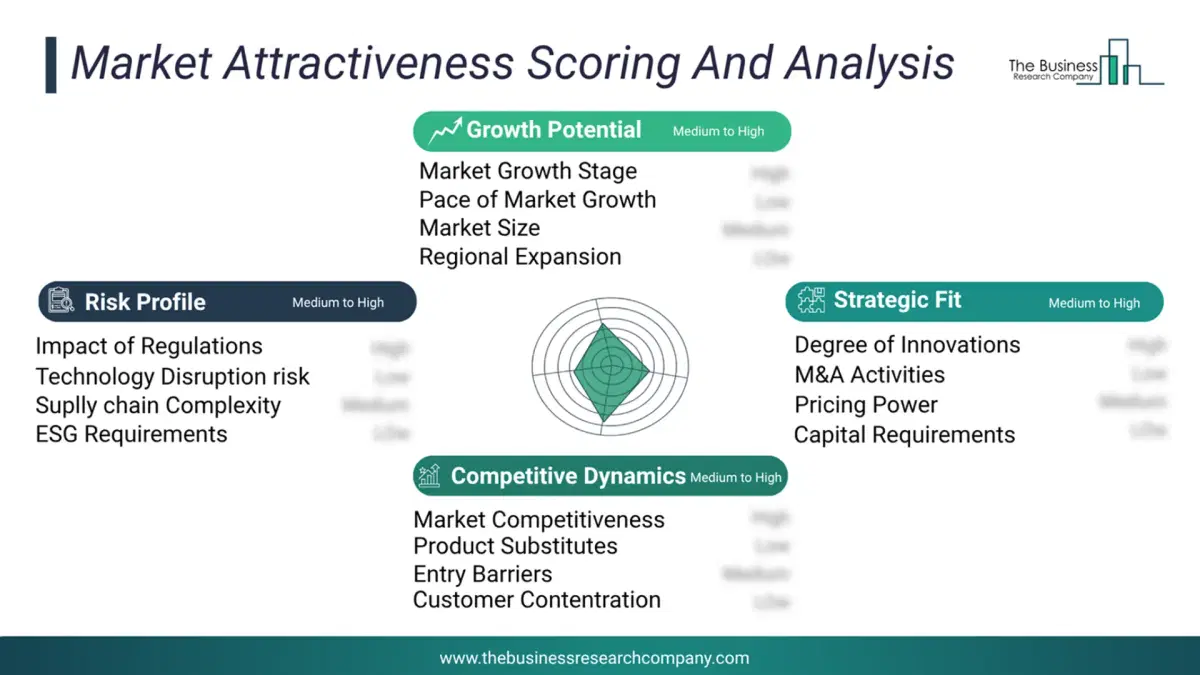
This chart presents market attractiveness based on a quantitative evaluation of growth, competition, strategic alignment, and risk, offering a clear view of opportunity areas for decision-making. This chart is for illustrative purposes; the full report contains the complete analysis.
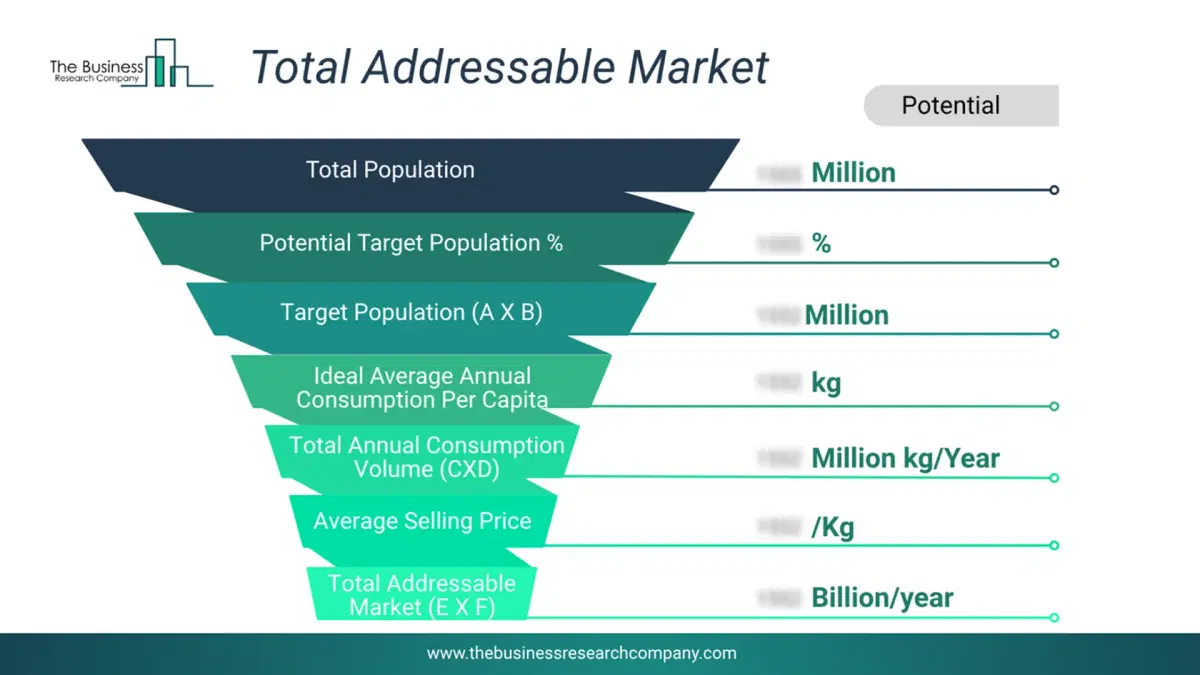
This chart highlights the Total Addressable Market (TAM) by estimating the maximum revenue opportunity using an assumption-driven approach, supporting strategic planning and opportunity sizing across markets. The chart is illustrative; the full report provides a more comprehensive analysis.
What Key Data and Analysis Are Included in the Field Service Management Market Report 2026?
The field service management market research report is one of a series of new reports from The Business Research Company that provides market statistics, including industry global market size, regional shares, competitors with the market share, detailed market segments, market trends and opportunities, and any further data you may need to thrive in the field service management industry. The market research report delivers a complete perspective of everything you need, with an in-depth analysis of the current and future state of the industry.Field Service Management Market Report Forecast Analysis
| Report Attribute | Details |
|---|---|
| Market Size Value In 2026 | $5.88 billion |
| Revenue Forecast In 2030 | $10.09 billion |
| Growth Rate | CAGR of 14.4% from 2026 to 2030 |
| Base Year For Estimation | 2025 |
| Actual Estimates/Historical Data | 2020-2025 |
| Forecast Period | 2026 - 2030 |
| Market Representation | Revenue in USD Billion and CAGR from 2026 to 2030 |
| Segments Covered | Component, Deployment Type, Application |
| Regional Scope | Asia-Pacific, Western Europe, Eastern Europe, North America, South America, Middle East, Africa |
| Country Scope | The countries covered in the report are Australia, Brazil, China, France, Germany, India, Indonesia, Japan, Taiwan, Russia, South Korea, UK, USA, Canada, Italy, Spain. |
| Key Companies Profiled | Accruent LLC, Acumatica Inc., Comarch SA, FieldAware Group Ltd., Geoconcept SAS, Kirona Solutions Ltd., IFS AB, International Business Machines Corporation, Microsoft Corporation, Mize Inc., OverIT S. p. A, Praxedo SAS, Salesforce. com Inc., SAP SE, ServiceMax Inc., Trimble Inc., Zinier Inc., ServicePower Inc., Oracle Corporation, Accenture plc., Cisco Systems Inc., FieldEZ Technologies Pvt LTD, ABB Ltd., Advanced Distribution Solutions Inc., AgileField LLC, ServiceTitan Inc., ServiceNow Inc. |
| Customization Scope | Request for Customization |
| Pricing And Purchase Options | Explore Purchase Options |