
Fin Field-Effect Transistor (FinFET) Technology Market Report 2026
Global Outlook – By Type (Shorted Gate (S.G.), Independent Gate (I.G.), Bulk FinFETS, Silicon On Insulator (SOI) FinFETS), By Technology (3nm, 5nm, 7nm, 10nm, 14nm, 16nm, 20nm, 22nm), By Application (Central Processing Unit (CPU), System-On-Chip (SoC), Field-Programmable Gate Array (FPGA), Graphics Processing Unit (GPU), Network Processor), By End User (Mobile, Cloud Server Or High-End Networks, Internet Of Thing (IoT) Or Consumer Electronics, Automotive, Computer And Tablets, Wearable, Other End Users) – Market Size, Trends, Strategies, and Forecast to 2030
Fin Field-Effect Transistor (FinFET) Technology Market Overview
• Fin Field-Effect Transistor (FinFET) Technology market size has reached to $38.14 billion in 2025 • Expected to grow to $90.48 billion in 2030 at a compound annual growth rate (CAGR) of 18.5% • Growth Driver: Growing Mobile And Consumer Electronics Drive The Growth Of FinFET Technology Market • Market Trend: NXP and TSMC Collaborate on Industry's First Automotive Embedded MRAM in 16 nm FinFET Technology for Software-Defined Vehicles • Asia-Pacific was the largest region in 2025.Market Gains By 2030 – Top Opportunities By Segment
Market Gain identifies the most promising market opportunities by highlighting the segments or products expected to generate the highest incremental revenue growth over the next five years.
What Is Covered Under Fin Field-Effect Transistor (FinFET) Technology Market?
Fin field-effect transistor (FinFET) technology refers to a semiconductor manufacturing process that uses a three-dimensional (3D) transistor structure to improve the performance and power efficiency of integrated circuits (ICs). This technology is particularly useful for applications where high performance and low power consumption are critical, such as smartphones and wearables. The main types of fin field-effect transistor (FinFET) technology are shorted gate (S.G.), independent gate (I.G.), bulk finFETS, and SOI finFETS. Shorted Gate (S.G.) FinFETs are a type of transistor architecture that uses a vertical fin structure to increase its surface area, enabling the transistor to operate more efficiently and consume less power than traditional transistors. The multiple technologies involved are 3nm, 5nm, 7nm, 10nm, 14nm, 16nm, 20nm, and 22nm and several applications include central processing unit (CPU), system-on-chip (SoC), field-programmable gate array (FPGA), graphics processing unit (GPU) and network processor and used in various end-users such as use mobile, cloud server or high-end networks, IoT or consumer electronics, automotive, computer and tablets, wearable and others.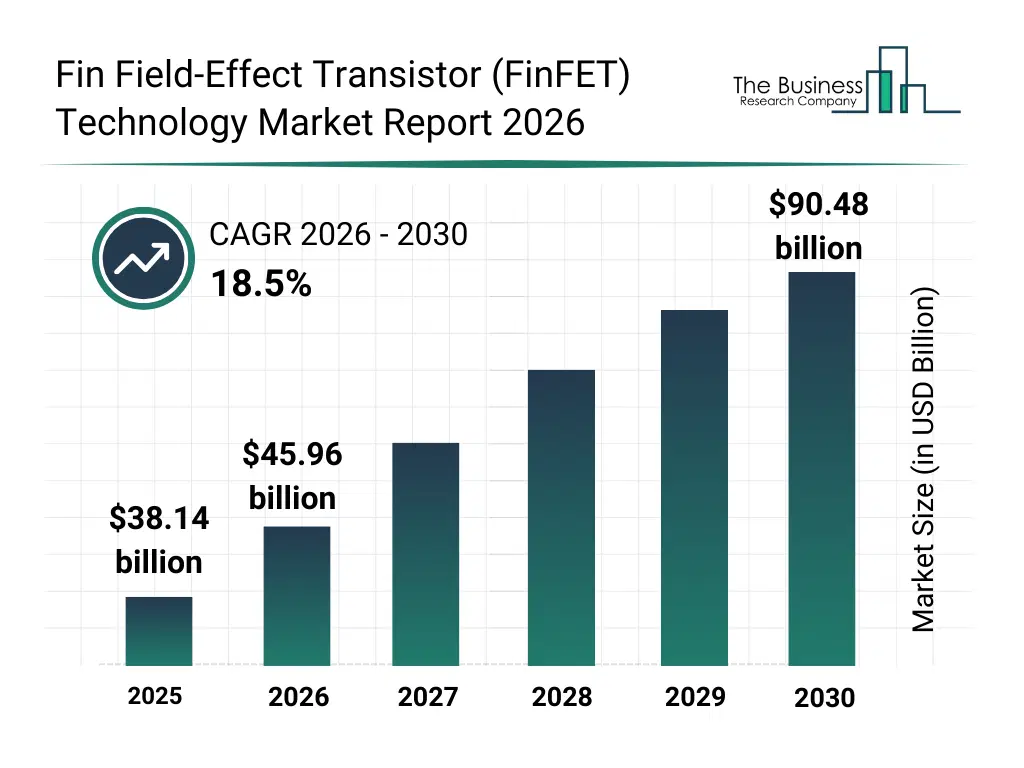
What Is The Fin Field-Effect Transistor (FinFET) Technology Market Size and Share 2026?
The fin field-effect transistor (finfet) technology market size has grown exponentially in recent years. It will grow from $38.14 billion in 2025 to $45.96 billion in 2026 at a compound annual growth rate (CAGR) of 20.5%. The growth in the historic period can be attributed to shrinking transistor geometries, rising demand for mobile processors, increased adoption of advanced semiconductor nodes, expansion of fab investments, growing use of finfets in consumer electronics.What Is The Fin Field-Effect Transistor (FinFET) Technology Market Growth Forecast?
The fin field-effect transistor (finfet) technology market size is expected to see rapid growth in the next few years. It will grow to $90.48 billion in 2030 at a compound annual growth rate (CAGR) of 18.5%. The growth in the forecast period can be attributed to increasing adoption of sub-5nm technologies, rising investments in next-generation fabs, growing demand from AI and data center applications, expansion of finfet use in automotive semiconductors, continued focus on energy-efficient chip designs. Major trends in the forecast period include increasing adoption of advanced finfet node architectures, rising demand for low-power high-performance transistors, expansion of multi-gate transistor designs, growing use of finfets in AI and high-compute chips, enhanced focus on power efficiency optimization.
Global Fin Field-Effect Transistor (FinFET) Technology Market Segmentation
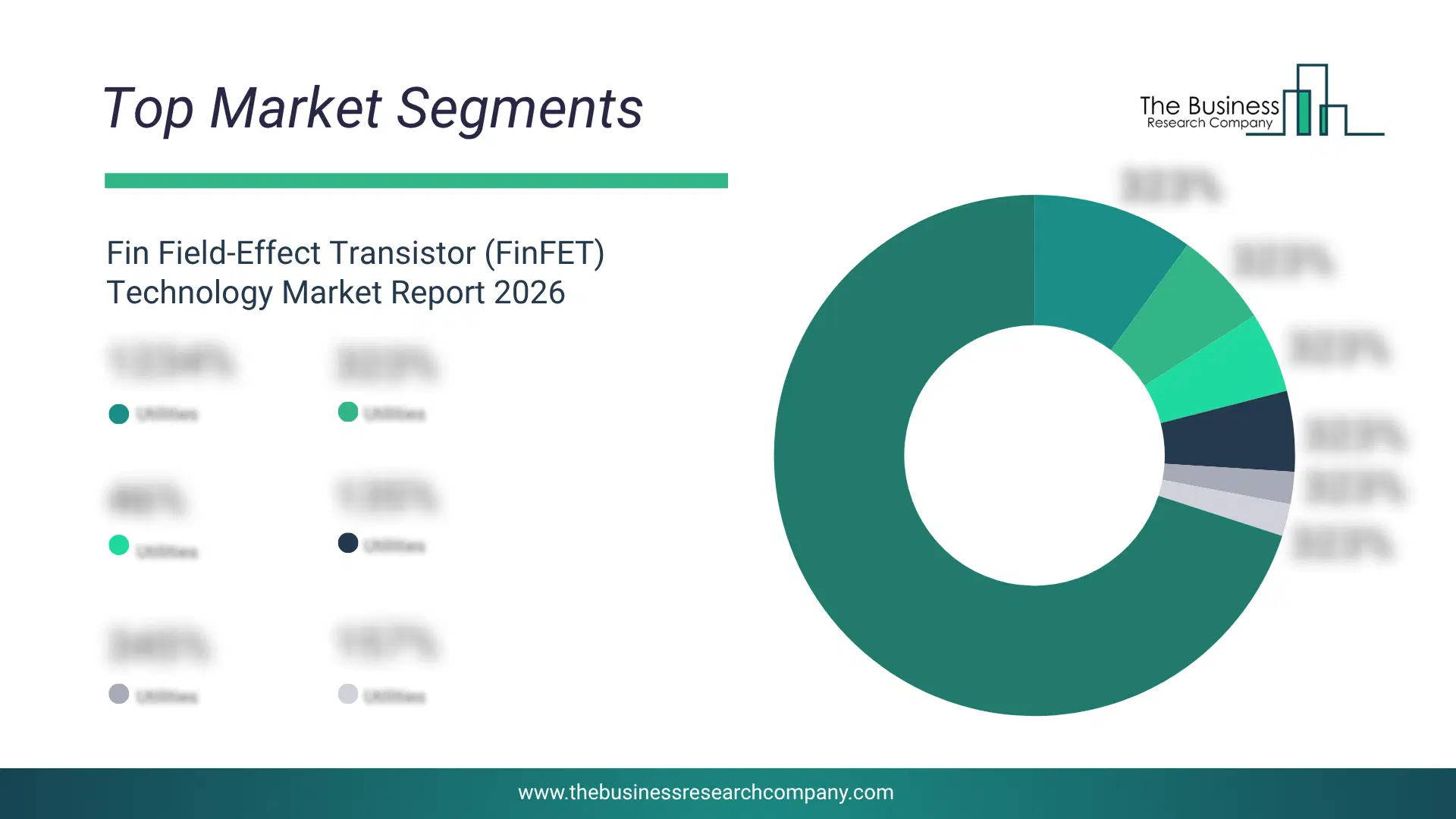
1) By Type: Shorted Gate (S.G.), Independent Gate (I.G.), Bulk FinFETS, Silicon On Insulator (SOI) FinFETS 2) By Technology: 3nm, 5nm, 7nm, 10nm, 14nm, 16nm, 20nm, 22nm 3) By Application: Central Processing Unit (CPU), System-On-Chip (SoC), Field-Programmable Gate Array (FPGA), Graphics Processing Unit (GPU), Network Processor 4) By End User: Mobile, Cloud Server Or High-End Networks, Internet Of Thing (IoT) Or Consumer Electronics, Automotive, Computer And Tablets, Wearable, Other End Users Subsegments: 1) By Shorted Gate (S.G.): Single-gate FinFETs, Multiple-gate FinFETs (with shorted gates) 2) By Independent Gate (I.G.): Dual-gate FinFETs, Triple-gate FinFETs, Multi-gate FinFETs (with independent gates) 3) By Bulk FinFETs: Bulk Silicon FinFETs, Bulk CMOS FinFETs 4) By Silicon On Insulator (SOI) FinFETs: SOI-based FinFETs for low power applications, SOI FinFETs for high-performance applications The top segments in the fin field-effect transistor (finfet) technology market will be: • Bulk FinFETS will reach $56 Billion by 2030. • Silicon On Insulator (SOI) FinFETS will reach $18 Billion by 2030. • Shorted Gate (S.G.) will reach $9 Billion by 2030. • Independent Gate (I.G.) will reach $9 Billion by 2030.What Is The Driver Of The Fin Field-Effect Transistor (FinFET) Technology Market?
The growing mobile and consumer electronics are expected to propel the growth of the FinFET technology market going forward. Consumer electronics refers to any electronic product designed for daily, non-commercial, or professional use by consumers. A mobile device is an electronic device that can be easily carried by an individual and is designed to operate without a physical connection. The mobile and consumer electronics industry is constantly evolving and expanding due to increasing connectivity, evolving consumer preferences, and demand for portability and mobility. FinFET technology is pivotal in advancing the capabilities of mobile and consumer electronics, enabling the development of devices that are more powerful, efficient, compact, and feature-rich. For instance, in June 2024, according to data published by the Federal Reserve Economic Data, a US-based federal reserve system, the sales of electronics and appliance stores stood at $7,678 million in 2023, which was raised to $7,814 million in 2024. Therefore, growing mobile and consumer electronics are driving the growth of the FinFET technology market.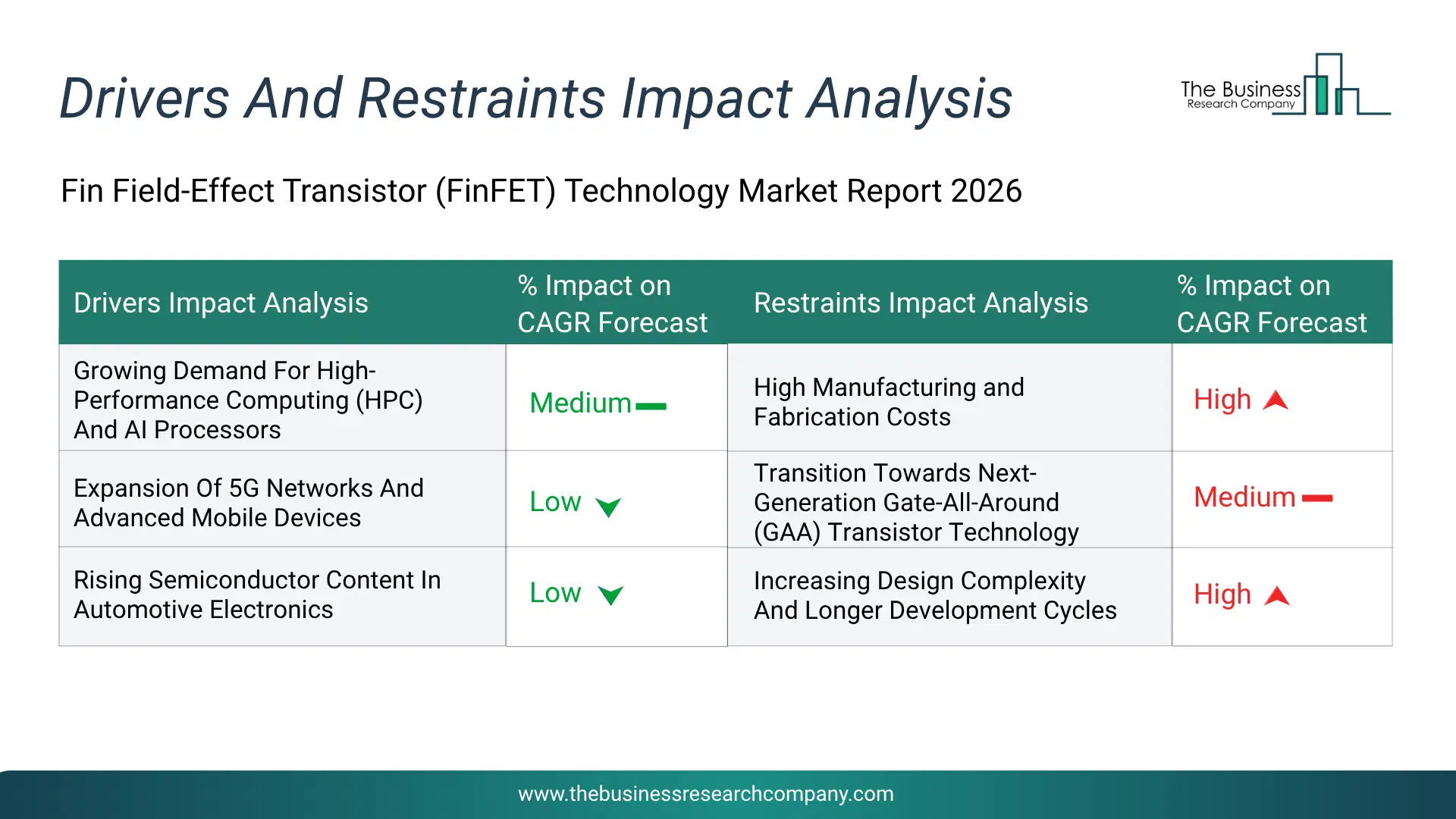
Infographic Chart Showing Key Market Drivers Analysis And Restraints For Fin Field-Effect Transistor (Finfet) Technology Market
The chart presents an impact analysis of key drivers and restraints, quantifying their relative influence on the market's growth rate and helping assess the balance between growth enablers and limiting factors. This chart offers a high-level perspective; the full report contains more detailed insights.
How Will The Drivers Impact Growth In The Global Fin Field-Effect Transistor (FinFET) Technology Market?
• Growing Demand For High-Performance Computing (HPC) And AI Processors (Medium) – During the forecast period, the growing demand for high-performance computing (HPC) and AI processors is expected to become a key growth driver for the fin field-effect transistor (FinFET) technology market by 2030. Enterprises are increasingly deploying AI, machine learning, and data-intensive computing platforms that require advanced semiconductor architectures capable of delivering higher processing capability with improved energy efficiency. FinFET technology enables higher transistor density and enhanced switching performance, making it well suited for next-generation computing workloads. Chip manufacturers are therefore expanding the adoption of FinFET-based process technologies to support advanced computing applications. • Expansion Of 5G Networks And Advanced Mobile Devices (Low) – During the forecast period, the expansion of 5G networks and advanced mobile devices is expected to emerge as a major factor driving the expansion of the fin field-effect transistor (FinFET) technology market by 2030. The widespread deployment of 5G infrastructure and the launch of increasingly powerful smartphones are accelerating the need for semiconductor devices that combine high-speed processing with efficient power management. FinFET technology supports these requirements through improved transistor performance and lower leakage characteristics. Continuous innovation in mobile processors and communication chipsets is therefore strengthening demand for advanced FinFET technologies. • Rising Semiconductor Content In Automotive Electronics (Low) – During the forecast period, the rising semiconductor content in automotive electronics is expected to act as a key growth catalyst for the fin field-effect transistor (FinFET) technology market by 2030. The increasing integration of electronic systems in electric vehicles, advanced driver-assistance systems (ADAS), and autonomous driving platforms is creating greater demand for advanced logic devices capable of supporting complex computational functions. FinFET technology provides the performance, reliability, and energy efficiency required for modern automotive semiconductor applications. As vehicle electronics become increasingly sophisticated, adoption of FinFET-based chips is expected to accelerate.How Will The Restraints Impact Growth In The Global Fin Field-Effect Transistor (FinFET) Technology Market?
• High Manufacturing and Fabrication Costs (Medium) – During the forecast period, the high fabrication costs and capital-intensive manufacturing act as a significant restraint on the fin field-effect transistor (FinFET) technology market because manufacturing FinFET devices requires highly advanced semiconductor fabrication facilities, extreme precision lithography, and sophisticated process technologies. Establishing and upgrading fabrication plants involves substantial investments in cleanrooms, wafer processing equipment, and process control systems. The increasing cost of advanced process nodes further raises production expenses and limits participation to a small number of large semiconductor manufacturers. Smaller chip designers and foundries often face financial barriers in adopting FinFET technology. These high capital requirements reduce market accessibility and slow the expansion of advanced semiconductor manufacturing. As a result, high fabrication costs remain a major restraint on the growth of the FinFET technology market. • Transition Towards Next-Generation Gate-All-Around (GAA) Transistor Technology (Low) – During the forecast period, the transition towards next-generation gate-all-around (GAA) transistor technology acts as a significant restraint on the fin field-effect transistor (FinFET) technology market because semiconductor manufacturers are increasingly investing in gate-all-around transistor architectures that offer superior power efficiency, improved electrostatic control, and better scalability at advanced process nodes. As chip manufacturers migrate to smaller technology nodes, GAA transistors are becoming the preferred solution for future high-performance semiconductor designs. This technological transition reduces long-term investments in new FinFET-based manufacturing capacity and research activities. Chip designers may also prioritize GAA-compatible products to remain competitive in advanced computing, artificial intelligence, and mobile applications. Consequently, the growing shift toward next-generation transistor technologies limits the long-term growth potential of the FinFET technology market. • Increasing Design Complexity And Longer Development Cycles (Low) – During the forecast period, the increasing design complexity and longer development cycles act as a major restraint on the fin field-effect transistor (FinFET) technology market because FinFET architectures require more sophisticated chip design methodologies, advanced electronic design automation tools, and extensive verification processes than conventional planar transistor technologies. Engineers must address complex challenges related to power optimization, thermal management, signal integrity, and transistor layout during chip development. These complexities increase research and development costs while extending product design and validation timelines. Semiconductor companies must also invest heavily in skilled engineering talent and advanced simulation capabilities. Longer development cycles can delay product launches and reduce time-to-market for next-generation semiconductor devices. Consequently, increasing design complexity restrains the widespread adoption of FinFET technology.Key Players In The Global Fin Field-Effect Transistor (FinFET) Technology Market
Major companies operating in the fin field-effect transistor (finfet) technology market are Huawei Technologies Co. Ltd., Taiwan Semiconductor Manufacturing Company Limited, Intel Corporation, Qualcomm Technologies Inc., Broadcom Inc., Toshiba Corporation, Advanced Micro Devices Inc., Texas Instruments Incorporated, MediaTek Inc., Infineon Technologies AG, Analog Devices Inc., NXP Semiconductors NV, United Microelectronics Corporation, GlobalFoundries Inc., Semiconductor Manufacturing International Corporation, Keysight Technologies Inc., Renesas Electronics Corporation, Xilinx Inc., Samsung Electronics Co. Ltd., Arm Holdings plc, ANSYS Inc.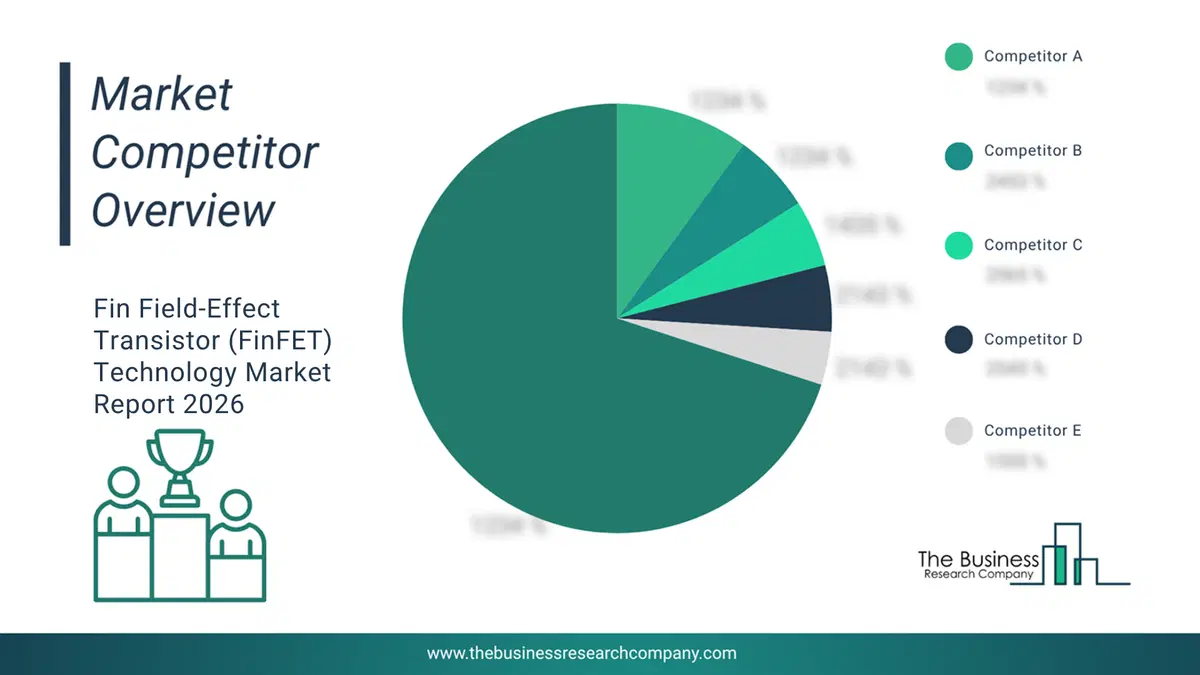
This chart is for illustrative purposes; the full report includes a detailed competitor analysis and comprehensive overview of the top 10 companies in the market.
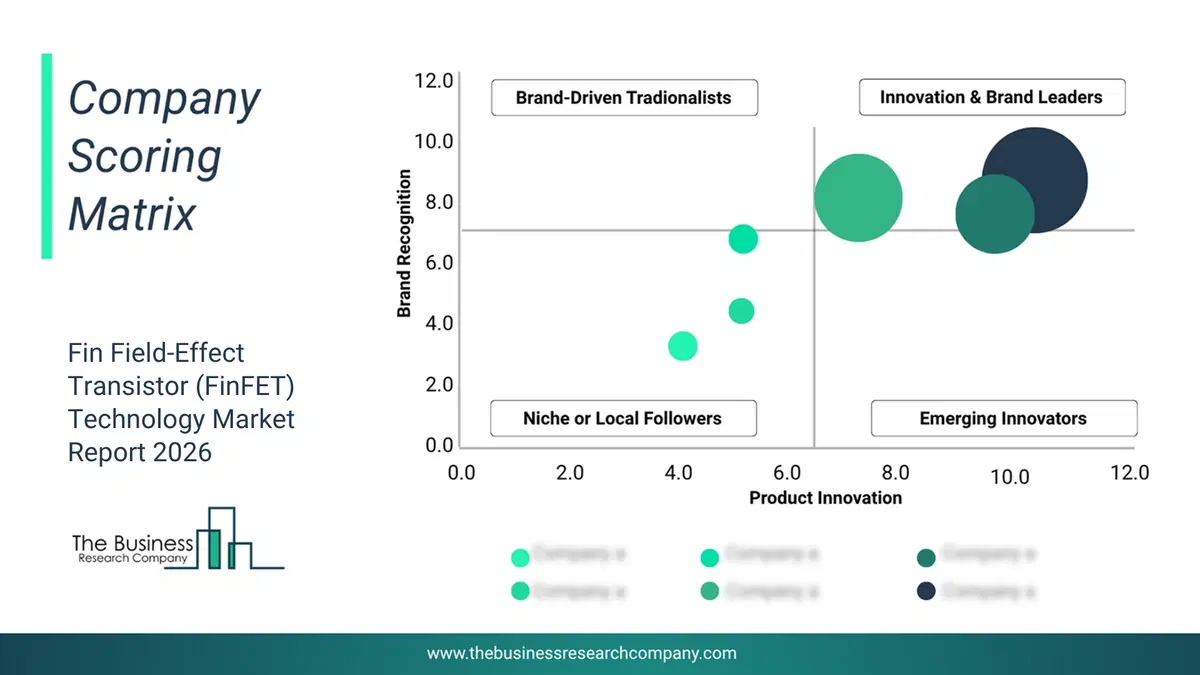
This chart maps companies by product innovation and brand strength, with bubble size indicating relative revenue, helping identify market leaders, challengers, and niche players. This is an illustrative chart; the full report provides a complete and accurate competitive analysis.
Global Fin Field-Effect Transistor (FinFET) Technology Market Trends and Insights
Major companies operating in the fin field-effect transistor (FinFET) technology market are innovating next generation zonal processors, to strengthen their position in the market. The next generation of zonal processors represents an evolution in automotive processing technology designed to meet the increasing demands of modern vehicles. For instance, in May 2023, NXP Semiconductors, a Netherlands-based automotive processing company, collaborated with Taiwan Semiconductor Manufacturing Company Limited, a Taiwan-based manufacturer of semiconductors, and developed the industry’s first automotive embedded MRAM (Magnetic Random Access Memory) in 16 nm FinFET technology. The 16nm FinFET process enhances performance and power efficiency, while the embedded MRAM technology offers faster write speeds, higher endurance, and better data retention compared to traditional memory types. This launch marks a significant advancement in automotive electronics, enabling more robust and efficient memory solutions for applications such as advanced driver-assistance systems (ADAS), autonomous driving, and in-vehicle infotainment systems, thereby supporting the development of smarter, safer, and more connected vehicles.What Are Latest Mergers And Acquisitions In The Fin Field-Effect Transistor (FinFET) Technology Market?
In February 2023, ON Semiconductor Corporation, a US-based semiconductor manufacturing company, acquired a 300 mm manufacturing plant from GlobalFoundries for an undisclosed amount. This move also enables ON Semiconductor to optimize production efficiencies and innovate with cutting-edge technologies, ensuring enhanced competitiveness and responsiveness to customer demands in the semiconductor industry. GlobalFoundries Inc. is a US-based semiconductor manufacturing business that uses fin field-effect transistor (FinFET) technology.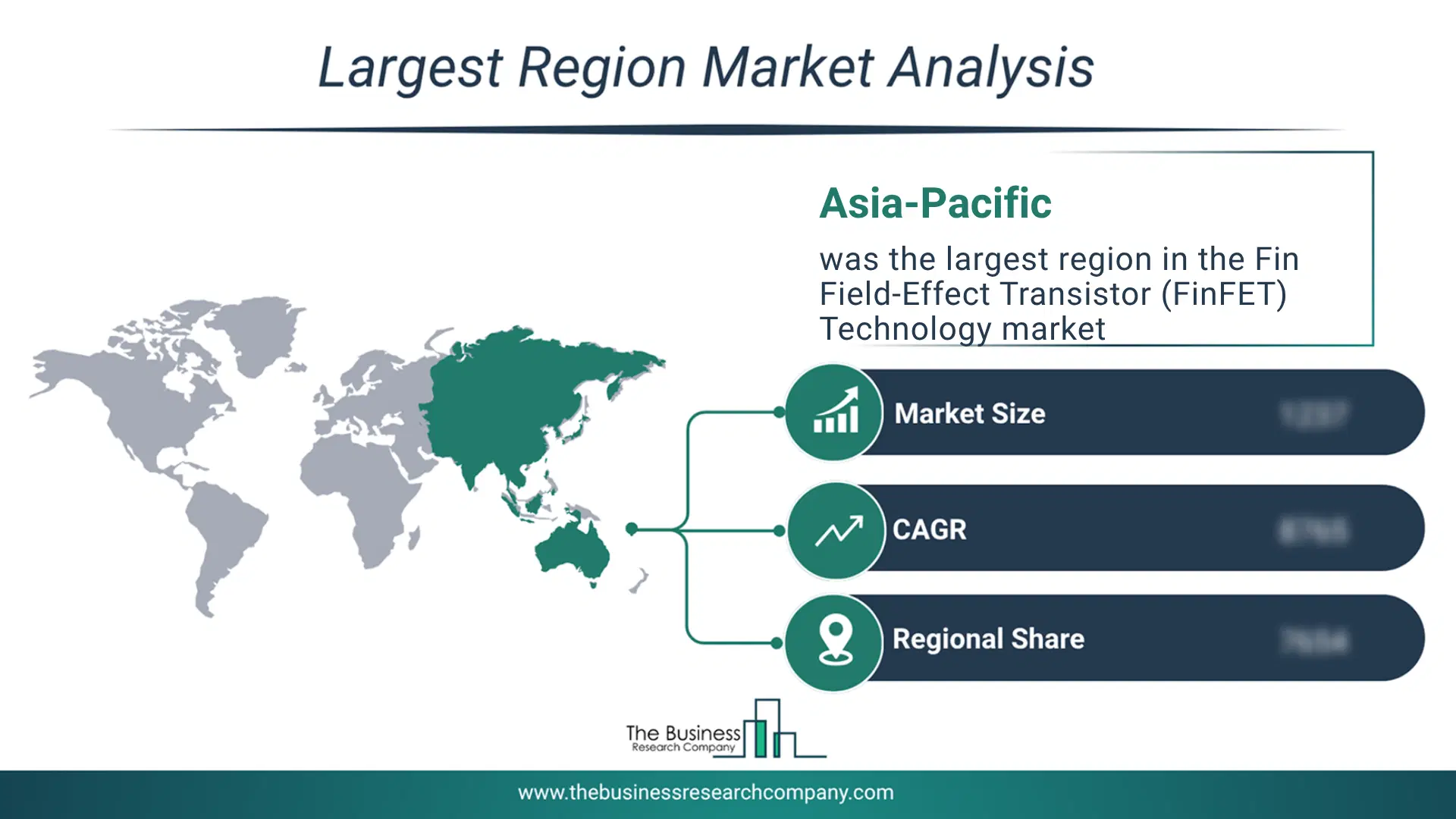
Regional Insights
Asia-Pacific was the largest region in the fin field-effect transistor (FinFET) technology market in 2025. The regions covered in this market report are Asia-Pacific, South East Asia, Western Europe, Eastern Europe, North America, South America, Middle East, Africa. The countries covered in this market report are Australia, Brazil, China, France, Germany, India, Indonesia, Japan, Taiwan, Russia, South Korea, UK, USA, Canada, Italy, Spain.What Defines the Fin Field-Effect Transistor (FinFET) Technology Market?
The fin field-effect transistor (FinFET) technology market includes revenues earned by entities by providing services such as prototyping and testing services, fabrication services, and intellectual property (IP) services. The market value includes the value of related goods sold by the service provider or included within the service offering. The fin field-effect transistor (FinFET) technology market consists of sales of graphics processing units (GPUs), application-specific integrated circuits (ASICs), consumer electronics, and networking equipment. Values in this market are ‘factory gate’ values, that is the value of goods sold by the manufacturers or creators of the goods, whether to other entities (including downstream manufacturers, wholesalers, distributors and retailers) or directly to end customers. The value of goods in this market includes related services sold by the creators of the goods.How is Market Value Defined and Measured?
The market value is defined as the revenues that enterprises gain from the sale of goods and/or services within the specified market and geography through sales, grants, or donations in terms of the currency (in USD unless otherwise specified). The revenues for a specified geography are consumption values that are revenues generated by organizations in the specified geography within the market, irrespective of where they are produced. It does not include revenues from resales along the supply chain, either further along the supply chain or as part of other products.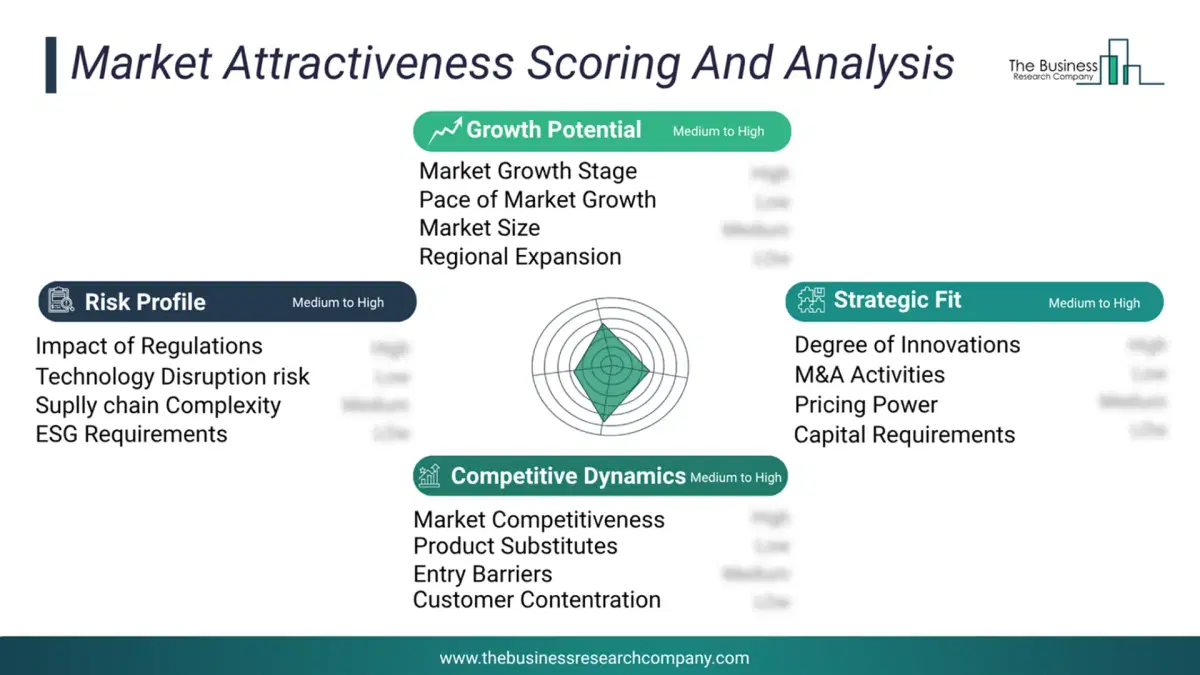
This chart presents market attractiveness based on a quantitative evaluation of growth, competition, strategic alignment, and risk, offering a clear view of opportunity areas for decision-making. This chart is for illustrative purposes; the full report contains the complete analysis.
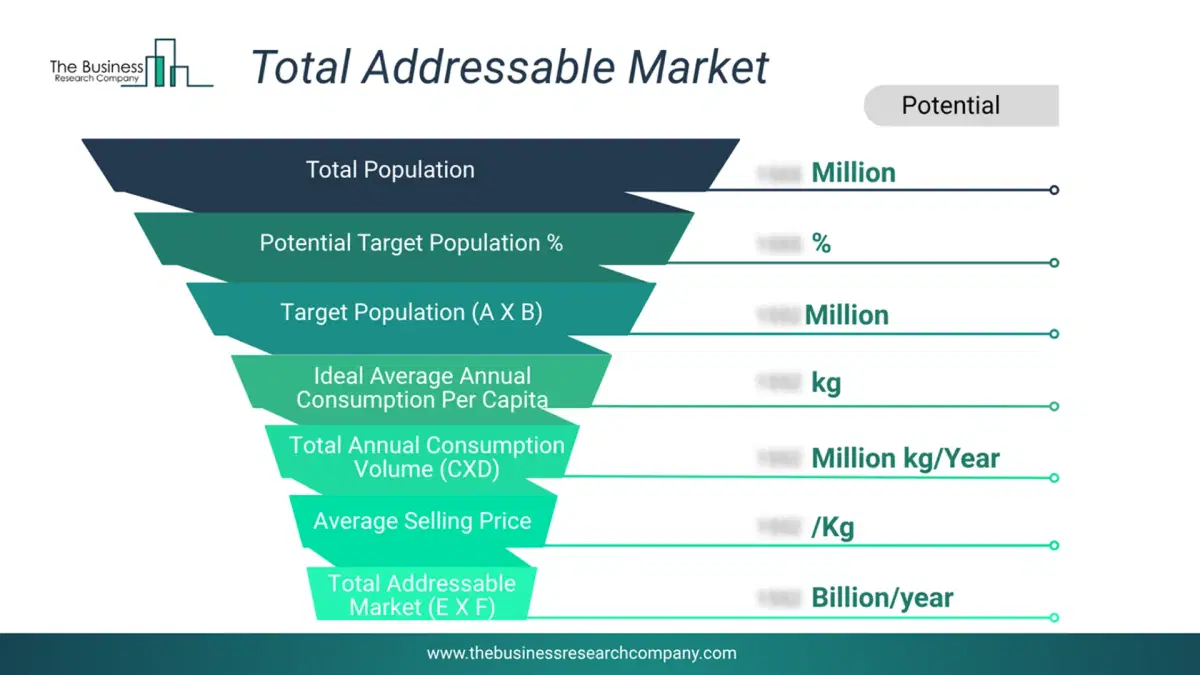
This chart highlights the Total Addressable Market (TAM) by estimating the maximum revenue opportunity using an assumption-driven approach, supporting strategic planning and opportunity sizing across markets. The chart is illustrative; the full report provides a more comprehensive analysis.
What Key Data and Analysis Are Included in the Fin Field-Effect Transistor (FinFET) Technology Market Report 2026?
The fin field-effect transistor (finfet) technology market research report is one of a series of new reports from The Business Research Company that provides market statistics, including industry global market size, regional shares, competitors with the market share, detailed market segments, market trends and opportunities, and any further data you may need to thrive in the fin field-effect transistor (finfet) technology industry. The market research report delivers a complete perspective of everything you need, with an in-depth analysis of the current and future state of the industry.Fin Field-Effect Transistor (FinFET) Technology Market Report Forecast Analysis
| Report Attribute | Details |
|---|---|
| Market Size Value In 2026 | $45.96 billion |
| Revenue Forecast In 2030 | $90.48 billion |
| Growth Rate | CAGR of 18.5% from 2026 to 2030 |
| Base Year For Estimation | 2025 |
| Actual Estimates/Historical Data | 2020-2025 |
| Forecast Period | 2026 - 2030 |
| Market Representation | Revenue in USD Billion and CAGR from 2026 to 2030 |
| Segments Covered | Type, Technology, Application, End User |
| Regional Scope | Asia-Pacific, Western Europe, Eastern Europe, North America, South America, Middle East, Africa |
| Country Scope | The countries covered in the report are Australia, Brazil, China, France, Germany, India, Indonesia, Japan, Taiwan, Russia, South Korea, UK, USA, Canada, Italy, Spain. |
| Key Companies Profiled | Huawei Technologies Co. Ltd., Taiwan Semiconductor Manufacturing Company Limited, Intel Corporation, Qualcomm Technologies Inc., Broadcom Inc., Toshiba Corporation, Advanced Micro Devices Inc., Texas Instruments Incorporated, MediaTek Inc., Infineon Technologies AG, Analog Devices Inc., NXP Semiconductors NV, United Microelectronics Corporation, GlobalFoundries Inc., Semiconductor Manufacturing International Corporation, Keysight Technologies Inc., Renesas Electronics Corporation, Xilinx Inc., Samsung Electronics Co. Ltd., Arm Holdings plc, ANSYS Inc. |
| Customization Scope | Request for Customization |
| Pricing And Purchase Options | Explore Purchase Options |