
Genetic Testing Market Report 2026
Global Outlook – By Type (Predictive Testing, Carrier Testing, Prenatal And Newborn Testing, Diagnostic Testing, Pharmacogenomics Testing, Nutrigenomic Testing, Other Types), By Technology (Cytogenetic Testing, Biochemical Testing, Molecular Testing ), By Application (Cancer Diagnosis, Genetic Disease Diagnosis, Cardiovascular Disease Diagnosis, Other Applications), By End User (Hospitals And Clinics, Diagnostic Laboratories And Centres, Other End Users) - Market Size, Trends, And Global Forecast 2026-2035
Genetic Testing Market Overview
• Genetic Testing market size has reached to $20.84 billion in 2025 • Expected to grow to $32.22 billion in 2030 at a compound annual growth rate (CAGR) of 8.9% • Growth Driver: Surge In Genetic Disorders Propels Growth Of Genetic Testing Market • Market Trend: Illumina And Merck Collaborate On Innovative Genetic Testing Program For Deeper Tumor Genome Insights • North America was the largest region in 2025 and Asia-Pacific is the fastest growing region.
What Is Covered Under Genetic Testing Market?
Genetic testing refers to a sort of medical examination that looks for alterations in genes, proteins, or chromosomes. A genetic test's results can identify a genetic ailment, as well as determine a person's risk of developing a genetic disorder. Genetic testing is used to confirm specific genetic disorders in children and their conditions based on physical signs and symptoms. The main types of genetic testing are predictive testing, carrier testing, prenatal and newborn testing, diagnostic testing, pharmacogenomic testing, nutrigenomic testing, and other types. The predictive tests are part of a new and rapidly expanding class of medical tests that are fundamentally different from traditional medical diagnostic examinations. The various technologies involved are cytogenetic testing, biochemical testing, and molecular testing. It is used in several applications, such as cancer diagnosis, genetic disease diagnosis, cardiovascular disease diagnosis, and others by various end users including hospitals and clinics, diagnostic laboratories and centers, and others.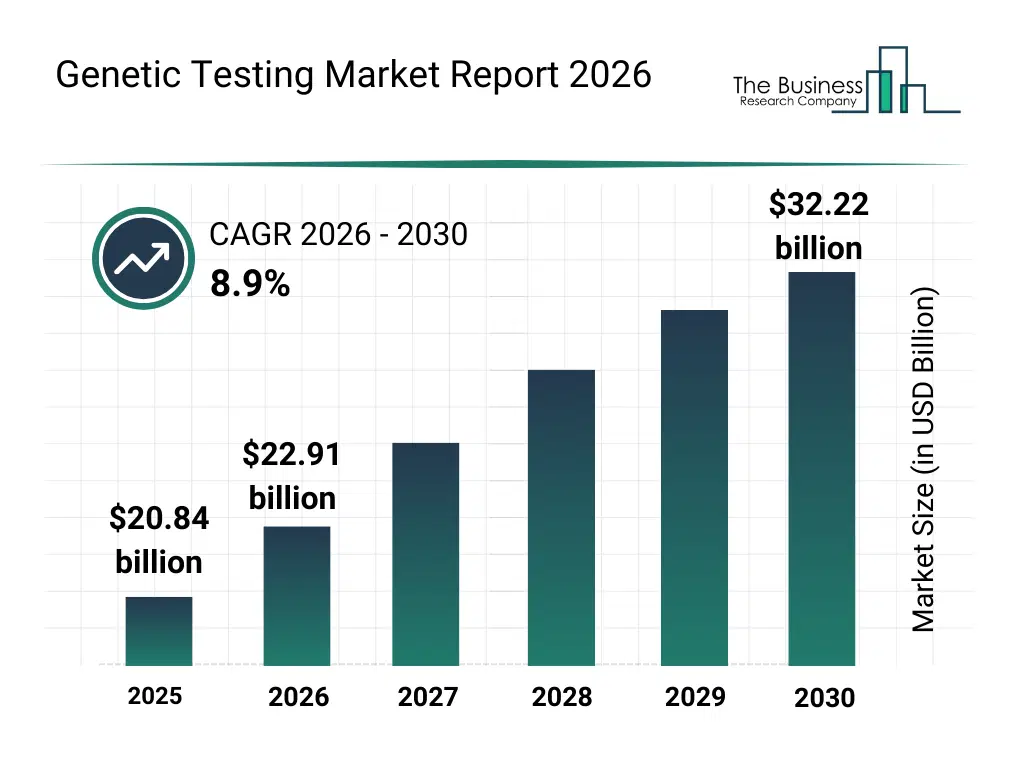
What Is The Genetic Testing Market Size and Share 2026?
The genetic testing market size has grown strongly in recent years. It will grow from $20.84 billion in 2025 to $22.91 billion in 2026 at a compound annual growth rate (CAGR) of 9.9%. The growth in the historic period can be attributed to advancements in molecular biology, declining dna sequencing costs, increased awareness of genetic disorders, expansion of diagnostic laboratories, early adoption in oncology.What Is The Genetic Testing Market Growth Forecast?
The genetic testing market size is expected to see strong growth in the next few years. It will grow to $32.22 billion in 2030 at a compound annual growth rate (CAGR) of 8.9%. The growth in the forecast period can be attributed to growth of personalized medicine, integration of genetic data in clinical decisions, rising chronic disease burden, expansion of preventive healthcare, improved genetic counseling services. Major trends in the forecast period include increasing adoption of predictive genetic testing, growing use of prenatal and newborn screening, rising demand for pharmacogenomics testing, expansion of cancer genetic diagnostics, increased availability of direct-to-consumer genetic tests.Global Genetic Testing Market Segmentation
1) By Type: Predictive Testing, Carrier Testing, Prenatal And Newborn Testing, Diagnostic Testing, Pharmacogenomics Testing, Nutrigenomic Testing, Other Types 2) By Technology: Cytogenetic Testing, Biochemical Testing, Molecular Testing 3) By Application: Cancer Diagnosis, Genetic Disease Diagnosis, Cardiovascular Disease Diagnosis, Other Applications 4) By End User: Hospitals And Clinics, Diagnostic Laboratories And Centres, Other End Users Subsegments: 1) By Predictive Testing: Genetic Risk Assessment, Family History-Based Testing 2) By Carrier Testing: Single Gene Carrier Testing, Expanded Carrier Screening 3) By Prenatal And Newborn Testing: Non-Invasive Prenatal Testing (NIPT), Newborn Screening Tests 4) By Diagnostic Testing: Confirmatory Genetic Testing, Clinical Diagnostic Testing 5) By Pharmacogenomics Testing: Drug Response Testing, Adverse Drug Reaction Testing 6) By Nutrigenomic Testing: Dietary Response Testing, Metabolism Testing 7) By Other Types: Ancestry Testing, Whole Genome SequencingWhat Is The Driver Of The Genetic Testing Market?
The rising prevalence of genetic disorders is expected to propel the growth of the genetic testing market going forward. Genetic disorders refer to some diseases that cause symptoms at birth, while others develop over time. Genetic testing can help get a diagnosis for a genetic issue and information about the chances of developing cancer. For instance, in 2024, according to a report by the World Health Organization, a Switzerland-based Intergovernmental organization, genetic disorders, and congenital abnormalities affect 2%-5% of live births and account for 30% of pediatric hospital admissions, leading to about 50% of childhood deaths in industrialized countries. Therefore, the rising prevalence of genetic disorders is driving the genetic testing industry.Key Players In The Global Genetic Testing Market
Major companies operating in the genetic testing market are Myriad Genetics Inc, Illumina Inc, Abbott Laboratories, Eurofins Scientific, Danaher Corporation, F. Hoffmann-La Roche Ltd, Quest Diagnostics Incorporated, Qiagen NV, Thermo Fisher Scientific Inc., BioRad Laboratories Inc., BGI, Berry Genomics Co. Ltd, Daan Gene Co. Ltd, Annoroad Gene Technology Co. Ltd, Igenomix, Circle DNA, Centogene, Probably Genetic, Genome Biologics, WuXi NextCODE, Genomtec, Testgene, Evogen Lab, Phosphorus, Helix, 10x Genomics, Quantgene, DNALabs, Deep Genomics, Hologic Inc, Molecular Biology & Genetics Laboratory, IVI MIDDLE EAST FERTILITY CLINIC, Bio CerticaGlobal Genetic Testing Market Trends and Insights
Major companies operating in the genetic testing market are focusing on developing innovative solutions, such as AI-driven genomic interpretation algorithms, to meet the rising demand for improved variant classification, enhanced diagnostic accuracy, and greater diversity in precision healthcare. AI-based genomic interpretation tools analyze large-scale genetic datasets to identify pathogenic variants more efficiently than traditional manual or rule-based methods, offering faster insights, reduced uncertainty, and higher predictive accuracy in genetic testing. For instance, in June 2023, Illumina, Inc., a U.S.-based biotechnology and medical equipment company, unveiled PrimateAI-3D, an innovative artificial intelligence algorithm designed to predict disease-causing genetic mutations. The tool uses a 3D structural understanding of proteins and evolutionary comparisons across primate species to prioritize potentially pathogenic variants. It enhances large-scale genomic interpretation, accelerates precision medicine, and improves diagnostic workflows by enabling researchers and clinicians to more accurately assess genetic risk. PrimateAI-3D supports faster, more reliable detection of clinically relevant mutations, ultimately strengthening genetic testing capabilities.What Are Latest Mergers And Acquisitions In The Genetic Testing Market?
In February 2025, Tempus, a US-based provider of precision medicine solutions, artificial intelligence-driven clinical insights, and oncology-focused genetic testing services, acquired Ambry Genetics for an undisclosed amount. With this acquisition, Tempus aims to expand its genetic testing capabilities and integrate Ambry’s hereditary disease testing services into its precision medicine platform, enhancing both technological capability and market presence in clinical genetic diagnostics. Ambry Genetics is a US-based provider of hereditary cancer, cardiovascular, pediatric, and rare disease genetic testing services.Regional Outlook
North America was the largest region in the genetic testing market in 2025. Asia-Pacific is expected to be the fastest-growing region in the forecast period. The regions covered in this market report are Asia-Pacific, South East Asia, Western Europe, Eastern Europe, North America, South America, Middle East, Africa. The countries covered in this market report are Australia, Brazil, China, France, Germany, India, Indonesia, Japan, Taiwan, Russia, South Korea, UK, USA, Canada, Italy, Spain.What Defines the Genetic Testing Market?
The genetic testing market includes revenues earned by entities by chromosomal genetic tests, molecular genetic tests (or gene tests), biochemical tests, newborn screening, and diagnostic testing. The market value includes the value of related goods sold by the service provider or included within the service offering. Only goods and services traded between entities or sold to end consumers are included.How is Market Value Defined and Measured?
The market value is defined as the revenues that enterprises gain from the sale of goods and/or services within the specified market and geography through sales, grants, or donations in terms of the currency (in USD unless otherwise specified). The revenues for a specified geography are consumption values that are revenues generated by organizations in the specified geography within the market, irrespective of where they are produced. It does not include revenues from resales along the supply chain, either further along the supply chain or as part of other products.What Key Data and Analysis Are Included in the Genetic Testing Market Report 2026?
The genetic testing market research report is one of a series of new reports from The Business Research Company that provides market statistics, including industry global market size, regional shares, competitors with the market share, detailed market segments, market trends and opportunities, and any further data you may need to thrive in the genetic testing industry. The market research report delivers a complete perspective of everything you need, with an in-depth analysis of the current and future state of the industry.Genetic Testing Market Report Forecast Analysis
| Report Attribute | Details |
|---|---|
| Market Size Value In 2026 | $22.91 billion |
| Revenue Forecast In 2035 | $32.22 billion |
| Growth Rate | CAGR of 9.9% from 2026 to 2035 |
| Base Year For Estimation | 2025 |
| Actual Estimates/Historical Data | 2020-2025 |
| Forecast Period | 2026 - 2030 - 2035 |
| Market Representation | Revenue in USD Billion and CAGR from 2026 to 2035 |
| Segments Covered | Type, Technology, Application, End User |
| Regional Scope | Asia-Pacific, Western Europe, Eastern Europe, North America, South America, Middle East, Africa |
| Country Scope | The countries covered in the report are Australia, Brazil, China, France, Germany, India, ... |
| Key Companies Profiled | Myriad Genetics Inc, Illumina Inc, Abbott Laboratories, Eurofins Scientific, Danaher Corporation, F. Hoffmann-La Roche Ltd, Quest Diagnostics Incorporated, Qiagen NV, Thermo Fisher Scientific Inc., BioRad Laboratories Inc., BGI, Berry Genomics Co. Ltd, Daan Gene Co. Ltd, Annoroad Gene Technology Co. Ltd, Igenomix, Circle DNA, Centogene, Probably Genetic, Genome Biologics, WuXi NextCODE, Genomtec, Testgene, Evogen Lab, Phosphorus, Helix, 10x Genomics, Quantgene, DNALabs, Deep Genomics, Hologic Inc, Molecular Biology & Genetics Laboratory, IVI MIDDLE EAST FERTILITY CLINIC, Bio Certica |
| Customization Scope | Request for Customization |
| Pricing And Purchase Options | Explore Purchase Options |