

Hospital-Acquired Infection Control Market Report 2026
Global Outlook – By Product (Sterilizers, Disinfectors, Endoscope Reprocessors, Microbial Testing Instruments, Consumables, Disinfectants, Infection Prevention And Surveillance Software, Other Products), By Technology (Phenotypic Methods, Genotypic Methods), By Diseases (Hospital Acquired Pneumonia, Bloodstream Infections, Surgical Site Infections, Gastrointestinal Infections, Urinary Tract Infection, Other Diseases ), By Application (Disease Testing, Drug-Resistance Testing), By End User (Hospitals, ICUs, Ambulatory Surgical, Diagnostic Centers, Nursing Homes, Maternity Centers, Other End Users) - Market Size, Trends, And Global Forecast 2026-2035
Hospital-Acquired Infection Control Market Overview
• Hospital-Acquired Infection Control market size has reached to $35.75 billion in 2025 • Expected to grow to $46.32 billion in 2030 at a compound annual growth rate (CAGR) of 5.3% • Growth Driver: Rising Healthcare Expenditures Expected To Propel Hospital-Acquired Infection Control Market Growth • Market Trend: Advancements In AI Technology For Early Sepsis Detection In Hospital-Acquired Infection Control • North America was the largest region in 2025 and Asia-Pacific is the fastest growing region.What Is Covered Under Hospital-Acquired Infection Control Market?
Hospital-acquired infections are acquired during hospital care that is not present before hospital admission. The prevention and control of hospital-acquired infection using various cleaning, sterilization, and disinfection methods refers to hospital-acquired infection control. These infections can be caused by the cross-infection from the surfaces of equipment, the skin of patients, and healthcare staff. Hospital-acquired infection control is used to reduce or eliminate the transmission of illnesses. The main types of products in hospital-acquired infection control are sterilizers, disinfectors, endoscope reprocessors, microbial testing instruments, reagents, consumables, disinfectants, infection prevention and surveillance software, and others. Sterilizers refer to a machine for making things entirely clean and bacteria-free. Sterilizers are used to kill germs on an article's surface or in a fluid in order to prevent disease transmission. The different technologies include phenotypic and genotypic methods and involve several types of diseases such as hospital acquired pneumonia, bloodstream infections, surgical site infections, gastrointestinal infections, urinary tract infections and other diseases. The various applications include disease testing and drug-resistance testing. The end user involved are hospitals, ICUs, ambulatory surgical, diagnostic centers, nursing homes, maternity centers, and others.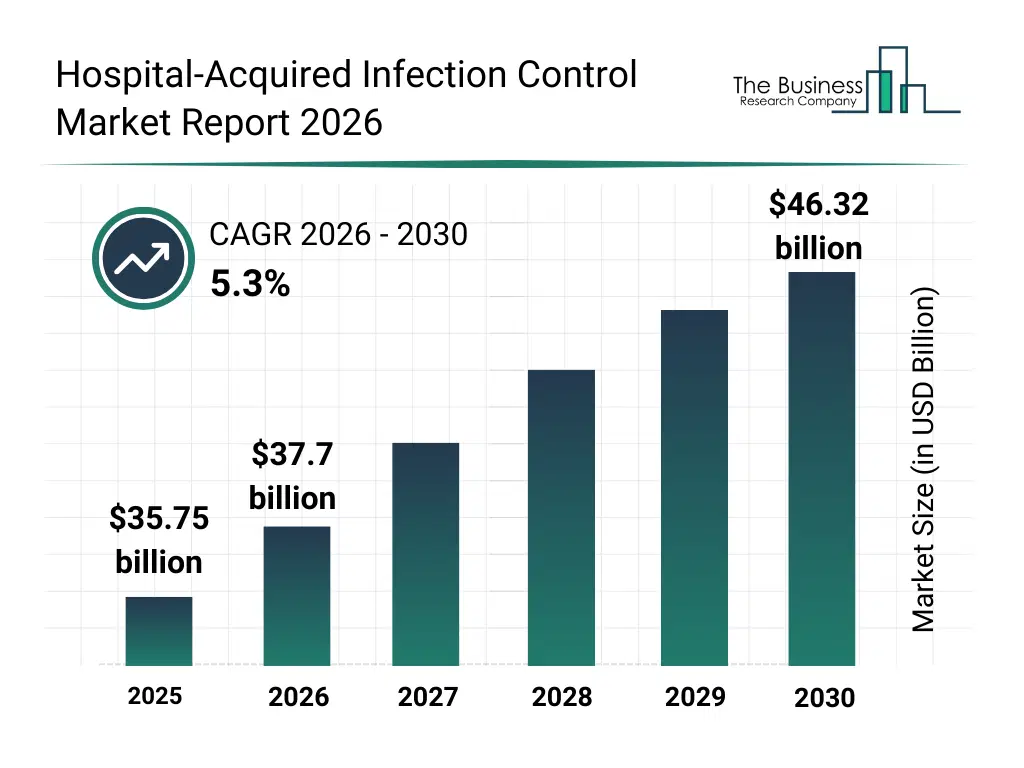
What Is The Hospital-Acquired Infection Control Market Size and Share 2026?
The hospital-acquired infection control market size has grown strongly in recent years. It will grow from $35.75 billion in 2025 to $37.7 billion in 2026 at a compound annual growth rate (CAGR) of 5.4%. The growth in the historic period can be attributed to rising incidence of hospital-acquired infections, increased use of invasive medical procedures, growing awareness of patient safety standards, expansion of intensive care units, stricter hospital hygiene regulations.What Is The Hospital-Acquired Infection Control Market Growth Forecast?
The hospital-acquired infection control market size is expected to see strong growth in the next few years. It will grow to $46.32 billion in 2030 at a compound annual growth rate (CAGR) of 5.3%. The growth in the forecast period can be attributed to increasing regulatory enforcement on infection control, rising adoption of automated sterilization technologies, growing demand for rapid microbial testing, expansion of surveillance and reporting systems, increasing investments in hospital infection prevention infrastructure. Major trends in the forecast period include increasing focus on preventing cross-contamination in hospitals, rising adoption of advanced sterilization and disinfection protocols, growing emphasis on continuous infection surveillance, expansion of automated and high-level disinfection solutions, increasing demand for comprehensive infection prevention programs.
Global Hospital-Acquired Infection Control Market Segmentation
1) By Product: Sterilizers, Disinfectors, Endoscope Reprocessors, Microbial Testing Instruments, Consumables, Disinfectants, Infection Prevention And Surveillance Software, Other Products 2) By Technology: Phenotypic Methods, Genotypic Methods 3) By Diseases: Hospital Acquired Pneumonia, Bloodstream Infections, Surgical Site Infections, Gastrointestinal Infections, Urinary Tract Infection, Other Diseases 4) By Application: Disease Testing, Drug-Resistance Testing 5) By End User: Hospitals, ICUs, Ambulatory Surgical, Diagnostic Centers, Nursing Homes, Maternity Centers, Other End Users Subsegments: 1) By Sterilizers: Steam Sterilizers, Ethylene Oxide Sterilizers, Hydrogen Peroxide Sterilizers 2) By Disinfectors: Washer Disinfectors, Automated Disinfectors 3) By Endoscope Reprocessors: High-Level Disinfection Reprocessors, Automated Endoscope Reprocessors 4) By Microbial Testing Instruments: Culture Systems, Rapid Microbial Testing Systems 5) By Consumables: Sterilization Wraps, Filters, Personal Protective Equipment (PPE) 6) By Disinfectants: Alcohol-based Disinfectants, Chlorine-based Disinfectants, Quaternary Ammonium Compounds 7) By Infection Prevention And Surveillance Software: Surveillance Software Solutions, Data Management Software 8) By Other Products: Cleaning Equipment, Air Purification SystemsWhat Is The Driver Of The Hospital-Acquired Infection Control Market?
Increasing healthcare expenditures are anticipated to propel the growth of the hospital-acquired infection control market. Healthcare expenditures refer to the total amount spent on healthcare-related services, products, and activities within a specified period, typically on an individual, community, national, or global level. Experiencing an increase in healthcare spending, hospitals and healthcare facilities are poised to allocate additional resources for the adoption of advanced infection prevention technologies, encompassing innovative solutions such as advanced disinfection systems, smart monitoring devices, and other technologies that enhance overall infection control measures. For instance, in May 2024, according to the Office for National Statistics, a UK-based government department, total healthcare expenditure increased by 5.6% in nominal terms between 2022 and 2023, compared with growth of 0.9% in 2022. Therefore, increasing healthcare expenditure will drive the growth of the g hospital-acquired infection control industry going forward.Key Players In The Global Hospital-Acquired Infection Control Market
Major companies operating in the hospital-acquired infection control market are Johnson and Johnson, P&G Professional, Honeywell International Inc., MMM Group, 3M Company, Becton Dickinson and Company, Reckitt Benckiser Group plc., Ecolab Inc, Olympus Corporation, Miele Group, Biomerieux SA, Getinge AB, Halyard Health Inc., Ansell Limited, Sotera Health LLC, Contec Inc., Cantel Medical Corp., Belimed AG, Nanosonics Limited, Advanced Sterilization Products Services Inc, Steelco S.P.A, Schülke & Mayr GmbH, Metrex Research LLC, Tristel Solutions Ltd., Whiteley Corporation, PDI Inc., Steris Healthcare PVT Ltd, Matachana Group, Pal International Ltd., Xttrium Laboratories Inc., Zep Inc.Global Hospital-Acquired Infection Control Market Trends and Insights
Major companies operating in the hospital-acquired infection control market are focused on developing new technological solutions, such as AI system to help identify sepsis early to enhance patient outcomes by facilitating rapid diagnosis and treatment. An AI system to help identify sepsis refers to advanced technological solutions that utilize artificial intelligence and machine learning algorithms to detect early signs of sepsis in patients. For instance, in April 2024, Prenosis Inc., a US-based medical clinic, received FDA marketing authorization for the Sepsis ImmunoScore, the first AI-driven system designed to predict sepsis, a life-threatening condition that can lead to severe complications. This innovative tool enhances early detection through real-time data analysis, allowing healthcare professionals to intervene more quickly and effectively. The integration of AI is intended to support medical staff in decision-making rather than replace them, ultimately improving patient outcomes and reducnig healthcare costs.What Are Latest Mergers And Acquisitions In The Hospital-Acquired Infection Control Market?
In August 2024, MicroCare, LLC, a US-based company that develops and manufactures cleaning and disinfecting products for medical, acquired ICT Infection Control Technologies for an undisclosed amount. Through this acquisition, MicroCare to expand its healthcare portfolio by incorporating ICT’s specialized infection control solutions into MicroCare’s established range of cleaning and lubrication products. This strategic initiative aims to bolster MicroCare’s standing in the fast-growing medical infection prevention market, enhancing the safety and effectiveness of cleaning solutions for healthcare facilities. ICT Infection Control Technologies is a US-based specializing in manufacturing infection control chemistries primarily for the dental and medical markets.Regional Outlook
North America was the largest region in the hospital-acquired infection control market in 2025. Asia-Pacific is expected to be the fastest-growing region in the forecast period. The regions covered in this market report are Asia-Pacific, South East Asia, Western Europe, Eastern Europe, North America, South America, Middle East, Africa. The countries covered in this market report are Australia, Brazil, China, France, Germany, India, Indonesia, Japan, Taiwan, Russia, South Korea, UK, USA, Canada, Italy, Spain.What Defines the Hospital-Acquired Infection Control Market?
The hospital-acquired infection control market includes revenues earned by entities by heat sterilization equipment, low temperature sterilization equipment, radiation sterilization equipment, other sterilization equipment, contract sterilization services, sterilization consumables and accessories, disinfectants, and disinfectors equipment. The market value includes the value of related goods sold by the service provider or included within the service offering. Only goods and services traded between entities or sold to end consumers are included.How is Market Value Defined and Measured?
The market value is defined as the revenues that enterprises gain from the sale of goods and/or services within the specified market and geography through sales, grants, or donations in terms of the currency (in USD unless otherwise specified). The revenues for a specified geography are consumption values that are revenues generated by organizations in the specified geography within the market, irrespective of where they are produced. It does not include revenues from resales along the supply chain, either further along the supply chain or as part of other products.What Key Data and Analysis Are Included in the Hospital-Acquired Infection Control Market Report 2026?
The hospital-acquired infection control market research report is one of a series of new reports from The Business Research Company that provides market statistics, including industry global market size, regional shares, competitors with the market share, detailed market segments, market trends and opportunities, and any further data you may need to thrive in the hospital-acquired infection control industry. The market research report delivers a complete perspective of everything you need, with an in-depth analysis of the current and future state of the industry.Hospital-Acquired Infection Control Market Report Forecast Analysis
| Report Attribute | Details |
|---|---|
| Market Size Value In 2026 | $37.7 billion |
| Revenue Forecast In 2035 | $46.32 billion |
| Growth Rate | CAGR of 5.4% from 2026 to 2035 |
| Base Year For Estimation | 2025 |
| Actual Estimates/Historical Data | 2020-2025 |
| Forecast Period | 2026 - 2030 - 2035 |
| Market Representation | Revenue in USD Billion and CAGR from 2026 to 2035 |
| Segments Covered | Product, Technology, Diseases, Application, End User |
| Regional Scope | Asia-Pacific, Western Europe, Eastern Europe, North America, South America, Middle East, Africa |
| Country Scope | The countries covered in the report are Australia, Brazil, China, France, Germany, India, ... |
| Key Companies Profiled | Johnson and Johnson, P&G Professional, Honeywell International Inc., MMM Group, 3M Company, Becton Dickinson and Company, Reckitt Benckiser Group plc., Ecolab Inc, Olympus Corporation, Miele Group, Biomerieux SA, Getinge AB, Halyard Health Inc., Ansell Limited, Sotera Health LLC, Contec Inc., Cantel Medical Corp., Belimed AG, Nanosonics Limited, Advanced Sterilization Products Services Inc, Steelco S.P.A, Schülke & Mayr GmbH, Metrex Research LLC, Tristel Solutions Ltd., Whiteley Corporation, PDI Inc., Steris Healthcare PVT Ltd, Matachana Group, Pal International Ltd., Xttrium Laboratories Inc., Zep Inc. |
| Customization Scope | Request for Customization |
| Pricing And Purchase Options | Explore Purchase Options |