
Hydrogen Fuel Cells Market Report 2026
Global Outlook – By Type ( Proton Exchange Membrane, Direct Methanol, Solid Oxide, Alkaline Membrane, Phosphoric Acid, Molten Carbonate), By End-User ( Fuel Cell Vehicles, Utilities, Defense), By Application ( Transportation, Stationary Power Generation, Portable) – Market Size, Trends, Strategies, and Forecast to 2035
Hydrogen Fuel Cells Market Overview
• Hydrogen Fuel Cells market size has reached to $16 billion in 2025 • Expected to grow to $76.85 billion in 2030 at a compound annual growth rate (CAGR) of 36.7% • Growth Driver: Growing Electric Vehicle Adoption Fuels Demand For Hydrogen Fuel Cells • Market Trend: Innovations in Hydrogen Fuel Cell Generators • Asia-Pacific was the largest region in 2025 and North America is the fastest growing region.
What Is Covered Under Hydrogen Fuel Cells Market?
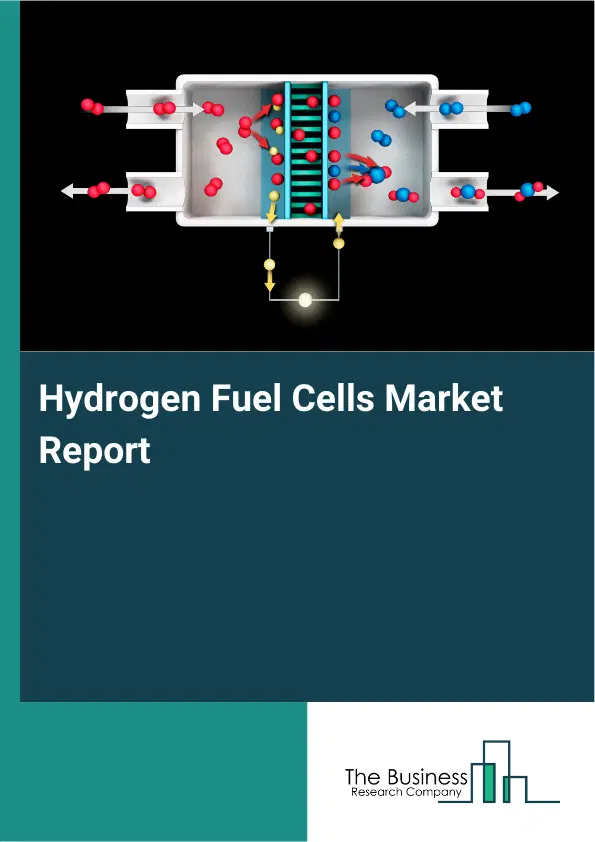
A hydrogen fuel cell is a device that converts hydrogen into clean energy and electricity by a chemical reaction and the by-products of this chemical reaction are electricity, water, and heat. Hydrogen fuel cells can be used in a wide range of applications such as cars, buildings, electronic devices, trucks, and backup power systems. The main types of products in hydrogen fuel cells are proton exchange membrane, direct methanol, solid oxide, alkaline membrane, phosphoric acid, and molten carbonate. A proton exchange membrane (PEM), also known as a polymer electrolyte membrane, is a key component in proton exchange membrane fuel cells (PEMFCs) and other electrochemical devices. These hydrogen fuel cells are used by various end users including fuel cell vehicles, utilities, and defense.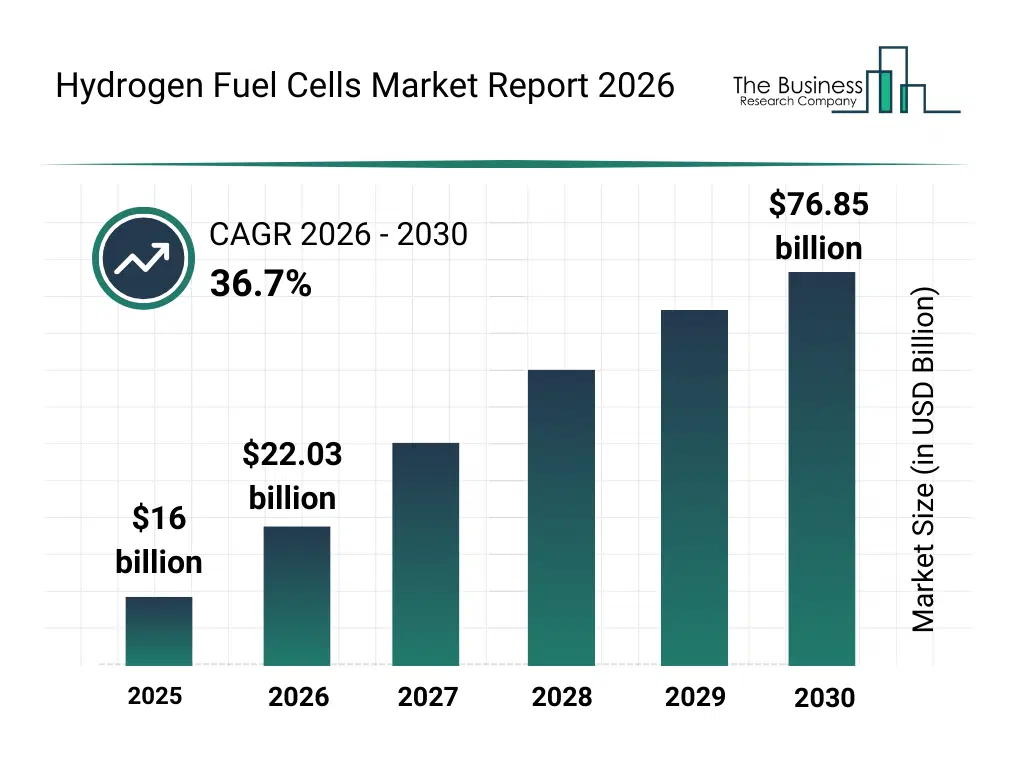
What Is The Hydrogen Fuel Cells Market Size 2026 And Growth Rate?
The hydrogen fuel cells market size has grown exponentially in recent years. It will grow from $16 billion in 2025 to $22.03 billion in 2026 at a compound annual growth rate (CAGR) of 37.7%. The growth in the historic period can be attributed to rise in demand for clean energy solutions, increasing adoption of fuel cell vehicles, growth in stationary power generation applications, rise in research funding for hydrogen technologies, expansion of microgrid and backup power installations.What Is The Hydrogen Fuel Cells Market Growth Forecast?
The hydrogen fuel cells market size is expected to see exponential growth in the next few years. It will grow to $76.85 billion in 2030 at a compound annual growth rate (CAGR) of 36.7%. The growth in the forecast period can be attributed to rising investment in hydrogen infrastructure, increasing production of green hydrogen, growth in heavy duty transport fuel cell adoption, rising demand for long duration energy storage solutions, increasing focus on decentralized clean energy systems. Major trends in the forecast period include rising adoption of hydrogen fuel cells in electric mobility, increasing use of smart monitoring and iot integrated fuel cell systems, advancements in automated manufacturing of fuel cell components, growing focus on low carbon and sustainable energy technologies, rising implementation of digital platforms for fuel cell optimization.Global Hydrogen Fuel Cells Market Segmentation
1) By Type: Proton Exchange Membrane, Direct Methanol, Solid Oxide, Alkaline Membrane, Phosphoric Acid, Molten Carbonate 2) By End-User: Fuel Cell Vehicles, Utilities, Defense 3) By Application: Transportation, Stationary Power Generation, Portable Subsegments: 1) By Proton Exchange Membrane: Automotive PEM Fuel Cells, Portable PEM Fuel Cells 2) By Direct Methanol: Small-scale DMFCs, Portable DMFCs 3) By Solid Oxide: Planar SOFCs, Tubular SOFCs 4) By Alkaline Membrane: Low-Temperature AFCs, High-Temperature AFCs 5) By Phosphoric Acid: Stationary PAFCs, Mobile PAFCs 6) Molten Carbonate: Large-Scale MCFCs, Distributed Generation MCFCsWhat Is The Driver Of The Hydrogen Fuel Cells Market?
The rising demand for electric vehicles will support the growth of the hydrogen fuel cells market. EVs have gained popularity, due to their environmental benefits and reduced dependence on fossil fuels. Fuel-cell electric vehicles use fuel cell stacks to convert onboard gaseous hydrogen to electricity, which is then stored in a battery to power the vehicle's electric motor. Most fuel cell electric vehicles (FCEVs) are powered by hydrogen (H2) and are considered zero-emission vehicles (ZEVs). For instance, in January 2024, according to a report published by Kelley Blue Book, a US-based Cox Automotive company, in 2023, a record 1.2 million car buyers in the United States chose electric vehicles, which accounted for 7.6% of the entire U.S. vehicle market, up from 5.9% in 2022. Therefore, the rising demand for electric vehicles will drive the hydrogen fuel cells industry.Key Players In The Global Hydrogen Fuel Cells Market
Major companies operating in the hydrogen fuel cells market are Plug Power, Toshiba Corporation, Doosan Fuel Cell, Bloom Energy, Ballard Power, SFC Energy AG, Cummins Inc, FuelCell Energy, Panasonic Holdings Corporation, Horizon Fuel Cell Technologies, Reliance Industries, GAIL, National Thermal Power Corporation Limited (NTPC), Indian Oil Corporation, Larsen and Toubro, Adani Green Energy, Tianneng, Corun, Narada, Sinohytec-U, Furuise, Huachang Chemical, Zhongding Group, ITM Power, Ceres Power Holdings, AFC Energy, Proton Motor Power Systems, Hydrogenone Capital Growth, Clean Power Hydrogen, TMH-Energy Solutions, APT spol. s r.o., Grupa Lotos SA, Gdansk-based refiner, Gazprom, Rosatom, Capital Power Corporation, ENMAX (Shepard Energy Centre), Federated Co-operatives Limited (FCL), Strathcona Resources Ltd, Lafarge Canada Inc, ArcelorMittal Mining Canada G.P, Suncor ATCO Heartland Hydrogen Hub, Alberta Power (2000) Ltd. (Heartland Generation), Stelco Inc., Dow Chemical Canada ULC, Bravo Motor, Great Wall Motor, HyundAI Motor Company, Cummins Brazil, Fortescue Rio Negro Hydrogen Complex, H2Pro, Masdar, NEOM Green Hydrogen Company, Car4future, HyPlat, Chem Energy SA, HySA Systems, Mitsubishi Power Egypt.Global Hydrogen Fuel Cells Market Trends and Insights
Major companies in the hydrogen fuel cells market are focused on developing innovative products such as hydrogen fuel cell generator to strengthen their position in the market. A hydrogen fuel cell generator refers to a device that converts hydrogen fuel into electricity through a chemical reaction between hydrogen and oxygen, producing only water and heat as byproducts, making it an environmentally friendly power source. For instance, in April 2024, Panasonic, a Japan-based company, launched H2 KIBOU. H2 KIBOU is a demonstration facility developed by Panasonic that showcases renewable energy solutions, generating 100% of its power from pure hydrogen fuel cell generators and photovoltaic systems. The facility aims to promote the use of hydrogen derived from renewable sources, contributing to Panasonic's goal of achieving RE100 status and a decarbonized society.What Are Latest Mergers And Acquisitions In The Hydrogen Fuel Cells Market?
In December 2024, SFC Energy AG, a Germany-based provider of innovative fuel cell and hybrid power products, acquired of Ballard Power Systems Europe A/S for an undisclosed amount. This deal enhances SFC Energy's product portfolio and strengthens its position in the stationary fuel cell market for backup power and off-grid applications. Ballard Power Systems Europe A/S is a Canada-based provider of proton exchange membrane (PEM) fuel cell technology.Regional Outlook
Asia-Pacific was the largest region in the hydrogen fuel cell market in 2025. North America was the second-largest market in the hydrogen fuel cell market. The regions covered in this market report are Asia-Pacific, South East Asia, Western Europe, Eastern Europe, North America, South America, Middle East, Africa. The countries covered in this market report are Australia, Brazil, China, France, Germany, India, Indonesia, Japan, Taiwan, Russia, South Korea, UK, USA, Canada, Italy, Spain.What Defines the Hydrogen Fuel Cells Market?
The hydrogen fuel cell market consists of sales of direct methanol fuel cells, polymer exchange membrane fuel cells, and other hydrogen fuel cells. Values in this market are ‘factory gate’ values, that is the value of goods sold by the manufacturers or creators of the goods, whether to other entities (including downstream manufacturers, wholesalers, distributors, and retailers) or directly to end customers. The value of goods in this market includes related services sold by the creators of the goods.How is Market Value Defined and Measured?
The market value is defined as the revenues that enterprises gain from the sale of goods and/or services within the specified market and geography through sales, grants, or donations in terms of the currency (in USD unless otherwise specified). The revenues for a specified geography are consumption values that are revenues generated by organizations in the specified geography within the market, irrespective of where they are produced. It does not include revenues from resales along the supply chain, either further along the supply chain or as part of other products.What Key Data and Analysis Are Included in the Hydrogen Fuel Cells Market Report 2026?
The hydrogen fuel cells market research report is one of a series of new reports from The Business Research Company that provides market statistics, including industry global market size, regional shares, competitors with the market share, detailed market segments, market trends and opportunities, and any further data you may need to thrive in the hydrogen fuel cells industry. The market research report delivers a complete perspective of everything you need, with an in-depth analysis of the current and future state of the industry.Hydrogen Fuel Cells Market Report 2026 Market Report Forecast Analysis
| Report Attribute | Details |
|---|---|
| Market Size Value In 2026 | $22.03 billion |
| Revenue Forecast In 2035 | $76.85 billion |
| Growth Rate | CAGR of 37.7% from 2026 to 2035 |
| Base Year For Estimation | 2025 |
| Actual Estimates/Historical Data | 2020-2025 |
| Forecast Period | 2026 - 2030 - 2035 |
| Market Representation | Revenue in USD Billion and CAGR from 2026 to 2035 |
| Segments Covered | Type, End-User, Application |
| Regional Scope | Asia-Pacific, Western Europe, Eastern Europe, North America, South America, Middle East, Africa |
| Country Scope | The countries covered in the report are Australia, Brazil, China, France, Germany, India, ... |
| Key Companies Profiled | Plug Power, Toshiba Corporation, Doosan Fuel Cell, Bloom Energy, Ballard Power, SFC Energy AG, Cummins Inc, FuelCell Energy, Panasonic Holdings Corporation, Horizon Fuel Cell Technologies, Reliance Industries, GAIL, National Thermal Power Corporation Limited (NTPC), Indian Oil Corporation, Larsen and Toubro, Adani Green Energy, Tianneng, Corun, Narada, Sinohytec-U, Furuise, Huachang Chemical, Zhongding Group, ITM Power, Ceres Power Holdings, AFC Energy, Proton Motor Power Systems, Hydrogenone Capital Growth, Clean Power Hydrogen, TMH-Energy Solutions, APT spol. s r.o., Grupa Lotos SA, Gdansk-based refiner, Gazprom, Rosatom, Capital Power Corporation, ENMAX (Shepard Energy Centre), Federated Co-operatives Limited (FCL), Strathcona Resources Ltd, Lafarge Canada Inc, ArcelorMittal Mining Canada G.P, Suncor ATCO Heartland Hydrogen Hub, Alberta Power (2000) Ltd. (Heartland Generation), Stelco Inc., Dow Chemical Canada ULC, Bravo Motor, Great Wall Motor, HyundAI Motor Company, Cummins Brazil, Fortescue Rio Negro Hydrogen Complex, H2Pro, Masdar, NEOM Green Hydrogen Company, Car4future, HyPlat, Chem Energy SA, HySA Systems, Mitsubishi Power Egypt. |
| Customization Scope | Request for Customization |
| Pricing And Purchase Options | Explore Purchase Options |