
Industrial Automation Market Report 2026
Global Outlook – By Component (Industrial Robots, Human Machine Interface (HMI), Industrial Sensors, Control Valves, Other Components), By Control System (Supervisory Control and Data Acquisition (SCADA), Programmable Logic Controller (PLC), Distributed Control System (DCS), Manufacturing Execution System (MES), Product Lifecycle Management (PLM), Enterprise Resource Planning (ERP), Other Control Systems), By Industry (Aerospace and Defense, Automotive, Healthcare, Energy and Utilities, Food and Beverages, Oil and Gas, Mining, Transportation, Other Industries) – Market Size, Trends, Strategies, and Forecast to 2030
Industrial Automation Market Overview
• Industrial Automation market size has reached to $210.68 billion in 2025 • Expected to grow to $302.01 billion in 2030 at a compound annual growth rate (CAGR) of 7.5% • Growth Driver: Rising Significance Of Robotics Drives Growth In The Industrial Automation Market • Market Trend: AI Enabled Vision-Based Robotics Transform Industrial Automation Efficiency • Asia-Pacific was the largest region in 2025.Market Gains By 2030 – Top Opportunities By Segment
Market Gain identifies the most promising market opportunities by highlighting the segments or products expected to generate the highest incremental revenue growth over the next five years.
What Is Covered Under Industrial Automation Market?
Industrial automation is used to control and monitor a process, machine, or device in a computerized manner that will fulfill repetitive functions or tasks. They are designed to operate automatically to reduce and improve human work in the industry. They are operated using logical programming commands and powerful machinery. The main components of industrial automation are industrial robots, human-machine interfaces (HMI), industrial sensors, control valves, and other components. Industrial automation uses HMIs to monitor machinery to make sure it's working properly and also; they are helpful in the maintenance of the machinery in the industries. They use various control systems such as supervisory control and data acquisition (SCADA), distributed control system (DCS), programmable logic controller (PLC), Manufacturing Execution System (MES), component lifecycle management (PLM), enterprise resource planning (ERP), and human-machine interface (HMI) that are used by aerospace and defense, automotive, healthcare, energy and utilities, manufacturing food and beverages, oil and gas, mining, transportation, and other industries.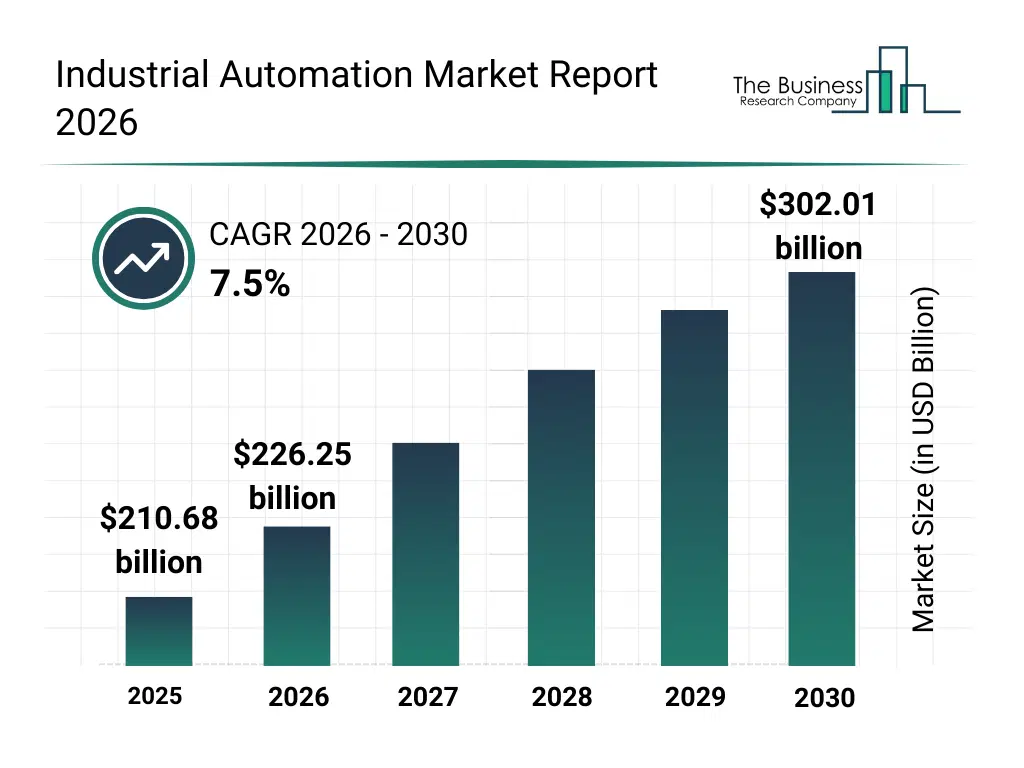
What Is The Industrial Automation Market Size and Share 2026?
The industrial automation market size has grown strongly in recent years. It will grow from $210.68 billion in 2025 to $226.25 billion in 2026 at a compound annual growth rate (CAGR) of 7.4%. The growth in the historic period can be attributed to manufacturing process standardization, demand for higher production efficiency, reduction of manual labor dependency, improvement in workplace safety, growth of mass production.What Is The Industrial Automation Market Growth Forecast?
The industrial automation market size is expected to see strong growth in the next few years. It will grow to $302.01 billion in 2030 at a compound annual growth rate (CAGR) of 7.5%. The growth in the forecast period can be attributed to adoption of AI driven automation, shortage of skilled labor, expansion of connected manufacturing ecosystems, focus on operational cost optimization, rising investments in smart infrastructure. Major trends in the forecast period include smart factory adoption, industrial robotics integration, real time process monitoring, predictive maintenance systems, flexible manufacturing automation.
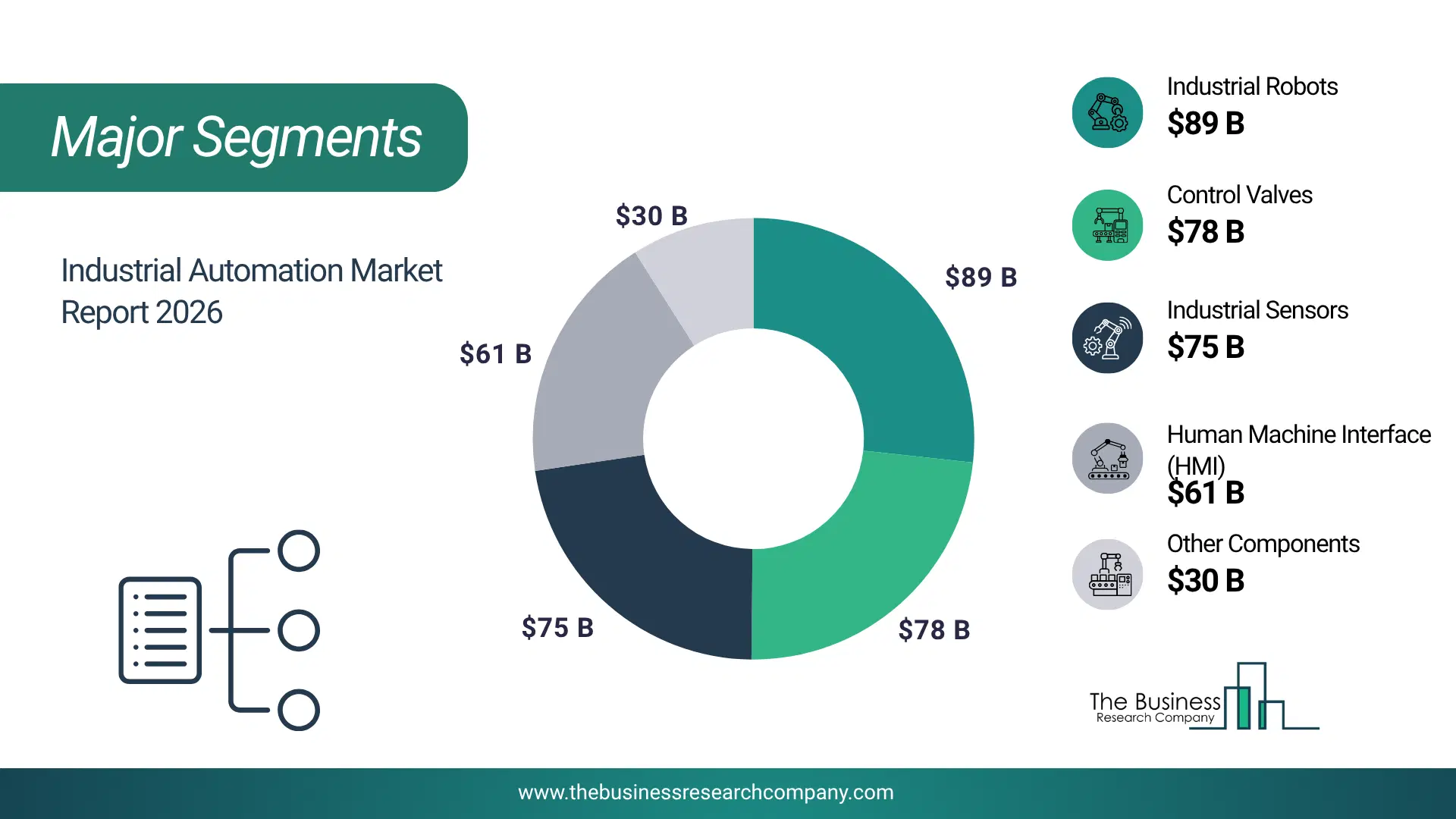
Global Industrial Automation Market Segmentation
1) By Component: Industrial Robots, Human Machine Interface (HMI), Industrial Sensors, Control Valves, Other Components 2) By Control System: Supervisory Control and Data Acquisition (SCADA), Programmable Logic Controller (PLC), Distributed Control System (DCS), Manufacturing Execution System (MES), Product Lifecycle Management (PLM), Enterprise Resource Planning (ERP), Other Control Systems 3) By Industry: Aerospace and Defense, Automotive, Healthcare, Energy and Utilities, Food and Beverages, Oil and Gas, Mining, Transportation, Other Industries Subsegments: 1) By Industrial Robots: Articulated Robots, SCARA Robots, Cartesian Robots, Collaborative Robots (Cobots), Delta Robots 2) By Human Machine Interface (HMI): Touch Screen HMI, PC-based HMI, Web-based HMI, Mobile HMI 3) By Industrial Sensors: Proximity Sensors, Pressure Sensors, Temperature Sensors, Level Sensors, Flow Sensors 4) By Control Valves: Globe Control Valves, Ball Control Valves, Butterfly Control Valves, Solenoid Control Valves 5) By Other Components: PLCs (Programmable Logic Controllers), Industrial Ethernet Switches, Servo Drives And Motors, Data Acquisition Systems The top segments in the industrial automation market will be: • Industrial Robots will reach $57492.41 Million by 2025. • Enterprise Resource Planning (ERP) will reach $52305.6 Million by 2025. • Control Valves will reach $51213.29 Million by 2025. • Industrial Sensors will reach $47911.66 Million by 2025. • Distributed Control System (DCS) will reach $45686.48 Million by 2025.What Is The Driver Of The Industrial Automation Market?
The increasing significance of robotics is expected to propel the growth of the industrial automation market going forward. Robotics involves the design, manufacture, and operation of intelligent machines to assist humans.Robotics is being increasingly applied in industrial automation processes to handle various processes and machinery in an industry to increase efficiency, replace manual labor, and increase speed, and overall performance. For instance, in April 2024, according to International Federation of Robotics, a Germany-based non-profit organization, in 2023, the total number of industrial robot installations rose by 12%, totaling 44,303 units. Therefore, the increasing significance of robotics is driving the industrial automation industry.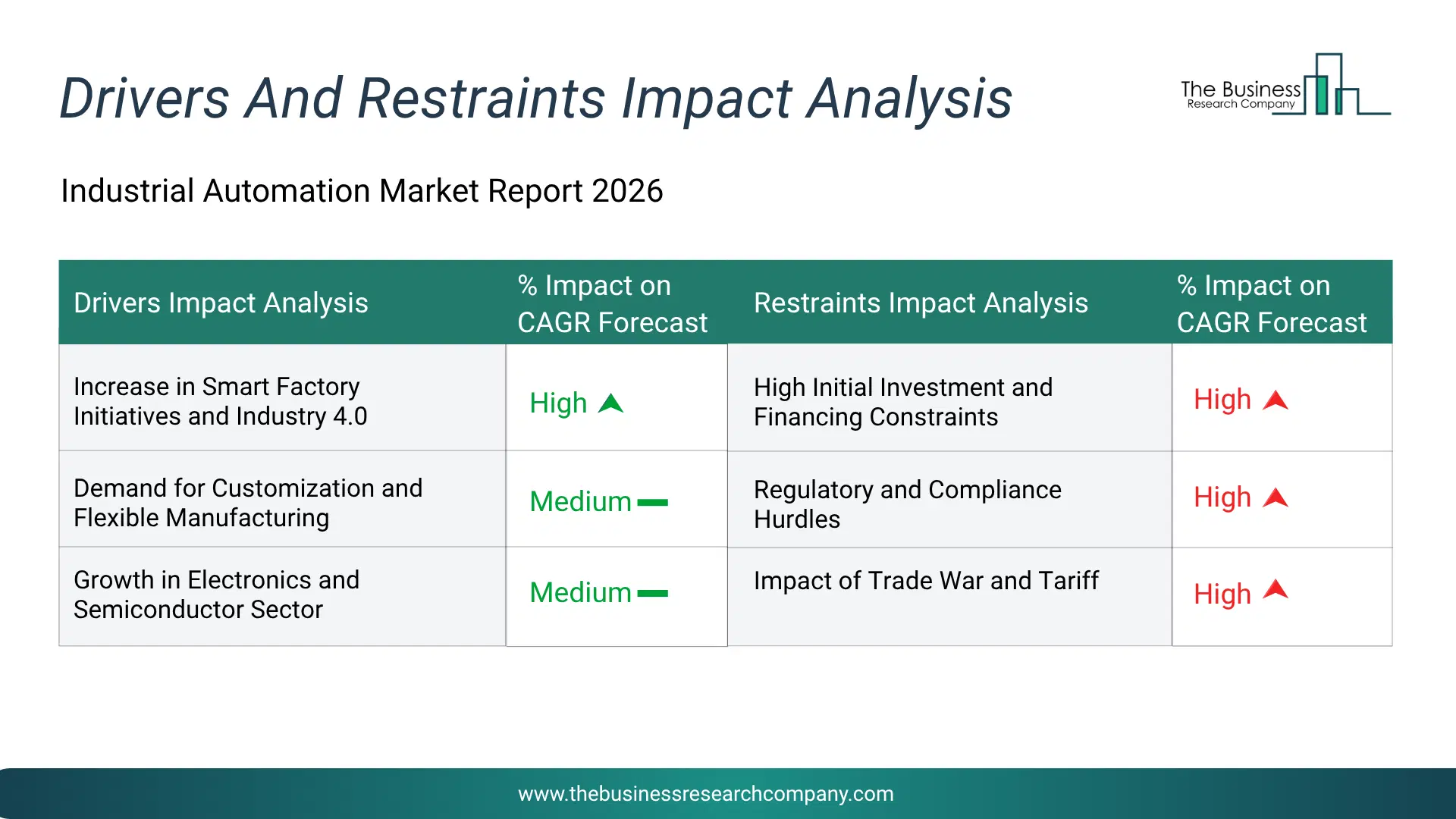
Infographic Chart Showing Key Market Drivers Analysis And Restraints For Industrial Automation Market
The chart presents an impact analysis of key drivers and restraints, quantifying their relative influence on the market's growth rate and helping assess the balance between growth enablers and limiting factors. This chart offers a high-level perspective; the full report contains more detailed insights.
How Will The Drivers Impact Growth In The Global Industrial Automation Market?
• Increase in Smart Factory Initiatives and Industry 4.0 (High) – The increase in smart factory initiatives and industry 4.0 will become a key driver of growth in the industrial automation market by 2030. The integration of advanced digital solutions—such as IoT, AI, cloud computing, and data analytics—into manufacturing operations is transforming traditional production systems into intelligent, connected, and highly efficient environments. These initiatives aim to boost productivity, optimize resource usage, and enhance product quality through automation and real-time data insights. Supported by government programs and industrial modernization policies, this digital transformation is attracting substantial investments in advanced manufacturing infrastructure. As industries increasingly embrace Industry 4.0 standards and connected automation systems, demand for robotics, intelligent control technologies, and data-driven manufacturing solutions is expected to surge, fuelling significant growth in the industrial automation market over the forecast period. As a result, the increase in smart factory initiatives and industry 4.0 is anticipated to contributing to a 2.0% annual growth in the market. • Demand for Customization and Flexible Manufacturing (Medium) – The demand for customization and flexible manufacturing will emerge as a major factor driving the expansion of the industrial automation market by 2030. As industries transition from traditional mass production toward adaptive, on-demand manufacturing systems, automation technologies are becoming vital for meeting diverse and rapidly evolving customer needs. To achieve greater flexibility, manufacturers are increasingly adopting digital design tools, robotics, and additive manufacturing technologies that enable rapid product variation, minimize downtime, and simplify production line reconfiguration. This shift toward flexible automation allows companies to deliver customized products efficiently, without compromising on quality or cost-effectiveness. Furthermore, advancements in 3D printing and smart manufacturing systems are accelerating this evolution, fostering innovation, and enhancing responsiveness across industrial operations. As consumers and businesses continue to prioritize personalization and fast delivery, flexible and automated manufacturing solutions will play a pivotal role in shaping the future of industrial production, thereby fuelling the growth of the industrial automation market throughout the forecast period. Consequently, the demand for customization and flexible manufacturing is projected to contributing to a 1.7% annual growth in the market. • Growth in Electronics and Semiconductor Sector (Medium) – The growth in electronics and semiconductor sector as a major factor driving the expansion of the industrial automation market by 2030. Rapid technological advancements in semiconductor fabrication and electronics manufacturing are creating a strong demand for precise, efficient, and scalable automation solutions. As the production of electronic components, consumer devices, and integrated circuits continues to rise, manufacturers are increasingly adopting robotics, process automation, and digital monitoring technologies to maintain consistency, enhance productivity, and meet stringent global quality standards. Supported by government initiatives promoting domestic manufacturing and technological self-sufficiency, the sector is experiencing substantial investments and capacity growth. The surge in electronics production from mobile devices to semiconductor chips is further boosting the demand for automation systems that can optimize assembly, inspection, and packaging processes. Consequently, the industrial automation market is poised for significant growth throughout the forecast period, fuelled by the rapid development of the electronics and semiconductor industries. Consequently, growth in electronics and semiconductor sector is projected to contributing to a 1.5% annual growth in the market. • Rise in Integration of IoT, Artificial Intelligence (AI), and Machine Learning (ML) (Medium) – The rise in integration of IoT, artificial intelligence (AI) and machine learning (ML) will emerge as a major factor driving the expansion of the industrial automation market by 2030. The convergence of these technologies is transforming traditional automation systems into intelligent, data-driven ecosystems capable of self-optimization and predictive decision-making. IoT connectivity facilitates seamless data exchange among machines, sensors, and control systems, while AI and ML algorithms analyse this data to improve process efficiency, minimize downtime, and enable real-time production adjustments. The increasing deployment of large-scale industrial IoT networks and AI-driven control systems is allowing manufacturers to create autonomous operations that continuously learn and enhance performance. As industries pursue higher productivity, precision, and sustainability, the integration of IoT, AI, and ML is becoming essential for developing adaptive and resilient manufacturing systems. Consequently, this technological synergy is projected to be a key driver of the industrial automation market throughout the forecast period. Consequently, the rise in integration of IoT, artificial intelligence (AI) and machine learning (ML) are projected to contributing to a 1.0% annual growth in the market.How Will The Restraints Impact Growth In The Global Industrial Automation Market?
• High Initial Investment and Financing Constraints (Medium) – High Initial Investment and Financing Constraints will restrict the growth of the Industrial Automation market during the forecast period. Industrial automation implementation requires significant capital investment in equipment, software, and integration. High costs create barriers for smaller manufacturers with limited budgets. Financing constraints can limit the adoption of automation technologies and affect market growth. • Regulatory and Compliance Hurdles (Medium) – Regulatory and Compliance Hurdles will restrict the growth of the Industrial Automation market during the forecast period. Industrial automation systems must comply with safety, quality, and industry-specific regulations. Compliance requirements add to implementation costs and timelines. Regulatory hurdles can affect the adoption of automation technologies and limit market growth in regulated industries. • Impact of Trade War and Tariff (Medium) – Impact of Trade War and Tariff will restrict the growth of the Industrial Automation market during the forecast period. Industrial automation equipment relies on imported components and systems subject to trade tariffs. Trade barriers can increase implementation costs and affect project economics. Trade tensions may also impact manufacturing investment and automation demand.Key Players In The Global Industrial Automation Market
Major companies operating in the industrial automation market are Siemens AG; ABB Ltd; Mitsubishi Electric Corporation; Schneider Electric; Fanuc Corporation; Omron Corporation; Emerson Electric Co.; Rockwell Automation Inc.; Yaskawa Electric Corporation; General Electric; EFACEC Electric International Engineering Co. Ltd; Youibot Robotics; InterTech Development Company; Immetech Industrial Co. Ltd; Zinsser Analytic GmbH; Wiesemann & Theis GmbH; Lammers Automation GmbH; syskomp gehmeyr GmbH; vision-tec gmbh; Otc Daihen Europe Gmbh; Honeywell International Inc.; Cognex Corporation; Teradyne Inc.; National Instruments Corporation; Novanta Inc.; Yokogawa Electric; Festo South Africa; SMC Corporation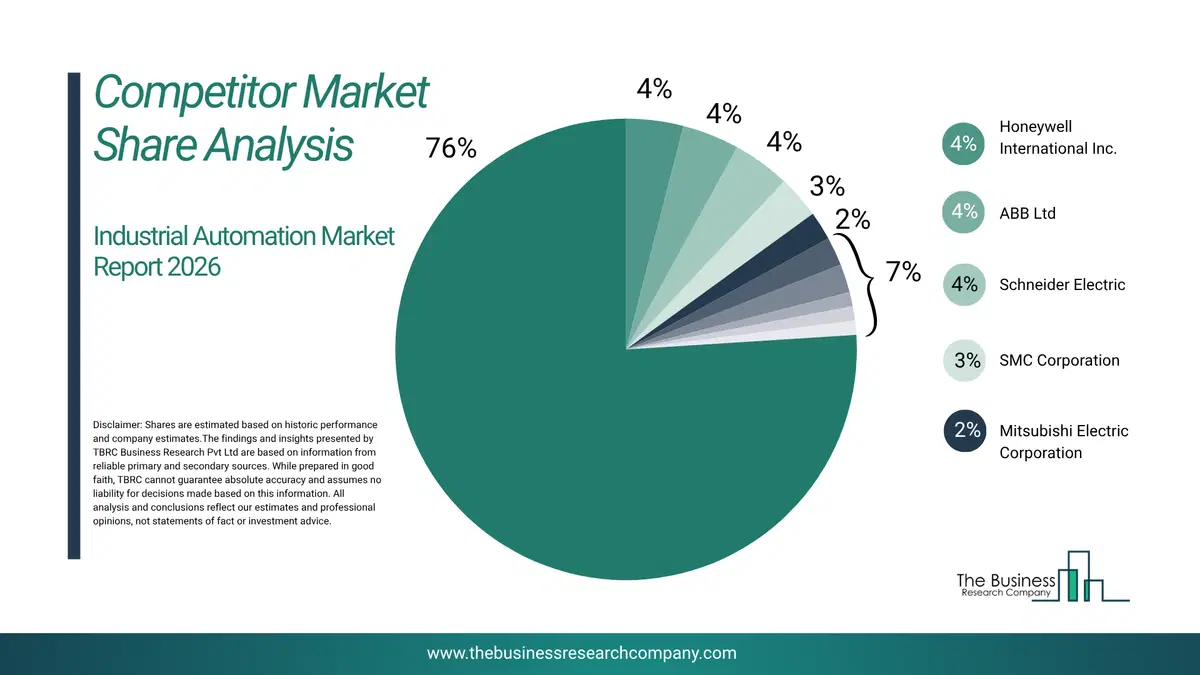
This chart is for illustrative purposes; the full report includes a detailed competitor analysis and comprehensive overview of the top 10 companies in the market.
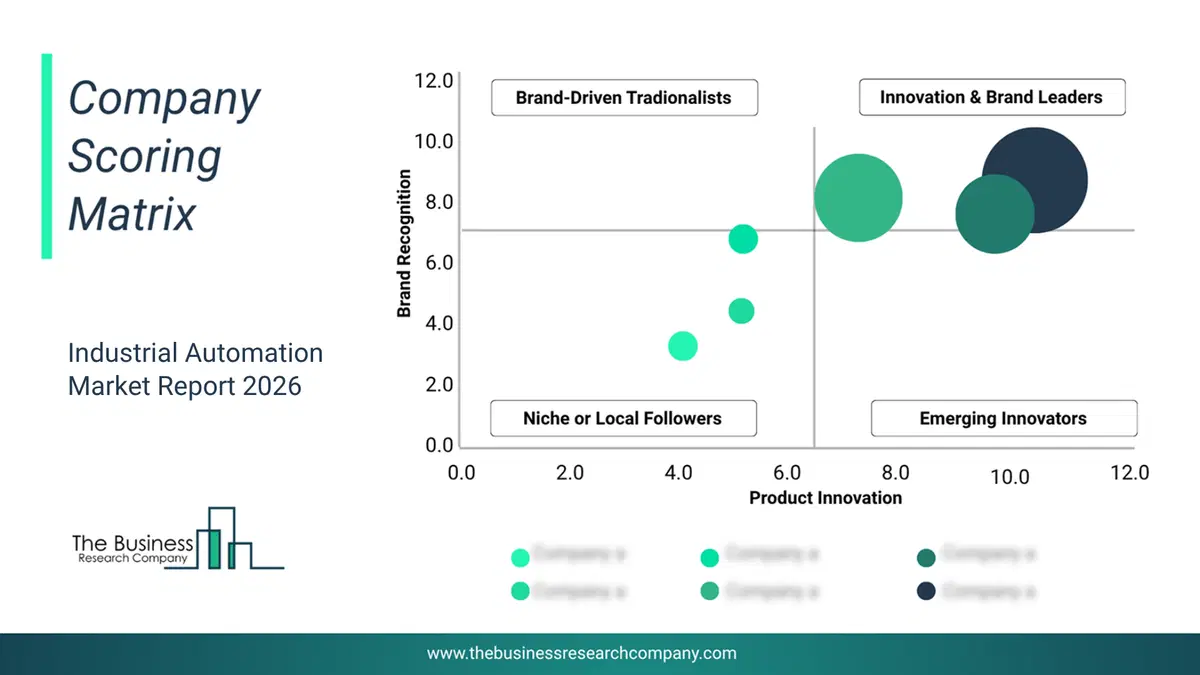
This chart maps companies by product innovation and brand strength, with bubble size indicating relative revenue, helping identify market leaders, challengers, and niche players. This is an illustrative chart; the full report provides a complete and accurate competitive analysis.
Global Industrial Automation Market Trends and Insights
Major companies operating in the industrial automation market are focusing on developing advanced solutions, such as AI enabled vision based piece picking systems, to increase throughput, enhance manufacturing flexibility, and address labor shortages. AI enabled vision-based piece picking systems combine 3D cameras, computer vision algorithms, and robotic arms to autonomously identify, grasp, and sort randomly placed items, unlike traditional robotic systems that rely on fixed item placement, rigid grippers, and pre-programmed trajectories. For instance, in May 2024, Consorzio Macchine Utensili, an Italy-based industrial automation company, launched its S Family of 6 axis articulated robots along with the vision-based piece picking system MI.RA or OnePicker, an innovative solution for arc welding, handling, and random-object sorting applications. The system integrates vision sensors with AI-powered motion planning and object recognition, features IP68-rated compact robots with flexible mounting options, and supports high-density deployment in confined spaces. Its applications span arc welding, assembly, food & beverage, foundry, battery manufacturing, and general material handling, offering benefits such as optimized space utilization, faster adaptation to mixed production, and reduced downtime and reprogramming efforts.What Are Latest Mergers And Acquisitions In The Industrial Automation Market?
In January 2023, Schneider Electric, a France-based provider of energy management and industrial automation solutions, acquired AVEVA Group plc for an undisclosed amount. Through this acquisition, Schneider Electric aims to enhance its digital automation offerings by integrating AVEVA’s global industrial software capabilities, driving a holistic approach to efficiency and sustainability in customer operations. AVEVA Group plc is a UK-based company that provides industrial automation through its software solutions and a robust partner ecosystem.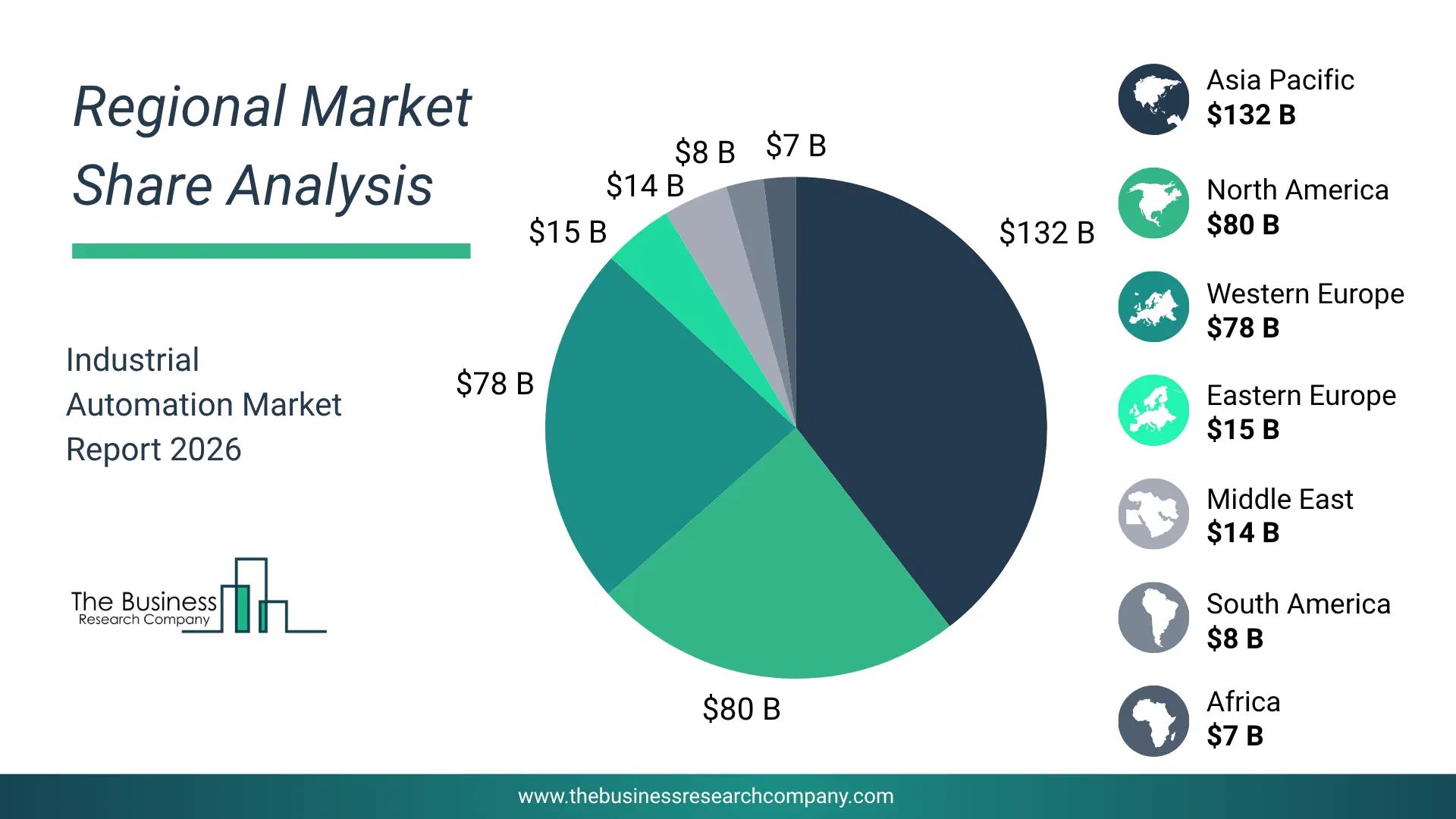
Regional Insights
Asia-Pacific was the largest region in the industrial automation market in 2025. The regions covered in this market report are Asia-Pacific, South East Asia, Western Europe, Eastern Europe, North America, South America, Middle East, Africa. The countries covered in this market report are Australia, Brazil, China, France, Germany, India, Indonesia, Japan, Taiwan, Russia, South Korea, UK, USA, Canada, Italy, SpainWhat Defines the Industrial Automation Market?
The industrial automation market includes revenues earned by entities by manufacturing automation, automated quality inspection systems, process automation services, remote monitoring and control. The market value includes the value of related goods sold by the service provider or included within the service offering. Only goods and services traded between entities or sold to end consumers are included.How is Market Value Defined and Measured?
The market value is defined as the revenues that enterprises gain from the sale of goods and/or services within the specified market and geography through sales, grants, or donations in terms of the currency (in USD unless otherwise specified). The revenues for a specified geography are consumption values that are revenues generated by organizations in the specified geography within the market, irrespective of where they are produced. It does not include revenues from resales along the supply chain, either further along the supply chain or as part of other products.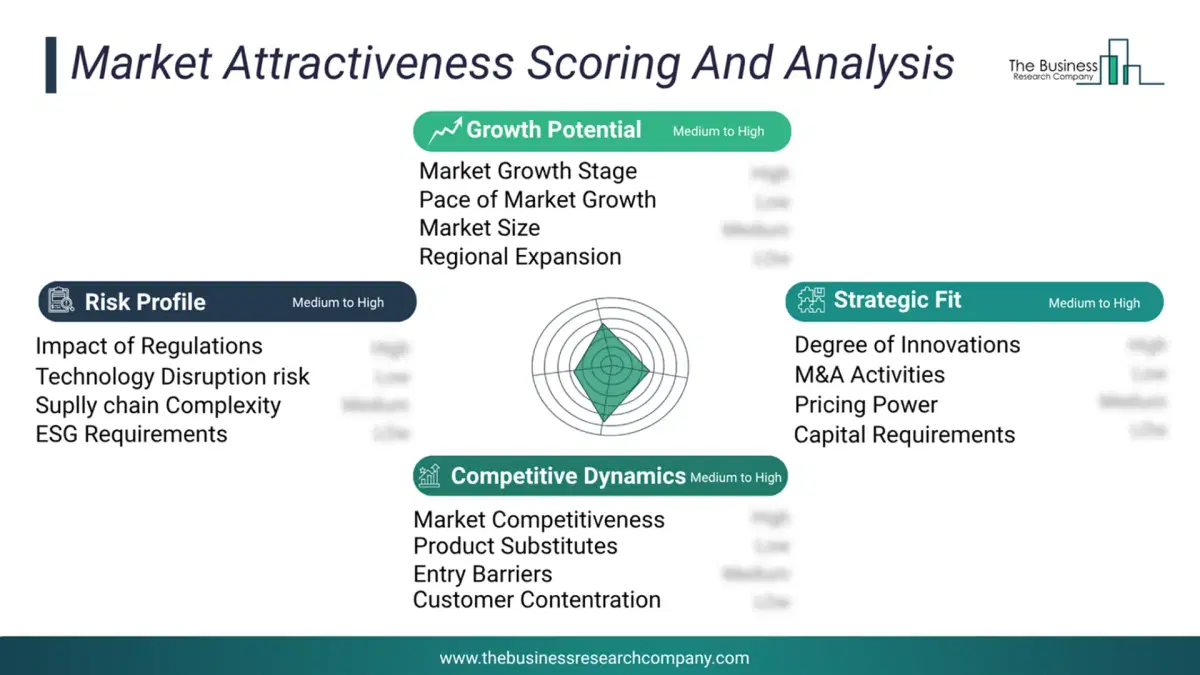
This chart presents market attractiveness based on a quantitative evaluation of growth, competition, strategic alignment, and risk, offering a clear view of opportunity areas for decision-making. This chart is for illustrative purposes; the full report contains the complete analysis.
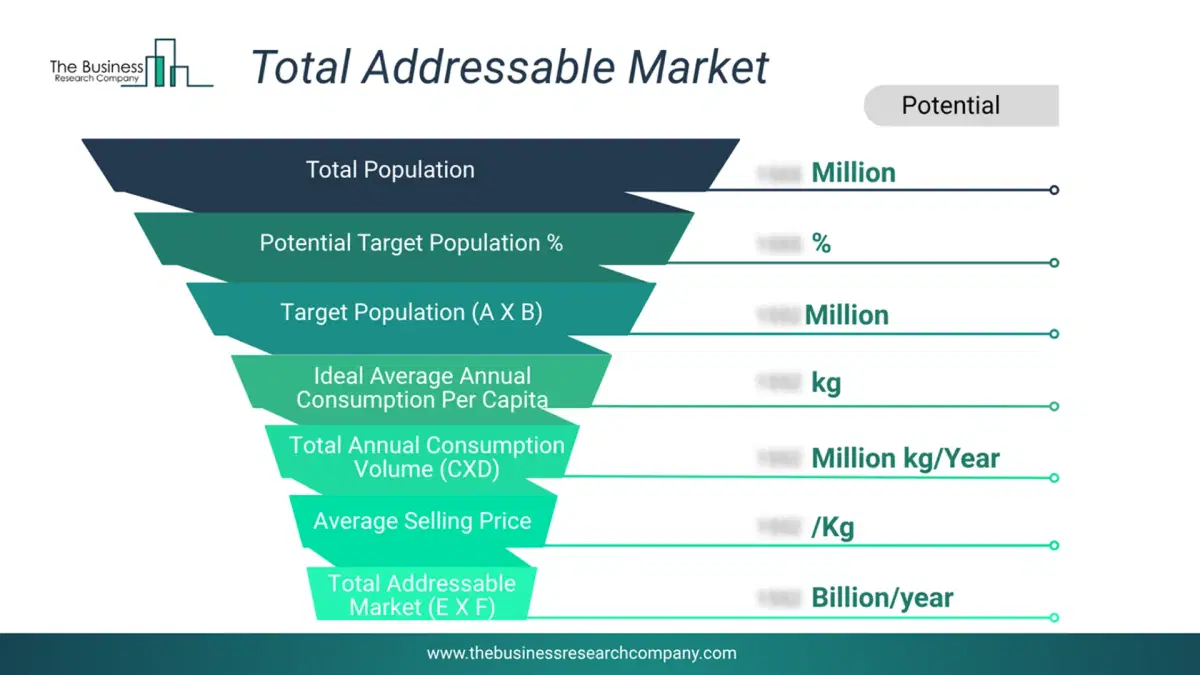
This chart highlights the Total Addressable Market (TAM) by estimating the maximum revenue opportunity using an assumption-driven approach, supporting strategic planning and opportunity sizing across markets. The chart is illustrative; the full report provides a more comprehensive analysis.
What Key Data and Analysis Are Included in the Industrial Automation Market Report 2026?
The industrial automation market research report is one of a series of new reports from The Business Research Company that provides market statistics, including industry global market size, regional shares, competitors with the market share, detailed market segments, market trends and opportunities, and any further data you may need to thrive in the industrial automation industry. The market research report delivers a complete perspective of everything you need, with an in-depth analysis of the current and future state of the industry.Industrial Automation Market Report Forecast Analysis
| Report Attribute | Details |
|---|---|
| Market Size Value In 2026 | $226.25 billion |
| Revenue Forecast In 2030 | $302.01 billion |
| Growth Rate | CAGR of 7.4% from 2026 to 2030 |
| Base Year For Estimation | 2025 |
| Actual Estimates/Historical Data | 2020-2025 |
| Forecast Period | 2026 - 2030 |
| Market Representation | Revenue in USD Billion and CAGR from 2026 to 2030 |
| Segments Covered | Component, Control System, Industry |
| Regional Scope | Asia-Pacific, Western Europe, Eastern Europe, North America, South America, Middle East, Africa |
| Country Scope | The countries covered in the report are Australia, Brazil, China, France, Germany, India, Indonesia, Japan, Taiwan, Russia, South Korea, UK, USA, Canada, Italy, Spain. |
| Key Companies Profiled | Siemens AG; ABB Ltd; Mitsubishi Electric Corporation; Schneider Electric; Fanuc Corporation; Omron Corporation; Emerson Electric Co.; Rockwell Automation Inc.; Yaskawa Electric Corporation; General Electric; EFACEC Electric International Engineering Co. Ltd; Youibot Robotics; InterTech Development Company; Immetech Industrial Co. Ltd; Zinsser Analytic GmbH; Wiesemann & Theis GmbH; Lammers Automation GmbH; syskomp gehmeyr GmbH; vision-tec gmbh; Otc Daihen Europe Gmbh; Honeywell International Inc.; Cognex Corporation; Teradyne Inc.; National Instruments Corporation; Novanta Inc.; Yokogawa Electric; Festo South Africa; SMC Corporation |
| Customization Scope | Request for Customization |
| Pricing And Purchase Options | Explore Purchase Options |