

Industrial Machinery Market Report 2026
Global Outlook – By Type (Woodworking And Paper Machinery, Printing Machinery And Equipment, Semiconductor Machinery, Food Product Machinery, Other Industrial Machinery ), By Operation (Autonomous, Semi-Autonomous, Manual ), By Capacity (Small, Medium, Large ) – Market Size, Trends, Strategies, and Forecast to 2030
Industrial Machinery Market Overview
• industrial machinery market size has reached to $613.44 billion in 2025 • Expected to grow to $847.68 billion in 2030 at a compound annual growth rate (CAGR) of 6.9% • Growth Driver: Manufacturing Growth As A Catalyst For The Industrial Machinery Market • Market Trend: Embracing Modular And Miniature Machines For Enhanced Competitiveness • Asia-Pacific was the largest region in 2025 and Western Europe is the fastest growing region.Market Gains By 2030 – Top Opportunities By Segment
Market Gain identifies the most promising market opportunities by highlighting the segments or products expected to generate the highest incremental revenue growth over the next five years.
What Is Covered Under Industrial Machinery Market?
Industrial machinery is power-driven machines or groups of machines working together in a coordinated manner in various industrial activities. This is used to cut, shape, form, press, lamination, or a combination of these processes. They are not portable by hand while working. The main types of industrial machinery are woodworking and paper machinery, other industrial machinery, printing machinery and equipment, semiconductor machinery, and food production machinery. Woodworking and paper machinery refers to the equipment that deals with wood and paper products. The various operations include autonomous, semi-autonomous, and manual. The various specificity includes small, medium, and large.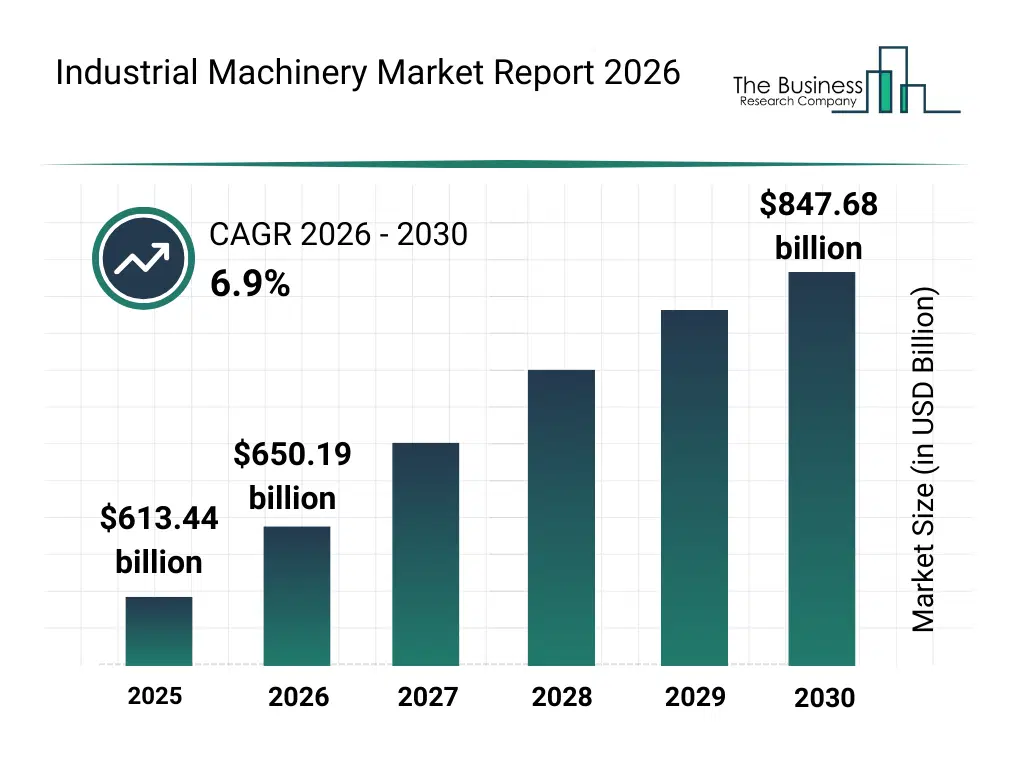
What Is The Industrial Machinery Market Size and Share 2026?
The industrial machinery market size has grown strongly in recent years. It will grow from $613.44 billion in 2025 to $650.19 billion in 2026 at a compound annual growth rate (CAGR) of 6.0%. The growth in the historic period can be attributed to industrialization growth, demand for mass production equipment, mechanization of manufacturing, expansion of industrial facilities, availability of conventional machinery.What Is The Industrial Machinery Market Growth Forecast?
The industrial machinery market size is expected to see strong growth in the next few years. It will grow to $847.68 billion in 2030 at a compound annual growth rate (CAGR) of 6.9%. The growth in the forecast period can be attributed to industry 4.0 adoption, demand for smart factories, labor cost optimization, customization in manufacturing, investment in advanced machinery. Major trends in the forecast period include shift toward automated production lines, rising demand for high-precision machinery, integration of smart sensors in equipment, growth of flexible manufacturing systems, expansion of multi-industry machinery usage.Tariff Impact On Industrial Machinery Market
Tariffs are impacting the industrial machinery market by increasing the cost of imported machine tools, control systems, bearings, motors, and fabricated metal components used across woodworking, semiconductor, and food processing machinery. Manufacturers in North America and Europe are particularly affected due to reliance on imported high-precision parts, while Asia-Pacific exporters face pricing pressure in global markets. These tariffs are raising capital expenditure and delaying machinery upgrades for small and mid-sized manufacturers. However, they are also encouraging localization of machinery manufacturing, regional sourcing of components, and innovation in cost-efficient and modular industrial equipment designs.
Global Industrial Machinery Market Segmentation
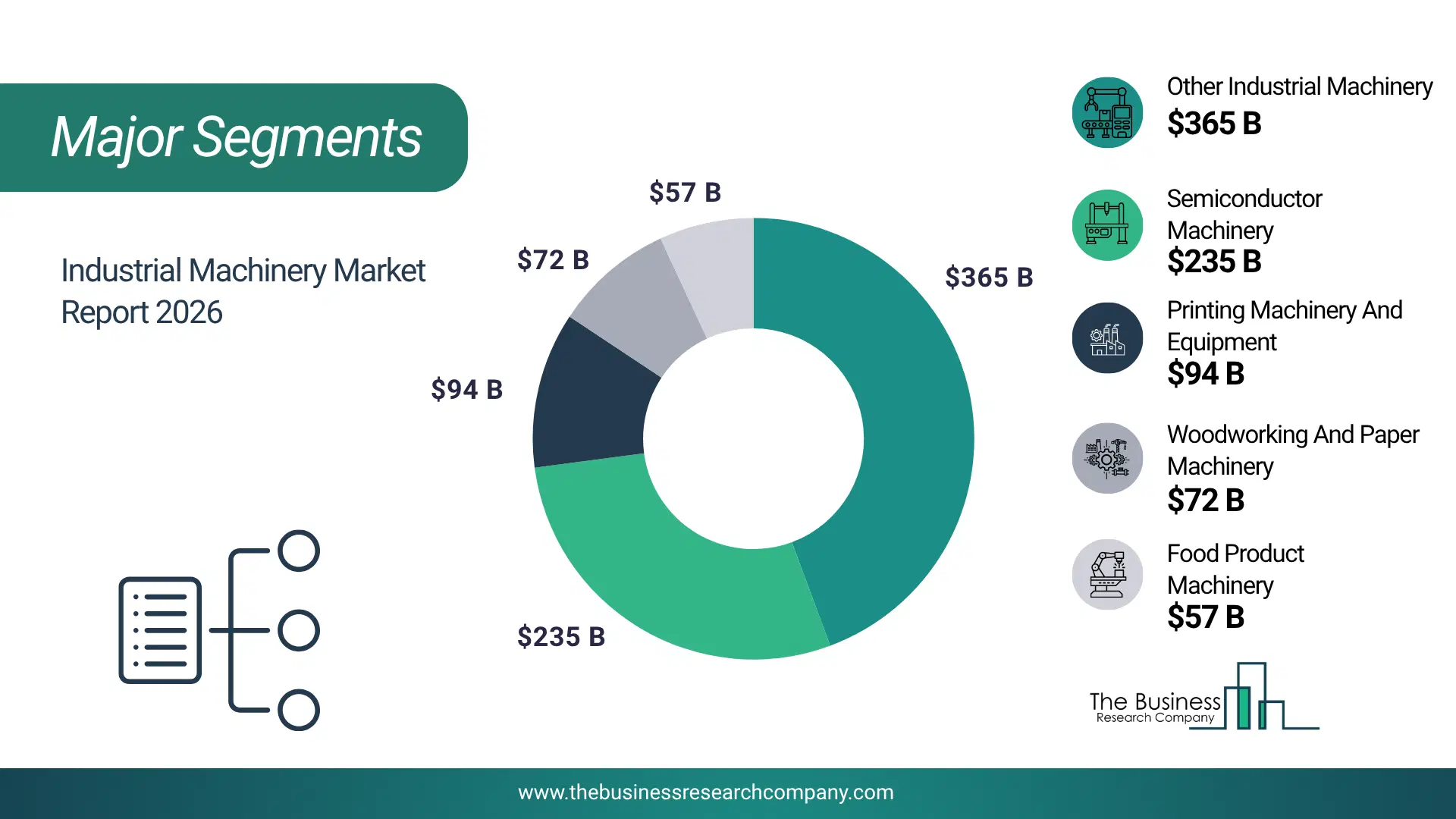
1) By Type: Woodworking And Paper Machinery, Printing Machinery And Equipment, Semiconductor Machinery, Food Product Machinery, Other Industrial Machinery 2) By Operation: Autonomous, Semi-Autonomous, Manual 3) By Capacity: Small, Medium, Large Subsegments: 1) By Woodworking And Paper Machinery: Sawing And Cutting Machines, Paper Processing Machines 2) By Printing Machinery And Equipment: Digital Printing Machines, Offset Printing Presses, Screen Printing Equipment 3) By Semiconductor Machinery: Wafer Processing Equipment, Chip Assembly And Packaging Machinery 4) By Food Product Machinery: Food Processing Machines, Packaging Equipment For Food Products 5) By Other Industrial Machinery: Textile Machinery, Plastic And Rubber Machinery, Metalworking Machinery, Mining And Construction MachineryThe top segments in the industrial machinery market will be: • Other Industrial Machinery will reach $365 Billion by 2030. • Semiconductor Machinery will reach $235 Billion by 2030. • Printing Machinery And Equipment will reach $94 Billion by 2030. • Woodworking And Paper Machinery will reach $72 Billion by 2030. • Food Product Machinery will reach $57 Billion by 2030.What Are The Drivers Of The Industrial Machinery Market?
The increasing manufacturing output across industries is expected to propel the growth of the industrial machinery market going forward. Manufacturing output refers to the quantity of products or goods produced by manufacturing processes within various industries. Industrial machinery is essential for automating and streamlining a variety of manufacturing processes, including cutting, forming, assembling, and packaging. For instance, in July 2023, according to Eurostat, a UK-based government statistical agency, industrial output in the euro area witnessed a 0.2% increase. Moreover, a 0.1% increase was reported in the European Union during the period between May and April 2023. Therefore, increasing manufacturing output across industries will drive the future industrial machinery industry. Rapid advances in technology are expected to drive innovation in industrial machinery manufacturing, thus driving the market during the forecast period. Furthermore, technologies such as 3D printing, artificial intelligence, and big data analytics are being used in manufacturing thus resulting in higher productivity, lower operating costs, and higher margins. For instance, according to a global survey by The Economist Intelligence Unit, about 90% of corporate executives felt that artificial intelligence (AI) will have a positive impact on a company’s growth and 86% of respondents considered that AI will help improve productivity. Lower operating costs lead to higher margins, this allows companies to increase product portfolio and enter new markets by making investments made through cost savings. IoT applications are also being integrated into these devices to enable services such as remote monitoring, and central feedback systems and to offer other services. Mobile applications, advanced sensors, and embedded software also created new opportunities for companies in this market. These factors are expected to drive the industrial machinery industry during the forecast period.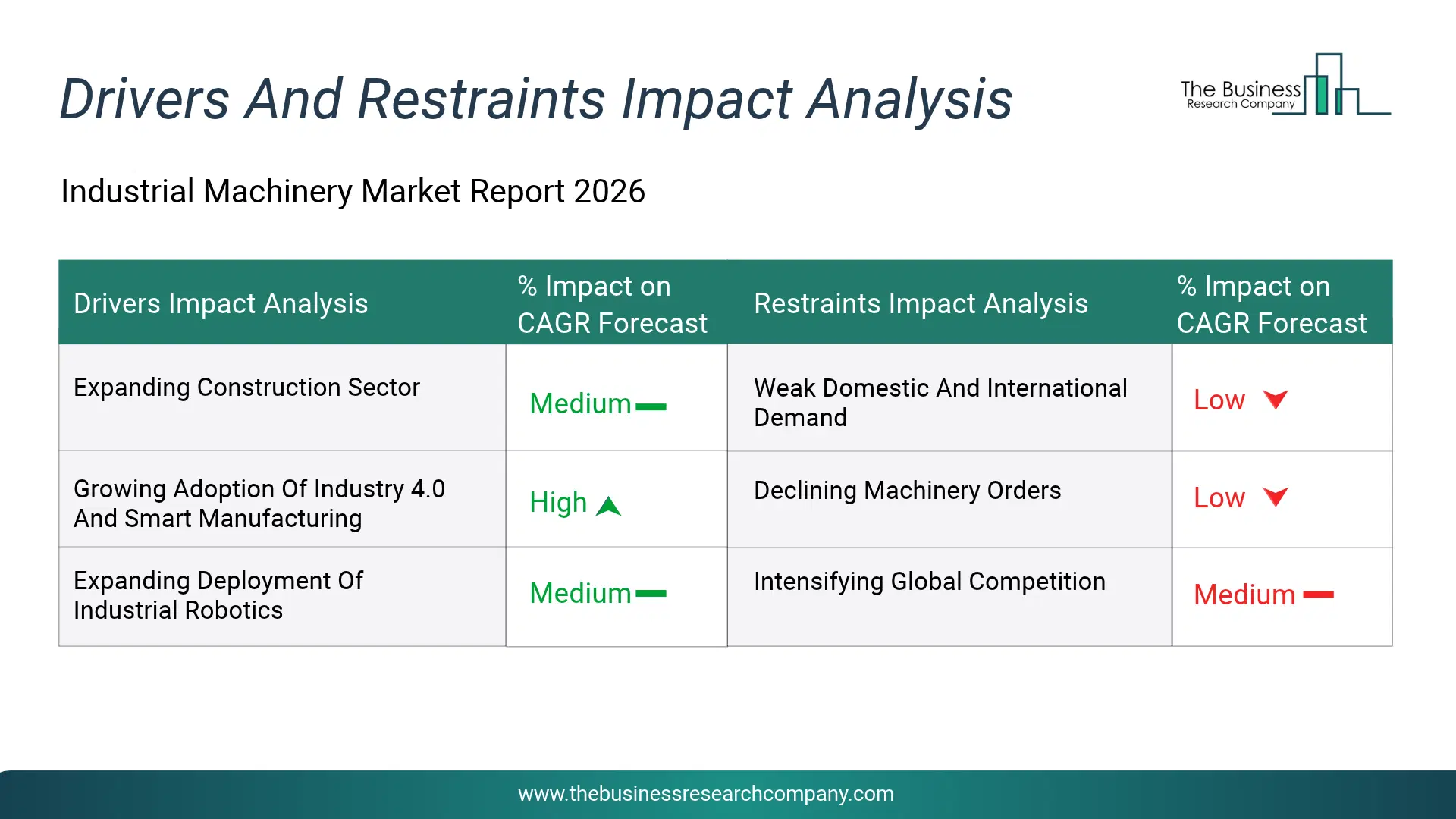
Infographic Chart Showing Key Market Drivers Analysis And Restraints For Industrial Machinery Market
The chart presents an impact analysis of key drivers and restraints, quantifying their relative influence on the market's growth rate and helping assess the balance between growth enablers and limiting factors. This chart offers a high-level perspective; the full report contains more detailed insights.
How Will The Drivers Impact Growth In The Global Industrial Machinery Market?
• Expanding Construction Sector (Medium) – During the forecast period, the expanding construction sector is expected to become a key growth driver for the industrial machinery market by 2030. Expanding construction sector is driving the growth of the industrial machinery market by increasing project activity and the use of engineered materials, industrial components, machinery, and production solutions. This trend encourages manufacturers, construction firms, infrastructure developers, and industrial operators to increase spending and capacity related to manufacturing, assembly, facility operations, and infrastructure development. As this trend continues, suppliers are expected to expand capacity, improve their offerings, and strengthen distribution to support manufacturing, assembly, facility operations, and infrastructure development. • Growing Adoption Of Industry 4.0 And Smart Manufacturing (High) – During the forecast period, the growing adoption of industry 4.0 and smart manufacturing is expected to emerge as a major factor driving the expansion of the industrial machinery market by 2030. Growing adoption of industry 4.0 and smart manufacturing is driving the growth of the industrial machinery market by encouraging investment in automation, data analysis, and digitally enabled operations that require engineered materials, industrial components, machinery, and production solutions. This trend encourages manufacturers, construction firms, infrastructure developers, and industrial operators to increase spending and capacity related to manufacturing, assembly, facility operations, and infrastructure development. As this trend continues, suppliers are expected to expand capacity, improve their offerings, and strengthen distribution to support manufacturing, assembly, facility operations, and infrastructure development. • Expanding Deployment Of Industrial Robotics (Medium) – During the forecast period, the expanding deployment of industrial robotics is expected to act as a key growth catalyst for the industrial machinery market by 2030. Expanding deployment of industrial robotics is driving the growth of the industrial machinery market by encouraging investment in automation, data analysis, and digitally enabled operations that require engineered materials, industrial components, machinery, and production solutions. This trend encourages manufacturers, construction firms, infrastructure developers, and industrial operators to increase spending and capacity related to manufacturing, assembly, facility operations, and infrastructure development. As this trend continues, suppliers are expected to expand capacity, improve their offerings, and strengthen distribution to support manufacturing, assembly, facility operations, and infrastructure development.How Will The Restraints Impact Growth In The Global Industrial Machinery Market?
• Weak Domestic And International Demand (Medium) – During the forecast period, the weak domestic and international demand is restraining the growth of the industrial machinery market by creating cost, capacity, affordability, or demand pressures for engineered materials, industrial components, machinery, and production solutions. This pressure makes it harder for providers to maintain efficient raw-material procurement, production, quality control, maintenance, and distribution and competitive pricing. As a result, market participants may delay expansion, limit new investment, or increase prices, slowing the adoption and availability of engineered materials, industrial components, machinery, and production solutions. • Declining Machinery Orders (High) – During the forecast period, the declining machinery orders is restraining the growth of the industrial machinery market by intensifying substitution and pricing pressure on engineered materials, industrial components, machinery, and production solutions. This pressure makes it harder for providers to maintain efficient raw-material procurement, production, quality control, maintenance, and distribution and competitive pricing. As a result, market participants may delay expansion, limit new investment, or increase prices, slowing the adoption and availability of engineered materials, industrial components, machinery, and production solutions. • Intensifying Global Competition (Medium) – During the forecast period, the intensifying global competition is restraining the growth of the industrial machinery market by intensifying substitution and pricing pressure on engineered materials, industrial components, machinery, and production solutions. This pressure makes it harder for providers to maintain efficient raw-material procurement, production, quality control, maintenance, and distribution and competitive pricing. As a result, market participants may delay expansion, limit new investment, or increase prices, slowing the adoption and availability of engineered materials, industrial components, machinery, and production solutions.Key Players In The Global Industrial Machinery Market
Major companies operating in the industrial machinery market are ASML Holdings N.V., Tokyo Electron Limited, Lam Research Corporation, Applied Materials, Inc., KLA Corporation, ASM Pacific Technology Ltd., Bühler AG, Tetra Pak International S.A., Marel hf., Alfa Laval AB, Amada Co., Ltd., AIDA Engineering, Ltd., The Japan Steel Works, Ltd., Komatsu Industries Corporation, Sanki Seiko Co., Ltd., Liebherr Group, Hitachi, Ltd., ELB Equipment Limited, SIGNAL-PACK, Strommasina Corporation, StankoMashStroy, VKP, ATH Maschinenbau GmbH, Bosch (Industrial Technology Division), ZF Friedrichshafen AG (Industrial Technology Division), Continental AG (Industrial Solutions), Volvo Group (Industrial & Construction Equipment Division), John Deere (Industrial & Manufacturing Machinery Division), Case Construction Equipment, GE Power Electronics Inc., Rolls-Royce Corporation, Honda of America Manufacturing, Inc., General Motors Global Propulsion Systems, Ford Motor Company of Canada Ltd.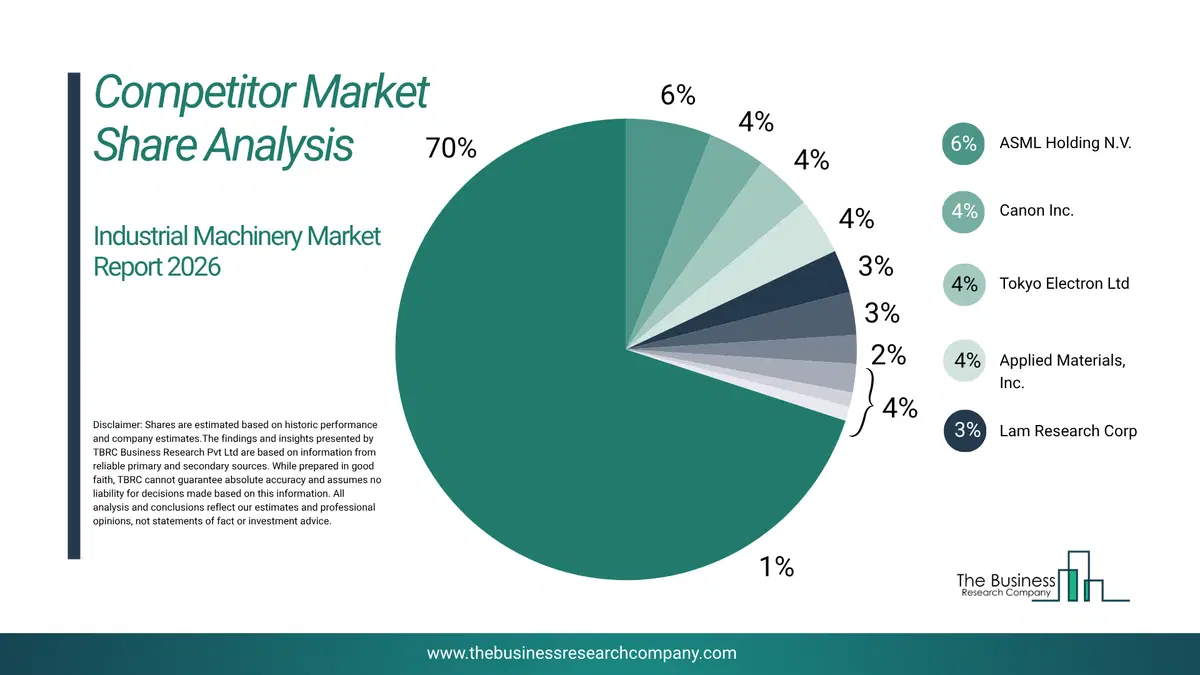
This chart is for illustrative purposes; the full report includes a detailed competitor analysis and comprehensive overview of the top 10 companies in the market.
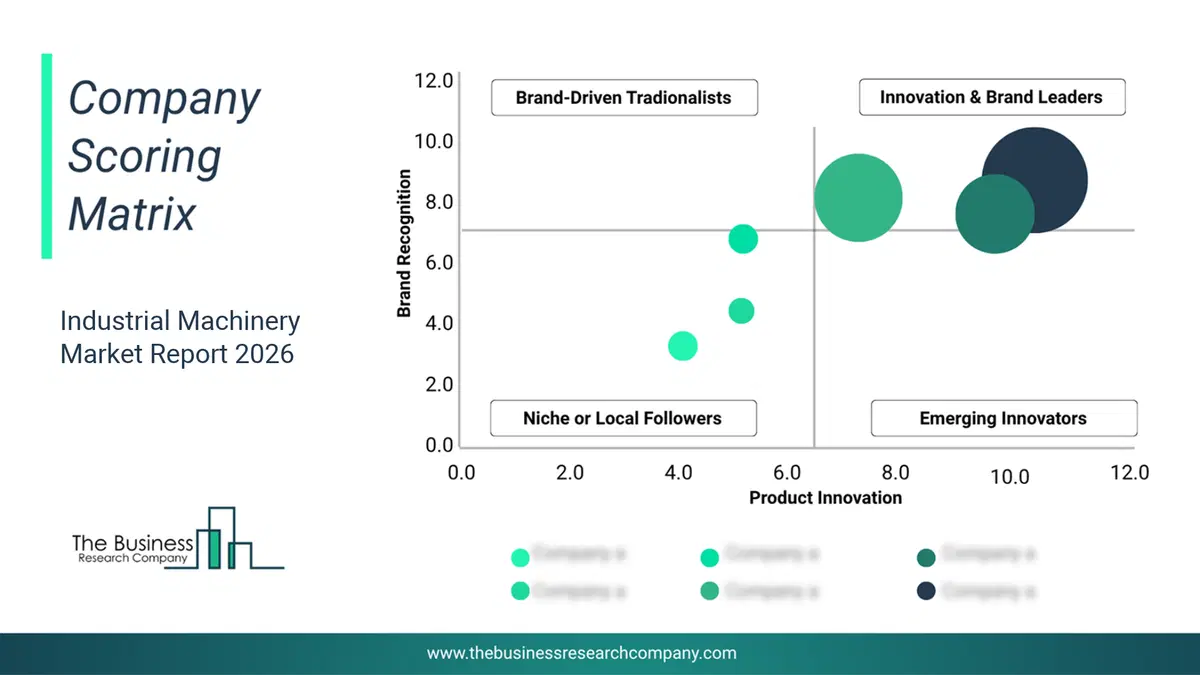
This chart maps companies by product innovation and brand strength, with bubble size indicating relative revenue, helping identify market leaders, challengers, and niche players. This is an illustrative chart; the full report provides a complete and accurate competitive analysis.
Global Industrial Machinery Market Trends and Insights
Major companies operating in the industrial machinery market are focusing on developing advanced solutions, such as modular and miniature equipment, to support next-generation semiconductor production and strengthen their competitive position. Modular and miniature industrial machinery refers to compact, high-precision systems designed to improve manufacturing efficiency, enable advanced device architectures, and support the fabrication of increasingly smaller and more powerful electronic components. For instance, in June 2023, Lam Research Corporation, a US-based semiconductor technology company, introduced Coronus DX, a one-step solution engineered to apply a protective film to both sides of wafer edges during advanced semiconductor manufacturing. This protective application helps prevent damage and residue buildup on wafer edges, improving overall yield and reliability in chip production.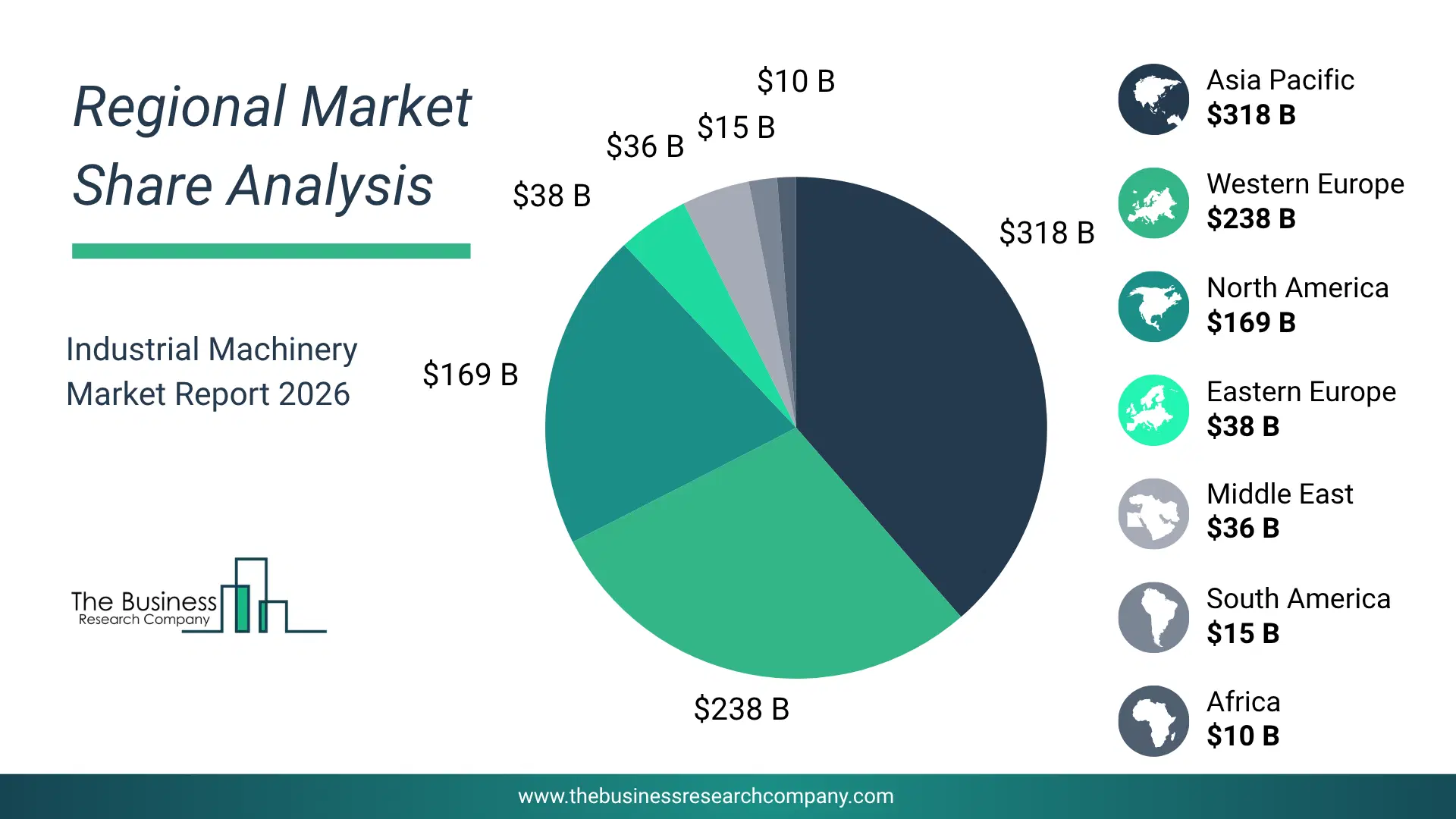
Regional Outlook
Asia-Pacific was the largest region in the industrial machinery market in 2025. Western Europe was the second largest region in the industrial machinery market. The regions covered in this market report are Asia-Pacific, South East Asia, Western Europe, Eastern Europe, North America, South America, Middle East, Africa The countries covered in this market report are China, India, Japan, Australia, Indonesia, South Korea, Bangladesh, Thailand, Vietnam, Malaysia, Singapore, Philippines, Hong Kong, Taiwan, New Zealand, UK, Germany, France, Italy, Spain, Austria, Belgium, Denmark, Finland, Ireland, Netherlands, Norway, Portugal, Sweden, Switzerland, Russia, Czech Republic, Poland, Romania, Ukraine, USA, Canada, Mexico, Brazil, Chile, Argentina, Colombia, Peru, Saudi Arabia, Israel, Iran, Turkey, UAE, Egypt, Nigeria, South Africa.What Defines the Industrial Machinery Market?
The industrial machinery market consists of sales of industrial machinery such as food and beverage manufacturing machinery, semiconductor manufacturing machinery, sawmill and woodworking machinery (except handheld), machinery for making paper and paper products, printing and binding machinery and equipment, textile-making machinery, and machinery for making plastics and rubber products. Values in this market are ‘factory gate’ values, that is the value of goods sold by the manufacturers or creators of the goods, whether to other entities (including downstream manufacturers, wholesalers, distributors and retailers) or directly to end customers. The value of goods in this market includes related services sold by the creators of the goods.How is Market Value Defined and Measured?
The market value is defined as the revenues that enterprises gain from the sale of goods and/or services within the specified market and geography through sales, grants, or donations in terms of the currency (in USD unless otherwise specified). The revenues for a specified geography are consumption values that are revenues generated by organizations in the specified geography within the market, irrespective of where they are produced. It does not include revenues from resales along the supply chain, either further along the supply chain or as part of other products.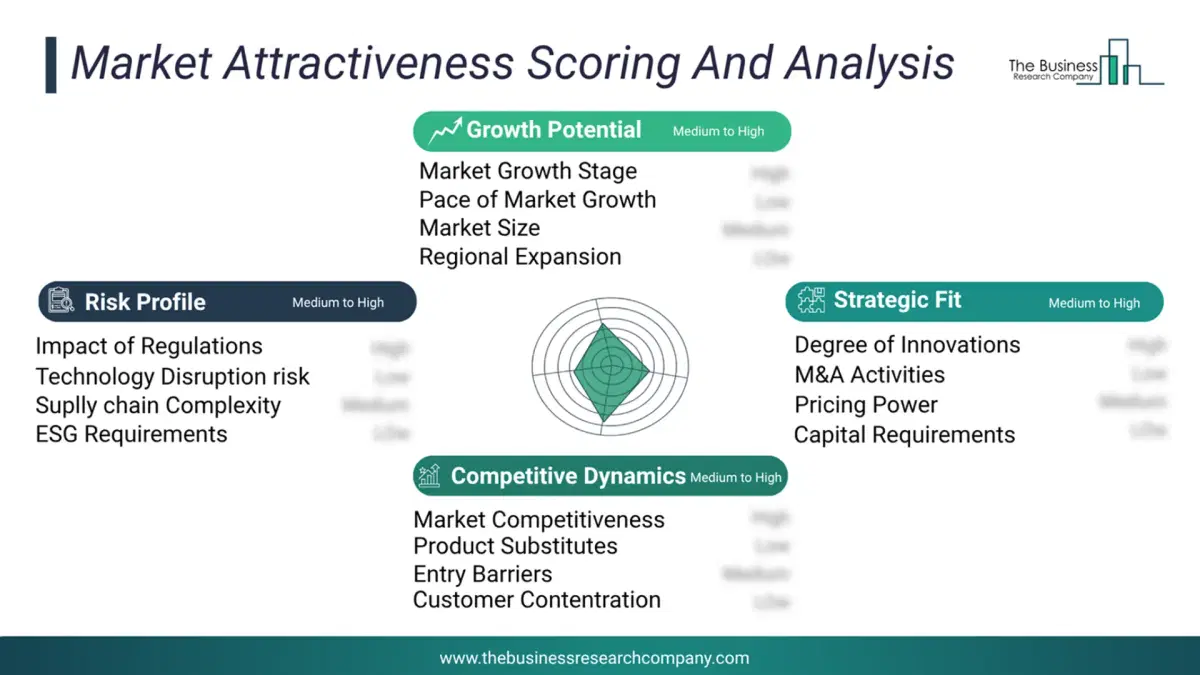
This chart presents market attractiveness based on a quantitative evaluation of growth, competition, strategic alignment, and risk, offering a clear view of opportunity areas for decision-making. This chart is for illustrative purposes; the full report contains the complete analysis.
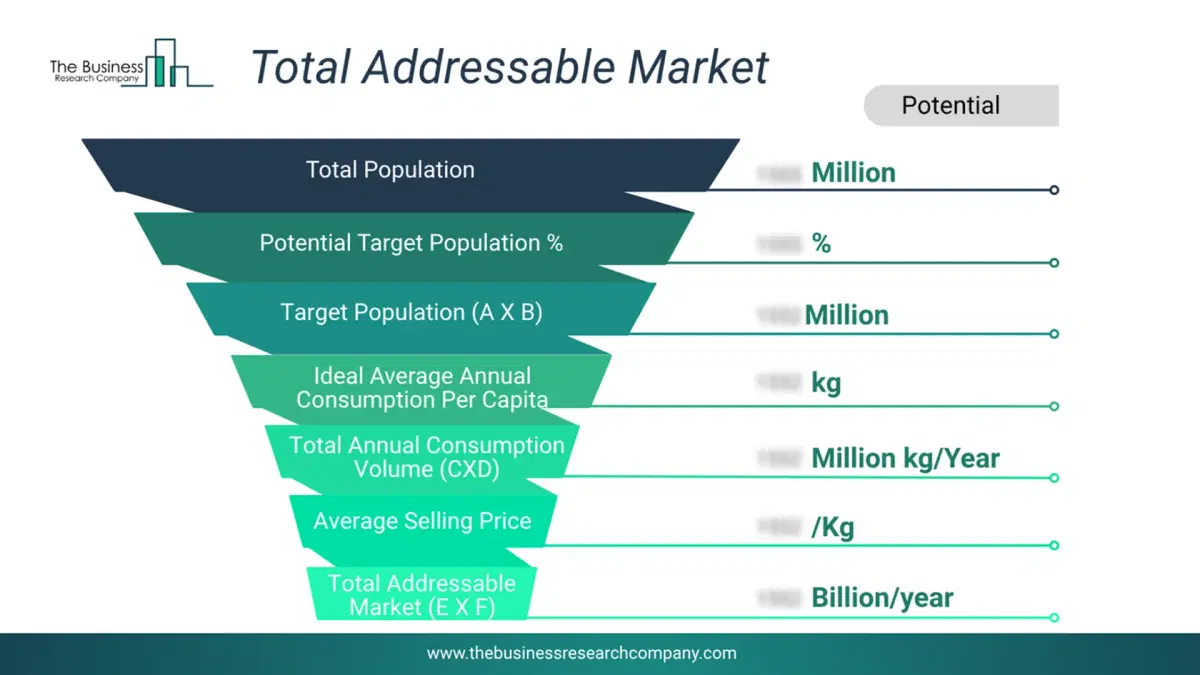
This chart highlights the Total Addressable Market (TAM) by estimating the maximum revenue opportunity using an assumption-driven approach, supporting strategic planning and opportunity sizing across markets. The chart is illustrative; the full report provides a more comprehensive analysis.
What Key Data and Analysis Are Included in the Industrial Machinery Market Report 2026?
The industrial machinery market research report is one of a series of new reports from The Business Research Company that provides market statistics, including industry global market size, regional shares, competitors with the market share, detailed market segments, market trends and opportunities, and any further data you may need to thrive in the industrial machinery industry. The market research report delivers a complete perspective of everything you need, with an in-depth analysis of the current and future state of the industry.Industrial Machinery Market Report Forecast Analysis
| Report Attribute | Details |
|---|---|
| Market Size Value In 2026 | $650.19 billion |
| Revenue Forecast In 2035 | $847.68 billion |
| Growth Rate | CAGR of 6.0% from 2026 to 2035 |
| Base Year For Estimation | 2025 |
| Actual Estimates/Historical Data | 2020-2025 |
| Forecast Period | 2026 - 2030 - 2035 |
| Market Representation | Revenue in USD Billion and CAGR from 2026 to 2035 |
| Segments Covered | Type, Operation, Capacity |
| Regional Scope | Asia-Pacific, Western Europe, Eastern Europe, North America, South America, Middle East, Africa |
| Country Scope | The countries covered in the report are Australia, Brazil, China, France, Germany, India, ... |
| Key Companies Profiled | ASML Holdings N.V., Tokyo Electron Limited, Lam Research Corporation, Applied Materials, Inc., KLA Corporation, ASM Pacific Technology Ltd., Bühler AG, Tetra Pak International S.A., Marel hf., Alfa Laval AB, Amada Co., Ltd., AIDA Engineering, Ltd., The Japan Steel Works, Ltd., Komatsu Industries Corporation, Sanki Seiko Co., Ltd., Liebherr Group, Hitachi, Ltd., ELB Equipment Limited, SIGNAL-PACK, Strommasina Corporation, StankoMashStroy, VKP, ATH Maschinenbau GmbH, Bosch (Industrial Technology Division), ZF Friedrichshafen AG (Industrial Technology Division), Continental AG (Industrial Solutions), Volvo Group (Industrial & Construction Equipment Division), John Deere (Industrial & Manufacturing Machinery Division), Case Construction Equipment, GE Power Electronics Inc., Rolls-Royce Corporation, Honda of America Manufacturing, Inc., General Motors Global Propulsion Systems, Ford Motor Company of Canada Ltd. |
| Customization Scope | Request for Customization |
| Pricing And Purchase Options | Explore Purchase Options |