
Offshore Wind Market Report 2026
Global Outlook – By Component (Turbines, Electrical Infrastructure, Substructure, Other Components), By Location (Shallow Water, Transitional Water, Deep Water), By Capacity (Up To 3MW, 3MW To 5MW, Above 5MW), By Application (Electric Power, Oil And Gas, Aviation, Transport, Other Applications) – Market Size, Trends, Strategies, and Forecast to 2030
Offshore Wind Market Overview
• Offshore Wind market size has reached to $58.22 billion in 2025 • Expected to grow to $120.04 billion in 2030 at a compound annual growth rate (CAGR) of 15.1% • Growth Driver: The Rise In Renewable Energy Investments Driving The Growth Of The Market Due To Increased Funding, Infrastructure Expansion, And Technological Advancement • Market Trend: Advanced Measurement Programs Accelerate Clean Energy Project Development • Western Europe was the largest region in 2025 and North America is the fastest growing region.Market Gains By 2030 – Top Opportunities By Segment
Market Gain identifies the most promising market opportunities by highlighting the segments or products expected to generate the highest incremental revenue growth over the next five years.
What Is Covered Under Offshore Wind Market?
Offshore wind refers to a clean and renewable energy source generated by utilizing the wind's force on the open seas, where it reaches a higher and more consistent speed than on land due to the lack of boundaries and is used for the generation of electricity from wind farms in water bodies, usually at sea. The main components of the offshore wind market are turbines, electrical infrastructure, substructures, and other components. A turbine refers to a machine or engine which uses a stream of air, gas, water, or steam to turn a wheel and produce power. The locations of wind power include shallow water, transitional water, and deep water. The capacity ranges of offshore wind include up to 3MW,3MW, and above 5MW. The various applications of wind power include electric power, oil and gas, aviation and transport, and other applications.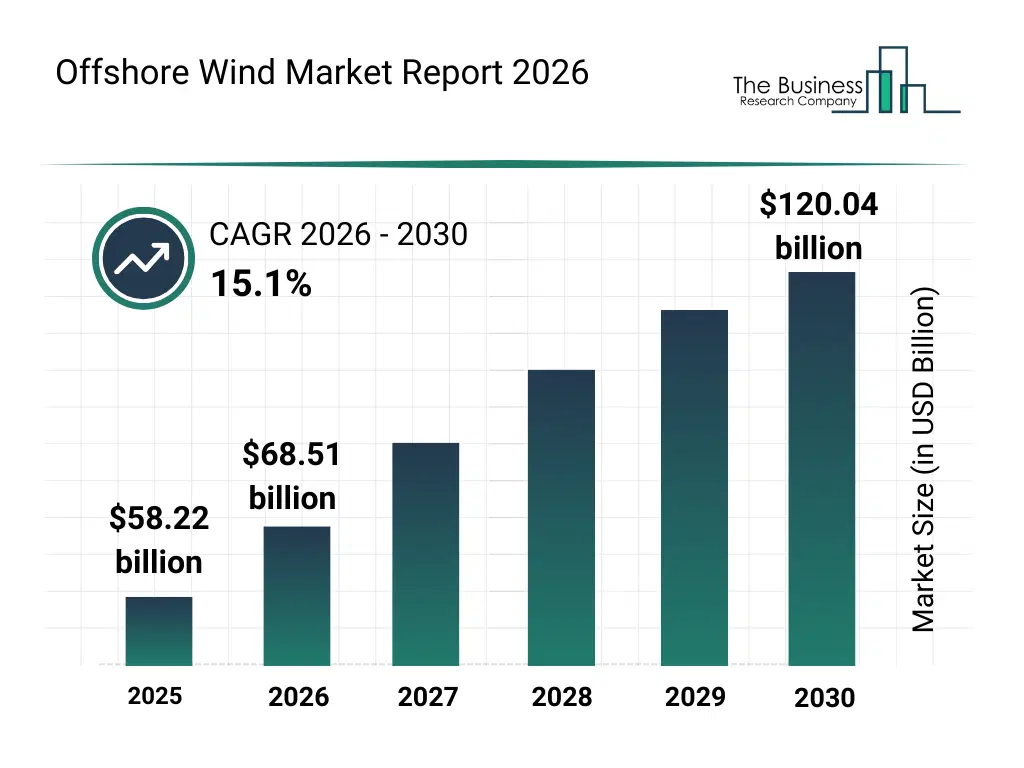
What Is The Offshore Wind Market Size and Share 2026?
The offshore wind market size has grown rapidly in recent years. It will grow from $58.22 billion in 2025 to $68.51 billion in 2026 at a compound annual growth rate (CAGR) of 17.7%. The growth in the historic period can be attributed to expansion of coastal renewable energy projects, increasing government offshore wind targets, availability of high-wind marine locations, early investments in fixed-bottom offshore wind farms, growth in offshore grid infrastructure.What Is The Offshore Wind Market Growth Forecast?
The offshore wind market size is expected to see rapid growth in the next few years. It will grow to $120.04 billion in 2030 at a compound annual growth rate (CAGR) of 15.1%. The growth in the forecast period can be attributed to increasing investments in floating offshore wind farms, rising demand for large-scale renewable power generation, expansion of offshore wind capacity auctions, growing focus on cost reduction per megawatt, increasing integration of offshore wind with energy storage. Major trends in the forecast period include increasing deployment of large-capacity offshore turbines, rising adoption of floating wind platforms, growing integration of smart wind farm monitoring, expansion of deep-water offshore projects, enhanced focus on turbine reliability and performance optimization.
Global Offshore Wind Market Segmentation
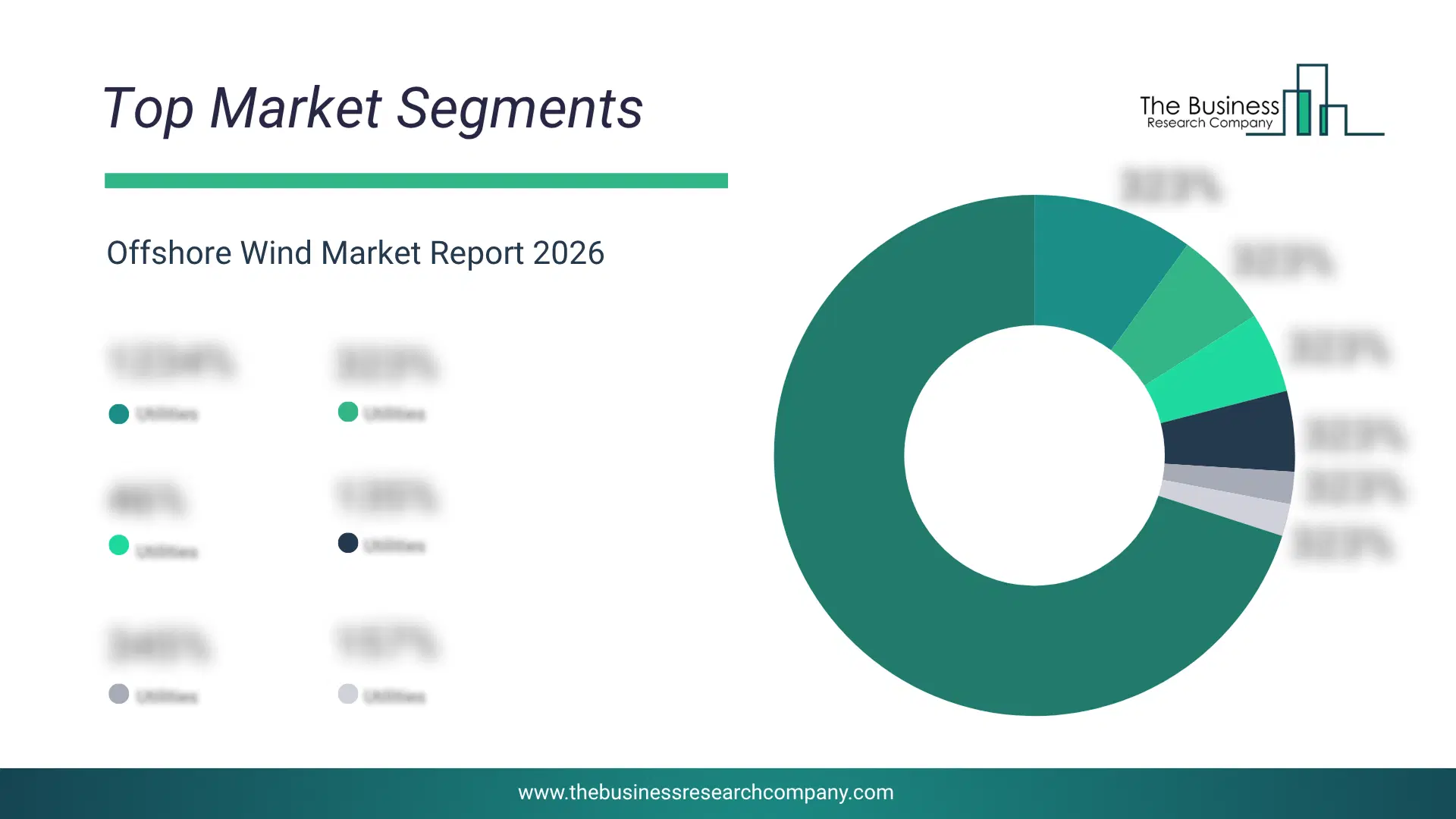
1) By Component: Turbines, Electrical Infrastructure, Substructure, Other Components 2) By Location: Shallow Water, Transitional Water, Deep Water 3) By Capacity: Up To 3MW, 3MW To 5MW, Above 5MW 4) By Application: Electric Power, Oil And Gas, Aviation, Transport, Other Applications Subsegments: 1) By Turbines: Wind Turbine Generators (WTGs), Rotor Blades, Nacelle, Gearbox And Drive Train 2) By Electrical Infrastructure: Offshore Substations, Undersea Cables (Inter-Array And Export Cables), Transformers, Switchgear And Circuit Breakers 3) By Substructure: Monopile Foundations, Jacket Foundations, Floating Platforms, Gravity-Based Structures 4) By Other Components: Maintenance And Service Equipment, SCADA Systems (Supervisory Control And Data Acquisition), Energy Storage Systems, Monitoring And Control Systems The top segments in the offshore wind market will be: • Turbines will reach $49 Billion by 2030. • Electrical Infrastructure will reach $32 Billion by 2030. • Substructure will reach $27 Billion by 2030. • Other Components will reach $12 Billion by 2030.What Is The Driver Of The Offshore Wind Market?
The increasing investments in renewable energy are expected to propel the growth of the offshore wind market going forward. Renewable energy is energy generated from naturally replenished sources such as the sun and wind. The increase in investments in renewable energy is due to government initiatives aimed at strengthening national energy security, supporting sustainable development, and expanding offshore wind generation capacity. Investments in renewable energy drive the growth of offshore wind by funding advanced technologies, expanding infrastructure, and accelerating the transition to cleaner, more sustainable power sources. For instance, in December 2025, according to the Visual Capitalist, a Canada-based media and data visualization company, in 2024, global spending on renewable energy increased to $807 billion, up from an average of $662 billion between 2022 and 2023. Therefore, the increasing global investments in renewable energy are driving the growth of the offshore wind industry.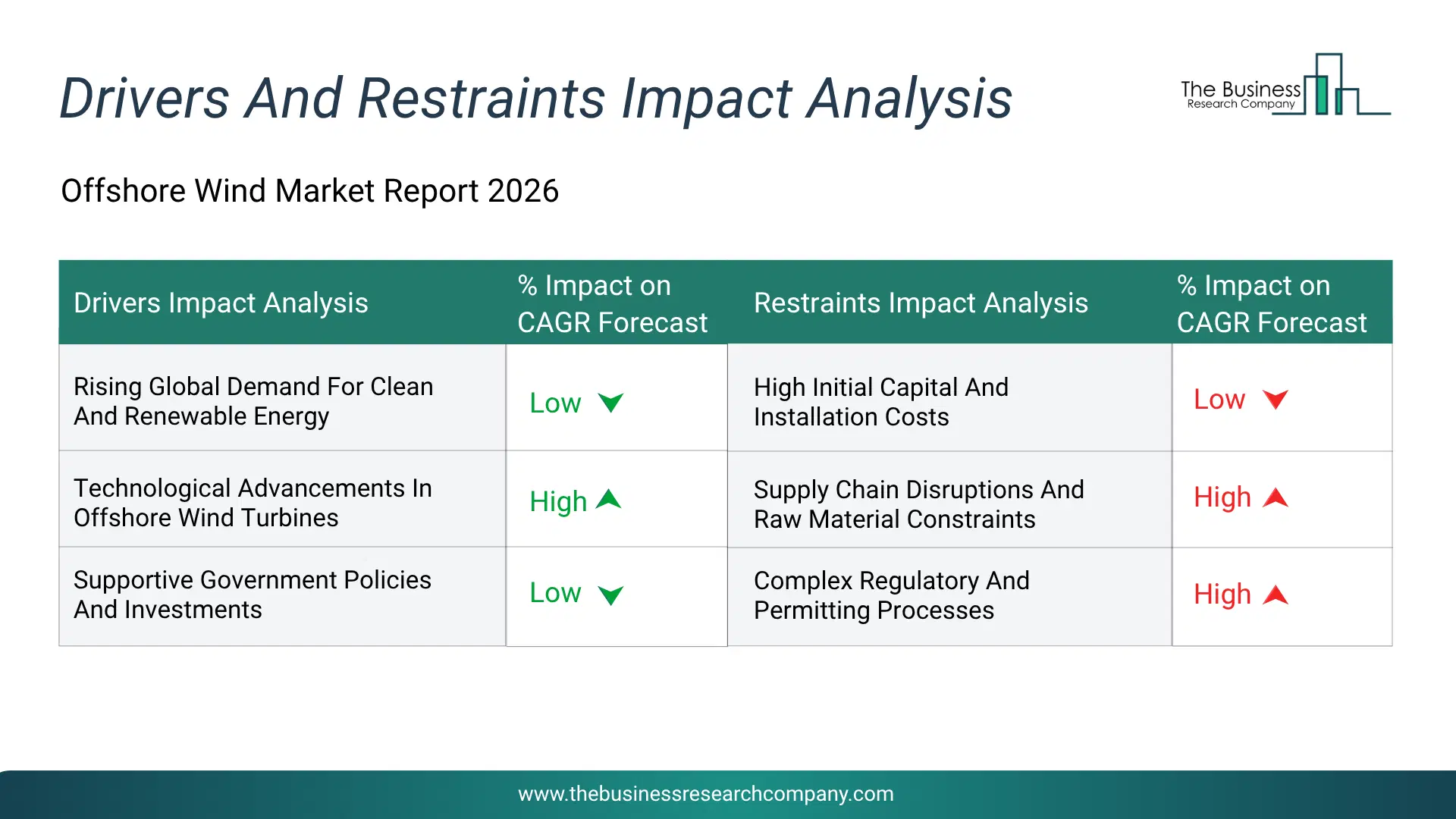
Infographic Chart Showing Key Market Drivers Analysis And Restraints For Offshore Wind Market
The chart presents an impact analysis of key drivers and restraints, quantifying their relative influence on the market's growth rate and helping assess the balance between growth enablers and limiting factors. This chart offers a high-level perspective; the full report contains more detailed insights.
How Will The Drivers Impact Growth In The Global Offshore Wind Market?
• Rising Global Demand For Clean And Renewable Energy (Low) – During the forecast period, the rising global demand for clean and renewable energy is expected to become a key growth driver of the expansion of the offshore wind market by 2030. The rising global demand for clean and renewable energy is driving the offshore wind market as governments and utilities increasingly invest in offshore wind projects to reduce carbon emissions, strengthen energy security, meet renewable energy targets, and deliver large-scale electricity generation from abundant offshore wind resources. • Technological Advancements In Offshore Wind Turbines (High) – During the forecast period, technological advancements in offshore wind turbines are expected to emerge as a major factor driving the expansion of the offshore wind market by 2030. This is because larger turbine capacities, longer blades, floating wind platforms, and advanced control systems improve energy generation efficiency, enable deployment in deeper waters, and reduce installation and maintenance costs while enhancing overall project reliability. • Supportive Government Policies And Investments (Low) – During the forecast period, supportive government policies and investments are expected to act as a key growth catalyst for the offshore wind market by 2030. This is supporting the offshore wind market as subsidies, tax incentives, renewable energy targets, competitive auctions, and investments in grid infrastructure and transmission networks encourage large-scale project development and attract greater private sector participation.How Will The Restraints Impact Growth In The Global Offshore Wind Market?
• High Initial Capital And Installation Costs (Low) – During the forecast period, the high initial capital and installation costs act as a major restraint for the offshore wind market by increasing the financial burden of project development. Offshore wind farms require significant investment in turbines, foundations, subsea cables, marine vessels, and grid connection infrastructure. Complex offshore construction and harsh marine conditions further raise labor and maintenance expenses. These high upfront costs can delay investment decisions and limit participation from smaller developers. As a result, elevated capital requirements can slow the expansion of the offshore wind market. • Supply Chain Disruptions And Raw Material Constraints (High) – During the forecast period, the supply chain disruptions and raw material constraints act as a significant restraint for the offshore wind market by delaying project timelines and increasing development costs. Offshore wind projects depend on timely availability of steel, copper, rare earth materials, cables, turbines, and specialized vessels. Shortages or transportation delays can disrupt manufacturing and installation schedules. Rising material prices also place pressure on project budgets and profitability. As a result, supply chain challenges can hinder the growth of the offshore wind market. • Complex Regulatory And Permitting Processes (Low) – During the forecast period, the complex regulatory and permitting processes act as a major restraint for the offshore wind market by extending project approval timelines and increasing development uncertainty. Offshore wind projects often require multiple environmental clearances, marine zoning approvals, grid connection permissions, and stakeholder consultations. Lengthy administrative procedures can delay construction starts and raise pre-development costs. Regulatory differences across regions may also complicate investment planning for developers. As a result, complex permitting processes can slow the expansion of the offshore wind market.Key Players In The Global Offshore Wind Market
Major companies operating in the offshore wind market are Ørsted, Vattenfall, Equinor, Iberdrola, RWE, SSE Renewables, EDP Renewables, EnBW Energie Baden‑Württemberg, GE Renewable Energy, Siemens Gamesa Renewable Energy, Vestas Wind Systems (offshore business), MHI Vestas Offshore Wind, Dongfang Electric Corporation (offshore wind turbines), Shanghai Electric Wind Power Group (offshore turbines), Ming Yang Smart Energy Group (offshore turbines), Subsea 7, Van Oord, TechnipFMC, DEME Offshore, Jan De Nul Group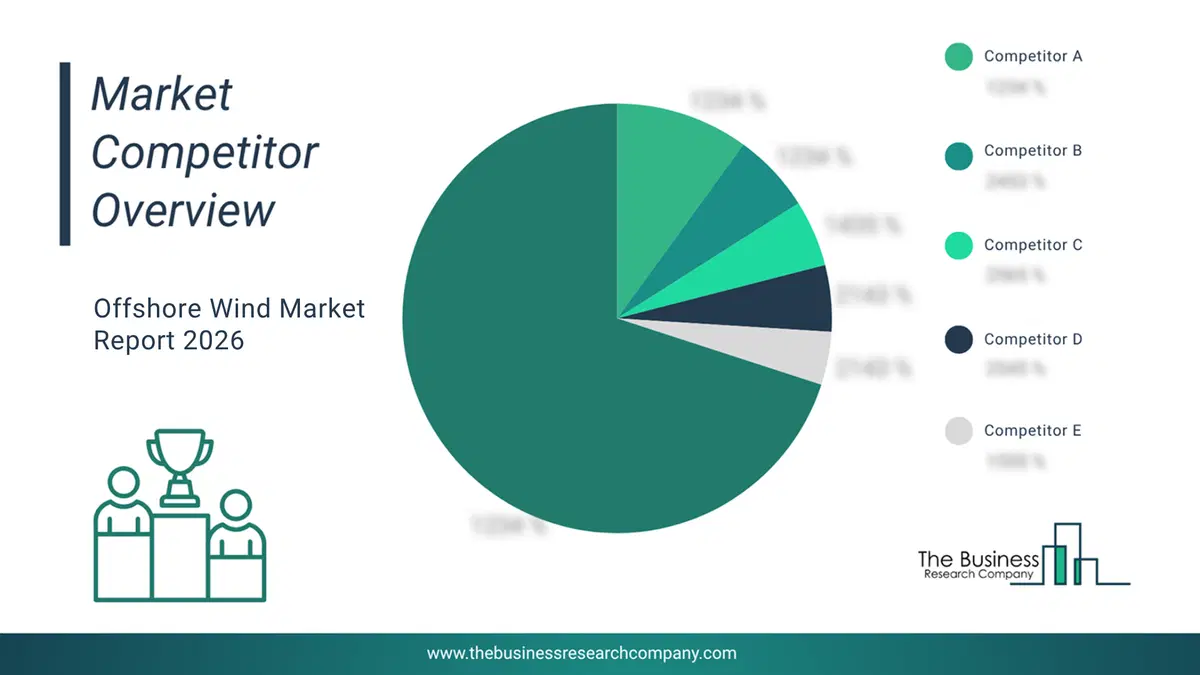
This chart is for illustrative purposes; the full report includes a detailed competitor analysis and comprehensive overview of the top 10 companies in the market.
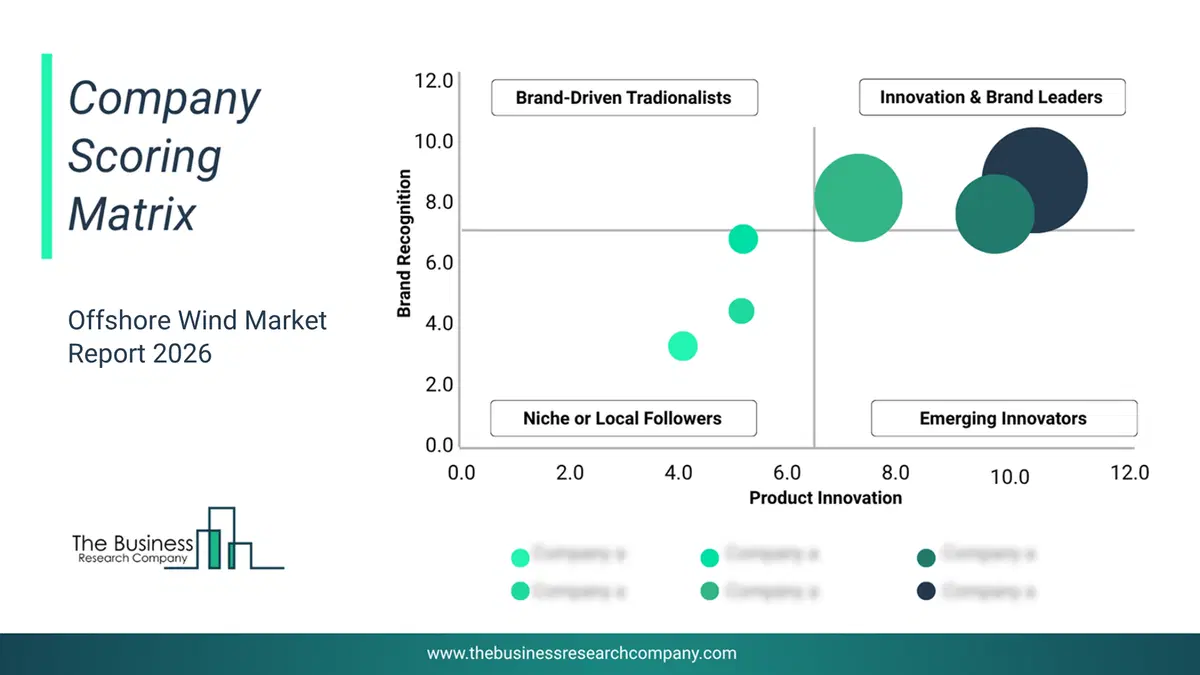
This chart maps companies by product innovation and brand strength, with bubble size indicating relative revenue, helping identify market leaders, challengers, and niche players. This is an illustrative chart; the full report provides a complete and accurate competitive analysis.
Global Offshore Wind Market Trends and Insights
Major companies operating in the offshore wind market are focusing on developing innovative initiatives such as large-scale offshore wind resource assessment and monitoring programs to support efficient project planning, reduce development risks, and accelerate the deployment of renewable energy capacity amid rising demand for clean energy. Large-scale offshore wind resource assessment and monitoring programs are structured initiatives that use advanced measurement technologies such as floating LiDAR, offshore buoys, and metocean sensors to collect long-term wind and ocean condition data, helping developers accurately evaluate site potential, reduce technical and financial risks, optimize turbine and foundation design, and support regulatory and investment decisions. For instance, in December 2025, Ocean Winds, S.L., a Spain-based offshore wind development company, initiated an offshore wind and metocean measurement campaign for the High Sea Wind project in Australia. The initiative deploys floating LiDAR and metocean sensors to gather high-resolution environmental data over extended periods, supporting accurate energy yield estimation, optimized turbine selection, and efficient foundation and cable design. These monitoring programs improve project bankability, enhance safety, streamline regulatory approvals, and play a critical role in scaling up offshore wind projects worldwide.What Are Latest Mergers And Acquisitions In The Offshore Wind Market?
In July 2023, JERA, a Japan-based wind energy company, acquired Parkwind NV for $1.58 billion. Through this acquisition, JERA aims to strengthen its renewable energy portfolio and enhance its position in the Taiwan and UK wind energy markets. Parkwind NV is a Belgium-based green energy company specializing in the development of offshore wind farm projects.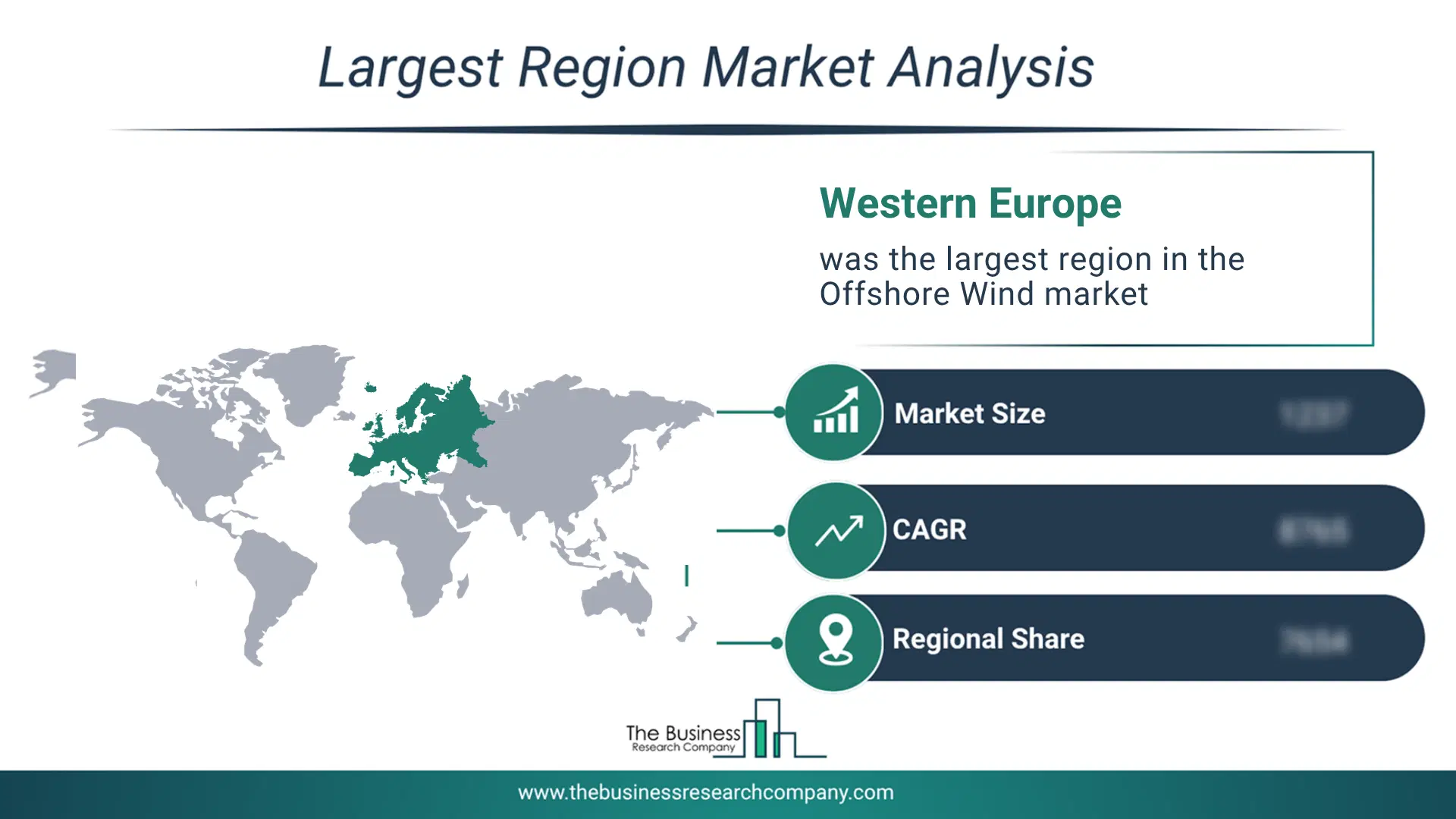
Regional Outlook
Western Europe was the largest region in the offshore wind market in 2025.North America is expected to be the fastest-growing region in the offshore wind market share during the forecast period. The regions covered in this market report are Asia-Pacific, South East Asia, Western Europe, Eastern Europe, North America, South America, Middle East, Africa. The countries covered in this market report are Australia, Brazil, China, France, Germany, India, Indonesia, Japan, Taiwan, Russia, South Korea, UK, USA, Canada, Italy, SpainWhat Defines the Offshore Wind Market?
The offshore wind market includes revenues earned by entities by providing services with the help of various floating platforms including spar-buoy, tension leg platform, semi-submersible, and barge. The market value includes the value of related goods sold by the service provider or included within the service offering. Only goods and services traded between entities or sold to end consumers are included.How is Market Value Defined and Measured?
The market value is defined as the revenues that enterprises gain from the sale of goods and/or services within the specified market and geography through sales, grants, or donations in terms of the currency (in USD unless otherwise specified). The revenues for a specified geography are consumption values that are revenues generated by organizations in the specified geography within the market, irrespective of where they are produced. It does not include revenues from resales along the supply chain, either further along the supply chain or as part of other products.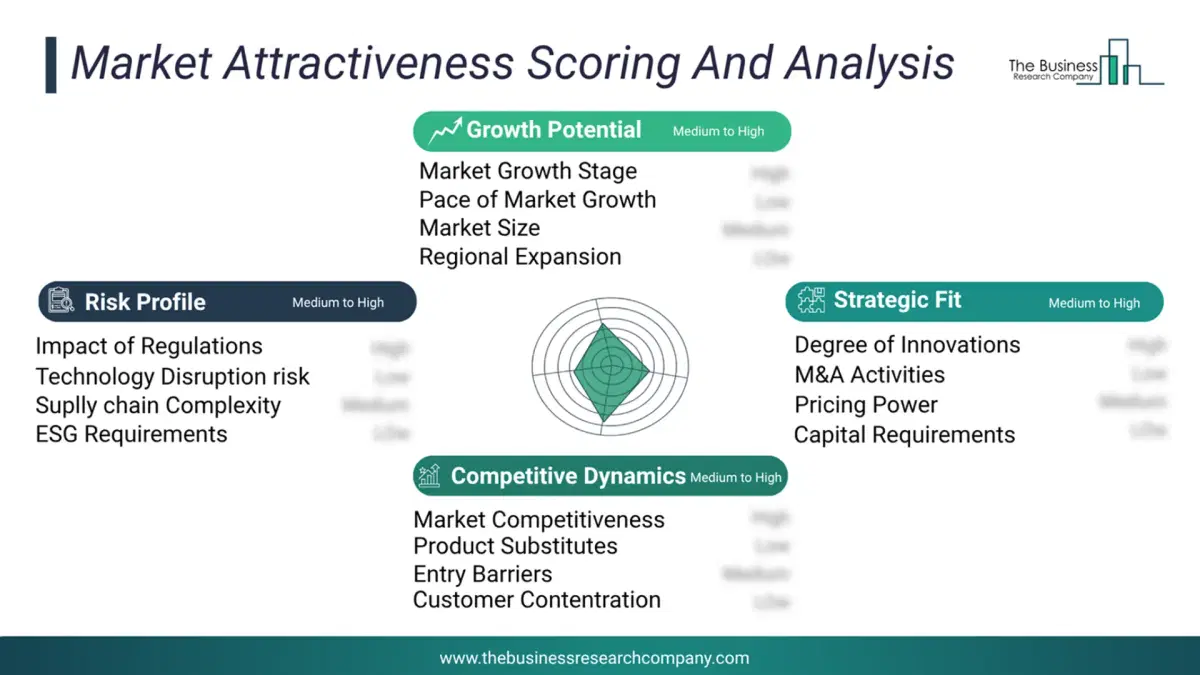
This chart presents market attractiveness based on a quantitative evaluation of growth, competition, strategic alignment, and risk, offering a clear view of opportunity areas for decision-making. This chart is for illustrative purposes; the full report contains the complete analysis.
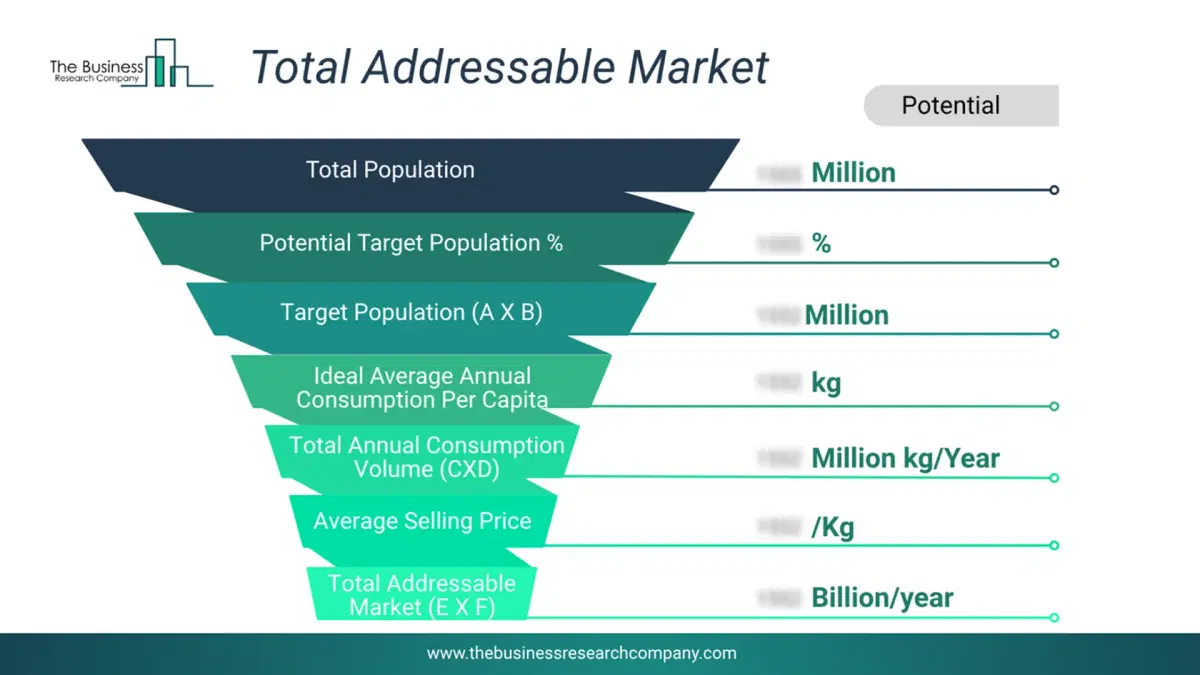
This chart highlights the Total Addressable Market (TAM) by estimating the maximum revenue opportunity using an assumption-driven approach, supporting strategic planning and opportunity sizing across markets. The chart is illustrative; the full report provides a more comprehensive analysis.
What Key Data and Analysis Are Included in the Offshore Wind Market Report 2026?
The offshore wind market research report is one of a series of new reports from The Business Research Company that provides market statistics, including Market Report 2026?global market size, regional shares, competitors with the market share, detailed market segments, market trends and opportunities, and any further data you may need to thrive in the offshore wind Market Report 2026? The market research report delivers a complete perspective of everything you need, with an in-depth analysis of the current and future state of the Market Report 2026?Offshore Wind Market Report Forecast Analysis
| Report Attribute | Details |
|---|---|
| Market Size Value In 2026 | $68.51 billion |
| Revenue Forecast In 2030 | $120.04 billion |
| Growth Rate | CAGR of 15.1% from 2026 to 2030 |
| Base Year For Estimation | 2025 |
| Actual Estimates/Historical Data | 2020-2025 |
| Forecast Period | 2026 - 2030 |
| Market Representation | Revenue in USD Billion and CAGR from 2026 to 2030 |
| Segments Covered | Component, Location, Capacity, Application |
| Regional Scope | Asia-Pacific, Western Europe, Eastern Europe, North America, South America, Middle East, Africa |
| Country Scope | The countries covered in the report are Australia, Brazil, China, France, Germany, India, Indonesia, Japan, Taiwan, Russia, South Korea, UK, USA, Canada, Italy, Spain. |
| Key Companies Profiled | Ørsted, Vattenfall, Equinor, Iberdrola, RWE, SSE Renewables, EDP Renewables, EnBW Energie Baden‑Württemberg, GE Renewable Energy, Siemens Gamesa Renewable Energy, Vestas Wind Systems (offshore business), MHI Vestas Offshore Wind, Dongfang Electric Corporation (offshore wind turbines), Shanghai Electric Wind Power Group (offshore turbines), Ming Yang Smart Energy Group (offshore turbines), Subsea 7, Van Oord, TechnipFMC, DEME Offshore, Jan De Nul Group |
| Customization Scope | Request for Customization |
| Pricing And Purchase Options | Explore Purchase Options |