
Optical Satellite Communication Market Report 2026
Global Outlook – By Component (Transmitter, Receiver, Modulator, Demodulator, Other Components), By Laser Type (Yag Laser, Silex Laser, Microwave Laser, Co2 Laser, Aigaas Laser Diode), By Application (Backhaul, Surveillance And Security, Tracking And Monitoring, Earth Observation, Enterprise Connectivity, Research And Space Exploration, Telecommunication, Other Applications) – Market Size, Trends, Strategies, and Forecast to 2030
Optical Satellite Communication Market Overview
• Optical Satellite Communication market size has reached to $16.66 billion in 2025 • Expected to grow to $71.23 billion in 2030 at a compound annual growth rate (CAGR) of 34.2% • Growth Driver: Smartphone Proliferation Driving Optical Satellite Communication Market Growth • Market Trend: Innovative Advancements In The Optical Satellite Communication Market • North America was the largest region in 2025 and Asia-Pacific is the fastest growing region.Market Gains By 2030 – Top Opportunities By Segment
Market Gain identifies the most promising market opportunities by highlighting the segments or products expected to generate the highest incremental revenue growth over the next five years.
What Is Covered Under Optical Satellite Communication Market?
Optical satellite communication (OSC) refers to a space-based digital data transmission system that uses an optical transmitter that encrypts a message into an optical signal. This is a technology that involves the use of optical fibers for the purpose of communication. The optical satellite communication is used to provide signals around the earth that help to provide effective communication between widely separated geographical points. The main types of components in the optical satellite communication market are transmitter, receiver, modulator, demodulator, and others. The transmitter is a device that converts information into light waves at the sending point. A laser beam carries data through space, after which it is received by an optical receiver, which decodes the signal and sends it to its destination, where another optical-to-electrical converter translates it back into electrical signals for further processing. The different laser types include YAG laser, silex laser, microwave laser, CO2 laser, and AIGaAs laser diode, which are used in several applications such as backhaul, surveillance and security, tracking and monitoring, earth observation, enterprise connectivity, research and space exploration, telecommunication, and others.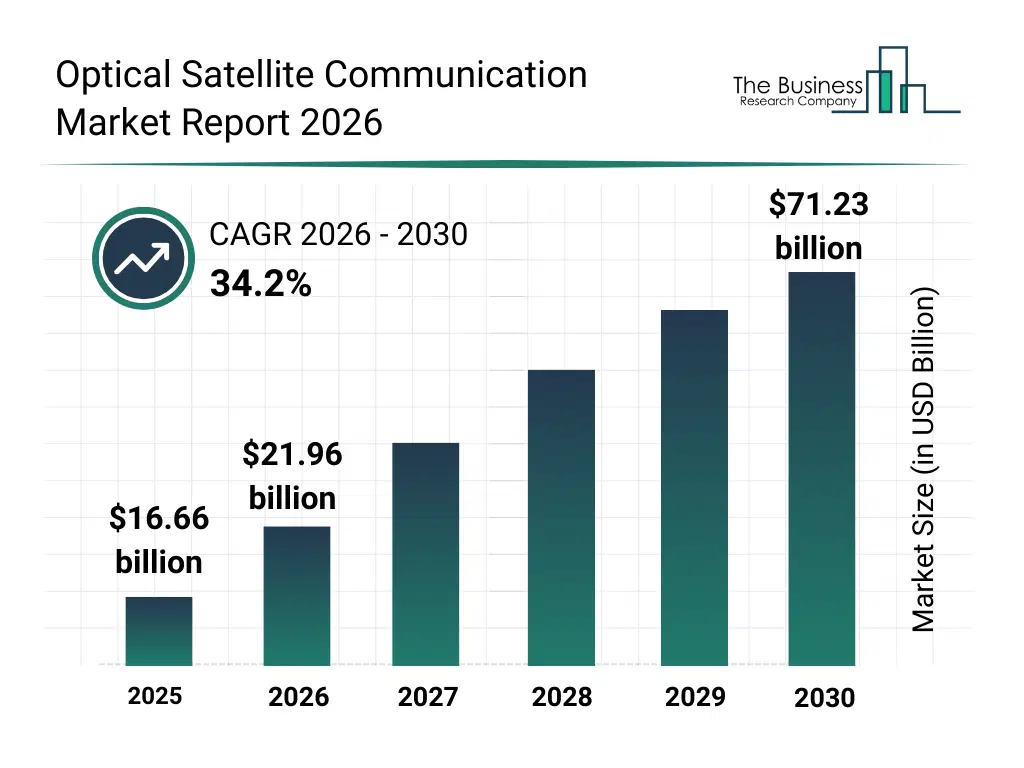
What Is The Optical Satellite Communication Market Size and Share 2026?
The optical satellite communication market size has grown exponentially in recent years. It will grow from $16.66 billion in 2025 to $21.96 billion in 2026 at a compound annual growth rate (CAGR) of 31.8%. The growth in the historic period can be attributed to growth in satellite communication demand, limitations of radio frequency bandwidth, early defense space programs, expansion of earth observation missions, need for secure long-distance communication.What Is The Optical Satellite Communication Market Growth Forecast?
The optical satellite communication market size is expected to see exponential growth in the next few years. It will grow to $71.23 billion in 2030 at a compound annual growth rate (CAGR) of 34.2%. The growth in the forecast period can be attributed to rising low earth orbit satellite deployments, demand for high data rate connectivity, increased space exploration missions, adoption of optical links in defense systems, advancements in laser communication technologies. Major trends in the forecast period include high-speed laser-based data transmission, inter-satellite optical communication links, secure space-based optical networks, miniaturization of optical communication payloads, integration with ground optical networks.
Global Optical Satellite Communication Market Segmentation
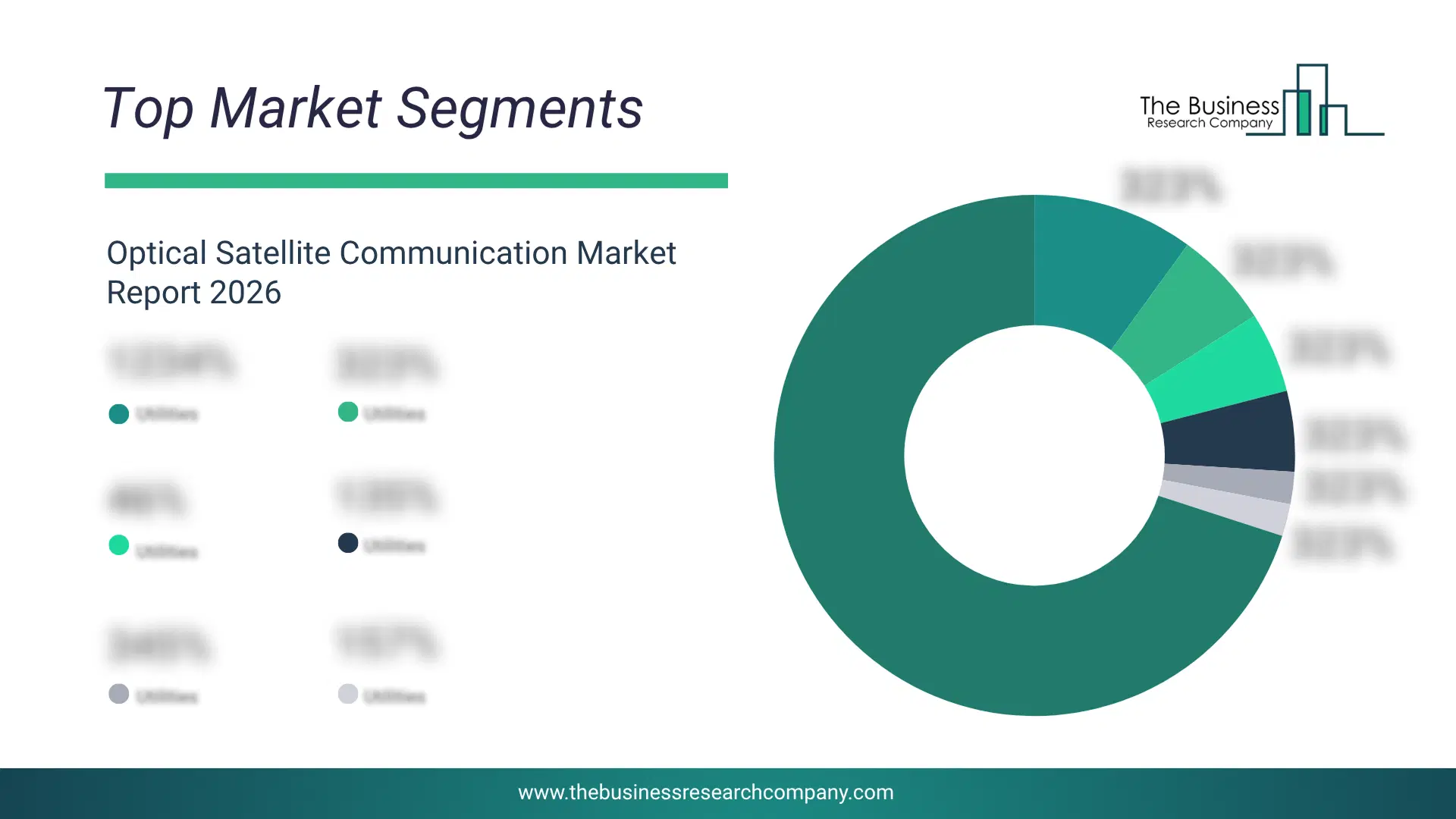
1) By Component: Transmitter, Receiver, Modulator, Demodulator, Other Components 2) By Laser Type: Yag Laser, Silex Laser, Microwave Laser, Co2 Laser, Aigaas Laser Diode 3) By Application: Backhaul, Surveillance And Security, Tracking And Monitoring, Earth Observation, Enterprise Connectivity, Research And Space Exploration, Telecommunication, Other Applications Subsegments: 1) By Transmitter: Laser Transmitters, Optical Amplifiers, Transmitter Modules 2) By Receiver: Optical Receivers, Photodetectors, Receiver Modules 3) By Modulator: Electro-Optic Modulators, Acousto-Optic Modulators, Phase And Amplitude Modulators 4) By Demodulator: Optical Demodulators, Digital Signal Processors (DSPs), Demodulation Software 5) By Other Components: Fiber Optic Cables And Connectors, Multiplexers And Switches, Optical Networking Equipment, Control And Monitoring Systems The top segments in the optical satellite communication market will be: • Transmitter will reach $2.27 Billion by 2030. • Receiver will reach $1.55 Billion by 2030. • Modulator will reach $1.09 Billion by 2030. • Demodulator will reach $0.63 Billion by 2030. • Other Components will reach $0.46 Billion by 2030.What Is The Driver Of The Optical Satellite Communication Market?
The increase in penetration of smartphones is expected to propel the growth of the optical satellite communication market going forward. Smartphones refer to portable electronic gadgets with features such as the internet and integrated software applications that can perform computer functions. Smartphones depend on optical satellite communication for proper functioning, as this satellite communication helps to provide communication signals in remote areas. For instance, in February 2023, according to the Groupe Speciale Mobile Association, an UK-based industry organization, as of January 2023, there were 229 commercial 5G networks worldwide, and more than 700 models of 5G smartphones had been launched, with over 200 introduced in 2022. Therefore, the increase in the penetration of phone users is driving the optical satellite communication industry growth.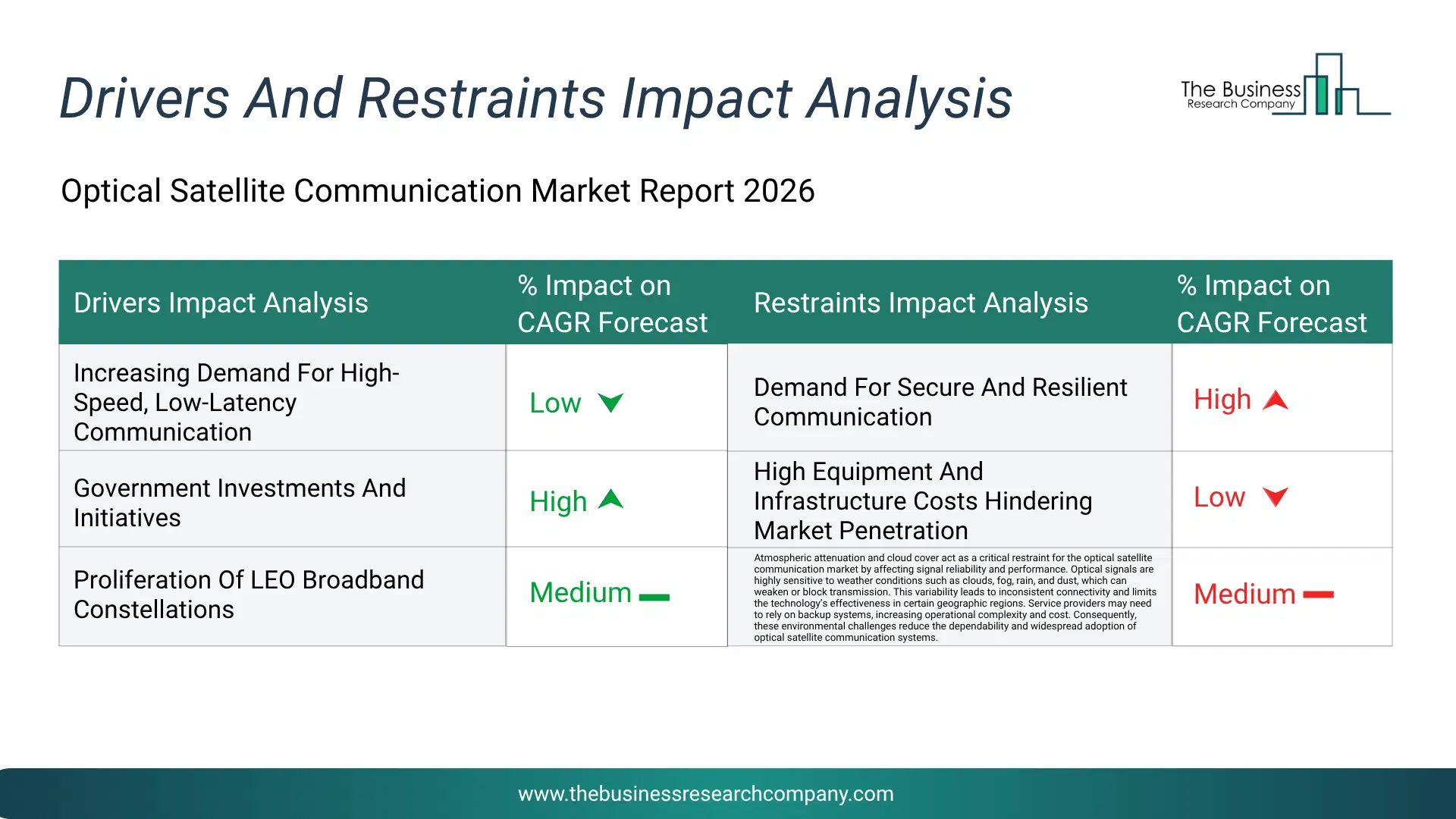
Infographic Chart Showing Key Market Drivers Analysis And Restraints For Optical Satellite Communication Market
The chart presents an impact analysis of key drivers and restraints, quantifying their relative influence on the market's growth rate and helping assess the balance between growth enablers and limiting factors. This chart offers a high-level perspective; the full report contains more detailed insights.
How Will The Drivers Impact Growth In The Global Optical Satellite Communication Market?
• Increasing Demand For High-Speed, Low-Latency Communication (Low) – During the forecast period, the increasing demand for high-speed, low-latency communication is expected to become a key growth driver for the optical satellite communication market by 2030. Increasing demand for high-speed, low-latency communication acts as a major driver for the optical satellite communication market because modern applications such as real-time data transfer, autonomous systems, and cloud computing require ultra-fast and reliable connectivity across long distances. Optical satellite communication delivers significantly higher data rates and lower latency compared to traditional radio frequency systems. This capability makes it highly suitable for bandwidth-intensive services such as video streaming, defense communication, and global internet coverage. As demand for seamless connectivity grows, industries increasingly adopt optical communication technologies. This rising need directly accelerates market expansion and technological deployment. • Government Investments And Initiatives (High) – During the forecast period, the government investments and initiatives is expected to emerge as a major factor driving the expansion of the optical satellite communication market by 2030. Government investments and initiatives acts as a major driver for the optical satellite communication market because space agencies and governments worldwide are heavily funding advanced satellite communication programs to strengthen national security and digital infrastructure. These investments support research, development, and deployment of next-generation optical communication systems. Public sector initiatives also encourage private participation and innovation in the space communication ecosystem. With increased funding and policy support, companies gain opportunities to scale technologies faster. This strong institutional backing significantly boosts overall market growth. • Proliferation Of LEO Broadband Constellations (Medium) – During the forecast period, the proliferation of LEO broadband constellations is expected to act as a key growth catalyst for the optical satellite communication market by 2030. Proliferation Of LEO Broadband Constellations Acts As A Major Driver For The Optical Satellite Communication Market Because the rapid deployment of low Earth orbit satellites is transforming global connectivity by enabling high-speed internet access even in remote regions. Optical communication systems are essential for inter-satellite links within these constellations due to their high bandwidth and efficiency. As companies expand LEO networks, the need for advanced optical links increases substantially. This creates strong demand for laser-based communication technologies. Consequently, the expansion of LEO constellations directly fuels market growth.How Will The Restraints Impact Growth In The Global Optical Satellite Communication Market?
• Demand For Secure And Resilient Communication (Low) – During the forecast period, the demand For Secure And Resilient Communication Acts As A Major Driver For The Optical Satellite Communication Market Because industries such as defense, finance, and government require highly secure communication channels to protect sensitive data. Optical satellite communication offers enhanced security features, including reduced signal interception and resistance to electromagnetic interference. These advantages make it more reliable than conventional communication technologies in critical applications. As cyber threats and data breaches continue to rise, organizations prioritize secure communication infrastructure. This growing emphasis on security drives widespread adoption and supports market expansion. • High Equipment And Infrastructure Costs Hindering Market Penetration (High) – During the forecast period, the high equipment and infrastructure costs hindering market penetration act as a significant restraint for the optical satellite communication market by making deployment financially challenging for new and existing players. The requirement for advanced ground stations, precision optical components, and space-qualified laser systems increases upfront capital expenditure. These high costs limit participation to well-funded organizations, reducing market competitiveness and innovation. Small and medium enterprises often struggle to invest in such expensive infrastructure, slowing overall adoption. As a result, the expansion of optical satellite communication networks across regions is considerably restricted. • Atmospheric attenuation and cloud cover act as a critical restraint for the optical satellite communication market by affecting signal reliability and performance. Optical signals are highly sensitive to weather conditions such as clouds, fog, rain, and dust, which can weaken or block transmission. This variability leads to inconsistent connectivity and limits the technology’s effectiveness in certain geographic regions. Service providers may need to rely on backup systems, increasing operational complexity and cost. Consequently, these environmental challenges reduce the dependability and widespread adoption of optical satellite communication systems. (Medium) – During the forecast period, the atmospheric attenuation and cloud cover act as a critical restraint for the optical satellite communication market by affecting signal reliability and performance. Optical signals are highly sensitive to weather conditions such as clouds, fog, rain, and dust, which can weaken or block transmission. This variability leads to inconsistent connectivity and limits the technology’s effectiveness in certain geographic regions. Service providers may need to rely on backup systems, increasing operational complexity and cost. Consequently, these environmental challenges reduce the dependability and widespread adoption of optical satellite communication systems.Key Players In The Global Optical Satellite Communication Market
Major companies operating in the optical satellite communication market are Mitsubishi Electric Corporation; Honeywell International Inc.; NEC Corporation; Thales Group; Space Exploration Technologies Corp; Ball Aerospace & Technologies Corp; Maxar Technologies Ltd.; Tesat-Spacecom GmbH & Co KG; Surrey Satellite Technology Ltd.; FiberTek Inc.; Space Micro Inc.; Synspective Inc.; Transcelestial Technologies; Skyloom Global Corp; ATLAS Space Operations Inc.; Aperture Optical Sciences Inc; BridgeCOMM Inc.; Analytical Space Inc.; Hisdesat Servicios Estrategicos S.A.; Mynaric AG; Kleos Space SA; BridgeSat Inc.; SITAEL S.p.A; Clutch Space Systems Ltd.; Laser Light Communications Inc.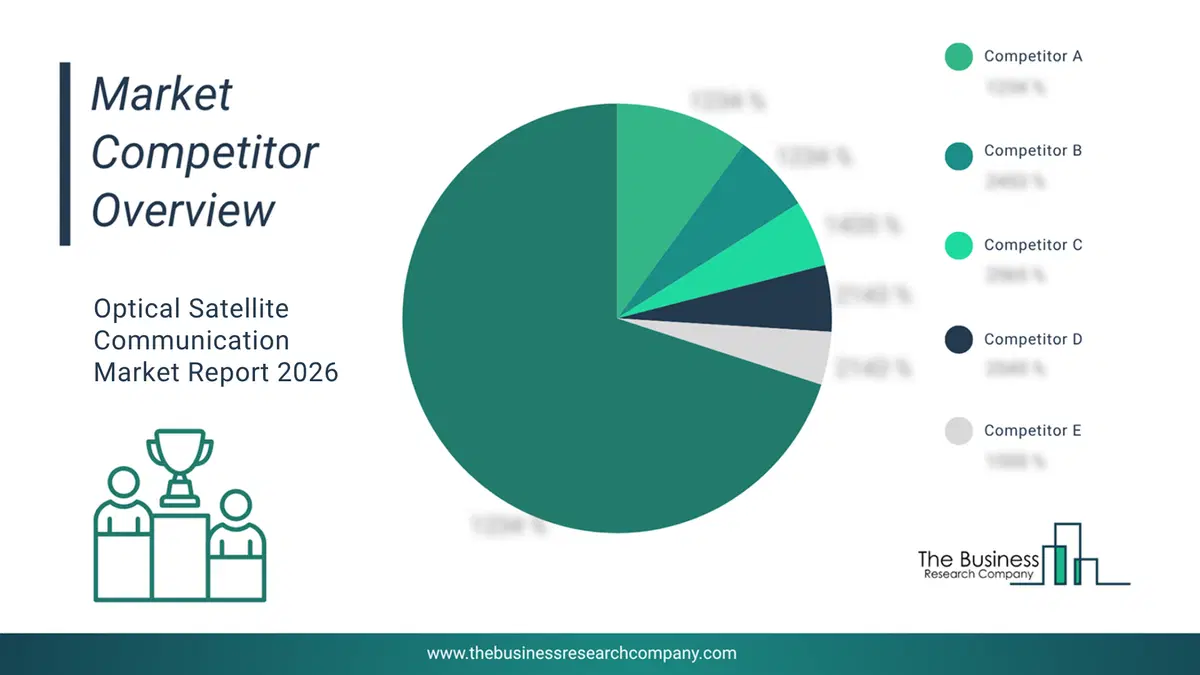
This chart is for illustrative purposes; the full report includes a detailed competitor analysis and comprehensive overview of the top 10 companies in the market.
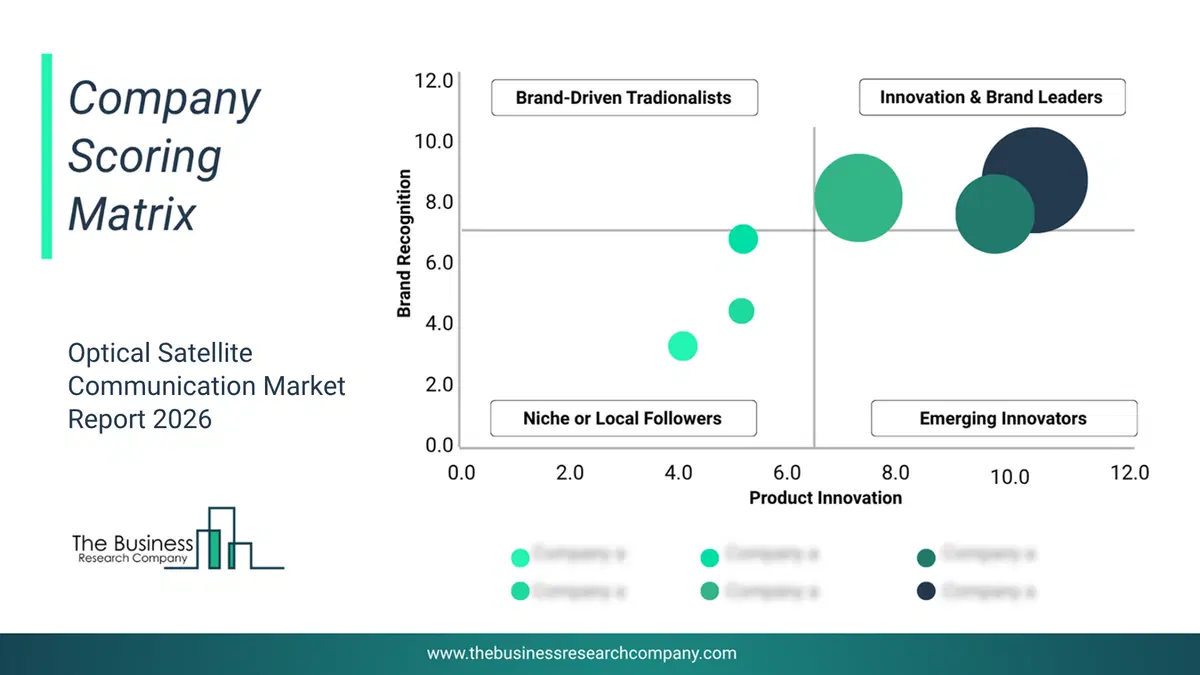
This chart maps companies by product innovation and brand strength, with bubble size indicating relative revenue, helping identify market leaders, challengers, and niche players. This is an illustrative chart; the full report provides a complete and accurate competitive analysis.
Global Optical Satellite Communication Market Trends and Insights
Major companies operating in the optical satellite communication market are developing innovative products, such as scalable optical communication terminals, to meet larger customer bases, increase sales, and increase revenue. A scalable optical communications terminal refers to a communication system that can be easily adjusted or expanded in size, capacity, or functionality to accommodate varying requirements. For instance, in March 2024, NEC Corporation, a Japan-based multinational information technology and electronics corporation, and Skyloom Global Corporation, a US-base space tech company, are partnering to transform space communications by developing advanced optical communication equipment for multi-orbit satellite networks. Their collaboration aims to commercialize one of the world's fastest space optical terminals, enabling high-speed inter-satellite communications of 100 Gbps and beyond, ushering in a new era of connectivity for the space industry.What Are Latest Mergers And Acquisitions In The Optical Satellite Communication Market?
In September 2023, General Atomics, a US-based energy and defense corporation, acquired EO Vista, LLC, for an undisclosed amount. The acquisition aims to enhance General Atomics' capabilities in weather and science programs, particularly in relation to a U.S. Space Force weather satellite project that includes an EO/IR sensor payload. EO Vista, LLC is a US-based company specializing in space and airborne electro-optical sensors.Regional Insights
North America was the largest region in the optical satellite communication market in 2025. Asia-Pacific is expected to be the fastest-growing region in the forecast period. The regions covered in this market report are Asia-Pacific, South East Asia, Western Europe, Eastern Europe, North America, South America, Middle East, Africa. The countries covered in this market report are Australia, Brazil, China, France, Germany, India, Indonesia, Japan, Taiwan, Russia, South Korea, UK, USA, Canada, Italy, SpainWhat Defines the Optical Satellite Communication Market?
The optical satellite communication market consists of revenues earned by entities by providing optical satellite communication lasers such as YAG laser, CO2 laser and AlGaAs laser. Values in this market are ‘factory gate’ values, that is the value of goods sold by the manufacturers or creators of the goods, whether to other entities (including downstream manufacturers, wholesalers, distributors, and retailers) or directly to end customers. The value of goods in this market includes related services sold by the creators of the goods.How is Market Value Defined and Measured?
The market value is defined as the revenues that enterprises gain from the sale of goods and/or services within the specified market and geography through sales, grants, or donations in terms of the currency (in USD unless otherwise specified). The revenues for a specified geography are consumption values that are revenues generated by organizations in the specified geography within the market, irrespective of where they are produced. It does not include revenues from resales along the supply chain, either further along the supply chain or as part of other products.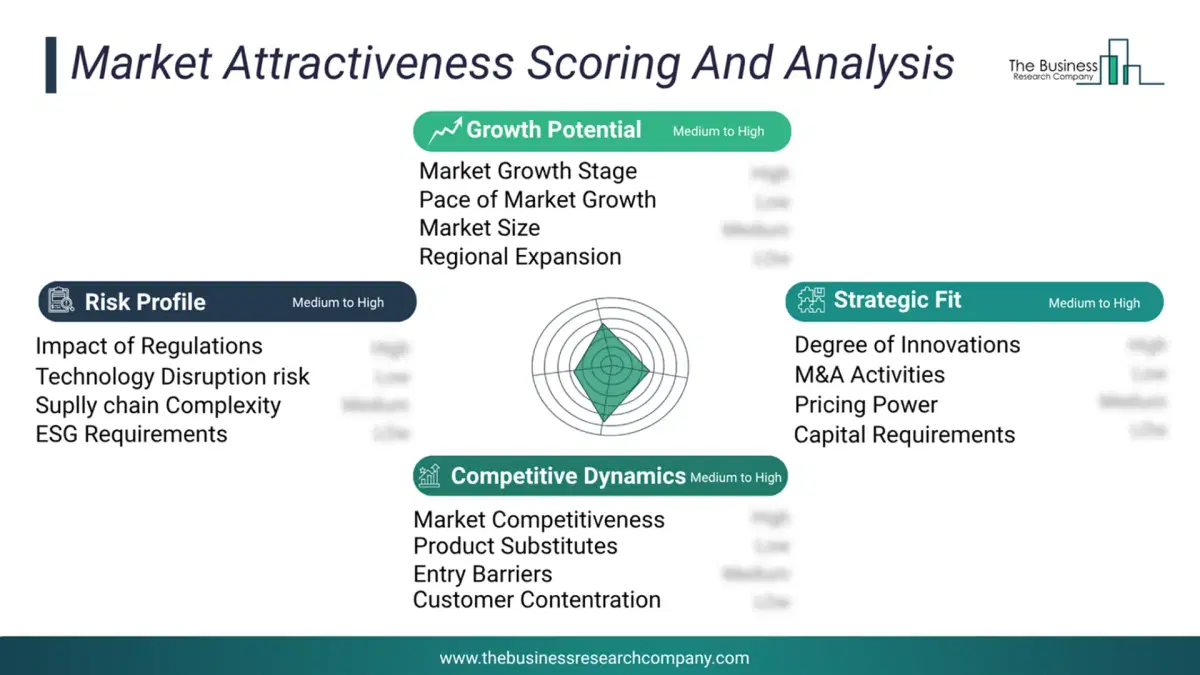
This chart presents market attractiveness based on a quantitative evaluation of growth, competition, strategic alignment, and risk, offering a clear view of opportunity areas for decision-making. This chart is for illustrative purposes; the full report contains the complete analysis.
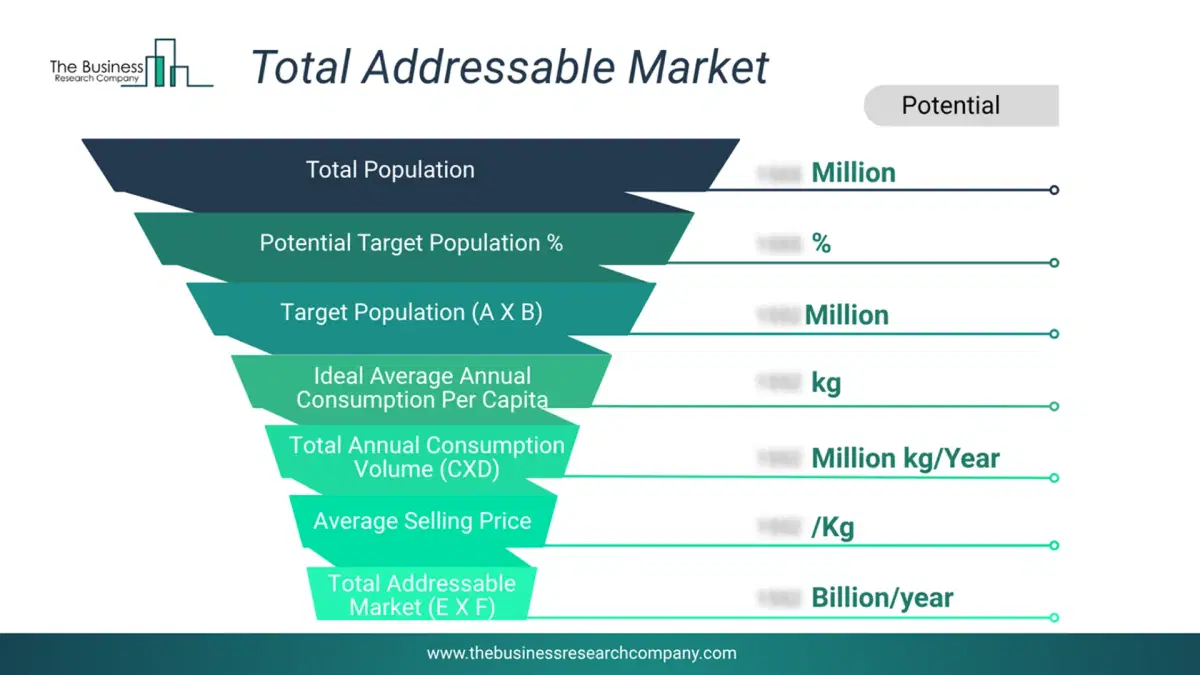
This chart highlights the Total Addressable Market (TAM) by estimating the maximum revenue opportunity using an assumption-driven approach, supporting strategic planning and opportunity sizing across markets. The chart is illustrative; the full report provides a more comprehensive analysis.
What Key Data and Analysis Are Included in the Optical Satellite Communication Market Report 2026?
The optical satellite communication market research report is one of a series of new reports from The Business Research Company that provides market statistics, including industry global market size, regional shares, competitors with the market share, detailed market segments, market trends and opportunities, and any further data you may need to thrive in the optical satellite communication industry. The market research report delivers a complete perspective of everything you need, with an in-depth analysis of the current and future state of the industry.Optical Satellite Communication Market Report Forecast Analysis
| Report Attribute | Details |
|---|---|
| Market Size Value In 2026 | $21.96 billion |
| Revenue Forecast In 2030 | $71.23 billion |
| Growth Rate | CAGR of 31.8% from 2026 to 2030 |
| Base Year For Estimation | 2025 |
| Actual Estimates/Historical Data | 2020-2025 |
| Forecast Period | 2026 - 2030 |
| Market Representation | Revenue in USD Billion and CAGR from 2026 to 2030 |
| Segments Covered | Component, Laser Type, Application |
| Regional Scope | Asia-Pacific, Western Europe, Eastern Europe, North America, South America, Middle East, Africa |
| Country Scope | The countries covered in the report are Australia, Brazil, China, France, Germany, India, Indonesia, Japan, Taiwan, Russia, South Korea, UK, USA, Canada, Italy, Spain. |
| Key Companies Profiled | Mitsubishi Electric Corporation; Honeywell International Inc.; NEC Corporation; Thales Group; Space Exploration Technologies Corp; Ball Aerospace & Technologies Corp; Maxar Technologies Ltd.; Tesat-Spacecom GmbH & Co KG; Surrey Satellite Technology Ltd.; FiberTek Inc.; Space Micro Inc.; Synspective Inc.; Transcelestial Technologies; Skyloom Global Corp; ATLAS Space Operations Inc.; Aperture Optical Sciences Inc; BridgeCOMM Inc.; Analytical Space Inc.; Hisdesat Servicios Estrategicos S.A.; Mynaric AG; Kleos Space SA; BridgeSat Inc.; SITAEL S.p.A; Clutch Space Systems Ltd.; Laser Light Communications Inc. |
| Customization Scope | Request for Customization |
| Pricing And Purchase Options | Explore Purchase Options |