

Passive Optical Network Market Report 2026
Global Outlook – By Component (Optical Power Splitters, Optical Filters, Wavelength Division Multiplexer/De-Multiplexe), By Structure (Ethernet Passive Optical Networks (EPON), Optical Network Terminal (ONT), Optical Line Terminal (OLT), Gigabit Passive Optical Network (GPON), Optical Network Terminal (ONT)), By Application (Residential Service (FTTH), Business Service (Other FTTx), Mobile Backhaul) – Market Size, Trends, Strategies, and Forecast to 2030
Passive Optical Network Market Overview
• Passive Optical Network market size has reached to $25.52 billion in 2025 • Expected to grow to $61.03 billion in 2030 at a compound annual growth rate (CAGR) of 19% • Growth Driver: Passive Optical Network Market Accelerates With Rising Data Traffic • Market Trend: Technological Advancements In The Passive Optical Network (PON) Market • North America was the largest region in 2025 and Asia-Pacific is the fastest growing region.What Is Covered Under Passive Optical Network Market?
Passive optical network refers to a fiber-optic network, which uses a point-to-multipoint topology and optical splitters to deliver data from a single transmission point to multiple user endpoints. The unpowered state of the fiber and splitting/combining components is referred to as passive in this context. The main components of the passive optical network include optical power splitters, optical filters, and wavelength division multiplexer/de-multiplexer. Optical power splitters are the basic parts of photonic integrated circuits (PIC). Splitters for passive optical networks (PONs) are essential in Fiber to the Home (FTTH) networks because they use a single PON network interface to be shared by several customers. The different passive optical network structures include ethernet passive optical networks (EPON), optical network terminal (ONT), optical line terminal (OLT), gigabit passive optical network (GPON), optical network terminal (ONT), an optical line terminal (OLT) for applications in residential service (FTTH), business service (Other FTTx) and mobile backhaul.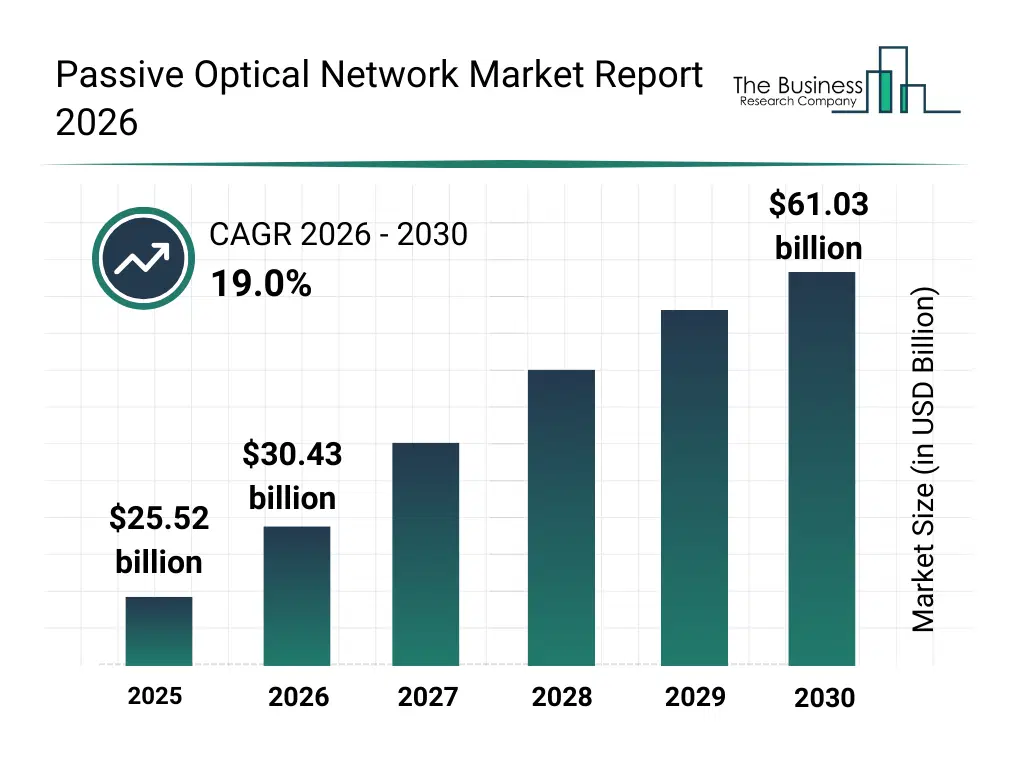
What Is The Passive Optical Network Market Size and Share 2026?
The passive optical network market size has grown rapidly in recent years. It will grow from $25.52 billion in 2025 to $30.43 billion in 2026 at a compound annual growth rate (CAGR) of 19.3%. The growth in the historic period can be attributed to growth in broadband demand, expansion of fiber infrastructure, early ftth deployments, rising internet penetration, need for high-speed connectivity.What Is The Passive Optical Network Market Growth Forecast?
The passive optical network market size is expected to see rapid growth in the next few years. It will grow to $61.03 billion in 2030 at a compound annual growth rate (CAGR) of 19.0%. The growth in the forecast period can be attributed to 5G network expansion, increasing data traffic volumes, smart city connectivity needs, adoption of cloud services, demand for low-latency networks. Major trends in the forecast period include fiber-to-the-home network expansion, high-capacity gigabit pon deployment, integration with 5G mobile backhaul, energy-efficient optical network solutions, migration to next-generation pon technologies.
Global Passive Optical Network Market Segmentation
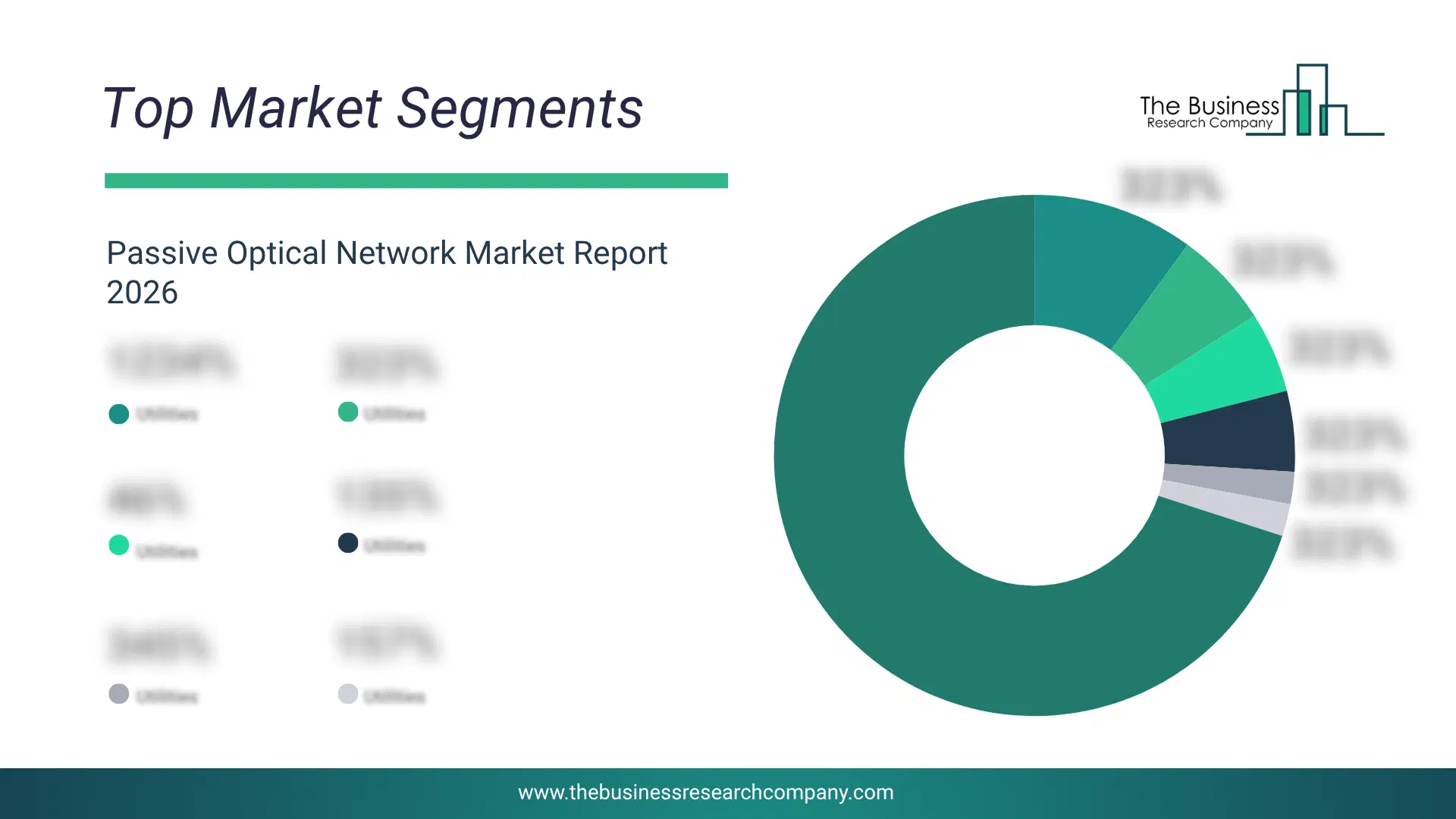
1) By Component: Optical Power Splitters, Optical Filters, Wavelength Division Multiplexer/De-Multiplexe 2) By Structure: Ethernet Passive Optical Networks (EPON), Optical Network Terminal (ONT), Optical Line Terminal (OLT), Gigabit Passive Optical Network (GPON), Optical Network Terminal (ONT) 3) By Application: Residential Service (FTTH), Business Service (Other FTTx), Mobile Backhaul Subsegments: 1) By Optical Power Splitters: Fused Biconical Taper Splitters (FBT), Planar Lightwave Circuit Splitters (PLC) 2) By Optical Filters: Bandpass Filters, Notch Filters, Optical Add-Drop Filters 3) By Wavelength Division Multiplexer Or De-Multiplexer: Coarse Wavelength Division Multiplexing (CWDM) Devices, Dense Wavelength Division Multiplexing (DWDM) DevicesWhat Is The Driver Of The Passive Optical Network Market?
The increasing data traffic is driving the growth of the passive optical network market. Data traffic refers to the volume of digital information or data transmitted over a network within a specific timeframe. Passive optical networks (PONs) are used in handling data traffic by leveraging Wavelength Division Multiplexing (WDM) technology to transmit data on different wavelengths within the same fiber, enabling simultaneous downstream and upstream communication without interference. For instance, in September 2023, according to the Demandsage, a US-based data driven marketing solution provider, as of 2023, the global data creation has reached 120 zettabytes, with projections indicating an expected increase to 181 zettabytes by the conclusion of 2025. Therefore, the increasing data traffic will rise with the increasing penetration of telecom and internet services.Key Players In The Global Passive Optical Network Market
Major companies operating in the passive optical network market are Verizon Communications Inc.; Huawei Technologies Co Ltd.; Hitachi Ltd.; Cisco Systems Inc.; Mitsubishi Electric Corporation; Broadcom Corporation Inc.; Fujitsu Ltd.; Telefonaktiebolaget LM Ericsson; Nokia Corporation; Sumitomo Electric Industries Ltd.; NEC Corporation; ZTE Corporation; Corning Inc.; NXP Semiconductors; FiberHome Technologies Group; Ciena Corporation; Lumentum Operations LLC; Infinera Corporation; Finisar Corporation; ADTRAN Inc.; Calix Inc.; Tellabs Inc.; Acacia Communications Inc.; ADVA Optical Networking SE; Oclaro Inc.; NeoPhotonics Corporation; Source Photonics Inc.; Alphion Corporation; TP-Link Technologies Co Ltd.
This chart is for illustrative purposes; the full report includes a detailed competitor analysis and comprehensive overview of the top 10 companies in the market.
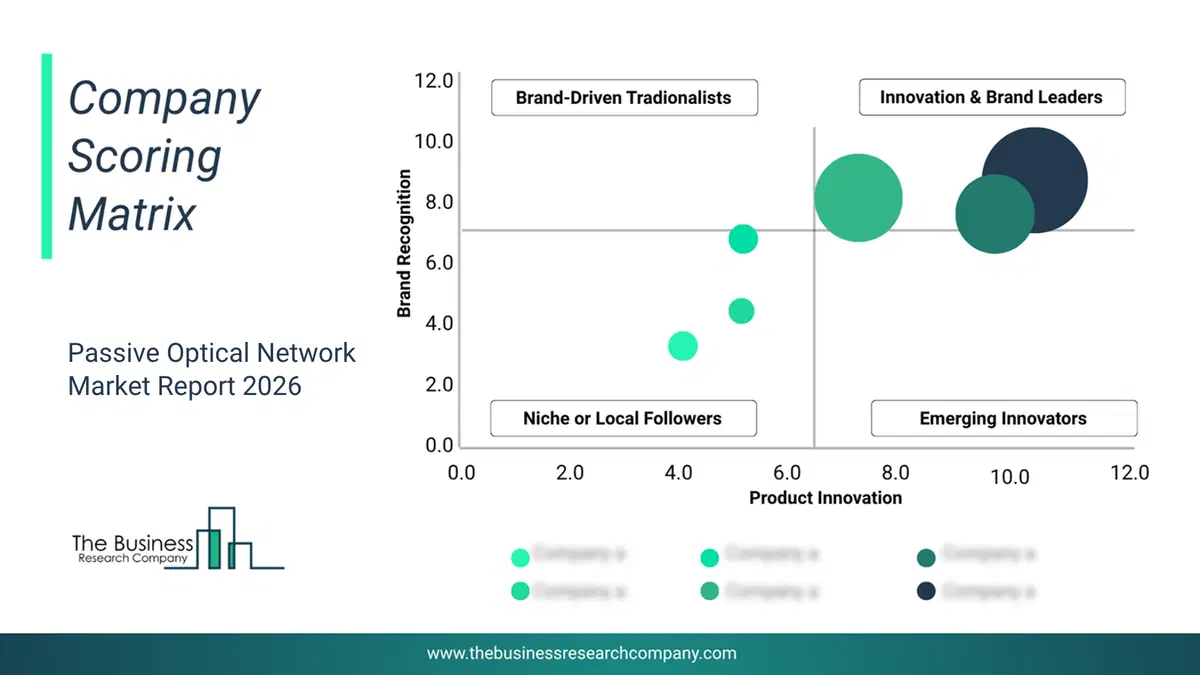
This chart maps companies by product innovation and brand strength, with bubble size indicating relative revenue, helping identify market leaders, challengers, and niche players. This is an illustrative chart; the full report provides a complete and accurate competitive analysis.
Global Passive Optical Network Market Trends and Insights
Major companies operating in the passive optical network market are focusing on technological advancements, such as passive optical network access solutions to enhance network performance, increase bandwidth, and support the rising demand for high-speed internet. A Passive Optical Network (PON) Access Solution refers to a telecommunications technology that uses fiber optic cables to deliver broadband network access without the need for active electronic components within the network. For instance, in February 2024, Precision Optical Technologies Inc., a US-based system engineering and integration company, launched OpenPath, a comprehensive passive optical network (PON) access solution designed to streamline the deployment and management of 10 Gigabit symmetrical networks (XGS-PON). This turnkey solution includes essential components such as optical line terminals (OLTs), optical network units (ONUs), splitters, and advanced controller software, enabling service providers to efficiently manage their networks. OpenPath features a white box hardware model for interoperability, allowing operators to avoid vendor lock-in and easily integrate various ONUs.What Are Latest Mergers And Acquisitions In The Passive Optical Network Market?
In July 2024, Belden Inc., a US-based publicly traded company known for designing and manufacturing security and connectivity products, acquired Precision Optical Technologies, Inc. for $290 million. Through this acquisition, Belden aims to bolster its optical transceiver market presence and enhance offerings in Enterprise Solutions and broadband segments, addressing rising fiber deployment and bandwidth demands while expanding reach among telecommunications providers, data centers, and enterprises. Precision Optical Technologies, Inc. is a US-based systems integration company that specializes in end-to-end optical networking solutions, network design services, and advanced product development.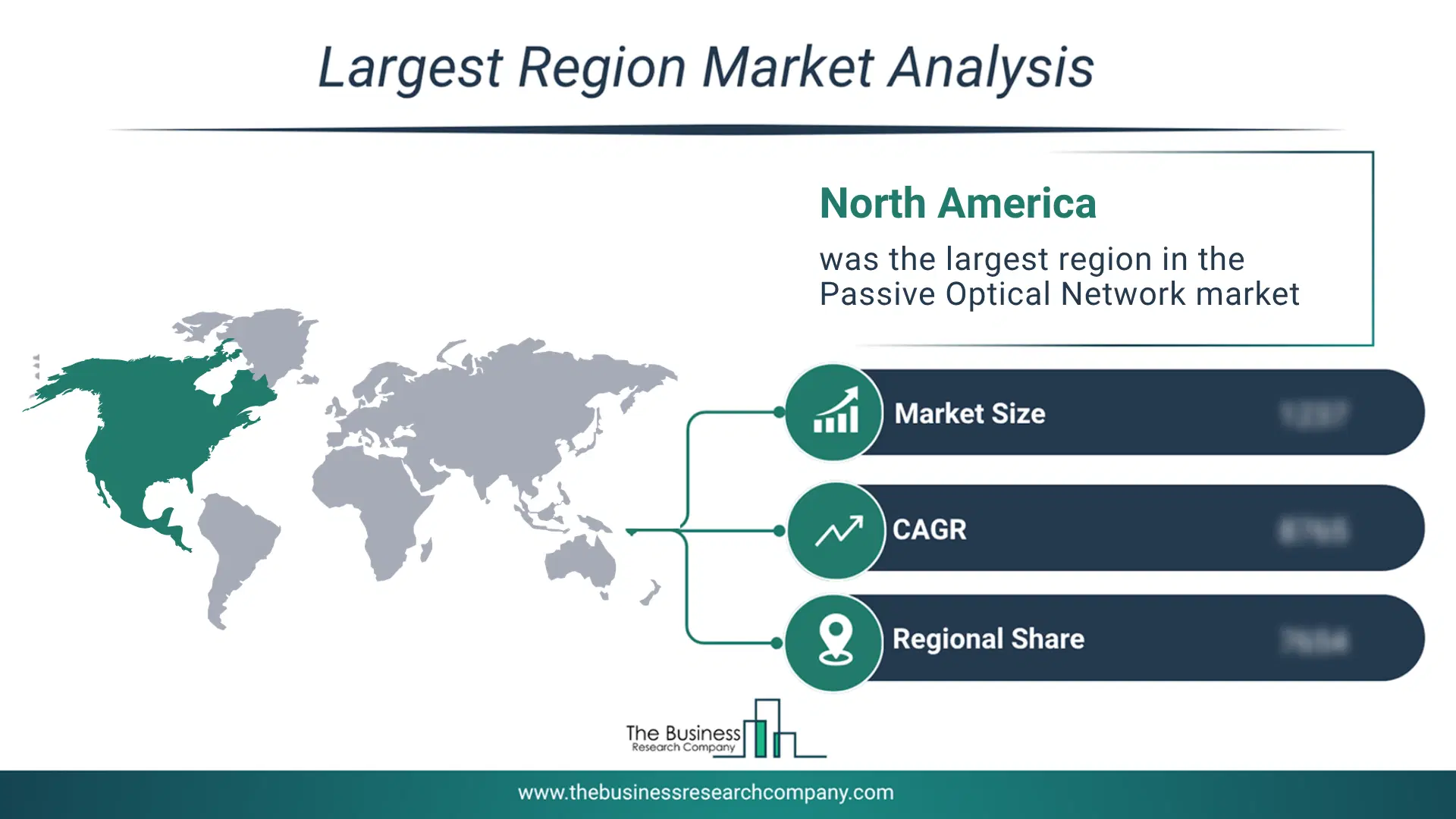
Regional Insights
North America was the largest region in the passive optical network market in 2025. Asia-Pacific is expected to be the fastest-growing region in the forecast period. The regions covered in this market report are Asia-Pacific, South East Asia, Western Europe, Eastern Europe, North America, South America, Middle East, Africa. The countries covered in this market report are Australia, Brazil, China, France, Germany, India, Indonesia, Japan, Taiwan, Russia, South Korea, UK, USA, Canada, Italy, SpainWhat Defines the Passive Optical Network Market?
The passive optical network market includes revenues earned by entities by providing services such as APON (ATM Passive Optical Networks), BPON (Broadband PON), EPON (Ethernet PON), GE-PON (for Gigabit Ethernet PON), GPON (Gigabit Ethernet PON). The market value includes the value of related goods sold by the service provider or included within the service offering. Only goods and services traded between entities or sold to end consumers are included.How is Market Value Defined and Measured?
The market value is defined as the revenues that enterprises gain from the sale of goods and/or services within the specified market and geography through sales, grants, or donations in terms of the currency (in USD unless otherwise specified). The revenues for a specified geography are consumption values that are revenues generated by organizations in the specified geography within the market, irrespective of where they are produced. It does not include revenues from resales along the supply chain, either further along the supply chain or as part of other products.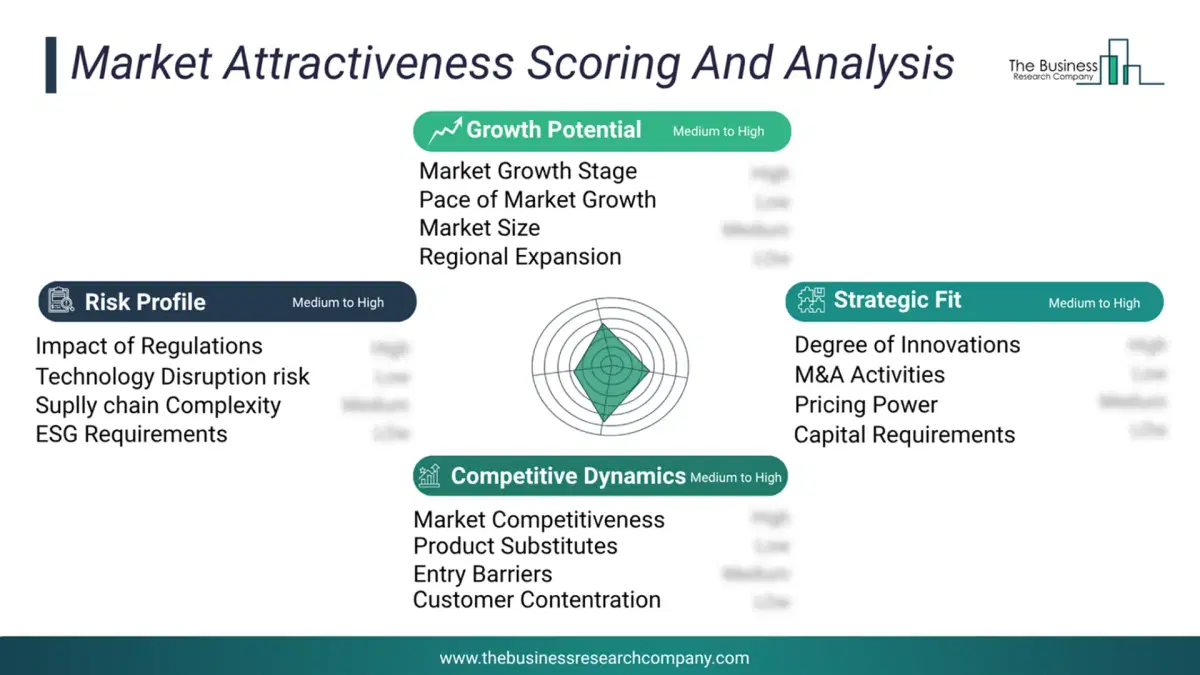
This chart presents market attractiveness based on a quantitative evaluation of growth, competition, strategic alignment, and risk, offering a clear view of opportunity areas for decision-making. This chart is for illustrative purposes; the full report contains the complete analysis.
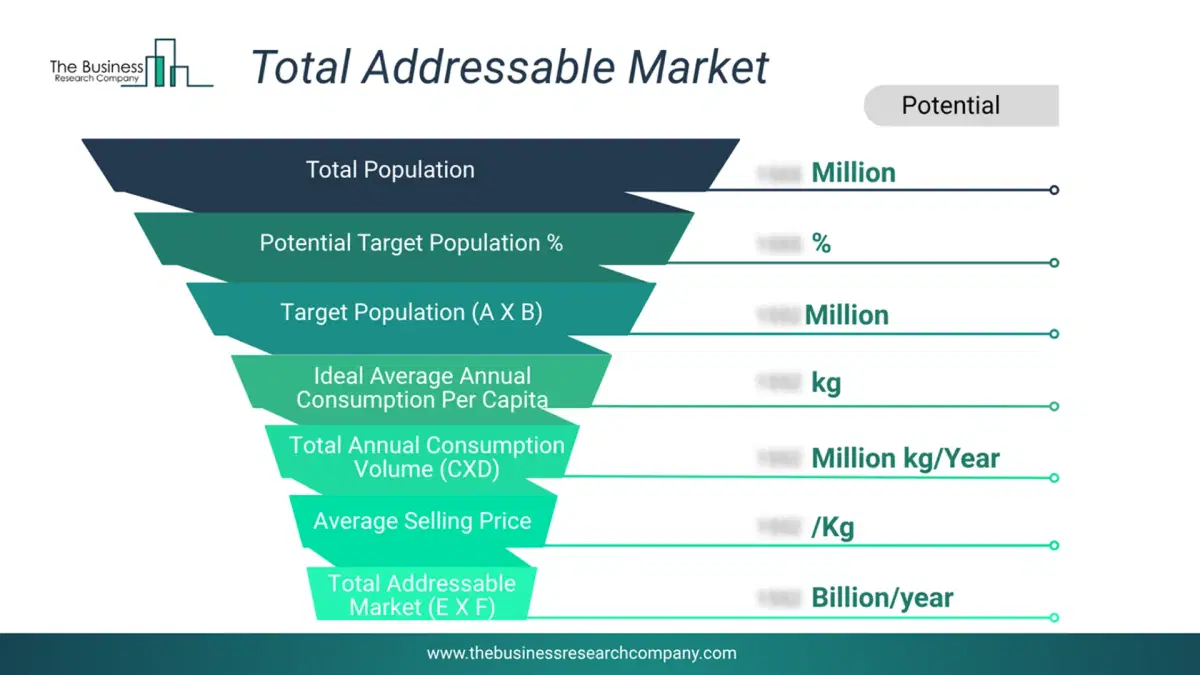
This chart highlights the Total Addressable Market (TAM) by estimating the maximum revenue opportunity using an assumption-driven approach, supporting strategic planning and opportunity sizing across markets. The chart is illustrative; the full report provides a more comprehensive analysis.
What Key Data and Analysis Are Included in the Passive Optical Network Market Report 2026?
The passive optical network market research report is one of a series of new reports from The Business Research Company that provides market statistics, including industry global market size, regional shares, competitors with the market share, detailed market segments, market trends and opportunities, and any further data you may need to thrive in the passive optical network industry. The market research report delivers a complete perspective of everything you need, with an in-depth analysis of the current and future state of the industry.Passive Optical Network Market Report Forecast Analysis
| Report Attribute | Details |
|---|---|
| Market Size Value In 2026 | $30.43 billion |
| Revenue Forecast In 2030 | $61.03 billion |
| Growth Rate | CAGR of 19% from 2026 to 2030 |
| Base Year For Estimation | 2025 |
| Actual Estimates/Historical Data | 2020-2025 |
| Forecast Period | 2026 - 2030 |
| Market Representation | Revenue in USD Billion and CAGR from 2026 to 2030 |
| Segments Covered | Component, Structure, Application |
| Regional Scope | Asia-Pacific, Western Europe, Eastern Europe, North America, South America, Middle East, Africa |
| Country Scope | The Countries Covered In This Market Report Are Australia, Brazil, China, France, Germany, India, Indonesia, Japan, Taiwan, Russia, South Korea, Uk, Usa, Canada, Italy, Spain. |
| Key Companies Profiled | Verizon Communications Inc., Huawei Technologies Co Ltd., Hitachi Ltd., Cisco Systems Inc., Mitsubishi Electric Corporation, Broadcom Corporation Inc., Fujitsu Ltd., Telefonaktiebolaget LM Ericsson, Nokia Corporation, Sumitomo Electric Industries Ltd., NEC Corporation, ZTE Corporation, Corning Inc., NXP Semiconductors, FiberHome Technologies Group, Ciena Corporation, Lumentum Operations LLC, Infinera Corporation, Finisar Corporation, ADTRAN Inc., Calix Inc., Tellabs Inc., Acacia Communications Inc., ADVA Optical Networking SE, Oclaro Inc., NeoPhotonics Corporation, Source Photonics Inc., Alphion Corporation, TP-Link Technologies Co Ltd. |
| Customization Scope | Request for Customization |
| Pricing And Purchase Options | Explore Purchase Options |