
Peripheral Artery Disease Market Report 2026
Global Outlook – By Type (Peripheral Angioplasty Balloons, Peripheral Stents, Peripheral Catheters, Inferior Vena Cava (IVC) Filters, Plaque Modification Devices, Hemodynamic Flow Alteration Devices, Peripheral Accessories), By Drugs (Lipid-Lowering Drugs, Blood Pressure Lowering Drugs, Glucose Regulating Drugs, Blood Clot Preventing Drugs, Inotropes, Thrombolytics Agents, Anti-Inflammatory Agents), By Route Of Administration (Oral, Parenteral, Other Routes Of Administrations), By End Users (Hospitals, Specialty Clinics, Other End Users) - Market Size, Trends, And Global Forecast 2026-2035
Peripheral Artery Disease Market Overview
• Peripheral Artery Disease market size has reached to $4.62 billion in 2025 • Expected to grow to $6.69 billion in 2030 at a compound annual growth rate (CAGR) of 7.8% • Growth Driver: Rising Prevalence Of Peripheral Artery Diseases Expected To Drive Growth In Peripheral Artery Disease Market • Market Trend: Technologically Advanced Solution For Peripheral Artery Disease Treatment • North America was the largest region in 2025 and Asia-Pacific is the fastest growing region.
What Is Covered Under Peripheral Artery Disease Market?
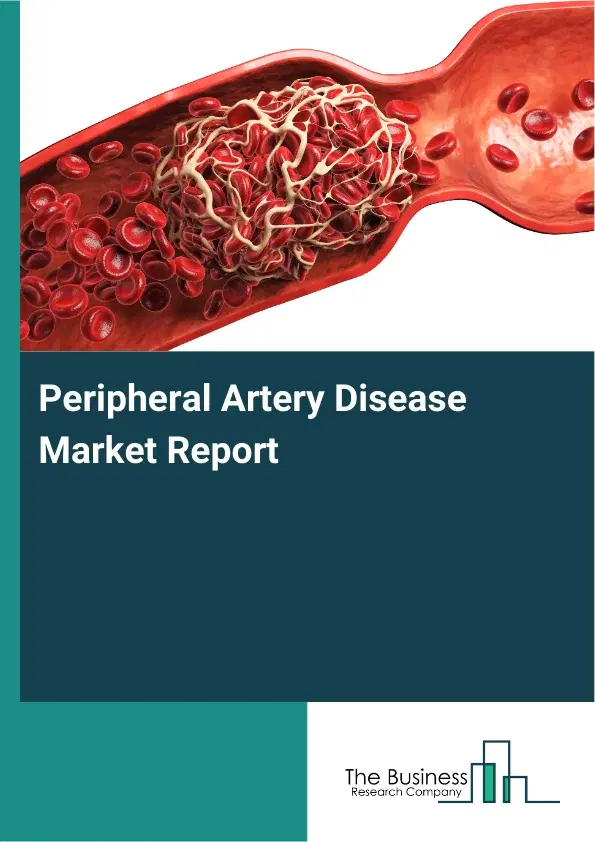
Peripheral artery disease (PAD) is a disorder that causes the arteries that carry blood to the limbs, most commonly the legs, to thin or block. It is usually caused by atherosclerosis, characterized by the accumulation of fatty deposits (plaques) inside the artery walls, resulting in decreased blood flow to the afflicted regions. The main peripheral artery disease products are peripheral angioplasty balloons, peripheral stents, peripheral catheters, inferior vena cava (IVC) filters, plaque modification devices, hemodynamic flow alteration devices, and peripheral accessories. Peripheral angioplasty balloons refer to medical devices designed to dilate narrowed or blocked peripheral arteries and it is used in peripheral artery disease to open narrowed or blocked arteries by inflating the balloon to compress the plaque and widen the artery, restoring blood flow. The various drugs used are lipid-lowering drugs, blood pressure-lowering drugs, glucose-regulating drugs, blood clot-preventing drugs, inotropes, thrombolytics agents, and anti-inflammatory agents that are administered through different routes of administration such as oral, parenteral, and others by different end users such as hospitals, specialty clinics, and others.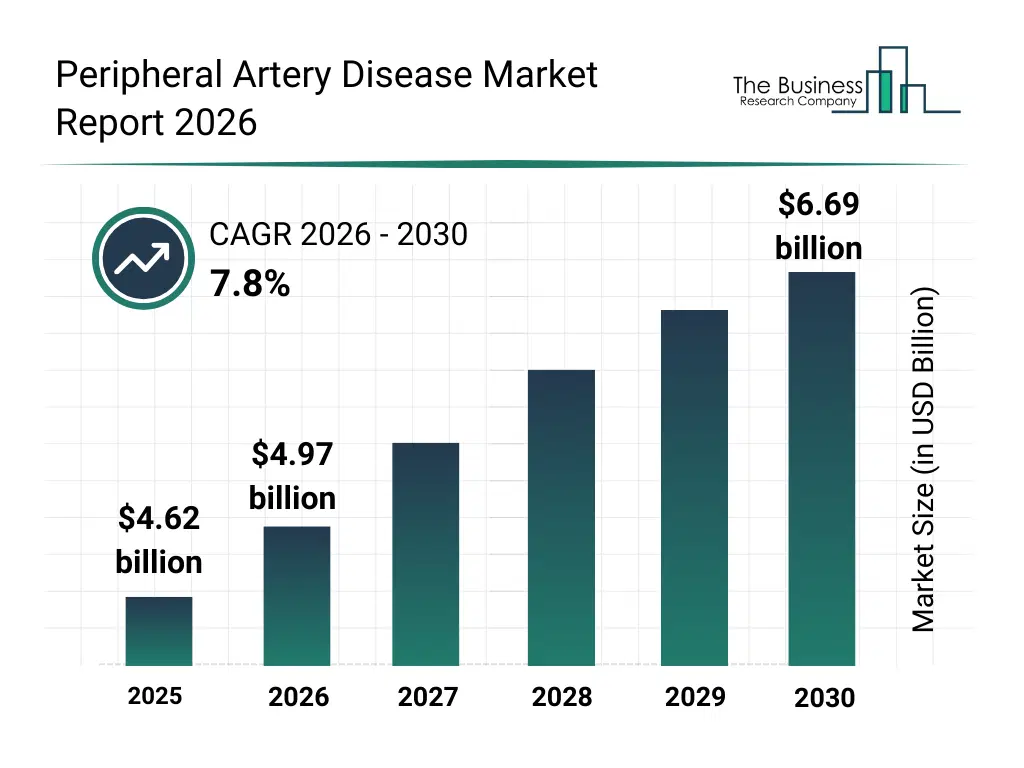
What Is The Peripheral Artery Disease Market Size and Share 2026?
The peripheral artery disease market size has grown strongly in recent years. It will grow from $4.62 billion in 2025 to $4.97 billion in 2026 at a compound annual growth rate (CAGR) of 7.5%. The growth in the historic period can be attributed to high prevalence of peripheral artery disease, limited awareness of PAD risk factors, reliance on traditional medications, inadequate access to interventional specialists, fragmented patient care pathways.What Is The Peripheral Artery Disease Market Growth Forecast?
The peripheral artery disease market size is expected to see strong growth in the next few years. It will grow to $6.69 billion in 2030 at a compound annual growth rate (CAGR) of 7.8%. The growth in the forecast period can be attributed to advancements in minimally invasive peripheral interventions, growing adoption of drug-eluting balloons and stents, expansion of hospitals and specialty vascular clinics, rising patient awareness and early detection initiatives, increasing use of combination therapies including lifestyle modification and pharmacotherapy. Major trends in the forecast period include increasing use of ai for early pad diagnosis and risk stratification, rising adoption of cloud-based patient monitoring systems, growing focus on genomic-guided personalized pad therapies, increasing integration of iot devices for post-intervention tracking, rising implementation of smart manufacturing in pad device production.Global Peripheral Artery Disease Market Segmentation
1) By Type: Peripheral Angioplasty Balloons, Peripheral Stents, Peripheral Catheters, Inferior Vena Cava (IVC) Filters, Plaque Modification Devices, Hemodynamic Flow Alteration Devices, Peripheral Accessories 2) By Drugs: Lipid-Lowering Drugs, Blood Pressure Lowering Drugs, Glucose Regulating Drugs, Blood Clot Preventing Drugs, Inotropes, Thrombolytics Agents, Anti-Inflammatory Agents 3) By Route Of Administration: Oral, Parenteral, Other Routes Of Administrations 4) By End Users: Hospitals, Specialty Clinics, Other End Users Subsegments: 1) By Peripheral Angioplasty Balloons: Drug-Eluting Balloons, Non-Drug-Eluting Balloons, Scoring Balloons, Cutting Balloons 2) By Peripheral Stents: Drug-Eluting Stents, Bare Metal Stents, Covered Stents 3) By Peripheral Catheters: Sheath Introducers, Guidewires, Diagnostic Catheters, Delivery Catheters 4) By Inferior Vena Cava (IVC) Filters: Retrievable IVC Filters, Permanent IVC Filters 5) By Plaque Modification Devices: Atherectomy Devices, Laser Atherectomy Devices, Rotational Atherectomy Devices 6) By Hemodynamic Flow Alteration Devices: Flow Diversion Devices, Flow Restriction Devices 7) By Peripheral Accessories: Diagnostic Imaging Accessories, Accessory Kits For Interventional Procedures, Support DevicesWhat Is The Driver Of The Peripheral Artery Disease Market?
The rise in the prevalence of peripheral artery diseases is expected to propel the growth of the peripheral artery disease market going forward. Peripheral artery disease refers to the narrowing or blockage of arteries outside the heart, usually in the legs, resulting in reduced blood flow and potential complications. Peripheral artery disease treatment helps reduce peripheral artery disease symptoms, enhance mobility, and decrease the risk of severe complications that improve patients' well-being. For instance, in June 2023, according to the American Heart Association, a US-based nonprofit organization it is estimated that between 7 to 12 million individuals in the United States and 200 million people globally are affected by the condition. Therefore, the rise in the prevalence of peripheral artery diseases is driving the growth of the peripheral artery disease industry.Key Players In The Global Peripheral Artery Disease Market
Major companies operating in the peripheral artery disease market are Cardinal Health Inc., Vascular Solutions Inc., Bayer AG, Abbott Laboratories, Medtronic plc., Koninklijke Philips N.V. (Royal Philips), B. Braun Melsungen AG., Terumo Corporation, Edwards Lifesciences, Becton Dickinson and Company (BD), Boston Scientific Corporation Incorporated, Cook Group Incorporated, Merit Medical Systems Inc., NuVasive Inc., Arjo AB, Penumbra Inc., BIOTRONIK SE and Co. KG, AngioDynamics Inc., Shockwave Medical Inc., Cardiovascular Systems Inc., Endologix LLC., LeMaitre Vascular Inc., Silk Road Medical Inc., WL Gore and Associates Inc., MicroPort Scientific Corporation, Bard Peripheral Vascular Inc., Avinger Inc.Global Peripheral Artery Disease Market Trends and Insights
Major companies operating in the peripheral artery disease (PAD) market are focusing on developing innovative solutions, such as dissolvable drug-eluting scaffold systems, to meet the rising demand for safer, more durable, and less invasive treatment options for below-the-knee arterial blockages. These resorbable scaffold technologies are designed to restore blood flow and then gradually dissolve, offering a key advantage over traditional permanent metallic stents. For instance, in April 2024, Abbott Laboratories, a U.S.-based medical-device company, introduced the Esprit BTK Everolimus Eluting Resorbable Scaffold System, a first-of-its-kind dissolvable stent therapy for below-the-knee PAD. The system delivers everolimus, a drug that helps prevent vessel re-narrowing, while its fully resorbable structure naturally dissolves over time, eliminating the long-term risks associated with metal implants. It offers physicians an advanced alternative to traditional angioplasty or permanent stenting, particularly benefiting patients with long lesions or critical limb ischemia. By combining drug delivery with temporary structural support, the Esprit BTK System aims to enhance vessel healing, reduce complications, and expand treatment possibilities in complex PAD cases.What Are Latest Mergers And Acquisitions In The Peripheral Artery Disease Market?
In April 2023, Abbott Laboratories, a US-based medical device company, acquired Cardiovascular Systems Inc. for an undisclosed amount. This acquisition broadens, diversifies, and enriches Abbott’s peripheral and coronary artery disease portfolio by adding the innovative atherectomy system from Cardiovascular Systems Inc. Cardiovascular Systems Inc is a US-based medical device company involved in manufacturing peripheral artery disease products.Regional Outlook
North America was the largest region in the peripheral artery disease market in 2025. Asia-Pacific is expected to be the fastest-growing region in the forecast period. The regions covered in this market report are Asia-Pacific, South East Asia, Western Europe, Eastern Europe, North America, South America, Middle East, Africa. The countries covered in this market report are Australia, Brazil, China, France, Germany, India, Indonesia, Japan, Taiwan, Russia, South Korea, UK, USA, Canada, Italy, Spain.What Defines the Peripheral Artery Disease Market?
The peripheral artery disease market consists of revenues earned by entities by providing peripheral artery disease management services and therapies such as diagnosis, angioplasty, atherectomy, lithoplasty, endovascular, vascular surgery, and rehabilitation. The market value includes the value of related goods sold by the service provider or included within the service offering. The peripheral artery disease market also includes sales of guidewires, bare metal, drug-eluting, compression stockings, and exercise equipment. Values in this market are ‘factory gate’ values, that is the value of goods sold by the manufacturers or creators of the goods, whether to other entities (including downstream manufacturers, wholesalers, distributors and retailers) or directly to end customers. The value of goods in this market includes related services sold by the creators of the goods.How is Market Value Defined and Measured?
The market value is defined as the revenues that enterprises gain from the sale of goods and/or services within the specified market and geography through sales, grants, or donations in terms of the currency (in USD unless otherwise specified). The revenues for a specified geography are consumption values that are revenues generated by organizations in the specified geography within the market, irrespective of where they are produced. It does not include revenues from resales along the supply chain, either further along the supply chain or as part of other products.What Key Data and Analysis Are Included in the Peripheral Artery Disease Market Report 2026?
The peripheral artery disease market research report is one of a series of new reports from The Business Research Company that provides market statistics, including industry global market size, regional shares, competitors with the market share, detailed market segments, market trends and opportunities, and any further data you may need to thrive in the peripheral artery disease industry. The market research report delivers a complete perspective of everything you need, with an in-depth analysis of the current and future state of the industry.Peripheral Artery Disease Market Report Forecast Analysis
| Report Attribute | Details |
|---|---|
| Market Size Value In 2026 | $4.97 billion |
| Revenue Forecast In 2035 | $6.69 billion |
| Growth Rate | CAGR of 7.5% from 2026 to 2035 |
| Base Year For Estimation | 2025 |
| Actual Estimates/Historical Data | 2020-2025 |
| Forecast Period | 2026 - 2030 - 2035 |
| Market Representation | Revenue in USD Billion and CAGR from 2026 to 2035 |
| Segments Covered | Type, Drugs, Route Of Administration, End Users |
| Regional Scope | Asia-Pacific, Western Europe, Eastern Europe, North America, South America, Middle East, Africa |
| Country Scope | The countries covered in the report are Australia, Brazil, China, France, Germany, India, ... |
| Key Companies Profiled | Cardinal Health Inc., Vascular Solutions Inc., Bayer AG, Abbott Laboratories, Medtronic plc., Koninklijke Philips N.V. (Royal Philips), B. Braun Melsungen AG., Terumo Corporation, Edwards Lifesciences, Becton Dickinson and Company (BD), Boston Scientific Corporation Incorporated, Cook Group Incorporated, Merit Medical Systems Inc., NuVasive Inc., Arjo AB, Penumbra Inc., BIOTRONIK SE and Co. KG, AngioDynamics Inc., Shockwave Medical Inc., Cardiovascular Systems Inc., Endologix LLC., LeMaitre Vascular Inc., Silk Road Medical Inc., WL Gore and Associates Inc., MicroPort Scientific Corporation, Bard Peripheral Vascular Inc., Avinger Inc. |
| Customization Scope | Request for Customization |
| Pricing And Purchase Options | Explore Purchase Options |