
Satellite Antenna Market Report 2026
Global Outlook – By Antenna Type (Flat Panel Antenna, Parabolic Reflector Antenna, Horn Antenna), By Component Type (Reflectors, Feed Horns, Feed Networks, Low Noise Converters, Other Component Types), By Frequency Band (C Band, K/KU/KA Band, S And L Band, X Band, VHF And UHF Band, Other Frequency Bands), By Application (Space, Land, Maritime) – Market Size, Trends, Strategies, and Forecast to 2030
Satellite Antenna Market Overview
• Satellite Antenna market size has reached to $3.83 billion in 2025 • Expected to grow to $6.67 billion in 2030 at a compound annual growth rate (CAGR) of 11.6% • Growth Driver: IOT Integration Fuels Surge In Satellite Antenna Market Growth • Market Trend: Advancements In Ultra-Compact Satellite Antennas Enhance Maritime Connectivity And Performance • North America was the largest region in 2025 and Asia Pacific is the fastest growing region.What Is Covered Under Satellite Antenna Market?
Satellite antenna refers to an apparatus designed to transmit or receive microwaves to satellites. Satellite antennas work by concentrating the satellite's transmitting power into a selected geographical region on earth to avoid interference from other signals transmitted from outside of the designated service area. The main types of satellite antennas are flat panel antennas, parabolic reflector antennas, and horn antennas. The parabolic reflector antenna is used for domestic satellite television reception, terrestrial microwave data links, and general satellite communications. The various components of a satellite are reflectors, feed horns, feed networks, low-noise converters, and others. These satellites' frequency bands include C band, K/KU/KA band, S and L band, X band, VHF and UHF band, and others. These satellite antennas are used in space, land, and maritime navigation.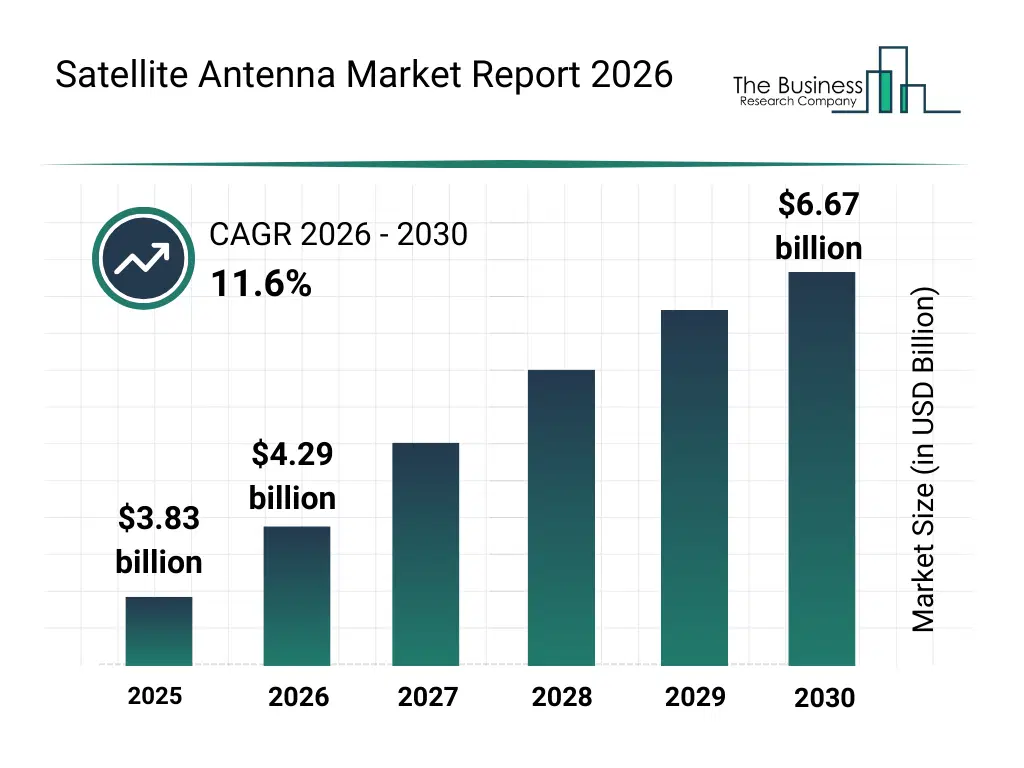
What Is The Satellite Antenna Market Size and Share 2026?
The satellite antenna market size has grown rapidly in recent years. It will grow from $3.83 billion in 2025 to $4.29 billion in 2026 at a compound annual growth rate (CAGR) of 12.0%. The growth in the historic period can be attributed to growing satellite communication demand, expansion of broadband services, rising defense and space applications, development of advanced antenna materials, increasing maritime and land-based connectivity needs.What Is The Satellite Antenna Market Growth Forecast?
The satellite antenna market size is expected to see rapid growth in the next few years. It will grow to $6.67 billion in 2030 at a compound annual growth rate (CAGR) of 11.6%. The growth in the forecast period can be attributed to adoption of ka/ku-band antennas, integration of AI for signal optimization, demand for high-throughput satellite networks, growth in flat panel antenna deployment, expansion of space-based and land satellite applications. Major trends in the forecast period include multi-band frequency antenna support, high-gain parabolic reflector antennas, flat panel antenna advancements, enhanced low noise converter efficiency, maritime and land-based connectivity solutions.
Global Satellite Antenna Market Segmentation
1) By Antenna Type: Flat Panel Antenna, Parabolic Reflector Antenna, Horn Antenna 2) By Component Type: Reflectors, Feed Horns, Feed Networks, Low Noise Converters, Other Component Types 3) By Frequency Band: C Band, K/KU/KA Band, S And L Band, X Band, VHF And UHF Band, Other Frequency Bands 4) By Application: Space, Land, Maritime Subsegments: 1) By Flat Panel Antenna: Active Flat Panel Antenna, Passive Flat Panel Antenna 2) By Parabolic Reflector Antenna: C-Band Parabolic Reflector Antenna, Ku-band Parabolic Reflector Antenna, Ka-Band Parabolic Reflector Antenna 3) By Horn Antenna: Standard Horn Antenna, Sectoral Horn Antenna, Conical Horn AntennaWhat Is The Driver Of The Satellite Antenna Market?
The increasing adoption of IoT devices is expected to propel the growth of the satellite antenna market going forward. IoT refers to a network of interconnected physical devices, vehicles, appliances, and other objects that are embedded with sensors, software, and network connectivity. Satellite antennas provide global coverage, allowing IoT devices to connect and communicate seamlessly across remote locations, ensuring that IoT devices remain operational during natural disasters, enabling real-time data transmission, asset tracking and management, scalability, and providing a secure and reliable means of connectivity for IoT devices, reducing vulnerabilities associated with traditional communication networks. For instance, in March 2023, according to Exploding Topics, a US-based online platform that provides insights into emerging and trending topics, by 2030, it is anticipated that there will be 25.4 billion IoT devices. Therefore, the increasing adoption of IoT devices is driving the growth of the satellite antenna industry.Key Players In The Global Satellite Antenna Market
Major companies operating in the satellite antenna market are Airbus SAS; General Dynamics Corporation; Mitsubishi Electric Corporation; Honeywell International Inc.; Thales Group; L3Harris Technologies; Viasat Inc.; Cobham plc; Advantech Wireless Inc.; EchoStar Corporation; Maxar Technologies Inc.; Inmarsat Global Limited; Skyware Technologies Ltd.; Airbus Defence and Space Government Solutions Inc.; Communications & Power Industries LLC; Comtech Telecommunications Corp; Gilat Satellite Networks Ltd.; Intellian Technologies Inc.; Satcom Direct Communications Inc.; Kymeta Corporation; Norsat International Inc.; C-COM Satellite Systems Inc.; Elite Antennas Ltd.; ThinKom Solutions Inc.; Orbital Systems (Pty) Ltd.
This chart is for illustrative purposes; the full report includes a detailed competitor analysis and comprehensive overview of the top 10 companies in the market.
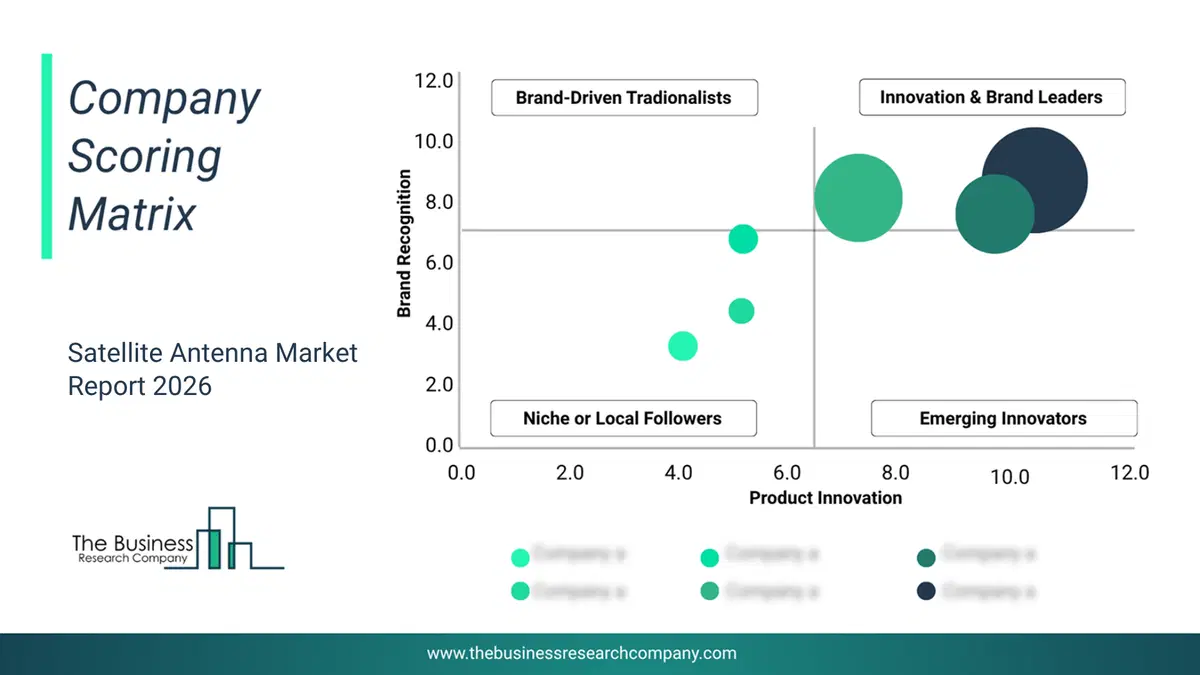
This chart maps companies by product innovation and brand strength, with bubble size indicating relative revenue, helping identify market leaders, challengers, and niche players. This is an illustrative chart; the full report provides a complete and accurate competitive analysis.
Global Satellite Antenna Market Trends and Insights
Major companies operating in the satellite antenna market are developing advancements in ultra-compact satellite antennas, such as maritime satellite TV antennas, to enhance connectivity, portability, and performance for various applications. A maritime satellite TV antenna is a specialized device that receives satellite television signals on moving vessels. It adjusts automatically to maintain a stable connection, ensuring access to entertainment and news while at sea. For instance, in July 2024, Cobham Satcom, a Denmark-based company, launched a Sea Tel 370s TV, that enhances onboard television access for cruise ships and mega yachts by providing high-quality programming with automatic C-band switching and 5G interference mitigation. Its purpose is to improve guest satisfaction while reducing operational costs and maintenance needs.What Are Latest Mergers And Acquisitions In The Satellite Antenna Market?
In May 2023, Viasat Inc., a US-based communications company that provides satellite and wireless communication services, acquired Inmarsat Global Limited for an undisclosed amount. Through the acquisition, government, and consumer markets would have access to a wider range of international services, with an emphasis on better connectivity. Inmarsat Global Limited is a UK-based satellite telecommunications company that provides mobile communication services via satellite.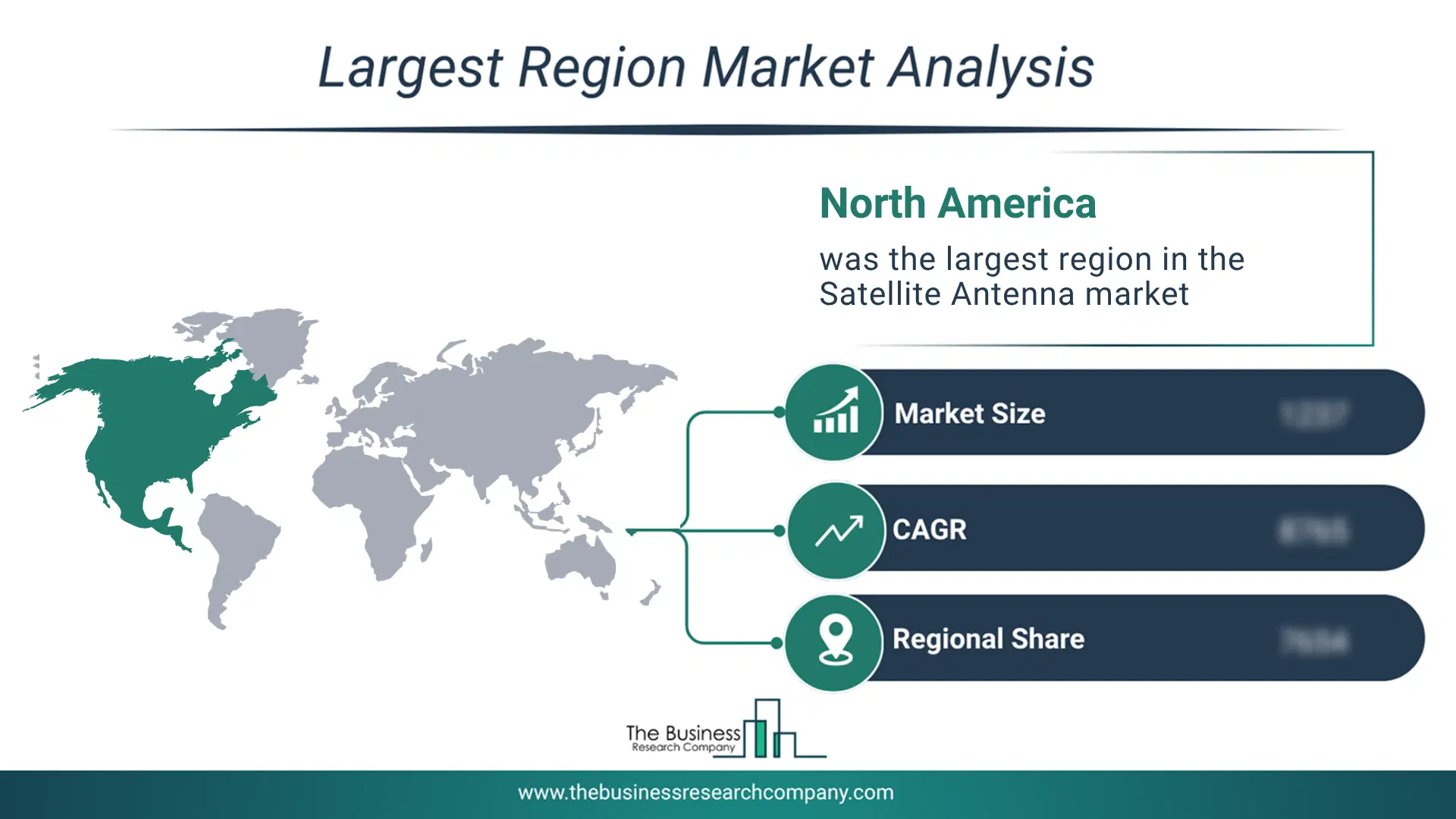
Regional Insights
North America was the largest region in the satellite antenna market in 2025. Asia Pacific is expected to be the fastest-growing region in the forecast period. The regions covered in this market report are Asia-Pacific, South East Asia, Western Europe, Eastern Europe, North America, South America, Middle East, Africa. The countries covered in this market report are Australia, Brazil, China, France, Germany, India, Indonesia, Japan, Taiwan, Russia, South Korea, UK, USA, Canada, Italy, SpainWhat Defines the Satellite Antenna Market?
The satellite antenna market consists of sales of wire antennas, horn antennas, reflector antennas, and array antennas. Values in this market are ‘factory gate’ values, that is the value of goods sold by the manufacturers or creators of the goods, whether to other entities (including downstream manufacturers, wholesalers, distributors and retailers) or directly to end customers. The value of goods in this market includes related services sold by the creators of the goods.How is Market Value Defined and Measured?
The market value is defined as the revenues that enterprises gain from the sale of goods and/or services within the specified market and geography through sales, grants, or donations in terms of the currency (in USD unless otherwise specified). The revenues for a specified geography are consumption values that are revenues generated by organizations in the specified geography within the market, irrespective of where they are produced. It does not include revenues from resales along the supply chain, either further along the supply chain or as part of other products.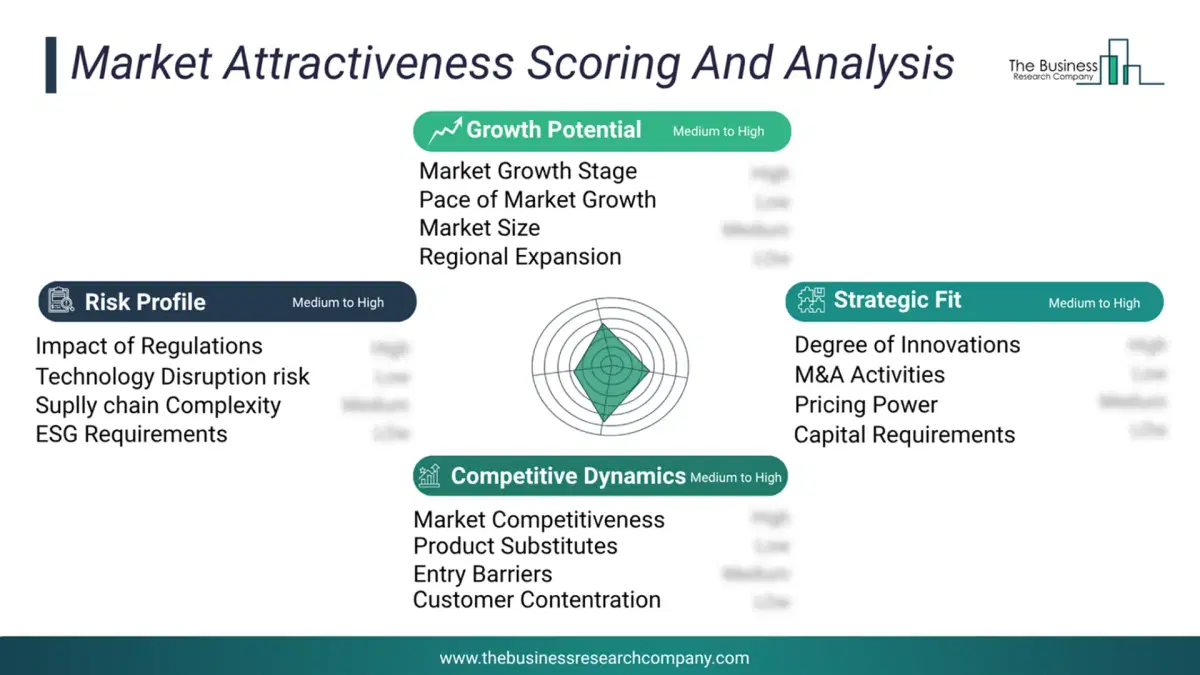
This chart presents market attractiveness based on a quantitative evaluation of growth, competition, strategic alignment, and risk, offering a clear view of opportunity areas for decision-making. This chart is for illustrative purposes; the full report contains the complete analysis.
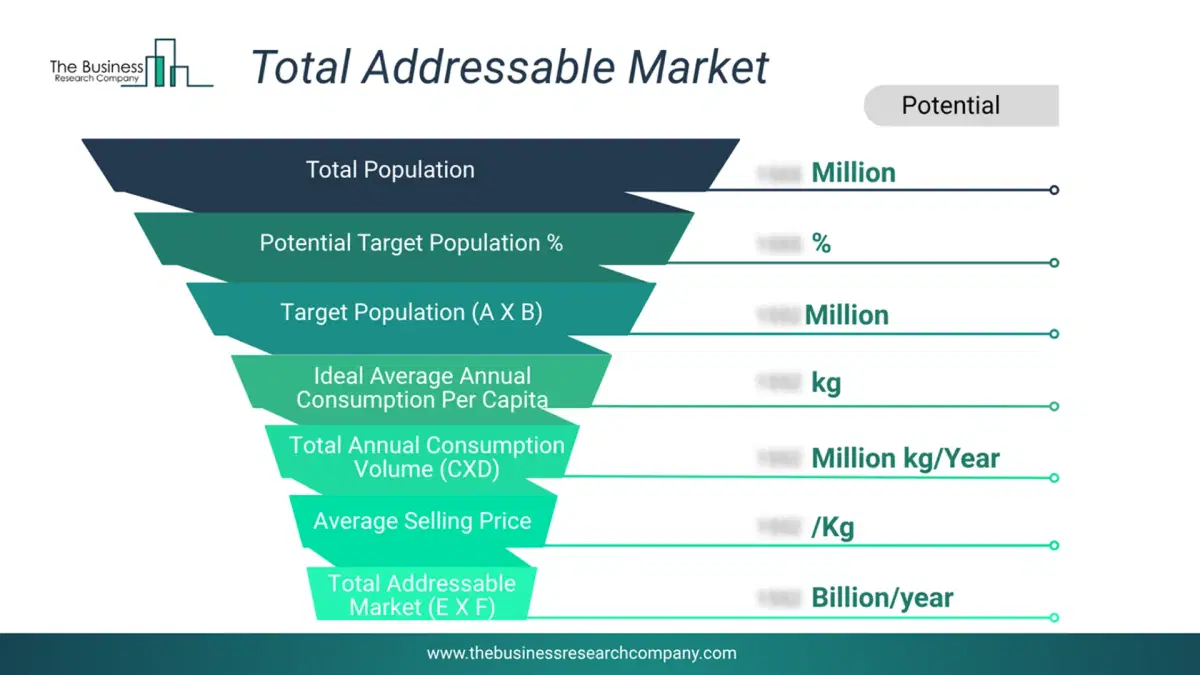
This chart highlights the Total Addressable Market (TAM) by estimating the maximum revenue opportunity using an assumption-driven approach, supporting strategic planning and opportunity sizing across markets. The chart is illustrative; the full report provides a more comprehensive analysis.
What Key Data and Analysis Are Included in the Satellite Antenna Market Report 2026?
The satellite antenna market research report is one of a series of new reports from The Business Research Company that provides market statistics, including industry global market size, regional shares, competitors with the market share, detailed market segments, market trends and opportunities, and any further data you may need to thrive in the satellite antenna industry. The market research report delivers a complete perspective of everything you need, with an in-depth analysis of the current and future state of the industry.Satellite Antenna Market Report Forecast Analysis
| Report Attribute | Details |
|---|---|
| Market Size Value In 2026 | $4.29 billion |
| Revenue Forecast In 2030 | $6.67 billion |
| Growth Rate | CAGR of 11.6% from 2026 to 2030 |
| Base Year For Estimation | 2025 |
| Actual Estimates/Historical Data | 2020-2025 |
| Forecast Period | 2026 - 2030 |
| Market Representation | Revenue in USD Billion and CAGR from 2026 to 2030 |
| Segments Covered | Antenna Type, Component Type, Frequency Band, Application |
| Regional Scope | Asia-Pacific, Western Europe, Eastern Europe, North America, South America, Middle East, Africa |
| Country Scope | The Countries Covered In This Market Report Are Australia, Brazil, China, France, Germany, India, Indonesia, Japan, Taiwan, Russia, South Korea, Uk, Usa, Canada, Italy, Spain. |
| Key Companies Profiled | Airbus SAS, General Dynamics Corporation, Mitsubishi Electric Corporation, Honeywell International Inc., Thales Group, L3Harris Technologies, Viasat Inc., Cobham plc, Advantech Wireless Inc., EchoStar Corporation, Maxar Technologies Inc., Inmarsat Global Limited, Skyware Technologies Ltd., Airbus Defence and Space Government Solutions Inc., Communications & Power Industries LLC, Comtech Telecommunications Corp, Gilat Satellite Networks Ltd., Intellian Technologies Inc., Satcom Direct Communications Inc., Kymeta Corporation, Norsat International Inc., C-COM Satellite Systems Inc., Elite Antennas Ltd., ThinKom Solutions Inc., Orbital Systems (Pty) Ltd. |
| Customization Scope | Request for Customization |
| Pricing And Purchase Options | Explore Purchase Options |