
Satellite Data Services Market Report 2026
Global Outlook – By Type (Administrative, Commercial, Scientific), By Service (Data Analytics, Image Data, Other Services), By Application (Energy And Power, Engineering And Infrastructure, Transportation And Logistics, Agriculture, Other Applications) – Market Size, Trends, Strategies, and Forecast to 2030
Satellite Data Services Market Overview
• Satellite Data Services market size has reached to $12.41 billion in 2025 • Expected to grow to $32.11 billion in 2030 at a compound annual growth rate (CAGR) of 20.9% • Growth Driver: The Increasing Need For Satellite Data Is Fueling The Market Growth Due To Rising Demand For Accurate Weather Forecasting • Market Trend: Innovative Satellite Solutions Empowering Environmental And Urban Monitoring • North America was the largest region in 2025.Market Gains By 2030 – Top Opportunities By Segment
Market Gain identifies the most promising market opportunities by highlighting the segments or products expected to generate the highest incremental revenue growth over the next five years.
What Is Covered Under Satellite Data Services Market?
Satellite Data Services refer to the process of collecting information about the earth, which is gathered by manmade satellites in their orbits to provide information about surface and weather changes on the planet. Images of the earth or other planets are taken with the assistance of imaging satellites to enable efficient data monitoring and mapping and are also used in the development of smart cities and connected vehicles. The main types of satellite data services are administrative, commercial, and scientific. The administrative satellite data services enable efficient mapping and monitoring of the earth’s resources, ecosystems, and events. The various services include data analytics, image data, and others, which are used in numerous applications such as energy and power, defense and intelligence, engineering and infrastructure, agriculture, transportation and logistics, and others.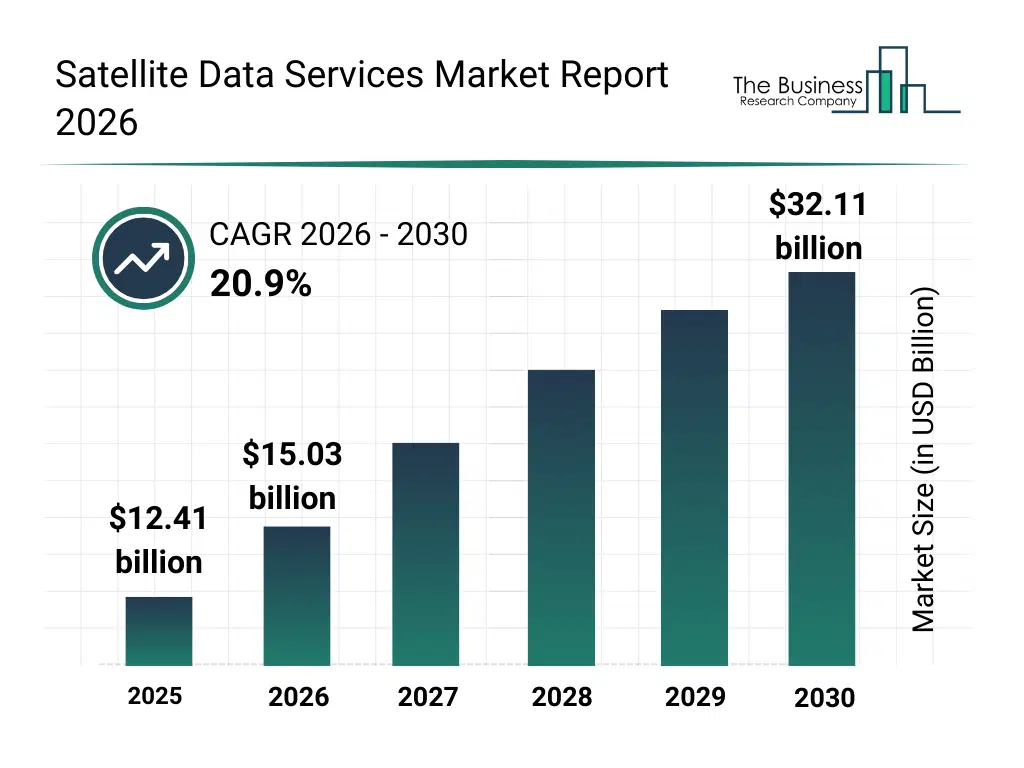
What Is The Satellite Data Services Market Size and Share 2026?
The satellite data services market size has grown exponentially in recent years. It will grow from $12.41 billion in 2025 to $15.03 billion in 2026 at a compound annual growth rate (CAGR) of 21.2%. The growth in the historic period can be attributed to expansion of earth observation satellite deployments, increasing government use of satellite data, growth in weather monitoring applications, rising demand for geospatial intelligence, availability of satellite imaging services.What Is The Satellite Data Services Market Growth Forecast?
The satellite data services market size is expected to see exponential growth in the next few years. It will grow to $32.11 billion in 2030 at a compound annual growth rate (CAGR) of 20.9%. The growth in the forecast period can be attributed to increasing adoption of satellite data for smart city planning, rising use of satellite analytics in agriculture and logistics, expansion of real-time environmental monitoring, growing demand for predictive earth intelligence, increasing integration with cloud-based analytics platforms. Major trends in the forecast period include increasing use of ai-driven satellite data analytics, rising demand for high-resolution earth observation data, growing integration of satellite data with iot platforms, expansion of real-time satellite monitoring services, enhanced focus on climate and environmental data.
Global Satellite Data Services Market Segmentation
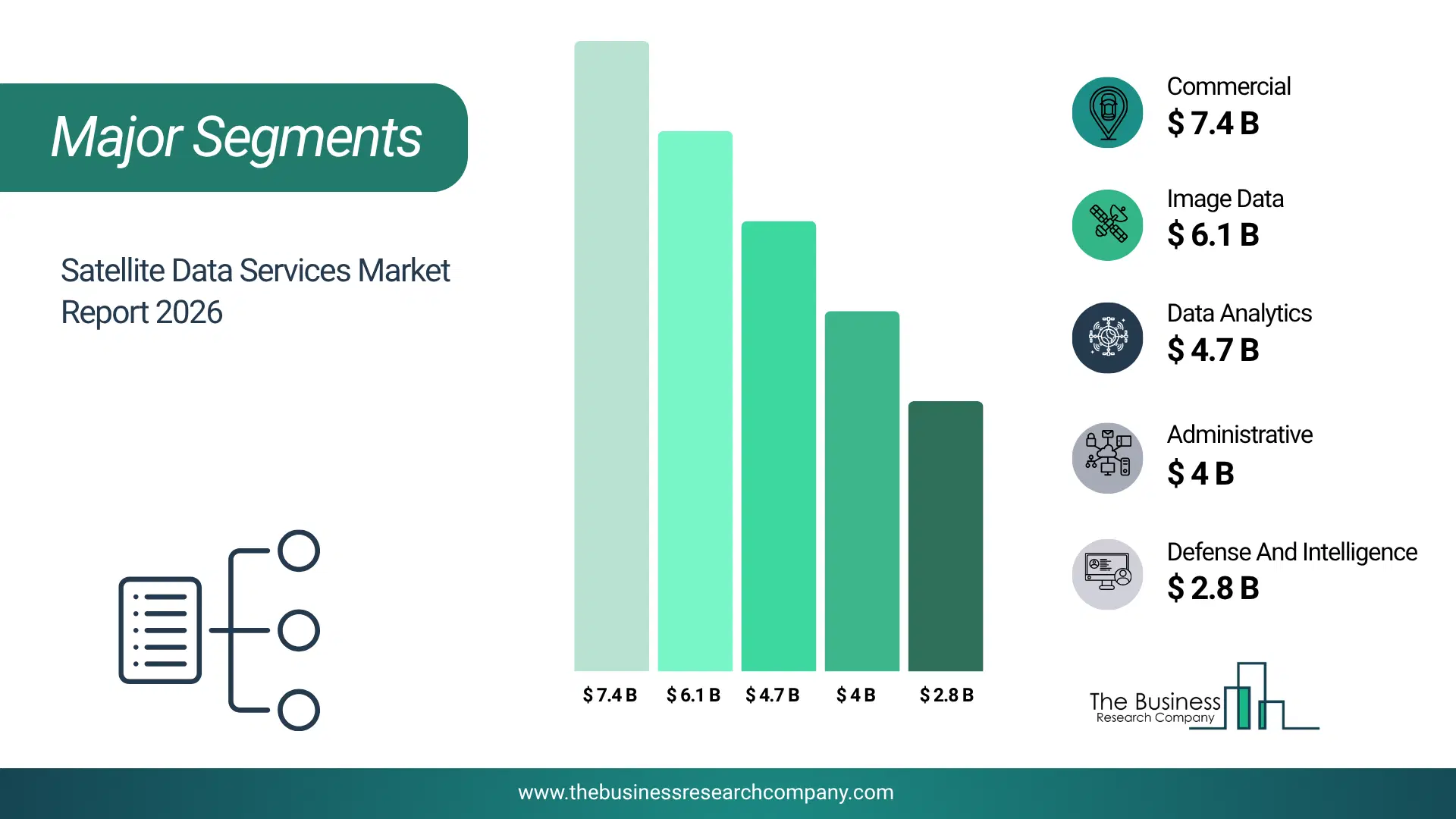
1) By Type: Administrative, Commercial, Scientific 2) By Service: Data Analytics, Image Data, Other Services 3) By Application: Energy And Power, Engineering And Infrastructure, Transportation And Logistics, Agriculture, Other Applications Subsegments: 1) By Administrative: Government Services, Defense And Intelligence, Disaster Management 2) By Commercial: Telecommunications, Media And Broadcasting, Agriculture And Forestry, Oil And Gas, Transportation And Logistics 3) By Scientific: Environmental Monitoring, Climate Research, Earth Science, Weather Forecasting The top segments in the satellite data services market will be: • Commercial will reach $7459.12 Million by 2025. • Image Data will reach $6192.24 Million by 2025. • Data Analytics will reach $4789.59 Million by 2025. • Administrative will reach $4044.93 Million by 2025. • Defense And Intelligence will reach $2886.35 Million by 2025.What Is The Driver Of The Satellite Data Services Market?
The increasing need for satellite data is expected to propel the growth of the satellite data services market going forward. Satellite data refers to information collected from Earth-observing satellites that can monitor weather, environmental changes, natural resources, and support navigation, defense, and industrial applications. The need for satellite data is rising because it provides real-time, comprehensive information about the atmosphere, oceans, and land, which is essential for making more accurate and timely weather forecasts. Satellite data services support satellite data by collecting, processing, analyzing, and distributing vast amounts of information from space, enabling accurate weather forecasting, climate monitoring, disaster management, and informed decision-making across various sectors. For instance, in March 2025, according to the National Aeronautics and Space Administration (NASA), a US–based government agency, global sea level rose at a rate of 0.59 cm (0.23 inches) in 2024, up from the expected 0.43 cm (0.17 inches), as measured by satellite altimetry highlighting the critical role of satellite data in monitoring such environmental shifts. Therefore, the increasing need for satellite data in various industries is driving the growth of the satellite data services industry.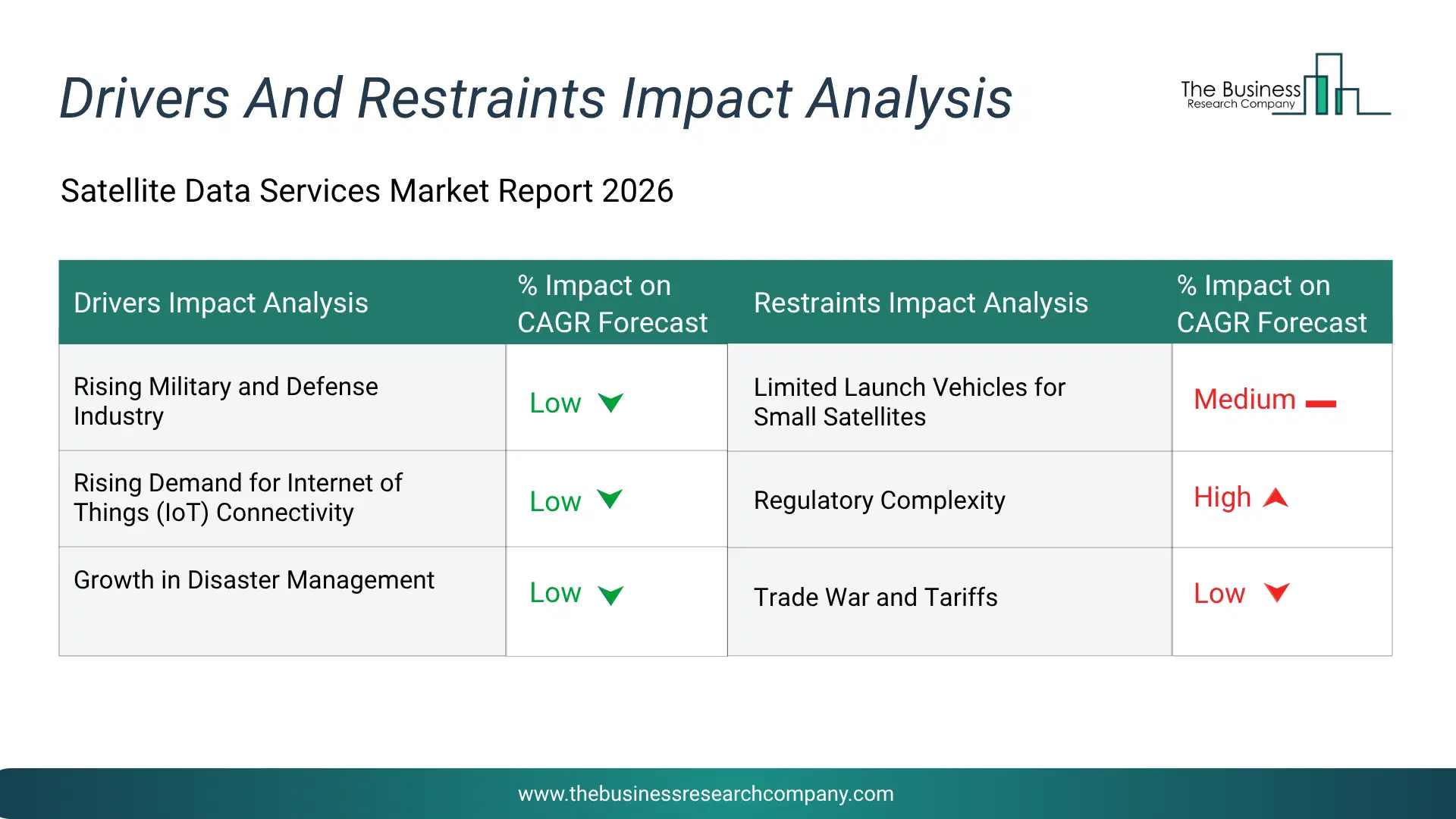
Infographic Chart Showing Key Market Drivers Analysis And Restraints For Satellite Data Services Market
The chart presents an impact analysis of key drivers and restraints, quantifying their relative influence on the market's growth rate and helping assess the balance between growth enablers and limiting factors. This chart offers a high-level perspective; the full report contains more detailed insights.
How Will The Drivers Impact Growth In The Global Satellite Data Services Market?
• Rising Military and Defense Industry (Low) – The rising military and defence industry will become a key driver of growth in the satellite data services market by 2030. Defence organizations increasingly depend on satellite data for intelligence, surveillance, reconnaissance and secure communication. High-resolution imagery and real-time geospatial data play a critical role in mission planning, border monitoring and threat detection. With growing geopolitical tensions and the need for advanced situational awareness, governments are investing heavily in satellite-based solutions to enhance national security. This rising demand for reliable, accurate and timely data from defence sectors globally is expected to significantly boost the adoption of satellite data services during. As a result, the rising military and defence industry is anticipated to contributing to a 0.7% annual growth in the market. • Rising Demand for Internet of Things (IoT) Connectivity (Low) – The rising demand for internet of things (IOT) connectivity will emerge as a major factor driving the expansion of the satellite data services market by 2030. IoT applications in sectors such as agriculture, logistics, maritime and energy require reliable, real-time data exchange, even in remote or hard-to-reach locations where terrestrial networks are unavailable. Satellite data services provide seamless global connectivity, enabling IoT devices to operate efficiently across diverse environments. This capability supports critical functions such as asset tracking, predictive maintenance and smart monitoring. As the adoption of IoT devices continues to surge worldwide, the need for satellite-enabled connectivity will significantly drive market expansion. Consequently, the accelerating rising demand for internet of things (IOT) connectivity capabilities is projected to contributing to a 0.4% annual growth in the market. • Growth in Disaster Management (Low) – The growth in disaster management processes will serve as a key growth catalyst for the satellite data services market by 2030. Governments and organizations increasingly rely on satellite imagery and geospatial data for early warning, real-time monitoring and post-disaster assessment. Satellites provide critical information for tracking natural disasters such as floods, hurricanes and wildfires, enabling faster response and resource allocation. High-resolution data helps in planning evacuation routes, assessing damage and supporting relief operations. As climate-related disasters become more frequent and severe, the demand for reliable satellite data services to enhance preparedness and recovery efforts is rising, significantly driving market growth in this sector. Therefore, this growth in disaster management operations is projected to supporting to a 0.8% annual growth in the market. • Rising Demand for Geospatial Analytics (Low) – The rising demand for geospatial analytics will become a significant driver contributing to the growth of the satellite data services market by 2030. Organizations across sectors such as agriculture, urban planning, transportation and defence increasingly rely on geospatial insights to make data-driven decisions. Satellite data provides accurate, high-resolution imagery and spatial information essential for mapping, monitoring land use, tracking environmental changes and optimizing operations. As businesses and governments seek to enhance efficiency, reduce risks and improve strategic planning, the reliance on advanced geospatial analytics continues to grow. This increasing adoption of satellite-enabled geospatial solutions is a key driver of market expansion. Consequently, the rising demand for geospatial analytics strategies is projected to contributing to a 0.5% annual growth in the market.How Will The Restraints Impact Growth In The Global Satellite Data Services Market?
• Limited Launch Vehicles for Small Satellites (Low) – Limited Launch Vehicles for Small Satellites will restrict the growth of the Satellite Data Services market during the forecast period. The availability of launch vehicles for small satellites affects the deployment of satellite constellations for data services. Limited launch capacity can delay satellite deployment and affect service availability. Launch constraints can limit the growth of satellite data services and new constellation development. • Regulatory Complexity (Low) – Regulatory Complexity will restrict the growth of the Satellite Data Services market during the forecast period. Satellite data services must comply with complex regulatory frameworks for spectrum allocation, orbital slots, and data transmission. Regulatory requirements add to operational costs and timelines. Regulatory complexity can affect service deployment and limit market growth. • Trade War and Tariffs (Low) – Trade War and Tariffs will restrict the growth of the Satellite Data Services market during the forecast period. Trade tensions and economic uncertainty can affect satellite manufacturing and launch services. Tariffs on satellite components can increase costs and affect project economics. Trade barriers may also impact international cooperation in satellite data sharing.Key Players In The Global Satellite Data Services Market
Major companies operating in the satellite data services market are Airbus S.A.S.; East View Geospatial Inc.; ImageSat International; L3Harris Technologies Inc.; Maxar Technologies; Earth-i Ltd.; ICEYE; Planet Labs Inc.; Satellite Imaging Corporation; SpecTIR LLC; Ursa Space Systems Inc.; Birdi Ltd.; BlackSky Technology; Capella Space; Descartes Labs; DigitalGlobe; Geospatial Intelligence Pty Ltd.; Gisat S.R.O.; Harris Geospatial Solutions; HawkEye 360; OmniEarth Inc.; Orbital Insight; SATPALDA Geospatial Services; SatSure AG; Spire Global Inc.; Terrafuse; EUMETSAT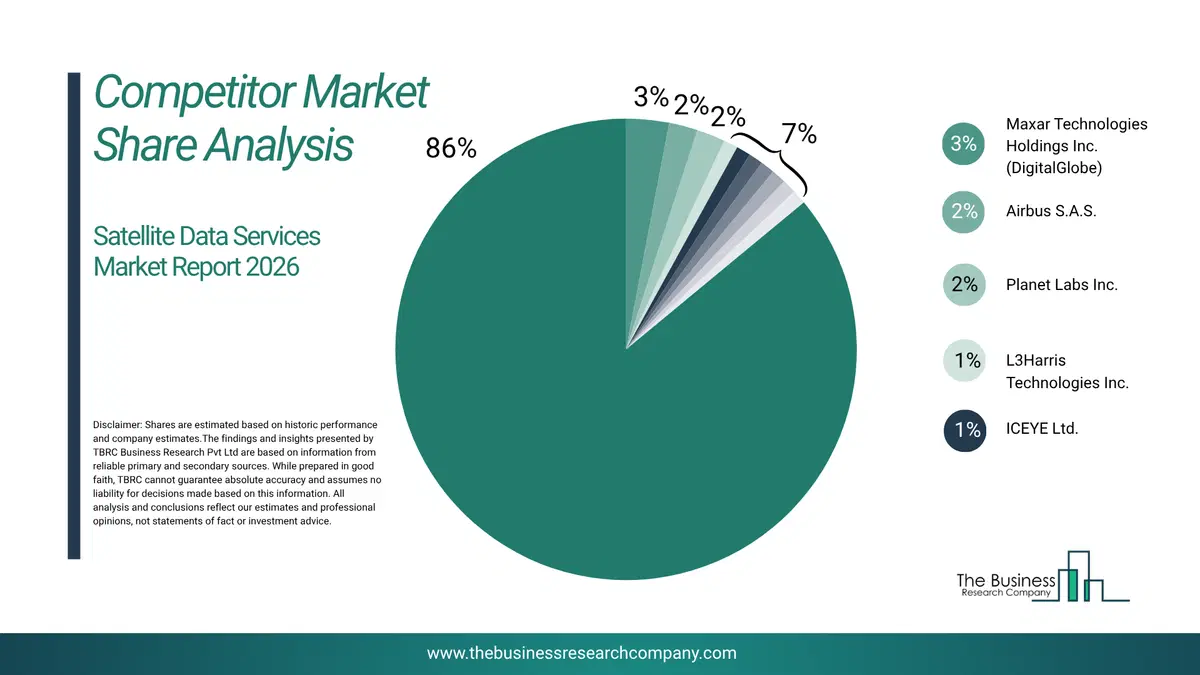
This chart is for illustrative purposes; the full report includes a detailed competitor analysis and comprehensive overview of the top 10 companies in the market.
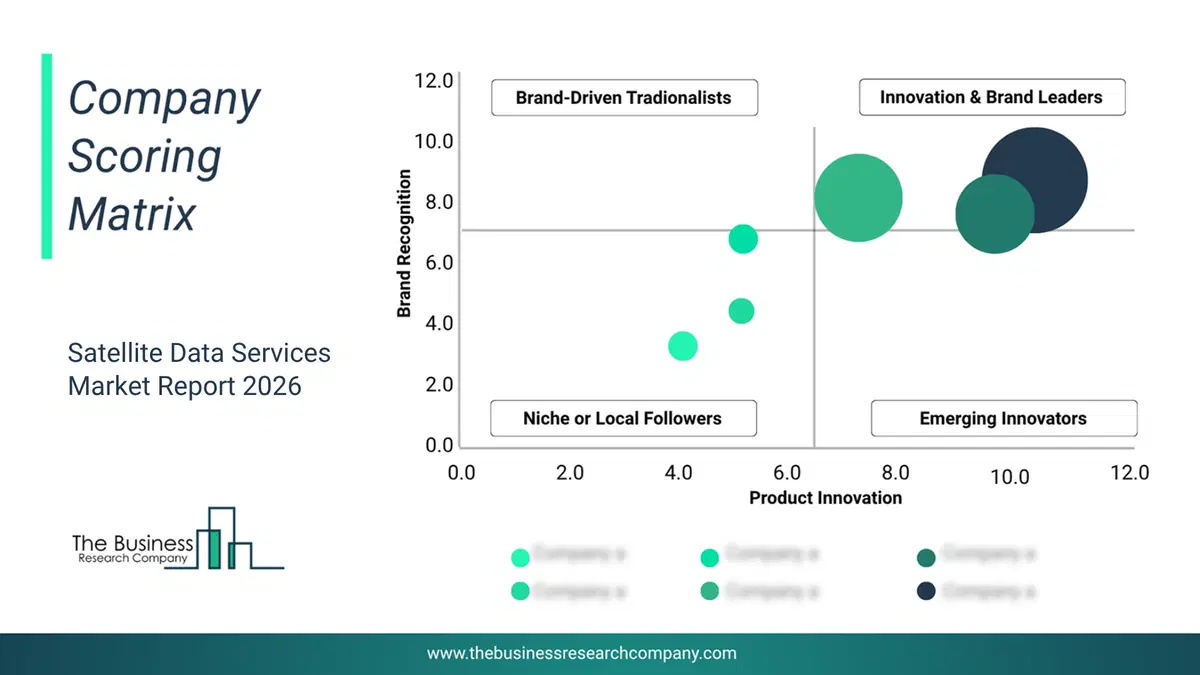
This chart maps companies by product innovation and brand strength, with bubble size indicating relative revenue, helping identify market leaders, challengers, and niche players. This is an illustrative chart; the full report provides a complete and accurate competitive analysis.
Global Satellite Data Services Market Trends and Insights
Major companies operating in the satellite data services market are focusing on developing innovative technologies, such as high-resolution earth observation satellites, to deliver more accurate and timely geospatial data for applications like environmental monitoring, urban planning, and disaster management. High-resolution Earth observation satellites are satellites equipped with advanced imaging sensors that capture detailed images of the Earth's surface, helping governments and businesses monitor land use, track environmental changes, manage disasters, and support urban planning with precise and timely geospatial data. For instance, in November 2025, Arianespace S.A., a France-based space industry company, launched KOMPSAT-7 (KOrea Multi-Purpose SATellite-7), developed by the Korea Aerospace Research Institute (KARI). KOMPSAT-7 weighs approximately 2000 kg at launch and will operate in a Sun-synchronous orbit to deliver high-resolution satellite imagery tailored to South Korea’s governmental and institutional needs. The satellite incorporates advanced imaging sensors capable of capturing detailed Earth observation data, enabling applications in land management, urban development, and environmental monitoring while enhancing national space program capabilities.What Are Latest Mergers And Acquisitions In The Satellite Data Services Market?
In September 2024, Network Innovations, a Canada-based satellite communications and data services provider, acquired Infosat Communications for an undisclosed amount. The aim of the acquisition is to expand enterprise broadband, maritime, mobile data, and voice services businesses across North America by leveraging expertise and offerings. Infosat Communications is a Canada-based satellite communications service provider that specializes in satellite connectivity and data services.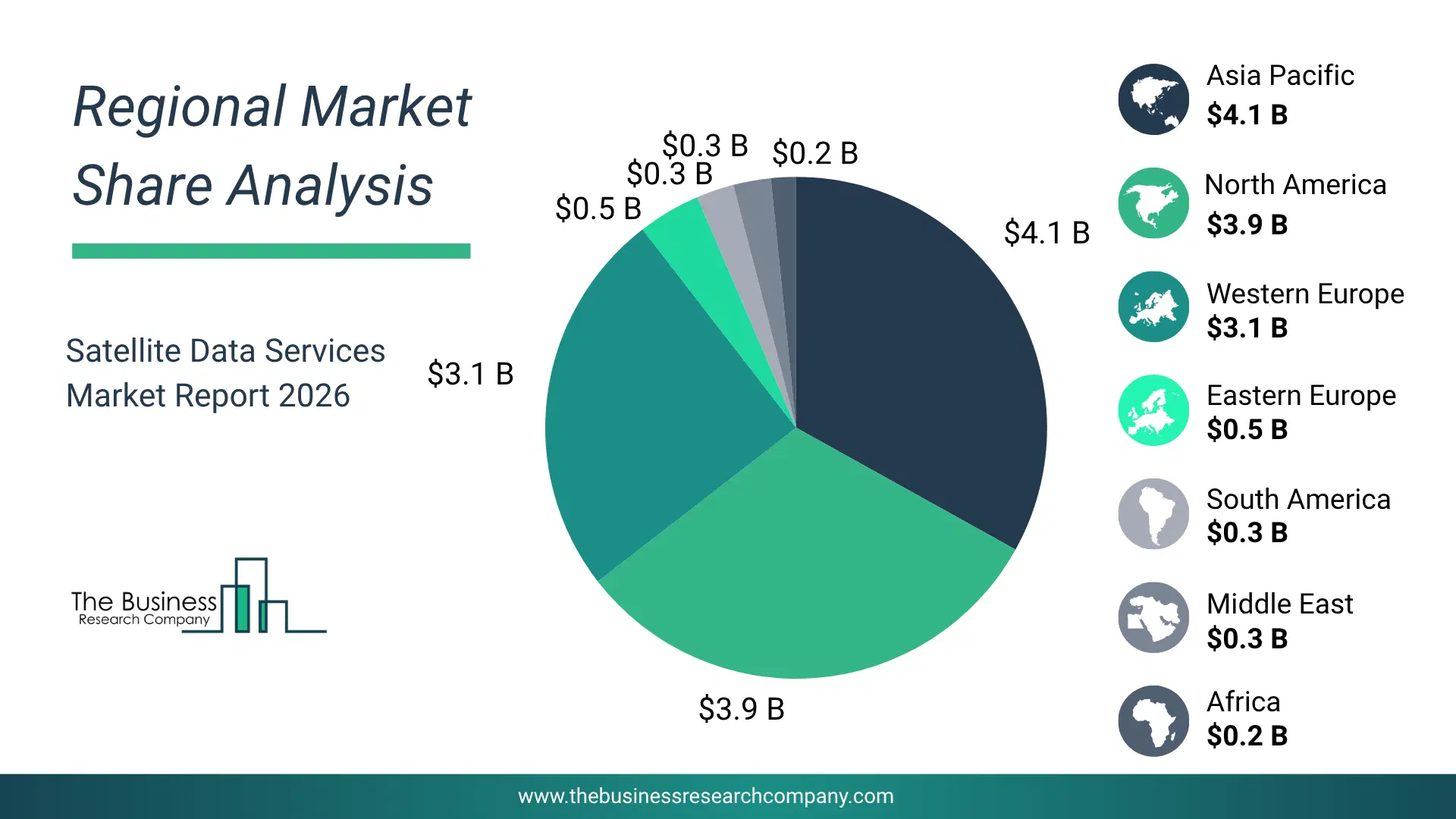
Regional Insights
North America was the largest region in the satellite data services market in 2025. The regions covered in this market report are Asia-Pacific, South East Asia, Western Europe, Eastern Europe, North America, South America, Middle East, Africa. The countries covered in this market report are Australia, Brazil, China, France, Germany, India, Indonesia, Japan, Taiwan, Russia, South Korea, UK, USA, Canada, Italy, SpainWhat Defines the Satellite Data Services Market?
The satellite data services market includes revenues earned by entities by providing facts about the weather, chemistry, biology, the surface of the earth, and resources. The market value includes the value of related goods sold by the service provider or included within the service offering. Only goods and services traded between entities or sold to end consumers are included.How is Market Value Defined and Measured?
The market value is defined as the revenues that enterprises gain from the sale of goods and/or services within the specified market and geography through sales, grants, or donations in terms of the currency (in USD unless otherwise specified). The revenues for a specified geography are consumption values that are revenues generated by organizations in the specified geography within the market, irrespective of where they are produced. It does not include revenues from resales along the supply chain, either further along the supply chain or as part of other products.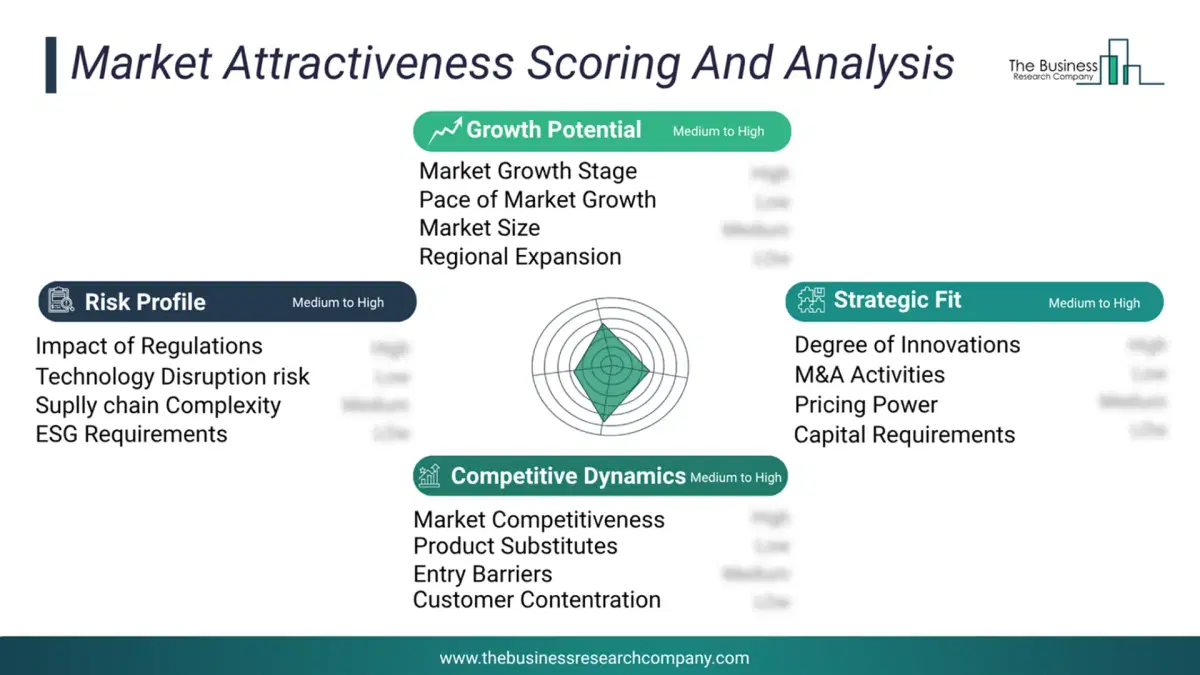
This chart presents market attractiveness based on a quantitative evaluation of growth, competition, strategic alignment, and risk, offering a clear view of opportunity areas for decision-making. This chart is for illustrative purposes; the full report contains the complete analysis.
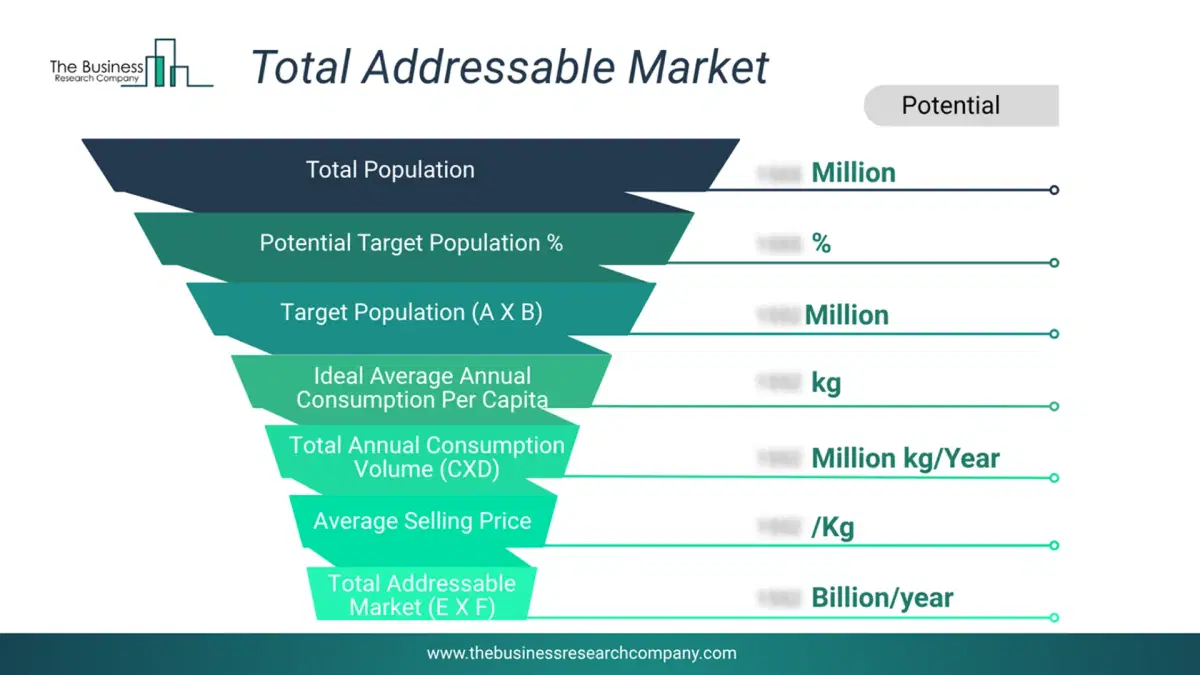
This chart highlights the Total Addressable Market (TAM) by estimating the maximum revenue opportunity using an assumption-driven approach, supporting strategic planning and opportunity sizing across markets. The chart is illustrative; the full report provides a more comprehensive analysis.
What Key Data and Analysis Are Included in the Satellite Data Services Market Report 2026?
The satellite data services market research report is one of a series of new reports from The Business Research Company that provides market statistics, including industry global market size, regional shares, competitors with the market share, detailed market segments, market trends and opportunities, and any further data you may need to thrive in the satellite data services industry. The market research report delivers a complete perspective of everything you need, with an in-depth analysis of the current and future state of the industry.Satellite Data Services Market Report Forecast Analysis
| Report Attribute | Details |
|---|---|
| Market Size Value In 2026 | $15.03 billion |
| Revenue Forecast In 2030 | $32.11 billion |
| Growth Rate | CAGR of 21.2% from 2026 to 2030 |
| Base Year For Estimation | 2025 |
| Actual Estimates/Historical Data | 2020-2025 |
| Forecast Period | 2026 - 2030 |
| Market Representation | Revenue in USD Billion and CAGR from 2026 to 2030 |
| Segments Covered | Type, Service, Application |
| Regional Scope | Asia-Pacific, Western Europe, Eastern Europe, North America, South America, Middle East, Africa |
| Country Scope | The countries covered in the report are Australia, Brazil, China, France, Germany, India, Indonesia, Japan, Taiwan, Russia, South Korea, UK, USA, Canada, Italy, Spain. |
| Key Companies Profiled | Airbus S.A.S.; East View Geospatial Inc.; ImageSat International; L3Harris Technologies Inc.; Maxar Technologies; Earth-i Ltd.; ICEYE; Planet Labs Inc.; Satellite Imaging Corporation; SpecTIR LLC; Ursa Space Systems Inc.; Birdi Ltd.; BlackSky Technology; Capella Space; Descartes Labs; DigitalGlobe; Geospatial Intelligence Pty Ltd.; Gisat S.R.O.; Harris Geospatial Solutions; HawkEye 360; OmniEarth Inc.; Orbital Insight; SATPALDA Geospatial Services; SatSure AG; Spire Global Inc.; Terrafuse; EUMETSAT |
| Customization Scope | Request for Customization |
| Pricing And Purchase Options | Explore Purchase Options |