

Self-Healing Grid Market Report 2026
Global Outlook – By Component (Hardware, Software, Services), By Application (Transmission Lines, Distribution Lines), By End-User (Public Utility, Private Utility) – Market Size, Trends, Strategies, and Forecast to 2030
Self-Healing Grid Market Overview
• Self-Healing Grid market size has reached to $2.46 billion in 2025 • Expected to grow to $4.17 billion in 2030 at a compound annual growth rate (CAGR) of 11% • Growth Driver: Impact Of Increasing Energy Demand On The Self-Healing Grid Market • Market Trend: Enhancing Reliability And Efficiency Through Data Repository Technology • North America was the largest region in 2025.What Is Covered Under Self-Healing Grid Market?
A self-healing grid refers to an intelligent network that makes use of sensing, control, and communication technology to provide real-time problem-solving for unforeseen events. These grids promote energy efficiency together with self-healing from power outages. It enables two-way secure information and power flow. The main components of a self-healing grid are hardware, software, and services. Hardware refers to the machine's mechanical and electronic components rather than its software. These are used in various applications such as transmission lines and distribution lines and are used in public utility and private utility.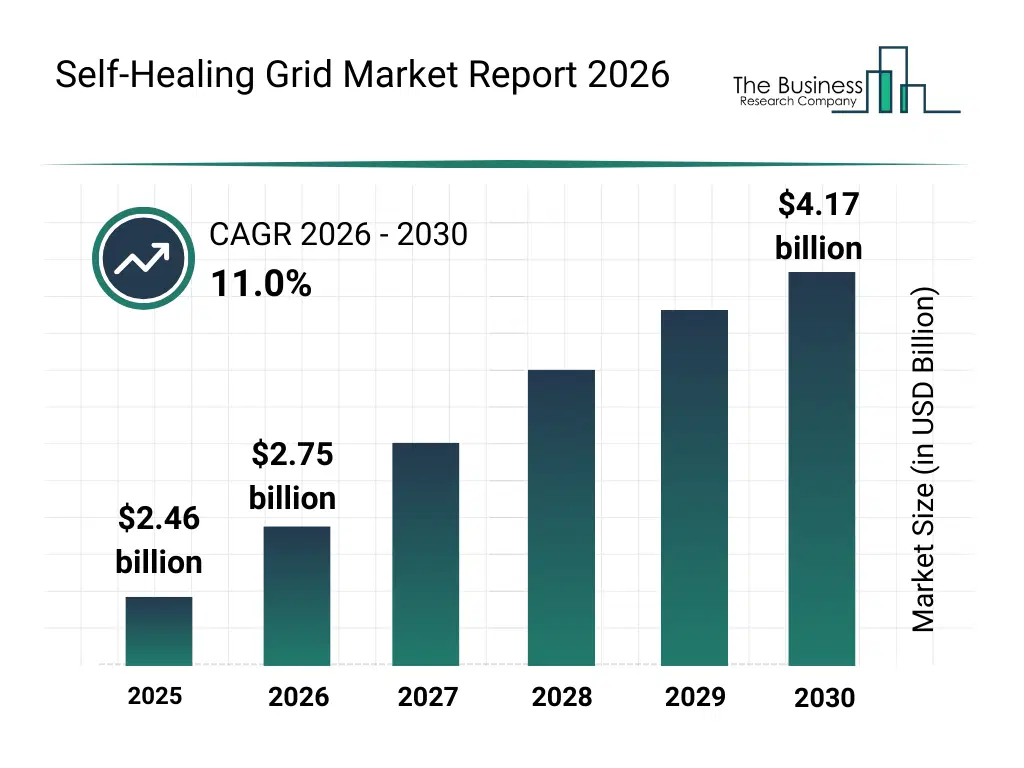
What Is The Self-Healing Grid Market Size and Share 2026?
The self-healing grid market size has grown rapidly in recent years. It will grow from $2.46 billion in 2025 to $2.75 billion in 2026 at a compound annual growth rate (CAGR) of 11.5%. The growth in the historic period can be attributed to expansion of electricity distribution networks, increasing frequency of grid outages, early adoption of smart grid technologies, growth of renewable energy integration, investments in grid modernization initiatives.What Is The Self-Healing Grid Market Growth Forecast?
The self-healing grid market size is expected to see rapid growth in the next few years. It will grow to $4.17 billion in 2030 at a compound annual growth rate (CAGR) of 11.0%. The growth in the forecast period can be attributed to rising investments in intelligent power infrastructure, increasing adoption of decentralized energy systems, growing demand for real-time grid monitoring, expansion of electric vehicle charging networks, stronger focus on grid cybersecurity and resilience. Major trends in the forecast period include increasing deployment of advanced grid sensing technologies, rising adoption of automated fault detection systems, growing integration of real-time grid communication platforms, expansion of distributed energy resource integration, enhanced focus on grid resilience and reliability.
Global Self-Healing Grid Market Segmentation
1) By Component: Hardware, Software, Services 2) By Application: Transmission Lines, Distribution Lines 3) By End-User: Public Utility, Private Utility Subsegments: 1) By Hardware: Sensors, Smart Meters, Control Devices, Communication Equipment 2) By Software: Grid Management Software, Data Analytics And Monitoring Software, Fault Detection And Diagnosis Software, Demand Response Management Software 3) By Services: Consulting Services, Implementation Services, Maintenance And Support Services, Training ServicesWhat Is The Driver Of The Self-Healing Grid Market?
The increase in the increasing energy demand is expected to boost the growth of the self-healing grid market going forward. Energy demand refers to the total amount of energy required by a specific region, sector, community, or individual within a given period. The surge in energy demand poses challenges for conventional grid systems, and the growing need for resilient, disruption-minimizing, and operationally optimized power grids is driving the demand for self-healing grid solutions in tandem with broader trends in energy consumption and grid modernization. For instance, in April 2023, according to a report published by the Energy Information Administration, a US-based government agency, the United States experienced a growth in the consumption of all energy forms ranging from 0% to 15% from 2022 to 2050. Within the industrial sector, energy consumption sees an increase of 5% to 32% during the period from 2022 to 2050. In 2022, households in the U.S. residential sector acquired a total of 5.1 quadrillion British thermal units (quads) of electricity. Therefore, the increasing energy demand is driving the growth of the self-healing grid industry.Key Players In The Global Self-Healing Grid Market
Major companies operating in the self-healing grid market are Siemens AG; General Electric Company; S & C Electric Company; Eaton Corporation PLC; Schneider Electric SE; Oracle Corporation; Landis+Gyr Corporation; Itron Inc.; Sprecher Automation GmbH; EnergyTech Global Pvt. Ltd.; Hitachi Ltd.; Open Systems International Inc.; Det Norske Veritas Germanischer Lloyd; ABB Ltd.; Aclara Technologies LLC; Cisco Systems Inc.; International Business Machines Corporation; Wipro Limited; Sentient Energy Inc.; Infosys Limited; G&W Electric Company; Alectra Utilities Corporation; Honeywell International Inc.; C3.AI Inc.; Power Analytics Corporation; Utilidata Inc.; Varentec Inc.; Enel X North America Inc.; Opus One Solutions Energy Corporation; Advanced Microgrid Solutions Inc.; Blue Pillar Inc.; Powerhive Inc.; Spirae LLC; Gridco Systems Inc.; Autogrid Systems Inc.; Grid4C Inc.; Smarter Grid Solutions Inc.
This chart is for illustrative purposes; the full report includes a detailed competitor analysis and comprehensive overview of the top 10 companies in the market.
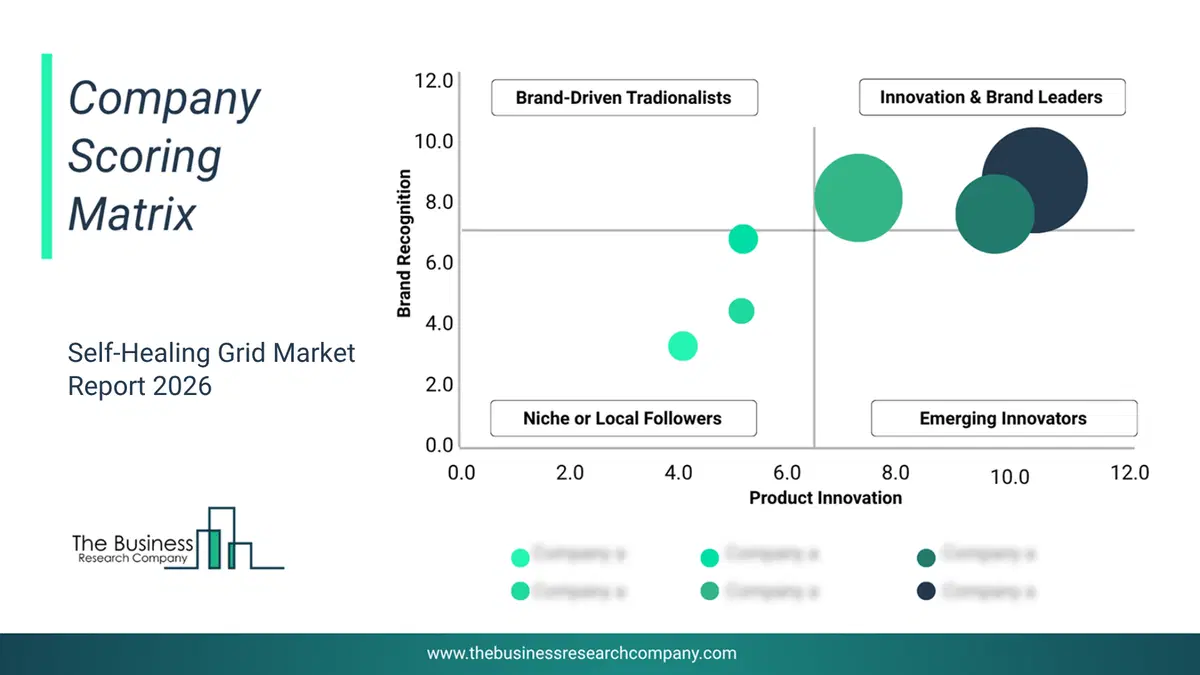
This chart maps companies by product innovation and brand strength, with bubble size indicating relative revenue, helping identify market leaders, challengers, and niche players. This is an illustrative chart; the full report provides a complete and accurate competitive analysis.
Global Self-Healing Grid Market Trends and Insights
Major companies operating in the self-healing grid market are focused on developing new technological solutions, such as data repository technology, to enhance Major companies operating in the self-healing grid market are focused on developing new technological solutions such as data repository technology to enhance real-time monitoring, predictive maintenance, and automated fault detection, ultimately improving grid reliability and reducing downtime. Data repository technology refers to systems and structures that store, manage, and facilitate access to large volumes of data, enabling efficient data retrieval and analysis. For instance, in February 2024, Siemens AG, a German multinational technology conglomerate company, launched Gridscale XTM. Gridscale X allows utilities to quickly scale their grid capacity and adapt to evolving energy demands. It is particularly beneficial for Transmission System Operators (TSOs) who need to operate closer to their physical limits while ensuring reliability.What Are Latest Mergers And Acquisitions In The Self-Healing Grid Market?
In August 2023, GE Vernova, a US-based energy company, acquired Greenbird Integration Technology AS for an undisclosed amount. This acquisition underscores GE Vernova's dedication to investing in technologies and talent that facilitate the advancement of a sustainable energy grid. The acquired platform will expedite the development of GridOS, the pioneering software portfolio tailored for grid orchestration. It will enhance GridOS by introducing additional features that streamline the connectivity of systems and enable the seamless integration of data across the grid on a larger scale. Greenbird Integration Technology AS is a Norway-based data integration platform company focused on utilities.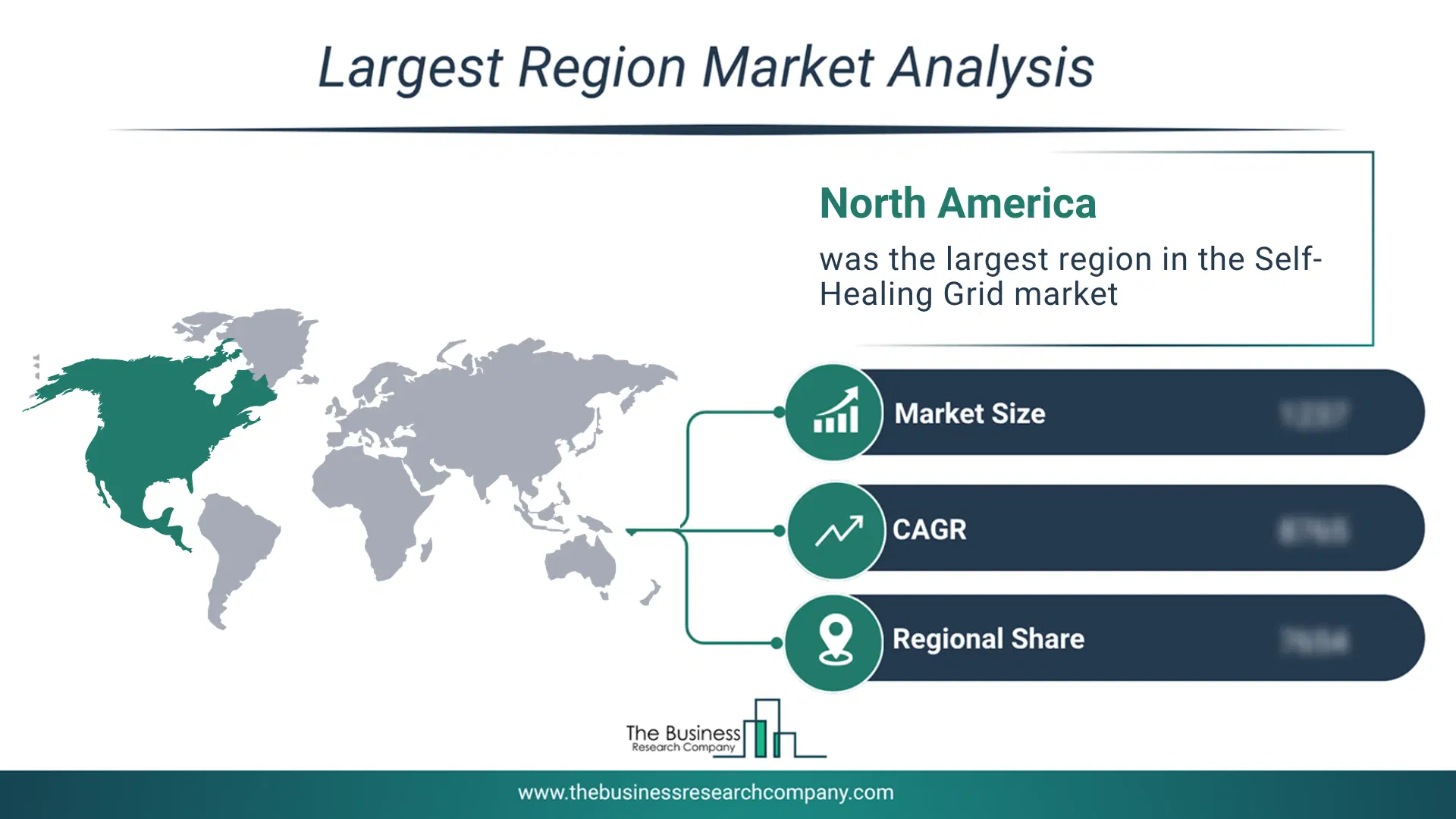
Regional Insights
North America was the largest region in the self-healing grid market share in 2025. The regions covered in this market report are Asia-Pacific, South East Asia, Western Europe, Eastern Europe, North America, South America, Middle East, Africa. The countries covered in this market report are Australia, Brazil, China, France, Germany, India, Indonesia, Japan, Taiwan, Russia, South Korea, UK, USA, Canada, Italy, SpainWhat Defines the Self-Healing Grid Market?
The self-healing grid market consists of revenues earned by entities by providing services such as advanced distribution management systems (ADMS), fault location isolation and service restoration (FLISR) services. The market value includes the value of related goods sold by the service provider or included within the service offering. The self-healing grid market also includes sales of electric network, digital control appliance, and intelligent monitoring system which are used in providing self-healing grid services. Values in this market are ‘factory gate’ values, that is the value of goods sold by the manufacturers or creators of the goods, whether to other entities (including downstream manufacturers, wholesalers, distributors and retailers) or directly to end customers. The value of goods in this market includes related services sold by the creators of the goods.How is Market Value Defined and Measured?
The market value is defined as the revenues that enterprises gain from the sale of goods and/or services within the specified market and geography through sales, grants, or donations in terms of the currency (in USD unless otherwise specified). The revenues for a specified geography are consumption values that are revenues generated by organizations in the specified geography within the market, irrespective of where they are produced. It does not include revenues from resales along the supply chain, either further along the supply chain or as part of other products.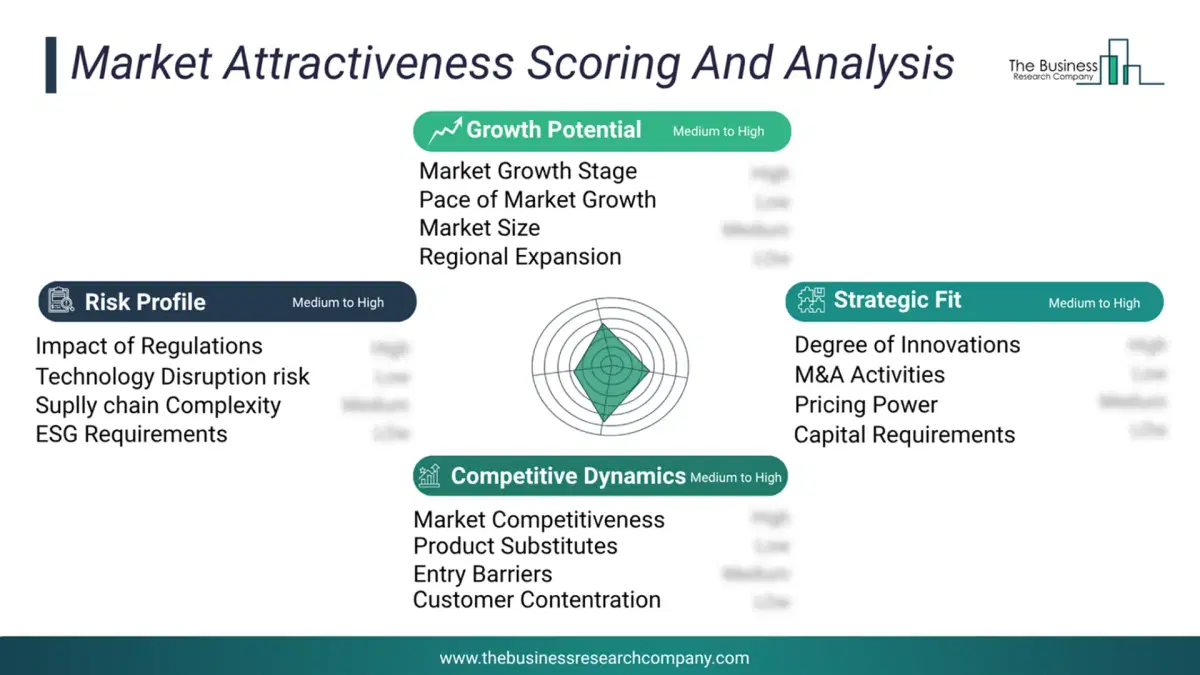
This chart presents market attractiveness based on a quantitative evaluation of growth, competition, strategic alignment, and risk, offering a clear view of opportunity areas for decision-making. This chart is for illustrative purposes; the full report contains the complete analysis.
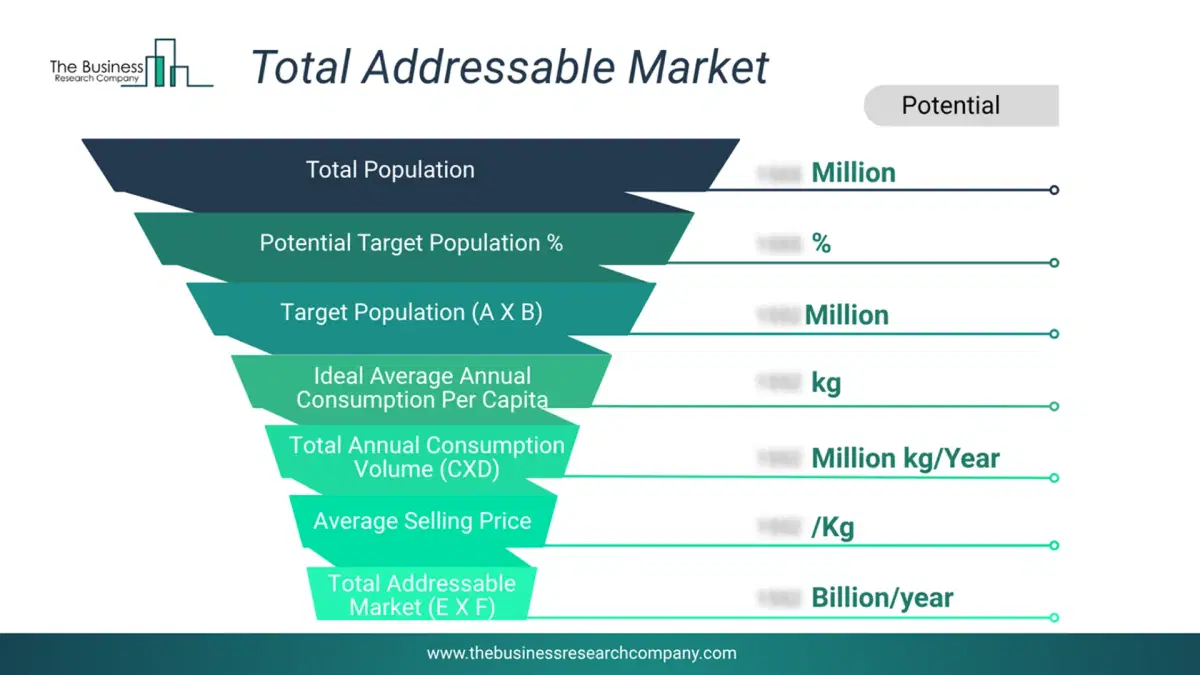
This chart highlights the Total Addressable Market (TAM) by estimating the maximum revenue opportunity using an assumption-driven approach, supporting strategic planning and opportunity sizing across markets. The chart is illustrative; the full report provides a more comprehensive analysis.
What Key Data and Analysis Are Included in the Self-Healing Grid Market Report 2026?
The self-healing grid market research report is one of a series of new reports from The Business Research Company that provides market statistics, including industry global market size, regional shares, competitors with the market share, detailed market segments, market trends and opportunities, and any further data you may need to thrive in the self-healing grid industry. The market research report delivers a complete perspective of everything you need, with an in-depth analysis of the current and future state of the industry.Self-Healing Grid Market Report Forecast Analysis
| Report Attribute | Details |
|---|---|
| Market Size Value In 2026 | $2.75 billion |
| Revenue Forecast In 2030 | $4.17 billion |
| Growth Rate | CAGR of 11% from 2026 to 2030 |
| Base Year For Estimation | 2025 |
| Actual Estimates/Historical Data | 2020-2025 |
| Forecast Period | 2026 - 2030 |
| Market Representation | Revenue in USD Billion and CAGR from 2026 to 2030 |
| Segments Covered | Component, Application, End-User |
| Regional Scope | Asia-Pacific, Western Europe, Eastern Europe, North America, South America, Middle East, Africa |
| Country Scope | The Countries Covered In This Market Report Are Australia, Brazil, China, France, Germany, India, Indonesia, Japan, Taiwan, Russia, South Korea, Uk, Usa, Canada, Italy, Spain. |
| Key Companies Profiled | Siemens AG, General Electric Company, S & C Electric Company, Eaton Corporation PLC, Schneider Electric SE, Oracle Corporation, Landis+Gyr Corporation, Itron Inc., Sprecher Automation GmbH, EnergyTech Global Pvt. Ltd., Hitachi Ltd., Open Systems International Inc., Det Norske Veritas Germanischer Lloyd, ABB Ltd., Aclara Technologies LLC, Cisco Systems Inc., International Business Machines Corporation, Wipro Limited, Sentient Energy Inc., Infosys Limited, G&W Electric Company, Alectra Utilities Corporation, Honeywell International Inc., C3.AI Inc., Power Analytics Corporation, Utilidata Inc., Varentec Inc., Enel X North America Inc., Opus One Solutions Energy Corporation, Advanced Microgrid Solutions Inc., Blue Pillar Inc., Powerhive Inc., Spirae LLC, Gridco Systems Inc., Autogrid Systems Inc., Grid4C Inc., Smarter Grid Solutions Inc. |
| Customization Scope | Request for Customization |
| Pricing And Purchase Options | Explore Purchase Options |