
Smart Manufacturing Market Report 2026
Global Outlook – By Component (Hardware, Software, Services), By Technology (Machine Execution Systems (MES), Programmable Logic Controller (PLC), Enterprise Resource Planning (ERP), SCADA, Discrete Control Systems (DCS), Machine Vision, 3D Printing, Other Technologies), By End-User (Automotive, Aerospace And Defense, Chemicals And Materials, Healthcare, Industrial Equipment, Electronics, Food And Agriculture, Oil And Gas, Other End-Users) – Market Size, Trends, Strategies, and Forecast to 2030
Smart Manufacturing Market Overview
• Smart Manufacturing market size has reached to $455.56 billion in 2025 • Expected to grow to $938.36 billion in 2030 at a compound annual growth rate (CAGR) of 15.5% • Growth Driver: Rising Adoption Of Robotics By Industries To Fuel The Smart Manufacturing Market • Market Trend: Innovations In Artificial Intelligence (AI) Technology Enhance Real-Time Monitoring And Predictive Maintenance In Smart Manufacturing • North America was the largest region in 2025.Market Gains By 2030 – Top Opportunities By Segment
Market Gain identifies the most promising market opportunities by highlighting the segments or products expected to generate the highest incremental revenue growth over the next five years.
What Is Covered Under Smart Manufacturing Market?
Smart manufacturing refers to a process that employs computer controls, modeling, big data, and other automation to improve manufacturing efficiencies. It analyzes machine and sensor data to improve operational efficiency and avoid downtime. The main smart manufacturing components include hardware, software, and services. Smart manufacturing hardware refers to devices that are used for real-time reactive, predictive, and preventative actions for high levels of data visibility, rich decision-making, and quick decision-making. The different smart manufacturing technologies include machine execution systems (MES), programmable logic controllers (PLC), enterprise resource planning (ERP), SCADA, discrete control systems (DCS), machine vision, 3D printing, and plant lifecycle management for end-users including automotive, aerospace and defense, chemicals and materials, healthcare, industrial equipment, electronics, food and agriculture, oil and gas and other end-users.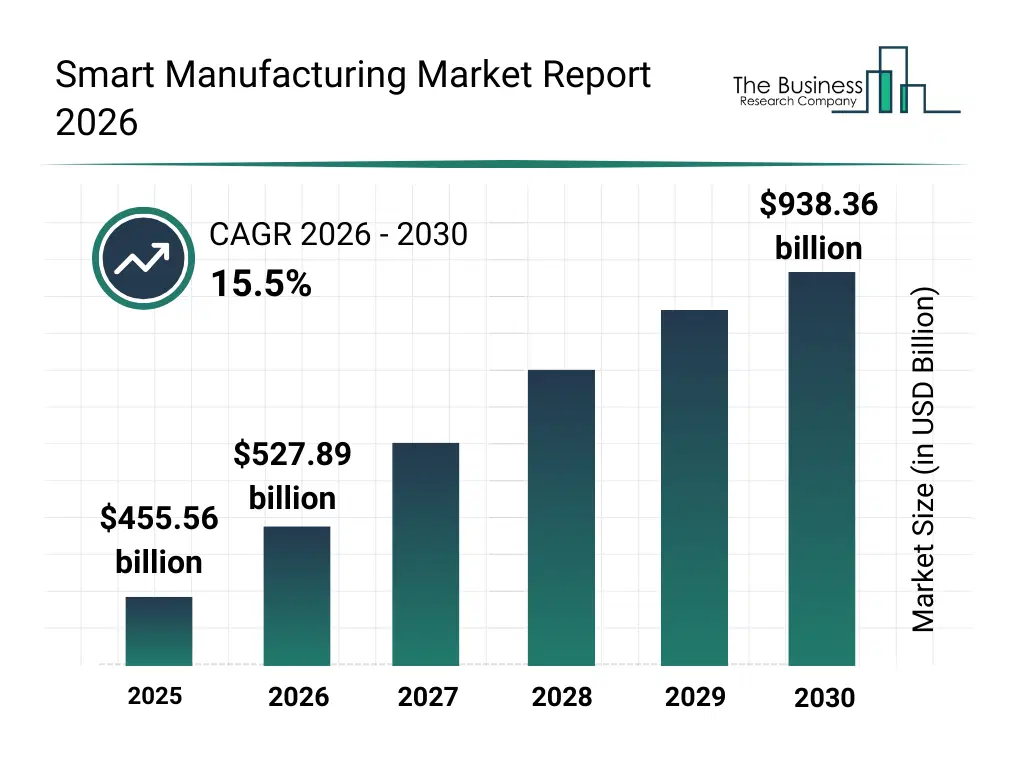
What Is The Smart Manufacturing Market Size and Share 2026?
The smart manufacturing market size has grown rapidly in recent years. It will grow from $455.56 billion in 2025 to $527.89 billion in 2026 at a compound annual growth rate (CAGR) of 15.9%. The growth in the historic period can be attributed to expansion of industrial automation adoption, rising need for operational efficiency, growth of sensor-based monitoring systems, increasing use of plc and scada systems, demand for reduced manufacturing downtime.What Is The Smart Manufacturing Market Growth Forecast?
The smart manufacturing market size is expected to see rapid growth in the next few years. It will grow to $938.36 billion in 2030 at a compound annual growth rate (CAGR) of 15.5%. The growth in the forecast period can be attributed to increasing investments in smart factories, rising adoption of ai-driven manufacturing analytics, expansion of autonomous production lines, growing focus on cyber-secure manufacturing systems, increasing integration of cloud-based manufacturing platforms. Major trends in the forecast period include increasing deployment of industrial iot platforms, rising adoption of predictive maintenance systems, growing integration of robotics and automation, expansion of digital twin technologies, enhanced focus on data-driven manufacturing.
Global Smart Manufacturing Market Segmentation
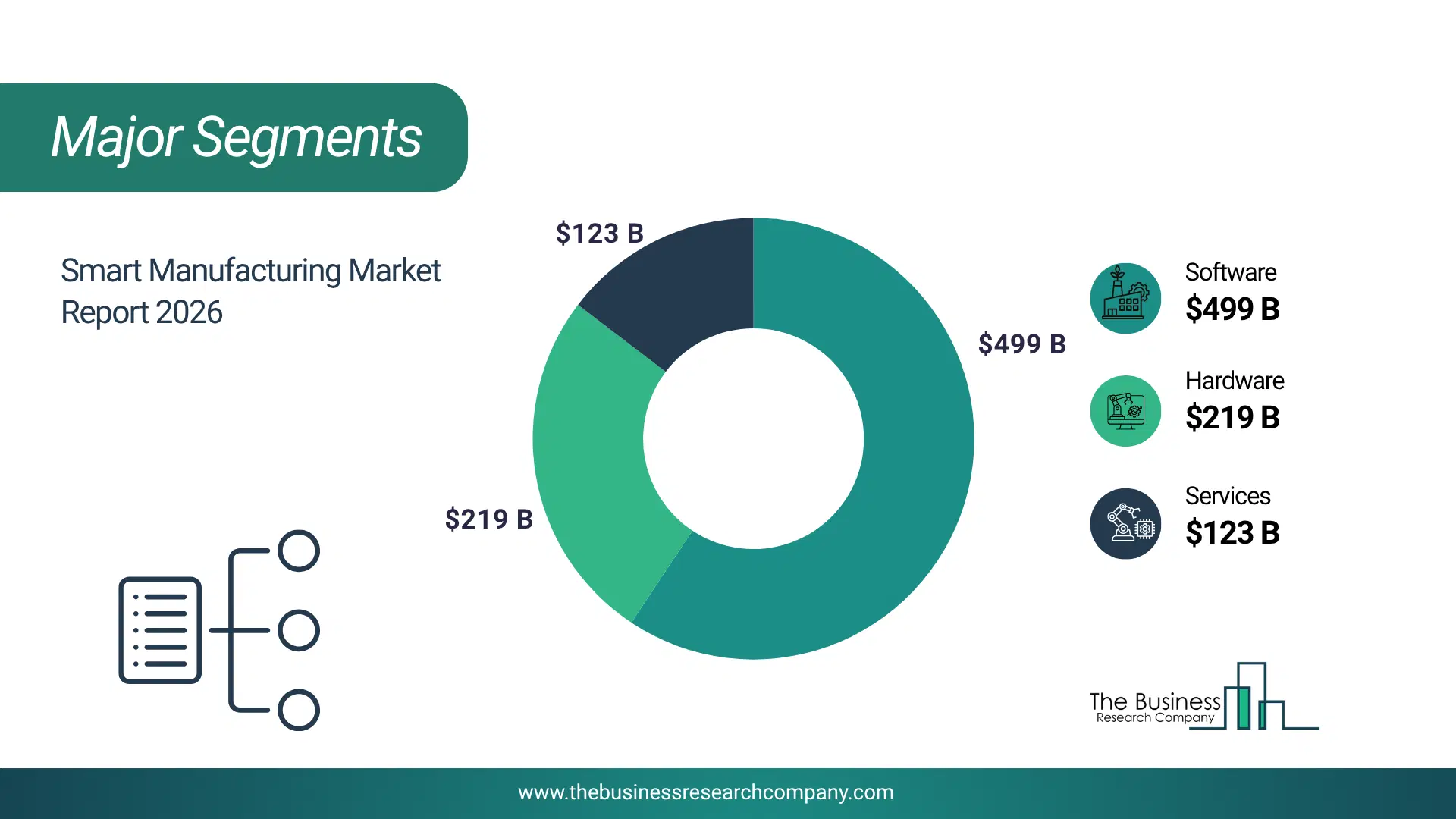
1) By Component: Hardware, Software, Services 2) By Technology: Machine Execution Systems (MES), Programmable Logic Controller (PLC), Enterprise Resource Planning (ERP), SCADA, Discrete Control Systems (DCS), Machine Vision, 3D Printing, Other Technologies 3) By End-User: Automotive, Aerospace And Defense, Chemicals And Materials, Healthcare, Industrial Equipment, Electronics, Food And Agriculture, Oil And Gas, Other End-Users Subsegments: 1) By Hardware: Sensors, Robotics, Industrial Control Systems, Machine Vision Systems, Connectivity Devices, Actuators 2) By Software: Manufacturing Execution Systems (MES), Enterprise Resource Planning (ERP), Supply Chain Management Software, Product Lifecycle Management (PLM), Quality Management Software, Data Analytics Software 3) By Services: Consulting Services, System Integration Services, Maintenance And Support Services, Training Services, Managed Services The top segments in the smart manufacturing market will be: • Software will reach $219868.9 Million by 2025. • Hardware will reach $158324.15 Million by 2025. • Automotive will reach $112709.08 Million by 2025. • Machine Execution Systems (MES) will reach $96015.24 Million by 2025. • Industrial Equipment will reach $84243.94 Million by 2025.What Is The Driver Of The Smart Manufacturing Market?
The rising adoption of robotics by industries is expected to propel the growth of the smart manufacturing market going forward. Robotics refers to the interdisciplinary field of science and engineering that involves the design, construction, operation, and use of robots. Smart manufacturing is used for integrating intelligent technologies to optimize production processes, increase efficiency, and enable adaptive and automated robotic systems. For instance, in September 2023, according to the World Robotics report published by the International Federation of Robotics, a Germany-based professional non-profit organization, there were 553,052 industrial robot installations in factories worldwide, marking a 5% year-on-year growth rate in 2022. Therefore, the rising adoption of robotics by industries is driving the growth of the smart manufacturing industry.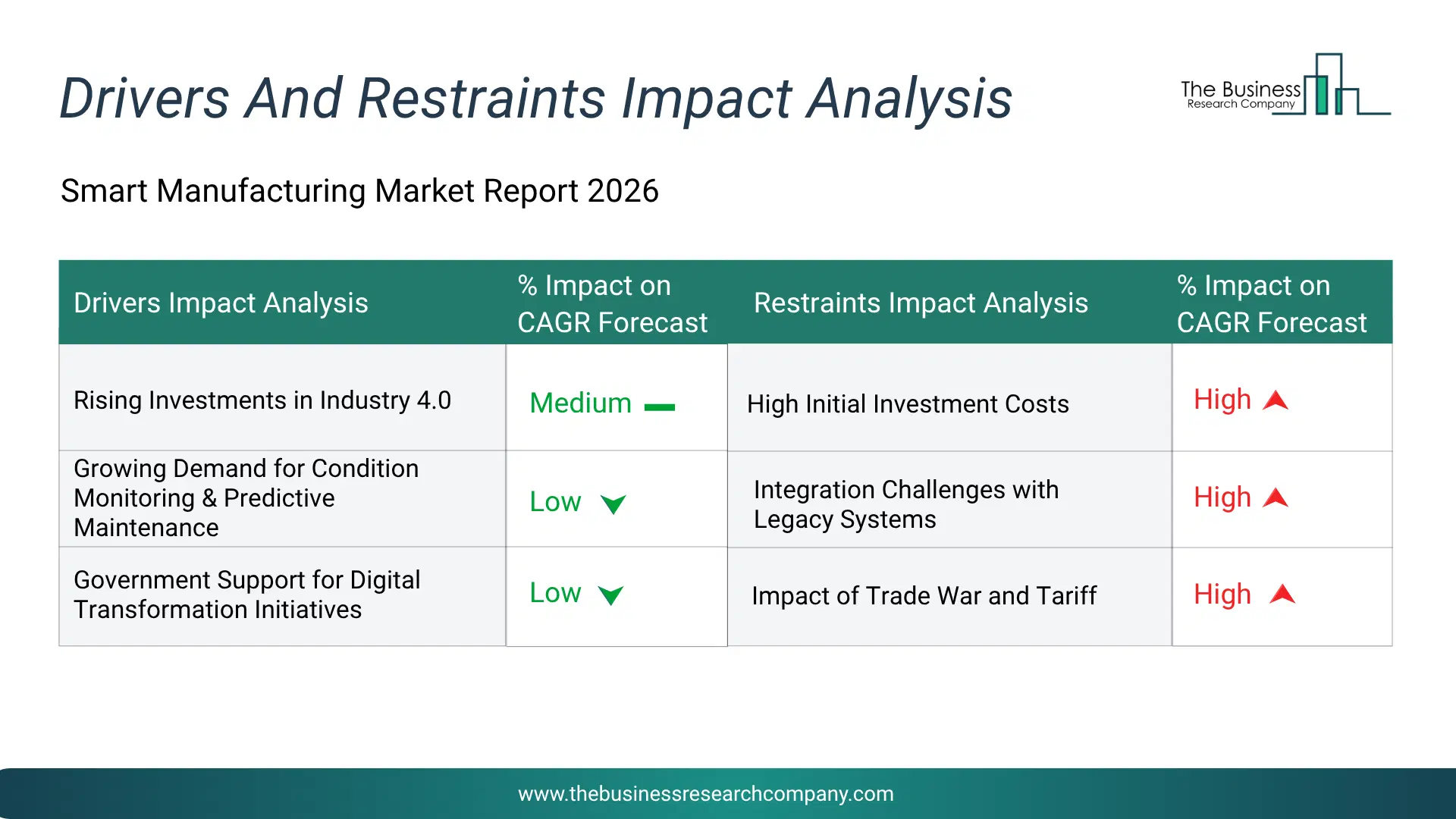
Infographic Chart Showing Key Market Drivers Analysis And Restraints For Smart Manufacturing Market
The chart presents an impact analysis of key drivers and restraints, quantifying their relative influence on the market's growth rate and helping assess the balance between growth enablers and limiting factors. This chart offers a high-level perspective; the full report contains more detailed insights.
How Will The Drivers Impact Growth In The Global Smart Manufacturing Market?
• Rising Investments in Industry 4.0 (Medium) – The rising investments in industry 4.0 will become a key driver of growth in the smart manufacturing market by 2030. As manufacturers invest more in cyber-physical systems, intelligent automation, IoT (internet of things) connectivity, cloud platforms, digital twins and advanced analytics, factories become increasingly capable of self-optimization and real-time decision-making. These investments establish the technological foundation needed for automated operations, seamless human-machine collaboration and interconnected production environments. With higher investment levels, companies can modernize legacy equipment, integrate end-to-end data flows and upgrade plant-level architectures to support smarter, faster and more resilient manufacturing. This steady capital infusion drives the transition toward highly automated, digitally orchestrated factories, positioning smart manufacturing as a core pillar of long-term industrial competitiveness. As a result, the rising investments in industry 4.0 is anticipated to contributing to a 1.5% annual growth in the market. • Demand for Condition Monitoring & Predictive Maintenance (Medium) – The demand for condition monitoring and predictive maintenance will emerge as a major factor driving the expansion of the smart manufacturing market by 2030. Smart factories rely on continuous monitoring of equipment performance through sensors, edge devices and real-time analytics to identify early signs of wear, misalignment, or system inefficiencies before failures occur. Predictive maintenance frameworks allow factories to transition from reactive to proactive maintenance strategies, optimizing service schedules, minimizing production interruptions and extending equipment life cycles. This shifts operational priorities toward data-driven maintenance, where machine health insights guide both short-term interventions and long-term asset planning. As predictive maintenance becomes more central to factory operations, manufacturers increasingly adopt advanced IoT (internet of things) solutions, AI (artificial intelligence) algorithms and integrated monitoring tools, all of which reinforce the growth of smart manufacturing ecosystems. Consequently, the demand for condition monitoring and predictive maintenance is projected to contributing to a 1.0% annual growth in the market. • Government Support for Digital Transformation Initiatives (Low) – The government support for digital transformation initiatives will serve as a key growth catalyst for the smart manufacturing market by 2030. Many governments prioritize smart manufacturing as part of national competitiveness and economic development strategies, promoting digital adoption through innovation grants, tax incentives, workforce upskilling programs and standards for industrial connectivity and automation. This support lowers the financial and operational barriers associated with transitioning to intelligent production environments, enabling small and large manufacturers to adopt advanced automation, IIoT (industrial internet of things) platforms, AI (artificial intelligence) technologies and cyber-physical systems. By fostering a favourable innovation environment, governments help build a stronger foundation for digital ecosystems, industrial interoperability and technology-driven productivity growth, all of which directly support the expansion of the smart manufacturing market. Therefore, this government support for digital transformation initiatives operations is projected to supporting to a 0.7% annual growth in the market. • Growing Adoption of Connected Devices (Low) – The growing adoption of connected devices will become a significant driver contributing to the growth of the smart manufacturing market by 2030. As more equipment, tools and production assets became equipped with connectivity features, manufacturers gained the ability to continuously capture machine-level data, monitor operating conditions and coordinate workflows with higher accuracy. This widespread device connectivity created the foundation for real-time operational visibility, where every process, from assembly lines to supply-chain movements. could be digitally tracked and managed. Connected devices also strengthened interoperability across hardware and software platforms, supporting seamless communication between machines, analytics systems and control architectures. Consequently, the growing adoption of connected devices is projected to contributing to a 0.5% annual growth in the market.How Will The Restraints Impact Growth In The Global Smart Manufacturing Market?
• High Initial Investment Costs (Medium) – High Initial Investment Costs will restrict the growth of the Smart Manufacturing market during the forecast period. Smart manufacturing implementation requires significant capital investment in equipment, software, and infrastructure. High costs create barriers for smaller manufacturers with limited budgets. Investment requirements can delay the adoption of smart manufacturing technologies and affect market growth. • Integration Challenges with Legacy Systems (Low) – Integration Challenges with Legacy Systems will restrict the growth of the Smart Manufacturing market during the forecast period. Smart manufacturing solutions face integration challenges with existing legacy equipment and systems. Compatibility issues can increase implementation costs and timelines. Integration challenges can limit the effectiveness of smart manufacturing initiatives and affect adoption rates. • Impact of Trade War and Tariff (Low) – Impact of Trade War and Tariff will restrict the growth of the Smart Manufacturing market during the forecast period. Trade tensions and economic uncertainty can affect manufacturing investment and technology adoption. Reduced spending during trade disputes may limit smart manufacturing implementation. Trade barriers may also impact the availability and cost of smart manufacturing technologies.Key Players In The Global Smart Manufacturing Market
Major companies operating in the smart manufacturing market are Siemens AG; General Electric Company; Rockwell Automation; Schneider Electric SE; Honeywell International Inc.; Emerson Electric; ABB India Limited; Amazon Web Services Inc.; Robert Bosch Manufacturing Solutions GmbH; Cisco Systems Inc.; 3D Systems Corporation; Plex Systems Inc.; Cognex Corporation; PTC Inc.; Mitsubishi Electric Corporation; HP Development Company L.P.; SAP SE; Hitachi Ltd.; IBM Corporation; Oracle Corporation; Microsoft Corporation; Intel Corporation; Accenture PLC; Fujitsu Limited; Fanuc Corporation; Kuka AG; Omron Corporation; Panasonic Corporation; Toshiba Corporation; Yokogawa Electric Corporation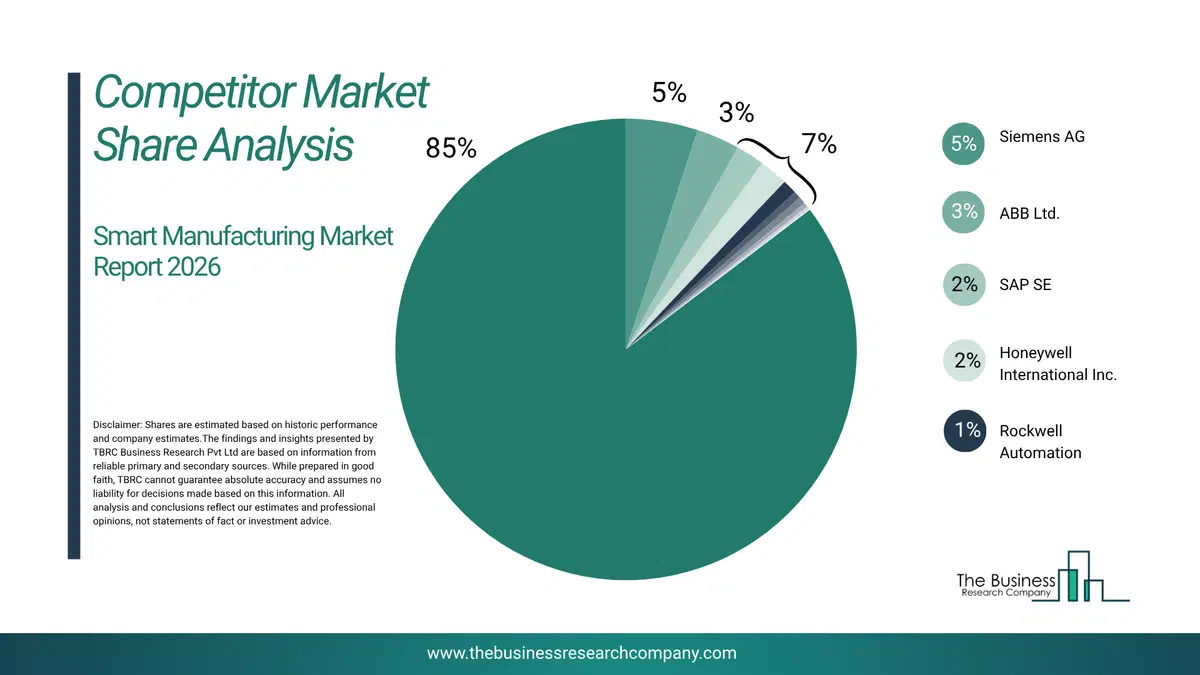
This chart is for illustrative purposes; the full report includes a detailed competitor analysis and comprehensive overview of the top 10 companies in the market.
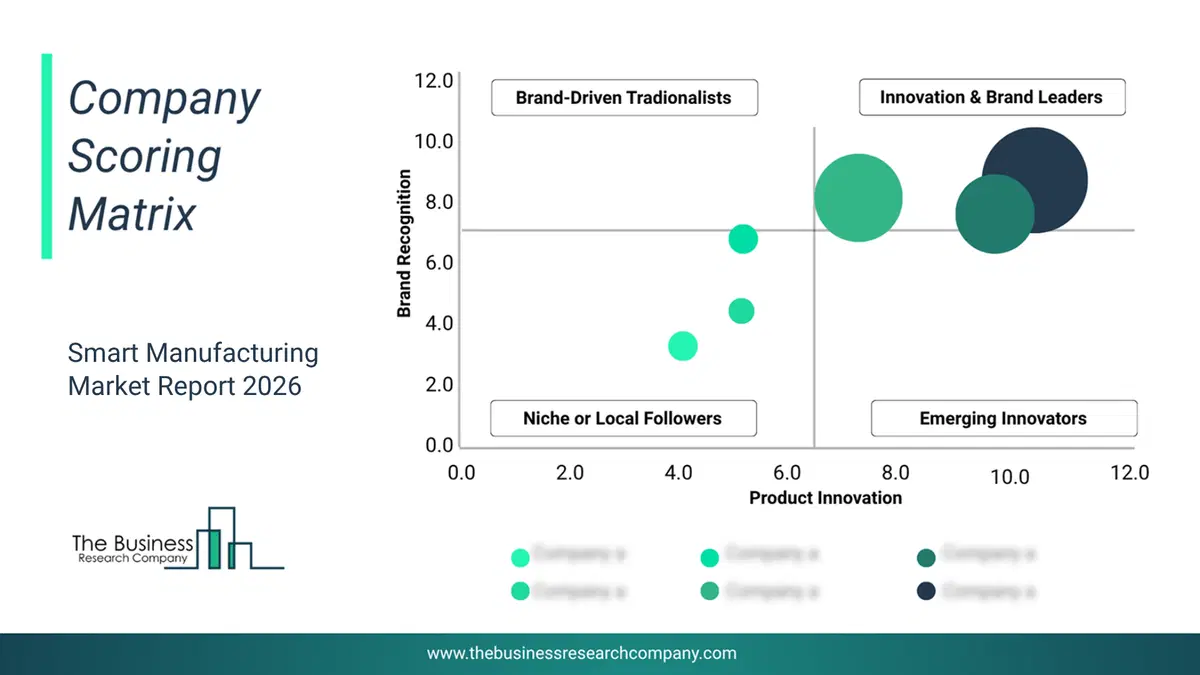
This chart maps companies by product innovation and brand strength, with bubble size indicating relative revenue, helping identify market leaders, challengers, and niche players. This is an illustrative chart; the full report provides a complete and accurate competitive analysis.
Global Smart Manufacturing Market Trends and Insights
Major companies operating in the smart manufacturing market are focusing on developing advanced solutions, such as AI-powered digital twins, to enhance real-time monitoring, predictive maintenance, and operational efficiency. AI-powered digital twins refer to virtual replicas of physical assets and manufacturing processes that integrate sensor data, machine learning, and analytics to optimize productivity and support informed decision-making. For instance, in November 2024, Bosch Digital Twin Industries, a Germany-based industrial technology company, in collaboration with Pepperl+Fuchs, a Germany-based company that manufactures electronic products for fabrication and process automation, introduced the Digital Twin Starter Kit for manufacturing environments. This solution provides real-time dashboards, AI-driven alerts, and predictive insights for machine parts and equipment, enabling manufacturers to optimize operations, reduce downtime, and improve overall production efficiency. The initiative emphasizes the integration of industrial IoT, AI, and sensor technology to advance Industry 4.0 practices and foster smarter manufacturing processes.What Are Latest Mergers And Acquisitions In The Smart Manufacturing Market?
In January 2024, INFICON, a Switzerland-based software development company, acquired assets of FabTime for an undisclosed amount. This acquisition aims to enhance INFICON's capabilities in the semiconductor and electronics manufacturing sectors. By integrating FabTime's advanced software solutions, INFICON seeks to improve its portfolio of process control and monitoring tools, enabling clients to optimize their manufacturing processes and increase efficiency. FabTime Inc. is a US-based company specializing in innovative manufacturing solutions.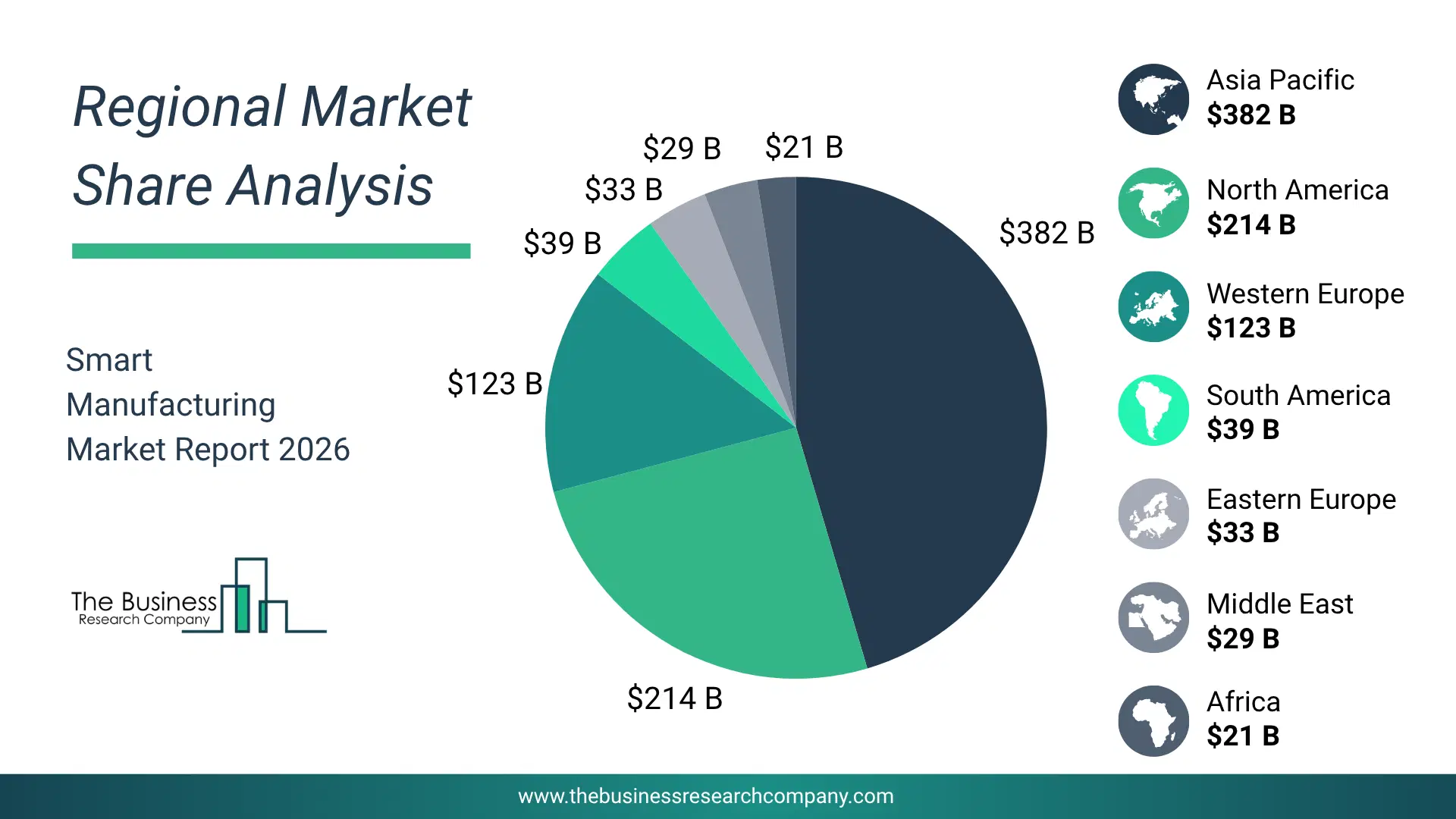
Regional Insights
North America was the largest region in the smart manufacturing market share in 2025. The regions covered in this market report are Asia-Pacific, South East Asia, Western Europe, Eastern Europe, North America, South America, Middle East, Africa. The countries covered in this market report are Australia, Brazil, China, France, Germany, India, Indonesia, Japan, Taiwan, Russia, South Korea, UK, USA, Canada, Italy, SpainWhat Defines the Smart Manufacturing Market?
The smart manufacturing market consists of revenues earned by entities by providing smart manufacturing products and services that enable firms to swiftly and effectively adapt to changes on the production floor and throughout their value chain. The market value includes the value of related goods sold by the service provider or included within the service offering. The smart manufacturing market also includes the sales of internet-connected machinery. Values in this market are ‘factory gate’ values, that is the value of goods sold by the manufacturers or creators of the goods, whether to other entities (including downstream manufacturers, wholesalers, distributors, and retailers) or directly to end customers. The value of goods in this market includes related services sold by the creators of the goods.How is Market Value Defined and Measured?
The market value is defined as the revenues that enterprises gain from the sale of goods and/or services within the specified market and geography through sales, grants, or donations in terms of the currency (in USD unless otherwise specified). The revenues for a specified geography are consumption values that are revenues generated by organizations in the specified geography within the market, irrespective of where they are produced. It does not include revenues from resales along the supply chain, either further along the supply chain or as part of other products.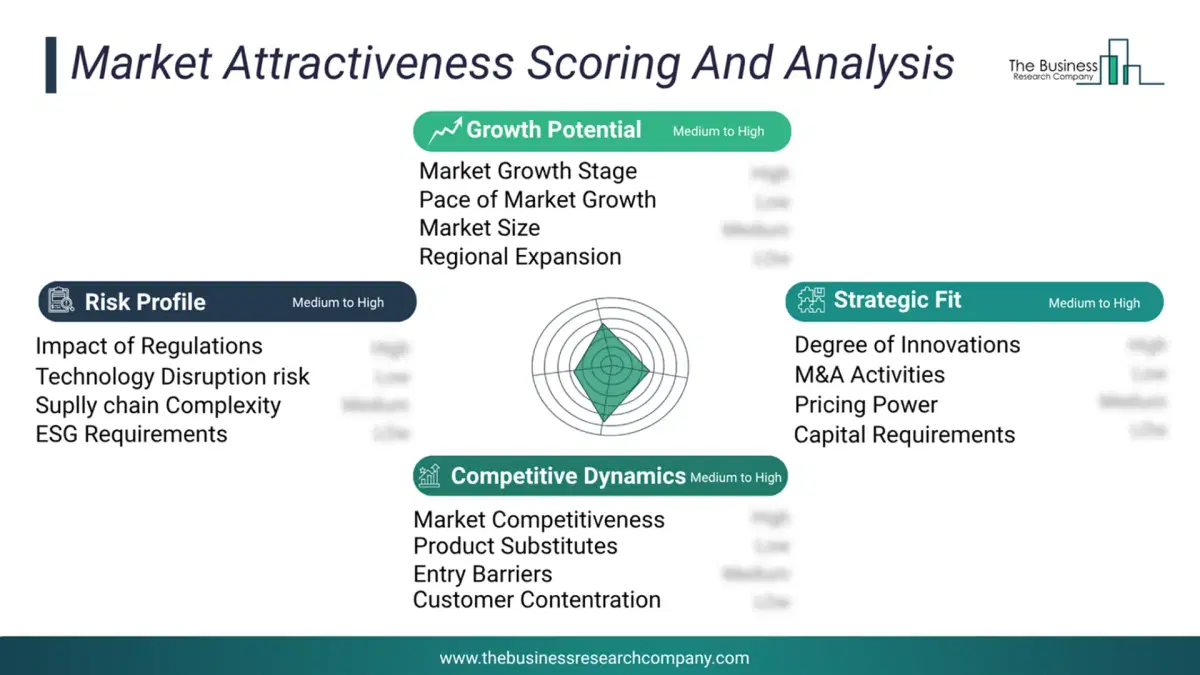
This chart presents market attractiveness based on a quantitative evaluation of growth, competition, strategic alignment, and risk, offering a clear view of opportunity areas for decision-making. This chart is for illustrative purposes; the full report contains the complete analysis.
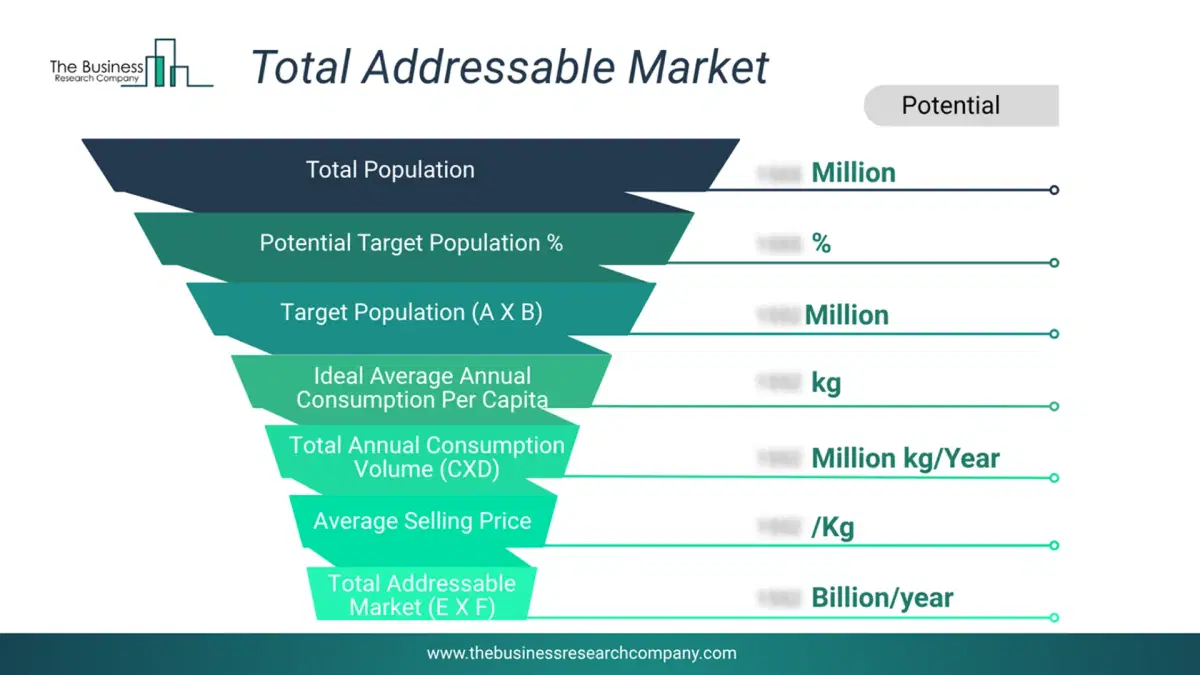
This chart highlights the Total Addressable Market (TAM) by estimating the maximum revenue opportunity using an assumption-driven approach, supporting strategic planning and opportunity sizing across markets. The chart is illustrative; the full report provides a more comprehensive analysis.
What Key Data and Analysis Are Included in the Smart Manufacturing Market Report 2026?
The smart manufacturing market research report is one of a series of new reports from The Business Research Company that provides market statistics, including industry global market size, regional shares, competitors with the market share, detailed market segments, market trends and opportunities, and any further data you may need to thrive in the smart manufacturing industry. The market research report delivers a complete perspective of everything you need, with an in-depth analysis of the current and future state of the industry.Smart Manufacturing Market Report Forecast Analysis
| Report Attribute | Details |
|---|---|
| Market Size Value In 2026 | $527.89 billion |
| Revenue Forecast In 2030 | $938.36 billion |
| Growth Rate | CAGR of 15.9% from 2026 to 2030 |
| Base Year For Estimation | 2025 |
| Actual Estimates/Historical Data | 2020-2025 |
| Forecast Period | 2026 - 2030 |
| Market Representation | Revenue in USD Billion and CAGR from 2026 to 2030 |
| Segments Covered | Component, Technology, End-User |
| Regional Scope | Asia-Pacific, Western Europe, Eastern Europe, North America, South America, Middle East, Africa |
| Country Scope | The countries covered in the report are Australia, Brazil, China, France, Germany, India, Indonesia, Japan, Taiwan, Russia, South Korea, UK, USA, Canada, Italy, Spain. |
| Key Companies Profiled | Siemens AG; General Electric Company; Rockwell Automation; Schneider Electric SE; Honeywell International Inc.; Emerson Electric; ABB India Limited; Amazon Web Services Inc.; Robert Bosch Manufacturing Solutions GmbH; Cisco Systems Inc.; 3D Systems Corporation; Plex Systems Inc.; Cognex Corporation; PTC Inc.; Mitsubishi Electric Corporation; HP Development Company L.P.; SAP SE; Hitachi Ltd.; IBM Corporation; Oracle Corporation; Microsoft Corporation; Intel Corporation; Accenture PLC; Fujitsu Limited; Fanuc Corporation; Kuka AG; Omron Corporation; Panasonic Corporation; Toshiba Corporation; Yokogawa Electric Corporation |
| Customization Scope | Request for Customization |
| Pricing And Purchase Options | Explore Purchase Options |