

Woodworking Machinery Market Report 2026
Global Outlook – By Product Type (Thickness Planer, Grinding Machines, Chain Or Chisel Mortise, Routers, Wood Lathes, Other Product Types), By Operating Principal (Electrical, Mechanical), By Sales Channel (Online, Offline), By End-User (Furniture Industry, Construction Industry, Other End-Users) – Market Size, Trends, Strategies, and Forecast to 2035
Woodworking Machinery Market Overview
• Woodworking Machinery market size has reached to $33.93 billion in 2025 • Expected to grow to $48.49 billion in 2030 at a compound annual growth rate (CAGR) of 7.6% • Growth Driver: Rise Of Construction Industry Fuels The Woodworking Machinery Market Growth • Market Trend: Professional Angle Grinder For Enhanced Grinding And Cutting In Woodworking Machinery Market • Asia-Pacific was the largest region in 2025 and North America is the fastest growing region.What Is Covered Under Woodworking Machinery Market?
Woodworking machines are specially designed machines that are used in workshops to cut, saw, plane, or drill wood to produce furniture. These machines are primarily powered by electric motors or are mechanical and are widely used in woodworking to provide fine dimensions and shapes. The woodworking machinery converts raw wood materials into structural products including plywood, boards, and beams for use in construction, shipbuilding, furniture, and others. The main types of products in woodworking machinery are thickness planers, grinding machines, chain or chisel mortises, routers, wood lathes, and others. Thickness planers are used to chisel wood from the surface of boards to either make rough surfaces flat and smooth or reduce their thickness. The different operating principles include mechanical, and electrical and are available in both online and offline sales channels. It is implemented in various verticals, including the furniture industry, construction industry, and others.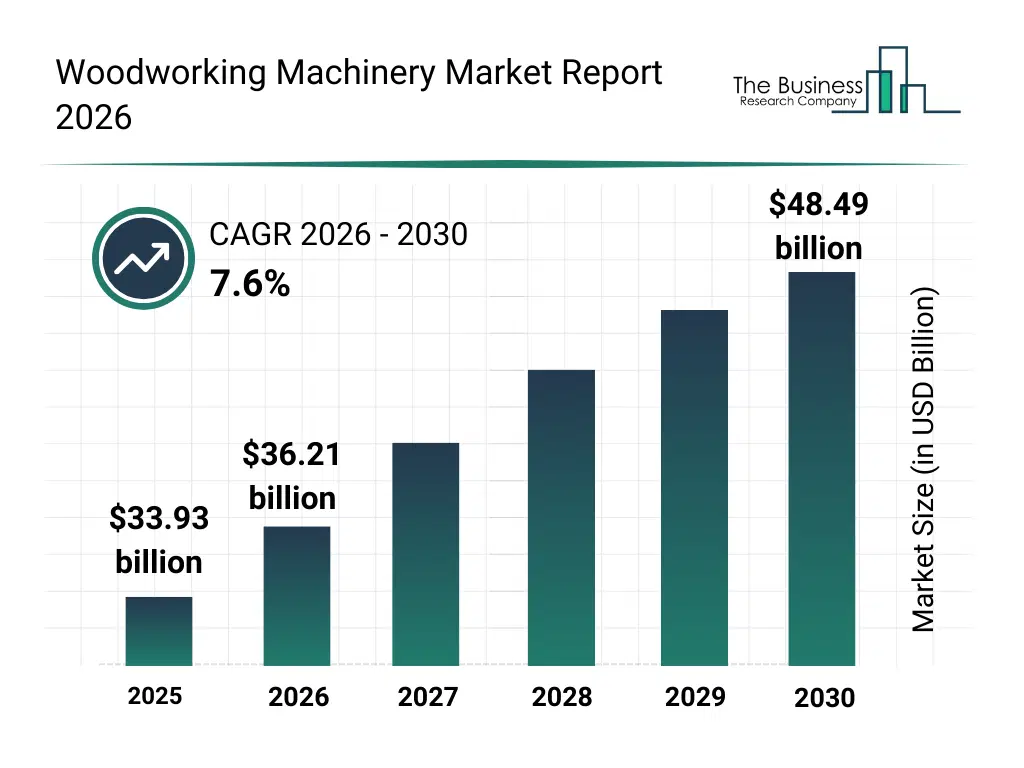
What Is The Woodworking Machinery Market Size and Share 2026?
The woodworking machinery market size has grown strongly in recent years. It will grow from $33.93 billion in 2025 to $36.21 billion in 2026 at a compound annual growth rate (CAGR) of 6.7%. The growth in the historic period can be attributed to growth in furniture demand, expansion of residential construction, increased woodworking workshops, adoption of electric machinery, demand for improved production efficiency.What Is The Woodworking Machinery Market Growth Forecast?
The woodworking machinery market size is expected to see strong growth in the next few years. It will grow to $48.49 billion in 2030 at a compound annual growth rate (CAGR) of 7.6%. The growth in the forecast period can be attributed to automation in furniture manufacturing, growth in custom furniture production, expansion of prefabricated construction, demand for high accuracy machines, integration of digital woodworking tools. Major trends in the forecast period include rising adoption of cnc woodworking machines, growing demand for precision cutting equipment, expansion of furniture manufacturing automation, preference for electric powered machinery, increasing use of modular workshop equipment.Tariff Impact On Woodworking Machinery Market
Tariffs have affected the woodworking machinery market by increasing costs of imported motors, cutting tools, CNC controllers, and mechanical components. Advanced woodworking machines are most impacted, particularly in Europe and Asia Pacific. Higher equipment prices have influenced small workshop investments. At the same time, tariffs have supported local machinery manufacturing and aftermarket service growth.
Global Woodworking Machinery Market Segmentation
1) By Product Type: Thickness Planer, Grinding Machines, Chain Or Chisel Mortise, Routers, Wood Lathes, Other Product Types 2) By Operating Principal: Electrical, Mechanical 3) By Sales Channel: Online, Offline 4) By End-User: Furniture Industry, Construction Industry, Other End-Users Subsegments: 1) By Thickness Planer: Portable Thickness Planers, Stationary Thickness Planers 2) By Grinding Machines: Surface Grinders, Cylindrical Grinders, Tool And Cutter Grinders 3) By Chain Or Chisel Mortise: Chain Mortisers, Chisel Mortisers 4) By Routers: Fixed Base Routers, Plunge Routers, Router Tables 5) By Wood Lathes: Mini Wood Lathes, Midi Wood Lathes, Full-Size Wood Lathes 6) By Other Product Types: Saws, Sanding Machines, Dovetail Machines, JointersWhat Are The Drivers Of The Woodworking Machinery Market?
The increasing expansion of construction industry is expected to propel the growth of woodworking machinery market going forward. The construction industry refers to a sector of the economy that encompasses the planning, designing, development, and construction of structures and infrastructure. Woodworking machinery is used in construction for precision shaping, cutting, and assembling of wood components, facilitating the production of doors, windows, furniture, and other architectural elements integral to building structures. For instance, in July 2023, according to the Australian Bureau of Statistics, an Australian-based government administration, reported that in the March quarter of 2023, the number of dwellings under construction increased to 240,813, up from 240,065 in 2022. Among these, new houses made up 103,778, compared to 101,240 in the previous year. Therefore, the increasing expansion of construction sector is driving the growth of woodworking machinery industry. The surge in infrastructure development is expected to propel the growth of woodworking machinery market going forward. Infrastructure development refers to the planning, design, construction, and maintenance of essential physical and organizational structures, facilities, and systems that support the functioning of a society, region, or industry. Woodworking machinery is utilized in infrastructure development for crafting essential components such as formwork, scaffolding, and architectural elements required in construction projects. These machines enable precision cutting, shaping, and assembly of wooden materials, contributing to the creation of durable and customized structures within the broader framework of infrastructure development. For instance, in March 2023, according to Global X ETF, a US-based fund management firm, the United States took a significant step towards improving its infrastructure with the $1.2 trillion Infrastructure Investment and Jobs Act (IIJA). Over the next ten years, the IIJA will invest $550 billion to improve roads, bridges, airports, and railroads, extend access to clean drinking water and broadband internet, and achieve environmental justice. Therefore, the surge in infrastructure development is driving the growth of woodworking machinery industry.What Are The Drivers Of The Woodworking Machinery Market?
The increasing expansion of construction industry is expected to propel the growth of woodworking machinery market going forward. The construction industry refers to a sector of the economy that encompasses the planning, designing, development, and construction of structures and infrastructure. Woodworking machinery is used in construction for precision shaping, cutting, and assembling of wood components, facilitating the production of doors, windows, furniture, and other architectural elements integral to building structures. For instance, in July 2023, according to the Australian Bureau of Statistics, an Australian-based government administration, reported that in the March quarter of 2023, the number of dwellings under construction increased to 240,813, up from 240,065 in 2022. Among these, new houses made up 103,778, compared to 101,240 in the previous year. Therefore, the increasing expansion of construction sector is driving the growth of woodworking machinery industry. The surge in infrastructure development is expected to propel the growth of woodworking machinery market going forward. Infrastructure development refers to the planning, design, construction, and maintenance of essential physical and organizational structures, facilities, and systems that support the functioning of a society, region, or industry. Woodworking machinery is utilized in infrastructure development for crafting essential components such as formwork, scaffolding, and architectural elements required in construction projects. These machines enable precision cutting, shaping, and assembly of wooden materials, contributing to the creation of durable and customized structures within the broader framework of infrastructure development. For instance, in March 2023, according to Global X ETF, a US-based fund management firm, the United States took a significant step towards improving its infrastructure with the $1.2 trillion Infrastructure Investment and Jobs Act (IIJA). Over the next ten years, the IIJA will invest $550 billion to improve roads, bridges, airports, and railroads, extend access to clean drinking water and broadband internet, and achieve environmental justice. Therefore, the surge in infrastructure development is driving the growth of woodworking machinery industry.Global Woodworking Machinery Market Trends and Insights
Major companies operating in the woodworking machinery market are developing new products such as angle grinders to gain a competitive edge in the market. Angle grinders, also known as disc grinders or side grinders, are handheld power tools used for grinding, cutting, and polishing. For instance, in January 2023, Robert Bosch GmbH, a Germany-based engineering and technology company, launched the GWS 800 Professional, a powerful and compact angle grinder designed for superior grinding and cutting experiences. It features an 800W motor for high material removal rates, a lightweight ergonomic body with a back switch, and a double air inlet cooling system. Specifically tailored to the Indian market, it considers the average palm size of an Indian user, ensuring comfort and reduced fatigue during overhead applications. Additionally, it features a metal flange and superior-quality carbon brush, enhancing durability and ease of maintenance for users across various applications.Regional Outlook
Asia-Pacific was the largest region in the woodworking machinery market in 2025. North America was the second-largest market in the woodworking machinery market share. The regions covered in this market report are Asia-Pacific, South East Asia, Western Europe, Eastern Europe, North America, South America, Middle East, Africa The countries covered in this market report are Australia, Brazil, China, France, Germany, India, Indonesia, Japan, Taiwan, Russia, South Korea, UK, USA, Canada, Italy, Spain.What Defines the Woodworking Machinery Market?
The woodworking machinery market consists of sales of surface/thickness planer, tenoning machine, chain/chisel mortiser, jig saw, grinder/grinding machine, and nail gun. Values in this market are ‘factory gate’ values, that is the value of goods sold by the manufacturers or creators of the goods, whether to other entities (including downstream manufacturers, wholesalers, distributors, and retailers) or directly to end customers. The value of goods in this market includes related services sold by the creators of the goods.How is Market Value Defined and Measured?
The market value is defined as the revenues that enterprises gain from the sale of goods and/or services within the specified market and geography through sales, grants, or donations in terms of the currency (in USD unless otherwise specified). The revenues for a specified geography are consumption values that are revenues generated by organizations in the specified geography within the market, irrespective of where they are produced. It does not include revenues from resales along the supply chain, either further along the supply chain or as part of other products.What Key Data and Analysis Are Included in the Woodworking Machinery Market Report 2026?
The woodworking machinery market research report is one of a series of new reports from The Business Research Company that provides market statistics, including industry global market size, regional shares, competitors with the market share, detailed market segments, market trends and opportunities, and any further data you may need to thrive in the woodworking machinery industry. The market research report delivers a complete perspective of everything you need, with an in-depth analysis of the current and future state of the industry.Woodworking Machinery Market Report Forecast Analysis
| Report Attribute | Details |
|---|---|
| Market Size Value In 2026 | $36.21 billion |
| Revenue Forecast In 2035 | $48.49 billion |
| Growth Rate | CAGR of 6.7% from 2026 to 2035 |
| Base Year For Estimation | 2025 |
| Actual Estimates/Historical Data | 2020-2025 |
| Forecast Period | 2026 - 2030 - 2035 |
| Market Representation | Revenue in USD Billion and CAGR from 2026 to 2035 |
| Segments Covered | Product Type, Operating Principal, Sales Channel, End-User |
| Regional Scope | Asia-Pacific, Western Europe, Eastern Europe, North America, South America, Middle East, Africa |
| Country Scope | The countries covered in the report are Australia, Brazil, China, France, Germany, India, ... |
| Key Companies Profiled | Robland Corporation, Biesse Group S.p.A., SCM Group S.p.A., Michael Weinig AG, SawStop, IMA Schelling Group GmbH, Altendorf GmbH & Co. KG, Grizzly Industrial Inc., HOMAG Group AG, Linze Woodworking Machinery Co. Ltd., Gongyou Group Co. Ltd., JPW Industries Inc., Laguna Tools, Felder Group, Thermwood Corporation, Delta Power Equipment Corporation, Cantek America, Oliver Machinery Co. Ltd., MiniMax S.r.l., Martin Woodworking Machines GmbH, JET Tools, Paolino Bacci S.p.A., Otto Martin Maschinenbau GmbH & Co. KG, Holytek Industrial Corp., Cheng Kuang Machinery Co. Ltd., Rilesa S.r.l., KTCC Woodworking Machinery Co. Ltd., Rojek Woodworking Machinery Inc., Vigano Mario S.r.l., Daltons Wadkin Ltd., Woodstock International Inc. |
| Customization Scope | Request for Customization |
| Pricing And Purchase Options | Explore Purchase Options |