

Automotive Crankshaft Market Report 2026
Global Outlook – By Type (Flat Plane, Cross Plane), By Material (Forged Iron Or Steel, Cast Iron Or Steel), By Vehicle Type (Heavy Commercial Vehicles, Light Commercial Vehicles, Luxury Vehicles, Passenger Vehicles, Sport Utility Vehicles, Multi Utility Vehicles, Other Vehicle Types) – Market Size, Trends, Strategies, and Forecast to 2030
Automotive Crankshaft Market Overview
• Automotive Crankshaft market size has reached to $4.76 billion in 2025 • Expected to grow to $5.87 billion in 2030 at a compound annual growth rate (CAGR) of 4.3% • Growth Driver: Growth In Vehicle Production Is Anticipated To Fuel Automotive Crankshaft Market • Market Trend: New Crankshafts To Fulfill The High Demand For This Aftermarket Product • Europe was the largest region in 2025.Market Gains By 2030 – Top Opportunities By Segment
Market Gain identifies the most promising market opportunities by highlighting the segments or products expected to generate the highest incremental revenue growth over the next five years.
What Is Covered Under Automotive Crankshaft Market?
The automotive crankshaft transforms the force generated by combustion into circular motion in the engine required to propel a vehicle. The crankshaft is a heavy-duty component located at the engine's bottom and is typically constructed of steel or iron. It is connected to the pistons' bases through connecting rods that attach to crank pins at zig-zag offsets from the crankshaft's centerline. This arrangement allows the pistons' vertical movement to spin the crankshaft and generate rotational energy. The main types of automotive crankshafts are flat planes and cross-plane. The flat-plane crank tends to rev higher than its cross-plane counterpart because each crankpin journal (the bits the connecting rods attach to) is spaced at 180-degree intervals. The various materials include forged iron and steel, cast iron and steel, and others and include several types of vehicles such as heavy commercial vehicles, light commercial vehicles, luxury vehicles, passenger vehicles, sport utility vehicles, multi-utility vehicles, and others.
What Is The Automotive Crankshaft Market Size and Share 2026?
The automotive crankshaft market size has grown steadily in recent years. It will grow from $4.76 billion in 2025 to $4.95 billion in 2026 at a compound annual growth rate (CAGR) of 3.9%. The growth in the historic period can be attributed to internal combustion engine dominance, forged steel usage, vehicle production growth, crankshaft standardization, engine platform expansion.What Is The Automotive Crankshaft Market Growth Forecast?
The automotive crankshaft market size is expected to see steady growth in the next few years. It will grow to $5.87 billion in 2030 at a compound annual growth rate (CAGR) of 4.3%. The growth in the forecast period can be attributed to hybrid powertrain demand, fuel efficiency regulations, high-performance vehicle growth, material innovation, precision manufacturing advancements. Major trends in the forecast period include lightweight crankshaft development, demand for high-strength materials, precision forging adoption, growth of performance engines, expansion of engine downsizing strategies.
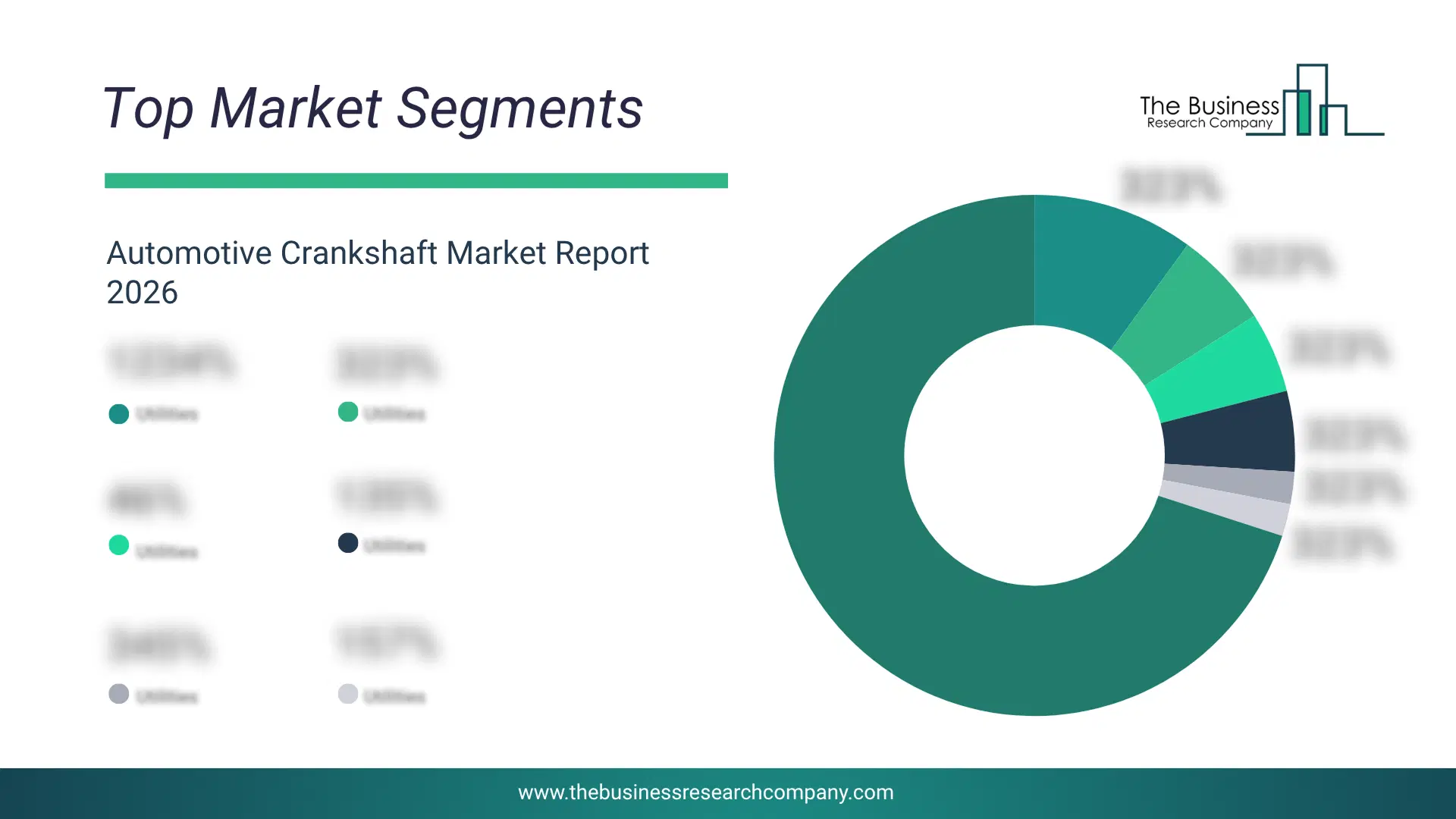
Global Automotive Crankshaft Market Segmentation
1) By Type: Flat Plane, Cross Plane 2) By Material: Forged Iron Or Steel, Cast Iron Or Steel 3) By Vehicle Type: Heavy Commercial Vehicles, Light Commercial Vehicles, Luxury Vehicles, Passenger Vehicles, Sport Utility Vehicles, Multi Utility Vehicles, Other Vehicle Types Subsegments: 1) By Flat Plane: Lightweight Flat Plane Crankshafts, High-Performance Flat Plane Crankshafts 2) By Cross Plane: Traditional Cross Plane Crankshafts, Performance Cross Plane Crankshafts The top segments in the automotive crankshaft market will be: • Cross Plane will reach $4 Billion by 2030. • Flat Plane will reach $2 Billion by 2030.What Is The Driver Of The Automotive Crankshaft Market?
The growth in vehicle production is expected to propel the growth of the automotive crankshaft market going forward. A vehicle is a mechanical device designed for transporting people or goods from one location to another, and increasing global production volumes directly raise the demand for essential engine components. Automotive crankshafts are critical parts of internal combustion engines, converting the reciprocating motion of pistons into rotational motion required to power the vehicle. The rise in global passenger car sales reflects expanding consumer demand and increasing mobility needs, which in turn accelerates the production of engines and associated components such as crankshafts. For instance, in March 2024, according to HonestJohn.co.uk, a UK-based automotive statistics website, global passenger car sales reached approximately 74.6 million units, marking a growth of about 2.5% compared to 2023. Therefore, the increasing demand for passenger and commercial vehicles is driving the growth of the automotive crankshaft industry.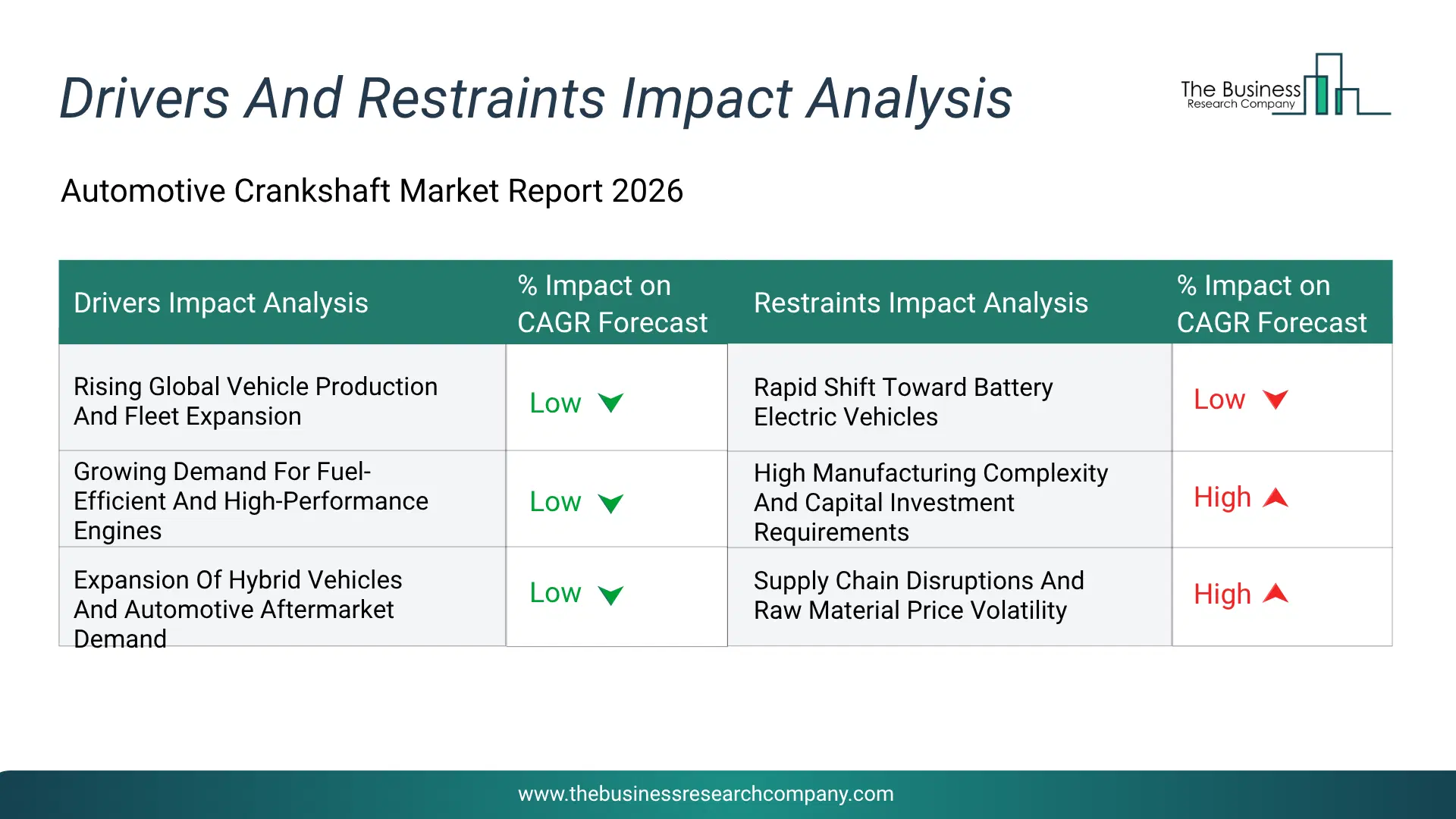
Infographic Chart Showing Key Market Drivers Analysis And Restraints For Automotive Crankshaft Market
The chart presents an impact analysis of key drivers and restraints, quantifying their relative influence on the market's growth rate and helping assess the balance between growth enablers and limiting factors. This chart offers a high-level perspective; the full report contains more detailed insights.
How Will The Drivers Impact Growth In The Global Automotive Crankshaft Market?
• Rising Global Vehicle Production And Fleet Expansion (Low) – During the forecast period, the rising global vehicle production and fleet expansion are expected to emerge as a major factor driving the expansion of the automotive crankshaft market by 2030. increasing production of passenger cars, light commercial vehicles, and heavy commercial vehicles is generating sustained demand for crankshafts across original equipment manufacturers and replacement markets. growing urbanization, expanding freight transportation, infrastructure development, and rising vehicle ownership are further supporting the need for durable crankshaft components used in a wide range of internal combustion engine and hybrid vehicle applications. • Growing Demand For Fuel-Efficient And High-Performance Engines (Low) – During the forecast period, the growing demand for fuel-efficient and high-performance engines is expected to emerge as a major factor driving the expansion of the automotive crankshaft market by 2030. automakers are increasingly adopting advanced forged steel materials, precision machining techniques, and optimized crankshaft designs to improve engine efficiency, reduce vibration, enhance durability, and comply with stricter fuel economy and emission standards. continuous innovation in lightweight and high-strength engine components is further supporting demand across passenger, premium, and commercial vehicle segments. • Expansion Of Hybrid Vehicles And Automotive Aftermarket Demand (Low) – During the forecast period, the expansion of hybrid vehicles and automotive aftermarket demand is expected to act as a key growth catalyst for the automotive crankshaft market by 2030. hybrid powertrains continue to require high-performance crankshafts capable of handling frequent engine start-stop operations, while aging vehicle fleets are increasing replacement demand during engine maintenance and overhauls. rising vehicle service life and expanding repair activities are creating stable long-term opportunities for crankshaft manufacturers across global aftermarket channels.How Will The Restraints Impact Growth In The Global Automotive Crankshaft Market?
• Rapid Shift Toward Battery Electric Vehicles (Low) – During the forecast period, rapid Shift Toward Battery Electric Vehicles represents the most significant long-term restraint for the Automotive Crankshaft Market because fully electric vehicles do not utilize internal combustion engines and therefore do not require crankshafts. Governments worldwide are implementing stricter emission regulations, fuel economy standards, EV subsidies, and carbon neutrality policies that accelerate the adoption of battery electric vehicles. As automakers gradually reduce investments in ICE platforms and expand electric vehicle production, future demand for crankshafts is expected to decline, creating long-term challenges for manufacturers that rely heavily on conventional engine components. • High Manufacturing Complexity And Capital Investment Requirements (Low) – During the forecast period, high Manufacturing Complexity And Capital Investment Requirements limit market expansion because crankshafts require highly specialized forging, heat treatment, precision machining, balancing, and quality inspection processes to achieve the strength and dimensional accuracy demanded by modern engines. Establishing manufacturing facilities requires significant investment in CNC machinery, forging presses, advanced testing equipment, automation systems, and skilled labor. These high capital expenditures create substantial entry barriers for new manufacturers while increasing production costs for existing companies. Rising energy prices and raw material costs further add pressure to operating margins across the industry. • Supply Chain Disruptions And Raw Material Price Volatility (Low) – During the forecast period, supply Chain Disruptions And Raw Material Price Volatility continue to restrain the Automotive Crankshaft Market by increasing production costs and creating uncertainty in manufacturing schedules. Crankshafts depend heavily on high-quality forged steel, cast iron, and specialty alloys whose prices fluctuate due to geopolitical tensions, trade restrictions, inflation, and disruptions in global metal supply chains. Delays in raw material procurement and transportation can interrupt production timelines, extend delivery periods, and reduce profitability for both OEM suppliers and aftermarket manufacturers. These uncertainties also complicate inventory planning and long-term procurement strategies, affecting overall market stability.Key Players In The Global Automotive Crankshaft Market
Major companies operating in the automotive crankshaft market report include Maschinenfabrik ALFING Kessler GmbH, Bharat Forge Ltd., ThyssenKrupp AG, Tianrun Crankshaft Co. Ltd., Arrow Precision Ltd., Farndon Engineering Ltd., Metalyst Forgings Ltd., Balu Forge Industries Ltd., Kellogg Crankshaft Company, Crower Cams & Equipment Co. Inc., Mahindra CIE Automotive Ltd., CIE Automotive S.A., Rheinmetall AG, MAHLE GmbH, GKN plc, Federal-Mogul LLC, Cooper Corporation, Amtek Group, Ciguenales Sanz SL, BMV Precision Engineering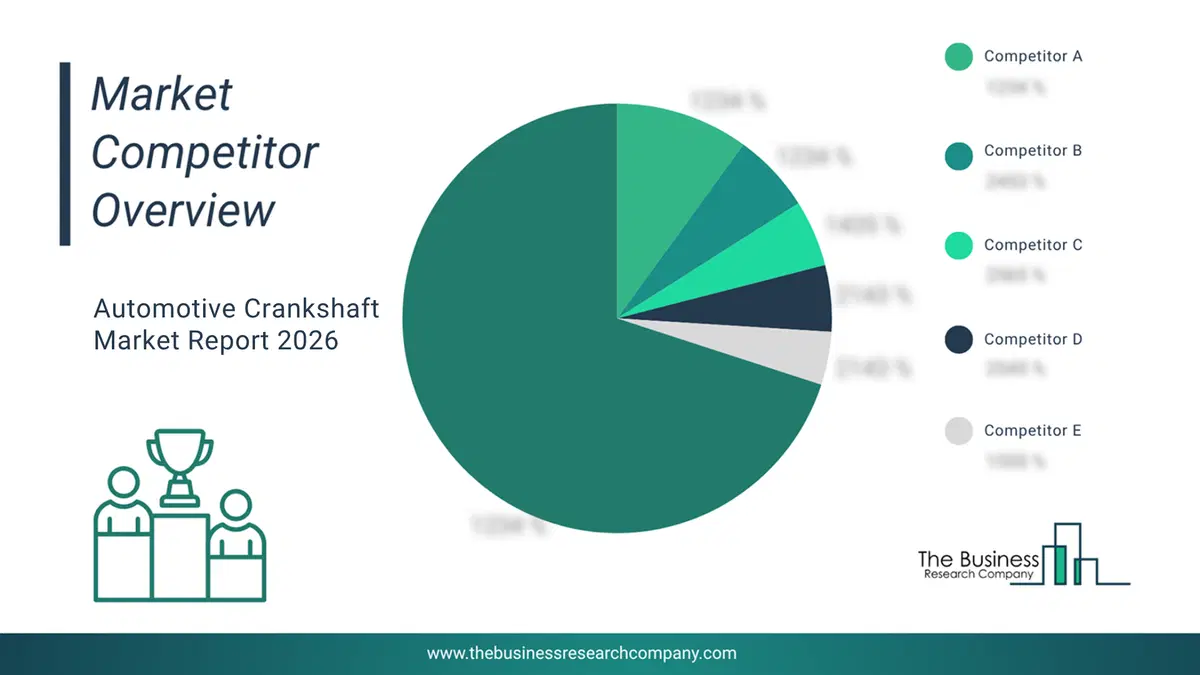
This chart is for illustrative purposes; the full report includes a detailed competitor analysis and comprehensive overview of the top 10 companies in the market.
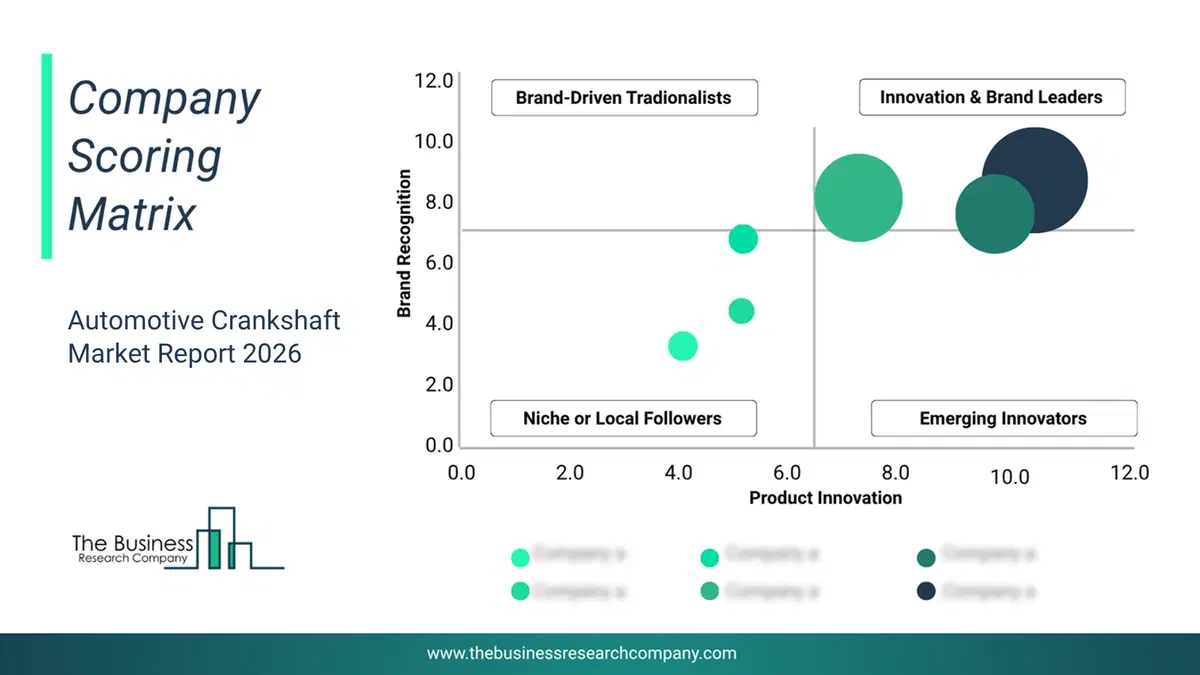
This chart maps companies by product innovation and brand strength, with bubble size indicating relative revenue, helping identify market leaders, challengers, and niche players. This is an illustrative chart; the full report provides a complete and accurate competitive analysis.
Global Automotive Crankshaft Market Trends and Insights
Major companies operating in the automotive crankshaft market are launching new crankshafts to fulfill the high demand for this aftermarket product. Crankshaft is a specific product designed for use in a piston engine to convert the reciprocating motion of the piston into rotational motion. For instance, in September 2023, Monedero, a Spain-based provider of components and accessories for the automotive, launched the first version of the OM471LA crankshaft, fulfilling a significant demand in the aftermarket. Prior to this, no aftermarket company could provide an alternative to the original references that met customer requirements. The reference for the OM471LA crankshaft is 10011000051, which is equivalent to the original Mercedes Benz references: A4710300101, A47110300201, and A4710300401.Notably, the OM471LA crankshaft designed for Mercedes Benz and other relevant model applications.What Are Latest Mergers And Acquisitions In The Automotive Crankshaft Market?
In July 2024, HD Korea Shipbuilding & Offshore Engineering (HD KSOE), a Korea–based shipbuilding company, acquired STX Heavy Industries for an undisclosed amount. As a result of the acquisition, HD Hyundai plans to leverage HD Hyundai Marine Engine's advanced manufacturing technologies in key components such as crankshafts and turbochargers to enhance synergy with HD HHI. Additionally, it aims to capitalize on eco-friendly engine technologies and broaden its global distribution network, bolstering its competitive position in the ship engine market. STX Heavy Industries is a Korea-based manufacturer of automotive crankshafts.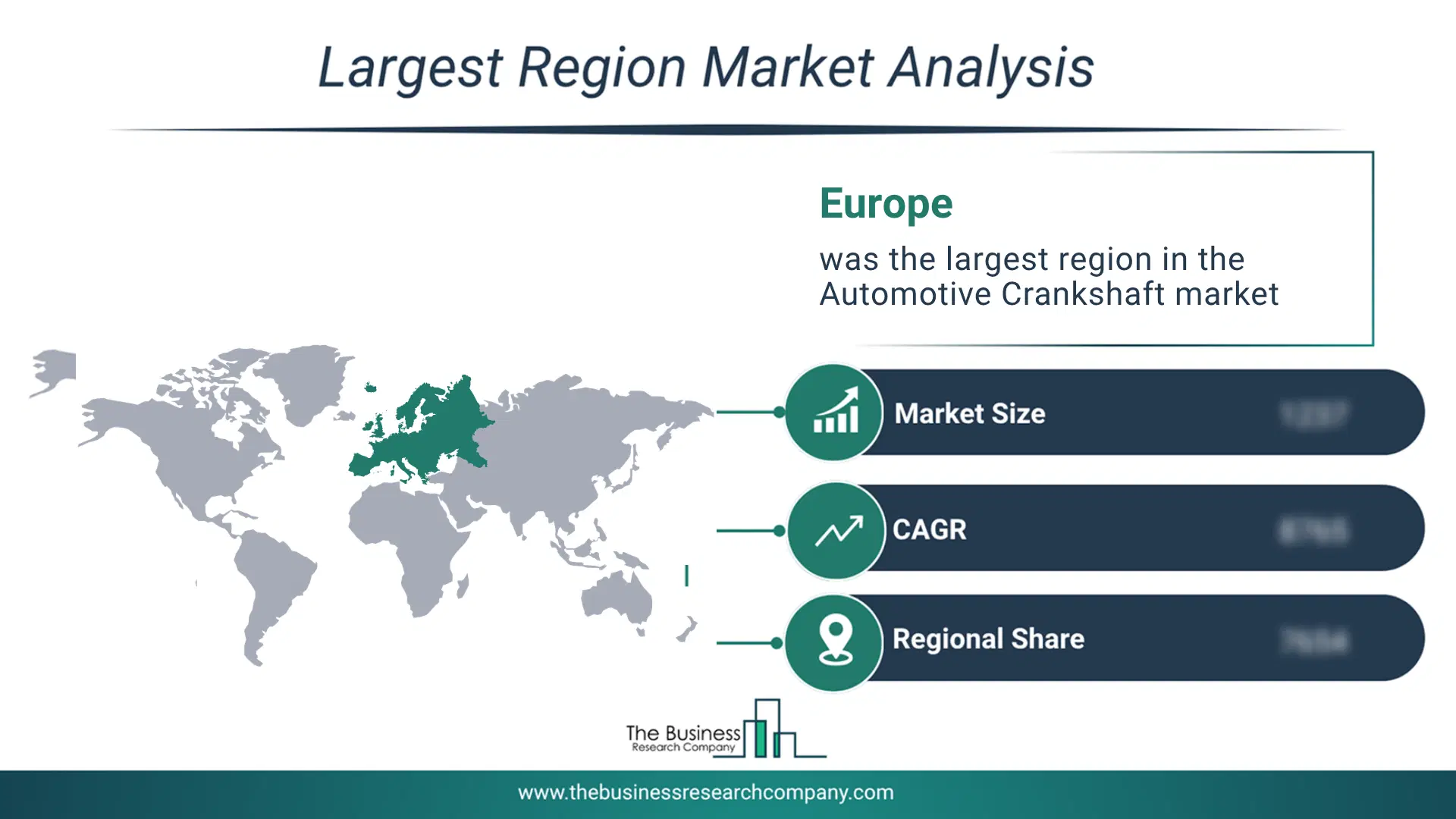
Regional Outlook
Europe was the largest region in the automotive crankshaft market in 2025. The regions covered in this market report include Asia-Pacific, South East Asia, Western Europe, Eastern Europe, North America, South America, Middle East, Africa. The countries covered in this market report include Australia, Brazil, China, France, Germany, India, Indonesia, Japan, Taiwan, Russia, South Korea, UK, USA, Canada, Italy, SpainWhat Defines the Automotive Crankshaft Market?
The automotive crankshaft market consist of sales of cast, forged and billet crankshafts. Values in this market are ‘factory gate’ values, that is the value of goods sold by the manufacturers or creators of the goods, whether to other entities (including downstream manufacturers, wholesalers, distributors and retailers) or directly to end customers. The value of goods in this market includes related services sold by the creators of the goods.How is Market Value Defined and Measured?
The market value is defined as the revenues that enterprises gain from the sale of goods and/or services within the specified market and geography through sales, grants, or donations in terms of the currency (in USD unless otherwise specified). The revenues for a specified geography are consumption values that are revenues generated by organizations in the specified geography within the market, irrespective of where they are produced. It does not include revenues from resales along the supply chain, either further along the supply chain or as part of other products.
This chart presents market attractiveness based on a quantitative evaluation of growth, competition, strategic alignment, and risk, offering a clear view of opportunity areas for decision-making. This chart is for illustrative purposes; the full report contains the complete analysis.
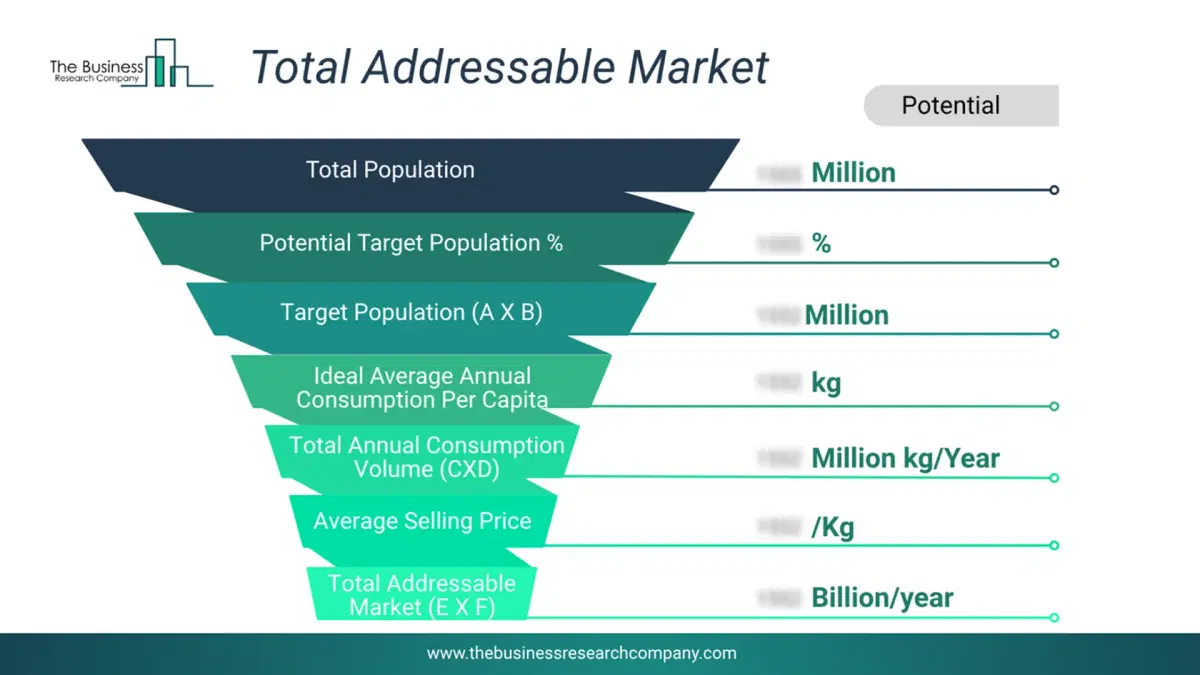
This chart highlights the Total Addressable Market (TAM) by estimating the maximum revenue opportunity using an assumption-driven approach, supporting strategic planning and opportunity sizing across markets. The chart is illustrative; the full report provides a more comprehensive analysis.
What Key Data and Analysis Are Included in the Automotive Crankshaft Market Report 2026?
The automotive crankshaft market research report is one of a series of new reports from The Business Research Company that provides market statistics, including industry global market size, regional shares, competitors with the market share, detailed market segments, market trends and opportunities, and any further data you may need to thrive in the automotive crankshaft industry. The market research report delivers a complete perspective of everything you need, with an in-depth analysis of the current and future state of the industry.Automotive Crankshaft Market Report Forecast Analysis
| Report Attribute | Details |
|---|---|
| Market Size Value In 2026 | $4.95 billion |
| Revenue Forecast In 2030 | $5.87 billion |
| Growth Rate | CAGR of 4.3% from 2026 to 2030 |
| Base Year For Estimation | 2025 |
| Actual Estimates/Historical Data | 2020-2025 |
| Forecast Period | 2026 - 2030 |
| Market Representation | Revenue in USD Billion and CAGR from 2026 to 2030 |
| Segments Covered | Type, Material, Vehicle Type |
| Regional Scope | Asia-Pacific, Western Europe, Eastern Europe, North America, South America, Middle East, Africa |
| Country Scope | The countries covered in the report are Australia, Brazil, China, France, Germany, India, Indonesia, Japan, Taiwan, Russia, South Korea, UK, USA, Canada, Italy, Spain. |
| Key Companies Profiled | Maschinenfabrik ALFING Kessler GmbH, Bharat Forge Ltd., ThyssenKrupp AG, Tianrun Crankshaft Co. Ltd., Arrow Precision Ltd., Farndon Engineering Ltd., Metalyst Forgings Ltd., Balu Forge Industries Ltd., Kellogg Crankshaft Company, Crower Cams & Equipment Co. Inc., Mahindra CIE Automotive Ltd., CIE Automotive S.A., Rheinmetall AG, MAHLE GmbH, GKN plc, Federal-Mogul LLC, Cooper Corporation, Amtek Group, Ciguenales Sanz SL, BMV Precision Engineering |
| Customization Scope | Request for Customization |
| Pricing And Purchase Options | Explore Purchase Options |