

Data Center Liquid Cooling Market Report 2026
Global Outlook – By Type ( Single Phase Cooling, Two Phase Cooling), By Component ( Solutions, Services), By Data Center Type ( Hyperscale Centers, Enterprise type, Colocation Data Centers, Other Data Center Types), By Industry Type ( Telecom and IT, BFSI, Research, Energy, Government and Academia, Healthcare, Other Industry Types) – Market Size, Trends, Strategies, and Forecast to 2030
Data Center Liquid Cooling Market Overview
• Data Center Liquid Cooling market size has reached to $5.1 billion in 2025 • Expected to grow to $16.16 billion in 2030 at a compound annual growth rate (CAGR) of 26% • Growth Driver: Increased Data Center Investments Drive Growth In The Data Center Liquid Cooling Market • Market Trend: Innovative Power And Reliability Solutions Driving Advancements In Data Center Liquid Cooling • North America was the largest region in 2025 and Asia-Pacific is the fastest growing region.Market Gains By 2030 – Top Opportunities By Segment
Market Gain identifies the most promising market opportunities by highlighting the segments or products expected to generate the highest incremental revenue growth over the next five years.
What Is Covered Under Data Center Liquid Cooling Market?
Data center liquid cooling refers to cooling technologies that are used to control the temperature of the data center. These data centers are cooled using a combination of air conditioning and immersion cooling to optimize energy consumption and allow the data center to operate at high availability and density. The liquid-cooled system can reduce overall power consumption and improve power usage effectiveness in a data center facility. The main types of data center liquid cooling are single-phase cooling and two-phase cooling. Single-phase cooling refers to a one-phase cooling system to control the temperature of the data center facility. In single-phase fluid states in liquid form that contact with system components and transfer the heat and cool in cooling distribution by the heat exchanger. The different components include solutions and services that offer solutions to hyperscale centers, enterprise types, colocation data centers, and other data centers in the telecom and IT, BFSI, research, energy, government and academia, healthcare, and other industries.
What Is The Data Center Liquid Cooling Market Size 2026 And Growth Rate?
The data center liquid cooling market size has grown exponentially in recent years. It will grow from $5.1 billion in 2025 to $6.41 billion in 2026 at a compound annual growth rate (CAGR) of 25.7%. The growth in the historic period can be attributed to rise in adoption of single-phase and two-phase liquid cooling solutions, increasing deployment in hyperscale and enterprise data centers, expansion in telecom and BFSI sectors, adoption in government and research facilities, integration in healthcare data centers.What Is The Data Center Liquid Cooling Market Growth Forecast?
The data center liquid cooling market size is expected to see exponential growth in the next few years. It will grow to $16.16 billion in 2030 at a compound annual growth rate (CAGR) of 26.0%. The growth in the forecast period can be attributed to increase in energy-efficient cooling solutions, rising adoption of immersion and direct-to-chip cooling, expansion in large-scale data centers, growth in sustainable and low-PUE cooling technologies, increase in predictive and automated cooling management. Major trends in the forecast period include implementation of AI-optimized data center liquid cooling, integration of IoT-based cooling monitoring, deployment of energy-efficient liquid cooling solutions, adoption of smart data center analytics, expansion of sustainable cooling practices.
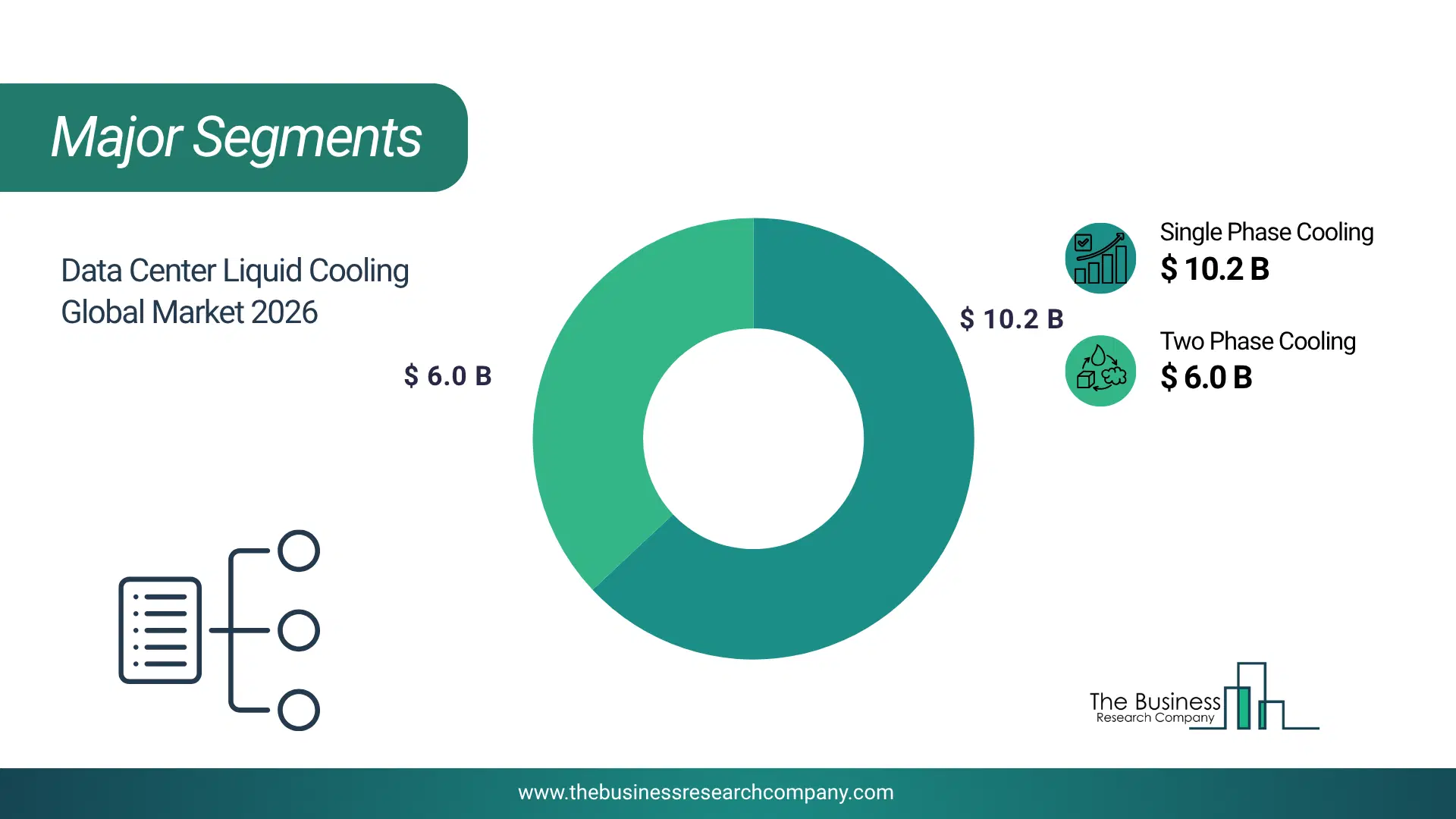
Global Data Center Liquid Cooling Market Segmentation
1) By Type: Single Phase Cooling, Two Phase Cooling 2) By Component: Solutions, Services 3) By Data Center Type: Hyperscale Centers, Enterprise type, Colocation Data Centers, Other Data Center Types 4) By Industry Type: Telecom and IT, BFSI, Research, Energy, Government and Academia, Healthcare, Other Industry Types Subsegments: 1) By Single Phase Cooling: Direct-to-Chip Cooling, Rack-Based Cooling Solutions, Immersion Cooling Systems 2) By Two-Phase Cooling: Vapor Chamber Cooling, Heat Pipes, Immersion Cooling The top segments in the data center liquid cooling market will be: • Single Phase Cooling will reach $10 Billion by 2030. • Two Phase Cooling will reach $6 Billion by 2030.What Is The Driver Of The Data Center Liquid Cooling Market?
The increase in spending in data centers is expected to propel the growth of the data center liquid cooling market going forward. A data center is a physical location that stores computing machines and their related hardware equipment and contains the computing infrastructure such as servers, data storage drives and network equipment. Data center investments are driving the growth of the data center liquid cooling market, which is primarily driven by the need for increased cooling efficiency, energy savings, scalability, sustainability, and higher performance. For instance, in July 2023, ActiveBatch by Redwood, a U.S.-based company, provides automation solutions designed to streamline and manage complex business processes and IT workflows. As organizations increasingly rely on data to drive decisions, the data center market continues to show a robust growth rate, reflecting the surge in both personal and corporate data generation. Revenue in the U.S. data center market is expected to grow from $99.97 billion in 2023 to $128.46 billion in 2028, driven by the ongoing digital transformation and the rising demand for cloud services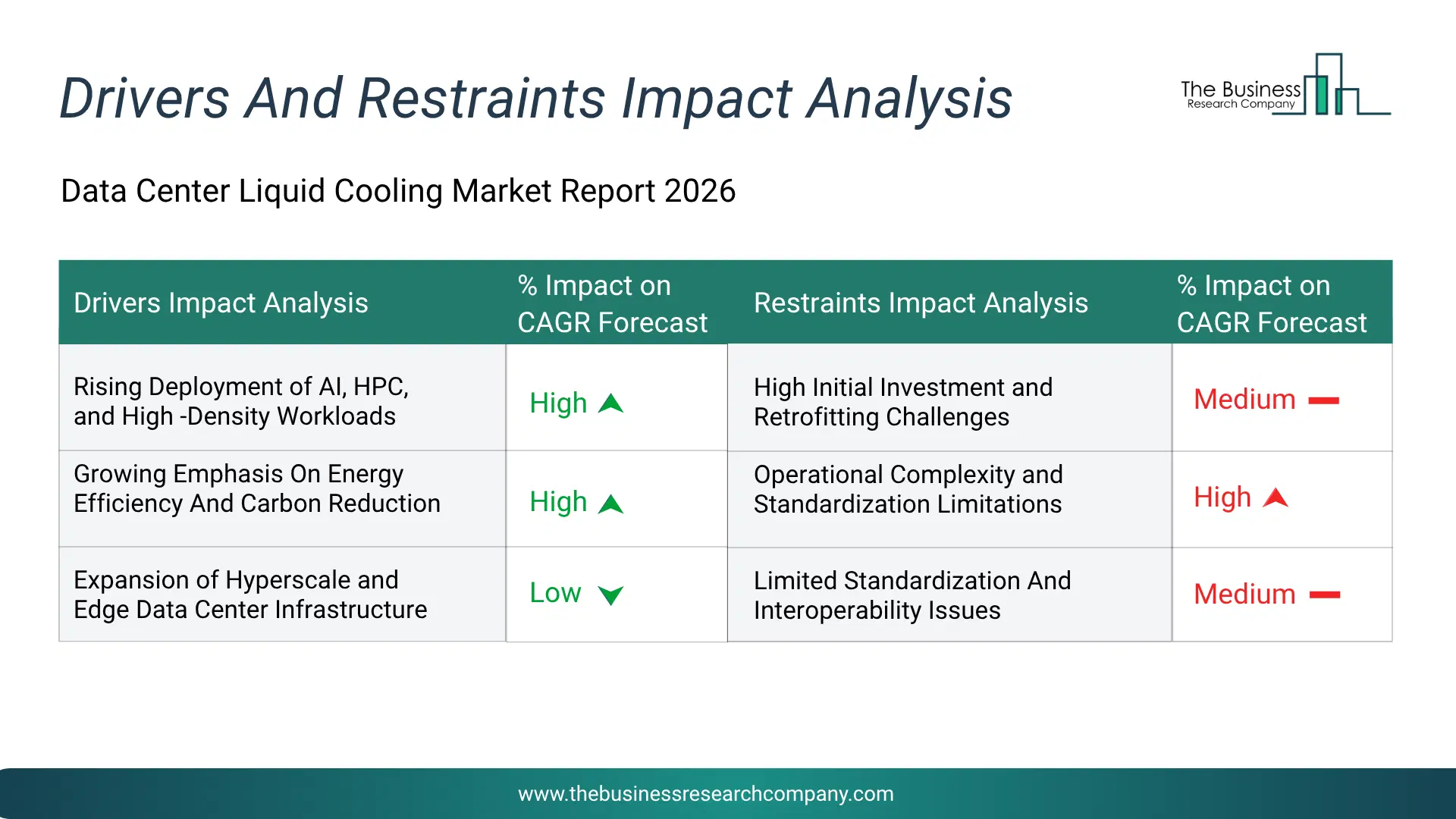
Infographic Chart Showing Key Market Drivers Analysis And Restraints For Data Center Liquid Cooling Market
The chart presents an impact analysis of key drivers and restraints, quantifying their relative influence on the market's growth rate and helping assess the balance between growth enablers and limiting factors. This chart offers a high-level perspective; the full report contains more detailed insights.
How Will The Drivers Impact Growth In The Global Data Center Liquid Cooling Market?
• Increasing Number Of Data Centers And Server Density (High) – During the forecast period, the increasing number of data centers and server density will be a key growth driver for the data center liquid cooling market by 2030. Installing more servers within a limited footprint increases the heat that cooling systems must manage. Liquid cooling can transfer heat efficiently from compatible equipment, making it relevant for demanding rack configurations. Operators adding dense computing capacity need thermal designs matched to the resulting load. This supports adoption where conventional cooling approaches become constrained by equipment density or operating requirements. • Growing Need For Energy-Efficient Cooling Solutions (High) – During the forecast period, the growing need for energy-efficient cooling solutions will be a major factor supporting expansion of the data center liquid cooling market by 2030. Cooling consumes a portion of a data center's operating energy, encouraging operators to evaluate more efficient thermal management. Liquid-based systems can reduce selected cooling requirements when properly integrated with facility design. Benefits vary with climate, equipment, and heat rejection arrangements. The focus on operating efficiency creates demand for solutions that maintain suitable temperatures while limiting unnecessary energy use. • Increased Demand From Hyperscalers (High) – During the forecast period, the increased demand from hyperscalers will be a key growth catalyst for the data center liquid cooling market by 2030. Hyperscale operators manage large equipment deployments and increasingly evaluate cooling approaches suited to intensive computing workloads. Liquid cooling can support compatible racks and server platforms that generate substantial heat. Standardized procurement and facility engineering can enable deployment across multiple sites. Their demand supports larger projects, with adoption determined by technical compatibility, utilization, and overall operating economics.How Will The Restraints Impact Growth In The Global Data Center Liquid Cooling Market?
• High Capital Expenditure And Maintenance Costs (High) – During the forecast period, high capital expenditure and maintenance costs act as a major restraint in the data center liquid cooling market by increasing the initial financial burden on operators. Liquid cooling systems require specialized equipment such as cooling distribution units, pumps, heat exchangers, and immersion tanks, which significantly raise upfront investment. In addition to installation expenses, ongoing maintenance and monitoring costs further impact total ownership expenditure. Smaller data center operators often hesitate to shift from conventional air cooling due to budget limitations. As a result, high financial commitments slow down widespread adoption despite long-term efficiency benefits. • Susceptibility To Leakage (High) – During the forecast period, susceptibility to coolant leakage will restrain the data center liquid cooling market by creating maintenance and reliability concerns. In water-based direct-to-chip systems, leaks can expose nearby components to conductive fluid and cause equipment damage or downtime if not detected and contained. Dielectric immersion fluids have different electrical risk characteristics, but fluid loss, contamination, and servicing remain operational considerations. Operators need suitable connectors, leak detection, monitoring, and trained maintenance teams. These requirements can increase implementation effort and delay adoption among customers with limited liquid-cooling experience. • Compatibility Issues And Lack Of Standardization (High) – During the forecast period, compatibility issues and lack of standardization restrict market growth by complicating integration with existing infrastructure. Many data centers are designed primarily for air-cooling architectures, making retrofitting complex and technically demanding. The absence of universal standards across vendors creates interoperability challenges between cooling systems and IT equipment. This lack of uniformity increases customization requirements and implementation timelines. Therefore, integration complexity and standardization gaps hinder seamless adoption across diverse data center environments.Key Players In The Global Data Center Liquid Cooling Market
Major companies operating in the data center liquid cooling market are Asetek Inc., Rittal GmbH & Co. KG, Fujitsu Limited, Vertiv Group Corp, Green Revolution Cooling Inc, Submer Technologies SL, Midas Green Technologies LLC, Schneider Electric SE, Alfa Laval AB, Chilldyne Inc, Iceotope Technologies Limited, CoolIT Systems Inc, Aspen Systems Inc, IBM Corporation, ExaScaler Inc, Stulz GmbH, Ebullient Inc, LiquidStack Inc, KyotoCooling BV, Asperitas B.V., Airedale International Air Conditioning Ltd, Motivair Corporation, Delta Electronics Inc.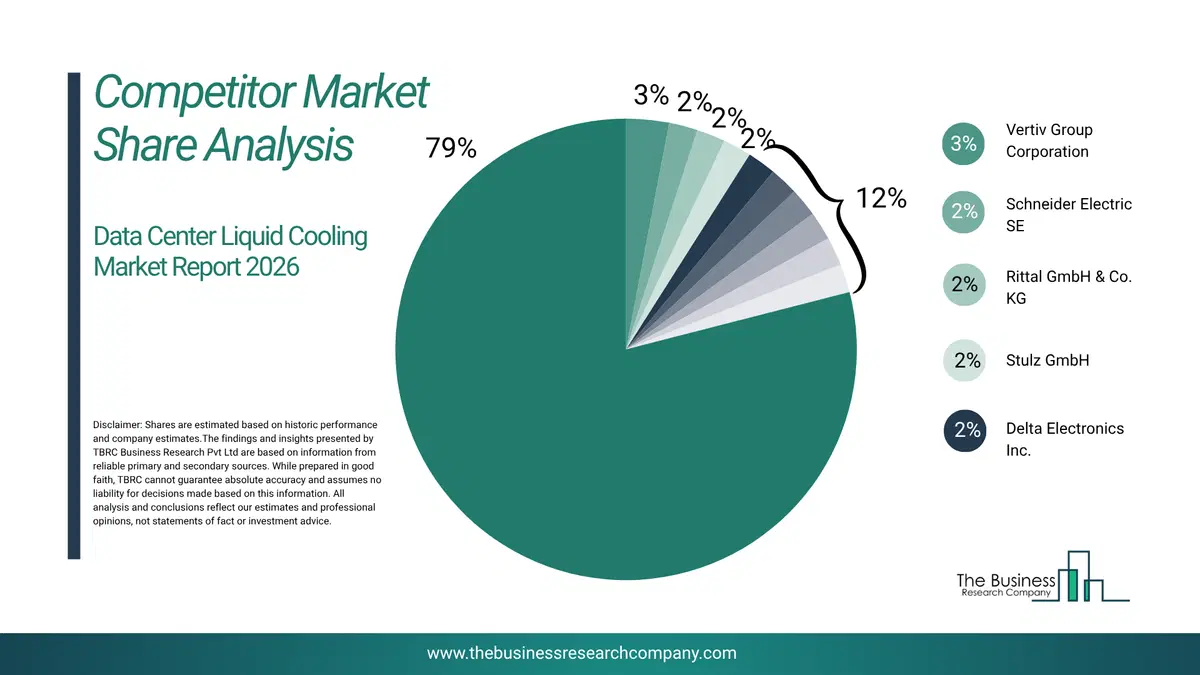
This chart is for illustrative purposes; the full report includes a detailed competitor analysis and comprehensive overview of the top 10 companies in the market.
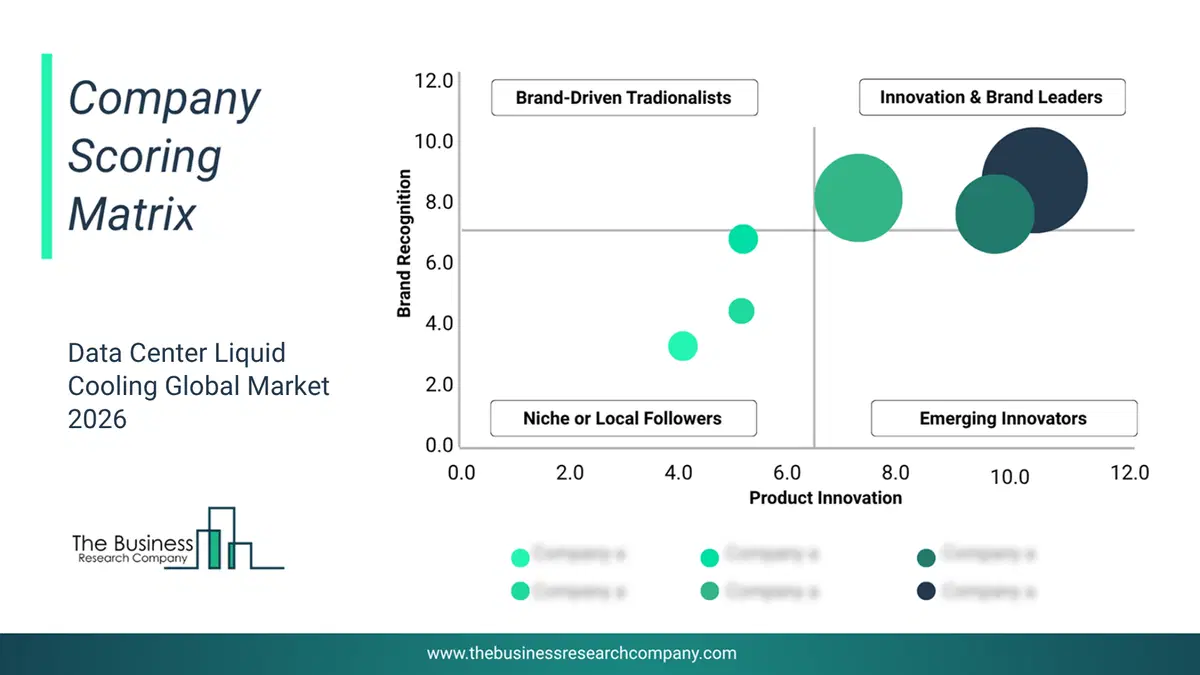
This chart maps companies by product innovation and brand strength, with bubble size indicating relative revenue, helping identify market leaders, challengers, and niche players. This is an illustrative chart; the full report provides a complete and accurate competitive analysis.
Global Data Center Liquid Cooling Market Trends and Insights
Major companies operating in the data center liquid cooling market are focusing on developing innovative products such as power and reliability solutions to enhance cooling efficiency, ensure system stability, and support high-performance computing operations. Power and reliability refer to the ability of data center systems to maintain consistent energy performance and operational stability under high computing loads. For instance, in June 2024, Asperitas, a Netherlands-based immersion cooling technology company, launched its Direct Forced Convection Immersion Cooling solution, designed to optimize cooling performance for AI and HPC workloads. The technology integrates forced liquid movement within immersion systems to achieve greater thermal control, support higher server densities, and deliver improved energy efficiency for modern data center infrastructures.What Are Latest Mergers And Acquisitions In The Data Center Liquid Cooling Market?
In January 2024, ZutaCore, a US-based company specializing in liquid cooling technologies, announced a significant four-year commercial agreement with Valeo. Through this agreement, Zutacore aims to enhance data center cooling solutions through their innovative waterless two-phase direct-on-chip cooling system. The collaboration seeks to improve cooling efficiency for high-density servers while promoting sustainability by reusing heat and reducing carbon emissions. Valeo is an automotive technology company that specializes in developing and manufacturing advanced systems.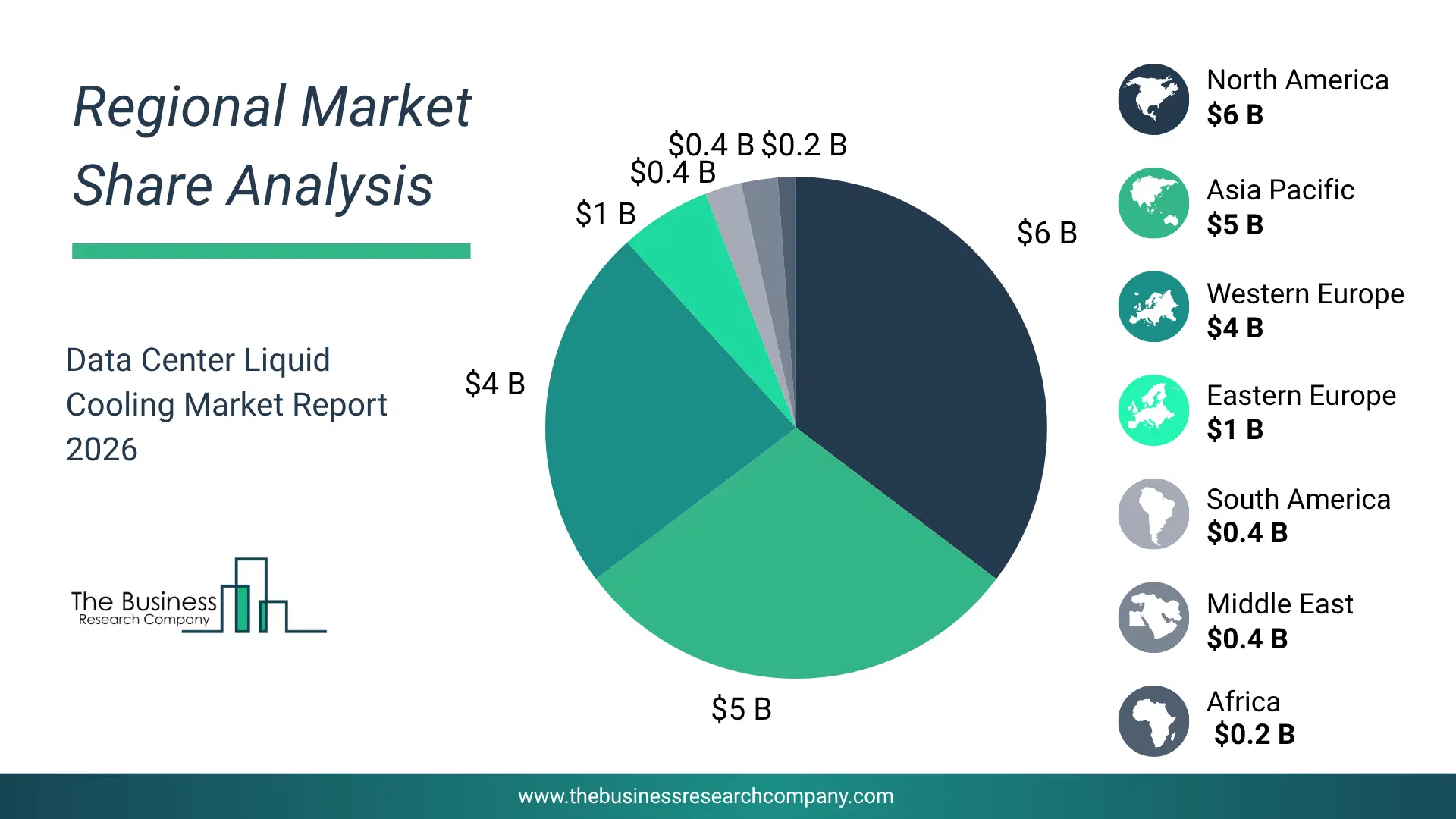
Regional Outlook
North America was the largest region in the data center liquid cooling market in 2025. Asia-Pacific is expected to be the fastest-growing region in the forecast period. The regions covered in this market report are Asia-Pacific, South East Asia, Western Europe, Eastern Europe, North America, South America, Middle East, Africa. The countries covered in this market report are Australia, Brazil, China, France, Germany, India, Indonesia, Japan, Taiwan, Russia, South Korea, UK, USA, Canada, Italy, Spain.What Defines the Data Center Liquid Cooling Market?
The data center liquid cooling market consists of revenues earned by entities by providing data center liquid cooling solutions such as direct-to-chip cooling, rear-door heat exchangers, and immersion cooling. The market value includes the value of related goods sold by the service provider or included within the service offering. The data center liquid cooling market also includes sales of cooling systems such as liquid-to-liquid, closed-loop dry systems, closed-loop dry systems with trim cooling, open-loop evaporative system, closed-loop evaporator system, and chilled water system. Values in this market are ‘factory gate’ values, that is the value of goods sold by the manufacturers or creators of the goods, whether to other entities (including downstream manufacturers, wholesalers, distributors, and retailers) or directly to end customers. The value of goods in this market includes related services sold by the creators of the goods.How is Market Value Defined and Measured?
The market value is defined as the revenues that enterprises gain from the sale of goods and/or services within the specified market and geography through sales, grants, or donations in terms of the currency (in USD unless otherwise specified). The revenues for a specified geography are consumption values that are revenues generated by organizations in the specified geography within the market, irrespective of where they are produced. It does not include revenues from resales along the supply chain, either further along the supply chain or as part of other products.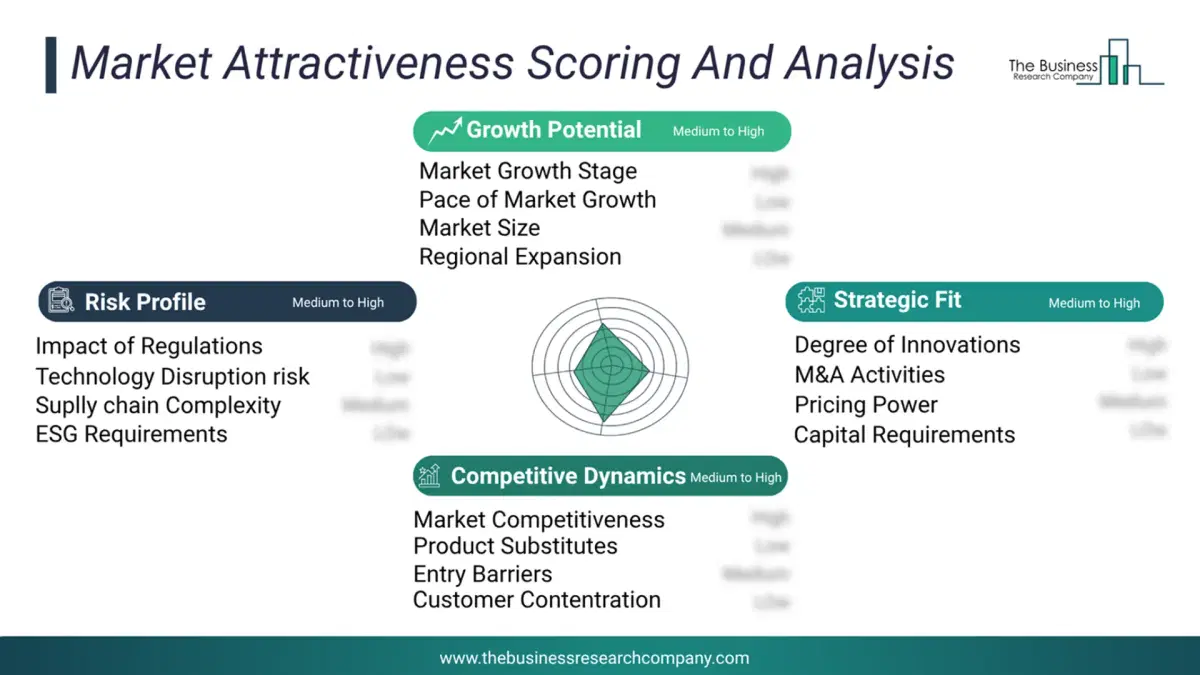
This chart presents market attractiveness based on a quantitative evaluation of growth, competition, strategic alignment, and risk, offering a clear view of opportunity areas for decision-making. This chart is for illustrative purposes; the full report contains the complete analysis.
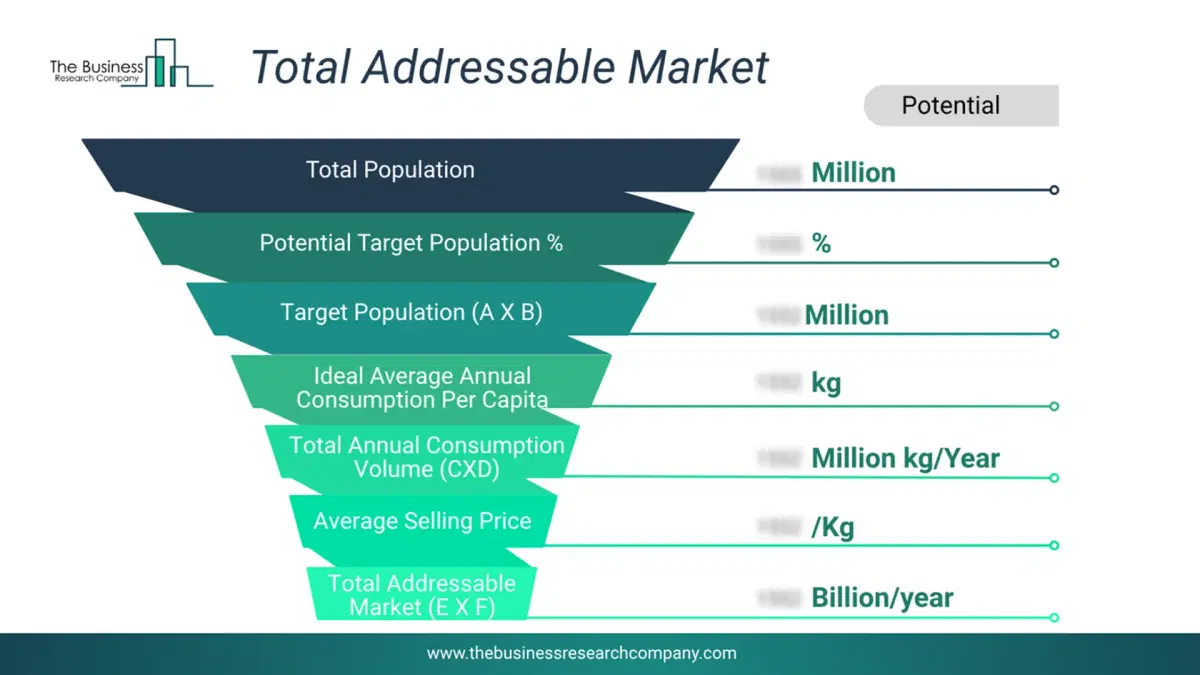
This chart highlights the Total Addressable Market (TAM) by estimating the maximum revenue opportunity using an assumption-driven approach, supporting strategic planning and opportunity sizing across markets. The chart is illustrative; the full report provides a more comprehensive analysis.
What Key Data and Analysis Are Included in the Data Center Liquid Cooling Market Report 2026?
The data center liquid cooling market research report is one of a series of new reports from The Business Research Company that provides market statistics, including industry global market size, regional shares, competitors with the market share, detailed market segments, market trends and opportunities, and any further data you may need to thrive in the data center liquid cooling industry. The market research report delivers a complete perspective of everything you need, with an in-depth analysis of the current and future state of the industry.Data Center Liquid Cooling Market Report 2026 Market Report Forecast Analysis
| Report Attribute | Details |
|---|---|
| Market Size Value In 2026 | $6.41 billion |
| Revenue Forecast In 2035 | $16.16 billion |
| Growth Rate | CAGR of 25.7% from 2026 to 2035 |
| Base Year For Estimation | 2025 |
| Actual Estimates/Historical Data | 2020-2025 |
| Forecast Period | 2026 - 2030 - 2035 |
| Market Representation | Revenue in USD Billion and CAGR from 2026 to 2035 |
| Segments Covered | Type, Component, Data Center Type, Industry Type |
| Regional Scope | Asia-Pacific, Western Europe, Eastern Europe, North America, South America, Middle East, Africa |
| Country Scope | The countries covered in the report are Australia, Brazil, China, France, Germany, India, ... |
| Key Companies Profiled | Asetek Inc., Rittal GmbH & Co. KG, Fujitsu Limited, Vertiv Group Corp, Green Revolution Cooling Inc, Submer Technologies SL, Midas Green Technologies LLC, Schneider Electric SE, Alfa Laval AB, Chilldyne Inc, Iceotope Technologies Limited, CoolIT Systems Inc, Aspen Systems Inc, IBM Corporation, ExaScaler Inc, Stulz GmbH, Ebullient Inc, LiquidStack Inc, KyotoCooling BV, Asperitas B.V., Airedale International Air Conditioning Ltd, Motivair Corporation, Delta Electronics Inc. |
| Customization Scope | Request for Customization |
| Pricing And Purchase Options | Explore Purchase Options |