

Enterprise Collaboration Market Report 2026
Global Outlook – By Type (Internal, External), By Deployment Type (Cloud-Based, On-Premise), By Enterprise (Small And Medium Enterprises (SME), Large Enterprises), By Component (Solutions, Services), By Industry (Information Technology (IT) And Telecommunication, Government, Energy And Utilities, Banking, Financial Services And Insurance (BFSI), Manufacturing, Retail And Consumer Goods, Healthcare, Travel And Hospitality) – Market Size, Trends, Strategies, and Forecast to 2030
Enterprise Collaboration Market Overview
• Enterprise Collaboration market size has reached to $63.64 billion in 2025 • Expected to grow to $131.34 billion in 2030 at a compound annual growth rate (CAGR) of 15.6% • Growth Driver: Increasing Communication Demand Fuels The Enterprise Collaboration Market • Market Trend: Integration Of AI to Streamline Development and Collaboration • North America was the largest region in 2025 and Asia-Pacific is the fastest growing region.Market Gains By 2030 – Top Opportunities By Segment
Market Gain identifies the most promising market opportunities by highlighting the segments or products expected to generate the highest incremental revenue growth over the next five years.
What Is Covered Under Enterprise Collaboration Market?
Enterprise collaboration refers to internal and external information system tools that collect, share, and store information between users by using a collaboration stage, communication instruments, the company intranet, file sharing tools, cloud storage, video conferencing, and whiteboards to interact and communicate across and beyond the work environment. The main types of enterprise collaboration include internal and external enterprise collaboration solutions. Internal enterprise collaboration refers to the digital workspace to share knowledge and expertise internally across the organization. They are deployed in small and medium enterprise on-premises or through a cloud platform. Both enterprise collaboration solutions and services are used in information technology (IT) & telecommunication, government, energy & utilities, banking, financial services & insurance (BFSI), manufacturing, retail & consumer goods, healthcare, and travel & hospitality industries.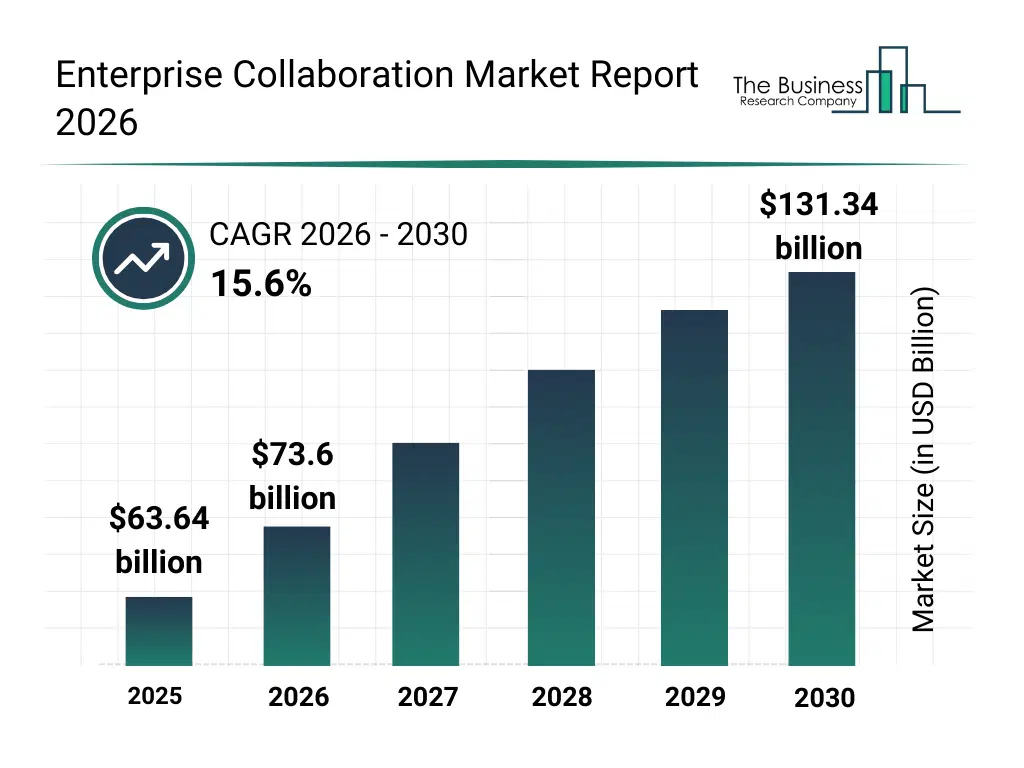
What Is The Enterprise Collaboration Market Size and Share 2026?
The enterprise collaboration market size has grown rapidly in recent years. It will grow from $63.64 billion in 2025 to $73.6 billion in 2026 at a compound annual growth rate (CAGR) of 15.7%. The growth in the historic period can be attributed to enterprise communication digitization, adoption of video conferencing tools, growth of global teams, demand for knowledge sharing, early cloud collaboration solutions.What Is The Enterprise Collaboration Market Growth Forecast?
The enterprise collaboration market size is expected to see rapid growth in the next few years. It will grow to $131.34 billion in 2030 at a compound annual growth rate (CAGR) of 15.6%. The growth in the forecast period can be attributed to hybrid workforce expansion, AI driven productivity tools, demand for secure collaboration, integration of immersive collaboration technologies, increased focus on employee experience. Major trends in the forecast period include cloud based collaboration platforms, unified communication and collaboration, AI powered collaboration tools, remote and hybrid work enablement, secure enterprise content sharing.
Global Enterprise Collaboration Market Segmentation
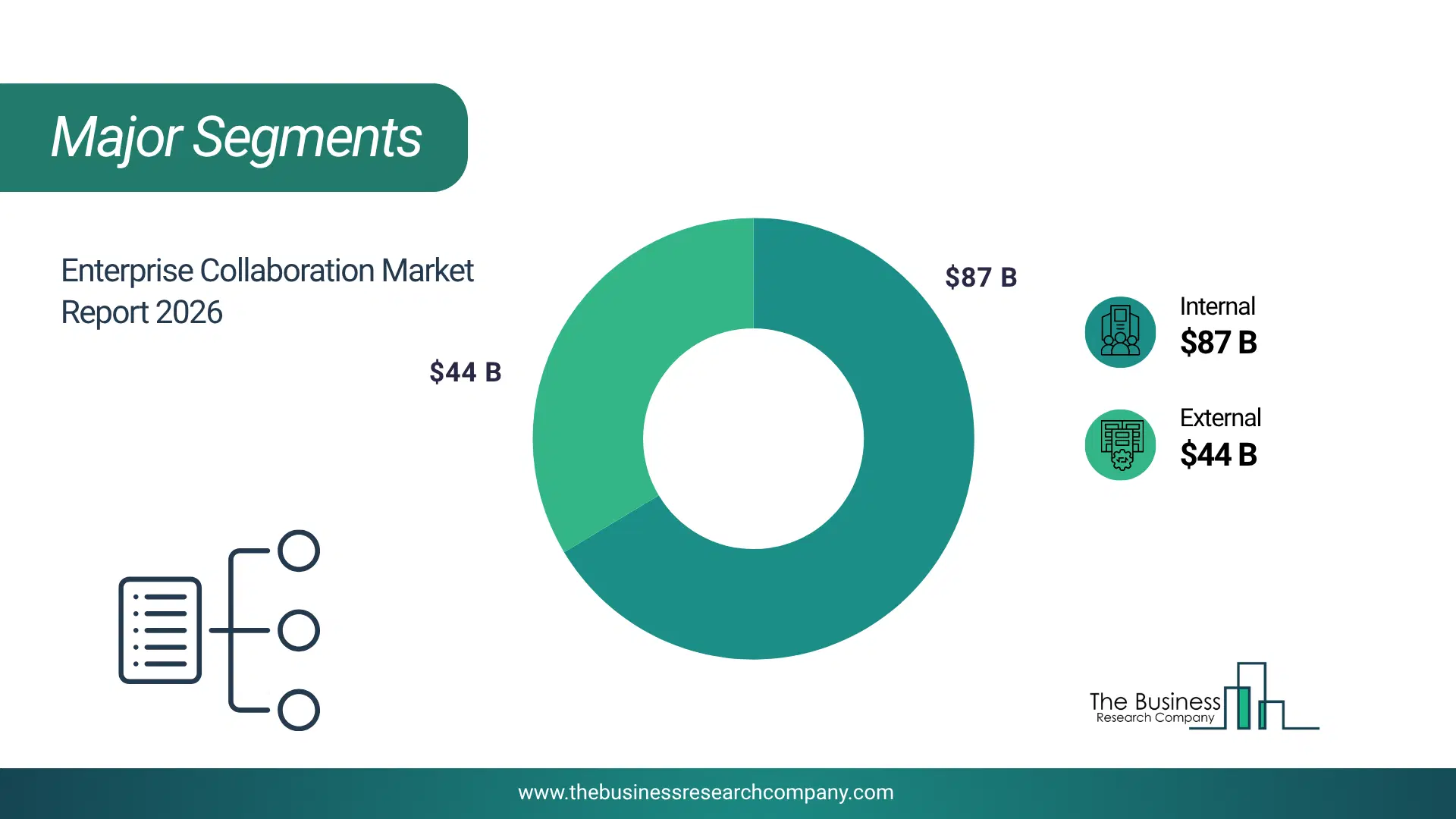
1) By Type: Internal, External 2) By Deployment Type: Cloud-Based, On-Premise 3) By Enterprise: Small And Medium Enterprises (SME), Large Enterprises 4) By Component: Solutions, Services 5) By Industry: Information Technology (IT) And Telecommunication, Government, Energy And Utilities, Banking, Financial Services And Insurance (BFSI), Manufacturing, Retail And Consumer Goods, Healthcare, Travel And Hospitality Subsegments: 1) By Internal: Team Collaboration Tools, Intranet Solutions, Document Sharing And Management Systems 2) By External: Customer Collaboration Platforms, Partner Collaboration Tools, Social Media Integration Solutions The top segments in the enterprise collaboration market will be: • Internal will reach $86.65 Billion by 2030. • External will reach $44.32 Billion by 2030.What Is The Driver Of The Enterprise Collaboration Market?
The increasing demand for communication is expected to propel the growth of the enterprise collaboration market going forward. Communication refers to the exchange of data or information between different entities, such as computers, devices, or users. Communication uses enterprise collaboration to facilitate seamless and coordinated interaction among individuals, teams, and systems within an organization, fostering efficiency, innovation, and the collective achievement of business objectives. For instance, in February 2023, according to the State of Business Communication by Grammarly Inc., a US-based software company, 72% of business leaders believe effective communication boosts team productivity. Additionally, 60% of business leaders believe communication boosts employee confidence. Therefore, the increasing demand for communication is driving the growth of the enterprise collaboration industry going forward.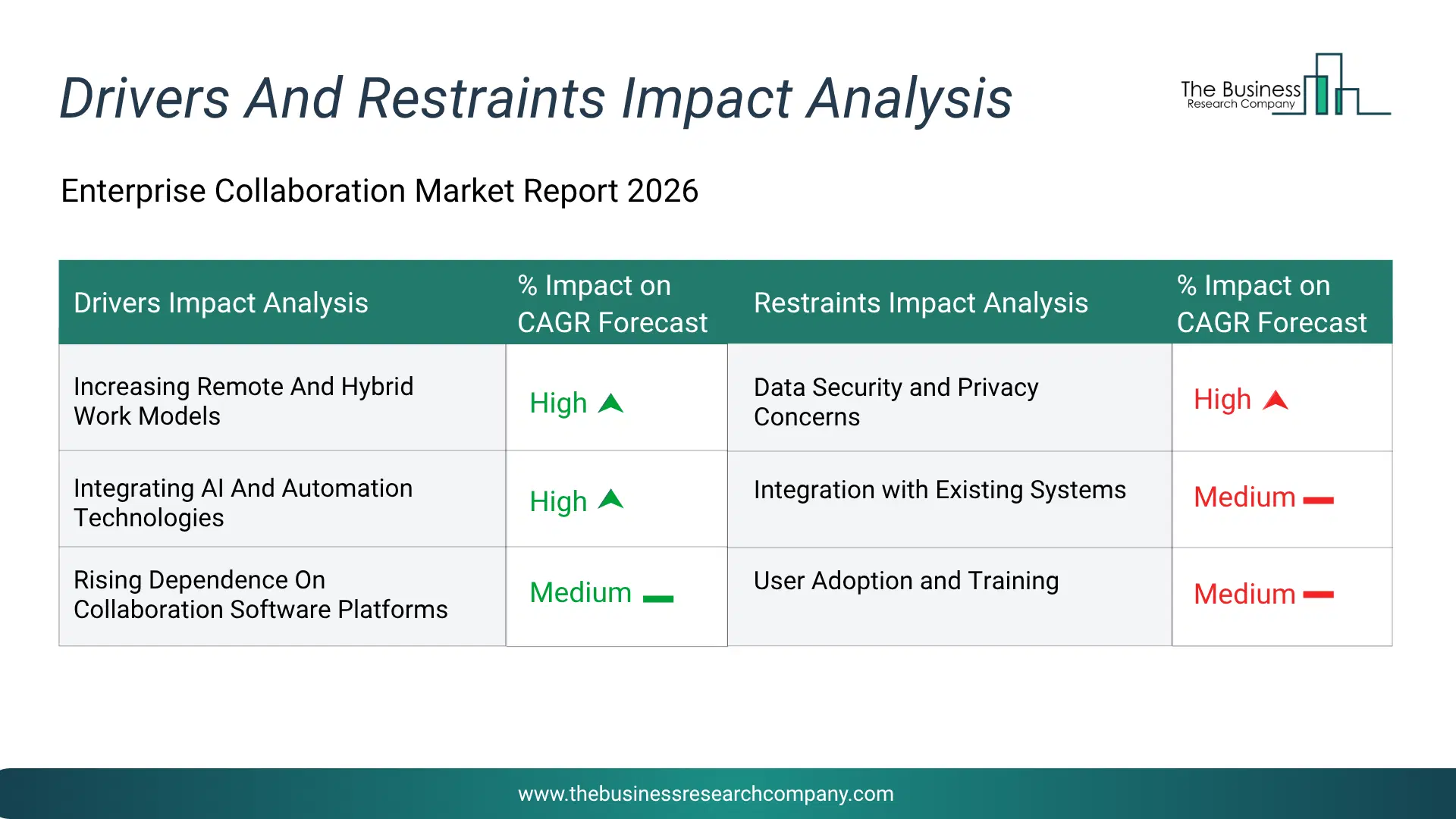
Infographic Chart Showing Key Market Drivers Analysis And Restraints For Enterprise Collaboration Market
The chart presents an impact analysis of key drivers and restraints, quantifying their relative influence on the market's growth rate and helping assess the balance between growth enablers and limiting factors. This chart offers a high-level perspective; the full report contains more detailed insights.
How Will The Drivers Impact Growth In The Global Enterprise Collaboration Market?
• Increasing Remote And Hybrid Work Models (High) – During the forecast period, the increasing remote and hybrid work models is expected to become a key growth driver for the enterprise collaboration market by 2030. Increasing remote and hybrid work models act as a major driver for the enterprise collaboration market because organizations are increasingly relying on digital communication and teamwork platforms to maintain workforce connectivity across distributed locations. Companies are investing in video conferencing, cloud collaboration, enterprise messaging, virtual whiteboards, and workflow management solutions to ensure uninterrupted business operations and employee productivity. The expansion of flexible work arrangements has created strong demand for real-time collaboration tools that enable seamless information sharing and remote decision-making. Enterprises are also adopting integrated collaboration ecosystems to improve employee engagement and operational coordination. As businesses continue transitioning toward digital workplaces, the need for scalable and secure collaboration platforms is growing significantly. This trend is encouraging technology providers to introduce advanced collaboration capabilities for hybrid work environments. Consequently, rising remote and hybrid work adoption continues to accelerate enterprise collaboration market growth globally. • Integrating AI And Automation Technologies (High) – During the forecast period, the integrating ai and automation technologies is expected to emerge as a major factor driving the expansion of the enterprise collaboration market by 2030. Integrating AI and automation technologies is driving the enterprise collaboration market by improving communication efficiency, workflow automation, and intelligent decision-making capabilities within organizations. Enterprises are increasingly deploying AI-powered collaboration platforms that offer automated meeting scheduling, real-time transcription, smart recommendations, virtual assistants, and predictive workflow management. These technologies help reduce manual tasks, enhance productivity, and streamline collaboration across teams and departments. AI integration also improves knowledge sharing by enabling faster document retrieval, automated content organization, and intelligent search functions. Businesses are adopting automation-driven collaboration tools to support large-scale operations and optimize employee performance. In addition, AI-enabled analytics provide actionable insights that improve project management and communication strategies. As enterprises prioritize digital transformation and operational efficiency, demand for AI-integrated collaboration solutions continues to expand rapidly. • Rising Dependence On Collaboration Software Platforms (Medium) – During the forecast period, the rising dependence on collaboration software platforms is expected to act as a key growth catalyst for the enterprise collaboration market by 2030. Rising dependence on collaboration software platforms is significantly contributing to the growth of the enterprise collaboration market as organizations increasingly centralize communication and business workflows through digital platforms. Enterprises rely on collaboration software for instant messaging, document sharing, team coordination, project tracking, and virtual meetings to improve operational efficiency and business continuity. The growing complexity of modern business operations has increased the need for unified collaboration environments that connect employees, departments, and external stakeholders in real time. Cloud-based collaboration platforms also provide scalability, accessibility, and secure data sharing, making them essential for organizations of all sizes. Increasing adoption of SaaS-based enterprise tools and integrated workplace applications is further strengthening market demand. Businesses are also focusing on improving employee productivity and customer engagement through collaborative digital ecosystems. As digital communication becomes a core business requirement, enterprise dependence on collaboration software platforms continues to rise steadily.How Will The Restraints Impact Growth In The Global Enterprise Collaboration Market?
• Data Security and Privacy Concerns (High) – During the forecast period, the data security and privacy concerns act as a major restraint for the enterprise collaboration market because organizations often hesitate to share sensitive business information through cloud-based communication and collaboration platforms. Enterprises handling confidential financial data, intellectual property, customer information, and internal business records face increasing risks related to cyberattacks, unauthorized access, and data breaches. Regulatory compliance requirements such as data protection laws and industry-specific security standards further complicate platform deployment and management. Businesses are also concerned about third-party access vulnerabilities and secure storage of collaborative content across multiple devices and locations. These security challenges increase implementation complexity and operational costs for enterprises adopting collaboration solutions. In highly regulated sectors, concerns regarding privacy and compliance can slow down digital collaboration investments. As a result, rising cybersecurity risks and data protection issues continue to limit the full-scale adoption of enterprise collaboration platforms. • Integration with Existing Systems (High) – During the forecast period, the integration with Existing Systems restrains the growth of the enterprise collaboration market because many organizations operate with complex legacy IT infrastructures that are difficult to connect with modern collaboration platforms. Enterprises often face technical compatibility issues when integrating collaboration software with existing enterprise resource planning systems, customer relationship management platforms, databases, and internal communication tools. The integration process can require significant customization, additional software investments, and skilled IT resources, increasing implementation costs and deployment timelines. Businesses may also experience workflow disruptions and operational inefficiencies during migration and system synchronization processes. Smaller organizations with limited technical expertise often struggle to manage seamless platform integration effectively. Inconsistent integration can reduce collaboration efficiency and negatively affect employee productivity. Consequently, concerns related to interoperability and integration complexity continue to challenge enterprise collaboration market expansion. • User Adoption and Training (Medium) – During the forecast period, the user adoption and training serve as an important restraint for the enterprise collaboration market because employees may resist transitioning from traditional communication methods to advanced digital collaboration platforms. Organizations frequently face challenges in ensuring that employees understand and effectively utilize new collaboration technologies and workflows. The implementation of enterprise collaboration solutions often requires continuous employee training, technical support, and change management initiatives, which increase operational costs and resource requirements. Differences in digital literacy levels across the workforce can also slow down adoption and reduce the overall effectiveness of collaboration systems. In some cases, employees may find advanced collaboration tools complex or difficult to integrate into daily work routines. Low user engagement and improper platform utilization can limit the expected productivity benefits of collaboration technologies. Therefore, difficulties related to workforce adaptation and training remain a key barrier to enterprise collaboration market growth.Key Players In The Global Enterprise Collaboration Market
Major companies operating in the enterprise collaboration market are Google Inc.; Microsoft Corporation; IBM; Cisco Systems Inc.; SAP SE; Salesforce.com Inc.; Adobe Systems Inc.; Zoom Video Communications Inc.; Atlassian Corporation plc; Polycom Inc.; Mitel LLC; Zoho Corporation Pvt. Ltd.; Slack Technologies Inc.; Blackboard Inc.; Asana Inc.; Jive Software; Rocketlane Inc.; Pitch Software GmbH; Uplevel Ops Inc.; MetaCX Inc.; Axero Solutions LLC; Dropbox Inc.; Citrix Systems Inc.; Box Inc.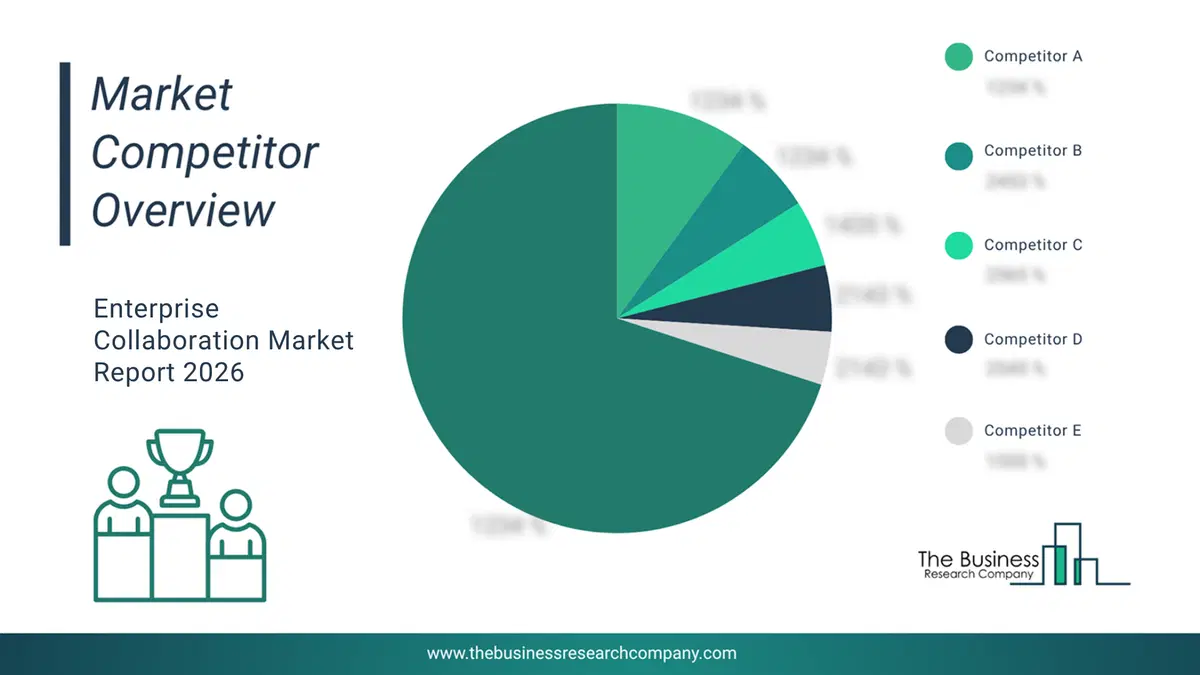
This chart is for illustrative purposes; the full report includes a detailed competitor analysis and comprehensive overview of the top 10 companies in the market.
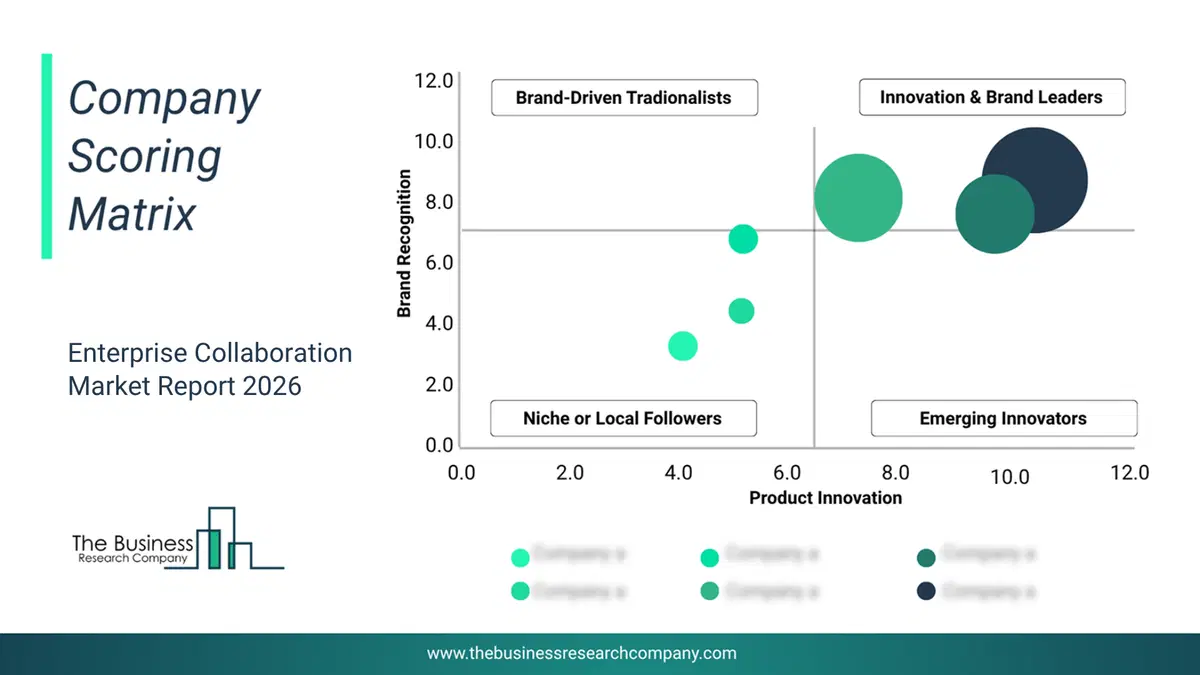
This chart maps companies by product innovation and brand strength, with bubble size indicating relative revenue, helping identify market leaders, challengers, and niche players. This is an illustrative chart; the full report provides a complete and accurate competitive analysis.
Global Enterprise Collaboration Market Trends and Insights
Major companies operating in the enterprise collaboration market are developing integrating artificial intelligence (AI) to improve communication, enhance productivity, and facilitate seamless collaboration across teams and organizations. Artificial intelligence (AI) refers to the simulation of human intelligence in machines that are programmed to think, learn, and make decisions like humans. For instance, in April 2024, LF AI & Data Foundation, a U.S.-based open-source organization, launched the Open Platform for Enterprise AI (OPEA). Open Platform for Enterprise AI (OPEA) is a comprehensive framework designed to accelerate the development and deployment of AI solutions in enterprise settings. OPEA provides organizations with a standardized environment that integrates various AI tools, libraries, and best practices, enabling teams to collaborate more effectively on AI projects. This platform focuses on promoting interoperability and scalability, allowing businesses to harness the power of AI while ensuring compliance with industry standards.What Are Latest Mergers And Acquisitions In The Enterprise Collaboration Market?
In June 2024, Hyperspace, a U.S.-based technology company, acquired Glue for an undisclosed amount. With this acquisition, Hyperspace aims to enhance its offerings in spatial computing and collaboration solutions, integrating Glue's innovative platform to create more immersive and interactive experiences for users. Glue is a U.S.-based collaboration platform that specializes in creating immersive virtual environments for teams to work together effectively.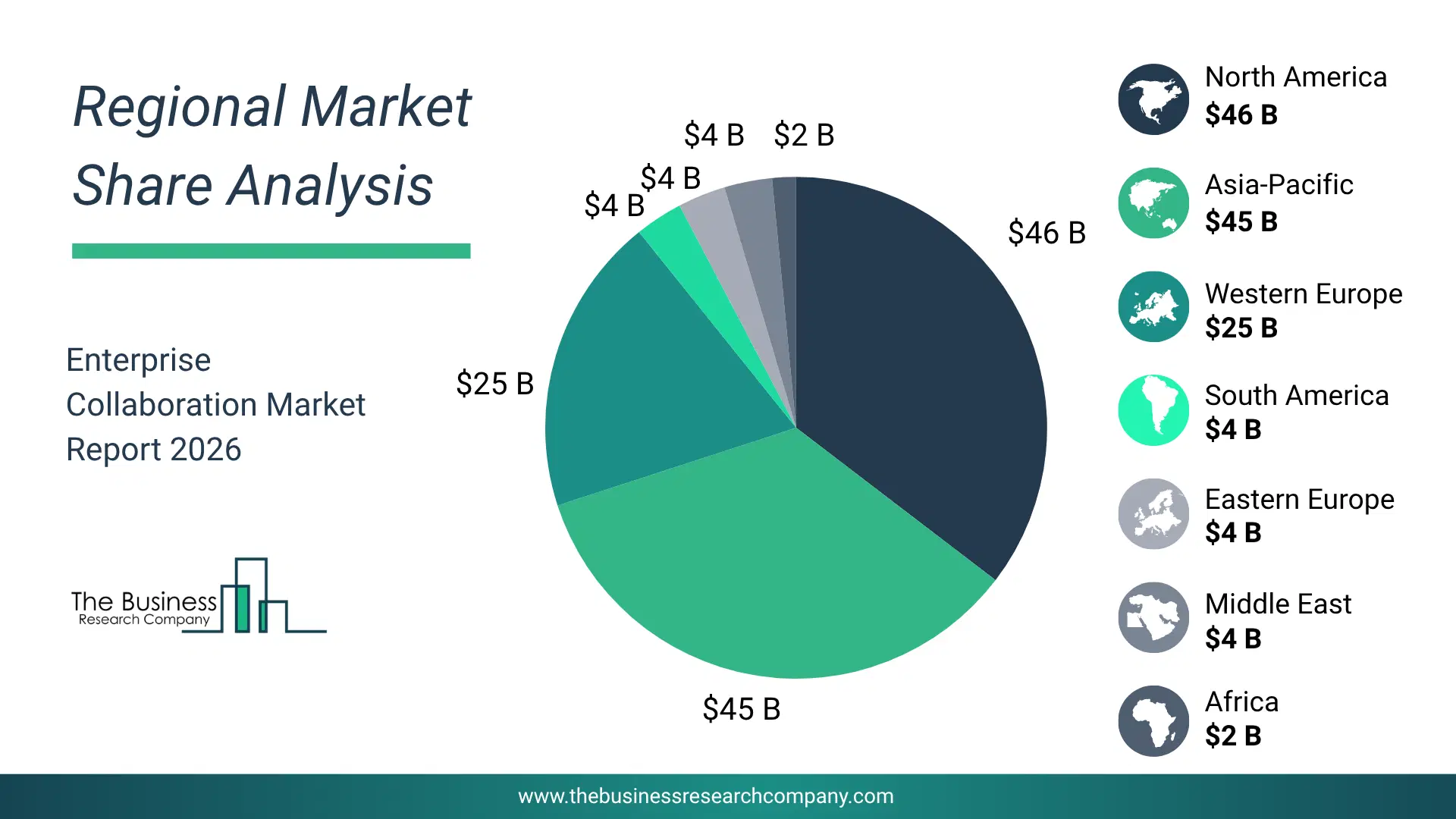
Regional Insights
North America was the largest region in the enterprise collaboration market in 2025. Asia-Pacific is expected to be the fastest-growing region in the forecast period. The regions covered in this market report are Asia-Pacific, South East Asia, Western Europe, Eastern Europe, North America, South America, Middle East, Africa. The countries covered in this market report are Australia, Brazil, China, France, Germany, India, Indonesia, Japan, Taiwan, Russia, South Korea, UK, USA, Canada, Italy, SpainWhat Defines the Enterprise Collaboration Market?
The enterprise collaboration market includes revenues earned by entities that enable interaction and cooperation, allowing remote workers to collaborate on projects even when they are in different locations. The market value includes the value of related goods sold by the service provider or included within the service offering. Only goods and services traded between entities or sold to end consumers are included.How is Market Value Defined and Measured?
The market value is defined as the revenues that enterprises gain from the sale of goods and/or services within the specified market and geography through sales, grants, or donations in terms of the currency (in USD unless otherwise specified). The revenues for a specified geography are consumption values that are revenues generated by organizations in the specified geography within the market, irrespective of where they are produced. It does not include revenues from resales along the supply chain, either further along the supply chain or as part of other products.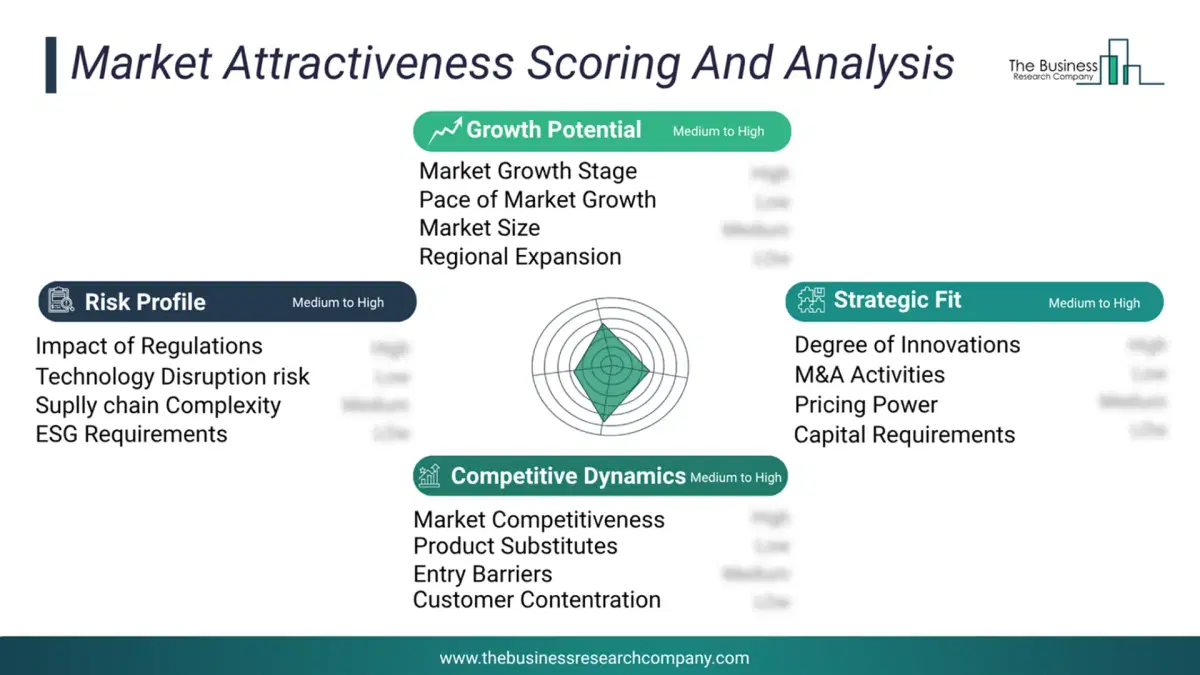
This chart presents market attractiveness based on a quantitative evaluation of growth, competition, strategic alignment, and risk, offering a clear view of opportunity areas for decision-making. This chart is for illustrative purposes; the full report contains the complete analysis.
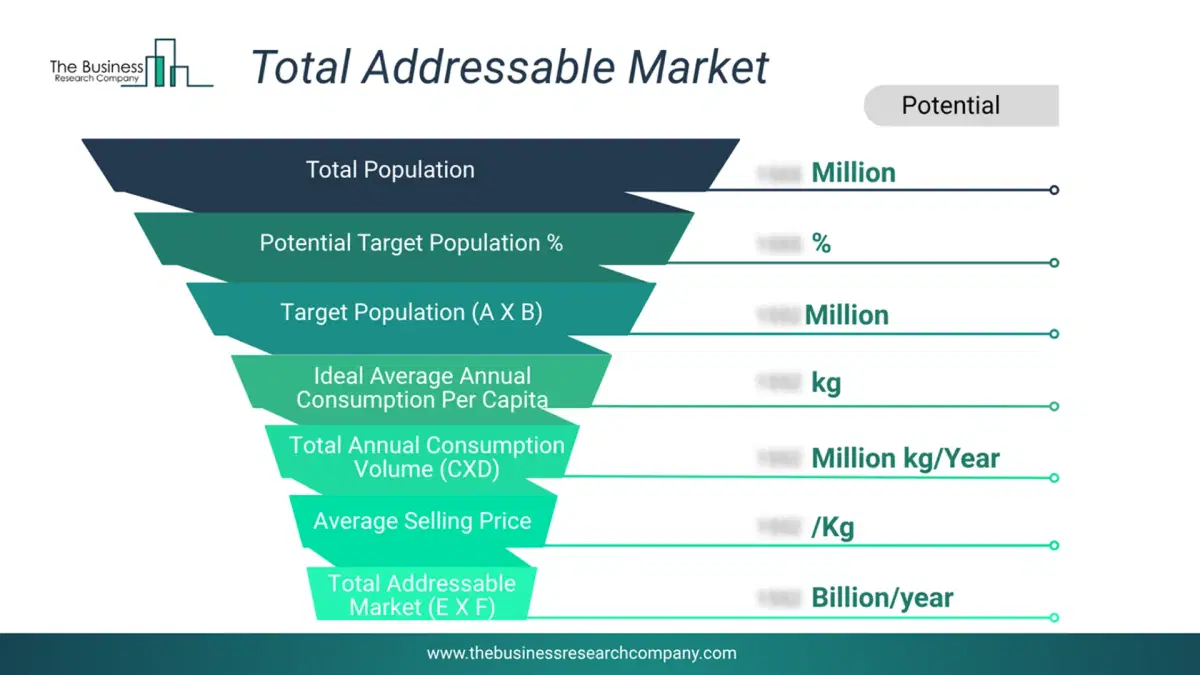
This chart highlights the Total Addressable Market (TAM) by estimating the maximum revenue opportunity using an assumption-driven approach, supporting strategic planning and opportunity sizing across markets. The chart is illustrative; the full report provides a more comprehensive analysis.
What Key Data and Analysis Are Included in the Enterprise Collaboration Market Report 2026?
The enterprise collaboration market research report is one of a series of new reports from The Business Research Company that provides market statistics, including industry global market size, regional shares, competitors with the market share, detailed market segments, market trends and opportunities, and any further data you may need to thrive in the enterprise collaboration industry. The market research report delivers a complete perspective of everything you need, with an in-depth analysis of the current and future state of the industry.Enterprise Collaboration Market Report Forecast Analysis
| Report Attribute | Details |
|---|---|
| Market Size Value In 2026 | $73.6 billion |
| Revenue Forecast In 2030 | $131.34 billion |
| Growth Rate | CAGR of 15.7% from 2026 to 2030 |
| Base Year For Estimation | 2025 |
| Actual Estimates/Historical Data | 2020-2025 |
| Forecast Period | 2026 - 2030 |
| Market Representation | Revenue in USD Billion and CAGR from 2026 to 2030 |
| Segments Covered | Type, Deployment Type, Enterprise, Component, Industry |
| Regional Scope | Asia-Pacific, Western Europe, Eastern Europe, North America, South America, Middle East, Africa |
| Country Scope | The countries covered in the report are Australia, Brazil, China, France, Germany, India, Indonesia, Japan, Taiwan, Russia, South Korea, UK, USA, Canada, Italy, Spain. |
| Key Companies Profiled | Google Inc.; Microsoft Corporation; IBM; Cisco Systems Inc.; SAP SE; Salesforce.com Inc.; Adobe Systems Inc.; Zoom Video Communications Inc.; Atlassian Corporation plc; Polycom Inc.; Mitel LLC; Zoho Corporation Pvt. Ltd.; Slack Technologies Inc.; Blackboard Inc.; Asana Inc.; Jive Software; Rocketlane Inc.; Pitch Software GmbH; Uplevel Ops Inc.; MetaCX Inc.; Axero Solutions LLC; Dropbox Inc.; Citrix Systems Inc.; Box Inc. |
| Customization Scope | Request for Customization |
| Pricing And Purchase Options | Explore Purchase Options |