
Feed Micronutrients Market Report 2026
Feed Micronutrients Market Report 2026
Global Outlook – By Product Type (Minerals, Vitamins, Carotenoids, Other Product Types), By Form Type (Non-Chelated, Chelated), By Livestock (Poultry, Aquaculture, Swine, Equine, Other Livestocks) – Market Size, Trends, Strategies, and Forecast to 2035
Feed Micronutrients Market Overview
• Feed Micronutrients market size has reached to $1.99 billion in 2025 • Expected to grow to $2.69 billion in 2030 at a compound annual growth rate (CAGR) of 6.1% • Growth Driver: Rising Demand For Poultry Products Fuels Expansion Of The Feed Micronutrient Market • Market Trend: The Emergence Of Organic-Compliant Chromium Propionate Feed Ingredients • Asia-Pacific was the largest region in 2025 and North America is the fastest growing region.
What Is Covered Under Feed Micronutrients Market?
Feed micronutrients are essential vitamins and minerals added to animal feed in small quantities to support overall health, growth, and productivity. These micronutrients are critical in various physiological functions, including immune response, bone development, and energy metabolism. The main product types of feed micronutrients are minerals, vitamins, carotenoids, and others. Minerals are essential nutrients required by animals for various bodily functions, including bone formation, muscle contraction, and enzyme activity. The various form types include non-chelated, chelated that are used by livestock such as poultry, aquaculture, swine, equine, and others.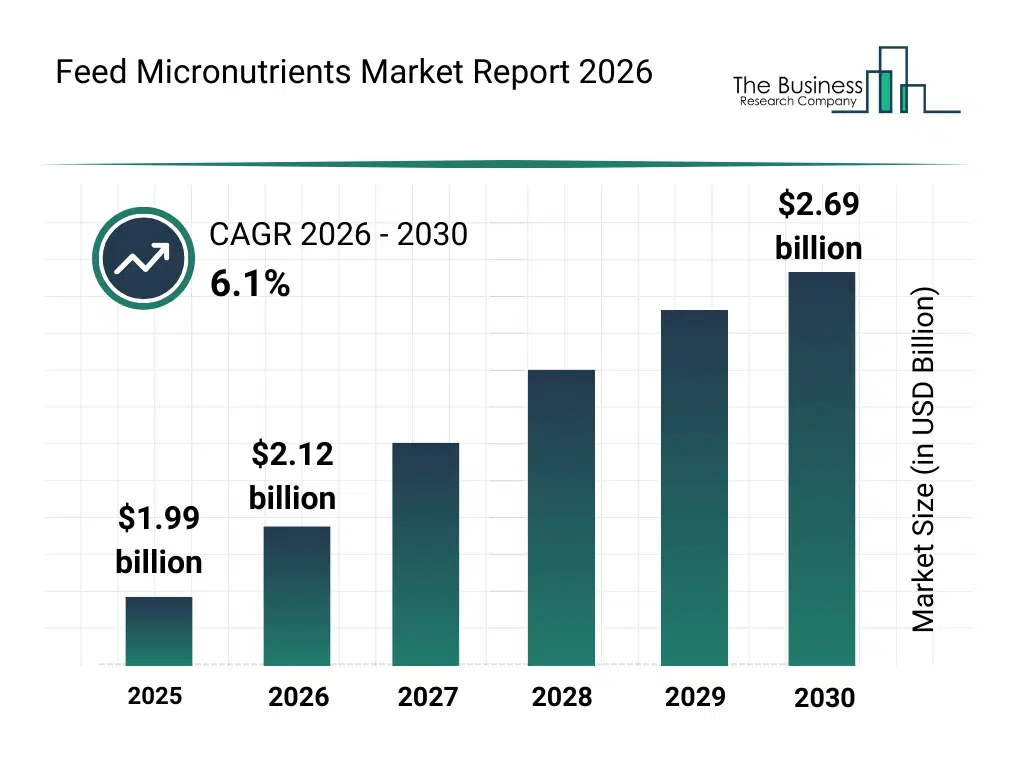
What Is The Feed Micronutrients Market Size and Share 2026?
The feed micronutrients market size has grown strongly in recent years. It will grow from $1.99 billion in 2025 to $2.12 billion in 2026 at a compound annual growth rate (CAGR) of 7.0%. The growth in the historic period can be attributed to increasing awareness about animal health and nutrition, expansion of livestock farming, growth in aquaculture and poultry industries, advancement in feed micronutrient formulations, rising demand for animal-derived food products.What Is The Feed Micronutrients Market Growth Forecast?
The feed micronutrients market size is expected to see strong growth in the next few years. It will grow to $2.69 billion in 2030 at a compound annual growth rate (CAGR) of 6.1%. The growth in the forecast period can be attributed to adoption of precision nutrition and feed formulations, increasing use of functional micronutrients, rising focus on sustainable and organic feed supplements, growth in aquaculture and poultry sectors, innovation in chelated and bioavailable micronutrients. Major trends in the forecast period include growing adoption of trace and macro minerals for animal health, rising use of fat-soluble and water-soluble vitamins, increasing integration of carotenoids for coloration and antioxidant benefits, expansion of chelated minerals and bioavailable micronutrients, development of synthetic vitamins and organic micronutrient blends.Global Feed Micronutrients Market Segmentation
1) By Product Type: Minerals, Vitamins, Carotenoids, Other Product Types 2) By Form Type: Non-Chelated, Chelated 3) By Livestock: Poultry, Aquaculture, Swine, Equine, Other Livestocks Subsegments: 1) By Minerals: Trace Minerals, Macro Minerals, Chelated Minerals 2) By Vitamins: Fat-Soluble Vitamins, Water-Soluble Vitamins, Pro-Vitamins And Synthetic Vitamins 3) By Carotenoids: Beta-Carotene, Lutein, Zeaxanthin, Astaxanthin 4) By Other Product Types: Amino Acids, Antioxidants, Enzymes, Organic MicronutrientsWhat Is The Driver Of The Feed Micronutrients Market?
The growing demand for poultry products is expected to drive the growth of the feed micronutrient market going forward. Poultry products refer to various items derived from domesticated birds, such as chickens, turkeys, ducks, geese, and quails. The demand for poultry products is due to their nutritional value, versatility in culinary applications, and cultural significance in many societies. Feed micronutrients are indispensable in poultry diets, contributing to optimal health, productivity, and product quality, ensuring that birds receive the necessary nutrients to thrive in various production environments. For instance, in December 2023, according to a report by the Food and Agriculture Organization of the United Nations (FAO), a US-based government organization, global poultry meat output reached 142 million metric tons in 2023, representing a 1% increase compared to the previous year. Similarly, global ovine meat output was 17.0 million metric tons in 2023, reflecting a 1.7% year-on-year increase. Therefore, the growing demand for poultry products drives growth in the feed micronutrient industry.Key Players In The Global Feed Micronutrients Market
Major companies operating in the feed micronutrients market are Cargill Incorporated, Archer Daniels Midland Company, BASF SE, Evonik Industries AG, Nutreco N.V., Alltech Inc., Lallemand Inc., Kemin Industries Inc., Godrej Agrovet Ltd., Phibro Animal Health Corporation, Ridley Inc., Purina Animal Nutrition LLC, Zinpro Corporation, Novus International Inc., Biochem GmbH, Pancosma SA., Pancosma S.A., Procare Solutions, QualiTech LLC, Mercer Milling Company Inc.Global Feed Micronutrients Market Trends and Insights
Major companies in the feed micronutrient market are focusing on developing innovative products such as organic-compliant chromium propionate feed ingredients to meet the growing demand for sustainable and effective animal nutrition solutions. An organic-compliant chromium propionate feed ingredient is a type of nutritional supplement used in animal feed that meets the standards and regulations for organic farming. For instance, in January 2024, Kemin Industries Inc., a US-based specialty ingredients company, announced the FDA's approval of chromium propionate for use in growing turkey diets, marking a significant advancement in animal nutrition. This approval allows chromium propionate, specifically Kemin's KemTRACE Chromium, to be utilized not only in turkeys but also in swine, broiler chickens, cattle, and horses.What Are Latest Mergers And Acquisitions In The Feed Micronutrients Market?
In December 2023, The Archer-Daniels-Midland Company (ADM), a US-based food processing company, acquired PT Trouw Nutrition Indonesia for an undisclosed amount. The acquisition would complement ADM's regional footprint, allowing it to provide localized solutions and customized services to customers in Indonesia and the broader Asia-Pacific region. PT Trouw Nutrition Indonesia is an Indonesia-based provider of innovative feed additives solutions for livestock farming.Regional Outlook
Asia-Pacific was the largest region in the feed micronutrients market in 2025. North America is expected to be the fastest growing region in the market. The regions covered in this market report are Asia-Pacific, South East Asia, Western Europe, Eastern Europe, North America, South America, Middle East, Africa. The countries covered in this market report are Australia, Brazil, China, France, Germany, India, Indonesia, Japan, Taiwan, Russia, South Korea, UK, USA, Canada, Italy, SpainWhat Defines the Feed Micronutrients Market?
The feed micronutrients market consists of sales of fat-soluble vitamins, water-soluble vitamins, macrominerals, trace minerals, premixes, concentrates, and additives. Values in this market are ‘factory gate’ values, that is the value of goods sold by the manufacturers or creators of the goods, whether to other entities (including downstream manufacturers, wholesalers, distributors and retailers) or directly to end customers. The value of goods in this market includes related services sold by the creators of the goods.How is Market Value Defined and Measured?
The market value is defined as the revenues that enterprises gain from the sale of goods and/or services within the specified market and geography through sales, grants, or donations in terms of the currency (in USD unless otherwise specified). The revenues for a specified geography are consumption values that are revenues generated by organizations in the specified geography within the market, irrespective of where they are produced. It does not include revenues from resales along the supply chain, either further along the supply chain or as part of other products.Feed Micronutrients Market Report Forecast Analysis
| Report Attribute | Details |
|---|---|
| Market Size Value In 2026 | $2.12 billion |
| Revenue Forecast In 2035 | $2.69 billion |
| Growth Rate | CAGR of 7.0% from 2026 to 2035 |
| Base Year For Estimation | 2025 |
| Actual Estimates/Historical Data | 2020-2025 |
| Forecast Period | 2026 - 2030 - 2035 |
| Market Representation | Revenue in USD Billion and CAGR from 2026 to 2035 |
| Segments Covered | Product Type, Form Type, Livestock |
| Regional Scope | Asia-Pacific, Western Europe, Eastern Europe, North America, South America, Middle East, Africa |
| Country Scope | The countries covered in the report are Australia, Brazil, China, France, Germany, India, ... |
| Key Companies Profiled | Cargill Incorporated, Archer Daniels Midland Company, BASF SE, Evonik Industries AG, Nutreco N.V., Alltech Inc., Lallemand Inc., Kemin Industries Inc., Godrej Agrovet Ltd., Phibro Animal Health Corporation, Ridley Inc., Purina Animal Nutrition LLC, Zinpro Corporation, Novus International Inc., Biochem GmbH, Pancosma SA., Pancosma S.A., Procare Solutions, QualiTech LLC, Mercer Milling Company Inc. |
| Customization Scope | Request for Customization |
| Pricing And Purchase Options | Explore Purchase Options |
Frequently Asked Questions
The Feed Micronutrients market was valued at $1.99 billion in 2025, increased to $1.99 billion in 2026, and is projected to reach $2.69 billion by 2030.
request a sample hereThe expected CAGR for the Feed Micronutrients market during the forecast period 2025–2030 is 6.1%.
request a sample hereMajor growth driver of the market includes: The growing demand for poultry products is expected to drive the growth of the feed micronutrient market going forward. Poultry products refer to various items derived from domesticated birds, such as chickens, turkeys, ducks, geese, and quails. The demand for poultry products is due to their nutritional value, versatility in culinary applications, and cultural significance in many societies. Feed micronutrients are indispensable in poultry diets, contributing to optimal health, productivity, and product quality, ensuring that birds receive the necessary nutrients to thrive in various production environments. For instance, in December 2023, according to a report by the Food and Agriculture Organization of the United Nations (FAO), a US-based government organization, global poultry meat output reached 142 million metric tons in 2023, representing a 1% increase compared to the previous year. Similarly, global ovine meat output was 17.0 million metric tons in 2023, reflecting a 1.7% year-on-year increase. Therefore, the growing demand for poultry products drives growth in the feed micronutrient market. in the Feed Micronutrients market. For further insights on this market,
request a sample hereThe feed micronutrients market covered in this report is segmented –
1) By Product Type: Minerals, Vitamins, Carotenoids, Other Product Types
2) By Form Type: Non-Chelated, Chelated
3) By Livestock: Poultry, Aquaculture, Swine, Equine, Other Livestocks Subsegments:
1) By Minerals: Trace Minerals, Macro Minerals, Chelated Minerals
2) By Vitamins: Fat-Soluble Vitamins, Water-Soluble Vitamins, Pro-Vitamins And Synthetic Vitamins
3) By Carotenoids: Beta-Carotene, Lutein, Zeaxanthin, Astaxanthin
4) By Other Product Types: Amino Acids, Antioxidants, Enzymes, Organic Micronutrients
request a sample here1) By Product Type: Minerals, Vitamins, Carotenoids, Other Product Types
2) By Form Type: Non-Chelated, Chelated
3) By Livestock: Poultry, Aquaculture, Swine, Equine, Other Livestocks Subsegments:
1) By Minerals: Trace Minerals, Macro Minerals, Chelated Minerals
2) By Vitamins: Fat-Soluble Vitamins, Water-Soluble Vitamins, Pro-Vitamins And Synthetic Vitamins
3) By Carotenoids: Beta-Carotene, Lutein, Zeaxanthin, Astaxanthin
4) By Other Product Types: Amino Acids, Antioxidants, Enzymes, Organic Micronutrients
Major trend in this market includes: The Emergence Of Organic-Compliant Chromium Propionate Feed Ingredients For further insights on this market,
request a sample hereMajor companies operating in the Feed Micronutrients market are Major companies operating in the feed micronutrients market are Cargill Incorporated, Archer Daniels Midland Company, BASF SE, Evonik Industries AG, Nutreco N.V., Alltech Inc., Lallemand Inc., Kemin Industries Inc., Godrej Agrovet Ltd., Phibro Animal Health Corporation, Ridley Inc., Purina Animal Nutrition LLC, Zinpro Corporation, Novus International Inc., Biochem GmbH, Pancosma SA., Pancosma S.A., Procare Solutions, QualiTech LLC, Mercer Milling Company Inc.
request a sample hereAsia-Pacific was the largest region in the feed micronutrients market in 2025. North America is expected to be the fastest growing region in the market. The regions covered in the feed micronutrients market report are Asia-Pacific, South East Asia, Western Europe, Eastern Europe, North America, South America, Middle East, Africa.
request a sample here