
Fertility Drugs Market Report 2026
Global Outlook – By Type Of Drug (Prescription Fertility Drugs, Over-The-Counter Fertility drugs , By Route of Administration (Oral, Intravenous, Subcutaneous, Intramuscular , By Distribution Channel (Hospital Pharmacies, Retail Pharmacies, Online Pharmacies) – Market Size, Trends, Strategies, and Forecast to 2035
Fertility Drugs Market Overview
• Fertility Drugs market size has reached to $3.21 billion in 2025 • Expected to grow to $4.76 billion in 2030 at a compound annual growth rate (CAGR) of 8.1% • Growth Driver: Rising Prevalence Of Obesity To Drive Market Growth • Market Trend: Enhancing Fertility Treatments with Single-Dose Prefilled Syringes • North America was the largest region in 2025 and Middle East is the fastest growing region.
What Is Covered Under Fertility Drugs Market?
Fertility drugs refer to a term used to describe medications that cause your body to release hormones that regulate or prompt ovulation, or the release of an egg from your ovary. The main types of fertility drugs are prescription fertility drugs and over-the-counter fertility drugs. The drugs are administered orally, intravenously, subcutaneously, and intramuscularly to male and female patients. Subcutaneous administration refers to the process of injecting the drugs into the fatty tissue just beneath the skin. The drugs are distributed through hospital pharmacies, retail pharmacies, and online pharmacies.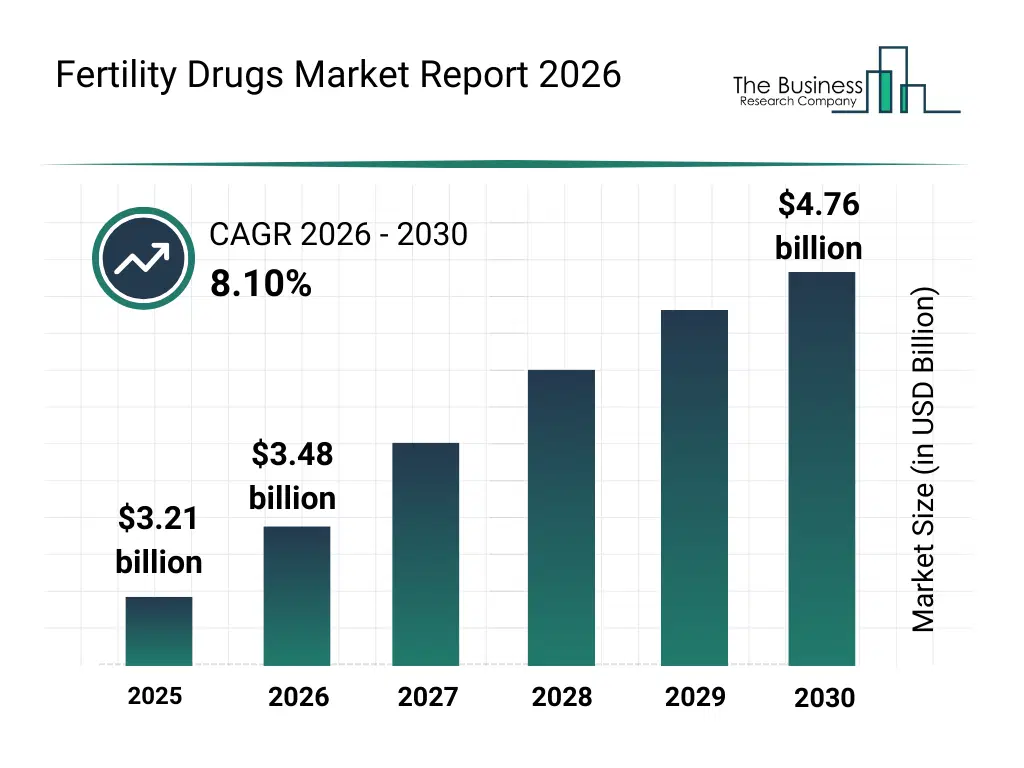
What Is The Fertility Drugs Market Size and Share 2026?
The fertility drugs market size has grown strongly in recent years. It will grow from $3.21 billion in 2025 to $3.48 billion in 2026 at a compound annual growth rate (CAGR) of 8.4%. The growth in the historic period can be attributed to limited availability of fertility drugs, increasing prevalence of infertility, reliance on conventional ovulation tracking methods, growing awareness of fertility supplements, expansion of hospital and clinic infrastructure.What Is The Fertility Drugs Market Growth Forecast?
The fertility drugs market size is expected to see strong growth in the next few years. It will grow to $4.76 billion in 2030 at a compound annual growth rate (CAGR) of 8.1%. The growth in the forecast period can be attributed to development of personalized fertility therapies, rise of telemedicine for fertility consultations, adoption of digital fertility monitors, increasing government support for reproductive health, growth in online pharmacy sales and distribution channels. Major trends in the forecast period include rising infertility rates among couples, growing preference for prescription fertility drugs over otc options, increasing awareness about ovulation tracking and fertility planning, expansion of online pharmacies and e-commerce channels for fertility products, integration of personalized fertility treatment plans and monitoring.Global Fertility Drugs Market Segmentation
1) By Type Of Drug: Prescription Fertility Drugs, Over-The-Counter Fertility drugs 2) By Route of Administration: Oral, Intravenous, Subcutaneous, Intramuscular 3) By Distribution Channel: Hospital Pharmacies, Retail Pharmacies, Online Pharmacies Subsegments: 1) By Prescription Fertility Drugs: Gonadotropins, Clomiphene Citrate, Letrozole, GnRH Agonists, GnRH Antagonists, Progesterone 2) By Over-The-Counter Fertility Drugs: Nutritional Fertility Supplements, Herbal Fertility AidsWhat Is The Driver Of The Fertility Drugs Market?
The increasing prevalence of obesity is expected to propel the growth of the fertility drugs market going forward. Obesity is a medical condition characterized by an excessive accumulation of body fat to the extent that it may have adverse effects on an individual's health. Obesity is a known contributor to infertility in both men and women. This increased demand is driven by the need for specialized treatments, greater awareness, supportive government policies, and ongoing research and development efforts tailored to addressing fertility challenges associated with obesity. For instance, in March 2023, according to the World Heart Federation, a Switzerland-based non-government global cardiovascular community, around 2.3 billion adults and children were obese or overweight globally, and with the current obesity trend, it is estimated that the number of people living with obesity will reach 2.7 billion by 2025. Therefore, the increasing prevalence of obesity is driving the growth of the fertility drugs industry.Key Players In The Global Fertility Drugs Market
Major companies operating in the fertility drugs market are Merck & Co., Ferring Pharmaceuticals Inc., Bayer AG, Berlex Laboratories Inc., Pfizer Inc., Novartis AG, Zydus Lifesciences Limited, Livzon Pharmaceutical Group Inc., Abbott Laboratories, Sanofi S.A., Eli Lilly and Company, Serono Inc., Takeda Pharmaceutical Co. Ltd., Aurobindo Pharma Ltd., Schering-Plough Corporation, Organon Group, Mankind PharmaGlobal Fertility Drugs Market Trends and Insights
Major companies operating in the fertility drugs market are focusing on developing innovative solutions, including peptide-based injectable treatments, to enhance reproductive health outcomes. Peptide-based injectable treatments refer to medications that utilize synthetic or naturally occurring peptides to stimulate or regulate hormonal activity, particularly in the context of fertility and reproductive health. For instance, in February 2024, Lupin Limited, an India-based pharmaceutical company, launched a ganirelix acetate injection in the United States. This medication is commonly used as a part of assisted reproductive technology (ART) protocols to prevent premature ovulation during controlled ovarian stimulation in women undergoing in vitro fertilization (IVF). Ganirelix acetate is a GnRH antagonist that helps regulate hormone levels, allowing for better control of the ovarian stimulation process. The US launch reflects Lupin's ongoing commitment to expanding its product offerings in the reproductive health sector, as well as its focus on addressing the needs of patients undergoing fertility treatments.What Are Latest Mergers And Acquisitions In The Fertility Drugs Market?
In March 2023, Sumitovant Biopharma Ltd., a US-based biopharmaceutical company acquired Myovant Sciences Ltd. for an undisclosed amount. The acquisition of Myovant by Sumitovant enhances their collaborative capabilities, resources, and expertise, allowing them to address unmet needs in women's health and prostate cancer, advance the development of their combined pipeline, and expand the impact of their differentiated therapies for the benefit of patient communities. Myovant Sciences Ltd. is a US-based biotechnology company that specializes in the development and commercialization of new treatments for women's diseases and endocrine disorders, with a focus on addressing conditions such as heavy menstrual bleeding associated with uterine fibroids and female infertility.Regional Insights
North America was the largest region in the fertility drugs market in 2025. The Middle East is expected to be the fastest-growing region in the drugs for infertility market during the forecast period. The regions covered in this market report are Asia-Pacific, South East Asia, Western Europe, Eastern Europe, North America, South America, Middle East, Africa. The countries covered in this market report are Australia, Brazil, China, France, Germany, India, Indonesia, Japan, Taiwan, Russia, South Korea, UK, USA, Canada, Italy, Spain.What Defines the Fertility Drugs Market?
The fertility drugs market consists of sales of clomiphene citrate, gonadotropins, and metformin. Values in this market are factory gate values, that is the value of goods sold by the manufacturers or creators of the goods, whether to other entities (including downstream manufacturers, wholesalers, distributors and retailers) or directly to end customers. The value of goods in this market includes related services sold by the creators of the goods.How is Market Value Defined and Measured?
The market value is defined as the revenues that enterprises gain from the sale of goods and/or services within the specified market and geography through sales, grants, or donations in terms of the currency (in USD unless otherwise specified). The revenues for a specified geography are consumption values that are revenues generated by organizations in the specified geography within the market, irrespective of where they are produced. It does not include revenues from resales along the supply chain, either further along the supply chain or as part of other products.What Key Data and Analysis Are Included in the Fertility Drugs Market Report 2026?
The fertility drugs market research report is one of a series of new reports from The Business Research Company that provides market statistics, including industry global market size, regional shares, competitors with the market share, detailed market segments, market trends and opportunities, and any further data you may need to thrive in the fertility drugs industry. The market research report delivers a complete perspective of everything you need, with an in-depth analysis of the current and future state of the industry.Fertility Drugs Market Report Forecast Analysis
| Report Attribute | Details |
|---|---|
| Market Size Value In 2026 | $3.48 billion |
| Revenue Forecast In 2035 | $4.76 billion |
| Growth Rate | CAGR of 8.4% from 2026 to 2035 |
| Base Year For Estimation | 2025 |
| Actual Estimates/Historical Data | 2020-2025 |
| Forecast Period | 2026 - 2030 - 2035 |
| Market Representation | Revenue in USD Billion and CAGR from 2026 to 2035 |
| Segments Covered | Type Of Drug, Route of Administration, Distribution Channel |
| Regional Scope | Asia-Pacific, Western Europe, Eastern Europe, North America, South America, Middle East, Africa |
| Country Scope | The countries covered in the report are Australia, Brazil, China, France, Germany, India, ... |
| Key Companies Profiled | Merck & Co., Ferring Pharmaceuticals Inc., Bayer AG, Berlex Laboratories Inc., Pfizer Inc., Novartis AG, Zydus Lifesciences Limited, Livzon Pharmaceutical Group Inc., Abbott Laboratories, Sanofi S.A., Eli Lilly and Company, Serono Inc., Takeda Pharmaceutical Co. Ltd., Aurobindo Pharma Ltd., Schering-Plough Corporation, Organon Group, Mankind Pharma |
| Customization Scope | Request for Customization |
| Pricing And Purchase Options | Explore Purchase Options |