

Live Commerce Platforms Market Report 2026
Global Outlook – By Type (E-Commerce Self-Built Platform, Content Community Platform, Traditional Social Platform), By E-Commerce Model (Business To Business (B2B), Business To Customer (B2C)), By Category (Apparel And Fashion, Cosmetics And Personal Care, Consumer Electronics, Furnishing, Entertainment, Other Categories) – Market Size, Trends, Strategies, and Forecast to 2030
Live Commerce Platforms Market Overview
• Live Commerce Platforms market size has reached to $1.54 billion in 2025 • Expected to grow to $4.31 billion in 2030 at a compound annual growth rate (CAGR) of 22.9% • Growth Driver: Navigating The Growth Of Live Commerce Platforms Amidst Expanding Internet Access • Market Trend: Revolutionizing Online Shopping With Interactive Live-Video Commerce • North America was the largest region in 2025.Market Gains By 2030 – Top Opportunities By Segment
Market Gain identifies the most promising market opportunities by highlighting the segments or products expected to generate the highest incremental revenue growth over the next five years.
What Is Covered Under Live Commerce Platforms Market?
Live commerce platforms are digital channels that combine live video streaming with the ability to purchase products in real-time. They are used for interactive online shopping experiences, where viewers can watch live demonstrations, interact with hosts or sellers through comments, and purchase directly during the broadcast. This approach enhances customer engagement, provides immediate feedback and query resolution, and boosts sales by leveraging the immediacy and interactivity of live streaming. The main types of live commerce platforms are e-commerce self-built platforms, content community platforms, and traditional social platforms. An e-commerce self-built platform is a digital platform where businesses or individuals create and manage their own online storefronts to sell products or services directly to consumers. They are used by various e-commerce models, such as business-to-business (b2b) and business-to-customer (b2c), and are also used in several categories of business, such as apparel and fashion, cosmetics and personal care, consumer electronics, furnishing, entertainment, and others.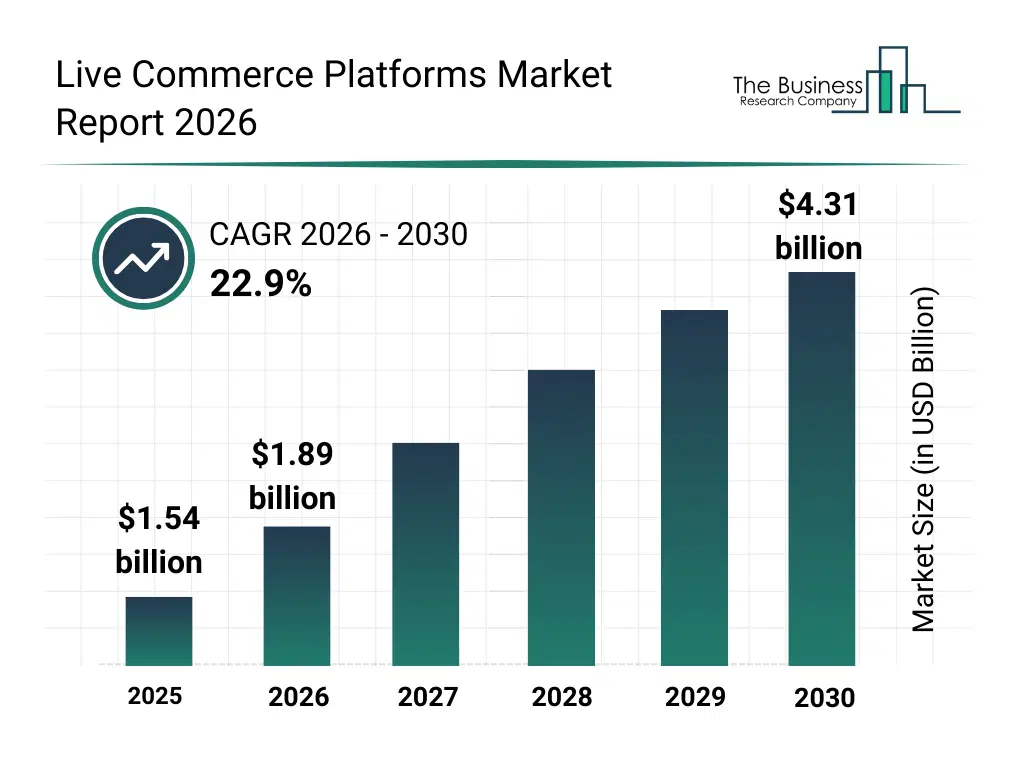
What Is The Live Commerce Platforms Market Size and Share 2026?
The live commerce platforms market size has grown exponentially in recent years. It will grow from $1.54 billion in 2025 to $1.89 billion in 2026 at a compound annual growth rate (CAGR) of 22.8%. The growth in the historic period can be attributed to growth of social media platforms, limited live video streaming technology, low consumer trust in online purchases, fragmented influencer marketing, slow adoption of mobile commerce.What Is The Live Commerce Platforms Market Growth Forecast?
The live commerce platforms market size is expected to see exponential growth in the next few years. It will grow to $4.31 billion in 2030 at a compound annual growth rate (CAGR) of 22.9%. The growth in the forecast period can be attributed to rise in mobile internet penetration, demand for personalized shopping experiences, expansion of influencer marketing, growth in AR/VR shopping features, adoption of integrated payment gateways. Major trends in the forecast period include live video product demonstrations, instant purchase integration, real-time viewer feedback analytics, influencer-led product promotions, interactive chat and polling features.
Global Live Commerce Platforms Market Segmentation
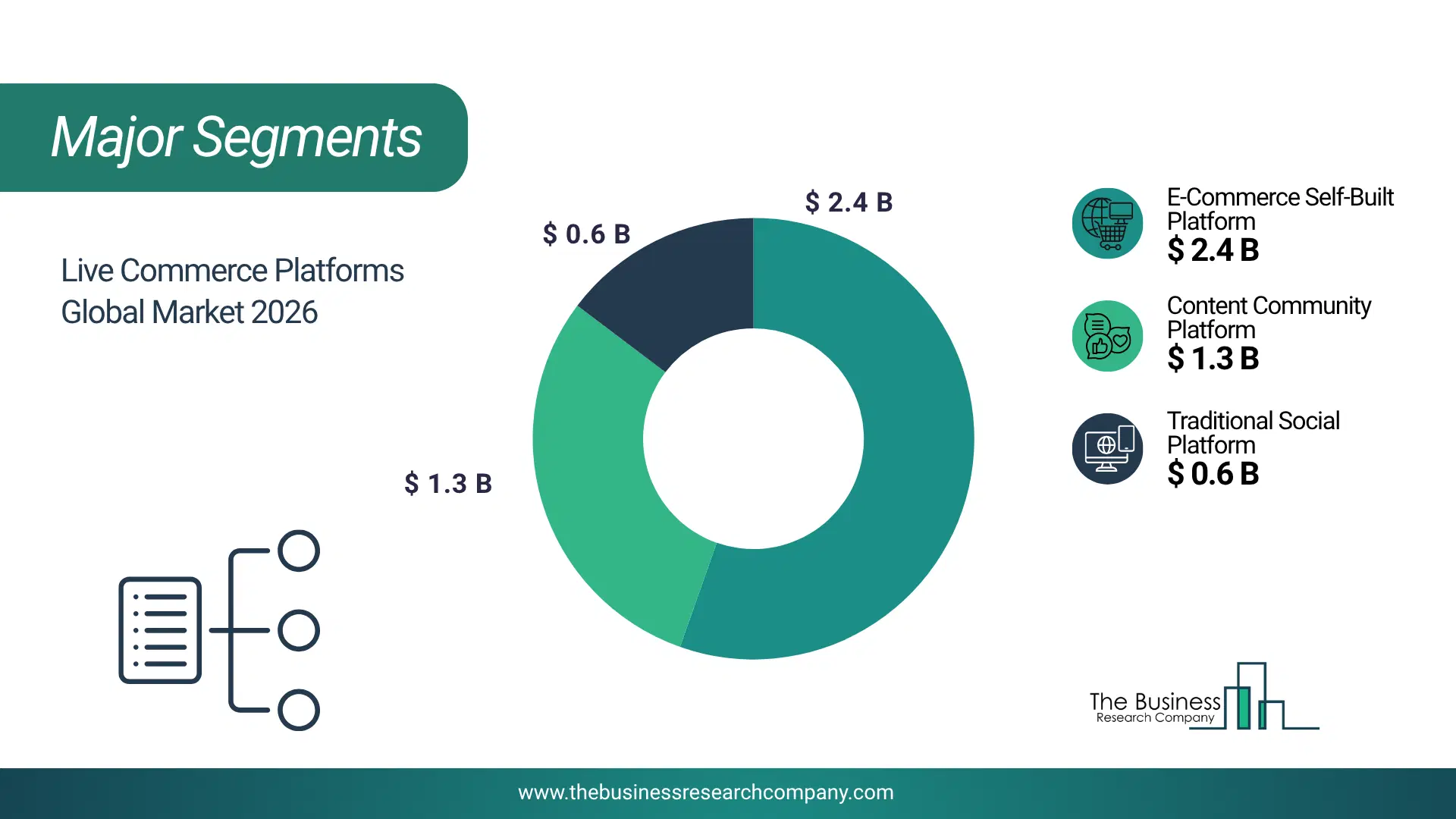
1) By Type: E-Commerce Self-Built Platform, Content Community Platform, Traditional Social Platform 2) By E-Commerce Model: Business To Business (B2B), Business To Customer (B2C) 3) By Category: Apparel And Fashion, Cosmetics And Personal Care, Consumer Electronics, Furnishing, Entertainment, Other Categories Subsegments: 1) By E-Commerce Self-Built Platform: Brand-Specific Platforms, Retailer-Owned Platforms 2) By Content Community Platform: Influencer-Driven Platforms, User-Generated Content Platforms 3) By Traditional Social Platform: Social Media Integration, Live Streaming Features On Existing Social Networks The top segments in the live commerce platforms market will be: • E-Commerce Self-Built Platform will reach $2.39 billion by 2030. • Content Community Platform will reach $1.29 billion by 2030. • Traditional Social Platform will reach $0.63 billion by 2030.What Is The Driver Of The Live Commerce Platforms Market?
The increasing internet penetration is expected to propel the growth of the live commerce platform market going forward. The Internet is a global network of computers enabling users to access and exchange information, and its demand stems from its ability to provide instant access to vast resources, communication, and services. The widespread adoption of smartphones and other mobile devices with internet connectivity capabilities has significantly increased internet penetration, enabling live commerce platforms to connect sellers with a global audience instantly and facilitating real-time interaction and transactions. For instance, in September 2023, according to a report published by the International Telecommunication Union (ITU), a Switzerland-based United Nations specialized agency, the number of internet users worldwide rose to 5.4 billion in 2023, up from 5.1 billion users (64%) in 2022. Therefore, the increasing internet penetration is driving the growth of the live commerce platform industry.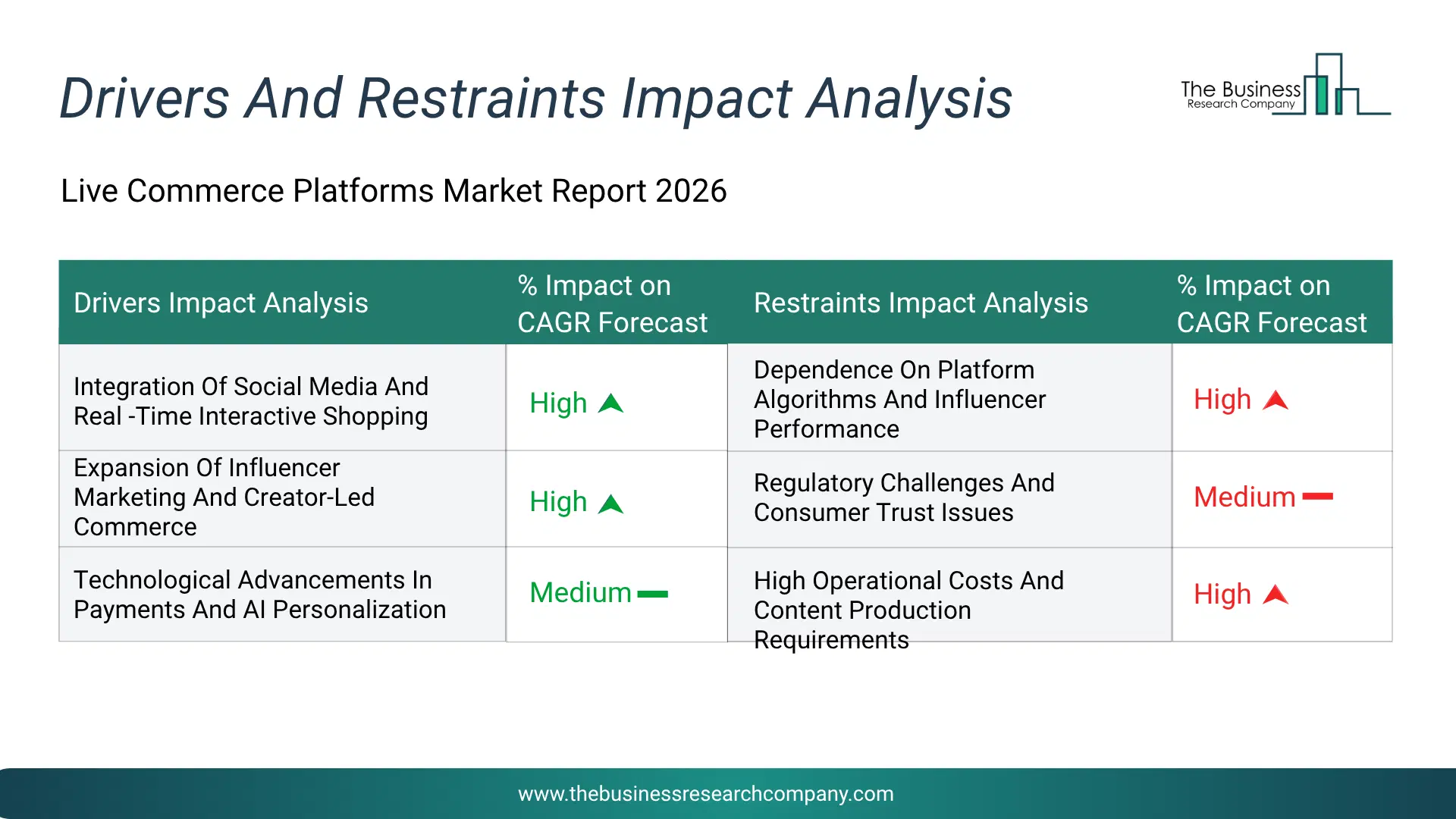
Infographic Chart Showing Key Market Drivers Analysis And Restraints For Live Commerce Platforms Market
The chart presents an impact analysis of key drivers and restraints, quantifying their relative influence on the market's growth rate and helping assess the balance between growth enablers and limiting factors. This chart offers a high-level perspective; the full report contains more detailed insights.
How Will The Drivers Impact Growth In The Global Live Commerce Platforms Market?
• Integration Of Social Media And Real -Time Interactive Shopping (High) – During the forecast period, the integration of social media and real -time interactive shopping is expected to become a key growth driver for the live commerce platforms market by 2030. The rapid convergence of social media and e -commerce is a primary driver for the live commerce platforms market. Consumers increasingly prefer interactive, real -time shopping experiences that combine entertainment with purchasing convenience. Live streaming enables influencers and brands to demonstrate products, answer questions instantly, and create urgency through limited -time offers. This fusion of content and commerce enhances engagement rates and conversion ratios compared to traditional online retail formats. • Expansion Of Influencer Marketing And Creator-Led Commerce (High) – During the forecast period, the expansion of influencer marketing and creator-led commerce is expected to emerge as a major factor driving the expansion of the live commerce platforms market by 2030. Growing influencer marketing and creator economy ecosystems significantly fuel market growth. Brands increasingly collaborate with influencers and content creators to build trust and drive impulse purchases during live sessions. Personalized engagement, authenticity, and peer-driven recommendations enhance consumer confidence. As digital-native generations dominate online consumption, influencer-led commerce is expected to expand across fashion, beauty, electronics, and lifestyle categories. • Technological Advancements In Payments And AI Personalization (Medium) – During the forecast period, the technological advancements in payments and ai personalization is expected to act as a key growth catalyst for the live commerce platforms market by 2030. Advancements in digital payment systems, ai-driven personalization, and mobile penetration further accelerate platform adoption. Seamless in-app checkout, one-click payments, and real-time recommendation engines improve user experience and reduce cart abandonment. High smartphone penetration and improved internet connectivity support scalable live-stream commerce models across emerging markets. Continuous technological innovation strengthens platform scalability and monetization capabilities.How Will The Restraints Impact Growth In The Global Live Commerce Platforms Market?
• Dependence On Platform Algorithms And Influencer Performance (High) – During the forecast period, the high dependence on platform algorithms and influencer performance acts as a major restraint in the live commerce platforms market. Sales volumes are often tied to viewer engagement levels, which can fluctuate based on content quality and audience trends. Changes in social media algorithms may reduce organic reach, impacting conversion rates. This volatility creates revenue unpredictability for brands and sellers. • Regulatory Challenges And Consumer Trust Issues (Medium) – During the forecast period, the regulatory scrutiny and consumer trust concerns also restrain market expansion. Issues related to misleading promotions, counterfeit products, and data privacy can reduce consumer confidence. Governments in various regions are tightening digital commerce regulations and advertising disclosure requirements. Compliance complexities and reputational risks may moderate growth in certain markets. • High Operational Costs And Content Production Requirements (High) – During the forecast period, the high operational costs and content production requirements act as a restraint for the live commerce platforms market by increasing the financial burden on brands and sellers. Continuous live streaming demands investment in professional equipment, skilled hosts, influencer partnerships, and real-time marketing support. Additionally, maintaining engaging and high-quality content on a regular basis increases staffing and production expenses. Smaller businesses often struggle to sustain these recurring costs, limiting their participation in live commerce activities. Overall, these financial pressures can reduce profitability and slow down market expansion.Key Players In The Global Live Commerce Platforms Market
Major companies operating in the live commerce platforms market are Amazon.com Inc.; JD.com Inc.; Meta Platforms Inc.; Tencent Holdings Limited; Pinduoduo Inc.; Rakuten Group Inc.; Kuaishou Technology Inc.; Suning Appliance Group Co. Ltd.; ByteDance Ltd.; Klarna Bank AB (publ); Weibo Corporation; Mercari Inc.; Taobao; Hopin Limited; Zappos.com LLC; CommentSold; StreamYard Inc.; Shopmatic Pvt. Ltd.; Restream Inc.; GhostRetail Inc.; Crowdcast Inc.; Streamlabs Inc.; TalkShopLive Inc.; Livescale Solutions GmbH; Giosg.com Ltd.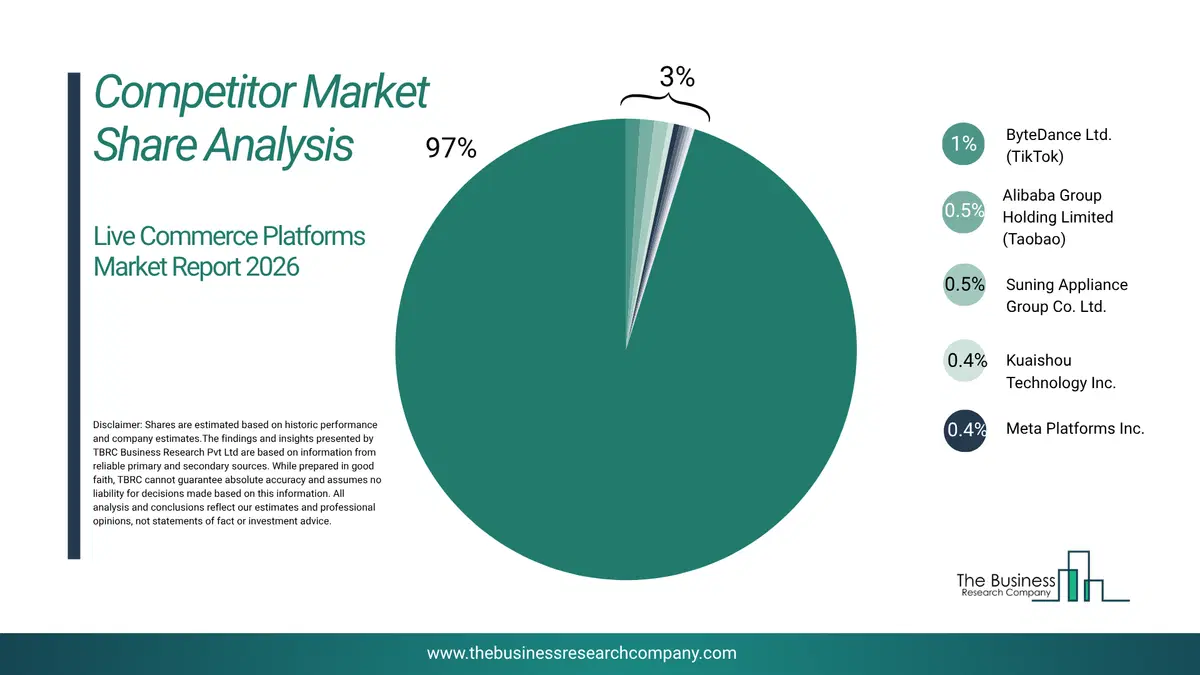
This chart is for illustrative purposes; the full report includes a detailed competitor analysis and comprehensive overview of the top 10 companies in the market.
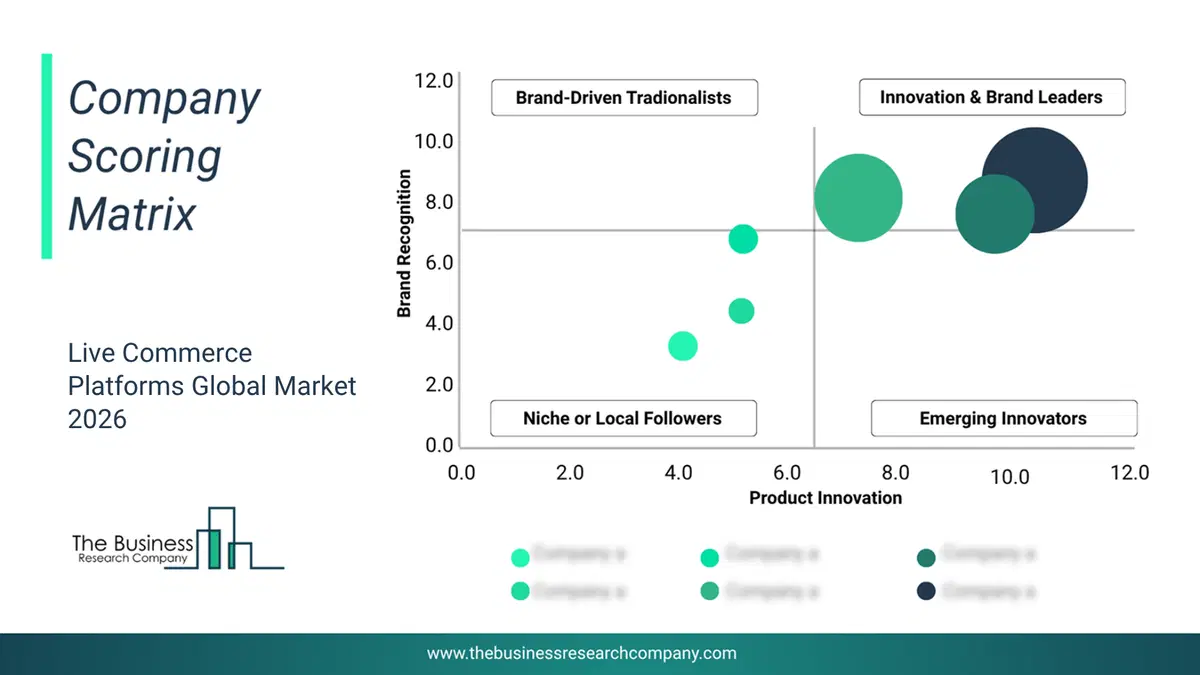
This chart maps companies by product innovation and brand strength, with bubble size indicating relative revenue, helping identify market leaders, challengers, and niche players. This is an illustrative chart; the full report provides a complete and accurate competitive analysis.
Global Live Commerce Platforms Market Trends and Insights
Major companies operating in the live commerce platforms market are focusing on developing innovative solutions such as integrated live-video commerce channels to meet the rising demand for immersive, real-time shopping experiences. These solutions embed interactive livestreaming directly into ecommerce environments, enabling instant product discovery, live engagement, and seamless in-app purchasing an advancement over traditional catalog-based online shopping. For instance, in February 2023, Stage TEN, a Canada-based live-commerce technology company, partnered with Shopify, a Canada-based ecommerce platform provider, to launch Live Video Commerce within Shopify’s Shop app. The solution integrates Stage TEN’s Live Creator technology into the Shop app, allowing merchants to broadcast shoppable livestreams, interact with viewers through real-time chat, and enable instant checkout directly inside the video player. It uses low-latency streaming, interactive overlays, and automated product linking to enhance consumer engagement and reduce friction compared with conventional ecommerce flows. This launch gives merchants new tools for hosting product demos, limited-time drops, and community-driven shopping sessions, ultimately helping drive higher conversion and retention rates.What Are Latest Mergers And Acquisitions In The Live Commerce Platforms Market?
In February 2023, Emplifi, a US-based customer engagement platform, acquired Go Instore for an undisclosed amount. Through this acquisition, Emplifi aims to solidify its leadership in the customer experience by offering a comprehensive platform that integrates social marketing, commerce, and omnichannel service while pioneering live commerce with ShopStream to enhance interactive customer engagement. Go Instore is a UK-based video-powered retail platform.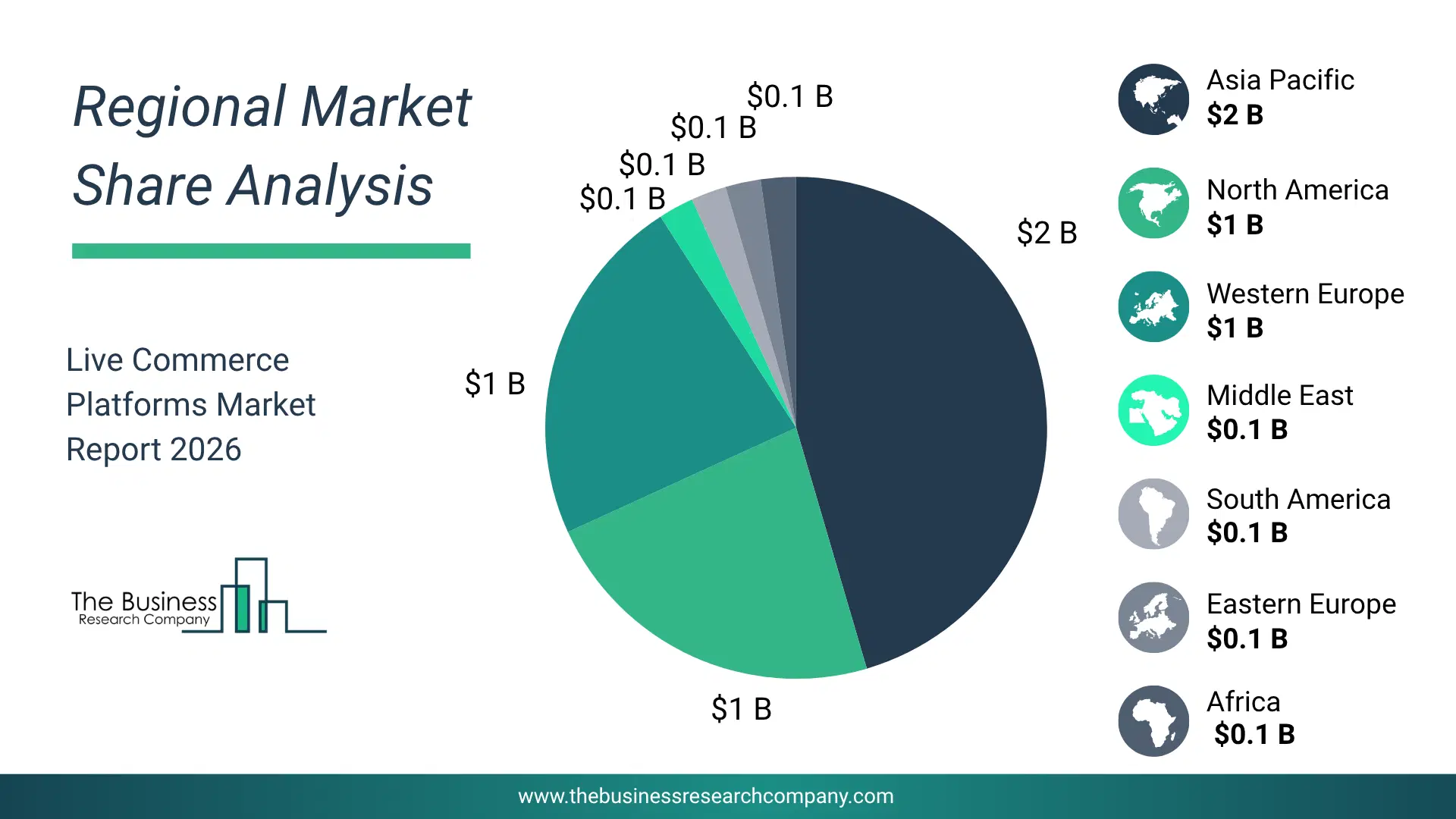
Regional Insights
North America was the largest region in the live commerce platforms market in 2025. The regions covered in this market report are Asia-Pacific, South East Asia, Western Europe, Eastern Europe, North America, South America, Middle East, Africa. The countries covered in this market report are Australia, Brazil, China, France, Germany, India, Indonesia, Japan, Taiwan, Russia, South Korea, UK, USA, Canada, Italy, SpainWhat Defines the Live Commerce Platforms Market?
The live commerce platform market consists of revenues earned by entities by providing services such as live streaming, real-time interaction, instant purchasing, analytics and insights, and multi-platform integration. The market value includes the value of related goods sold by the service provider or included within the service offering. The live commerce platform market also includes sales of live streaming software, real-time interaction tools, and e-commerce integration platforms that are used in providing services. Values in this market are ‘factory gate’ values, that is, the value of goods sold by the manufacturers or creators of the goods, whether to other entities (including downstream manufacturers, wholesalers, distributors, and retailers) or directly to end customers. The value of goods in this market includes related services sold by the creators of the goods.How is Market Value Defined and Measured?
The market value is defined as the revenues that enterprises gain from the sale of goods and/or services within the specified market and geography through sales, grants, or donations in terms of the currency (in USD unless otherwise specified). The revenues for a specified geography are consumption values that are revenues generated by organizations in the specified geography within the market, irrespective of where they are produced. It does not include revenues from resales along the supply chain, either further along the supply chain or as part of other products.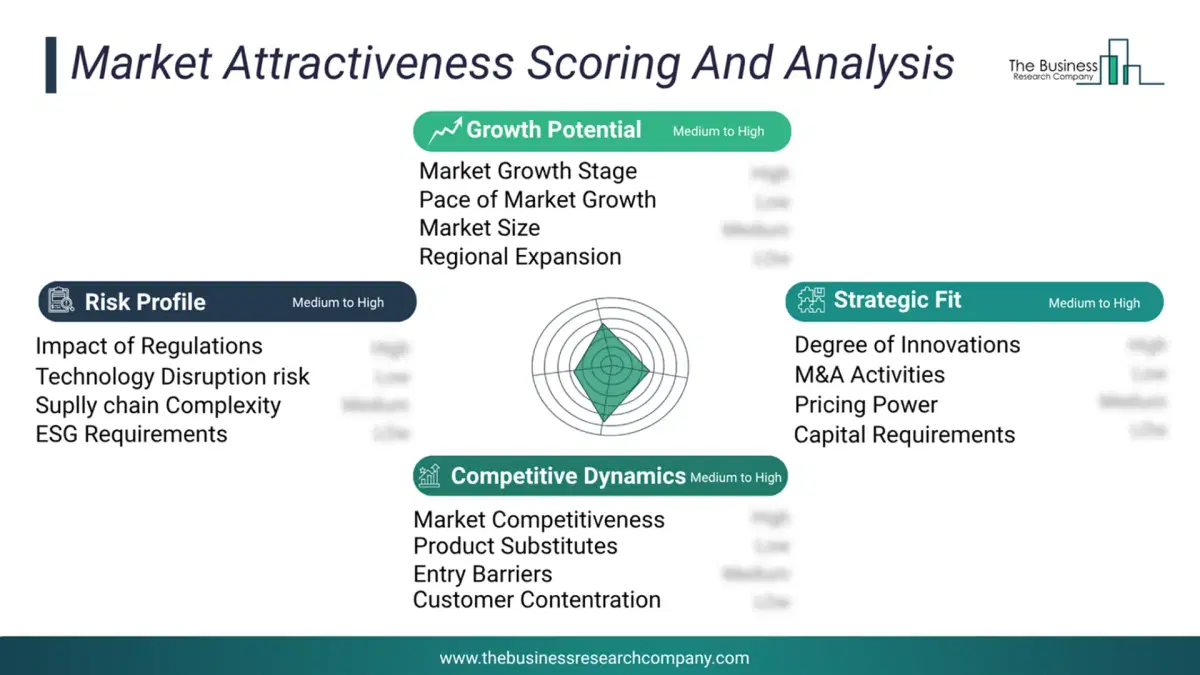
This chart presents market attractiveness based on a quantitative evaluation of growth, competition, strategic alignment, and risk, offering a clear view of opportunity areas for decision-making. This chart is for illustrative purposes; the full report contains the complete analysis.
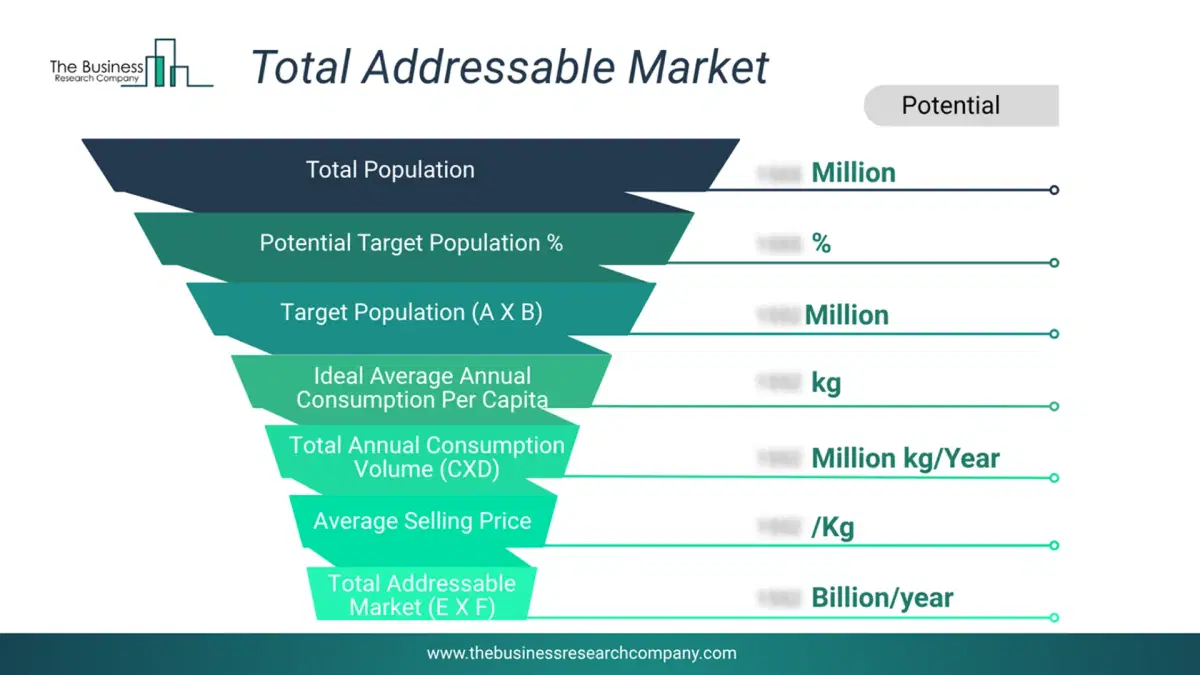
This chart highlights the Total Addressable Market (TAM) by estimating the maximum revenue opportunity using an assumption-driven approach, supporting strategic planning and opportunity sizing across markets. The chart is illustrative; the full report provides a more comprehensive analysis.
What Key Data and Analysis Are Included in the Live Commerce Platforms Market Report 2026?
The live commerce platforms market research report is one of a series of new reports from The Business Research Company that provides market statistics, including industry global market size, regional shares, competitors with the market share, detailed market segments, market trends and opportunities, and any further data you may need to thrive in the live commerce platforms industry. The market research report delivers a complete perspective of everything you need, with an in-depth analysis of the current and future state of the industry.Live Commerce Platforms Market Report Forecast Analysis
| Report Attribute | Details |
|---|---|
| Market Size Value In 2026 | $1.89 billion |
| Revenue Forecast In 2030 | $4.31 billion |
| Growth Rate | CAGR of 22.8% from 2026 to 2030 |
| Base Year For Estimation | 2025 |
| Actual Estimates/Historical Data | 2020-2025 |
| Forecast Period | 2026 - 2030 |
| Market Representation | Revenue in USD Billion and CAGR from 2026 to 2030 |
| Segments Covered | Type, E-Commerce Model, Category |
| Regional Scope | Asia-Pacific, Western Europe, Eastern Europe, North America, South America, Middle East, Africa |
| Country Scope | The countries covered in the report are Australia, Brazil, China, France, Germany, India, Indonesia, Japan, Taiwan, Russia, South Korea, UK, USA, Canada, Italy, Spain. |
| Key Companies Profiled | Amazon.com Inc.; JD.com Inc.; Meta Platforms Inc.; Tencent Holdings Limited; Pinduoduo Inc.; Rakuten Group Inc.; Kuaishou Technology Inc.; Suning Appliance Group Co. Ltd.; ByteDance Ltd.; Klarna Bank AB (publ); Weibo Corporation; Mercari Inc.; Taobao; Hopin Limited; Zappos.com LLC; CommentSold; StreamYard Inc.; Shopmatic Pvt. Ltd.; Restream Inc.; GhostRetail Inc.; Crowdcast Inc.; Streamlabs Inc.; TalkShopLive Inc.; Livescale Solutions GmbH; Giosg.com Ltd. |
| Customization Scope | Request for Customization |
| Pricing And Purchase Options | Explore Purchase Options |