
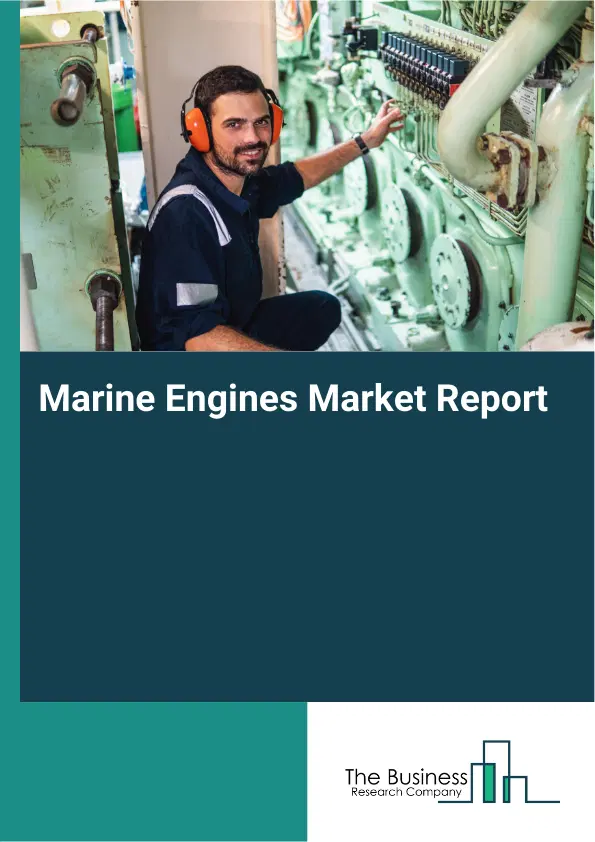
Marine Engines Market Report 2026
Global Outlook – By Engine Type (Diesel Engine, Gas Turbine), By Ship Type (Oil Tankers, Bulk Carriers, General Cargo Ships, Container Ship), By Fuel Type (Heavy Fuel Oil, Intermediate Fuel Oil, Marine Diesel Oil, Marine Gas Oil, LNG, Other Fuel Types), By Stroke (Four Stroke, Two Stroke), By Power Range (Up to 1,000 HP, 1,001–5,000 HP, 5,001–10,000 HP, 10,001–20,000 HP, Above 20,000 HP) – Market Size, Trends, Strategies, and Forecast to 2035
Marine Engines Market Overview
• Marine Engines market size has reached to $10.82 billion in 2025 • Expected to grow to $14.17 billion in 2030 at a compound annual growth rate (CAGR) of 5.5% • Growth Driver: Rising International Marine Freight Transport Fuels Demand For Marine Engines • Market Trend: Advancements In Marine Engines High-Pressure Fuel Injection Systems For Enhanced Efficiency And Reduced Emissions • Asia-Pacific was the largest region in 2025.
What Is Covered Under Marine Engines Market?
Marine engines refer to a heat engine used to transform heat energy into mechanical energy by burning fuel to propel a ship. It is installed or planned to be installed on a marine vessel. Marine engines are categorized as propulsion marine engine, which propels or guides the movement of a ship through the sea, and auxiliary marine engine refers to a propulsion-less marine engine. The main types of marine engines are diesel engine, gas turbine, natural engine, and other engine types. The gas turbine can convert natural gas or other liquid fuels to mechanical energy. These marine engines are used ships like oil tankers, bulk carriers, general cargo ships, and container ship. The fuel used to power the marine engines categorized as heavy fuel oil, intermediate fuel oil, marine diesel oil, marine gas oil, LNG, and other fuel types. The marine engines are categorized as four stroke, and two stroke with power ranging from up to 1,000 HP, 1,001–5,000 HP, 5,001–10,000 HP, 10,001–20,000 HP, and above 20,000 HP.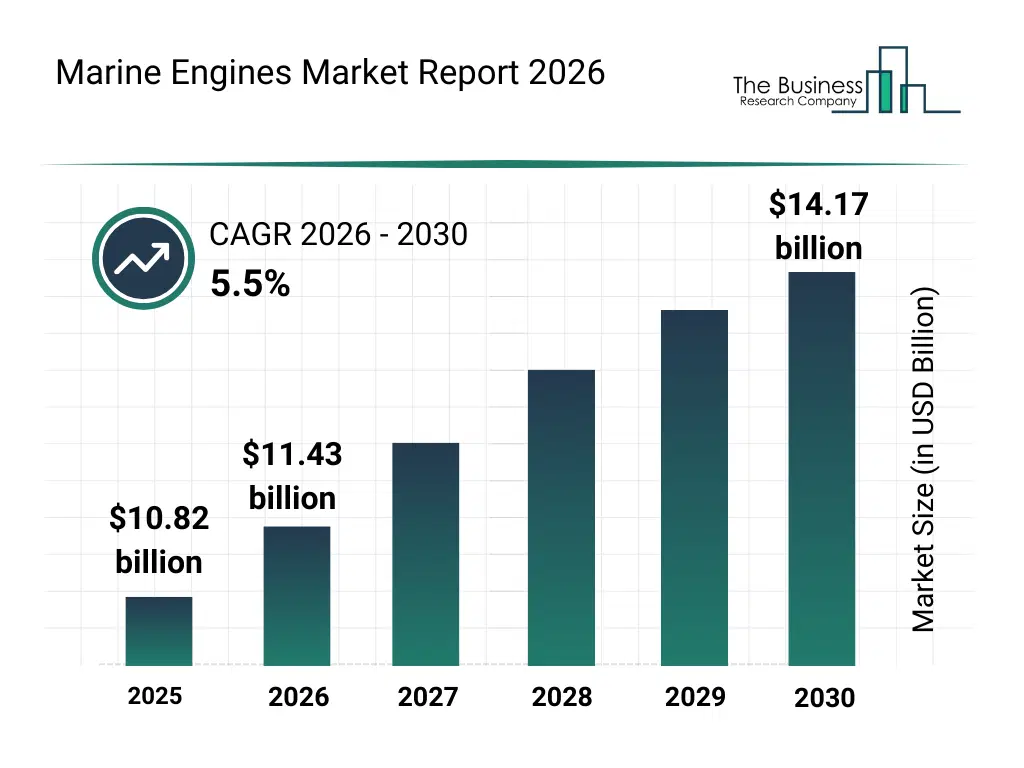
What Is The Marine Engines Market Size and Share 2026?
The marine engines market size has grown strongly in recent years. It will grow from $10.82 billion in 2025 to $11.43 billion in 2026 at a compound annual growth rate (CAGR) of 5.6%. The growth in the historic period can be attributed to global shipping growth, demand for large vessels, diesel engine dominance, maritime trade expansion, shipbuilding investments.What Is The Marine Engines Market Growth Forecast?
The marine engines market size is expected to see strong growth in the next few years. It will grow to $14.17 billion in 2030 at a compound annual growth rate (CAGR) of 5.5%. The growth in the forecast period can be attributed to decarbonization regulations, adoption of alternative fuels, smart engine monitoring, demand for high-power engines, marine efficiency standards. Major trends in the forecast period include shift toward dual-fuel engines, demand for fuel-efficient propulsion, growth of lng-powered vessels, expansion of fleet modernization, adoption of emission control technologies.Tariff Impact On Marine Engines Market
Tariffs are impacting the marine engines market by increasing the cost of imported engine blocks, turbochargers, fuel injection systems, crankshafts, and electronic control modules. Shipowners and shipyards in North America and Europe are most affected due to reliance on imported high-power engines, while Asia-Pacific manufacturers face pricing pressure on exports. These tariffs are raising vessel construction and retrofit costs. However, they are also driving localization of engine manufacturing, regional component sourcing, and innovation in hybrid and low-emission marine engine technologies.Global Marine Engines Market Segmentation
1) By Engine Type: Diesel Engine, Gas Turbine 2) By Ship Type: Oil Tankers, Bulk Carriers, General Cargo Ships, Container Ship 3) By Fuel Type: Heavy Fuel Oil, Intermediate Fuel Oil, Marine Diesel Oil, Marine Gas Oil, LNG, Other Fuel Types 4) By Stroke: Four Stroke, Two Stroke 5) By Power Range: Up to 1,000 HP, 1,001–5,000 HP, 5,001–10,000 HP, 10,001–20,000 HP, Above 20,000 HP Subsegments: 1) By Diesel Engine: Medium-Speed Diesel Engines, High-Speed Diesel Engines 2) By Gas Turbine: Aero-Derivative Gas Turbines, Industrial Gas TurbinesWhat Is The Driver Of The Marine Engines Market?
Growth in international marine freight transport is expected to drive the marine engine market. Marine freight transport refers to ships or cargo used to move goods from one location to another. Marine transport is cheaper and more feasible than railroad and air transportation for international transport. For instance, in October 2024, according to the United Nations Conference on Trade and Development (UNCTAD), a Switzerland-based permanent intergovernmental body of the United Nations, reported that in 2023, global maritime trade grew by 2.4% to 12.3 billion tons, rebounding from the 2022 contraction. The sector is projected to grow by 2% in 2024 and an average of 2.4% annually through 2029. Thus, an increase in international marine freight transport will increase the demand for marine engines.What Is The Driver Of The Marine Engines Market?
Growth in international marine freight transport is expected to drive the marine engine market. Marine freight transport refers to ships or cargo used to move goods from one location to another. Marine transport is cheaper and more feasible than railroad and air transportation for international transport. For instance, in October 2024, according to the United Nations Conference on Trade and Development (UNCTAD), a Switzerland-based permanent intergovernmental body of the United Nations, reported that in 2023, global maritime trade grew by 2.4% to 12.3 billion tons, rebounding from the 2022 contraction. The sector is projected to grow by 2% in 2024 and an average of 2.4% annually through 2029. Thus, an increase in international marine freight transport will increase the demand for marine engines.Global Marine Engines Market Trends and Insights
Major companies operating in the marine engines market are focused on introducing marine engines feature high-pressure fuel injection systems to enhance fuel efficiency, reduce emissions, and improve overall performance. High-pressure fuel injection systems refer to advanced mechanisms used in internal combustion engines, including marine engines, to inject fuel into the combustion chamber at very high pressures. For instance, in September 2024, Scania AB, a Sweden-based company, launched DI13, a marine engine that utilizes a high-pressure fuel injection system, that improves fuel efficiency while reducing emissions, making them compliant with stringent environmental regulations. The engines offer an output range from 220 to 1,150 horsepower (162 to 846 kW), catering to diverse marine applications, including fishing vessels, patrol boats, and cargo ships. These units allow for precise monitoring and adjustments, ensuring optimal performance under varying operational conditions.What Are Latest Mergers And Acquisitions In The Marine Engines Market?
In February 2024, Hanwha Group, a South Korea-based conglomerate firm, acquired HSD Engine Co., Ltd., for an undisclosed amount. Through this acquisition, Hanwha Group aims to offer total shipbuilding solutions by integrating HSD Engine’s low-speed marine propulsion engines, including eco-friendly and dual-fuel technologies, thereby strengthening its capabilities in large-scale ship propulsion systems and sustainable maritime solutions. HSD Engine Co., Ltd. is a South Korea-based company specializing in the design and manufacture of large, low-speed marine engines for container ships.Regional Outlook
Asia-Pacific was the largest region in the marine engines market share in 2025. The regions covered in this market report are Asia-Pacific, South East Asia, Western Europe, Eastern Europe, North America, South America, Middle East, Africa The countries covered in this market report are Australia, Brazil, China, France, Germany, India, Indonesia, Japan, Taiwan, Russia, South Korea, UK, USA, Canada, Italy, Spain.What Defines the Marine Engines Market?
The marine engines market consists of sales of outboard marine engines, inboard marine engines, sterndrive marine engines, and jet drive marine engines. Values in this market are ‘factory gate’ values, that is the value of goods sold by the manufacturers or creators of the goods, whether to other entities (including downstream manufacturers, wholesalers, distributors, and retailers) or directly to end customers. The value of goods in this market includes related services sold by the creators of the goods.How is Market Value Defined and Measured?
The market value is defined as the revenues that enterprises gain from the sale of goods and/or services within the specified market and geography through sales, grants, or donations in terms of the currency (in USD unless otherwise specified). The revenues for a specified geography are consumption values that are revenues generated by organizations in the specified geography within the market, irrespective of where they are produced. It does not include revenues from resales along the supply chain, either further along the supply chain or as part of other products.What Key Data and Analysis Are Included in the Marine Engines Market Report 2026?
The marine engines market research report is one of a series of new reports from The Business Research Company that provides market statistics, including industry global market size, regional shares, competitors with the market share, detailed market segments, market trends and opportunities, and any further data you may need to thrive in the marine engines industry. The market research report delivers a complete perspective of everything you need, with an in-depth analysis of the current and future state of the industry.Marine Engines Market Report Forecast Analysis
| Report Attribute | Details |
|---|---|
| Market Size Value In 2026 | $11.43 billion |
| Revenue Forecast In 2035 | $14.17 billion |
| Growth Rate | CAGR of 5.6% from 2026 to 2035 |
| Base Year For Estimation | 2025 |
| Actual Estimates/Historical Data | 2020-2025 |
| Forecast Period | 2026 - 2030 - 2035 |
| Market Representation | Revenue in USD Billion and CAGR from 2026 to 2035 |
| Segments Covered | Engine Type, Ship Type, Fuel Type, Stroke, Power Range |
| Regional Scope | Asia-Pacific, Western Europe, Eastern Europe, North America, South America, Middle East, Africa |
| Country Scope | The countries covered in the report are Australia, Brazil, China, France, Germany, India, ... |
| Key Companies Profiled | Honda Motor Co Ltd., Caterpillar Marine Power Systems, Volvo Penta AB, Suzuki Motor Corporation, Hyundai Heavy Industries Co Ltd., Mitsubishi Heavy Industries Ltd., Cummins Inc., Isuzu Motors Ltd., Kubota Corporation, Scania AB, Rolls-Royce plc, Yanmar Holdings Co Ltd., MTU Friedrichshafen GmbH, Wärtsilä Oyj Abp, MAN Energy Solutions SE, Mercury Marine, Perkins Engines Company Limited, DEUTZ AG, Detroit Diesel Corporation, Lister Petter Ltd., Nanni Diesel S.r.l., Beta Marine OY, Tohatsu Corporation, Weichai Power Co Ltd. |
| Customization Scope | Request for Customization |
| Pricing And Purchase Options | Explore Purchase Options |