
Oil And Gas Infrastructure Market Report 2026
Global Outlook – By Category (Surface And Lease Equipment, Gathering And Processing, Oil, Gas And NGL Pipelines, Oil And Gas Storage, Refining And Oil Products Transport, Export Terminals), By Operation (Transmission, Distribution), By Deployment (Onshore, Offshore) – Market Size, Trends, Strategies, and Forecast to 2030
Oil And Gas Infrastructure Market Overview
• Oil And Gas Infrastructure market size has reached to $798.89 billion in 2025 • Expected to grow to $1187.45 billion in 2030 at a compound annual growth rate (CAGR) of 8.3% • Growth Driver: Natural Gas Boom Fuels Soaring Growth In Oil And Gas Infrastructure Market • Market Trend: Increasing Focus On Product Innovations To Provide Reliable Services To Their Customers • Europe was the largest region in 2025.Market Gains By 2030 – Top Opportunities By Segment
Market Gain identifies the most promising market opportunities by highlighting the segments or products expected to generate the highest incremental revenue growth over the next five years.
What Is Covered Under Oil And Gas Infrastructure Market?
Oil and gas infrastructure refers to the buildings, equipment, and systems that energy companies need to run their operations. Upstream oil and gas producers require infrastructure to find and use energy resources. Midstream producers have access to the necessary infrastructure for processing and refining fuel. Additionally, by employing infrastructure, downstream producers deliver and sell gas and oil to retailers. The main categories of oil and gas infrastructure include surface and lease equipment, gathering and processing, oil, gas and NGL pipelines, oil and gas storage, refining and oil products transport, and export terminals. Surface equipment refers to the contractor's equipment that isn't specifically classified as Subsea Equipment, including DP equipment, whether it's above or below the water's surface. The operations include transmission and distribution employed in onshore and offshore deployments.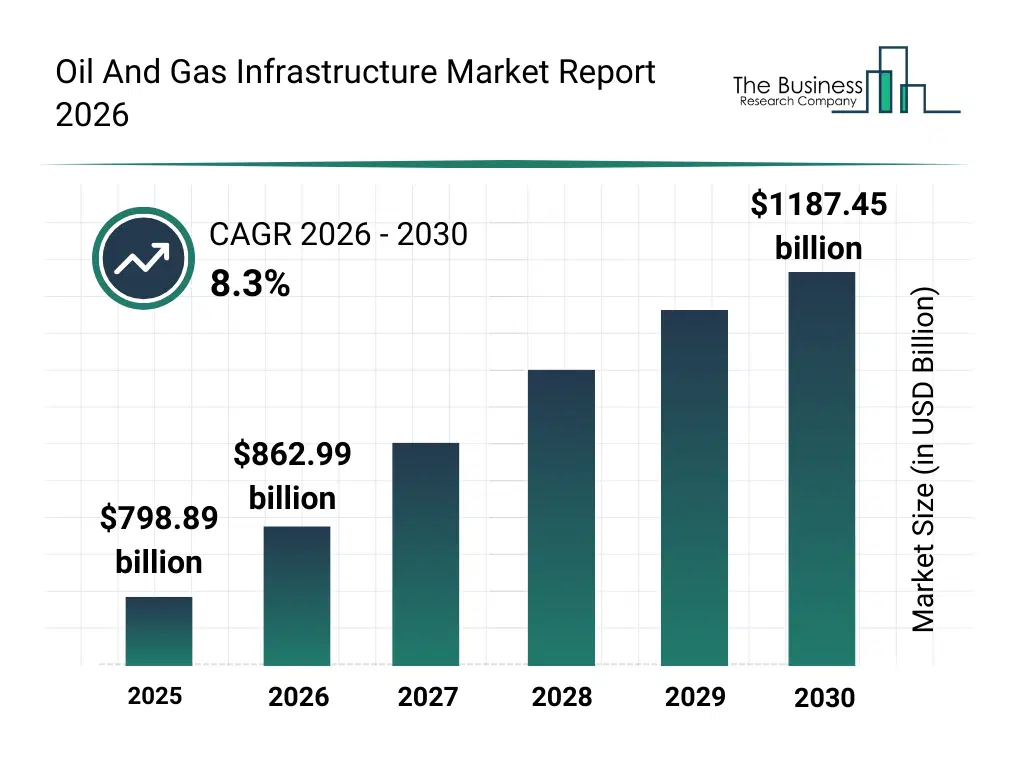
What Is The Oil And Gas Infrastructure Market Size and Share 2026?
The oil and gas infrastructure market size has grown strongly in recent years. It will grow from $798.89 billion in 2025 to $862.99 billion in 2026 at a compound annual growth rate (CAGR) of 8.0%. The growth in the historic period can be attributed to growth in global oil and gas production, expansion of refining capacity, rising demand for fuel transportation, investments in pipeline networks, development of export terminals.What Is The Oil And Gas Infrastructure Market Growth Forecast?
The oil and gas infrastructure market size is expected to see strong growth in the next few years. It will grow to $1187.45 billion in 2030 at a compound annual growth rate (CAGR) of 8.3%. The growth in the forecast period can be attributed to increasing lng trade volumes, rising offshore field developments, focus on energy security infrastructure, investments in resilient supply chains, modernization of downstream infrastructure. Major trends in the forecast period include expansion of pipeline and storage infrastructure, rising investments in lng and export terminals, modernization of aging oil and gas assets, increasing focus on midstream capacity expansion, growth of offshore infrastructure development.
Global Oil And Gas Infrastructure Market Segmentation
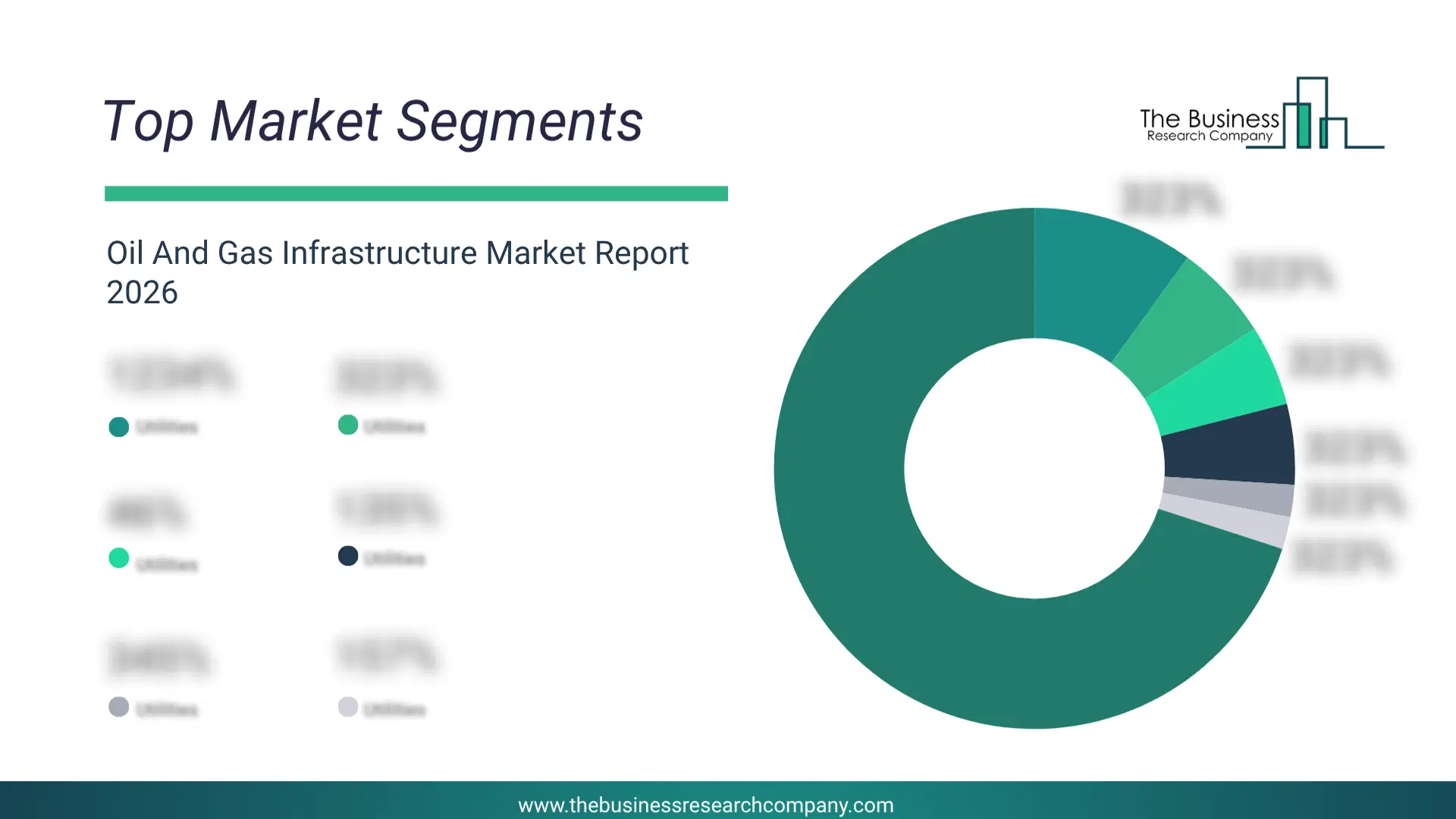
1) By Category: Surface And Lease Equipment, Gathering And Processing, Oil, Gas And NGL Pipelines, Oil And Gas Storage, Refining And Oil Products Transport, Export Terminals 2) By Operation: Transmission, Distribution 3) By Deployment: Onshore, Offshore Subsegments: 1) By Surface And Lease Equipment: Wellhead Equipment, Separators And Treaters, Pumps And Compressors 2) By Gathering And Processing: Gathering Systems, Processing Facilities 3) By Oil, Gas, And NGL Pipelines: Crude Oil Pipelines, Natural Gas Pipelines, Natural Gas Liquids (NGL) Pipelines 4) By Oil And Gas Storage: Aboveground Storage Tanks (ASTs), Underground Storage (UGS), LNG Storage Tanks 5) By Refining And Oil Products Transport: Refineries, Product Pipelines, Transportation And Distribution Systems 6) By Export Terminals: Crude Oil Export Terminals, LNG Export Terminals, Product Export Terminals The top segments in the oil and gas infrastructure market will be: • Oil, Gas And NGL Pipelines will reach $347 Billion by 2030. • Surface And Lease Equipment will reach $211 Billion by 2030. • Refining And Oil Products Transport will reach $194 Billion by 2030. • Gathering And Processing will reach $193 Billion by 2030. • Oil And Gas Storage will reach $138 Billion by 2030.What Is The Driver Of The Oil And Gas Infrastructure Market?
The rising demand for natural gas is expected to propel the growth of the oil and gas infrastructure market going forward. Natural gas is a colorless and odorless fossil fuel composed of one carbon atom and four hydrogen atoms (CH₄ or methane) and is considered the cleanest fossil fuel. The increase in global natural gas demand is driving higher production levels, which in turn requires the development of additional infrastructure to transport, store, and distribute the fuel efficiently. Natural gas infrastructure development supports energy security by enabling reliable supply, optimizing distribution networks, and supporting cleaner energy transitions. For instance, in May 2024, according to the European Commission, a Belgium-based executive branch of the European Union, in 2023, natural gas demand increased in Finland (+25.6%), Sweden (+11.1%), Poland (+5.3%), Malta (+4.5%), Denmark (+1.1%), and Croatia (+0.8%) compared to 2022. Therefore, the rising demand for natural gas is driving the growth of the oil and gas infrastructure industry.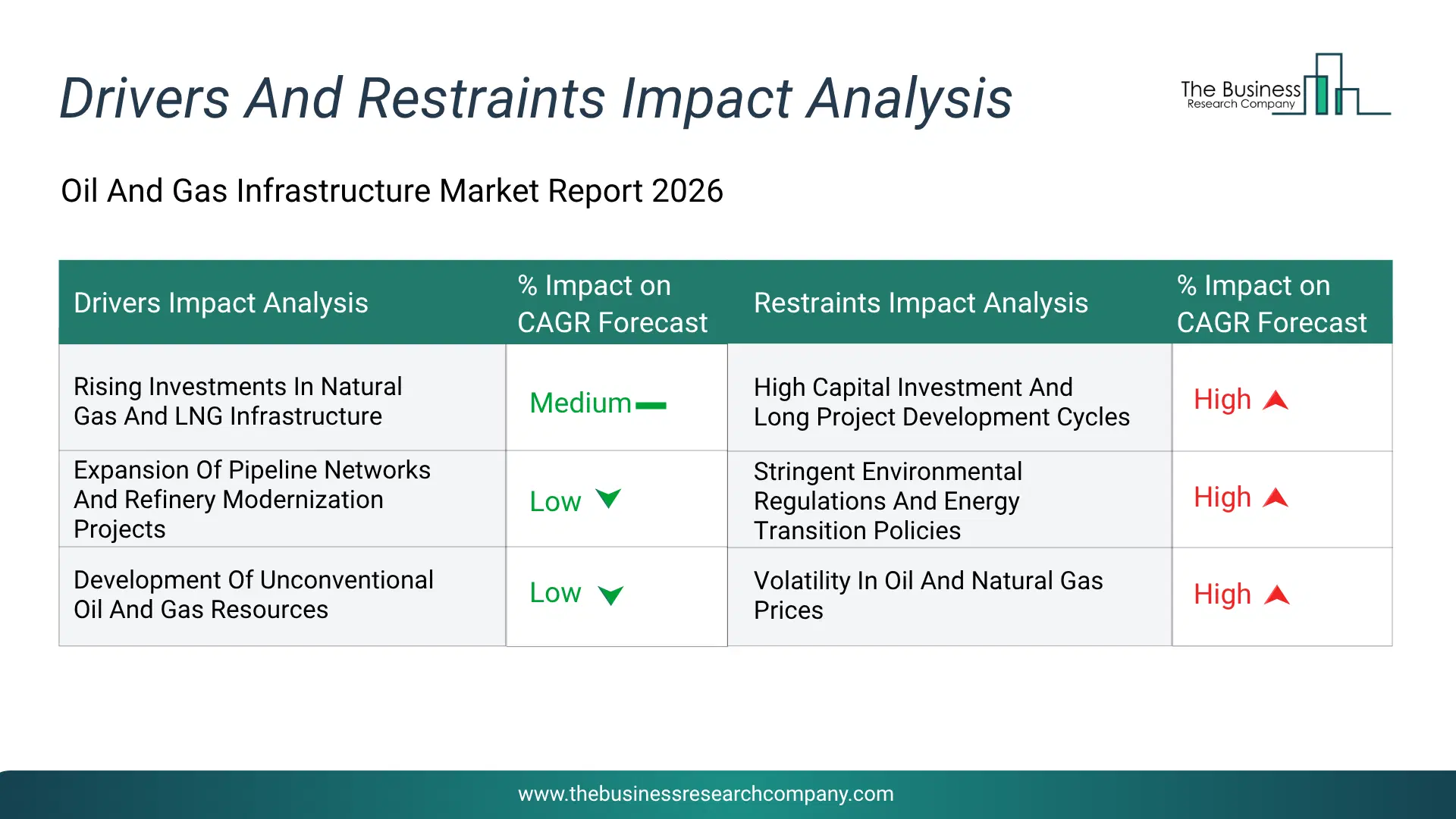
Infographic Chart Showing Key Market Drivers Analysis And Restraints For Oil And Gas Infrastructure Market
The chart presents an impact analysis of key drivers and restraints, quantifying their relative influence on the market's growth rate and helping assess the balance between growth enablers and limiting factors. This chart offers a high-level perspective; the full report contains more detailed insights.
How Will The Drivers Impact Growth In The Global Oil And Gas Infrastructure Market?
• Rising Investments In Natural Gas And LNG Infrastructure (Medium) – During the forecast period, the rising investments in natural gas and LNG infrastructure are expected to emerge as a major factor driving the expansion of the oil and gas infrastructure market by 2030. governments and energy companies are expanding LNG liquefaction plants, regasification terminals, gas processing facilities, storage terminals, compressor stations, and transmission pipelines to strengthen energy security and meet growing global demand for natural gas. the increasing importance of LNG in international energy trade and the growing role of natural gas as a transition fuel are further supporting long-term infrastructure investments. • Expansion Of Pipeline Networks And Refinery Modernization Projects (Low) – During the forecast period, the expansion of pipeline networks and refinery modernization projects is expected to emerge as a major factor driving the expansion of the oil and gas infrastructure market by 2030. ongoing investments in upgrading aging pipeline systems, expanding crude oil and natural gas transportation capacity, and modernizing refineries with advanced automation, digital monitoring, and emission control technologies are improving operational efficiency and supply chain reliability. these developments continue to generate significant demand for engineering, construction, and maintenance services across the energy sector. • Development Of Unconventional Oil And Gas Resources (Low) – During the forecast period, the development of unconventional oil and gas resources is expected to act as a key growth catalyst for the oil and gas infrastructure market by 2030. increasing production of shale gas, shale oil, tight oil, and coal bed methane is creating demand for new gathering systems, processing plants, compressor stations, storage facilities, and export infrastructure to support commercial operations. technological advancements in horizontal drilling and hydraulic fracturing are further accelerating upstream and midstream infrastructure development.How Will The Restraints Impact Growth In The Global Oil And Gas Infrastructure Market?
• High Capital Investment And Long Project Development Cycles (Medium) – During the forecast period, high Capital Investment And Long Project Development Cycles remain one of the biggest challenges for the Oil And Gas Infrastructure Market because large-scale projects require enormous financial resources and extended development periods before becoming operational. Infrastructure such as cross-country pipelines, LNG export terminals, refineries, offshore production facilities, and underground storage systems often require billions of dollars in investment, complex engineering, environmental assessments, regulatory approvals, land acquisition, and multi-year construction schedules. Rising construction costs, labor shortages, inflation, and financing risks further increase project expenses, while long payback periods discourage investors from committing capital, particularly during periods of market uncertainty. These factors often delay infrastructure expansion and reduce the number of new projects entering the market. • Stringent Environmental Regulations And Energy Transition Policies (Low) – During the forecast period, stringent Environmental Regulations And Energy Transition Policies are restraining market growth by increasing compliance requirements and limiting investments in conventional oil and gas infrastructure. Governments worldwide are implementing stricter carbon emission standards, methane reduction regulations, environmental impact assessments, and permitting requirements for new infrastructure projects. Simultaneously, increasing investments in renewable energy, electrification, hydrogen, and net-zero emission initiatives are shifting capital away from conventional fossil fuel infrastructure. These policy changes increase project costs, extend approval timelines, and create uncertainty regarding long-term returns on investment, making developers more cautious about launching large-scale oil and gas infrastructure projects. • Volatility In Oil And Natural Gas Prices (Low) – During the forecast period, volatility In Oil And Natural Gas Prices significantly restrains the Oil And Gas Infrastructure Market because fluctuations in global energy prices directly influence exploration budgets, production plans, and infrastructure investment decisions. During periods of declining crude oil or natural gas prices, energy companies often reduce capital expenditures, postpone pipeline construction, delay refinery upgrades, and cancel large infrastructure developments to preserve cash flow. Unpredictable commodity prices also create uncertainty for financial institutions and investors, making it more difficult to secure funding for long-term projects. Since most infrastructure assets require decades to recover investment costs, prolonged price instability can considerably slow market expansion and reduce overall infrastructure development activity.Key Players In The Global Oil And Gas Infrastructure Market
Major companies operating in the oil and gas infrastructure market are NGL Energy Partners LP, Centrica PLC, Kinder Morgan Inc., Schlumberger Limited, Royal Vopak NV, Shell PLC, Exxon Mobil Corporation, Baker Hughes Company, Chevron Corporation, TotalEnergies SE, ConocoPhillips Company, British Petroleum PLC, Energy Transfer LP, Marathon Oil Corporation, Occidental Petroleum Corporation, Hatch Ltd., Aker Solutions ASA, Subsea 7 S.A., Saipem S.p.A., Fluor Corporation, KBR Inc., WorleyParsons Limited, Bechtel Corporation, CH2M Hill Companies Ltd., SNC-Lavalin Group Inc., Petrofac Limited, Chicago Bridge & Iron Company N.V., Shawcor Ltd., The Shaw Group Inc., Foster Wheeler AG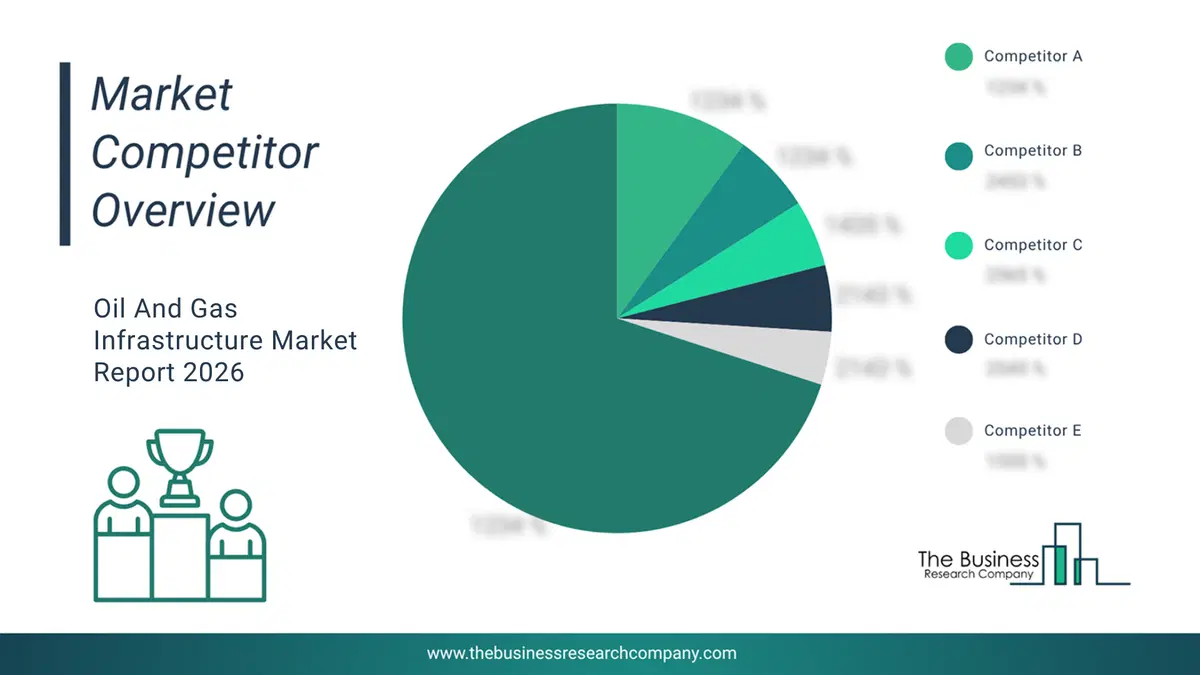
This chart is for illustrative purposes; the full report includes a detailed competitor analysis and comprehensive overview of the top 10 companies in the market.
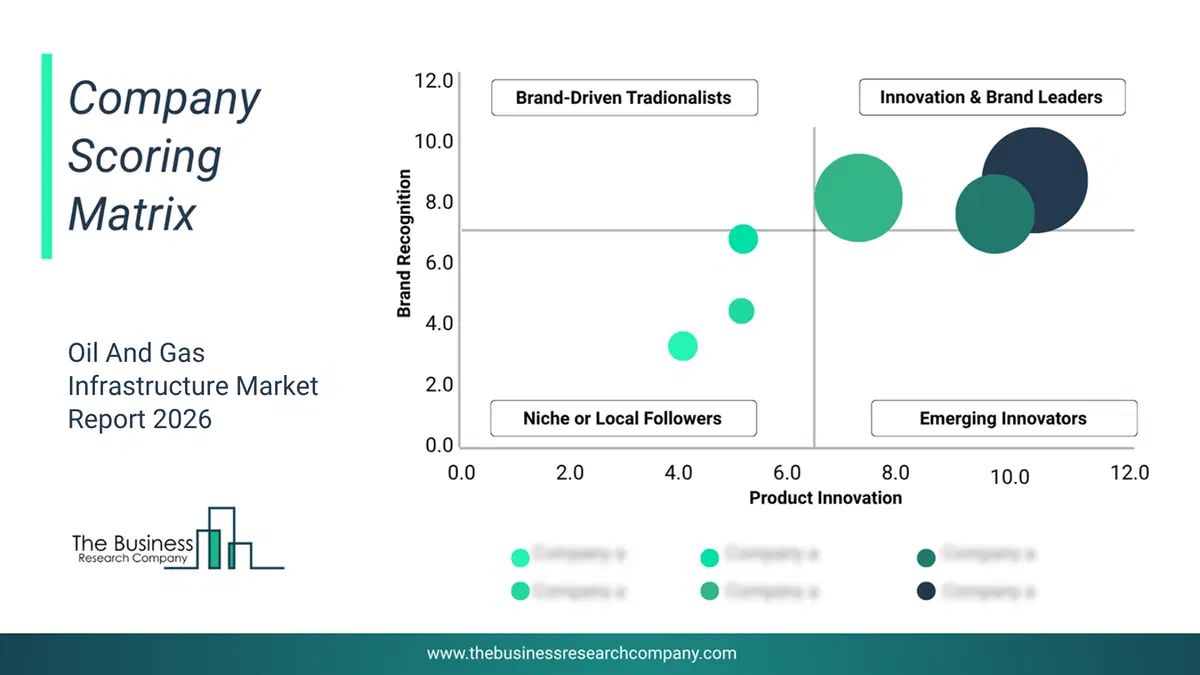
This chart maps companies by product innovation and brand strength, with bubble size indicating relative revenue, helping identify market leaders, challengers, and niche players. This is an illustrative chart; the full report provides a complete and accurate competitive analysis.
Global Oil And Gas Infrastructure Market Trends and Insights
Major companies operating in the oil and gas infrastructure market are focusing on innovative products, such as intelligent architecture and E&P solutions, to drive revenues in their market. Intelligent architecture and E&P solution typically refer to the integration of advanced technologies and data analytics into the design and operation of systems within the oil and gas industry. For instance, in September 2023, Huawei Technologies Co. Ltd., a China-based technology and telecommunications company, launched intelligent architecture and E&P solutions for the oil and gas industry. Huawei's intelligent exploration and production (E&P) solution combines high-performance computing, large-scale data storage, AI models for exploration, and cooperative scheduling of hardware and software resources. E&P research can be conducted more effectively and refined by oil and gas companies with the use of new technologies such as storage, cloud computing, AI, and high-performance computer platforms.What Are Latest Mergers And Acquisitions In The Oil And Gas Infrastructure Market?
In August 2025, Hazoor Multi Projects Ltd., an India based infrastructure and engineering company, acquired Quippo Oil and Gas Infrastructure Ltd. for an undisclosed amount. With this acquisition, Hazoor Multi Projects aimed to strategically expand its footprint into the upstream oil & gas services sector, diversifying beyond traditional infrastructure engineering into high margin oilfield services and offshore energy capabilities. Quippo Oil and Gas Infrastructure Ltd. is an India based oilfield services provider that specializes in offering drilling rig services, equipment rentals, and technical/operational support for onshore and offshore oil & gas exploration and production activities.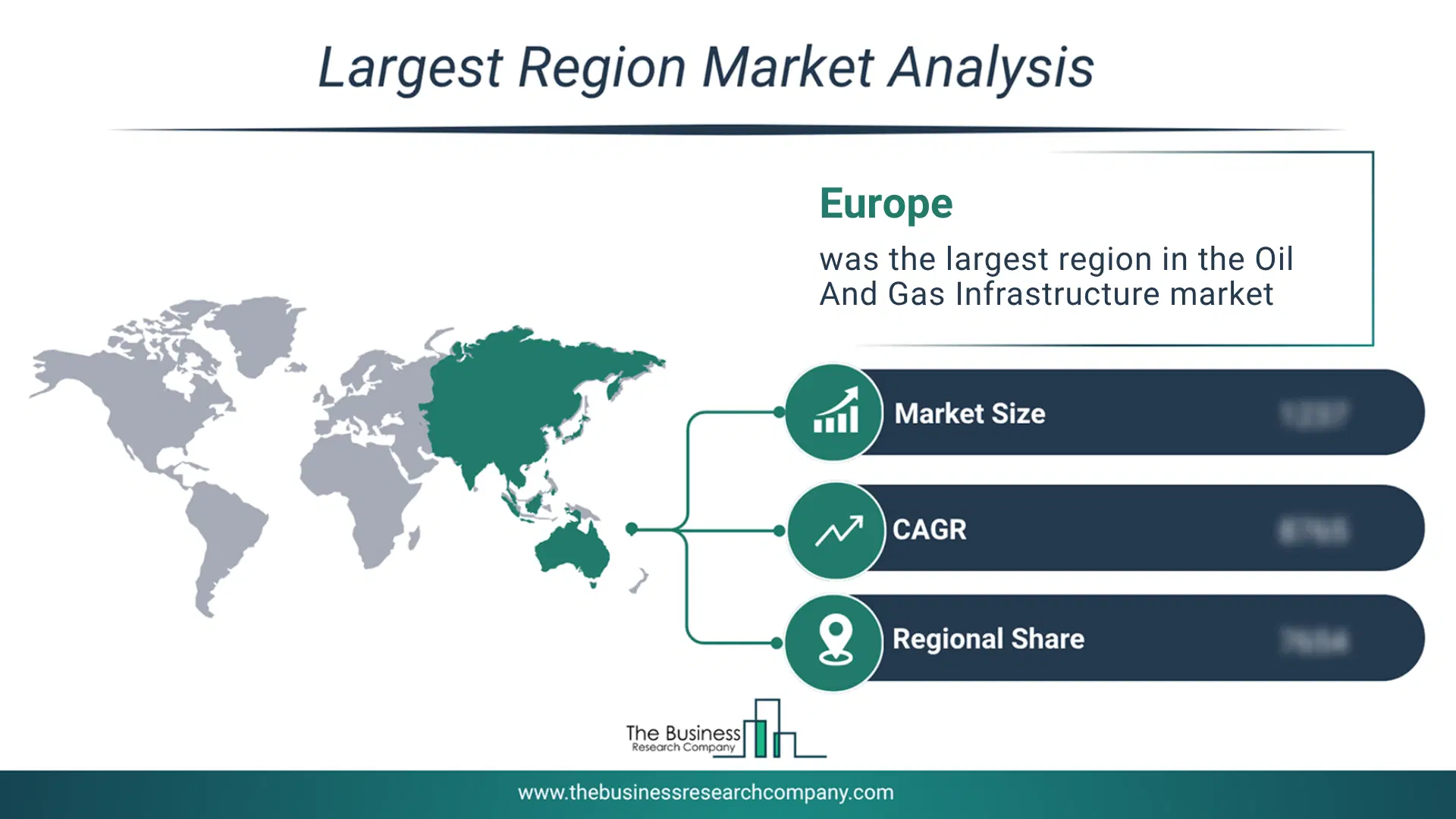
Regional Outlook
Europe was the largest region in the oil and gas infrastructure market in 2025. The regions covered in this market report are Asia-Pacific, South East Asia, Western Europe, Eastern Europe, North America, South America, Middle East, Africa. The countries covered in this market report are Australia, Brazil, China, France, Germany, India, Indonesia, Japan, Taiwan, Russia, South Korea, UK, USA, Canada, Italy, SpainWhat Defines the Oil And Gas Infrastructure Market?
The oil and gas infrastructure market consists of sales of oil and gas-related products. Values in this market are ‘factory gate’ values, that is the value of goods sold by the manufacturers or creators of the goods, whether to other entities (including downstream manufacturers, wholesalers, distributors, and retailers) or directly to end customers. The value of goods in this market includes related services sold by the creators of the goods.How is Market Value Defined and Measured?
The market value is defined as the revenues that enterprises gain from the sale of goods and/or services within the specified market and geography through sales, grants, or donations in terms of the currency (in USD unless otherwise specified). The revenues for a specified geography are consumption values that are revenues generated by organizations in the specified geography within the market, irrespective of where they are produced. It does not include revenues from resales along the supply chain, either further along the supply chain or as part of other products.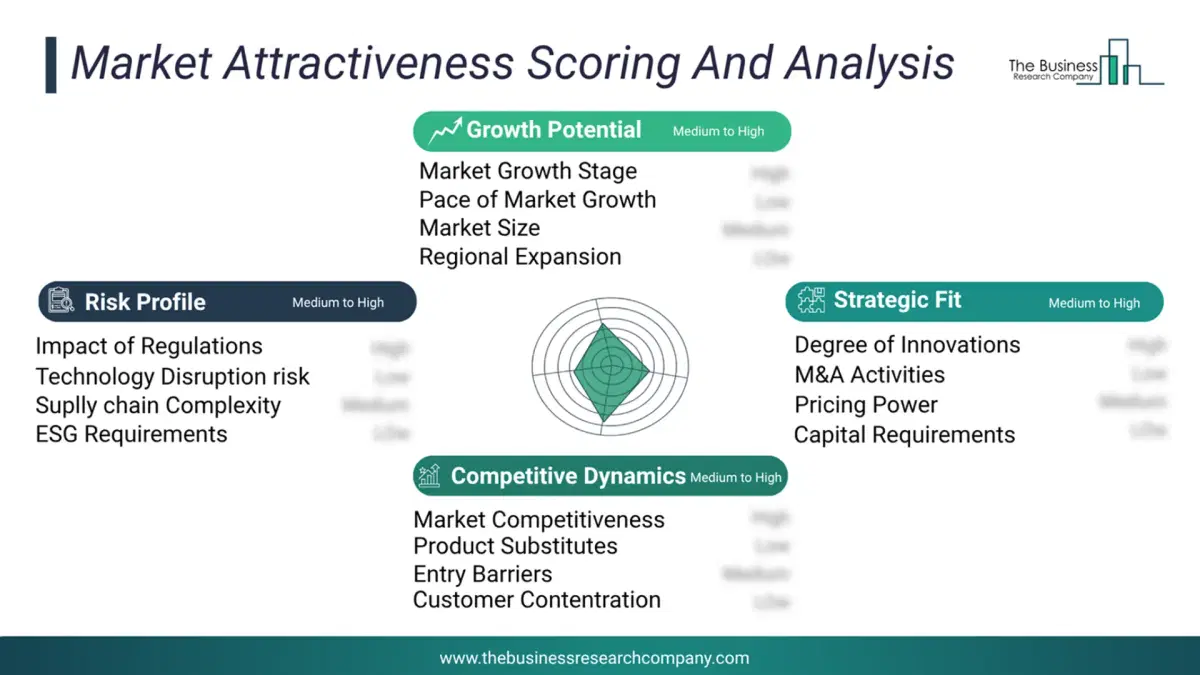
This chart presents market attractiveness based on a quantitative evaluation of growth, competition, strategic alignment, and risk, offering a clear view of opportunity areas for decision-making. This chart is for illustrative purposes; the full report contains the complete analysis.
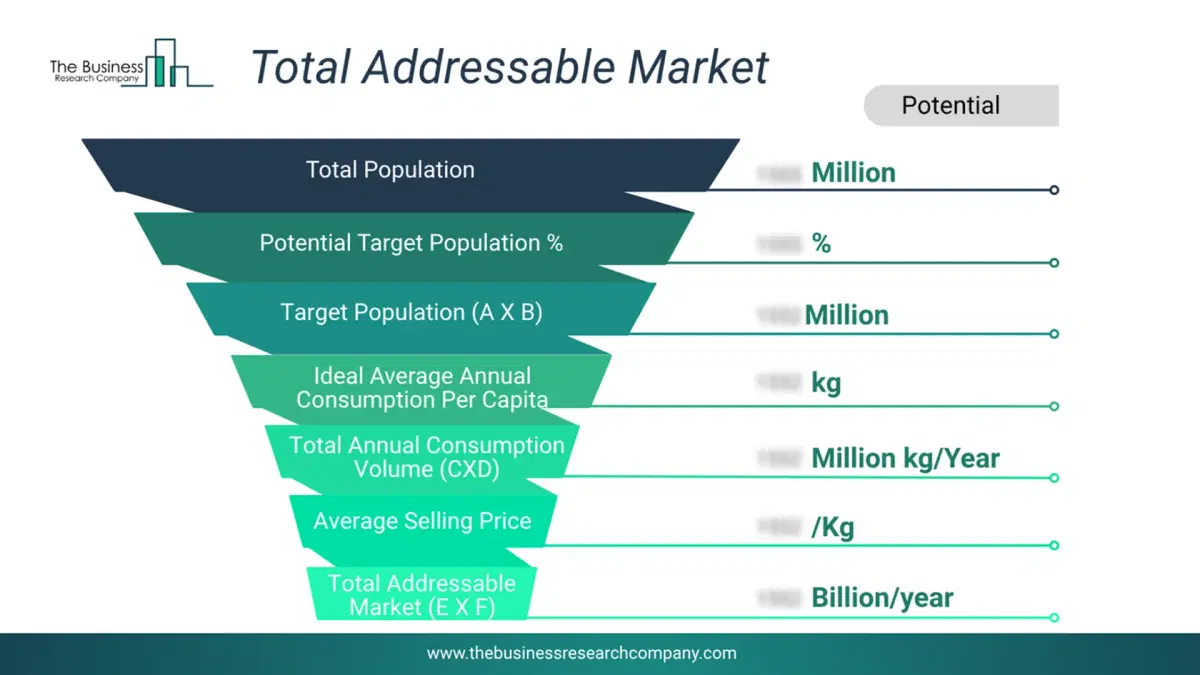
This chart highlights the Total Addressable Market (TAM) by estimating the maximum revenue opportunity using an assumption-driven approach, supporting strategic planning and opportunity sizing across markets. The chart is illustrative; the full report provides a more comprehensive analysis.
What Key Data and Analysis Are Included in the Oil And Gas Infrastructure Market Report 2026?
The oil and gas infrastructure market research report is one of a series of new reports from The Business Research Company that provides market statistics, including industry global market size, regional shares, competitors with the market share, detailed market segments, market trends and opportunities, and any further data you may need to thrive in the oil and gas infrastructure industry. The market research report delivers a complete perspective of everything you need, with an in-depth analysis of the current and future state of the industry.Oil And Gas Infrastructure Market Report Forecast Analysis
| Report Attribute | Details |
|---|---|
| Market Size Value In 2026 | $862.99 billion |
| Revenue Forecast In 2030 | $1187.45 billion |
| Growth Rate | CAGR of 8.3% from 2026 to 2030 |
| Base Year For Estimation | 2025 |
| Actual Estimates/Historical Data | 2020-2025 |
| Forecast Period | 2026 - 2030 |
| Market Representation | Revenue in USD Billion and CAGR from 2026 to 2030 |
| Segments Covered | Category, Operation, Deployment |
| Regional Scope | Asia-Pacific, Western Europe, Eastern Europe, North America, South America, Middle East, Africa |
| Country Scope | The countries covered in the report are Australia, Brazil, China, France, Germany, India, Indonesia, Japan, Taiwan, Russia, South Korea, UK, USA, Canada, Italy, Spain. |
| Key Companies Profiled | NGL Energy Partners LP, Centrica PLC, Kinder Morgan Inc., Schlumberger Limited, Royal Vopak NV, Shell PLC, Exxon Mobil Corporation, Baker Hughes Company, Chevron Corporation, TotalEnergies SE, ConocoPhillips Company, British Petroleum PLC, Energy Transfer LP, Marathon Oil Corporation, Occidental Petroleum Corporation, Hatch Ltd., Aker Solutions ASA, Subsea 7 S.A., Saipem S.p.A., Fluor Corporation, KBR Inc., WorleyParsons Limited, Bechtel Corporation, CH2M Hill Companies Ltd., SNC-Lavalin Group Inc., Petrofac Limited, Chicago Bridge & Iron Company N.V., Shawcor Ltd., The Shaw Group Inc., Foster Wheeler AG |
| Customization Scope | Request for Customization |
| Pricing And Purchase Options | Explore Purchase Options |