
Structured Cabling Market Report 2026
Global Outlook – By Product Type (Fiber Optic Cables, Copper Cables), By Application (LAN, Data Center), By End Use Industry (IT And Telecommunication, Residential And Commercial, Government And Education, Transportation, Industrial, Other End Users) – Market Size, Trends, Strategies, and Forecast to 2030
Structured Cabling Market Overview
• Structured Cabling market size has reached to $14.8 billion in 2025 • Expected to grow to $23.82 billion in 2030 at a compound annual growth rate (CAGR) of 10% • Growth Driver: Residential Sector Drives Growth In The Structured Cabling Market • Market Trend: Innovative Product Launches Driving Structured Cabling Market Growth • North America was the largest region in 2025 and Asia-Pacific is the fastest growing region.Market Gains By 2030 – Top Opportunities By Segment
Market Gain identifies the most promising market opportunities by highlighting the segments or products expected to generate the highest incremental revenue growth over the next five years.
What Is Covered Under Structured Cabling Market?
Structured cabling refers to a full cabling system with related devices that offers a complete communications infrastructure. This infrastructure is used for a variety of purposes, including phone service and data transmission across computer networks. Structured cabling is defined as building or campus cabling infrastructure such as telecommunication cabling or ethernet cabling, a properly designed and installed structure cabling provides the infrastructure that delivers the flexibility to make changes to the cabling system, maximize system availability, and delivers predictable performance. The main types of structured cabling are fiber optic cables and copper cables. A fiber optic cable is a medium that contains one or more optical fibers through which high-speed data is transmitted. Copper cable is a physical cable medium made of copper through which data is transmitted. The structured cabling is used by IT & telecommunication, residential & commercial, government & education, and transportation industries for applications in local area networks (LAN) and data centers.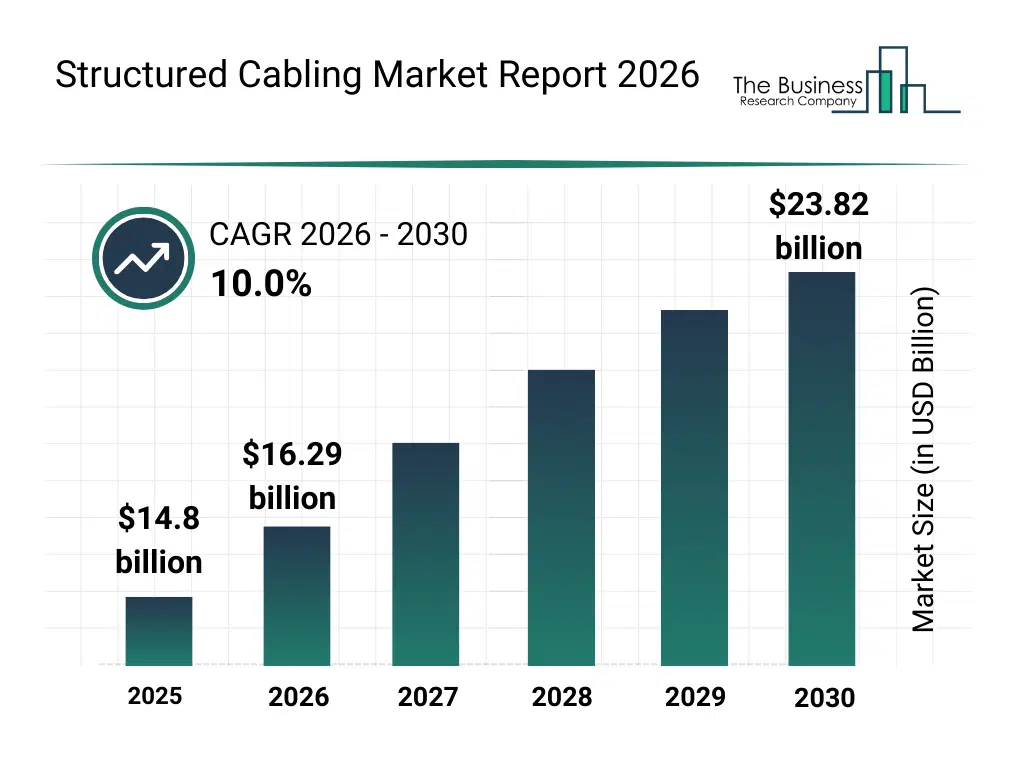
What Is The Structured Cabling Market Size and Share 2026?
The structured cabling market size has grown rapidly in recent years. It will grow from $14.8 billion in 2025 to $16.29 billion in 2026 at a compound annual growth rate (CAGR) of 10.1%. The growth in the historic period can be attributed to expansion of enterprise network infrastructure, growth of commercial and residential construction, increasing adoption of lan systems, rising demand for reliable data transmission, widespread use of copper cabling systems.What Is The Structured Cabling Market Growth Forecast?
The structured cabling market size is expected to see strong growth in the next few years. It will grow to $23.82 billion in 2030 at a compound annual growth rate (CAGR) of 10.0%. The growth in the forecast period can be attributed to increasing deployment of data centers, rising adoption of fiber-to-the-building solutions, expansion of smart city infrastructure, growing focus on high-bandwidth connectivity, increasing investments in future-ready network infrastructure. Major trends in the forecast period include increasing deployment of fiber optic cabling systems, rising demand for high-speed data center cabling, growing adoption of structured cabling in smart buildings, expansion of modular and scalable cabling architectures, enhanced focus on network reliability and performance.
Global Structured Cabling Market Segmentation
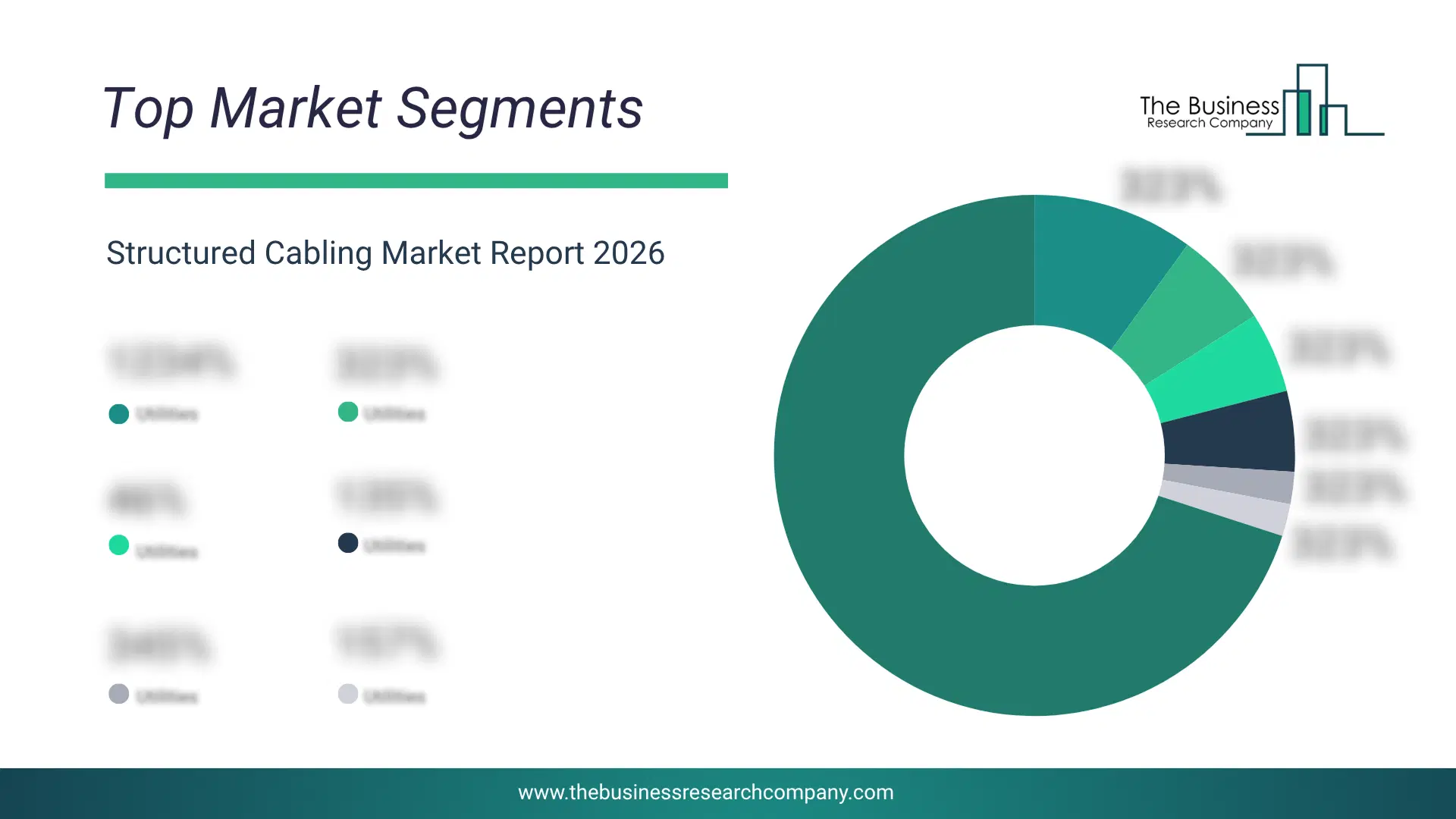
1) By Product Type: Fiber Optic Cables, Copper Cables 2) By Application: LAN, Data Center 3) By End Use Industry: IT And Telecommunication, Residential And Commercial, Government And Education, Transportation, Industrial, Other End Users Subsegments: 1) By Fiber Optic Cables: Single-Mode Fiber (SMF), Multi-Mode Fiber (MMF), Loose-Tube Fiber Cables, Tight-Buffered Fiber Cables 2) By Copper Cables: Twisted Pair Cables, Coaxial Cables, Shielded, Unshielded Cables The top segments in the structured cabling market will be: • Fiber Optic Cables will reach $12.15 Billion by 2030. • Copper Cables will reach $11.66 Billion by 2030.What Is The Driver Of The Structured Cabling Market?
The increasing adoption in residential sector is expected to propel the growth of the structured cabling market going forward. The residential sector refers to the segment of the economy that encompasses housing, primarily for individuals and families as opposed to commercial or industrial purposes. Structured cabling in the residential sector enhances the quality of life, convenience, and value of homes while adapting to the ever-evolving technology landscape. For instance, in October 2023, according to the United States Census Bureau, a US-based principal agency of the federal statistical system, the number of privately owned housing units approved by building permits in February was 1,524,000 on a seasonally adjusted yearly basis. This is 13.8% more than the January rate, which was corrected to 1,339,000. Therefore, the increasing adoption in residential sector is driving the growth of the structured cabling industry.
Infographic Chart Showing Key Market Drivers Analysis And Restraints For Structured Cabling Market
The chart presents an impact analysis of key drivers and restraints, quantifying their relative influence on the market's growth rate and helping assess the balance between growth enablers and limiting factors. This chart offers a high-level perspective; the full report contains more detailed insights.
How Will The Drivers Impact Growth In The Global Structured Cabling Market?
• Accelerating Hyperscale And Edge Data-Center Build-Outs (High) – During the forecast period, the accelerating hyperscale and edge data-center build-outs are expected to become a key growth driver for the structured cabling market by 2030. Enterprises and cloud service providers are rapidly expanding data-center capacity to support growing digital workloads, AI-driven computing, and low-latency data processing requirements. This expansion is increasing demand for high-performance structured cabling systems capable of supporting faster data transfer speeds, scalable network architectures, and uninterrupted connectivity across distributed environments. Edge computing deployments are further strengthening the need for advanced cabling infrastructure in localized facilities. • Surge In Poe And Remote Powering Requirements (Medium) – During the forecast period, the surge in PoE and remote powering requirements is expected to emerge as a major factor driving the expansion of the structured cabling market by 2030. Organizations are increasingly adopting Power over Ethernet solutions to support IP cameras, wireless access points, smart lighting systems, and connected security devices through simplified network infrastructure. This trend is creating strong demand for structured cabling systems capable of delivering both reliable power transmission and high-speed communication within commercial and industrial facilities. Growing deployment of IoT-enabled devices and intelligent automation systems is further accelerating the need for efficient remote powering networks. • Increasing Retrofits For Smart Buildings And Campuses (Low) – During the forecast period, the increasing retrofits for smart buildings and campuses are expected to act as a key growth catalyst for the structured cabling market by 2030. Building owners and institutions are modernizing legacy infrastructure with integrated communication networks to support energy management systems, intelligent surveillance, connected HVAC systems, and digital access controls. Retrofitting activities require flexible and scalable structured cabling solutions that can accommodate evolving connectivity standards and rising bandwidth requirements. Educational campuses, healthcare facilities, and commercial complexes are increasingly prioritizing network modernization to improve operational efficiency and user experience.How Will The Restraints Impact Growth In The Global Structured Cabling Market?
• Rising Adoption Of Enterprise Wlan And 5g Fwa Solutions (High) – During the forecast period, the growing adoption of enterprise WLAN and 5G Fixed Wireless Access (FWA) solutions acts as a restraint on the market. These wireless technologies reduce the dependency on traditional wired infrastructure, limiting demand for cabling and related components. Organizations are increasingly opting for flexible and scalable wireless networks that are easier to deploy and maintain. 5G FWA, in particular, provides high-speed connectivity without extensive physical installations. This shift is especially prominent in remote and temporary setups where wiring is impractical. Additionally, advancements in wireless performance are narrowing the gap between wired and wireless solutions. As a result, the preference for wireless alternatives can slow down market growth. Over time, this trend may reduce investments in traditional infrastructure systems. • Complex Standards Compliance And Testing Costs (Medium) – During the forecast period, the compliance with evolving industry standards and certification requirements presents a significant challenge for market players. Manufacturers must ensure that their products meet stringent performance, safety, and interoperability standards. This process involves extensive testing, validation, and documentation, increasing operational costs. Frequent updates to standards require continuous investment in research and development. Smaller companies may struggle to keep up with these requirements, limiting market participation. Additionally, delays in certification can slow down product launches and adoption. The complexity of compliance also increases time-to-market, affecting competitiveness. Overall, these factors act as a restraint on market expansion. • Supply-Chain Volatility In Copper And Optical Fiber (Low) – During the forecast period, the fluctuations in the supply chain of key raw materials such as copper and optical fiber significantly impact the market. Price volatility and supply disruptions can increase production costs and create uncertainty for manufacturers. Geopolitical tensions, trade restrictions, and logistical challenges further exacerbate these issues. Limited availability of raw materials can delay project timelines and reduce profitability. Companies may struggle to maintain consistent pricing and supply commitments to customers. Additionally, dependency on global supply chains increases vulnerability to external shocks. These disruptions can hinder long-term planning and investment decisions. Consequently, supply-chain instability acts as a major restraint on market growth.Key Players In The Global Structured Cabling Market
Major companies operating in the structured cabling market are CommScope; Nexans SA; Legrand Group; Corning Inc.; Belden Inc.; Schneider Electric SE; Siemon; Panduit Corporation; Furukawa Electric; ABB Group; TE Connectivity; Superior Essex; Reichle & De-Massari AG; Hitachi Cable Ltd.; Teknon Corporation; Brand-Rex; Paige Electric; Datwyler Cabling Solutions AG; Connectix Ltd.; Electra Link Inc.; Network Cabling Services; Desert Communications; Xin Networks PTE Ltd.; Synergy Solution; America Fujikura Ltd.; Intelligent Business Technologies; Black Box Network Services; Vega Global; Sterlite Technologies; Anixter International Inc.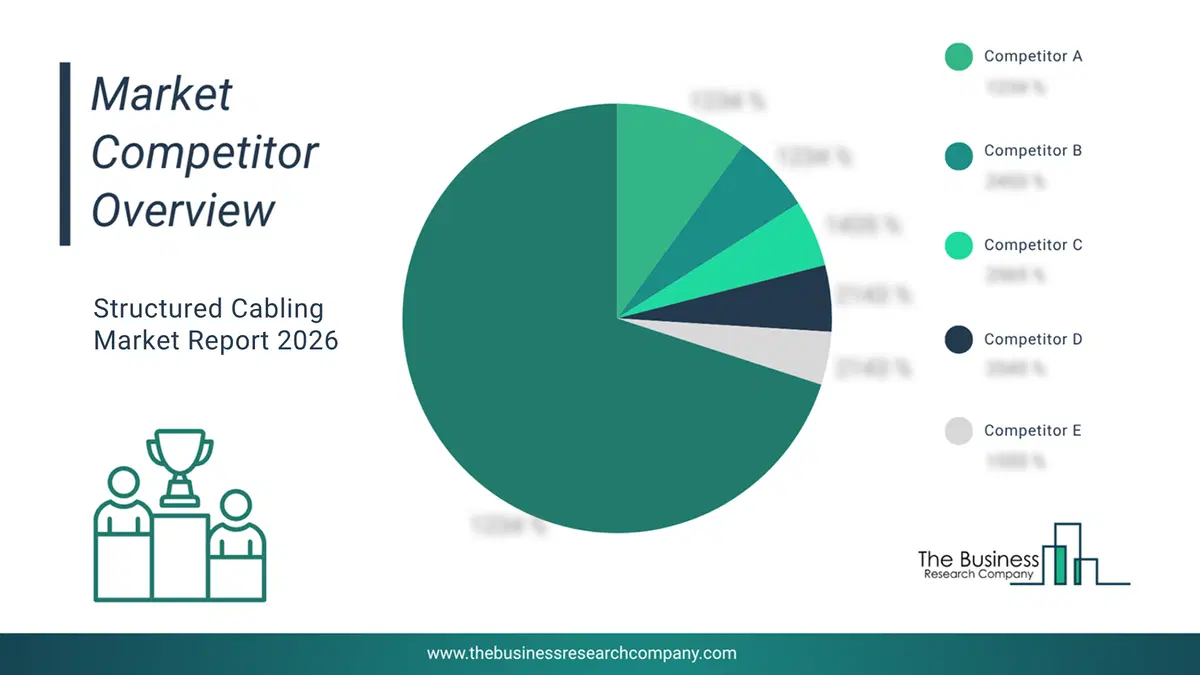
This chart is for illustrative purposes; the full report includes a detailed competitor analysis and comprehensive overview of the top 10 companies in the market.
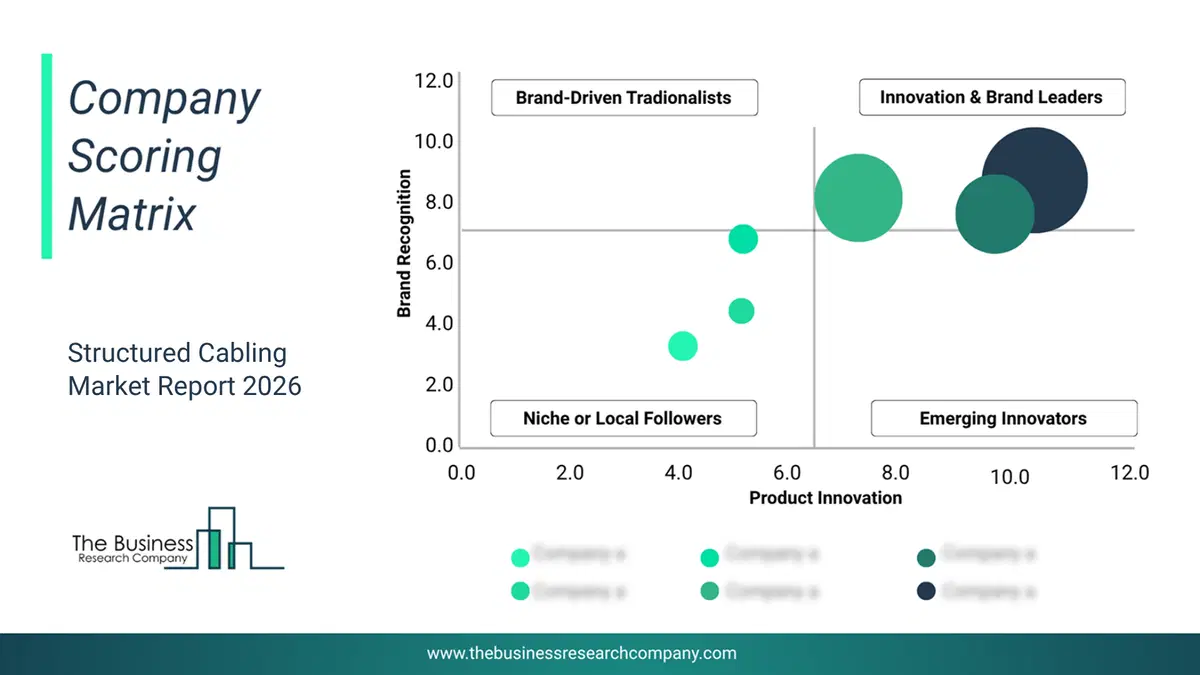
This chart maps companies by product innovation and brand strength, with bubble size indicating relative revenue, helping identify market leaders, challengers, and niche players. This is an illustrative chart; the full report provides a complete and accurate competitive analysis.
Global Structured Cabling Market Trends and Insights
Major companies operating in the structured cabling market are focusing on innovative products such new-age structured cabling solutions to drive revenues in their market. New-age structured cabling solutions are advanced, integrated systems that provide high-speed, reliable data and communication networks within modern buildings, supporting a wide range of devices and applications. For instance, in April 2023, Panduit, a US-based company developing smarter, scalable network infrastructure, launched RapidID network mapping system, a solution designed to streamline and automate the labor-intensive process of cable documentation in network environments. This system aims to enhance efficiency and reduce errors associated with traditional manual documentation methods.What Are Latest Mergers And Acquisitions In The Structured Cabling Market?
In February 2024, Centaris, a US-based company that specializes in cloud-based solutions and IT services acquired Network Connections Inc, (NCI) for an undisclosed amount. The acquisition of Network Connections, Inc. (NCI) by Centaris aims to expand Centaris's IT service offerings and enhance its capabilities in managed IT services, hosted VoIP solutions, and cloud integration. Network Connections, Inc. (NCI) is a US-based IT services provider that specializes in hosted VoIP solutions, cloud integration services, IT consulting, and mobile/remote workplace solutions.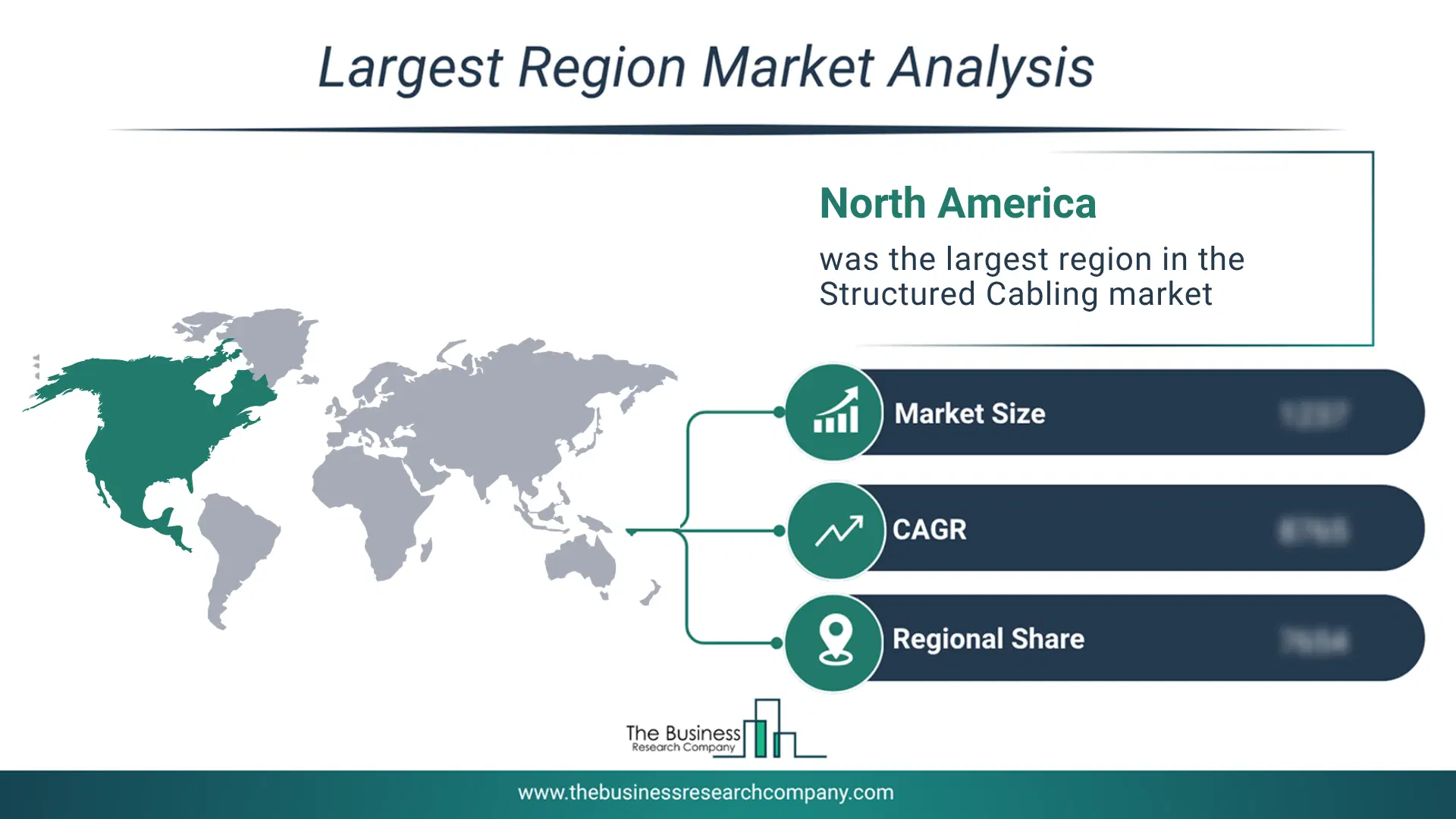
Regional Insights
North America was the largest region in the structured cabling market in 2025. Asia-Pacific is expected to be the fastest-growing region during the forecast period. The regions covered in this market report are Asia-Pacific, South East Asia, Western Europe, Eastern Europe, North America, South America, Middle East, Africa. The countries covered in this market report are Australia, Brazil, China, France, Germany, India, Indonesia, Japan, Taiwan, Russia, South Korea, UK, USA, Canada, Italy, SpainWhat Defines the Structured Cabling Market?
The structured cabling market includes revenues earned by entities by supplying a dependable system for data, voice, and video connectivity, and allowing all building systems to share a single cabling infrastructure. The market value includes the value of related goods sold by the service provider or included within the service offering. Only goods and services traded between entities or sold to end consumers are included.How is Market Value Defined and Measured?
The market value is defined as the revenues that enterprises gain from the sale of goods and/or services within the specified market and geography through sales, grants, or donations in terms of the currency (in USD unless otherwise specified). The revenues for a specified geography are consumption values that are revenues generated by organizations in the specified geography within the market, irrespective of where they are produced. It does not include revenues from resales along the supply chain, either further along the supply chain or as part of other products.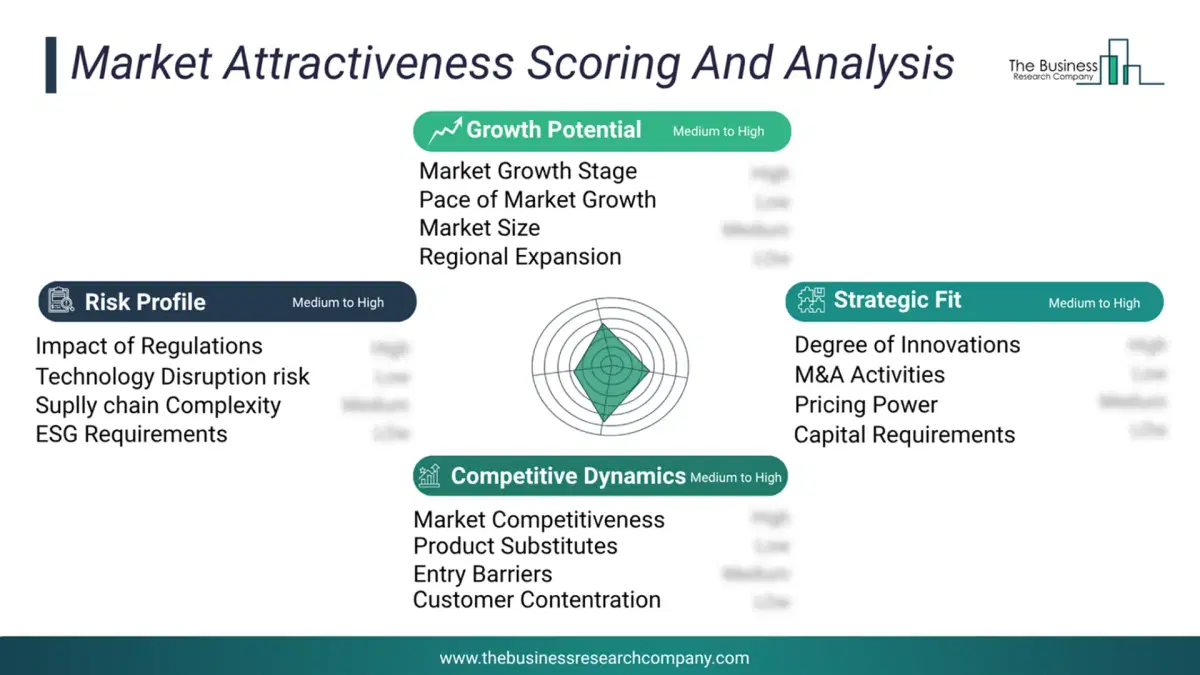
This chart presents market attractiveness based on a quantitative evaluation of growth, competition, strategic alignment, and risk, offering a clear view of opportunity areas for decision-making. This chart is for illustrative purposes; the full report contains the complete analysis.
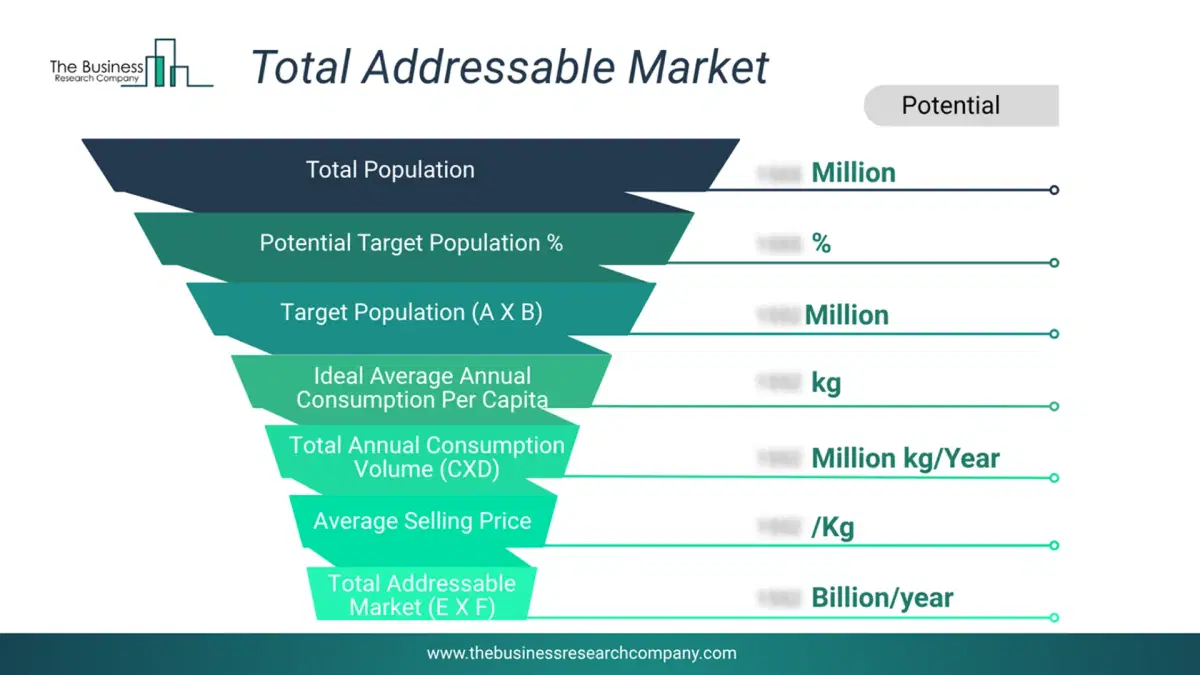
This chart highlights the Total Addressable Market (TAM) by estimating the maximum revenue opportunity using an assumption-driven approach, supporting strategic planning and opportunity sizing across markets. The chart is illustrative; the full report provides a more comprehensive analysis.
What Key Data and Analysis Are Included in the Structured Cabling Market Report 2026?
The structured cabling market research report is one of a series of new reports from The Business Research Company that provides market statistics, including industry global market size, regional shares, competitors with the market share, detailed market segments, market trends and opportunities, and any further data you may need to thrive in the structured cabling industry. The market research report delivers a complete perspective of everything you need, with an in-depth analysis of the current and future state of the industry.Structured Cabling Market Report Forecast Analysis
| Report Attribute | Details |
|---|---|
| Market Size Value In 2026 | $16.29 billion |
| Revenue Forecast In 2030 | $23.82 billion |
| Growth Rate | CAGR of 10.1% from 2026 to 2030 |
| Base Year For Estimation | 2025 |
| Actual Estimates/Historical Data | 2020-2025 |
| Forecast Period | 2026 - 2030 |
| Market Representation | Revenue in USD Billion and CAGR from 2026 to 2030 |
| Segments Covered | Product Type, Application, End Use Industry |
| Regional Scope | Asia-Pacific, Western Europe, Eastern Europe, North America, South America, Middle East, Africa |
| Country Scope | The countries covered in the report are Australia, Brazil, China, France, Germany, India, Indonesia, Japan, Taiwan, Russia, South Korea, UK, USA, Canada, Italy, Spain. |
| Key Companies Profiled | CommScope; Nexans SA; Legrand Group; Corning Inc.; Belden Inc.; Schneider Electric SE; Siemon; Panduit Corporation; Furukawa Electric; ABB Group; TE Connectivity; Superior Essex; Reichle & De-Massari AG; Hitachi Cable Ltd.; Teknon Corporation; Brand-Rex; Paige Electric; Datwyler Cabling Solutions AG; Connectix Ltd.; Electra Link Inc.; Network Cabling Services; Desert Communications; Xin Networks PTE Ltd.; Synergy Solution; America Fujikura Ltd.; Intelligent Business Technologies; Black Box Network Services; Vega Global; Sterlite Technologies; Anixter International Inc. |
| Customization Scope | Request for Customization |
| Pricing And Purchase Options | Explore Purchase Options |