
Supply Chain Finance Market Report 2026
Global Outlook – By Offering (Export And Import Bills, Letter Of Credit, Other Offerings), By Provider (Banks, Trade Finance House, Other Providers), By Application (Domestic, International), By End User (Large Enterprises, Small And Medium-Sized Enterprises) – Market Size, Trends, Strategies, and Forecast to 2030
Supply Chain Finance Market Overview
• Supply Chain Finance market size has reached to $13.42 billion in 2025 • Expected to grow to $20.36 billion in 2030 at a compound annual growth rate (CAGR) of 8.8% • Growth Driver: Rising Fintech Solutions Drive Supply Chain Finance Market Expansion • Market Trend: Strategic Collaborations Reshape The Supply Chain Finance Landscape • Asia-Pacific was the largest region in 2025 and North America is the fastest growing region.What Is Covered Under Supply Chain Finance Market?
Supply chain finance is a collection of advanced business tools and financing processes that reduce costs and increase efficiency for all parties engaged in a transaction. It is used to provide buyers and sellers with a short-term loan that optimizes working capital. The main types of offerings in supply chain finance are export and import bills, letters of credit, performance bonds, shipping guarantees, and others. An export bill is a document generated by the seller when exporting goods or services, outlining the transaction details, whereas, an import bill is a document presented by the buyer to facilitate payment and verify the transaction when importing goods or services and these are used in supply chain finance to serve as underlying documentation for trade transactions, where export bills, such as invoices or shipping documents, provide proof of the goods being exported, while import bills validate the payment obligation of the importer. The major providers are banks, trade finance houses, and others that are applied in domestic and international trade applications by large enterprises and small and medium-sized enterprises.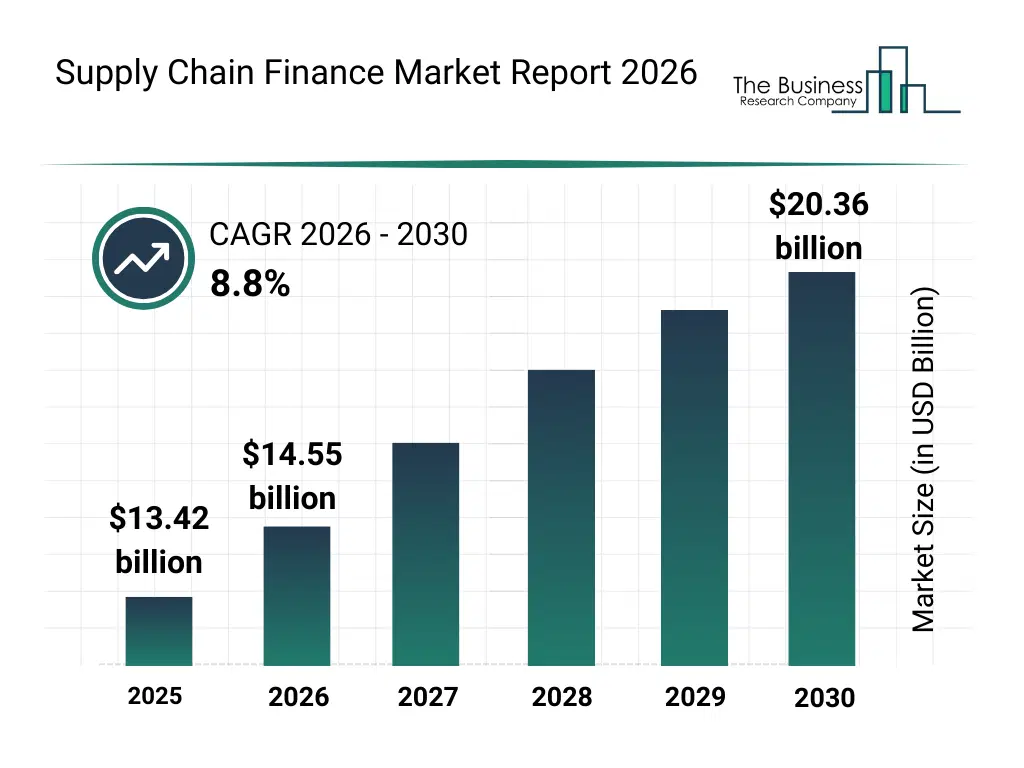
What Is The Supply Chain Finance Market Size and Share 2026?
The supply chain finance market size has grown strongly in recent years. It will grow from $13.42 billion in 2025 to $14.55 billion in 2026 at a compound annual growth rate (CAGR) of 8.4%. The growth in the historic period can be attributed to increasing globalization of trade, expansion of multinational supply chains, rising working capital optimization needs, growing reliance on bank-led trade finance, increased participation of smes in global trade.What Is The Supply Chain Finance Market Growth Forecast?
The supply chain finance market size is expected to see strong growth in the next few years. It will grow to $20.36 billion in 2030 at a compound annual growth rate (CAGR) of 8.8%. The growth in the forecast period can be attributed to increasing digitization of trade finance processes, rising adoption of blockchain-enabled platforms, expansion of cross-border supply chain finance, growing demand for faster liquidity access, increasing integration of ai-based credit assessment. Major trends in the forecast period include increasing adoption of digital supply chain financing platforms, rising use of blockchain-based trade finance solutions, expansion of dynamic discounting models, growing integration of real-time risk assessment tools, enhanced focus on sme financing.
Global Supply Chain Finance Market Segmentation
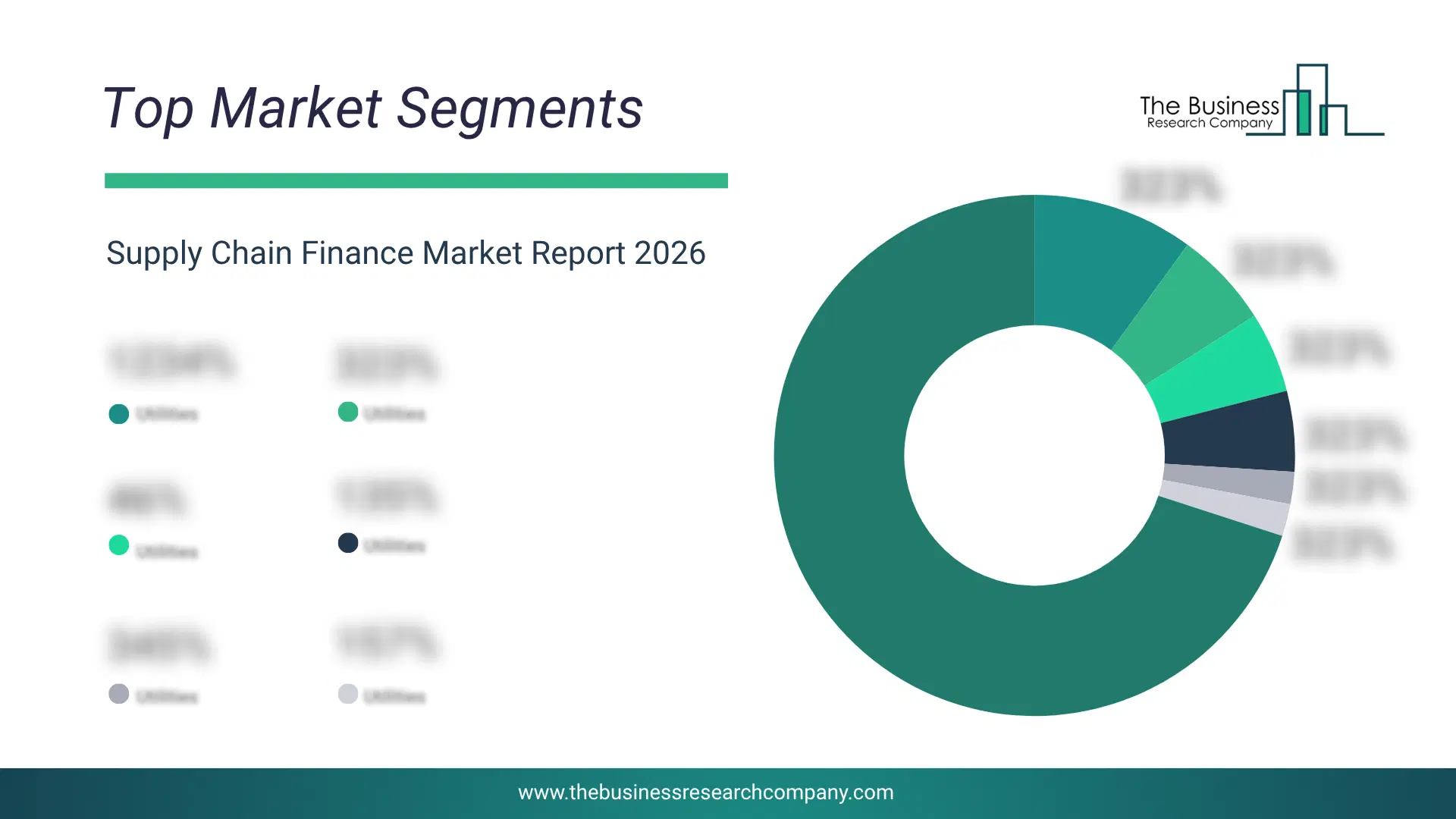
1) By Offering: Export And Import Bills, Letter Of Credit, Other Offerings 2) By Provider: Banks, Trade Finance House, Other Providers 3) By Application: Domestic, International 4) By End User: Large Enterprises, Small And Medium-Sized Enterprises Subsegments: 1) By Export And Import Bills: Documentary Bills, Clean Bills 2) By Letter Of Credit: Irrevocable Letter Of Credit, Standby Letter Of Credit 3) By Other Offerings: Trade Financing Solutions, Factoring Services, Inventory FinancingWhat Is The Driver Of The Supply Chain Finance Market?
Rising fintech solutions is expected to propel the growth of the supply chain finance market going forward. FinTech solutions refer to the innovative and technology-driven products, services, or applications designed to provide efficient and modern solutions for various financial activities. Supply chain finance supports the fintech solutions by optimizing and streamlining financial transactions within the supply chain, enhancing overall efficiency, transparency, and agility. For instance, in November 2023, according to International Trade Administration, a US-based Government agency, there are already more than 1,600 companies in the UK's FinTech market, and by 2030, that number is expected to treble. An estimated $13.4 billion (£11 billion) and more than 76,000 jobs are generated by this industry for the UK economy. Therefore, rising fintech solutions drives the growth of the supply chain finance industry.Key Players In The Global Supply Chain Finance Market
Major companies operating in the supply chain finance market are JPMorgan Chase & Co, Allianz Trade, Alibaba, Bank of America Corporation, Citigroup Inc., HSBC Holdings Plc., Mitsubishi UFJ Financial Group Inc., BNP Paribas, Oracle Corporation, SAP SE, Deutsche Bank, Royal Bank of Scotland Plc., DBS Bank, Standard Chartered Plc., Asian Development Bank, Finastra, Euler Hermes, C2FO, Tradeshift, Taulia, Demica, Vayana Network, Incomlend, PrimeRevenue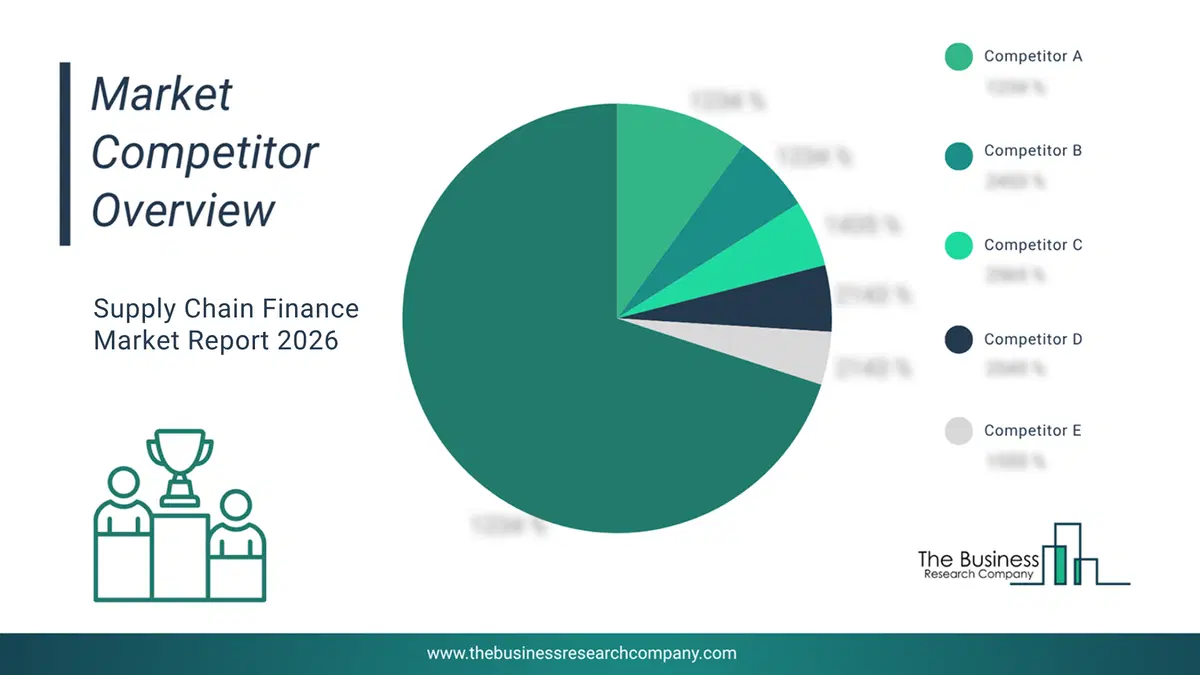
This chart is for illustrative purposes; the full report includes a detailed competitor analysis and comprehensive overview of the top 10 companies in the market.
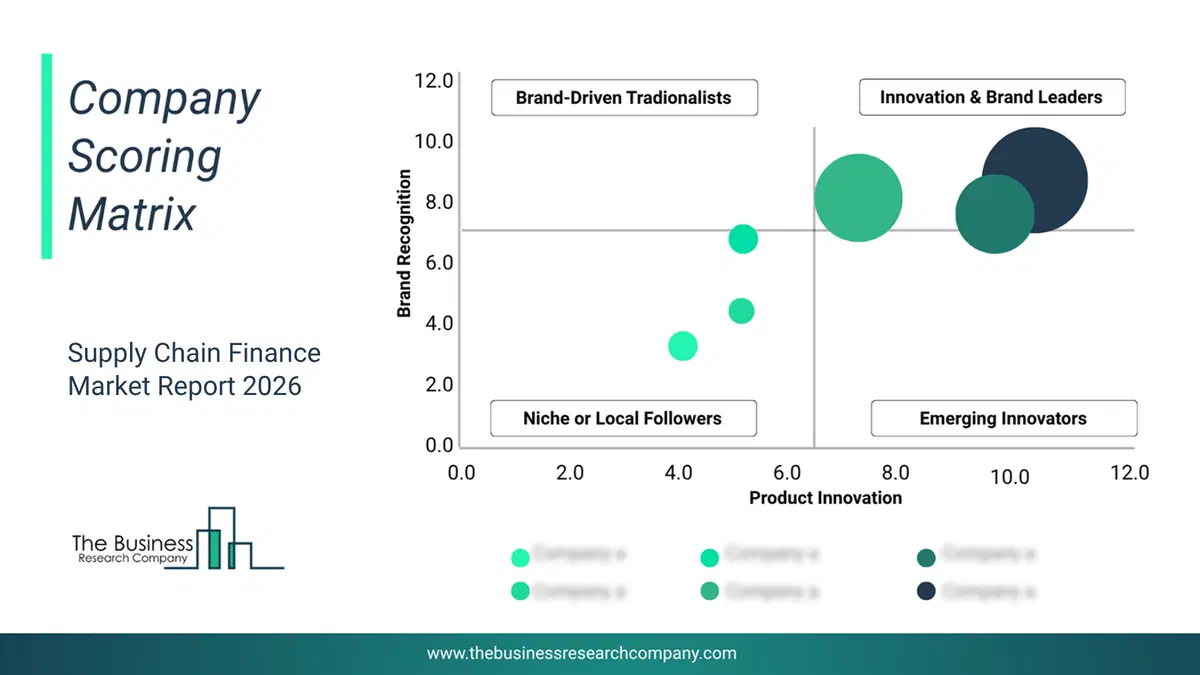
This chart maps companies by product innovation and brand strength, with bubble size indicating relative revenue, helping identify market leaders, challengers, and niche players. This is an illustrative chart; the full report provides a complete and accurate competitive analysis.
Global Supply Chain Finance Market Trends and Insights
Major companies in the supply chain finance sector are undergoing into strategic collaborations to strengthen and sustain their position in the market. Strategic collaborations in supply chain finance drive innovation, efficiency, and market expansion, contributing to the overall advancement and sustainability of solutions in a dynamic business landscape. For instance, in February 2023, Commerzbank AG, a Germany-based Commercial banking company, and T-Systems International GmbH, a Germany-based Information technology company, have collaborated to introduce automated supply-chain financial services. Leveraging IoT sensors, AI, 5G, and blockchain, T-Systems' integration platform initiates orders and payments, executed fully automatically by Commerzbank. The solution aims to eliminate manual processes in logistics and billing, reducing errors and costs. The automated finance solution supports manufacturers, suppliers, and logistics companies, enhancing resilience and productivity in the supply chain.What Are Latest Mergers And Acquisitions In The Supply Chain Finance Market?
In February 2025, Fidelity National Information Services Inc, a US-based provider of banking and payments technology solutions, acquired Demica, for an undisclosed amount. With this acquisition, FIS aims to expand its lending and supply chain finance capabilities strengthening its ability to serve banks and large corporate clients with integrated supply chain financing, dynamic discounting, and securitization solutions. Demica Limited is a UK -based provider of supply chain finance and receivables financing technology, offering white-labeled solutions that help corporates and financial institutions manage complex payables and receivables finance programs.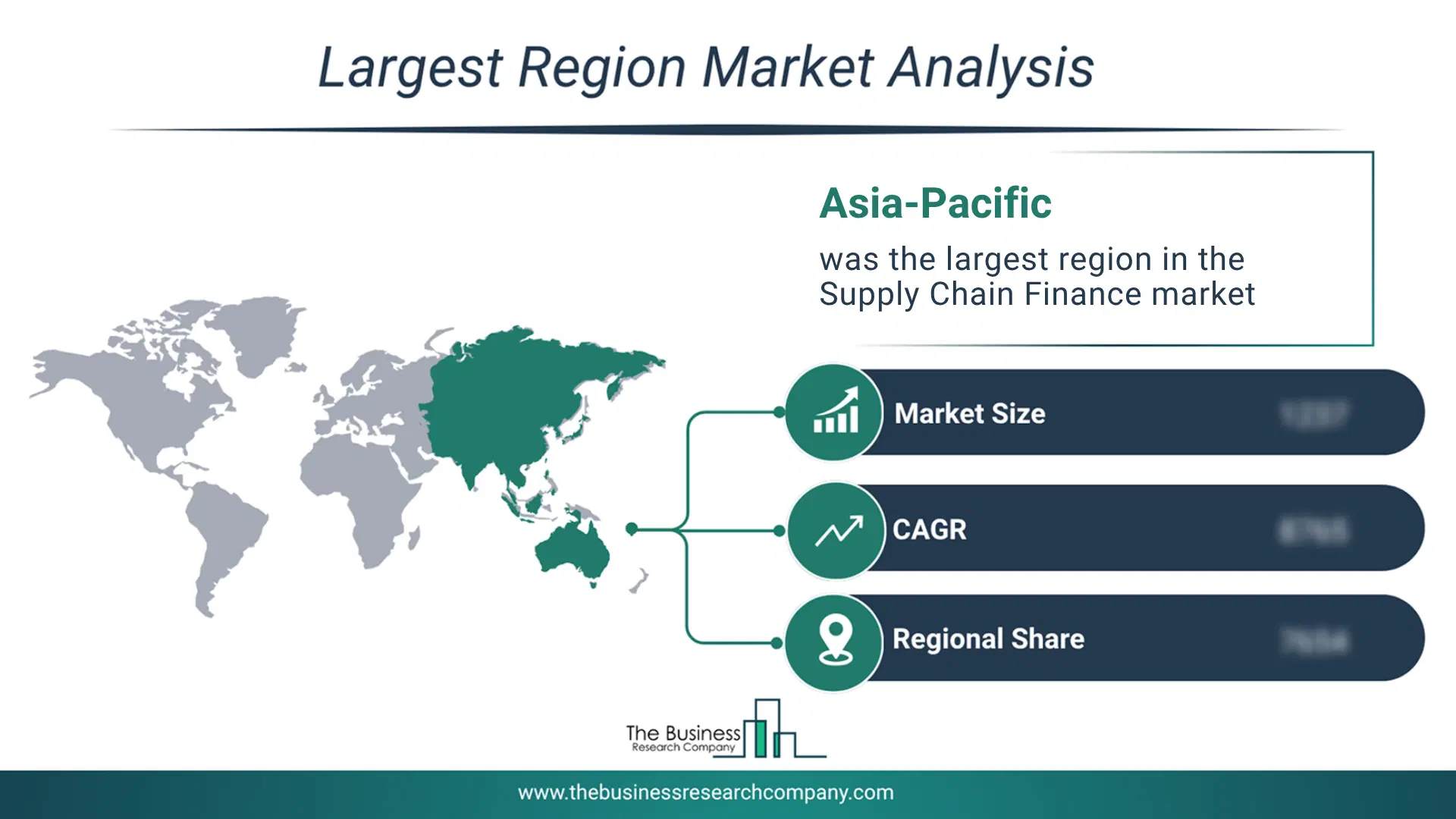
Regional Outlook
Asia-Pacific was the largest region in the global supply chain finance market in 2025. North America is expected to be the fastest-growing region in the forecast period. The regions covered in this market report are Asia-Pacific, South East Asia, Western Europe, Eastern Europe, North America, South America, Middle East, Africa. The countries covered in this market report are Australia, Brazil, China, France, Germany, India, Indonesia, Japan, Taiwan, Russia, South Korea, UK, USA, Canada, Italy, Spain.What Defines the Supply Chain Finance Market?
The supply chain finance market includes revenues earned by entities by providing various supply chain finance services such as real-time data and analytics, minimizing fraud risks, managing disputes, digitizing invoice collections, automating mechanical processes, generating risk-free returns, invoice discounting, and collateral-free solution management. The market value includes the value of related goods sold by the service provider or included within the service offering. Only goods and services traded between entities or sold to end consumers are included.How is Market Value Defined and Measured?
The market value is defined as the revenues that enterprises gain from the sale of goods and/or services within the specified market and geography through sales, grants, or donations in terms of the currency (in USD unless otherwise specified). The revenues for a specified geography are consumption values that are revenues generated by organizations in the specified geography within the market, irrespective of where they are produced. It does not include revenues from resales along the supply chain, either further along the supply chain or as part of other products.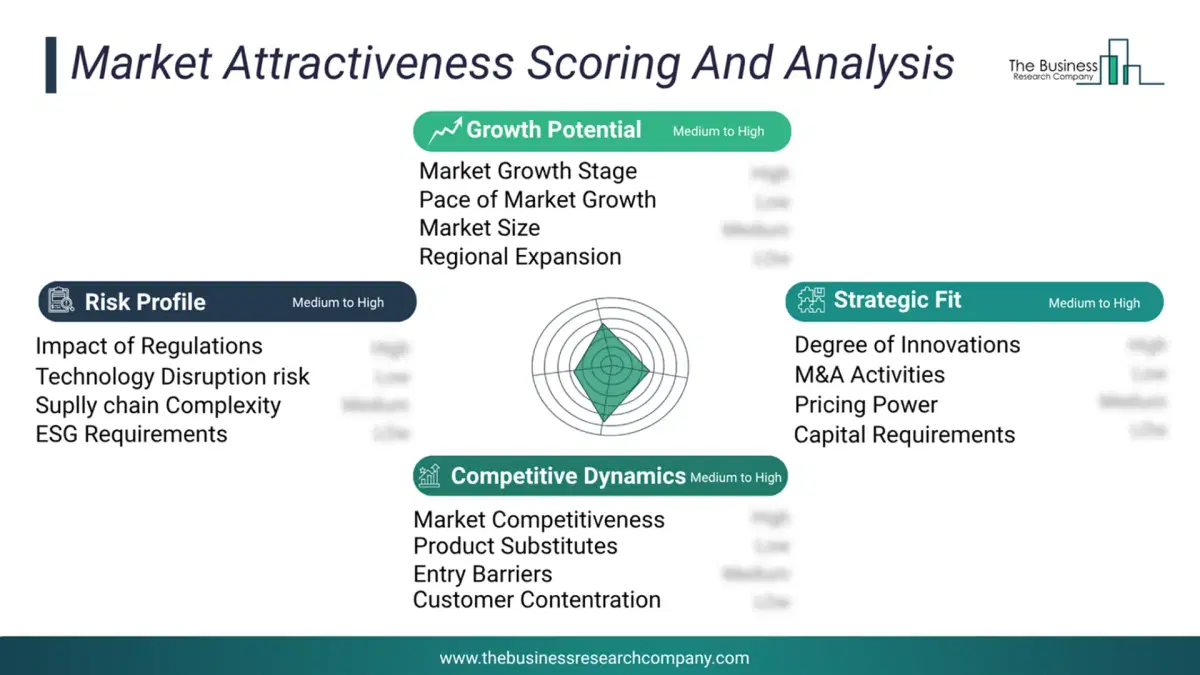
This chart presents market attractiveness based on a quantitative evaluation of growth, competition, strategic alignment, and risk, offering a clear view of opportunity areas for decision-making. This chart is for illustrative purposes; the full report contains the complete analysis.
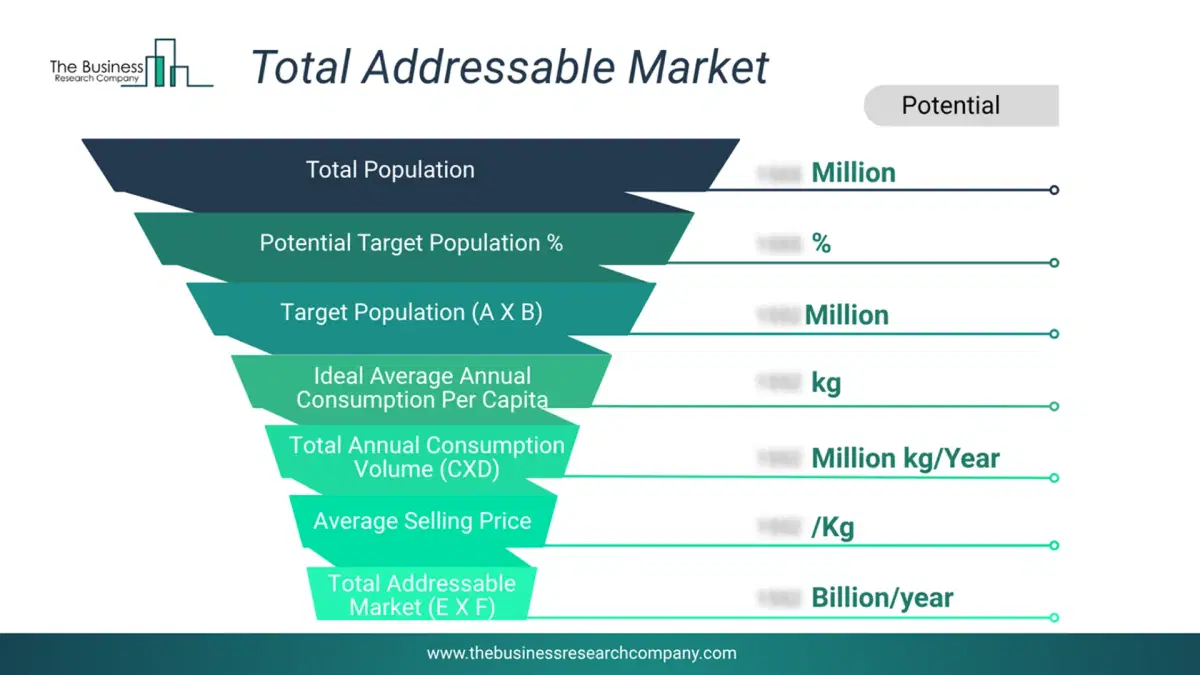
This chart highlights the Total Addressable Market (TAM) by estimating the maximum revenue opportunity using an assumption-driven approach, supporting strategic planning and opportunity sizing across markets. The chart is illustrative; the full report provides a more comprehensive analysis.
What Key Data and Analysis Are Included in the Supply Chain Finance Market Report 2026?
The supply chain finance market research report is one of a series of new reports from The Business Research Company that provides market statistics, including Market Report 2026?global market size, regional shares, competitors with the market share, detailed market segments, market trends and opportunities, and any further data you may need to thrive in the supply chain finance Market Report 2026? The market research report delivers a complete perspective of everything you need, with an in-depth analysis of the current and future state of the Market Report 2026?Supply Chain Finance Market Report Forecast Analysis
| Report Attribute | Details |
|---|---|
| Market Size Value In 2026 | $14.55 billion |
| Revenue Forecast In 2030 | $20.36 billion |
| Growth Rate | CAGR of 8.4% from 2026 to 2030 |
| Base Year For Estimation | 2025 |
| Actual Estimates/Historical Data | 2020-2025 |
| Forecast Period | 2026 - 2030 |
| Market Representation | Revenue in USD Billion and CAGR from 2026 to 2030 |
| Segments Covered | Offering, Provider, Application, End User |
| Regional Scope | Asia-Pacific, Western Europe, Eastern Europe, North America, South America, Middle East, Africa |
| Country Scope | The countries covered in the report are Australia, Brazil, China, France, Germany, India, Indonesia, Japan, Taiwan, Russia, South Korea, UK, USA, Canada, Italy, Spain. |
| Key Companies Profiled | JPMorgan Chase & Co, Allianz Trade, Alibaba, Bank of America Corporation, Citigroup Inc., HSBC Holdings Plc., Mitsubishi UFJ Financial Group Inc., BNP Paribas, Oracle Corporation, SAP SE, Deutsche Bank, Royal Bank of Scotland Plc., DBS Bank, Standard Chartered Plc., Asian Development Bank, Finastra, Euler Hermes, C2FO, Tradeshift, Taulia, Demica, Vayana Network, Incomlend, PrimeRevenue |
| Customization Scope | Request for Customization |
| Pricing And Purchase Options | Explore Purchase Options |