

Commercial Vehicle Market Report 2026
Global Outlook – By Type (Light Commercial Vehicle, Heavy Trucks), By Fuel Type (Gasoline, Diesel, Other Fuel Types ), By Application (Mining And Construction, Logistics, Other Applications ), By Propulsion Type (IC Engine, Electric Vehicle ) – Market Size, Trends, Strategies, and Forecast to 2030
Commercial Vehicle Market Overview
• Commercial Vehicle market size has reached to $1052.31 billion in 2025 • Expected to grow to $1555.65 billion in 2030 at a compound annual growth rate (CAGR) of 8.3% • Growth Driver: Technology Advancements Revolutionizing The Commercial Vehicle Market • Market Trend: Development Of Products To Drive The Revenues Of Commercial Vehicles Market • North America was the largest region in 2025 and Asia-Pacific is the fastest growing region.Market Gains By 2030 – Top Opportunities By Segment
Market Gain identifies the most promising market opportunities by highlighting the segments or products expected to generate the highest incremental revenue growth over the next five years.
What Is Covered Under Commercial Vehicle Market?
A commercial vehicle is a vehicle with a license to transport goods or materials rather than people. A commercial vehicle is used for commercial or business purposes. The main types in the commercial vehicle market include light commercial vehicles, heavy trucks, buses, and coaches. Light commercial vehicles refer to vehicles that are no more than 3.5 metric tons. The various fuel types are gasoline, diesel, and other fuel types. The various propulsion types include IC engines and electric vehicles. Commercial vehicles are used in mining and construction, logistics, passenger transportation, and other applications.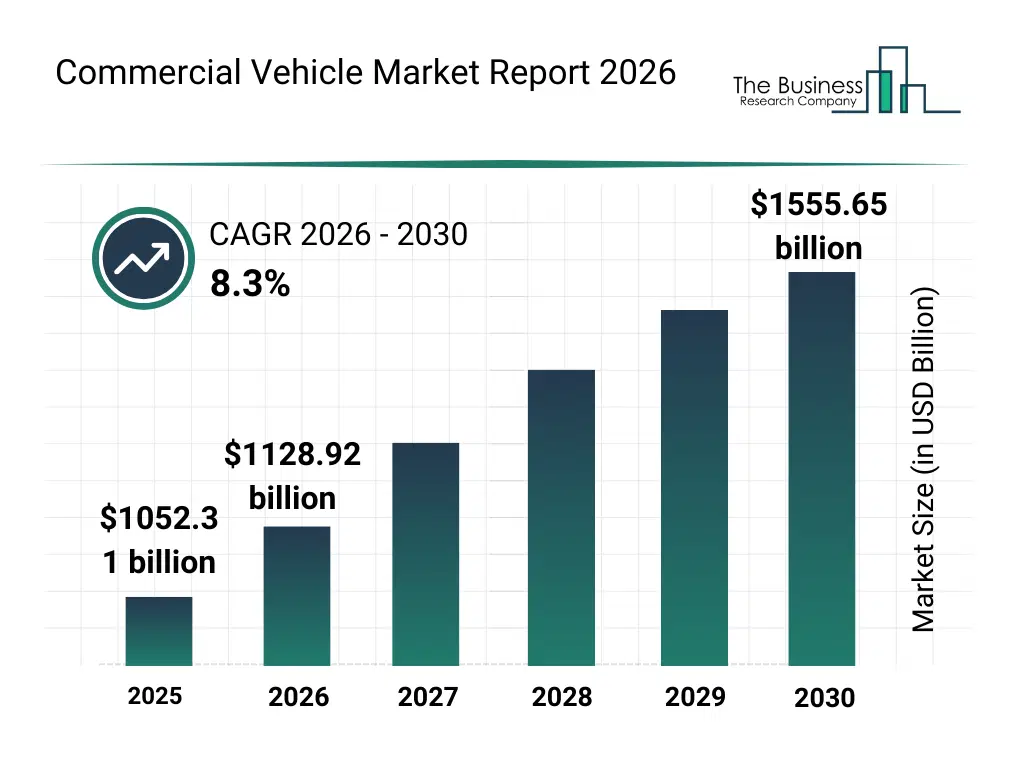
What Is The Commercial Vehicle Market Size and Share 2026?
The commercial vehicle market size has grown strongly in recent years. It will grow from $1052.31 billion in 2025 to $1128.92 billion in 2026 at a compound annual growth rate (CAGR) of 7.3%. The growth in the historic period can be attributed to freight transportation growth, infrastructure development, diesel vehicle dominance, expansion of logistics networks, urbanization.What Is The Commercial Vehicle Market Growth Forecast?
The commercial vehicle market size is expected to see strong growth in the next few years. It will grow to $1555.65 billion in 2030 at a compound annual growth rate (CAGR) of 8.3%. The growth in the forecast period can be attributed to electric vehicle adoption, emission regulations, autonomous fleet development, smart fleet management, demand for last-mile delivery solutions. Major trends in the forecast period include growth of electric commercial vehicles, expansion of logistics and e-commerce fleets, adoption of telematics systems, demand for fuel-efficient vehicles, integration of advanced safety features.
Global Commercial Vehicle Market Segmentation
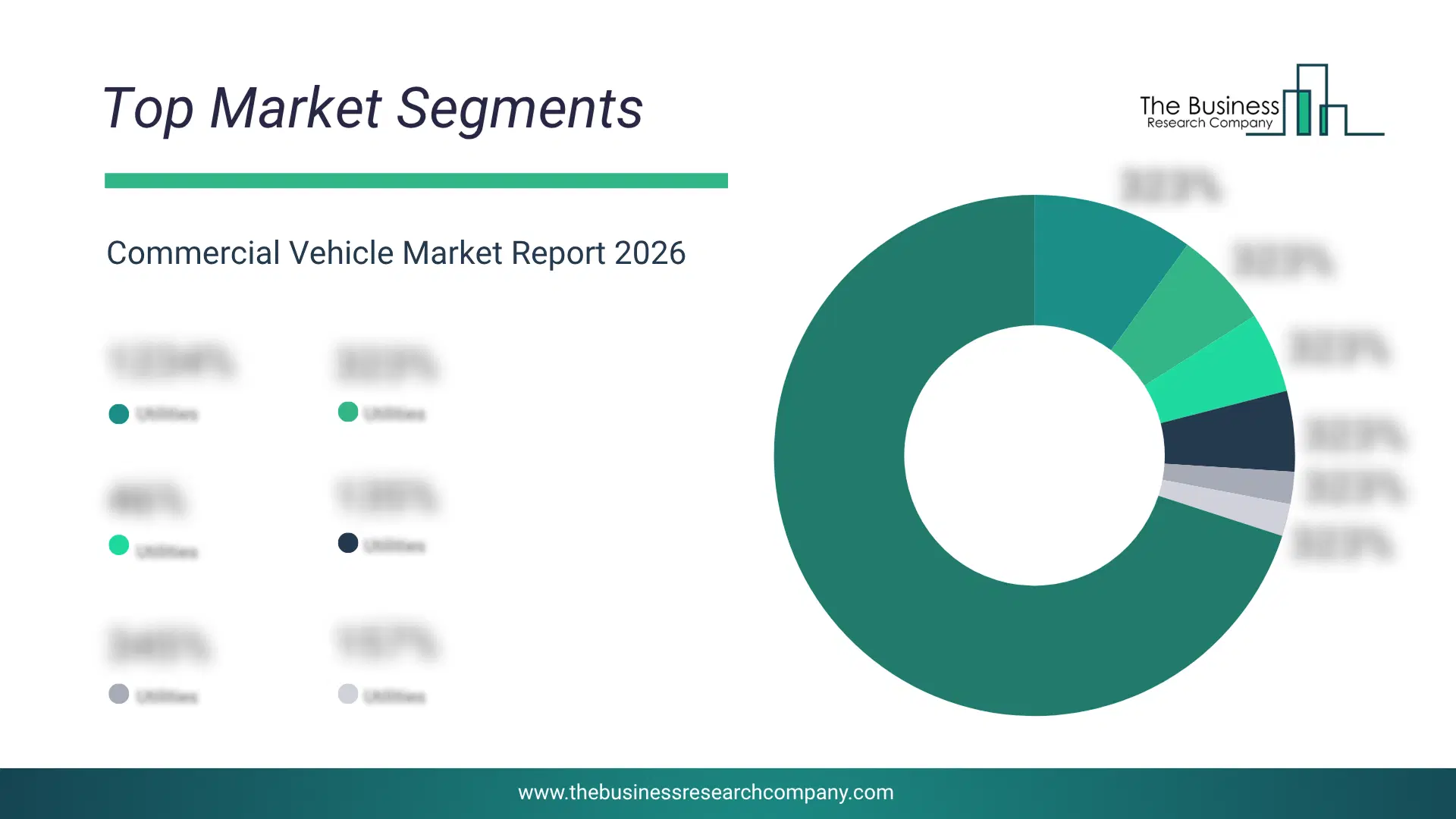
1) By Type: Light Commercial Vehicle, Heavy Trucks 2) By Fuel Type: Gasoline, Diesel, Other Fuel Types 3) By Application: Mining And Construction, Logistics, Other Applications 4) By Propulsion Type: IC Engine, Electric Vehicle Subsegments: 1) By Light Commercial Vehicle: Vans, Pickup Trucks 2) By Heavy Trucks: Dump Trucks, Flatbed Trucks, Tanker Trucks, Refrigerated TrucksThe top segments in the commercial vehicle market will be: • Light Commercial Vehicle will reach $1462 Billion by 2030. • Heavy Trucks will reach $80 Billion by 2030. • Buses And Coaches will reach $23 Billion by 2030.What Is The Driver Of The Commercial Vehicle Market?
Advances in technology are expected to be a continued driver of market growth in the forecast period. The commercial vehicle industry has experienced many technological advances in the last decade, and this trend is expected to intensify. For instance, in October 2023, according to the Rail Infrastructure and Assets report by the Office of Rail and Road, a UK-based government agency, As of 31 March 2023, a total of 15,220 railway vehicles were registered and in operation across all passenger train operators, with electric vehicles accounting for 70% of the fleet. These innovations are expected to drive the commercial vehicle industry during the forecast period.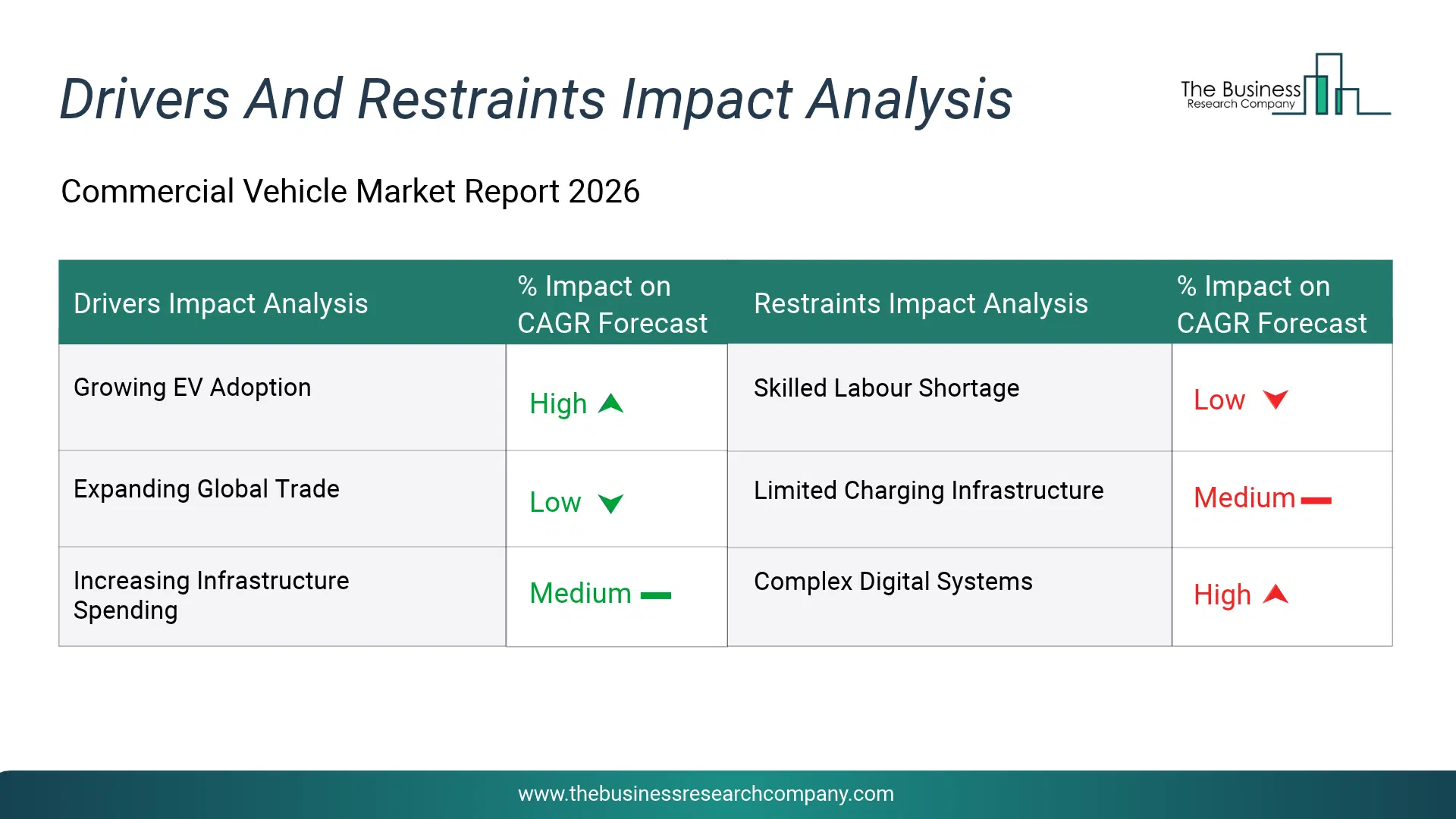
Infographic Chart Showing Key Market Drivers Analysis And Restraints For Commercial Vehicle Market
The chart presents an impact analysis of key drivers and restraints, quantifying their relative influence on the market's growth rate and helping assess the balance between growth enablers and limiting factors. This chart offers a high-level perspective; the full report contains more detailed insights.
How Will The Drivers Impact Growth In The Global Commercial Vehicle Market?
• Growing EV Adoption (High) – During the forecast period, the growing EV adoption is expected to become a key growth driver for the commercial vehicle market by 2030. Growing electric vehicle adoption is driving the growth of the commercial vehicle market by increasing demand for electric vans, trucks, buses, and other commercial transportation solutions. Businesses and fleet operators are increasingly adopting electric commercial vehicles to reduce fuel expenses, operating emissions, and exposure to changing environmental requirements. Improvements in battery technology, charging capabilities, and vehicle performance are expanding the range of commercial applications suitable for electrification. Government incentives and emissions reduction targets further support adoption. • Expanding Global Trade (Low) – During the forecast period, the expanding global trade is expected to emerge as a major factor driving the expansion of the commercial vehicle market by 2030. Expanding global trade is driving the growth of the commercial vehicle market by increasing demand for trucks, vans, and other vehicles used to transport goods between manufacturers, warehouses, distribution centers, ports, and customers. Growth in international manufacturing, cross-border commerce, and logistics networks increases freight volumes and requires additional transportation capacity. Commercial vehicle fleets are therefore being expanded and modernized to support changing distribution requirements. Growth in regional logistics hubs also creates additional demand for delivery vehicles. • Increasing Infrastructure Spending (Medium) – During the forecast period, the increasing infrastructure spending is expected to act as a key growth catalyst for the commercial vehicle market by 2030. Increasing infrastructure spending is driving the growth of the commercial vehicle market by increasing demand for trucks, buses, utility vehicles, and other vehicles used in construction and infrastructure projects. Roads, bridges, railways, energy facilities, housing developments, and public infrastructure require transportation of construction materials, equipment, workers, and supplies. Infrastructure investment therefore increases commercial vehicle utilization and encourages contractors and service providers to expand or replace their fleets. Government-funded projects can provide sustained demand across multiple regions.How Will The Restraints Impact Growth In The Global Commercial Vehicle Market?
• Skilled Labour Shortage (High) – During the forecast period, the skilled labour shortage is restraining the growth of the commercial vehicle market by limiting the availability of workers required for vehicle manufacturing, maintenance, repair, and fleet operations. Commercial vehicles increasingly incorporate advanced mechanical, electrical, electronic, and digital systems that require specialized technical knowledge. A shortage of qualified technicians and manufacturing workers can increase recruitment and training costs and delay vehicle production or maintenance. Fleet operators may also face difficulties keeping vehicles in service when skilled maintenance personnel are unavailable. Consequently, persistent skilled labor shortages can increase operating costs, reduce fleet efficiency, and restrain the growth of the commercial vehicle market. • Limited Charging Infrastructure (Low) – During the forecast period, the limited charging infrastructure is restraining the growth of the commercial vehicle market by creating operational challenges for businesses considering electric commercial vehicle adoption. Commercial fleets require reliable and strategically located charging facilities to support high vehicle utilization and predictable delivery schedules. Inadequate public and depot-based charging infrastructure can increase charging downtime, require route modifications, and limit the operating range of electric vehicles. Businesses may therefore delay electrification investments until sufficient charging capacity becomes available. Consequently, limited charging infrastructure can slow commercial vehicle electrification and restrain the overall growth of the commercial vehicle market. • Complex Digital Systems (Medium) – During the forecast period, the complex digital systems are restraining the growth of the commercial vehicle market by increasing vehicle development costs, maintenance requirements, and technical complexity. Modern commercial vehicles increasingly incorporate connected systems, electronic control units, telematics, advanced driver assistance, cybersecurity features, and software-based functions. These systems require specialized engineering, testing, maintenance, and technician expertise. Software failures or system integration issues can also increase downtime and repair expenses. Consequently, increasing digital complexity can raise development and maintenance costs, increase skill requirements, and restrain the growth of the commercial vehicle market.Key Players In The Global Commercial Vehicle Market
Major companies operating in the commercial vehicle market report include Daimler Truck AG, Volvo AB, PACCAR Inc., TRATON SE, Scania AB, MAN Truck & Bus SE, Tata Motors Ltd., Ashok Leyland, Isuzu Motors Limited, Hino Motors Ltd., Dongfeng Motor Corporation, FAW Group Corporation, Foton Motor, IVECO Group, Navistar International, Mack Trucks, UD Trucks, BYD Motors, Rivian Automotive, Hyundai Motor Company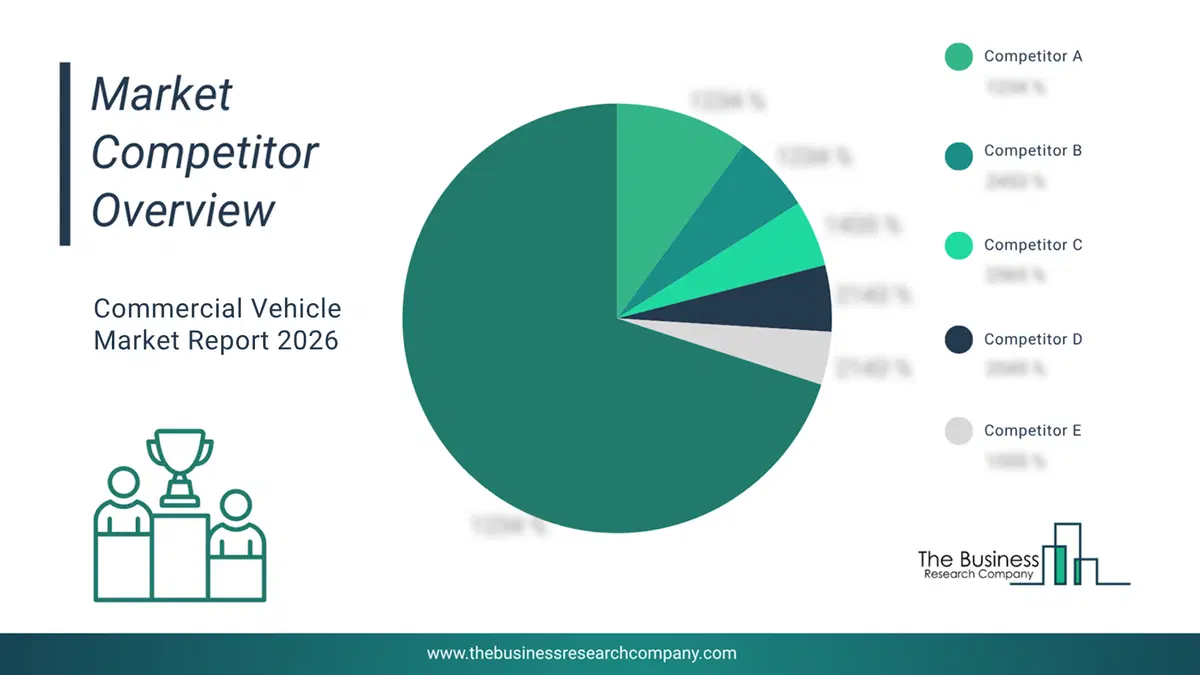
This chart is for illustrative purposes; the full report includes a detailed competitor analysis and comprehensive overview of the top 10 companies in the market.
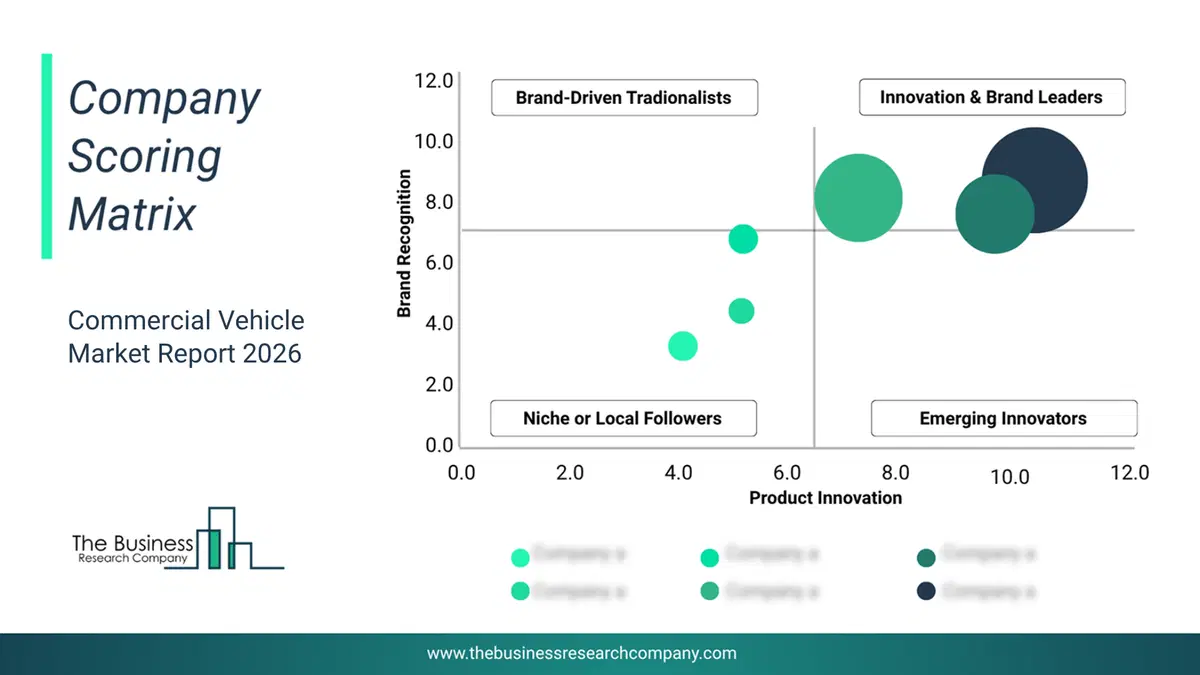
This chart maps companies by product innovation and brand strength, with bubble size indicating relative revenue, helping identify market leaders, challengers, and niche players. This is an illustrative chart; the full report provides a complete and accurate competitive analysis.
Global Commercial Vehicle Market Trends and Insights
Major companies operating in the commercial vehicles market are developing new products such as commercial vehicle cooling systems to meet larger customer bases, more sales, and increase revenue. A commercial vehicle cooling system is a system that helps regulate the temperature of the engine and other components of commercial vehicles, like trucks, buses, and construction machinery. For instance, in September 2023, DENSO Corporation, a Japan-based automotive manufacturer, launched, Everycool, an innovative cooling system for commercial vehicles that offers comfort and energy efficiency when the engine of a vehicle is not running. It accomplishes the dual goals of enhancing driver working conditions during the summer heat, lowering environmental impact, and boosting efficient energy utilization by cutting fuel consumption. Everycool makes use of DENSO's experience in air conditioning technology to intensely target cool air at the driver for increased comfort. It achieves energy efficiency by consuming around 57% less power than conventional cabin-wide cooling systems in Japan. It can therefore be powered by the original car battery.What Are Latest Mergers And Acquisitions In The Commercial Vehicle Market?
In July 2025, Tata Motors, an India-based automotive manufacturer, acquired Iveco Group, for €3.8 billion ($4.4 billion). With this acquisition, Tata Motors aims to expand its global commercial vehicle footprint, enhance product portfolio and technological capabilities, strengthen its presence in key international markets, and drive long-term growth and operational synergies across its commercial vehicle operations. Iveco Group is an Italy-based commercial vehicle company specializes in the design, manufacturing, and distribution of commercial trucks, buses, and specialty vehicles.
Regional Outlook
North America was the largest region in the commercial vehicles market in 2025. Asia-Pacific was the second-largest region in the commercial vehicle market. The regions covered in this market report include Asia-Pacific, South East Asia, Western Europe, Eastern Europe, North America, South America, Middle East, Africa. The countries covered in this market report include China, India, Japan, Australia, Indonesia, South Korea, Bangladesh, Thailand, Vietnam, Malaysia, Singapore, Philippines, Hong Kong, Taiwan, New Zealand, UK, Germany, France, Italy, Spain, Austria, Belgium, Denmark, Finland, Ireland, Netherlands, Norway, Portugal, Sweden, Switzerland, Russia, Czech Republic, Poland, Romania, Ukraine, USA, Canada, Mexico, Brazil, Chile, Argentina, Colombia, Peru, Saudi Arabia, Israel, Iran, Turkey, UAE, Egypt, Nigeria, South Africa.What Defines the Commercial Vehicle Market?
The commercial vehicle market consists of sales of trucks, buses, trailers, taxis, heavy equipment, trailers, and travel trailers. Values in this market are ‘factory gate’ values, that is the value of goods sold by the manufacturers or creators of the goods, whether to other entities (including downstream manufacturers, wholesalers, distributors and retailers) or directly to end customers. The value of goods in this market includes related services sold by the creators of the goods.How is Market Value Defined and Measured?
The market value is defined as the revenues that enterprises gain from the sale of goods and/or services within the specified market and geography through sales, grants, or donations in terms of the currency (in USD unless otherwise specified). The revenues for a specified geography are consumption values that are revenues generated by organizations in the specified geography within the market, irrespective of where they are produced. It does not include revenues from resales along the supply chain, either further along the supply chain or as part of other products.
This chart presents market attractiveness based on a quantitative evaluation of growth, competition, strategic alignment, and risk, offering a clear view of opportunity areas for decision-making. This chart is for illustrative purposes; the full report contains the complete analysis.
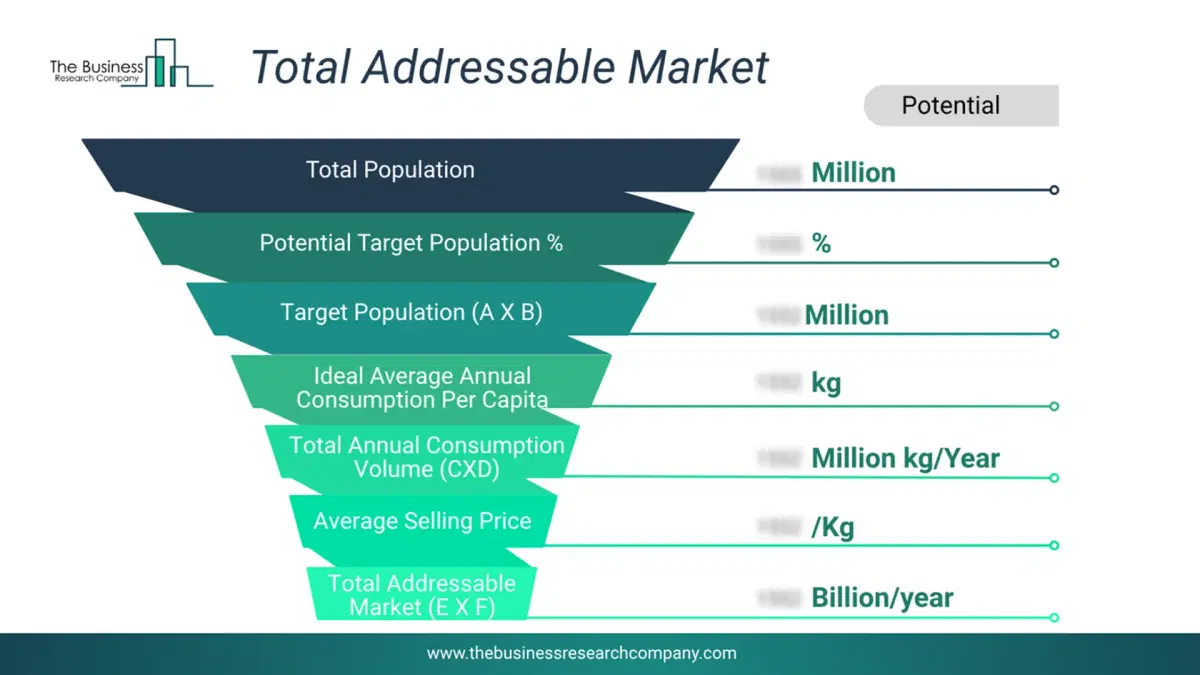
This chart highlights the Total Addressable Market (TAM) by estimating the maximum revenue opportunity using an assumption-driven approach, supporting strategic planning and opportunity sizing across markets. The chart is illustrative; the full report provides a more comprehensive analysis.
What Key Data and Analysis Are Included in the Commercial Vehicle Market Report 2026?
The commercial vehicle market research report is one of a series of new reports from The Business Research Company that provides market statistics, including industry global market size, regional shares, competitors with the market share, detailed market segments, market trends and opportunities, and any further data you may need to thrive in the commercial vehicle industry. The market research report delivers a complete perspective of everything you need, with an in-depth analysis of the current and future state of the industry.Commercial Vehicle Market Report Forecast Analysis
| Report Attribute | Details |
|---|---|
| Market Size Value In 2026 | $1128.92 billion |
| Revenue Forecast In 2035 | $1555.65 billion |
| Growth Rate | CAGR of 7.3% from 2026 to 2035 |
| Base Year For Estimation | 2025 |
| Actual Estimates/Historical Data | 2020-2025 |
| Forecast Period | 2026 - 2030 - 2035 |
| Market Representation | Revenue in USD Billion and CAGR from 2026 to 2035 |
| Segments Covered | Type, Fuel Type, Application, Propulsion Type |
| Regional Scope | Asia-Pacific, Western Europe, Eastern Europe, North America, South America, Middle East, Africa |
| Country Scope | The countries covered in the report are Australia, Brazil, China, France, Germany, India, ... |
| Key Companies Profiled | Daimler Truck AG, Volvo AB, PACCAR Inc., TRATON SE, Scania AB, MAN Truck & Bus SE, Tata Motors Ltd., Ashok Leyland, Isuzu Motors Limited, Hino Motors Ltd., Dongfeng Motor Corporation, FAW Group Corporation, Foton Motor, IVECO Group, Navistar International, Mack Trucks, UD Trucks, BYD Motors, Rivian Automotive, Hyundai Motor Company |
| Customization Scope | Request for Customization |
| Pricing And Purchase Options | Explore Purchase Options |