

Industry 4.0 Market Report 2026
Global Outlook – By Technology (Industrial Robots, Blockchain, Industrial Sensors, Industrial 3D Printing, Machine Vision, Human Machine Interface (HMI), Artificial Intelligence In Manufacturing, Digital Twin, Automatic Guided Vehicles (AGV), Machine Condition Monitoring), By Component (Solution, Services), By Enterprise Size (Small And Medium Enterprises, Large Enterprise), By End-User (Manufacturing, Automotive, Oil And Gas, Energy And Utilities, Electronics And Foundry, Food And Beverage, Aerospace And Defense, Other End-Users) – Market Size, Trends, Strategies, and Forecast to 2030
Industry 4.0 Market Overview
• Industry 4.0 market size has reached to $202.78 billion in 2025 • Expected to grow to $459.68 billion in 2030 at a compound annual growth rate (CAGR) of 17.8% • Growth Driver: Cloud Adoption And The Rise Of Industry 4.0 • Market Trend: Novus Automation Pioneers Industry 4.0 With IOT Controller Launch • Europe was the largest region in 2025 and Asia-Pacific is the fastest growing region.Market Gains By 2030 – Top Opportunities By Segment
Market Gain identifies the most promising market opportunities by highlighting the segments or products expected to generate the highest incremental revenue growth over the next five years.
What Is Covered Under Industry 4.0 Market?
Industry 4.0 refers to production systems that are intelligent and interconnected and are built to perceive, anticipate, and interact with the physical world to make decisions that support production in real time. It is used for the creation of intelligent factories and smart manufacturing. The main types of industry 4.0 technologies are industrial robots, blockchain, industrial sensors, industrial 3D printing, machine vision, human-machine interface (HMI), artificial intelligence in manufacturing, digital twin, automatic guided vehicles (AGV), and machine condition monitoring. Industrial robots refer to a mechanical machine that is designed to do production-related tasks automatically in industrial settings. The various components are the solution and services used in small and medium enterprises and large enterprises. The end-users are manufacturing, automotive, oil and gas, energy and utilities, electronics and foundry, food and beverage, Aerospace & Defense, and others.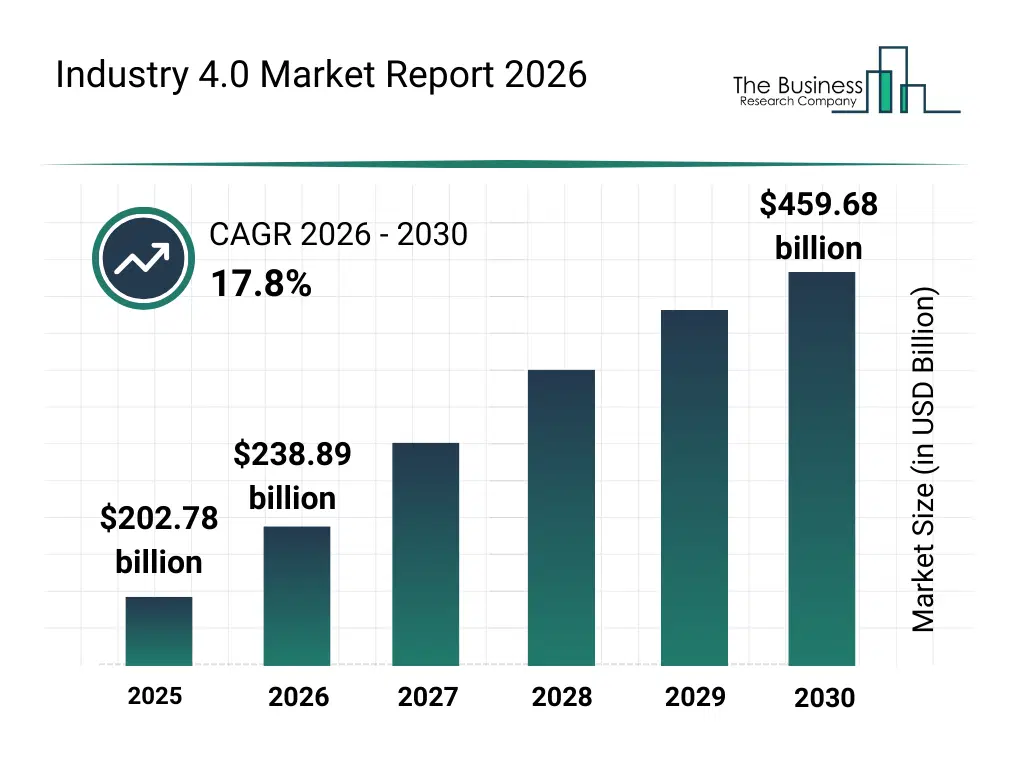
What Is The Industry 4.0 Market Size and Share 2026?
The industry 4.0 market size has grown rapidly in recent years. It will grow from $202.78 billion in 2025 to $238.89 billion in 2026 at a compound annual growth rate (CAGR) of 17.8%. The growth in the historic period can be attributed to automation adoption in manufacturing, need for productivity improvement, advancement in industrial robotics, demand for quality optimization, growth of connected devices.What Is The Industry 4.0 Market Growth Forecast?
The industry 4.0 market size is expected to see rapid growth in the next few years. It will grow to $459.68 billion in 2030 at a compound annual growth rate (CAGR) of 17.8%. The growth in the forecast period can be attributed to expansion of smart manufacturing initiatives, increasing use of AI in production, demand for real time decision making, integration of digital twins, growth of flexible manufacturing systems. Major trends in the forecast period include smart factory implementation, connected manufacturing systems, predictive maintenance deployment, digital twin integration, autonomous production processes.
Global Industry 4.0 Market Segmentation
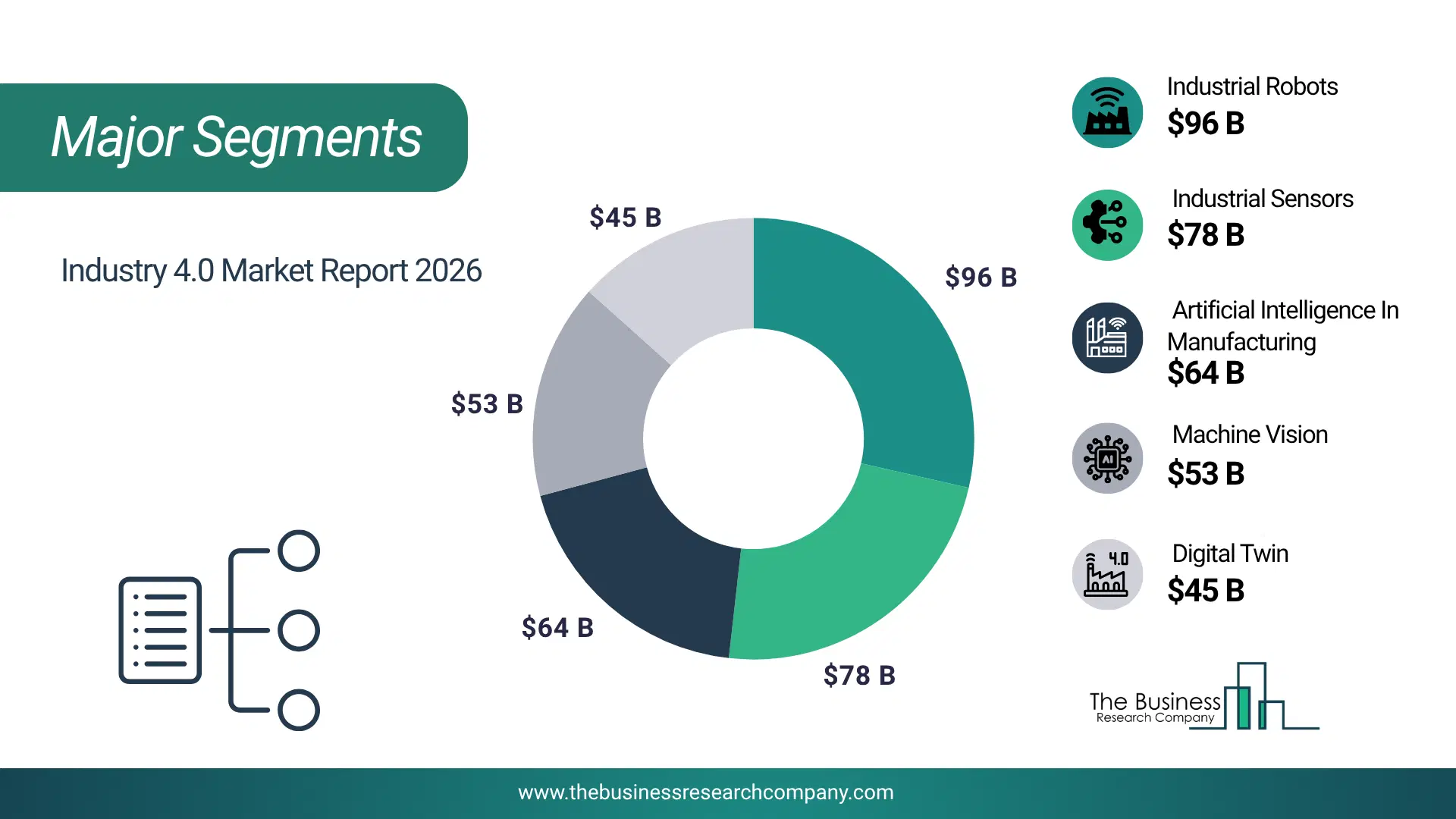
1) By Technology: Industrial Robots, Blockchain, Industrial Sensors, Industrial 3D Printing, Machine Vision, Human Machine Interface (HMI), Artificial Intelligence In Manufacturing, Digital Twin, Automatic Guided Vehicles (AGV), Machine Condition Monitoring 2) By Component: Solution, Services 3) By Enterprise Size: Small And Medium Enterprises, Large Enterprise 4) By End-User: Manufacturing, Automotive, Oil And Gas, Energy And Utilities, Electronics And Foundry, Food And Beverage, Aerospace And Defense, Other End-Users Subsegments: 1) By Industrial Robots: Articulated Robots, Collaborative Robots (Cobots), SCARA Robots 2) By Blockchain: Supply Chain Management Solutions, Data Security Applications, Smart Contracts 3) By Industrial Sensors: Temperature Sensors, Pressure Sensors, Proximity Sensors 4) By Industrial 3D Printing: Additive Manufacturing Systems, Materials For 3D Printing, Software For Design And Simulation 5) By Machine Vision: Image Processing Systems, Quality Inspection Solutions, Identification And Tracking Systems 6) By Human Machine Interface (HMI): Touchscreen Panels, Software Interfaces, Remote Monitoring Tools 7) By Artificial Intelligence In Manufacturing: Predictive Maintenance Tools, Production Optimization Software, Quality Control Algorithms 8) By Digital Twin: Simulation Software, Monitoring And Analytics Platforms, Integration Solutions With IoT 9) By Automatic Guided Vehicles (AGV): Navigation Systems, Fleet Management Software, Charging And Maintenance Solutions 10) By Machine Condition Monitoring: Vibration Analysis Tools, Temperature Monitoring Systems, Acoustic Emission Monitoring Systems The top segments in the industry 4.0 market will be: • Industrial Robots will reach $96.47 Billion by 2030. • Industrial Sensors will reach $78.26 Billion by 2030. • Artificial Intelligence In Manufacturing will reach $64.1 Billion by 2030. • Machine Vision will reach $52.63 Billion by 2030. • Digital Twin will reach $45.01 Billion by 2030.What Is The Driver Of The Industry 4.0 Market?
The increasing cloud adoption is expected to propel the growth of the Industry 4.0 market going forward. Cloud adoption refers to the process and strategy by which individuals, organizations, or businesses migrate their computing infrastructure, data, applications, and services from on-premises environments to cloud-based solutions. Cloud adoption is a fundamental enabler of Industry 4.0, providing the necessary infrastructure and tools for manufacturers to embrace digital transformation, enhance efficiency, and stay competitive in an increasingly connected and data-driven industrial landscape. For instance, in 2023, according to the European Commission (EC), the Belgium-based executive body of the European Union (EU), the signals that node deployment has grown from 498 in 2022 to approximately 1,836 in 2024. Therefore, the increasing cloud adoption is driving the growth of the Industry 4.0 industry.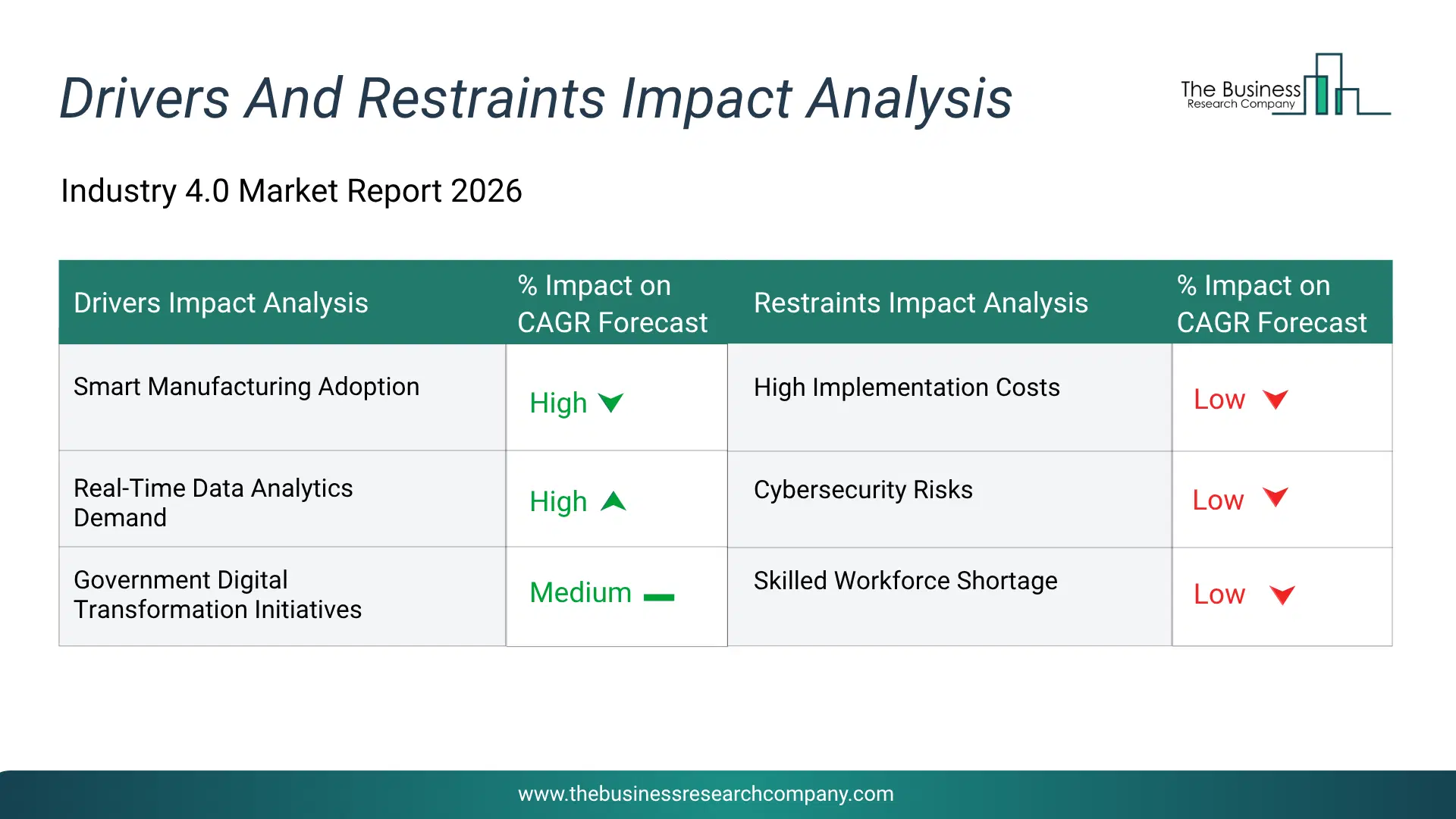
Infographic Chart Showing Key Market Drivers Analysis And Restraints For Industry 4.0 Market
The chart presents an impact analysis of key drivers and restraints, quantifying their relative influence on the market's growth rate and helping assess the balance between growth enablers and limiting factors. This chart offers a high-level perspective; the full report contains more detailed insights.
How Will The Drivers Impact Growth In The Global Industry 4.0 Market?
• Smart Manufacturing Adoption (High) – During the forecast period, the increasing adoption of smart manufacturing systems is expected to become a key growth driver for the industry 4.0 market by 2030. Manufacturers are accelerating the deployment of interconnected production environments that leverage IoT-enabled machinery, cloud-based platforms, and cyber-physical systems to optimize operations. Smart manufacturing enables real-time coordination across production lines, improves resource utilization, and enhances product quality through automated control mechanisms. Companies are investing in scalable digital infrastructures to transition from traditional manufacturing to intelligent factories. This shift toward fully connected production ecosystems is strengthening market expansion. • Real-Time Data Analytics Demand (High) – During the forecast period, the rising demand for real-time data analytics in industrial operations is expected to emerge as a major factor driving the expansion of the industry 4.0 market by 2030. Industrial enterprises are increasingly leveraging advanced analytics tools to monitor equipment performance, detect anomalies, and optimize production workflows instantly. Real-time insights enable predictive maintenance, reduce operational disruptions, and support faster decision-making across complex manufacturing environments. The growing integration of edge computing and AI-driven analytics platforms is further enhancing data processing capabilities at the factory level. • Government Digital Transformation Initiatives (Medium) – During the forecast period, the expansion of government-led digital transformation programs is expected to act as a key growth catalyst for the industry 4.0 market by 2030. National initiatives focused on modernizing industrial infrastructure are encouraging the adoption of automation, robotics, and digital technologies across key sectors. Governments are promoting smart factories through funding programs, regulatory support, and public-private partnerships aimed at boosting industrial competitiveness. These initiatives are accelerating the integration of advanced technologies in both developed and emerging economies. As digital transformation efforts scale globally, industrial modernization is expected to intensify.How Will The Restraints Impact Growth In The Global Industry 4.0 Market?
• High Implementation Costs (High) – During the forecast period, high implementation costs are significantly restricting the growth of the Industry 4.0 market. Substantial investments required for automation systems, IoT infrastructure, advanced robotics, and cloud-based platforms are limiting adoption, particularly among small and medium-sized enterprises. • Cybersecurity Risks (High) – During the forecast period, cybersecurity risks are significantly restricting the growth of the Industry 4.0 market. Increasing connectivity and reliance on digital industrial systems are exposing manufacturers to cyber threats, data breaches, and operational disruptions, thereby raising concerns over system security and reliability. • Skilled Workforce Shortage (Medium) – During the forecast period, the skilled workforce shortage is significantly restricting the growth of the Industry 4.0 market. Limited availability of professionals with expertise in automation, AI, data analytics, and industrial IoT is slowing technology deployment and reducing the efficiency of advanced manufacturing systems.Key Players In The Global Industry 4.0 Market
Major companies operating in the industry 4.0 market are Siemens AG; General Electric Company; Intel Corporation; International Business Machines Corporation; Cisco Systems Inc.; Mitsubishi Electric Corporation; Honeywell International Inc.; ABB Ltd.; NVIDIA Corporation; Emerson Electric Co; Rockwell Automation Inc.; Omron Corporation; Bosch Rexroth AG; Fanuc Corporation; Dassault Systemes SE; Daifuku Co Ltd.; KUKA AG; Advantech Co Ltd.; PTC Inc.; Cognex Corporation; Stratasys Ltd.; 3D Systems Inc.; John Bean Technologies Corporation; Universal Robots A/S; Basler AG; Techman Robot Inc.; Addverb Technologies Limited; Algolux; AIBrain Inc.; Beckhoff Automation Pvt. Ltd.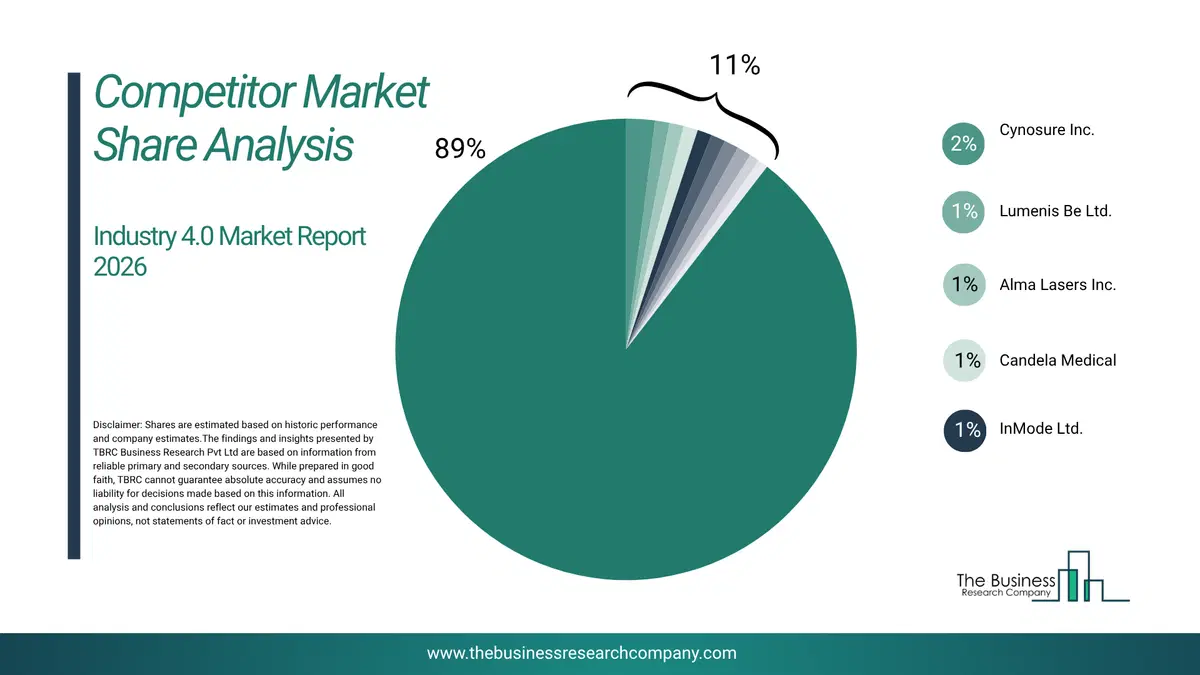
This chart is for illustrative purposes; the full report includes a detailed competitor analysis and comprehensive overview of the top 10 companies in the market.
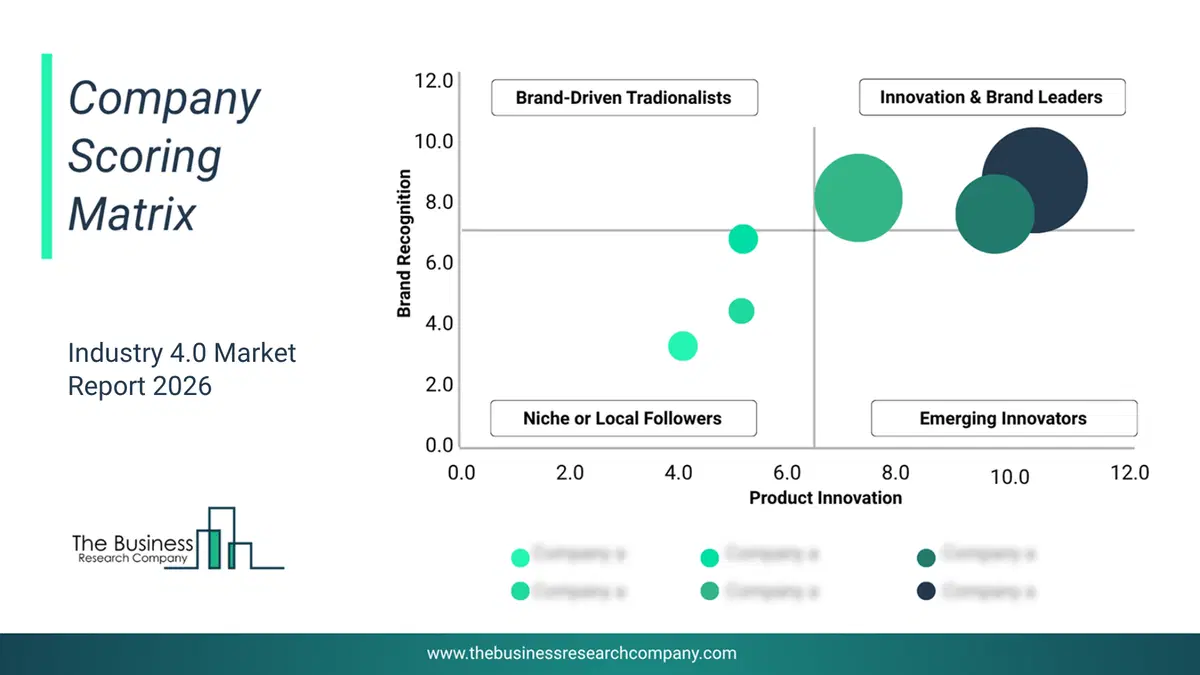
This chart maps companies by product innovation and brand strength, with bubble size indicating relative revenue, helping identify market leaders, challengers, and niche players. This is an illustrative chart; the full report provides a complete and accurate competitive analysis.
Global Industry 4.0 Market Trends and Insights
Major companies operating in the market are launching new products such as IOT controllers to increase their profitability in the market. In Industry 4.0, an IoT (Internet of Things) controller refers to a device or system responsible for managing and coordinating connected devices, sensors, and machines within a smart industrial environment. For instance, in May 2023, NOVUS Automation, a Brazil-based data solutions and process control manufacturer, launched N20K48. The N20K48 controller features a robust core controller and expandable micromodules, addressing diverse industrial needs. The N20K48 enhances Industry 4.0 integration with a Wi-Fi micromodule, enabling seamless communication and legacy device incorporation. This innovation centralizes data on a single network, streamlining real-time monitoring and issue identification in production. Tailored for industrial applications, the N20K48 reflects NOVUS Automation's dedication to delivering cutting-edge instruments for control, data acquisition, and SCADA systems.What Are Latest Mergers And Acquisitions In The Industry 4.0 Market?
In December 2023, Kontron AG, an Austria-based provider of IoT hardware, embedded systems, and “Industry 4.0” software solutions, acquired Bsquare Corporation for approximately US $38 million. With this acquisition, Kontron sought to enhance its software development, marketing, and integration capabilities in North America and bolster its connected-device ecosystem as part of its smart-manufacturing growth strategy. Bsquare is a U.S.-based provider of device-management software and services for connected-device networks, offering its SquareOne platform to enable large-scale IoT deployments.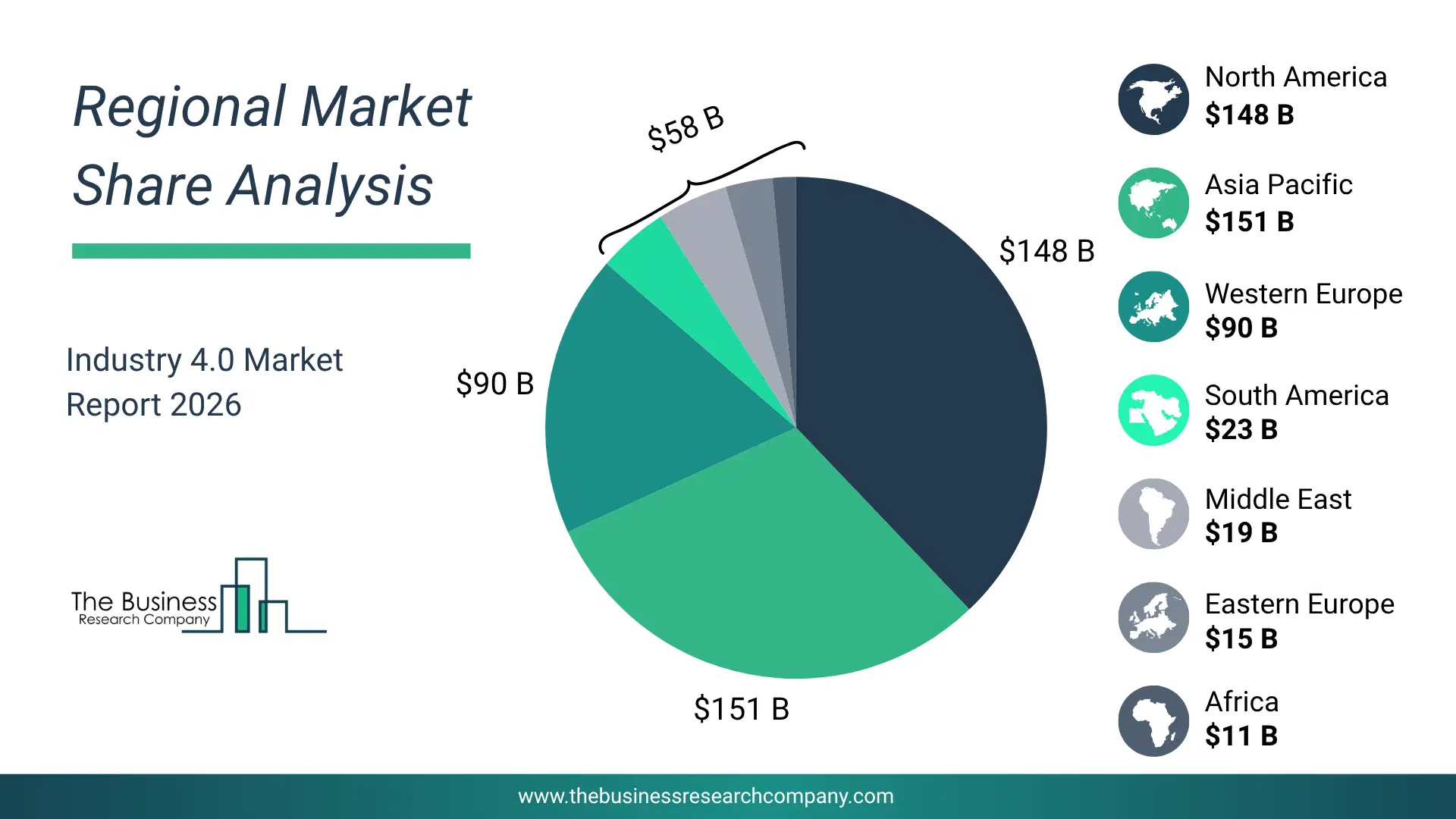
Regional Insights
Europe was the largest region in the industry 4.0 market in 2025. Asia-Pacific is expected to be the fastest-growing region in the forecast period. The regions covered in this market report are Asia-Pacific, South East Asia, Western Europe, Eastern Europe, North America, South America, Middle East, Africa. The countries covered in this market report are Australia, Brazil, China, France, Germany, India, Indonesia, Japan, Taiwan, Russia, South Korea, UK, USA, Canada, Italy, SpainWhat Defines the Industry 4.0 Market?
The industry 4.0 market consists of revenues earned by entities by providing services such as implementation and integration, support and maintenance, and consulting and training. The market value includes the value of related goods sold by the service provider or included within the service offering. The industry 4.0 market also includes sales of hardware, software, and industrial automation solutions. Values in this market are ‘factory gate’ values, that is the value of goods sold by the manufacturers or creators of the goods, whether to other entities (including downstream manufacturers, wholesalers, distributors and retailers) or directly to end customers. The value of goods in this market includes related services sold by the creators of the goods.How is Market Value Defined and Measured?
The market value is defined as the revenues that enterprises gain from the sale of goods and/or services within the specified market and geography through sales, grants, or donations in terms of the currency (in USD unless otherwise specified). The revenues for a specified geography are consumption values that are revenues generated by organizations in the specified geography within the market, irrespective of where they are produced. It does not include revenues from resales along the supply chain, either further along the supply chain or as part of other products.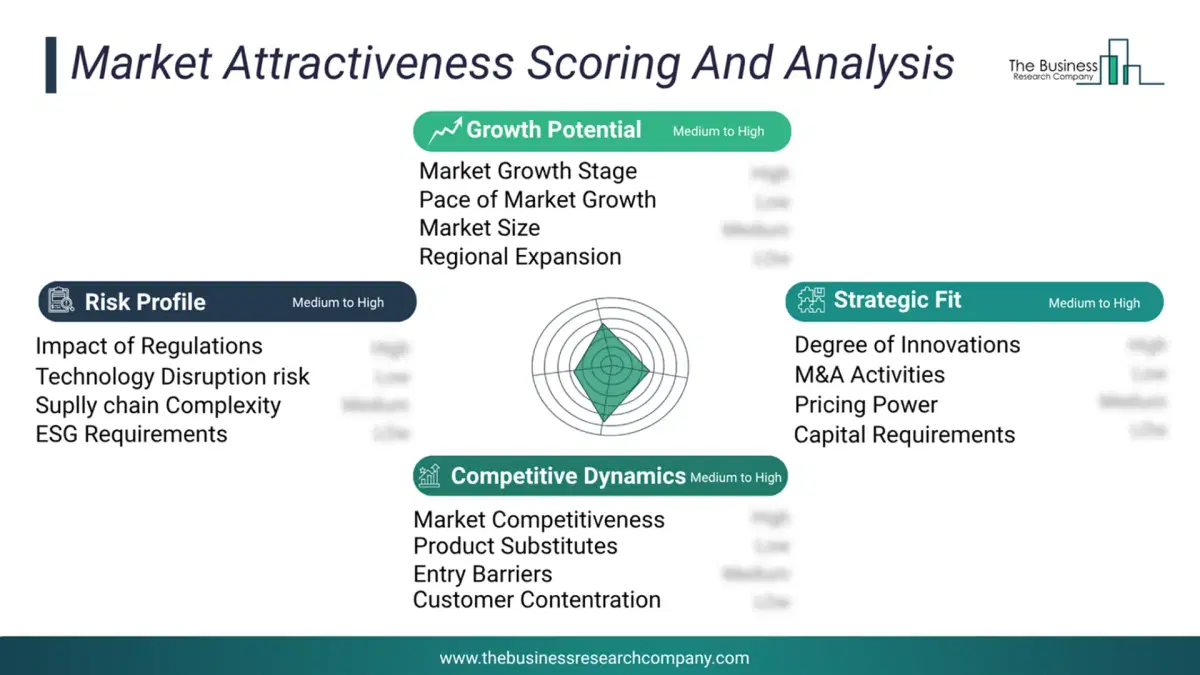
This chart presents market attractiveness based on a quantitative evaluation of growth, competition, strategic alignment, and risk, offering a clear view of opportunity areas for decision-making. This chart is for illustrative purposes; the full report contains the complete analysis.
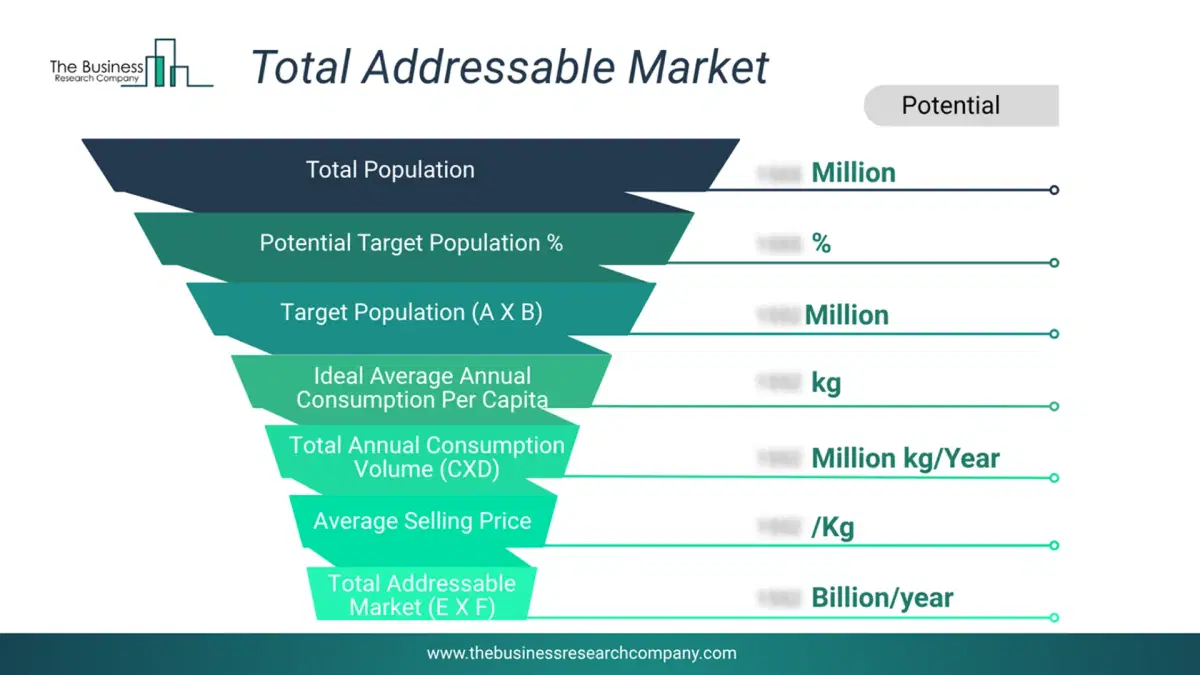
This chart highlights the Total Addressable Market (TAM) by estimating the maximum revenue opportunity using an assumption-driven approach, supporting strategic planning and opportunity sizing across markets. The chart is illustrative; the full report provides a more comprehensive analysis.
What Key Data and Analysis Are Included in the Industry 4.0 Market Report 2026?
The industry 4.0 market research report is one of a series of new reports from The Business Research Company that provides market statistics, including industry global market size, regional shares, competitors with the market share, detailed market segments, market trends and opportunities, and any further data you may need to thrive in the industry 4.0 industry. The market research report delivers a complete perspective of everything you need, with an in-depth analysis of the current and future state of the industry.Industry 4.0 Market Report Forecast Analysis
| Report Attribute | Details |
|---|---|
| Market Size Value In 2026 | $238.89 billion |
| Revenue Forecast In 2030 | $459.68 billion |
| Growth Rate | CAGR of 17.8% from 2026 to 2030 |
| Base Year For Estimation | 2025 |
| Actual Estimates/Historical Data | 2020-2025 |
| Forecast Period | 2026 - 2030 |
| Market Representation | Revenue in USD Billion and CAGR from 2026 to 2030 |
| Segments Covered | Technology, Component, Enterprise Size, End-User |
| Regional Scope | Asia-Pacific, Western Europe, Eastern Europe, North America, South America, Middle East, Africa |
| Country Scope | The countries covered in the report are Australia, Brazil, China, France, Germany, India, Indonesia, Japan, Taiwan, Russia, South Korea, UK, USA, Canada, Italy, Spain. |
| Key Companies Profiled | Siemens AG; General Electric Company; Intel Corporation; International Business Machines Corporation; Cisco Systems Inc.; Mitsubishi Electric Corporation; Honeywell International Inc.; ABB Ltd.; NVIDIA Corporation; Emerson Electric Co; Rockwell Automation Inc.; Omron Corporation; Bosch Rexroth AG; Fanuc Corporation; Dassault Systemes SE; Daifuku Co Ltd.; KUKA AG; Advantech Co Ltd.; PTC Inc.; Cognex Corporation; Stratasys Ltd.; 3D Systems Inc.; John Bean Technologies Corporation; Universal Robots A/S; Basler AG; Techman Robot Inc.; Addverb Technologies Limited; Algolux; AIBrain Inc.; Beckhoff Automation Pvt. Ltd. |
| Customization Scope | Request for Customization |
| Pricing And Purchase Options | Explore Purchase Options |